
Old Lyme Open Space Commission Co-Chair Explains Why ‘Ames Property’ Acquisition Efforts Ended

Old Lyme Open Space Commission Co-chair Evan Griswold. Photo courtesy of E. Griswold.

OLD LYME — Several readers raised questions regarding the reasons why the efforts to acquire the two parcels of ‘Ames Property’ donated to the Old Lyme Open Space Commission have concluded.

We contacted the commission and were told that its co-chair Evan Griswold was speaking on behalf of the agency.

Griswold kindly returned our phone call earlier today and explained first that terminating the effort to acquire the parcels was “personally a disappointment” to him since he had invested a great deal of time and energy on the project over the past 18 months. He added, “It’s just a shame that we weren’t able to bring all the parties together.”

He noted that the owner of the properties, Stephen Ames, had been “very patient” throughout the whole process.

Asked what the fundamental issue was that halted the acquisition, Griswold explained that the problem went back to the restrictions that were placed on the five-parcel subdivision by Ames when it was created in 2005. Those restrictions deemed that the lots, in Griswold’s words, were, “really for residential purposes only,” and moreover, “Anyone buying one of the lots would have to commence construction of a house within 18 months of purchase.”

Griswold commented that the Open Space Commission by its very nature was not planning any construction and that its intentions were to preserve the 35 acres of land, adding that the most ‘construction’ they would undertake would be some signage and trail map information.

A second issue was that the access road for all five lots was established as a private road.

Noting that all the homeowners would have to be on board in order for the restrictions to be waived to allow for a house not to be built and to give access to the two lots in question over the private road, Griswold said, “one neighbor objected.”

Two of the three remaining lots not included in the proposed land acquisition are sold and Griswold said he believes the third is currently on the market.

While stressing his disappointment with the outcome, he noted that as a “someone involved in real estate for over 40 years,” he can appreciate both sides of the situation in that there were, “privacy concerns” for the objecting homeowner. He concluded, “There must be equity for the public and landowners.”
Old Lyme Open Space Commission Announces Efforts to Acquire Two Parcels of ‘Ames Property’ Have Ended, Obstacles “Impossible to Overcome”

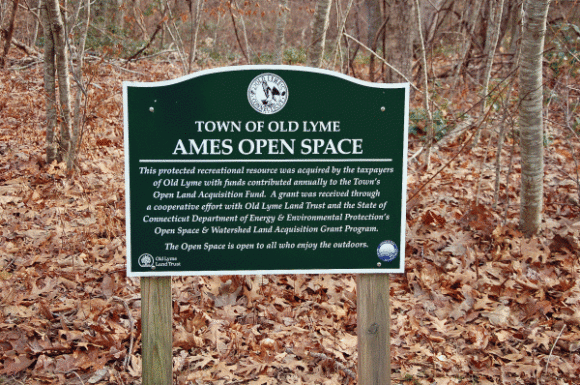
The acquisition of the two new ‘Ames Property’ parcels, which cannot now be completed, would have directly expanded the existing 195-acre Ames Family Open Space, which can be accessed from Evergreen Trail (via Boggy Hole Road). Photo credit: OL Open Space Commission. 

OLD LYME —  This afternoon, the Old Lyme Open Space Commission released the following statement on the proposed Ames Property purchase:

“The Old Lyme Open Space Commission deeply regrets that, despite its diligent work over the past 18 months, and the work and support of other Town boards and commissions including the Board of Selectmen, the Board of Finance and the Planning Commission, its efforts to acquire two parcels of the “Ames Property” for addition to the Town’s open space lands have not been successful and have concluded. 

In the end, it proved impossible to overcome obstacles posed by the recorded documents that created the five-parcel subdivision of which the two open-space parcels were a part. 

This outcome is especially unfortunate because acquisition of the open space parcels would have been of great benefit to the Town. The acquisition would have directly expanded the existing Ames Open Space, further protected the Black Hall River watershed, provided additional refuge for endangered species, preserved forest land and its carbon sequestration potential, and moved Old Lyme closer to a town-wide hiking trail.

The possibility of new access to Ames Open Space via a well-constructed and maintained driveway with safe, off-road parking, and potential new trail access by persons with disabilities, including to the existing open space ancient Native-American caves/shelters, would have been another key benefit.

The Open Space Commission thanks the property owner, Steven Ames, for his patient consideration while the Commission pursued the acquisition.”

NOAA Announces Creation of New Protected Area on CT’s Southeast Coast, Includes Several State-Owned Coastal Properties in Lyme, Old Lyme

This map shows the location of the new National Estuarine Research Reserve in southeastern Connecticut. Photo courtesy of The Nature Conservancy in Connecticut.

The Nature Conservancy celebrates the establishment of Connecticut’s first National Estuarine Research Reserve (NERR) along southeastern coast of State

LYME/OLD LYME/NEW HAVEN, CONN. – Today, the National Oceanic and Atmospheric Administration (NOAA) announced the establishment of a new National Estuarine Research Reserve (NERR) on Connecticut’s southeastern coast. The new reserve is the 30th in the national reserve system and the first in Connecticut.

“Establishing the Connecticut NERR is a critical step toward enhancing the preservation of Connecticut’s coastal and marine habitats, wildlife and heritage,” said Chantal Collier, director of marine systems conservation at The Nature Conservancy in Connecticut.

She added, “The Nature Conservancy is proud to have worked closely with the Connecticut Department of Energy and Environmental Protection, the University of Connecticut, NOAA and other partners to bring this new level of protection to the Sound that will help us address the challenges facing our estuary and sustain its benefits for local communities.”

The National Estuarine Research Reserve System is a partnership between NOAA and coastal states. NOAA provides guidance and funding while state departments or universities work with local partners to manage the sites day-to-day. The program is designed to protect and study estuaries and their surrounding wetlands—unique ecosystems that exist in the places where rivers meet the sea.

Located along the southeastern coast of the State, the newly announced reserve spans the lower Connecticut River, the lower Thames River, most of the Connecticut waters of eastern Long Island Sound and western Fishers Island Sound, and several state-owned coastal properties in Groton, Old Lyme, and Lyme.

The boundaries of the Connecticut NERR also include traditional lands of the Mashantucket Pequot Tribal Nation, Mohegan Tribe, Western Nehântick Tribal Nation, Hammonasset Tribe, Wappinger Tribe, and Wangunks Tribe.

The Connecticut NERR encompasses a total of 52,160 acres and a range of ecosystems including coastal forests and grasslands, intertidal marshes, beaches and bluffs, rocky reefs, and seagrass meadows, including 36 percent of the vitally important but imperiled Long Island Sound eelgrass ecosystem.

“These coastal and marine habitats are a haven for a wide variety of plants and animals,” said Collier. “From piping plovers, horseshoe crabs and seals that rest or breed along its shores, to sea turtles, dolphins and whales that forage for food in its waters—the range of species that will benefit from this new protected area is tremendous.”

The designation of the new reserve is not the end of the process, however.

“Now, we are turning our attention to supporting effective implementation of the Connecticut NERR Management Plan that was developed by state and local partners. Successful implementation will help ensure that this reserve realizes its environmental, research, and educational potential,” Collier said.

Editor’s Note: This article is based on a press release from The Nature Conservancy in Connecticut.

RTP Estuary Center Hosts Virtual Presentation on ‘The State of the Estuary’ by CT Audubon Director, Tonight; All Welcome

CT Audubon Executive Director Patrick Comins will give a virtual, interactive presentation on ‘The State of the Estuary,’ Dec. 9. All are welcome.

OLD LYME/VIRTUAL — Join the Roger Tory Peterson Estuary Center on Tuesday, Dec. 7, at 6 p.m. when it presents a virtual, interactive program titled, “The State of the Estuary,” with Patrick Comins, Executive Director of Connecticut Audubon.

Topics will include the state of birds and wildlife in the estuary, conditions in the Connecticut River watershed, advocacy efforts at the state and national level, and what all of us can do to help promote healthy habitats in our own backyards.

The program is free but registration is required. Participants will be able to submit questions via Zoom chat.

A lifelong, dedicated conservationist, Comins was Director of Bird Conservation for Connecticut prior to becoming CT Audubon’s Executive Director in 2017.  A past president of the Connecticut Ornithological Association and recipient of their Mabel Osgood Wright Award in 2001, he has written articles on bird conservation for the Connecticut Warbler and is past chair of the Friends of the Silvio O. Conte National Fish and Wildlife Refuge.

Comins began his career with the CAS doing bird surveys on the coast at the Stewart B. McKinney National Wildlife Refuge and then worked for the US Fish and Wildlife Service as a biological technician at the refuge. He is the principal author of Protecting Connecticut’s Grassland Heritage.

His talk will highlight environmental improvements we can celebrate along with ongoing concerns.

Visit www.ctaudubon.org/rtp-programs-events for more information and registration details.

Named for the internationally and locally renowned artist, scientific illustrator, environmental educator, and conservation advocate, the Roger Tory Peterson Estuary Center is known for its work in environmental education, conservation, research, and advocacy to preserve and protect the Estuary and its beauty for generations.

The Center serves young people and adults across the region, offering such programs as birding basics and owl prowls, a CT River ecology course, Estuary Explorations and seasonal nature crafts, as well as summer and vacation camp programs.

Visit this link for further information:  www.ctaudubon.org/rtp-estuary-home/.

Lyme-Old Lyme Food Share Garden Seeks Businesses/Individuals to ‘Sponsor a Row’

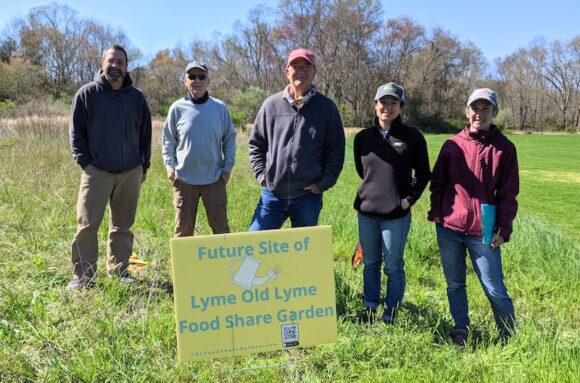
How it all began … Lyme-Old Lyme Food Share Garden Board Members gathered for a photo. From left to right are Jack Larocca, Jim Ward, Peter Hunt, Amy Mastrangelo, and Sheila McTigue-Ward.

OLD LYME — The Lyme-Old Lyme Food Share Garden (LOLFSG) has recently initiated a Sponsor a Row campaign. For a $250 donation, a Row Sponsor will have a sign designated with their name or business name posted in the garden for the growing season.

Approximately $250 is required to plant and maintain a row every year.  This includes the plants/seeds and fertilizer in addition to fencing/supports, ground cover, irrigation, tools, compost and general maintenance.

The LOLFSG invites LymeLine readers to consider being a Row Sponsor, for this year and future years, so the goal of providing fresh healthy produce to families in need can be fulfilled.

Visit this link for more information on how to become a sponsor.