Here a Bear, There a Bear …

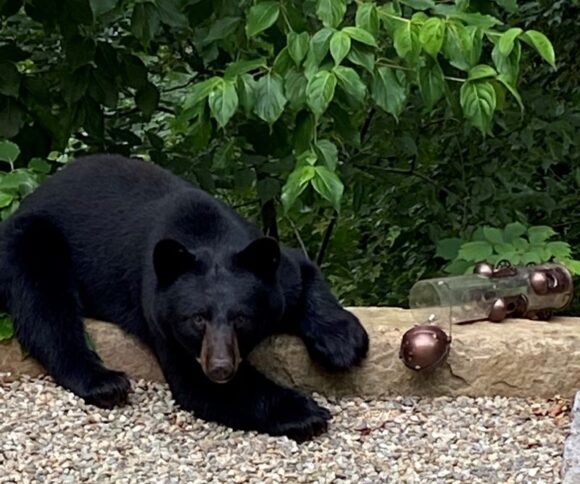
LYME/OLD LYME — Around 5:50 p.m. on Sunday, July 18, Paul and Barbara Hallwood had just returned to their home on Sterling City Rd. in Lyme, when they saw the black bear, pictured above, hard at work in their yard.

Paul explained, “The bear had destroyed our bird feeder, bending the sturdy, metal pole [and] holding it up to a  right angle with ease. It treated the bird seed holder, which can be seen in the photo, like a lollipop wrapper, tearing at it and then tipping seeds out before eating them and grunting with satisfaction.”

The last the Hallwoods saw of  the bear – and the seed holder – was when the bear dipped down below their patio and, in Paul’s words,  “… presumably, moved on to somebody else’s garden.”

Paul and Barbara Hallwood

Asked, “How did you feel when you saw the bear?” Paul replied, “It was an OMG moment, and just look at the thickness of that fur with rippling muscles also evident!”

Was it the first time they had seen a bear in their yard?  Paul responded in the affirmative, saying, “First time we had ever seen one in our garden or anywhere for that matter. We knew then and there that that was the end of our bird feeder joy – well, at least until the hibernation season.”

He added, “As many neighbors as possible were immediately alerted to the danger.”

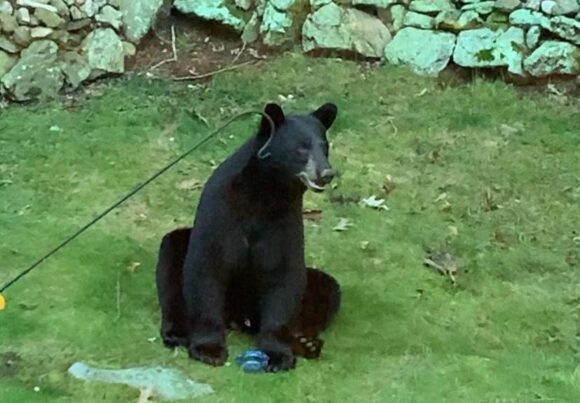
We were also sent the photo below, which was taken July 9, in Old Lyme at about 7:30 p.m. by Ron Breault at his neighbor’s house. Breault noted, “Then for the next hour plus the bear roamed our backyard and ravaged our bird feeders.”

Photo by Ron Breault.

We will let Paul Hallwood have the last word on the current, local black bear situation with his wise comment, “It’s a good idea not to feed the birds.”

Virtual ‘Clean-up Coffee Hours’ Offer Training for ‘Source to Sea’ Volunteers; Next Session, Aug. 11

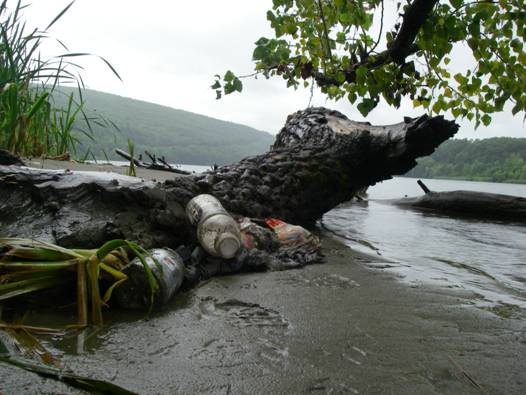
Connecticut River Conservancy’s Source to Sea Clean-up volunteers have removed tons of trash over the 24 years of the river clean-up event. Find out how to join the effort this September at one of three virtual Clean-up Coffee Hours, starting July 14.

GREENPORT, Mass./LYME/OLD LYME — The Connecticut River Conservancy (CRC) will host three virtual Clean-up Coffee Hour sessions leading up to their 25th annual Source to Sea Clean-up being held this fall, Sept. 24-26.

The annual Source to Sea Clean-up is a river clean-up coordinated by CRC in all four states of the 410-mile Connecticut River basin (NH, VT, MA, CT). Each fall, thousands of volunteers of all ages and abilities clean trash from the Connecticut River and its tributaries on foot or by boat.

Join CRC at these virtual Clean-up Coffee Hours to learn more about how to get involved in the Source to Sea Clean-up:  

·         Registration and Site Selection:  Wednesday, July 14,  12 – 1 p.m. 

·         Trash Disposal and Tallies:  Wednesday, Aug. 11,  4 – 5 p.m.

·         General Q&A: Thursday, Sept. 9,  5 – 6 p.m. 

Additional details and links to register for these online events can be found at www.ctriver.org/events.

“These coffee hours will be a fun, informal way to get familiar with this year’s Source to Sea Clean-up,” says Stacey Lennard, CRC’s cleanup coordinator. “Anyone can come with questions about the process, or just come to meet other group leaders and volunteers. The Source to Sea Clean-up strengthens community while cleaning up our rivers and streams. It’s an opportunity for you to make a difference.” 

The Source to Sea Clean-up is one of the largest river cleanups in the country. Thousands of volunteers participate each year to remove trash along rivers, streams, parks, boat launches, trails and more.

To learn more about how you can register for the Source to Sea Clean-up, connect with a group, choose a trash site, and tally your trash, tune into any of these three Clean-up Coffee Hours.   

Since 1952, Connecticut River Conservancy has been the voice for the Connecticut River watershed, from source to sea. They collaborate with partners across four states to protect and advocate for the state’s rivers and educate and engage communities. They bring people together to prevent pollution, improve habitat, and promote enjoyment of your river and its tributary streams. Healthy rivers support healthy economies.

To learn more about CRC, or to make a contribution to help protect your rivers, visit www.ctriver.org.  

Op-Ed: Save Our Beautiful Dark Skies From The Threat Of Light Pollution

Editor’s Note: This Op-ed was submitted by Alan Sheiness of Lyme, Conn.

How often have you stopped to notice how wonderfully bright and alive the stars are in our peaceful town of Lyme, especially once turning off one of our ‘major thoroughfares’ like Rte. 156 or Brush Hill Rd.?

That dark sky up there is a part of our world. It is as much a gift to us as are the forests, the trails within those forests, the rivers and waterways, and everything else that makes Lyme special.

As part of the Sustainable CT effort (sustainablect.org) we seek to inform the public about light pollution and how to arrest its insidious spread across our region.

What do I mean by light pollution? Light pollution is what occurs when a preponderance of lighting, and poorly-designed lighting fixtures, create a glare both locally and across entire swaths of geography, which renders the night sky as a dim shadow of itself. 

The universe is ours to behold just for the simple act of looking up at night. Except, in so many places all over the country and indeed the world, light pollution is removing those vistas much as deforestation and asphalt and other aspects of modern life remove the natural wonders that are part of our terrestrial consciousness. 

Guarding against light pollution really comes down to two simple principles: do not light what does not need to be lit, and when you do need to light something, do it with a source that is effective and efficient.

Our little town, because of its almost non-existent commercialization and heavy forestation, is indeed a miraculous enclave from the typical onslaught of ineffective lighting. We need to keep it that way. 

We can do so by ensuring that all new lighting projects, residential and commercial, take light pollution into account, protecting the night sky, no different than protecting a watershed or any other natural habitat. To the extent that existing installations are night sky-unfriendly, we should consider replacing those fixtures over time with ones that do a better job pointing down with an efficient light source. 

Our environment makes Lyme what it is, and we can be a leader in the sky just as we are on the ground. Please endeavor to learn more about the beauty of the night sky and the threat of light pollution.

A great place to start is here: International Dark-Sky Association.  Also, you can experience the splendor of our night sky first-hand, with experienced astronomers as your guide, by signing up for future observing sessions hosted by the Lyme Land Trust at lymelandtrust.org

That look up there is through a window into our universe, and it should be our intention to keep that window pristine for ourselves and our future generations.

About the author: Alan Sheiness is a 10-year resident of Lyme, Conn., and treasurer of the Lyme Land Trust. Among other interests, he is a life-long astronomy enthusiast and astrophotographer. He has documented lunar eclipses, solar eclipses, the Venus transit of the Sun, a Mercury transit of the Sun, many of the planets, star clusters, and nebula; all admittedly decidedly amateur in result, but rewarding nonetheless. Sheiness is a promoter of dark skies and interested in establishing a new Astronomy Society in Lyme as an adjunct activity within the scope of the Lyme Land Trust. Contact him at alan.sheiness@icloud.com.

Lyme-Old Lyme’s Food Share Garden Reaches Fundraising Goal, Further Donations Will Support Additional Needs

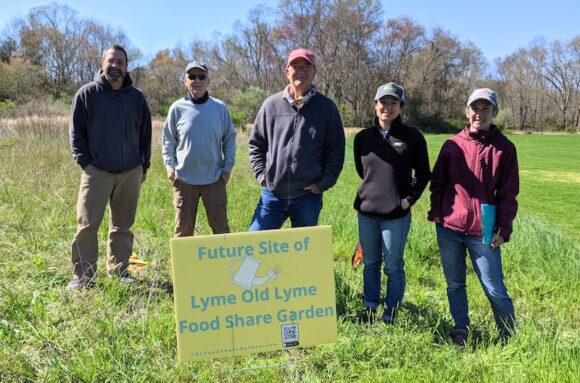
Lyme-Old Lyme Community Share Garden Board Members gather for a photo. From left to right are Jack Larocca, Jim Ward, Peter Hunt, Amy Mastrangelo, and Sheila McTigue-Ward.

Editor’s Note: Several hours after we published this article, we heard the wonderful news from Jim Ward that the fundraising goal of $7,500 had been reached. He greatly appreciates this, “tremendous support to the start of the garden.” He notes however, that, “While this gives us the ability to install a fence and purchase tools and equipment we have other important projects in the pipeline such as an irrigation system, electrical hook up, and a shed. Any further donations will assist us towards the completion of these projects.”

OLD LYME —The Lyme-Old Lyme Food Share Garden (LOLFSG) set itself quite a challenge back at the end of March.  The group launched a crowdfunding campaign with a target to raise $7,500.

If that amount is successfully raised by May 26, then the project will receive a matching grant of $7500 from Sustainable CT’s Community Match Fund — an initiative of Eastern Connecticut State University’s Institute for Sustainable Energy that inspires, supports, and recognizes sustainability action by towns and cities statewide.

The Community Match Fund — supported by the Smart Seed Fund, Emily Hall Tremaine Foundation and the Connecticut Green Bank —provides a dollar-for-dollar match to donations raised from the community, doubling local investment in projects. 

As at today’s date, the campaign stands at a remarkable $7,145.00!
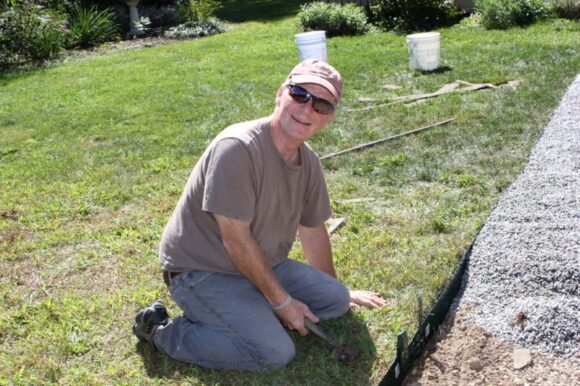
Old Lyme resident Jim Ward is the inspiration behind the Lyme-Old Lyme Community Share Garden.

Asked what he felt about the community’s response to the campaign, the originator of the project Jim ward said, “We are extremely pleased and excited about the community’s support. Not only are we about to reach our goal, but we also have added several new volunteers. The generosity of the residents of Lyme/Old Lyme demonstrates the commitment they have towards helping those in need.”

He added, “I would also like to thank SustainableCT for making this possible.”

The LOLFSG celebrated a significant accomplishment on May 1 when members of the Board of Directors and Garden Design Committee staked out the perimeter of the future food share garden at Town Woods Park in Old Lyme.

All produce from the garden will be donated to area food pantries and food banks. 

Ward, a resident of Old Lyme since 2006, was the inspiration behind the project. While working towards his UCONN Master Gardening Certificate in 2020, he volunteered with the Food for All garden in Clinton, CT.

As a volunteer, he was impressed by the organization of the garden, humbled by the increasing demands on community food banks and food pantries, and energized by the sense of community that the garden embodied. He noted similar trends while visiting similar gardens in Old Saybrook, Pomfret and Killingworth and sought to develop a garden in the Lyme-Old Lyme area.

In the ensuing months, Ward worked with multiple town agencies to procure a site at the Town Woods Park, a recreational park overseen by the town Parks & Recreation Commission.

Ward describes the site as “ideal” in that the sports fields are organically maintained and the parcel of land, in addition to the fields, contains a playground and the Lymes’ Senior Center, thus making the garden accessible to multi-generational families in the towns.

Furthermore, he notes, through generous cooperation with the Parks and Recreation Commision, the garden has access to water, electricity and parking. 

The LOLFSG plans to have a fully functional garden by the spring of 2022. To make this vision become a reality, the organization is actively involved in grant writing and fundraising.

Notably, the Lyme-Old Lyme Food Share Garden is raising money through a crowd-sourcing effort supported by Sustainable CT. 
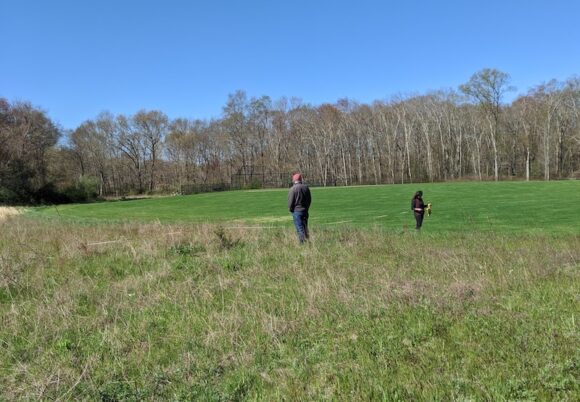
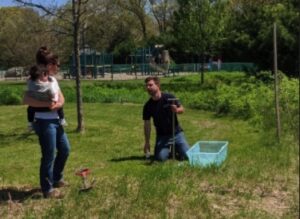
Measuring for the garden are Peter Hunt (left) and Carie Tonovitz.

The money raised by LOLFSG’s crowdfunding campaign was launched to enable the organization to erect a deer/rodent fence and purchase tools and equipment. 

Ward was delighted to share with LymeLine that the deer fencing has now been ordered and is set for installation on June 5-6.  He noted that the Rubitiski family has offered their backhoe to dig a trench for the rodent part of the fence.

In other updates, he said that:

  • LOLCSG Board Member Amy Mastrangelo watches as Mike Baczewski of New England Pollinator Garden tests the soil at the garden.
    Baczewski generously donated the soil testing.

    Board member Amy Mastrangelo arranged for Mike Baczewski of New England Pollinator Gardens to take soil samples from the garden for testing. New England Pollinator Gardens is donating the testing to the garden project.

  • Estate Solutions of Branford donated several tools consisting of rakes, shovels, sprayer,  etc, with more to come.
  • A small group visited the Food For All Garden in Clinton where we were given a tour of the facility and the opportunity to ask questions about composting, fundraising, irrigation, volunteering, and many other topics. They also donated a picnic table to our cause.
  • A meeting is planned with United Way to discuss a possible collaboration.
  • The board has met several times in the past months and continues to work hard.
  • A bank account has been established and has a positive balance.
  • The Design Committee met at Town Woods and measured and staked out the garden area and installed “Future Site of LOL Food Share Garden” signs.
  • A donation of tools has been made.
  • A Region 18 high school student, Connie Pan, is painting a couple of Rain Barrels for us. One of the Rain Barrels is being donated to Old Lyme Phoebe Griffin Noyes Library for their new garden.
  • LOLCSG received a $350 grant from the CT Master Gardening Program. These funds were put towards the SustainableCT fundraising effort.
  • LOLCSG applied for a Pfizer Community Grant for an irrigation system.

If you wish to donate to this project, visit this link.

 

Open Space Coordinator Seeks Volunteers to ‘Nip the Knotweed,’ This Morning

Japanese Knotweed

LYME — On Friday, May 14, from 9:30 to 11:30 a.m., Lyme’s Open Space Coordinator is looking for volunteers to help the Town remove invasive Japanese knotweed from a few areas in Lyme.

Volunteers are encouraged to bring their own work gloves, clippers or loppers and bottled water.
The plan is to cut the knotweed down to the ground and bag the plant material using the “method of 3s,” which involves undertaking three chops this growing season (May, mid-July and August), then repeating the process for three years to eliminate the knotweed for good without herbicide. The cuttings must be carefully disposed of since each little piece will regrow into a new plant.

Interested volunteers should send an email to openspace@townlyme.org to register and receive more information and directions.

A brochure explaining how to eliminate knotweed at home can be found by clicking on this link: https://bit.ly/2RKt2sa