OLD SAYBROOK—Department of Energy and Environmental Protection (DEEP) Environmental Conservation Police (EnCon Police) along with multiple agencies, responded to a boating accident in Old Saybrook around 9:15 p.m. on Monday, Sept. 2.
A single motorboat was found floating, half-submerged, near the Harbor One Marina in Old Saybrook. There was significant damage to the boat, which hit the east-facing jetty at the mouth of the CT River.
A total of nine people were on the boat. An adult male was recovered deceased, and six people were transported to the hospital. As of 1 a.m., two people were still being searched for. The search was suspended for the night shortly after 1 a.m., and resumed in the morning as, most likely, a recovery operation.
In addition to EnCon Police, several agencies assisted in the response to this incident, including- Old Lyme FD, Middletown FD, Middlesex Health (EMTs), Essex FD, Goshen Fire, Old Saybrook FD and PD, Clinton Fire, the Coast Guard, and the State Police Dive Unit.
Editor’s Note: This article is based on a press release issued by DEEP.com at 1:27 a.m. today.
Editor’s Notes: i) This op-ed was submitted by Eric Knapp, who is employed as the Town of Old Lyme’s Land Use Coordinator. He is writing here as a private citizen. ii) This is the opinion of Eric Knapp.
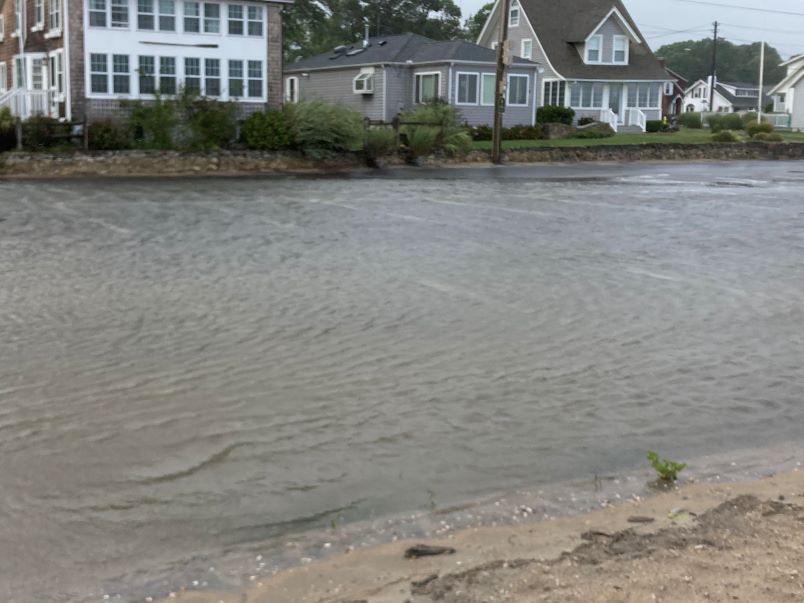
As Long Island Sound rises inexorably, flooding along the Connecticut shoreline is likely to become more frequent. This file photo shows flooding in a prior year at White Sand Beach in Old Lyme.
I have lived in Connecticut my entire life. My career as a lawyer involved representing property owners and land use commissions across the state, but especially along the shoreline, attending countless evening meetings, court hearings and conferences with municipal officials. In my time as a land use officer, I have staffed commissions and served in various positions as a zoning enforcement officer, wetlands enforcement officer, flood plain manager and de facto planner. While I am not a planner by training, my decades of time seeing the Connecticut shoreline in variance capacities has given me time to think about its present and its future.
Connecticut is blessed with abundant water, both fresh and salt. We have a system of rivers that flow through every community, many man-made lakes (almost all of the lakes and ponds in Connecticut are man-made) and a long shoreline with natural harbors. The waters of Connecticut powered our industrialization in the 19th century, and we continue utilizing them for off-shore power and maritime-related centers such as the Coast Guard Academy, Electric Boat and the submarine base. You would be hard-pressed to find anyone who does not have some fond association with the waters of the State.
That makes it particularly difficult to address the sorts of changes that have already arrived and those that are likely to arrive during the course of the 21st century. It does not rain in the same way it did when I was a child. We get many more “rain bombs” — short intense storms that drop an inch, two inches, sometimes more in an hour. It does not snow in the same way that it did when I was a child. December and January are largely snow-less now. Storms during February and March more frequently involve collisions between moisture moving north and a cold front moving south, resulting in huge dumping events, with feet of snow falling at a time.
Infrastructure designed for the 20th century cannot keep up with the 21st century weather. Culverts are now undersized, leading to road-flooding. Some of the pipes draining into Long Island Sound now flow backwards during high tide events. Bulkheads are failing. Streets are flooding. The cooling system for the Millstone nuclear plant has been unable to draw water that is sufficiently cool from a warmer ocean, leaving the biggest source of energy for Connecticut subject to shutdowns. All of this is already here. But more is to come.
The Federal Emergency Management Agency (FEMA) has released a detailed map showing where it anticipates coastal erosion in New London County. It is a scary map to look at, with entire streets anticipated to face serious erosion by 2030.
Nearly all the properties around the mouth of the Connecticut River are serviced by septic systems, most of which are outdated. As Long Island Sound rises, saltwater intrusion will make these systems ineffective. Even now, the nitrogen and phosphorus being added to the Sound due to the over-concentration of septic systems is impairing the water quality, impacting attempts at re-establishing shellfish beds along our shorefront.
As impervious surfaces increase year after year, and the rain bombs occur with greater frequency, storm sewer systems will fail with increasing regularity. Roads will flood and then fail. Methods such as rain gardens and detention basins will lose their effectiveness as the water table rises. There will be, quite literally, no place to put the water.
Elected leaders have not fully embraced this reality. It is not hard to see why. In towns such as Clinton or Westbrook, these low-lying areas provide a large percentage of the real estate taxes. Importantly, since many of the dwellings are seasonally-used, they contribute the same taxes as year-round dwellings, but use a fraction of the services, and do not send any children to the school system. The fact that these neighborhoods are at risk poses potential financial threats to these communities.
Property owners do not want to face this reality either. These are valuable properties. Even when the structures on them are old and dilapidated, the land is worth a great deal. That this investment might lose value, or worse, become valueless, is a hard pill to swallow. Taking steps to address climate-related issues only highlights the problem, putting pressure on resale values. There is frequently an insistence that all that is required is a simple fix: a better drain, or an elevated road, and whatever “temporary” issue there is with water can be resolved.
One of the clearest examples of how the system is not working is the FEMA “substantial improvement” requirement. In theory, the rule is simple: if you perform improvements on your structure, the fair market value of which exceeds 50 percent of the value of the structure, you are obligated to make the structure FEMA-compliant for flood zone purposes. The idea is commendable: over time, as owners perform necessary repairs and improvements, houses will have to be raised, diminishing that owner’s and the community’s flood risk.
The reality is quite different. There are three pathways, and none of them is ideal. First, yes, there are those with the money to elevate their houses. But the truth is that if an owner is going to spend the money to elevate their home, they will also likely want to maximize their investment, making the home as big as zoning will allow, and obtaining variances to go beyond even that. The effluent will still be in the septic system, of course, but the house will be there after the next storm.
Next are the “dodgers”. As any zoning officer will tell you, people will play games to show that they are not exceeding the 50 percent threshold. They can provide their own appraisal of the structure to show it is worth more. They can claim that there is some code-related emergency. They can try and undervalue the work proposed, or simply do more work than their permit sets forth, or maybe not bother to get a permit at all.
The fact that all of this will leave them vulnerable when some future storm arrives is tomorrow’s problem. By then, it may be another owner’s problem. Every seller of a vulnerable shoreline dwelling silently knows that they have dodged a bullet.
Finally, there are those who are simply not in a position to make improvements. Their dwellings will continue to deteriorate, making the problem harder to solve. Each dollar of value that a structure depreciates lowers the threshold of any future improvement that would trigger the “substantial improvement” requirement. These houses are potential death-traps. Inevitably, when these structures collapse and wash away, their debris will harm other properties.
Each year, the amount of impervious coverage grows, the Sound inexorably rises and the odds of a catastrophic storm get worse.
As the saying goes, the first step to recovery is admitting that you have a problem. Shoreline Connecticut has a problem.
So, what happens next?
Realistically, a lot of hard choices. Solutions will take money. There will be winners and losers. Some towns may need to rethink how they see themselves. But it must be done, and we need to start now.
Let’s start with what we can’t do. We cannot simply try and armor the coastline. Not only is this completely disfavored by both FEMA and the Department of Energy and Environmental Protection, but it would also be wildly expensive and would not even work. Armor merely diverts the energy and water from the ocean. The water that is not coming ashore on one site will search for another location to enter.
Water may not overtop a wall, but it will exert pressure on the surface water beneath the wall, pressing the fresh water north and then rising up out of the ground. Likewise, where streams or inlets meet the shore, the tidal wetlands will fill up and freshwater wetland will become brackish. A Maginot Wall along the Sound will work as well as the real one did. Water will find a way around. It always does.
Realistically, we are going to need to create space.
“Creating space” will mean different things in different locations.
For distressed homeowners, who cannot afford to make improvements, a modest buyout program may be possible. Removing houses and creating more pervious area for water to infiltrate will help, if only modestly. Removing potentially hazardous structures from the flood zone will reduce the danger to other structures. Finally, if the structure is removed, there is no chance of anyone being inside during a storm event.
This latter option has two negative financial implications. First, there is the cost of any buyout. Second, each of these dwellings pays taxes, and removing them directly affects the Grand List. But increasing the security of other structures should, in theory, increase their value, somewhat offsetting this loss.
Buffers around tidal wetlands may need to increase. As the Sound rises, these coastal areas will try and move inland. By creating and enforcing realistic buffers, towns can protect the spaces into which these tidal marshes and flats will want to intrude. Property owners will not like seeing these encroachments on their properties. They will feel, rightfully, that they are losing something they own. The abstract idea that healthy tidal areas protect everyone is little comfort to those most affected by these efforts.
Fortunately, there are other creative ways being developed to help mitigate some of these issues. Boston is trying out an “emerald tutu” system, described by the American Society of Mechanical Engineers as, “A linked group of floating spherical mats. Each is roughly a meter in diameter, made of a mix of biomass, seeded with marsh grass, and surrounded by a net to hold it all together.” These serve the dual purpose of assisting the ecosystem while also helping to dissipate wave energy, preventing or mitigating erosion.
In Stratford, they are using concrete reef balls to perform a similar function. Other communities are adding a layer of additional soil to their tidal wetlands to keep them above rising waters.
It will take a lot of trial and error to figure out the best ways to accomplish these goals. Not every project will be successful, and what may work in one place may not work in another.
At the risk of starting a firestorm, there is also the dynamic of reliance on individual septic systems in a large portion of the coast. From Clinton to Old Lyme, the official policy has been “sewer avoidance”. As a result, many older systems, while not officially “failing”, are putting nitrogen and phosphorus into the ecosystem at a rate higher than it can be absorbed. There is also the basic hydrological issue that most of the shore is served by public water, so water arrives from outside of a community and then leaves through the septic system, creating a net increase in water.
The likelihood that new large sewer plants will be constructed is low. They are expensive and unpopular, however necessary they might be. What seems feasible is that smaller community systems can be installed on small lots throughout shoreline communities. Even tying eight or 10 houses into a small system would prove beneficial. Of course, this is not easy to do under the present Health Code, so regulatory changes may be required to allow this to occur.
For larger commercial uses, there may be some benefit to having them build systems that exceed what they require (in exchange for regulatory benefits), which could allow nearby substandard systems to be phased out and those properties to hook into the commercial system (for a cost.)
Inevitably, while making choices, there will be those who will lose property rights, or more clearly, their properties will be reduced in value, sometimes to zero. The reality is that this is going to happen anyway, as the water rises. But if the government does this, it constitutes a taking and compensation will need to be paid. This will cost real money. People will fight to get as much compensation as possible in exchange for giving up some or all of their property, and rightfully so.
The alternative is to wait for a large storm to come and then see who has the resources to rebuild. I am not persuaded that this would be better.
I am not writing this because I have the answers. I am writing this because we all need to come together and start contemplating the answers together. This will take time. It will be hard. People will disagree, quite loudly, about the extent of the problem, before we even get to the question of what answers will look like.
But I would encourage the people of Connecticut to take up this work now, so that my 14-year-old sons will have a future here. We may be the Land of Steady Habits, but we are also a land of inventors and hard workers. We can solve this, but only if we put our minds and our energy, and yes, our dollars towards a solution.
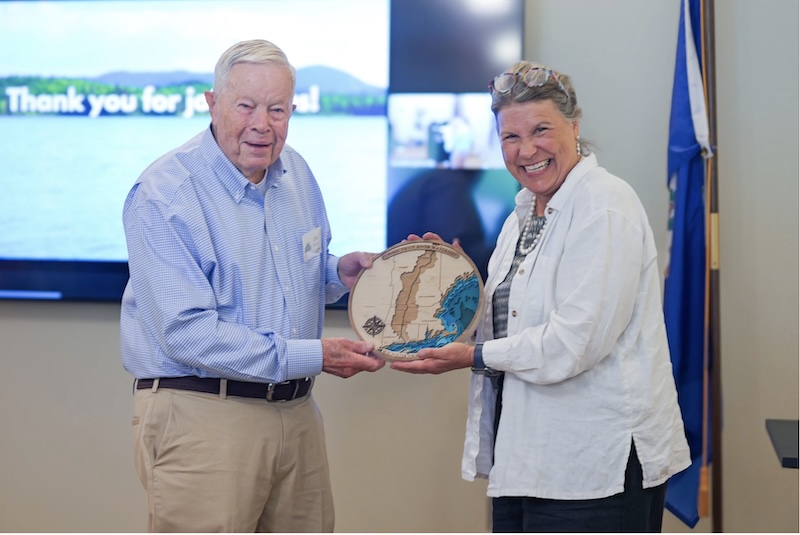
Dick Shriver of Old Lyme receives the Bud Foster Award from Connecticut River Conservancy Executive Director Rebecca Todd.
OLD LYME—Among the governance and programmatic updates, brunch and boat rides, and community mingling, Connecticut River Conservancy’s (CRC) recent Annual Meeting & Riverside Celebration also honored the contributions of Dick Shriver of Old Lyme with the Bud Foster award.
Every year, CRC has the distinct honor of recognizing individuals from our communities with the Bud Foster Award. This award is given to those showing outstanding devotion, service, and accomplishment in the Connecticut River watershed.
Bud Foster was the first Executive Director of the Connecticut River Watershed Council, now the Connecticut River Conservancy. In those pre-Clean Water Act days when CRC was first established, the challenge facing our rivers was significant. That meant the dedication of those looking to make a difference was also extraordinary.
This award shines a light on those who work hard for the benefit of our rivers.
The Shriver family gathered to celebrate Dick receiving the Bud Foster Award.
Richard (Dick) H. Shriver has an esteemed professional history that has taken him all around the world and led him to settle by the Connecticut River we all know and love.
He has a Bachelor’s degree in Mechanical Engineering and a Master’s degree in Industrial Engineering. He has held executive positions in government and industry having been assistant secretary of the US Treasury Department and Senior Vice President of Chase Manhattan Bank.
He has been professor of Business Finance & Marketing at the International Management Institute in Kiev, Ukraine and Executive-in-Residence at the US Coast Guard Academy.
Shriver has also worked in an advisory role on behalf of Native American communities conducting research for the Department of the Interior, and served as a member of the board of the National Museum of the American Indian, participating in the transition of this museum to the Smithsonian Institute.
He is also Provost Emeritus of the European College of Liberal Arts (now Bard College Berlin).
These years of experience have led to incredible contributions in international business and education, and national heritage, and ultimately led Shriver to focus his attention closer to home. When he retired near the mouth of the Connecticut River in Old Lyme in 2007, Shriver began to get friendly with his neighbors and form a deeper connection with the river through recreation, hiking, fishing, sailing, and photography.
This resulted in the launch of Estuary Magazine in 2019, an aspiring endeavor of traditional media which was quickly challenged by the economic impacts of the Covid-19 health crisis in 2020. But the magazine survived under Shriver’s leadership as Publisher and Editor, highlighting unique bioregional perspectives, history, scientific insights, and storytelling from up and down the watershed.
Shriver has been supportive of Connecticut River Conservancy at every turn since starting the magazine and developing a connection to our organization and many others. He has been an early morning boat captain for the Unified Water Study, has published articles about restoration stories (such as the Fenwick project) with great depth and detail, has hosted murmuration bird paddles for local community members, and offered his home as a celebratory reception for CRC Board of Trustee Kari Kastango’s monumental Connecticut River swim.
He has been a convener, connector, and friend who brings others together with open arms to unite our efforts for greater collective impact. Thanks to Shriver’s leadership, 1 million dollars was recently granted by the Endeavor Foundation to support conservation priorities throughout the watershed. All this in a relatively short time after a successful career.
Dick Shriver is an impressive example of how much one person can accomplish when inspired and committed. And now his efforts inspire more of us to appreciate and steward this amazing resource.
Editor’s Note: This article was originally published July 1, 2024 by the Connecticut River Conservancy. It was written by Diana Chaplin and is published here with kind permission of the Connecticut River Conservancy.
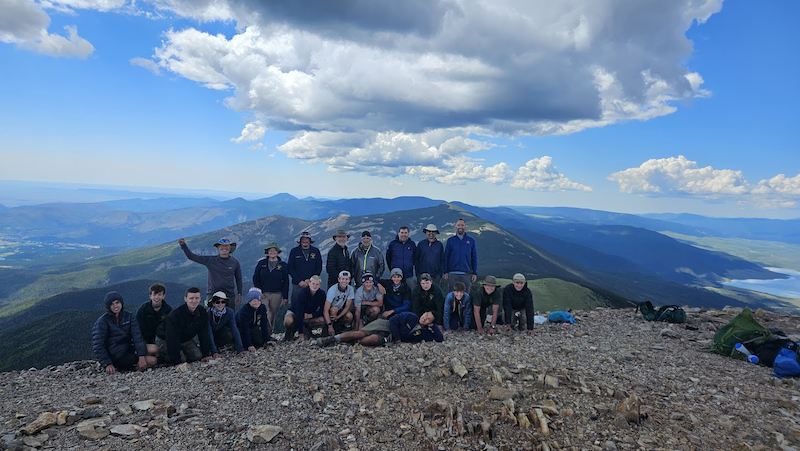
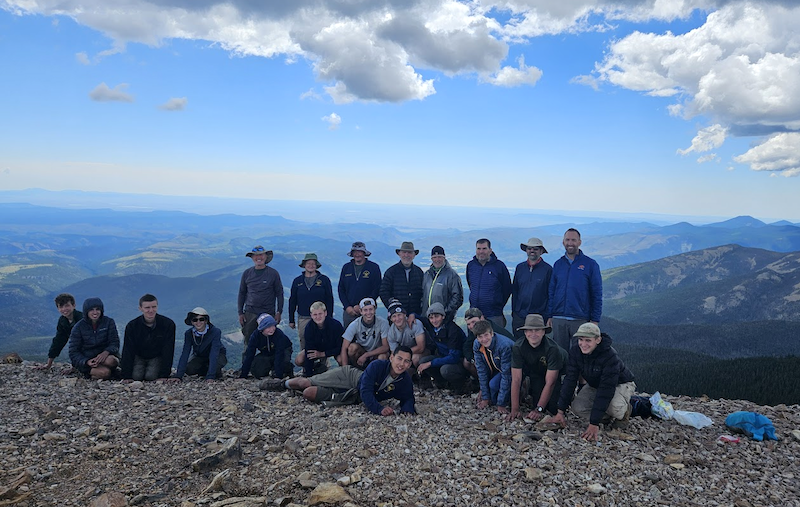
What a view! All members of Lyme-Old Lyme’s Troop 26 who traveled to New Mexico made it to the summit of Mount Baldy. All photos submitted by Troop 26.
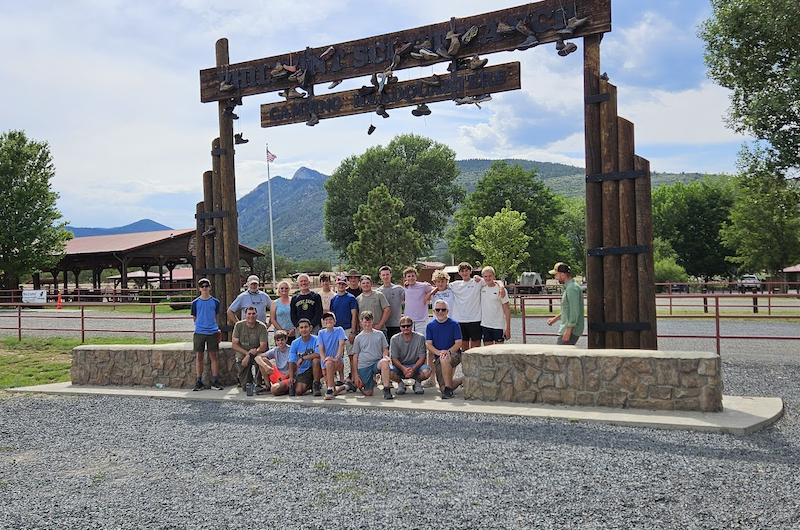
LYME/OLD LYME —Twenty-two Scouts and Scout Leaders from Lyme-Old Lyme Troop 26 recently completed 90 miles of hiking over 12 days in Northern New Mexico. The Scouts visited Philmont Scout Ranch, a 214-sq. mile rugged mountain wilderness area.
The Ranch offered the Scouts the chance to learn leadership and outdoor skills as they backpacked to a new wilderness campsite each day. Along the way, Troop 26 also participated in an activity at each camp, such as horseback riding, rock climbing, and panning for gold.
The scoutinf group from Lyme/Old Lyme stands at the ceremonial gate to Philmont Scout Ranch, N.M.
Woody Goss who attended the trek with Troop 26 said, “It was hard, but I enjoyed the views, especially from places like the top of Mount Baldy. We reached 12,441 ft. at its summit and could see into two other states.”
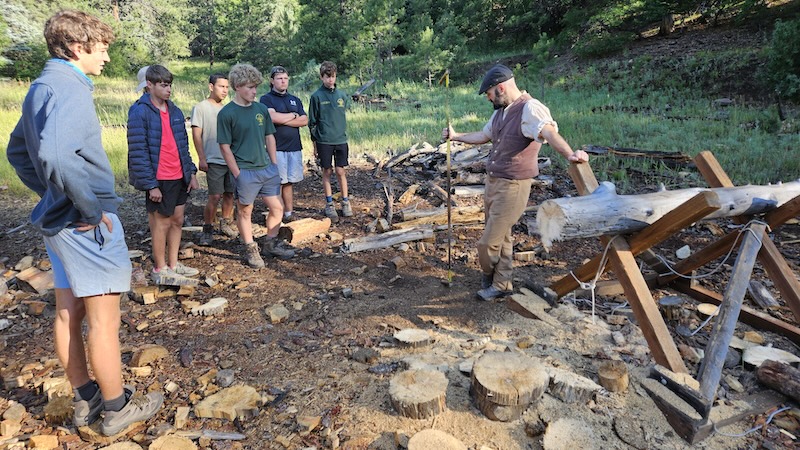
The scouts listened intently to this woodsman, who carefully explained his craft.
He continued, “Blacksmithing was also something we got to do. Our crew worked together to make a hook using an anvil, hammer, and coal fire.”
Boys in Grade 6 or higher and under the age of 18 can join Troop 26. The Scouts camp every month of the year. It is a great opportunity to learn new skills and get outdoors.
Troop 26 members and leaders gather at the top of Mount Baldy, N.M.
The Troop meets at the Hamburg Fire House in Lyme from 7 to 8:30 p.m. on Wednesdays during the school year. Their first meeting of the year will be on Sept. 11.