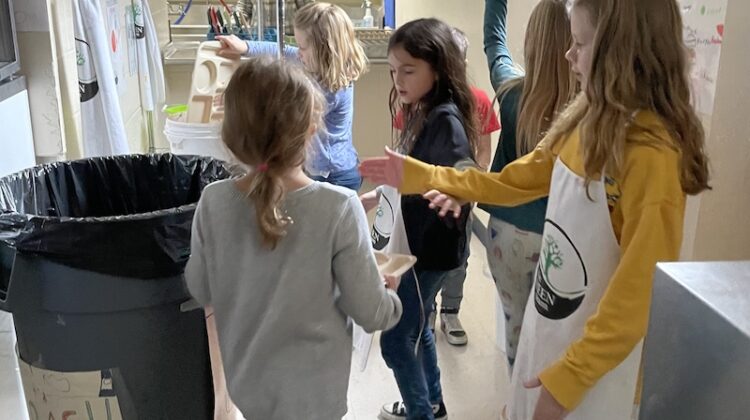
Lyme School Green Club members help fellow students compost correctly at lunch by guiding them to place food waste and other items into either the trash or compost as appropriate. The compost is subsequently sent to Long Table Farm in Lyme. Photo credit: Lyme-Old Lyme Schools.
LYME–The Connecticut Department of Agriculture has announced that Lyme is among the 15 communities receiving a $23,753 grant through the ‘CT Grown for CT Kids’ program.
Lyme Consolidated School will receive the grant to support its “Waste Warriors” project. This project teaches local students about the value of composting, which allows them to reduce food waste and learn how they can recycle and support local agriculture. It also teaches them about waste management and ecosystems.
Asked her reaction to receiving the award, Allison Hine, Principal of Lyme School, told LymeLine by email, “Lyme Consolidated is excited to have received this grant award. We will be partnering with the Town of Lyme and with Long Table Farm to support and enhance the composting and recycling initiatives of our Green Team.”
She added, “Ultimately, the project aims to enhance environmental stewardship, promote sustainability, and deepen students’ understanding of how effective waste management contributes to a healthier, more resilient community.”
State Senator Norm Needleman (D-33rd), whose District includes Lyme, commented in a press release, “Our local students learning about agriculture and the connections between our farms, our diets and our communities is very valuable as they grow.” He commented, “I’m really happy to hear that our region is getting support from the ‘CT Grown for CT Kids‘ program.”
‘CT Grown for CT Kids‘ focuses on increasing availability of locally grown foods in child nutrition programs and teaching children about the importance of nutrition and farm-to-school connections.
To the Editor: An Open Letter to the People of Old Lyme
I truly think that the Public Hearing this evening at 5:30 p.m. in the Old Lyme Town Hall is our last best chance to protect this precious Mile Creek River, this habitat. With the start of full-time quarrying operations at the gravel pit, the peace, the quiet, the wildlife are all about to disappear.
I wish I could have been more effective in helping to protect this, As Claudia Weicker, from R.T.P. Audubon called it when she visited our home, it is an incredible habitat, a birder’s dream. She truly loved the place.
Please, encourage your neighbors to attend and make their concerns be heard. If there is a large turnout the hearing may be continued.
So this may be a bit of a long haul, But not anywhere near as long or loud as the Gravel Pit operation will be …
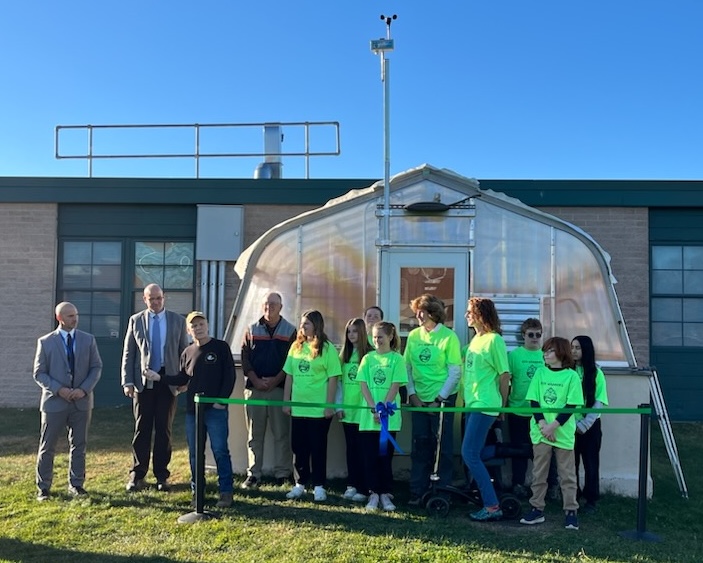
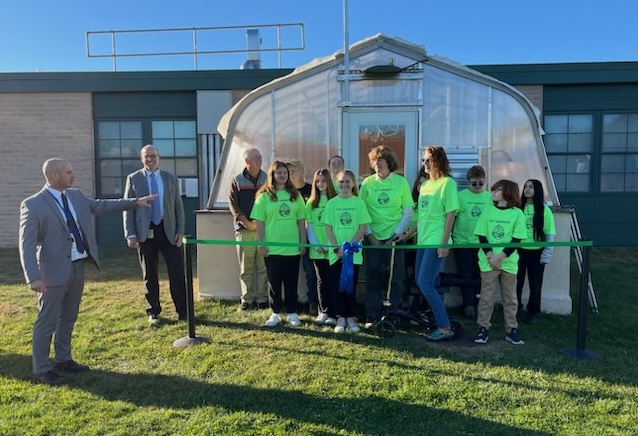
Lyme Food Share Garden President Jim Ward (third from left) thanks Sustainable CT, Lyme-Old Lyme Schools, and the numerous donors to the greenhouse renovation project in a short speech made immediately prior to the ribbon-cutting.
OLD LYME — Lyme-Old Lyme Middle School welcomed more than a dozen community members to view the renovated school greenhouse at a ribbon-cutting ceremony held Tuesday, Nov. 19. The greenhouse has been renovated as a partnership between Lyme-Old Lyme Schools, the Lyme-Old Lyme Food Share Garden (LOLFSG), and the community.
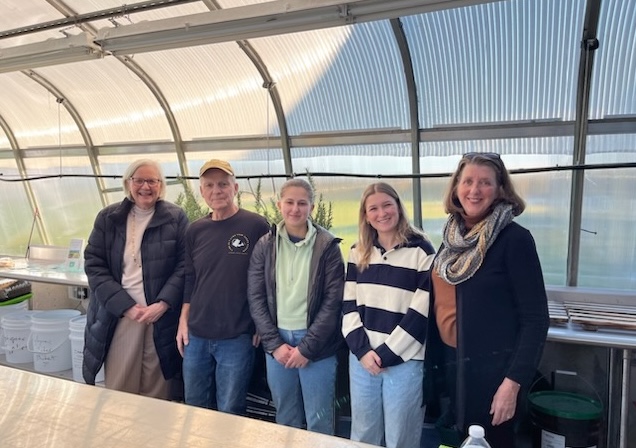
From left to right, Old Lyme First Selectwoman Martha Shoemaker (left) joins Lyme-Old Lyme Food Share Garden President Jim Ward, Sustainable CT Fellow Summer Mitchell, Sustainable CT Program Coordinator Dorothy Piszczek and Old Lyme Economic Development Chairwoman Cheryl Poirier (right) in the renovated Lyme-Old Lyme Middle School greenhouse, which was officially reopened Tuesday with a ribbon-cutting.
At the ribbon-cutting, Lyme Food Share Garden President Jim Ward spoke warmly of the relationship LOLFSG had established with Lyme-Old Lyme Schools, saying, “We are excited to collaborate with the school district to revitalize and utilize the greenhouse. This effort fosters a great connection between the school and the community.”
He added, “We look forward to working with students and teachers in enhancing the curriculum and hands-on learning. Garden volunteers will maintain educational exhibits, such as a vermicomposting (worm) bin and a hydroponic display.”
Ward noted, “Access to a greenhouse will enable the Food Share garden to increase production by starting and maintaining plants for early and late-season crops.”
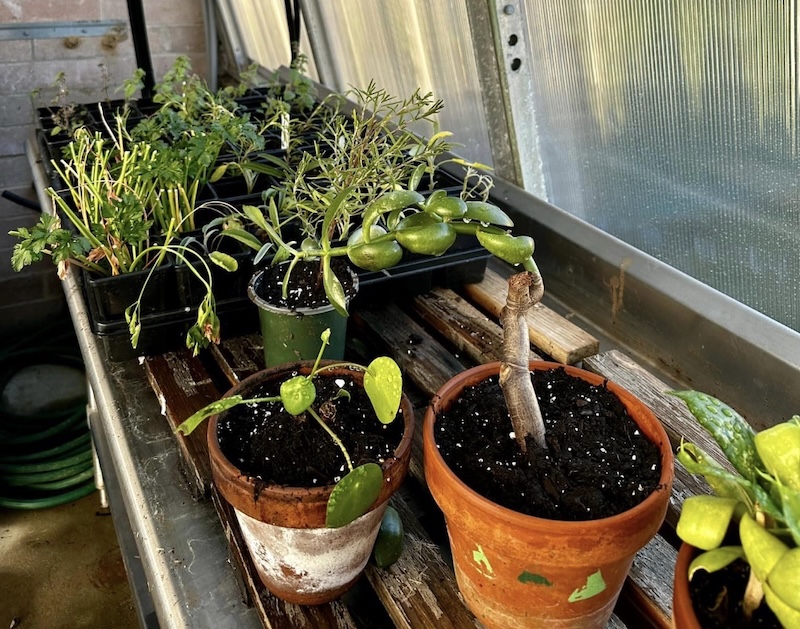
The greenhouse is already yielding valuable results.
Expressing thanks to all the donors, who had made the greenhouse renovation possible, Ward gave examples of the impact the project had made on certain former students.
He explained, “During the fundraising campaign, I spoke to a former student who is a farmer; he told me that his experience in this greenhouse helped inspire his desire to grow vegetables and raise cattle. I also spoke with a local landscaper who shared his positive senior-year experience with the greenhouse. Hopefully, the greenhouse experience will have an impact on future students.”
Ward also acknowledged the support from the Sustainable CT Community Match Fund, noting, “Three years ago, we utilized this program to establish the garden and turned to them to assist us in funding this greenhouse project.” This program supports sustainability improvements across Connecticut.
Lyme-Old Lyme Middle School (LOLMS) Principal Mark Ambruso welcomes the LOLMS ‘EcoWarriors’ to the greenhouse where they will be undertaking a number of projects under the guidance of LOLMS science teacher Shannon Glorioso.
While searching for a greenhouse in which the LOLFSG could start and maintain plants for late season crops, Jim Ward, president of LOLFSG, noticed the rarely-used greenhouse at the middle school. In his mind, he began to think about the possibilities …
After extensive discussions between LOLFSG and Lyme-Old Lyme Schools, it was agreed that renovating the greenhouse would be beneficial to all.
The LOLFSG raised approximately $8,000 for the project via the Community Match Fund offered by Sustainable CT.
With these funds, the polycarbonate on the roof, sides and gable end of the greenhouse have been replaced. New exhaust fans, shutters, and vents have been added, along with an irrigation system and a hydroponic tower.
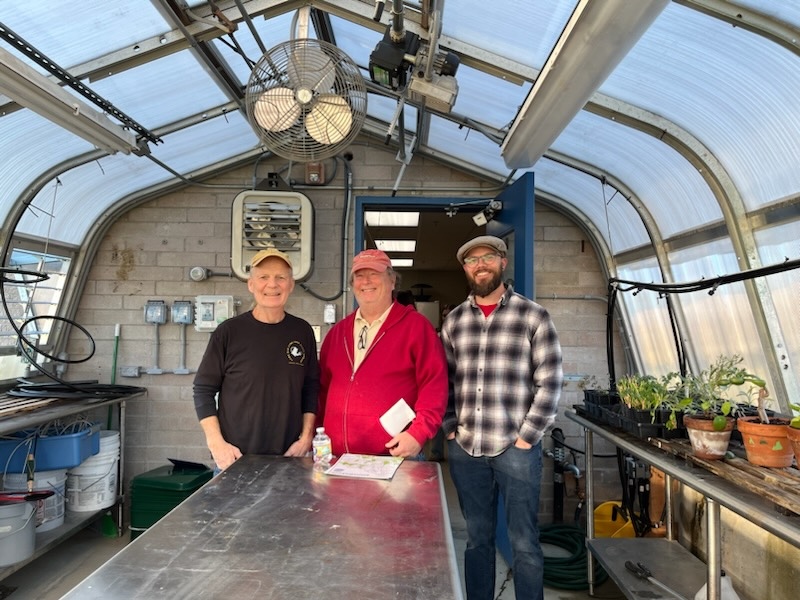
From left to right, Lyme-Old Lyme Food Share Garden LOLFSG) President Jim Ward is joined by fellow LOLFSG Board Members Steven Moore and Michael Hansen for this celebratory photo.
Ward commented, “The Lyme-Old Lyme Food Share Garden is excited to collaborate with the school district to revitalize and utilize the greenhouse. This effort fosters a great connection between the school and the community.” He added, “ We look forward to working with students and teachers in enhancing the curriculum and hands-on learning.”
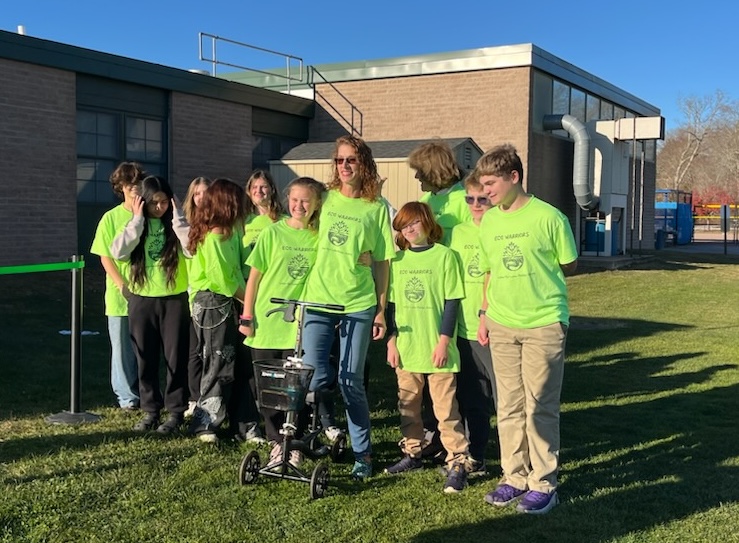
Lyme-Old Lyme Middle School science teacher Shannon Glorioso (center) stands with her team of ‘EcoWarriors’ prior to the ribbon-cutting.
Lyme-Old Lyme Middle School science teacher Shannon Glorioso aims to incorporate use of the greenhouse in her teaching this year, including implementing worm-composting. She plans to Introduce and maintain a worm-composting system within the greenhouse to recycle organic waste, thus promoting nutrient-rich soil for plant growth and reducing waste sent to landfills.
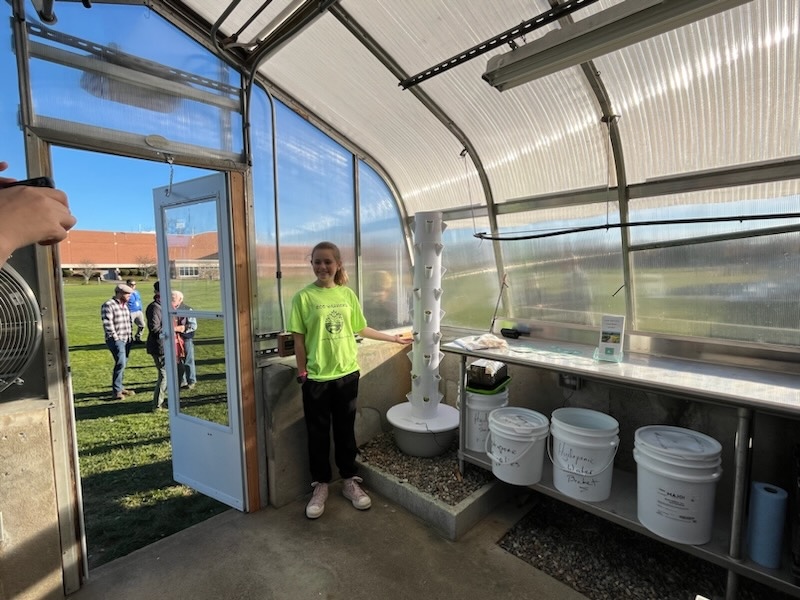
Another topic Glorioso intends to explore in the greenhouse with her students is hydroponics. She hopes to establish a hydroponic system in the greenhouse to teach students about alternative methods of cultivation, water conservation, and the importance of nutrient management in plant growth.
This ‘Eco-Warrior’ was delighted to have the opportunity to explain the details of hydroponic gardening to the assembled onlookers.
Raised-bed farming will also be introduced by the energetic Glorioso. She intends to teach students how to cultivate raised-bed gardens within the greenhouse to demonstrate sustainable farming techniques, including soil management, crop rotation, and pest control methods.
Finally, Glorioso plans to engage students in the entire process of growing lettuce from seed to harvest. But she will not stop there—she hopes to organize regular deliveries of the lettuce to the Shoreline Soup Kitchen and Pantries at the First Congregational Church of Old Lyme. This in turn will not only address local food insecurity but also instill values of community service and empathy in the students.
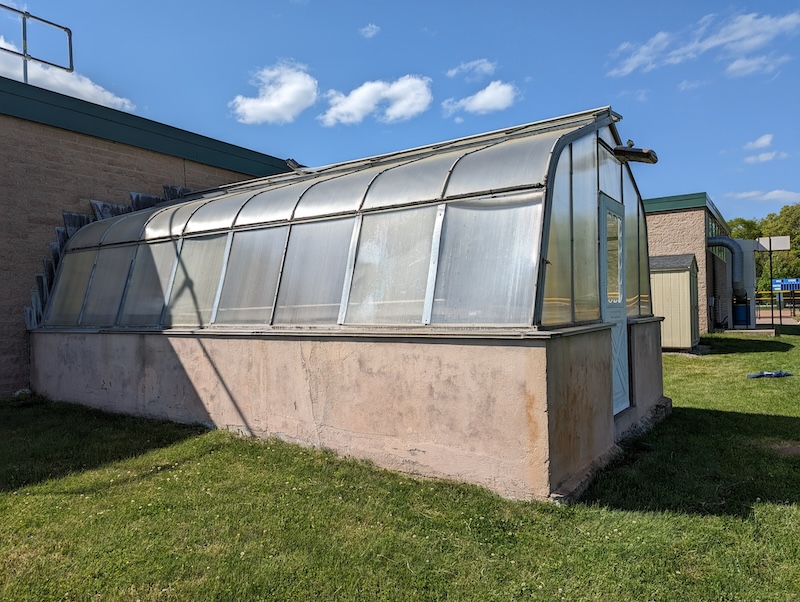
A view of the exterior of the greenhouse. The facility has been ‘in situ ‘at the LOL Middle School for decades but had fallen into disrepair. This project has rejuvenated both the greenhouse and its role as a learning environment for students.
“Partnerships such as this one between our students, staff and the community are an integral part of what makes our schools outstanding,” said Superintendent of Schools Ian Neviaser.
He continued, “We thank LOLFSG for bringing new learning experiences to our students and raising the funds necessary for the work.”
Editor’s Note: The greenhouse renovation project used Sustainable CT’s Community Match Fund grant program to crowdfund the project and access a matching grant. For further information on the Community Match Fund grant program page, visit this link.
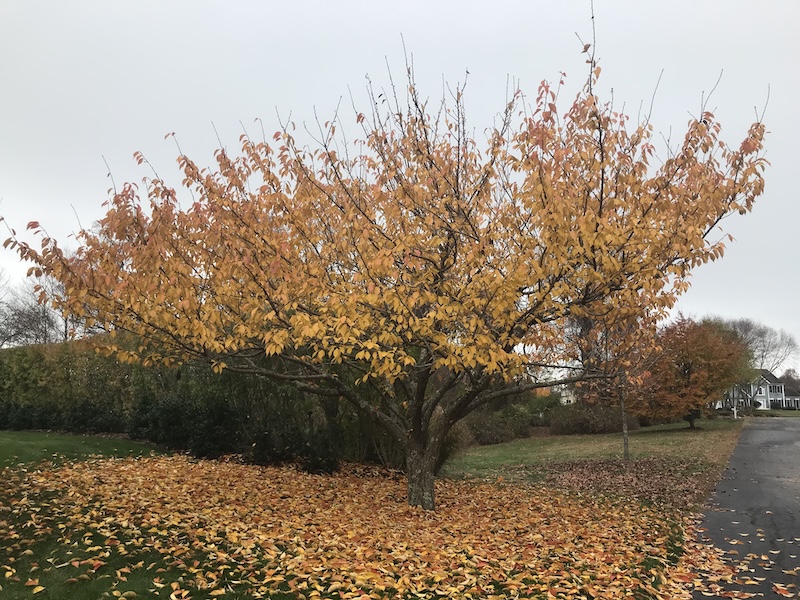
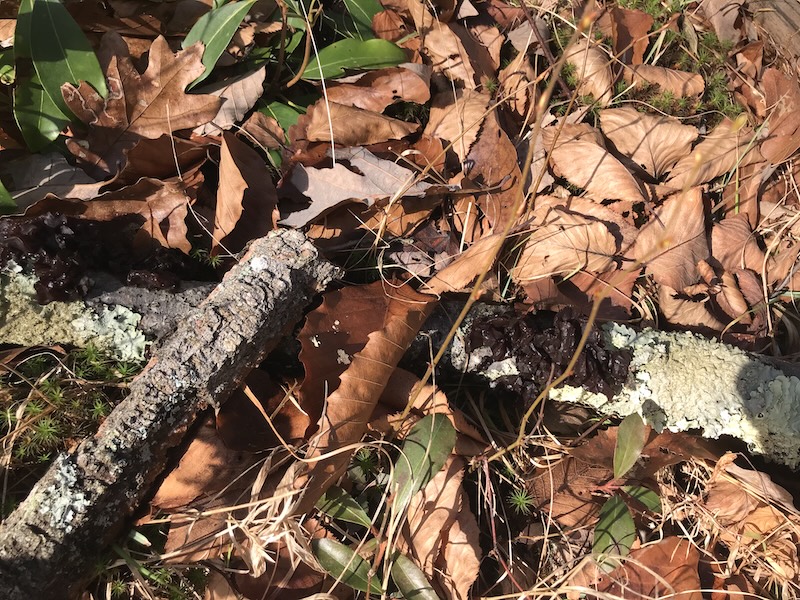
Leaves falling off of a copper beech tree. These leaves can be gently raked to the side in a leaf pile or run the mower over dried leaves on your lawn to break them up as organic lawn mulch. All photos by Suzanne Thompson.
Ah, the sights, sounds and smells of fall … unfortunately, they often involve the racket and fuel fumes of motorized leaf blowers and visions of yard crews scalping lawns as part of our traditional New England fall yard cleanup.
But did you know that we should be doing less to our yards this time of year, letting nature do her thing and saving some money in the process?
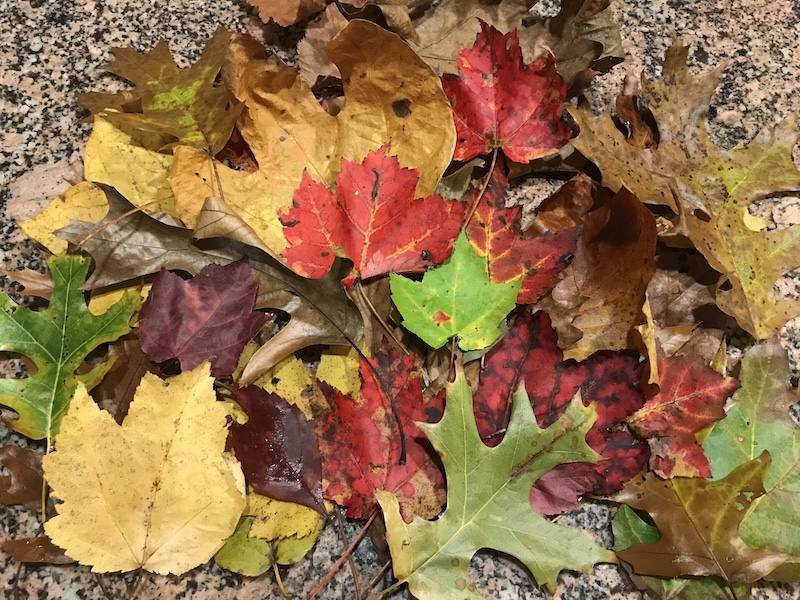
You see, dead leaves have a purpose in nature, more than just looking pretty for us two-legged leaf-peepers for a few weeks every fall. They are food and shelter for many beneficial insects (by definition, invertebrates) and other little critters (including frogs, salamanders and box turtles) that make up the outdoor ecosystem around us. And with the help of insects and wildlife, the leaves are broken down into nutrients and organic matter for our lawns, flowerbeds and landscapes. That is, if we leave them in place to do their good.
The Nature Conservancy points out that at least seven species depend on the leaves, as well as on the seed heads and stems of many of our favorite flowerbed plants. If we would only not strip these away in some fall frenzy to clear off our yards before colder weather hits. What we see as unnecessary brown stuff is actually natural insulation and nutrients.
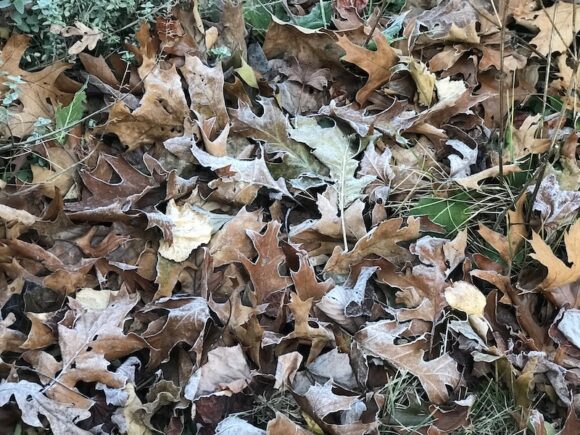
If left untouched where they fall, leaves will soon be covered by early frosts that will help them decompose.
So, this fall, instead of contributing to the incessant drone and damage of motorized leaf blowers, try taking a kinder and gentler approach to fall cleanup. Xerces Society recommends raking leaves into garden beds and under trees where they serve as natural mulch. Or, if you have an area in the yard that can accommodate a leaf pile over the winter, push the leaves over there. In the spring, you will have valuable leaf mold. Rewilding Magazine, a Canada-based publication, tells you how to make your own leaf mold.
Fallen leaves and wood decompose to provide not only a natural mulch but also food and shelter for many beneficial insects.
Create small brush piles with the branches and twigs that you don’t want to leave in the middle of your yard; these also become home for insects and small wildlife. Put them at the far end of your property if you are worried about critters.
If you need to justify your actions to yourself, your spouse or neighbors (the ones with the scalped lawns), see National Wildlife Federation’s Six Excuses to Avoid Yard Work this Fall.
And, if you installed perennials, trees and shrubs this fall or earlier this year, don’t forget to give them a good watering. After a summer of enough rain, we are experiencing a dry fall.
For more good gardening advice, listen to garden writer Tom Christopher’s weekly Growing Greener podcasts and spend some time researching Pollinator Pathways. There are now Pollinator Pathway community programs in 19 states and Ontario, Canada.
State Mosquito Management Program Warns CT Residents of Continuing Risk of EEE
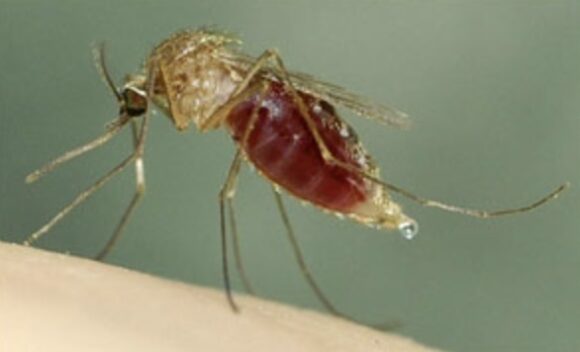
NEW HAVEN – In a press release dated Oct. 4, the State Mosquito Management Program reported that Eastern Equine Encephalitis (EEE)-infected mosquitoes had been reported in Lyme and 15 other Connecticut towns.
The other towns in the state where EEE-infected mosquitoes have been found are Canterbury, Chester, Farmington, Griswold, Groton, Killingworth, Ledyard, Manchester, Newtown, North Stonington, Plainfield, Sterling, Stonington, Trumbull, and Voluntown.
Although no human cases have been reported so far this season in Connecticut, human cases usually lag behind virus detections in mosquitoes due to the time it takes for a person to develop disease and confirm the diagnosis.
“Although mosquito numbers are declining with the onset of cool weather, we continue to detect EEE virus, some of which are being found in new communities in Connecticut,” said John Shepard, Medical Entomologist at the Connecticut Agricultural Experiment Station (CAES). “There is continued risk for mosquito-borne diseases until the first hard freeze when mosquito activity ends.”
“Mosquitoes are still active, and residents should continue to take measures to prevent mosquito bites especially during episodes of warmer weather” said Dr. Philip Armstrong, Chief Scientist at CAES. “This includes applying insect repellent and covering bare skin, especially in wooded areas and during dusk and dawn when biting mosquitoes are most active.”
“Since there is no vaccine for EEE for use in humans, protection from this virus depends on personal protective measures to decrease exposure to infected mosquitoes,” said Connecticut Department of Public Health Commissioner Manisha Juthani, MD. “Symptoms from EEE include severe headache and neck stiffness which can result in nausea, vomiting, and dehydration. Anyone experiencing these symptoms should seek medical attention immediately.”
“DEEP encourages residents to continue to take appropriate precautions as we are still not through the mosquito season,” said DEEP Commissioner Katie Dykes. “Residents taking part in outdoor fall activities such as hiking, fishing, and camping should continue to take steps to avoid exposure to mosquitoes, including minimizing time outdoors during dawn and dusk when mosquitoes are prevalent, wearing long-sleeved shirts and pants, and using insect repellent if out at any point during those times.”
To reduce the risk of being bitten by mosquitoes, residents should:
Minimize time spent outdoors between dusk and dawn when mosquitoes are most active.
When it is necessary to be outdoors, use mosquito repellents containing an EPA-registered active ingredient, including DEET, Picaridin, IR3535, oil of lemon eucalyptus, para-menthane-diol (PMD), or 2-undecanone. EPA registration of skin-applied repellent products indicates that they have been evaluated and approved for human safety and effectiveness when applied according to instructions on the label.
Wear shoes, socks, long pants, and a long-sleeved shirt when outdoors for long periods of time, or when mosquitoes are more active. Clothing should be light-colored and loose-fitting and made of tightly woven materials that keep mosquitoes away from the skin.
Wear clothing and gear treated with permethrin. Permethrin is an insecticide that kills or repels mosquitoes and ticks.
Be sure door and window screens are tight-fitting and in good repair.
When sleeping outdoors, use tents or mosquito netting in an unscreened structure. Treat camping gear with permethrin when possible.
Cover strollers and baby carriers with mosquito nets when outside.
EEE is a rare but serious illness in humans with 4-8 cases reported in a typical year in the U.S. To date this season, 13 human cases have been reported in seven states including Massachusetts (4), New Hampshire (4), Vermont (1), New York (1), Rhode Island (1), New Jersey (1), and Wisconsin (1); two of these were fatal. EEE is the most severe mosquito-transmitted disease in the U.S. with approximately 40 percent mortality and significant brain damage in half of survivors.
The response to mosquito transmitted diseases in Connecticut is a collaborative inter-agency effort involving the Department of Energy and Environmental Protection (DEEP), The Connecticut Agricultural Experiment Station (CAES), the Department of Public Health (DPH), the Department of Agriculture, and the Department of Pathobiology at the University of Connecticut (UCONN). These agencies are responsible for monitoring mosquito populations and the potential public health threat of mosquito-borne diseases.
The CAES maintains a network of 108 mosquito-trapping stations in 88 municipalities throughout the state. Mosquito traps are set Monday – Thursday nights at each site every ten days on a rotating basis and then at least once a week after detection of virus. Mosquitoes are grouped (pooled) for testing according to species, collection site, and date. Positive findings are reported to local health departments and on the CAES website.
For information on WNV and EEE, what can be done to prevent getting bitten by mosquitoes, the latest mosquito test results and human infections, visit the Connecticut Mosquito Management Program website.
Editor’s Note: This article is based on a press release issued Oct. 4, 2024 by the State of Connecticut Mosquito Management Program.