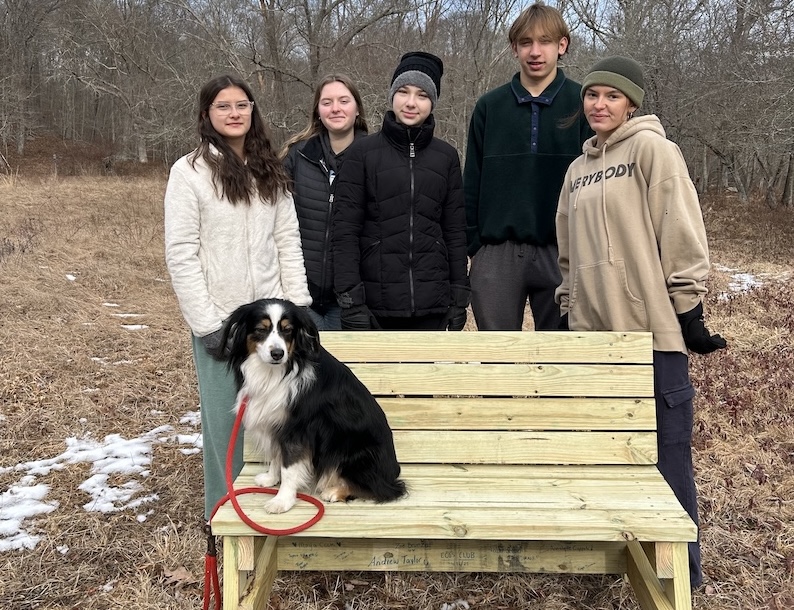
Justifiably proud of their work, these Lyme-Old Lyme High School (LOLHS) students, who are all members of the Environmental Club, stand behind the just-constructed bench in its new location at Rook’s Meadow Open Space in Old Lyme. Fizz, the mini-Australian Shepherd, who sits in pride of place, is owned by Open Space Commission member Andrea Fenton, who assisted with the project. All photos by A. Fenton.
OLD LYME—The Old Lyme Open Space Commission has been busy recently!
On Jan. 26, some 10 members of the Lyme-Old Lyme High School (LOLHS) Environmental Club assembled a bench following the design of others already constructed on various Old Lyme Land Trust properties. Karen Taylor, who is a tutor at LOLHS, is the advisor for the Environmental Club.
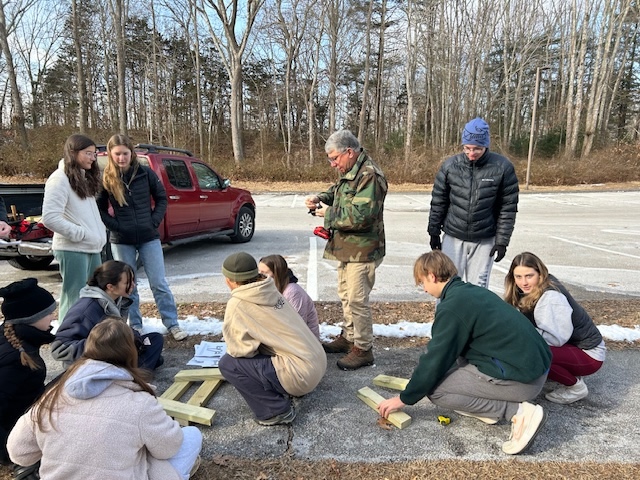
These LOLHS Environmental Club members worked in freezing conditions to assemble the benches.
The students braved 30 degree weather to align and drill frames, which then supported the carefully-measured and spaced bench seat and back.
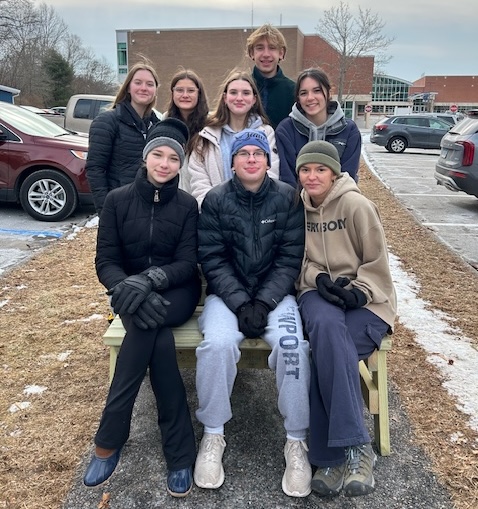
And they did it! Prior to placing the new seat in its final location at Rook’s Meadow Open Space, these hard-working students posed for a final photo on ‘their’ bench.
Some students helped place the new bench in the Rook’s Meadow Open Space in Old Lyme, where the existing cedar bench is still stable despite having lost its back!
OLD LYME—UPDATED 1/11 at 12:10 pm: The ‘Record of Votes’ related to Monday night’s meeting has now been published. Regarding the Special Permit Application to replace and construct a new 5-bedroom residence with an attached 2 car garage at 43 Smith Neck Rd., RU-40 Zone, Jeffrey and Emily Merriam, applicants, the Record states, “A motion was made by D. Savageau, seconded by J. Marsh to DENY without prejudice the special permit. The Motion further stated that insufficient evidence had been submitted to allow the Commission to find the proposed activity would have or would be reasonably likely to have the effect of unreasonably polluting, impairing or destroying the public trust in the air, water, or other natural resources of the State of Connecticut.”
UPDATED 1/11 at 1am: The application for the proposed 11,000 sf house at 43 Smith Neck Rd.was denied without prejudice in a unanimous 5-0 vote at Monday night’s Old Lyme Zoning Commission meeting.
Around 50 people attended the meeting.
UPDATED1/10 at 7pm with corrected number of days for Zoning Commission to deliberate. The proposed 11,000 sf house at 43 Smith Neck Rd. is back on the Old Lyme Zoning Commission’s agenda tonight. Their Regular Meeting starts at 6:30 p.m. in the Meeting Room at Old Lyme Town Hall.
Appearing as the first item under Old Business, the agenda item states, ” 43 Smith’s Neck Road, RU-40 Zone. Special Permit application to replace and construct a new 5-bedroom residence with an attached 2 car garage. Jeffrey and Emily Merriam, applicants.”
The Zoning Commission closed the Public Hearing at the end of the previous Jan 13 meeting. This means no further public comment can be heard on the matter and the Commission cannot ask any additional questions of the applicant.
The Commission must render a decision within 65 days of closing the Public Hearing. Members could vote on the proposed plans tonight but are not obliged to do so. They will, however, deliberate on the proposal this evening in a public setting but cannot entertain any comments from the public or ask any further questions of the applicant or their representatives.
At the Zoning Commission’s Regular Meeting on Jan. 13, some 17 residents offered opinions and concerns during the Public Hearing on the proposal. The comments made by members of the public all expressed a negative point of view towards the proposal.
Those commenting variously asked the Commission outright to deny the application for the 11,000 sq. ft. eight-bedroom, seven-bathroom house with two laundries, a swimming pool, and extensive gardens; or send it back to the Connecticut River Gateway Commission for further review; or to request answers to the numerous still unanswered questions by the applicant; or a number of other questions.
Related articles and letters published on LymeLine.com are as follows:
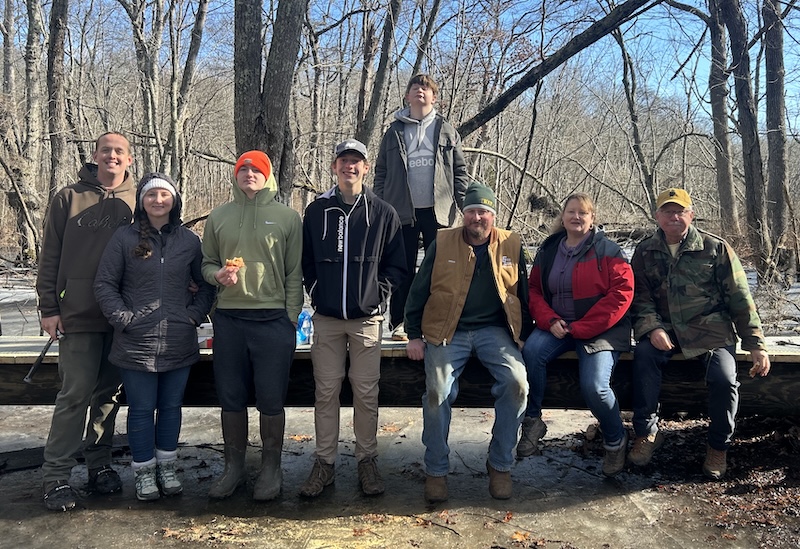
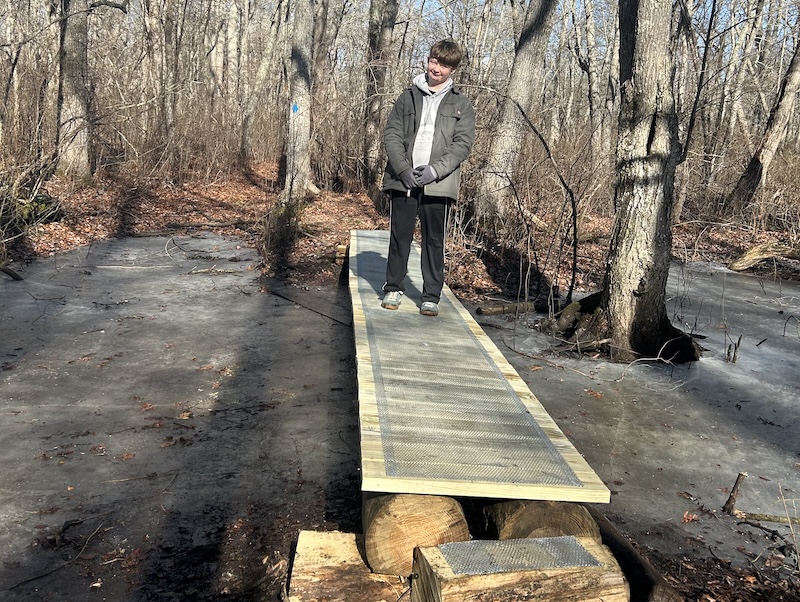
A job well done—Members of Lyme-Old Lyme Boy Scout Troop 26 relax after completion of the bridge-building project with some of the volunteers who assisted. All photos by Andrea Fenton.
LYME-OLD LYME—As part of his qualifications to gain the prestigious Eagle Scout honor, Logan Landry, a member of Lyme-Old Lyme Boy Scout Troop 26, designed a 25 ft. long bridge to be installed over a flooded—and hence closed—trail in Bartholomew Open Space in Old Lyme.
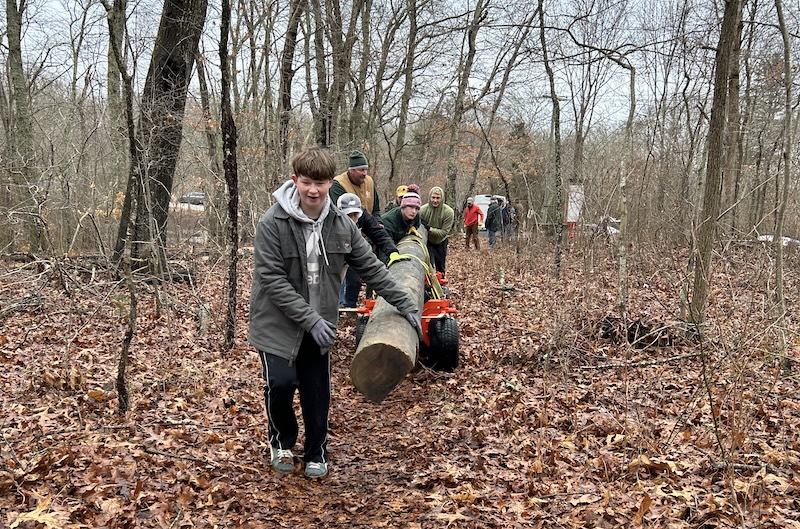
Moving the telegraph poles needed all hands on deck.
On Feb. 1, Landry successfully coordinated construction of the bridge. He was assisted by several older and fellow Troop 26 Scouts including Ryan Ortoleva, who is already an Eagle Scout, and Charlie Zelek. Landry’s family, including his brother Brenden Landry—who is also an Eagle Scout— also assisted.
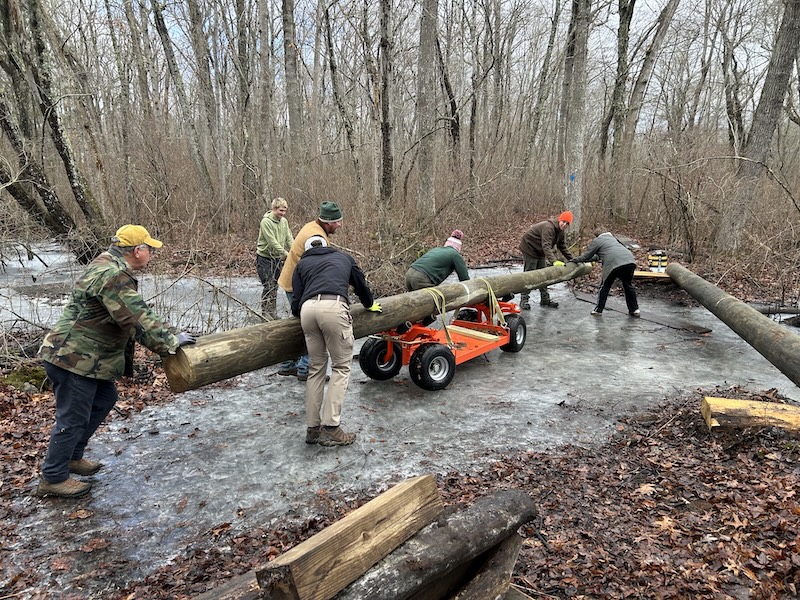
The work continued despite the icy conditions.A great dealmof measuring
Brenden had previously built several foot bridges on Old Lyme Land Trust property off Boggy Hole Rd. in the town.
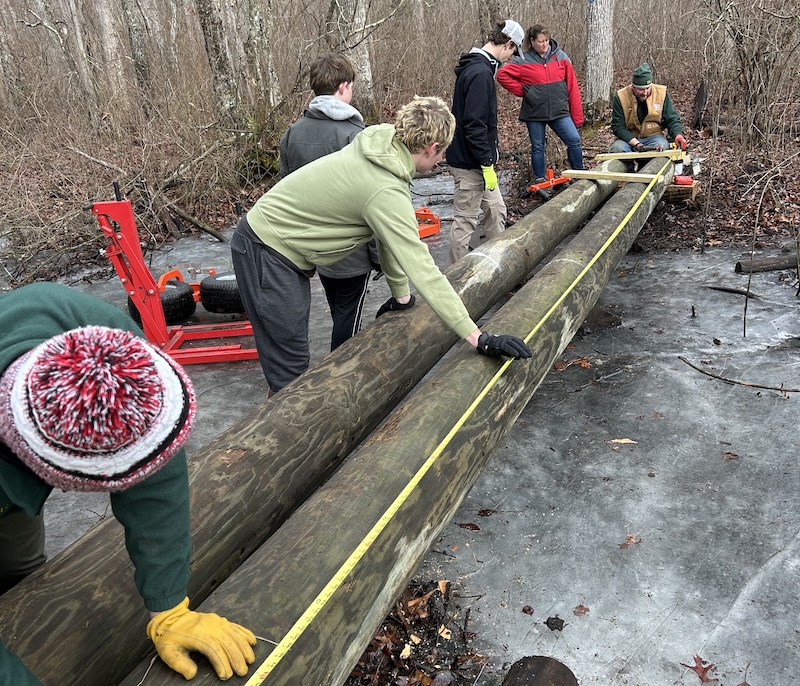
A great deal of measuring was required to complete the project.
Also in attendance were Open Space Commission members Peter Norris, who serves as Head Steward, Evan Griswold, Joan Meek and Andrea Fenton. Mike Aurelia of the Old Lyme Inlands Wetlands Commission also joined the project.
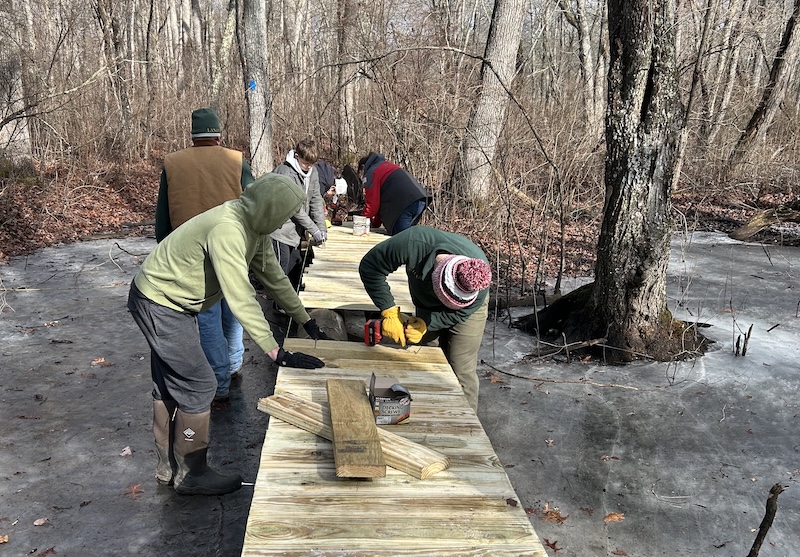
Installing the final horizontal planks was a satisfying moment for all involved.
Material contributions, also coordinated by Logan, were made by Eversource (telephone poles), Middlesex Tree (locust logs), Beard Lumber (wood planks), Gregg Landry Plumbing and Heating, and Teddy’s Pizza (pizza for the crew.)
Success! Logan Landry stands atop his just-constructed bridge.
A spokesperson for the Old Lyme Open Space Commission commented, “The Commission is very proud of and grateful to Logan who initiated this project and allowed the Bartholomew Trail to be open once again.”
As residents of Old Lyme, we feel a strong responsibility to voice our concerns regarding a recent Special Permit application before the Zoning Commission for 43 Smiths Neck Road, which poses a serious threat to the natural beauty of our cherished Connecticut River Valley. After attending the public hearing, we identified two critical issues that were not addressed, further supporting the case for denying this application—issues the community should be aware of and take action on.
1. Inadequate Planning for Visual Impact
The applicant has failed to present any visual renditions illustrating how the proposed structure will appear in relation to its surroundings—particularly in relation to the neighboring home, located less than 11 yards away. This omission is especially concerning given the site’s pristine location at the mouth of the Back River, where it meets Long Island Sound.
We urge residents to visit the boat landing to envision the visual impact of two substantial homes—a new, massive build adjacent to an already large existing home—situated a mere 11 yards apart. The resulting juxtaposition of two overwhelming, obtrusive, and incongruously designed homes (“monstrous” is a more apt description) would be entirely out of character with the area’s natural charm.
Furthermore, the visual impact of these structures starkly contradicts the Connecticut River Gateway Commission’s mission “to preserve the aesthetic and ecological natural beauty of the lower Connecticut River valley for present and future generations.” Disregarding the Gateway Commission’s expert recommendation to reject the Special Permit application would establish a dangerous precedent, weakening the regulatory framework that safeguards our community and environment and opening the door to unchecked deviations from established zoning principles. The Gateway Commission and its mission were established in law by the Connecticut General Assembly in 1973, recognizing that “this river possesses unique scenic, ecological, scientific, and historic value contributing to public enjoyment, inspiration, and scientific study…that it is in the public interest…to preserve such values and to prevent deterioration of the natural and traditional river-way scene for the enjoyment of present and future generations.”
Allowing this development to proceed would violate the Gateway Commission’s mission and the principles it was founded to uphold. The construction of this new home—essentially positioned on top of an existing one—would irrevocably degrade the unique beauty of the marsh and the entire Back River as it flows into Long Island Sound.
2. Violation of Zoning Regulations
The proposal also conflicts with zoning regulations requiring structures to be built behind the natural crest of a hill to maintain the site’s topography. The applicant’s plans rely on substantial landfill to artificially alter the hill’s contours, concealing the fact that the proposed home’s river-facing wall extends at least 30 yards beyond the hill’s natural crest. Such actions contradict both the letter and the spirit of local zoning laws.
Preserving Our Community’s Legacy
If approved, this application would set a dangerous precedent, endorsing incongruous development that disregards zoning standards and the region’s natural beauty. We urge residents to join us in calling on the Zoning Commission to uphold the principles of responsible land use by denying this application. Together, we can protect the natural legacy we are privileged to enjoy and ensure its preservation for future generations.
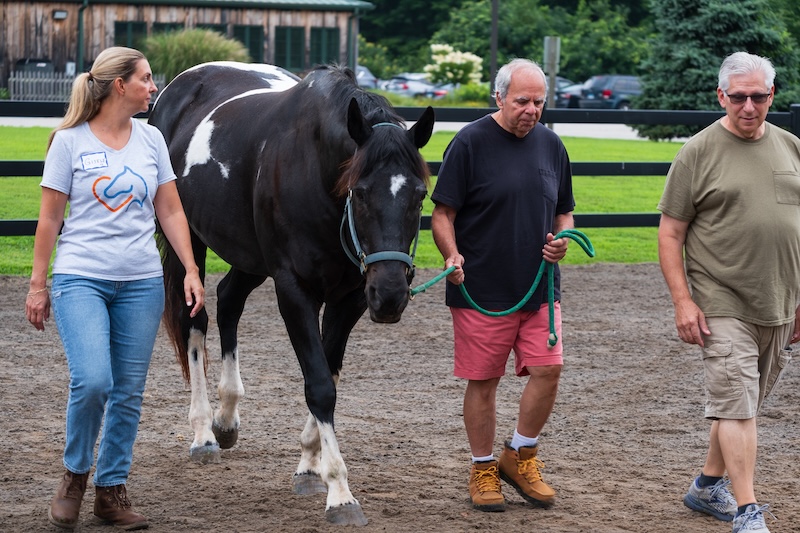
Parkinson’s program participants Michael Bigiarelli (second from right) and David Plat (right ) lead High Hopes horse Addie in the outdoor arena. High Hopes volunteer Gisele Kurns stands by for support.
Program Creates Pathways to Wellness, Relaxation, and Connection
OLD LYME—High Hopes Therapeutic Riding, Inc. has announced the continued success and expansion of its pioneering Equine-Assisted Services Program for people with Parkinson’s disease. What began as a pilot program just one year ago has blossomed into a transformative, life-changing initiative, helping participants experience improved movement, relaxation, and a unique connection with horses.
The program, which meets weekly on Tuesdays from 10:30 to 11:30 a.m., offers gentle stretching exercises, grooming, and leading of horses as part of a therapeutic regimen designed to encourage physical activity, relieve muscle tension, and promote relaxation. The natural, calming presence of the horses fosters a sense of mindfulness, helping participants to be fully present while they engage in each activity.
A year ago, a compassionate High Hopes volunteer and participant, Carol Merkt, recognized a growing need in the community for services tailored to people living with Parkinson’s disease. Merkt, whose deep connection with the High Hopes community led her to identify this gap, approached the center with the idea for a specialized program.
Her insight into and dedication to improving the lives of others has been instrumental in shaping this initiative. “I couldn’t be more impressed with the progress of this program,” says Merkt. “When I first brought the idea to High Hopes, I was hopeful, but what’s been created is better than I ever expected. The benefits for participants are truly remarkable.”
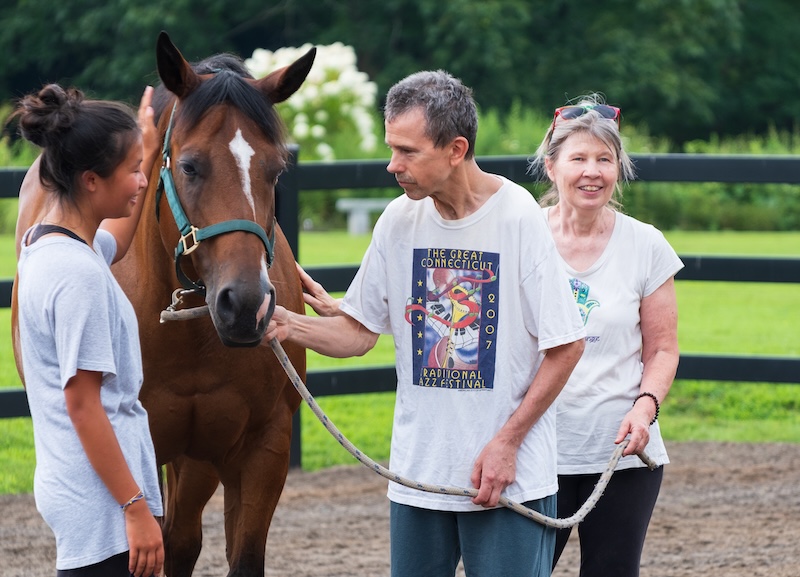
James Bendinzski, a program participant (second from right), praises his horse, Savannah, after completing an obstacle course. Bendinzski’s wife Karen Nichols (right) and High Hopes volunteer Danielle Liston greet both Bendinzski and Savannah at the finish line.
The Parkinson’s Program is facilitated by several High Hopes instructors, who are certified in ‘Equine Mental Health and Learning.’
One of the instructors, who co-facilitates the program, explains more about the program saying, “[It] is about more than physical benefits—it’s about building relationships and finding joy.” She continues, “Horses have an incredible ability to meet people where they are, offering connection and understanding that goes beyond words. Seeing participants light up during these sessions is what makes this work so rewarding.”
The High Hopes Parkinson’s Program is funded by the generous support of the Kitchings Family Foundation, whose contributions cover over 95 percent of the program’s costs through scholarships, ensuring accessibility for all participants regardless of financial circumstances.
Another facilitator of the program comments, “We’re honored to help make this program possible. Our goal is to create a safe and supportive environment where participants feel empowered. The horses are truly the heart of what we do—they offer nonjudgmental companionship and help participants find moments of peace and accomplishment.”
The program is open to new participants at any time, welcoming individuals with Parkinson’s disease to join the classes and experience the benefits of equine-assisted services. For those who wish to reflect on their experience, there is an optional group “coffee session” following each class.
“This program exemplifies the mission of High Hopes—to inspire, support, and transform through the power of horses,” says Missy Lamont, Executive Director of High Hopes, adding, “Thanks to the incredible support from the Kitchings Family Foundation, we’re able to provide life-changing experiences to individuals living with Parkinson’s disease.”
Lamont concludes, “At High Hopes, we believe in the power of horses to inspire, heal, and transform. Our equine-assisted services are designed to meet the diverse needs of our community, and we are excited to see how the program continues to grow, improving the lives of people with Parkinson’s disease.”