
A Tool Kit for Parents: Cannabis Legalization and Marijuana’s Impact on Our Youth

LYME/OLD LYME — Cannabis is now legal for adult use in Connecticut and retail sales officially began in January. How do we support our children and parents through this change and what it means moving forward?   

Learning more about today’s marijuana, its impact on our youth, and the new law is a great way to start.

Over the next few months, the Lyme-Old Lyme Prevention Coalition and Lymes’ Youth Service Bureau (LYSB) will be running a youth cannabis education and prevention campaign, including a six-part direct mail Tool Kit for Parents that will be in mailboxes all over Lyme and Old Lyme.

This postcard will be arriving soon in Lyme and Old Lyme mailboxes. It is the first of a six-part direct mail Tool Kit for Parents regarding cannabis legalization in Connecticut and how to deal with its impact on our youth.

Why is Youth Cannabis Use a Problem?

The 2021 Lyme-Old Lyme (LOL) Youth Survey assessing current youth substance use/misuse trends in students grades 7-12 offers insight.   

By 12th grade, nearly a quarter of all seniors reported trying marijuana in their lifetime, with 13.3% reporting recent use. Of equal concern is society’s view of marijuana use and reduced perception of its harm by youth.    By 12th grade, only 20 percent of LOLHS students report great risk for using marijuana one to two times a week, while 68 percent of surveyed parents reporting that weekly marijuana use is risky for youth.  

Teens (and often parents) believe the myth that today’s marijuana is neither dangerous nor addictive. What some do not fully understand is that today’s marijuana is incredibly potent, containing at least three times more THC (Tetrahydrocannabinol – the primary psychoactive cannabinoid extracted from the cannabis (marijuana) plant) than the weed of most adults’ youth, and rising to 99 percent THC content. This rise in potency means a comparable rise in risk.  

Just because adult cannabis-use is legal and it is on retail shelves in Connecticut, it does not mean that this retail marijuana is “better” for youth if they experiment with it or use on a regular basis. 

Alli Behnke, LYSB Prevention Coordinator, explains, “Sometimes people share with me that they feel legalizing marijuana was the safest thing for kids. If they experiment now at least it will be “safe.” This argument might make sense on the outside, but if you really look at the facts, you will find that youth use increased dramatically in other states post-legalization, and cannabis sold in dispensaries is still incredibly high in THC.”

She adds, “Our kids are at risk for some very serious consequences. It is important to know the facts and be prepared to talk to your children about cannabis,” emphasizing, “The legal age is 21 for a reason.”

It is important for parents, caregivers, and other adults who interact with youth to understand that adolescents are at the most risk for developing Cannabis Use Disorder. Many people believe that marijuana is not addictive, but that is a complete misconception. 

In fact, around 10% of all cannabis users will develop a Cannabis Use Disorder (CUD) and 1 in 6 teens, who try marijuana, will become addicted – around 11% of teen users becoming addicted within the first year of use. 

The effects of teen marijuana use can result in lower grades, poorer mood, low attention span, lack of motivation, and more. Some teens may experience rapid heartbeat, feelings of paranoia, and hallucinations. Weekly use of marijuana doubles a teen’s risk of having depression and/or anxiety. Teens who are daily marijuana users are seven times more likely to attempt suicide.   

For more information about teen marijuana use and its effects, visit www.lysb.org/prevention

Cannabis is now legal for adult use in Connecticut and retail sales officially began in January. Photo by Panos Sakalakis on Unsplash

Cannabis Law in Connecticut

Understanding Connecticut’s new Cannabis Laws is a key first step. A 2016 study in the legal state of Washington found that 1/3 of parents incorrectly believed that the minimum legal age for cannabis was 18 rather than 21. In Connecticut, it is legal for adults (21+) to possess 1.5 ounces of cannabis at home or transporting it to home. Adults may also have up to 5 ounces stored in a locked container.  

Cannabis can’t be used just anywhere – it is strictly prohibited at Connecticut State Parks, State Beaches, or on State Waters.  

In every case, possessing and using cannabis under the age of 21 is illegal.

Much like Connecticut’s Social Host Law, permitting any person under the age of 21 to possess cannabis is a Class A misdemeanor and punishable by law. The Lyme-Old Lyme 2021 Youth Survey reports that 76.6% of youth, who use marijuana, do so in the homes of other people and 69% in their own homes. In fact, 50% of LOL 12th graders, who use marijuana, report that they use at a party with an adult present. This is illegal and harmful to all youth involved.

In October 2021, the Old Lyme Zoning Commission voted unanimously to prohibit all marijuana establishments “to prevent negative unintended consequences of its sale, production, or distribution.” 

Keep in mind that surrounding communities (e.g., East Lyme, New London and Westbrook) have not banned sales and retail establishments will start selling shortly. Waterford and Clinton rejected retail marijuana sales.

Increased access, decreased perception of harm, and normalization of marijuana use will impact our youth in the coming years.

What Can Parents Do?

Adult-use marijuana may now be legal in Connecticut, but parents and other adults are strongly encouraged to avoid using cannabis in front of any youth. Lyme-Old Lyme youth report that they watch, listen, and learn about substance use and beliefs from their parents and adults around them.   This includes cannabis use role modeling, positive coping skills, and ways to relax and have fun that don’t involve substance use, which can only pay off as youth develop their own behaviors and skills.

If cannabis is in your home, lock it up in accordance with CT State Law and away from children or adolescents. Children can and are being hospitalized for accidental exposure and overdose from adult cannabis. 

It is highly recommended to keep track of what you possess so you can confirm that no one else is using it. Lock boxes can be purchased from many retailers with a limited amount available for free at LYSB for the LOL Community.

Remember that the most important tool in prevention, including the prevention of an adolescent Cannabis Use Disorder, is setting clear rules and talking often and early to your children. Learn the facts, create family rules, and work together to develop a strategy that will support your child’s health, well-being, and future. 

Although talking about cannabis to your teens can be awkward at first, it is critical to communicate your expectations and reinforce that its use is illegal for those under 21. By helping kids choose to not use marijuana, we can together prevent countless cases of substance use disorders.  

For more information about the Tool Kit for Parents or to learn more about the Lyme-Old Lyme Prevention Coalition, visit www.lysb.org/prevention or contact Alli Behnke,  Prevention Coordinator, abehnke@lysb.org

Editor’s Note: This article was submitted by LYSB Prevention Coordinator Alli Behnke. Here at LymeLine, we are committed to supporting all LYSB’s determined efforts in the field of prevention to keep our youth safe and support their health, well-being and future.

Seven Non-Profits to Launch Center for Housing Equity & Opportunity (CHEO) in Eastern CT

Goal of CHEO is to Expand Equitable Access to Housing 

NEW LONDON, CT – A new Center for Housing Equity & Opportunity (CHEO) in Eastern CT will officially launch on March 16, 2023, to facilitate a coordinated, regional response to address housing affordability in Eastern Connecticut including throughout New London, Windham, and  part of Tolland Counties.

Modeled after similar efforts in other parts of the state, the new Center will work collaboratively with housing practitioners, residents, municipalities, and  policymakers throughout the region to develop a regional housing affordability strategy, and to  align, grow, and deliver critical resources including dedicated staff, regional data capacity, and  technical assistance to support the preservation, production, and protection of housing  affordability regionwide. 

The CHEO will be a strategic  partnership between seven nonprofits brought together by the Community Foundation of Eastern Connecticut. Other founding partners in the Center include Connecticut College,  Eastern Connecticut State University, The Housing Collective, Partnership for Strong  Communities, Regional Plan Association, and United Way of Southeastern Connecticut. 

Maryam Elahi is President and CEO of the Community Foundation of Eastern Connecticut.

“Simply put, we are stronger together,” says the Community Foundation of Eastern  Connecticut’s President and CEO Maryam Elahi, “and together, we intend to lean into the  significant housing challenges facing thousands of households in our region and to work in collaboration with those communities most impacted by these challenges to identify solutions  and recalibrate our housing system so that it works for everyone in our region.”

The  Foundation’s mission is to collaborate with partners to put philanthropy into action to address the needs, rights and interests of the community in Eastern Connecticut. 

“Connecticut College is proud to be part of this exciting initiative,” said President Katherine Bergeron, who graduated from Lyme-Old Lyme High School in 1976. She added, “Our Holleran Center for Community Action and Public Policy’s faculty, students and staff will play an important role in this collaborative partnership to make safe and affordable housing more available.”

Connecticut College was the first regional partner to commit funding  to this initiative.

Each of the Center’s partner organizations has made a commitment to ensuring equitable access to housing opportunities for every household in Eastern Connecticut. Leveraging the  collective strengths and areas of expertise across all seven partners, the work of the new Center will include:  

● Convening the region in thought partnership around its housing challenges and  solutions 

● Providing capacity for regional research, data collection and analysis that can inform and improve housing practices and policies going forward 

● Connecting a diverse coalition of partner organizations who can promote the production and preservation of affordable housing to reduce the number of cost burdened  households throughout the region 

● Participate in advocacy at the local, regional, and statewide levels to increase public and private resources for housing 

● Build power among and elevate the voices of those most impacted by the region’s housing challenges in developing housing solutions 

● Support municipalities and Councils of Government (COGs) in the implementation of newly-adopted town housing plans 

Eastern Connecticut native, Beth Sabilia, will take the helm as CHEO’s Director. A long-time  attorney in the region and a former Mayor of New London, Sabilia says “I am excited by this  opportunity to work with our neighbors throughout the region to address the pressing need that workers and families face when seeking affordable and accessible housing. I am looking forward to working with stakeholders throughout Eastern Connecticut to make a real impact and improve the lives of all of our neighbors.” 

Funding to launch CHEO comes from an array of philanthropic partners including Berkshire Bank Foundation, Centreville Bank Charitable Foundation, Chelsea Groton Foundation,  Community Foundation of Eastern Connecticut, Connecticut College, The Connecticut Project,  Dime Bank Foundation, The Housing Collective, Liberty Bank Foundation, Melville Charitable Trust, Ossen Fund for Windham, United Way of Southeastern Connecticut, and the William Caspar Graustein Memorial Fund. 

Editor’s Notes: i) The Center for Housing Equity and Opportunity in Eastern CT (CHEO) is a strategic partnership between the Community  Foundation of Eastern Connecticut, Connecticut College, Eastern Connecticut State University, The Housing Collective, Partnership for Strong Communities, Regional Plan Association, and United Way of  Southeastern Connecticut. The mission of CHEO is to align a diverse coalition of practitioners,  policymakers, residents, and community organizations to collectively identify and build upon community-driven and data-informed solutions that preserve, protect, and produce safe and affordable housing for  all. CHEO envisions a future where every resident of Eastern CT, regardless of income, race, or ethnicity, has access to a safe and affordable home as the foundation from which to pursue their goals, achieve their dreams, and sustain a stable, fulfilling, and healthy life.

ii) This article is based on a press release issued by the Community  Foundation of Eastern Connecticut.

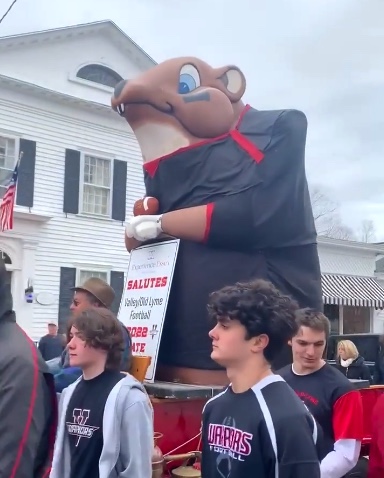
‘Essex Ed’ Honors Lyme-Old Lyme/Valley Regional Football Team

Members of the Valley Regional/Lyme-Old Lyme football team accompanied Essex Ed on his trip up Main Street in Essex last Sunday.

ESSEX, CT — The Essex Ed Parade was held last Sunday. Pots and pans, spoons, whistles and trumpets ‘played’ by parade-goers, many in festive groundhog gear, celebrated the larger-than-life-groundhog making his annual pilgrimage from Essex Boatworks on Ferry Street and up Main Street.

As always, Ed’s costume was a secret until his parade appearance. Each year a community organization dresses him in a costume that acknowledges a person, group or special occasion. That costume and organization will be revealed on the parade route to Ed’s final place of honor, at the roundabout on the top of Main Street. 

It turned out that this year Ed was honoring the Valley Regional/Lyme-Old Lyme Football Team, which reached the 2022 CIAC Class S State Final.

In 1978, Essex Ed was created out of boredom by local resident Mary Ellen Brophy and friends who wanted to interject some fun into what was an extremely cold and unpleasant winter. Without securing town approval, Brophy referred to Essex Ed’s surprise appearance at the Essex Square roundabout on Groundhog Day as “creative vandalism – a way to get everybody outside for some silly, winter fun.”   

Over the years, Ed has sported a wide range of disguises, ranging from an Olympic skier, complete with a gold medal touting “Gopher the Gold”, to Superhog, with a cape and Superwoman-style uniform. He/she’s been the Captain of the Titanic, Princess Leia, a football player, firefighter, fisherman, soldier, Beethoven, preppie, librarian, and even Elvis!

The local celebrity groundhog is featured in a new children’s book, Essex Ed’s Groundhog Day Parade (ISBN: 9798840622902), written by Essex resident Susan Cornell. This independently-published book is illustrated by award-winning artist Mina Hamanoto Mohtasham, an instructor at the Lyme Academy of Fine Arts in Old Lyme and Essex resident. 

Death Announced of Geraldine “Gerry” U. Foster, Formerly of Old Lyme; Celebration of Life in Old Saybrook, Jan. 29

Geraldine U. Foster, age 80, of North Branford, beloved wife of Johnnie D. Johnson, died January 18, 2023 at her residence. Mrs. Foster was born on May 25, 1942 in Wilkinsburg, PA the daughter of Adolph and Julia Bartolomucci …

She started her pharmaceutical career with Schering-Plough then retiring from Merck Pharmaceutical as a Senior Vice President of Public and Investor Relations …

Besides her husband Johnnie of 35 years, Gerry is survived by her step-daughter Judith M. Johnson and her husband Nigel J. Grainge of Morocco …

A Memorial Service will be held on Saturday, January 28, 2023 at 11am in Grassy Hill Church, 371 Grassy Hill Rd., Lyme, CT. Later a Celebration of Life will be held on Sunday, January 29, 2023 from 2-5pm in Swan Funeral Home, 1224 Boston Post Rd., Old Saybrook, CT 06475.

Please visit: www.swanfuneralhomeold saybrook.com for more service information and directions.

Visit this link to read the full obituary published by ‘New York Times’ on Jan. 24, 2023.

Legal News You Can Use: Safety Tips for Winter Driving

Editor’s Note: This is a Sponsored Post by Suisman Shapiro Attorneys-at-Law.

Snow may be pretty but driving in it demands special care and attention. Photo by Korey Moore on Unsplash.

Driving during winter months is inherently more dangerous than driving in other seasons because the road conditions can make an accident more likely. Some of this is also out of the control of motorists, who may have no choice but to drive in suboptimal conditions when they have to go to work or to school.

As such, it is important to know how to drive safely and avoid accidents. Here are some tips that can help.

Remember that you can’t always see ice

In some situations, it is very obvious that there is ice and snow on the road, so drivers are more likely to be careful. But you also have to watch out for black ice, which is a type of thin ice that is so clear that you can’t even see it while you’re driving. This is perhaps the most dangerous road condition in the winter.

Reduce your speed when possible

Slick road conditions are going to make it harder to react to conditions ahead of you because you cannot slow the car down as quickly. The best counter for this is simply to reduce your speed while you drive. This gives you a better chance of stopping and reduces the odds of serious injuries if you are involved in a wreck.

Focus on staying calm and in control

If you have to drive in poor conditions, always try to stay calm and remain in control of the vehicle, staying alert and keeping your eyes on the road. Never allow yourself to become distracted. Don’t rush, but focus on careful driving until you reach your destination.

If you do get injured in an accident caused by another driver, you may be able to seek financial compensation.

Editor’s Note: Suisman Shapiro is located at 75 State Street, New London, CT 06320. Their mailing address is 2 Union Plaza, P.O. Box 1591 New London, CT 06320. Visit their website or call 800-499-0145 — lines are open 24 hours a day.