Talking Transportation: Why I Support Malloy’s Plan for Tolls, Gas Taxes

Am I the only person in the state who thinks Gov Malloy’s plan for tolls and gas taxes makes sense?  Probably.  But let me try once again to overcome the usual objections and explain why Malloy’s plan is fair and necessary.

TOLLS ARE TAXES:
No, tolls are users fees.  Train fares aren’t taxes, are they?  If you don’t want to pay a few pennies a gallon more for gasoline, don’t drive.  Join us on the train and pay the highest commuter rail fares in the US.  There is no free ride.

I ALREADY PAY ENOUGH TAXES:
That may be your perception.  But in 1997 when legislators cut the sky-high gas taxes by 14 cents, why didn’t they tell us that would lose us $3.7 billion in needed transportation funding?  The bill has come due.

BUT I ALSO PAY A PROPERTY TAX ON MY CAR:
Sure, but it doesn’t go to fixing the roads.  That’s a town / city tax.  If you don’t like it, tell City Hall.

WE ALREADY HAVE THE HIGHEST GASOLINE TAXES:
Not so anymore.  Connecticut’s 39 cents per gallon tax is third highest in the Northeast, trailing Pennsylvania (59 cents) and New York (44 cents) and just ahead of New Jersey (37 cents).

THE ROADS SHOULD BE FREE:
And just where in the Constitution does it say that?  This isn’t the pioneer West:  we’re talking about I-95 and the Parkways!  Driving is not like going to an all-you-can-eat buffet.  Think of the new paradigm as an a la carte restaurant where you pay for what you eat.

TOLLS AREN’T SAFE:
Another myth since the days of the “fiery truck crash” in Milford in 1983.  Tolls don’t require barriers or booths anymore.  They’re electronic gantries over the highway reading your EZPass or license plate without slowing down.

TOLLS WILL DIVERT TRAFFIC TO LOCAL ROADS:
Maybe, for the first week.  Then people will decide if they want to waste time in traffic or pay a few cents to get where they’re going.

IF WE RAISE THE GAS TAX WHY DO WE NEED TOLLS?:
Because raising the gasoline tax can be done in weeks.  But tolls will take 2-4 years to install and by then upwards of half of all cars will be electric, paying no gas tax.  Why should a Tesla driver get a free ride?

OK, BUT JUST TOLL SOMEONE ELSE:
Sure, something like 34 percent of all traffic in Connecticut is from out-of-state.  But building tolls just at our borders is unconstitutional (and unfair).  We can offer a discount to Connecticut residents, but can’t charge those driving through our state while we pay nothing.

MALLOY STOLE MONEY FROM TRANSPORTATION:
True, money has been regularly “reapportioned” from the Special Transportation Fund for years, by Rowland and Rell as well as Malloy.  You’ll get the chance to stop that in November when there’s a referendum question on the ballot for a “lock box” on the STF.

THE REAL PROBLEM IS STATE EMPLOYEE UNION CONTRACTS:
That may be so, but the SEBAC contracts were just renegotiated and approved by the legislature, so how do we undo that before the STF goes belly-up next year?

I’VE HAD ENOUGH!  I’M LEAVING THE STATE:
Sorry to see you go.  But when you say goodbye, remember you’ll have to pay tolls to NY, MA or RI on your way out.

Posted with permission of Hearst CT Media

Jim Cameron

About the author: Jim Cameron is founder of The Commuter Action Group, and a member of the Darien RTM.  The opinions expressed in this column are only his own.  You can reach him at CommuterActionGroup@gmail.com

For a full collection of “Talking Transportation” columns, visit www.talkingtransportation.blogspot.com

Talking Transportation: “Getting There” Malloy’s Transportation Cuts

Fare hikes, rail service cuts and a freeze on transportation projects.  As he promised in December, Governor Malloy announced them all in January.  Rail commuters and highway drivers are justifiably outraged, but they should direct their anger not at the Governor or CDOT but at the legislature.

WHY NOW?
This funding crisis has been years in the making, exacerbated 20 years ago when lawmakers’ political pandering saw them lower the gasoline tax.  Coupled with better gas mileage and increased use of electric cars, the Special Transportation Fund (STF), which pays for our roads and rails has been running out of money.  By next year, it will be in deficit.

RAIDS ON THE STF:
His critics are quick to blame Malloy, correctly noting that he raided the STF for money to balance the state’s budget.  But so did Governors Rell and Rowland.  Blaming their past mistakes doesn’t answer the question of what we do now.

FARE HIKES:
Metro-North riders already pay the highest commuter rail fares in the US.  The proposed 10 percent hike in July, while unpopular, will be absorbed by commuters, who have no real choice in how to get to their jobs in NYC … assuming they don’t move.

PUBLIC HEARINGS:
Required by law 90 days before they go into effect, the public hearings on fare hikes will be cathartic but meaningless.  Think of them as political theater.  The CDOT will present the numbers, explain why the STF is running out of money and sit patiently as commuters yell and scream.  Then they will do what they must:  raise fares.

RAIL SERVICE CUTS:
Why is Malloy cutting off-peak weekday and all weekend service on the New Canaan, Danbury, Waterbury and Shore Line East lines?  Because, unlike the mainline, these lines are subsidized 100 percent by Connecticut, have lower ridership and are much more expensive to operate.

ECONOMIC IMPACT:
While higher fares are never popular, cuts in train service can be economically devastating.  Without daily trains, houses in communities like Wilton and Redding will be less desirable.  Property values will decrease, affecting local taxes.  Transit-oriented development dreams for communities in the Naugatuck Valley will be dashed.

FUTURE PROJECTS:
Not only is the Governor threatening fare hikes and service cuts, he’s freezing $4.3 billion worth of transportation projects across the state.  Forget about the new Stamford rail garage, Route 8 – I-84 “mixmaster” in Waterbury, the Barnum rail station in east Bridgeport, and hundreds of other projects.  There may even be a 15 perent staff cut at CDOT.  That means months or years of delays on these projects if and when money is ever found, making our state even less desirable for new business investment.

ROAD MAINTENANCE:
These cuts may even affect CDOT’s ability to plow our roads in the next blizzard, let alone fix the potholes and our aging bridges.

WHAT CAN BE DONE?:
It will be up the legislature to finally address STF funding.  None of the alternatives will be popular, especially in an election year.  But I’d expect tolls, taxes, and yes, fare hikes … all predicated on passage of a true STF “lock box” in November’s referendum.

If you’re as angry as I am, do something.  Call your state representative and senator and demand that they vote on new funding sources for the STF to stop these service cuts and project delays.  They created this problem.  Now they’ll have to solve it.

Posted with permission of Hearst CT Media

Jim Cameron

About the author: Jim Cameron is founder of The Commuter Action Group, and a member of the Darien RTM.  The opinions expressed in this column are only his own.  You can reach him at CommuterActionGroup@gmail.com

For a full collection of “Talking Transportation” columns, visit www.talkingtransportation.blogspot.com

Talking Transportation: Will the Real ID Act Disrupt Travel?

Something like 1.73 million Americans board airplanes ever day.  And each of them must go through a very necessary screening by the TSA, the Transportation Security Agency.  But beginning in late January 2018, a lot of passengers will be denied boarding because they don’t have the right kind of ID.

You can thank (or blame) the Real ID Act passed by Congress in 2005 after 9/11 to make sure people really are who they claim to be.  As any teen can tell you, it’s too easy to obtain a fake ID.  And if teens can do it, terrorists can also.

Because most people rely on their state driver’s license as ID, it’s been up to the states to gain compliance with the Federal rules.  A lot of those states are not in compliance, but Connecticut has passed the test, sort of.

If you’ve recently renewed your Connecticut license, you know you were given an option:  get a “regular” license or a “verified” ID.  To get a verified license you needed to bring extra proof to the DMV:  a US passport, birth certificate, original Social Security card, etc.

Look at your CT license and you’ll easily see the difference.  If yours has a gold star in the upper right corner, you’re verified.  No gold star, NOT verified … meaning that as of 2020 your license will NOT be enough ID to get you on an airplane.  That license clearly says “Not for Federal Identification.”  But for now, any CT driver’s license will get you past TSA.

Sure, you can always use your US Passport as ID.  It’s the gold standard and requires all kinds of identity proof to be issued.  But if you don’t have a passport and don’t have a gold star on your CT driver’s license, starting in 2020 you’ll have to start thinking about taking Amtrak or driving.

Only about 40 percent of all Americans have a passport.  Compare that to countries like Canada (60 percent) or the UK (70 percent).  Considering the fact that millions of Americans have never even been out of the country, why would they need one?  (PS: Isn’t it amazing how those same people always say the USA is #1 having no point of comparison?)

Leaving aside the paranoids who think that having a passport is an invasion of privacy because they are now embedded with RFID chips containing who-knows-what kind of information about you, we should all have a passport.  And getting one is pretty easy.

There are more than 8,000 Passport Offices in the US, most of them US Post Offices or libraries, which will process applications certain days each month.  But the main Passport Office for our state is in Stamford.  You can also file your application by mail, but only for renewals.  First time applicants must appear in person with all their documentation.

Mind you, US Passports are not cheap: $110 for first time applicants, plus $25 application fee.  Renewals are also $110 and “expedited” passports are an extra $60.

Turn-around time on your application can be anywhere from two to six weeks.  There are also private services that claim to be able to get you a new passport in one day, but they’ll cost you.

So the bad news is:  if you don’t have a passport already, may need one eventually.  The good news is, December is a great time to apply as it’s the Passport Office’s “slow season”, compared to the summer travel rush.  Happy traveling!

Posted with permission of Hearst CT Media

Editor’s Note: This is the opinion of Jim Cameron.

About the author: Former NBC News director and anchor, now a professional communications consultant, Jim Cameron, pictured left, leads workshops on media training, speech and presentations skills and preps clients for analyst briefings and legislative testimony. Jim served for 19 years on the CT Metro-North Rail Commuter Council, is an elected member of the Darien Representative Town Meeting (RTM) and is Program Director of Darien TV79, his town’s government TV station.

Talking Transportation: Who Should Pay for Sound Barriers?

Sound barriers … great idea, but who should pay for them?

Building and maintaining our highways is expensive.  But here’s a quiz question:  on interstates 95 and 84, what costs a half-million dollars a mile to construct?  The answer:  sound barriers.

Why are we spending that kind of money to enshroud our interstates simply to protect the peace and quiet of its neighbors?  Didn’t they know that living that close to a highway came with the twin costs of increased noise and air pollution along with the benefits of proximity to the highways?

Do you have sympathy for people who live near airports and then complain about the jets?  Neither do I.  But the solution to highway noise is not to create a walled canyon paid for by others.

Sound barriers, in my view, are a waste of precious resources.  They don’t reduce accidents, improve safety or do anything about congestion.  And they’re a magnet for graffiti artists.  Three miles of sound barriers on both sides of an interstate would buy another M8 railcar for Metro-North, taking 100 passengers out of their cars.

Worse yet, sound barriers really just reflect the sound, not absorb it, sending the noise further afield.  But there are alternatives:

1)     Why not sound-proof the homes?  That has worked well for neighbors of big airports and would be a lot cheaper than miles of sound barriers.  Plus, insulation against sound also insulates against energy loss, saving money.

2)    Rubberized asphalt.  Let’s reduce the highway noise at its source, literally where the “rubber meets the road”.  Using the latest in rubberized asphalt some highways have seen a 12 decibel reduction in noise.  And rubberized asphalt, as its name implies, is made from old tires … about 12 million a year that would otherwise be junked.

3)    Pay for it yourself.  Create special taxing zones in noisy neighborhoods and let those home owners pay for their sound barriers.  They’re the ones who are benefiting, so shouldn’t they be the ones who pay?  And that investment will easily be recouped in increased property values.

4)    Penalize the noise makers.  Let’s crack down on truckers who “Jake brake,” downshifting noisily to slow their speed instead of using their real brakes.  And motorcyclists or those cars with busted mufflers, they too should be penalized.

5)    Go electric.  Electric cars are virtually silent.  And there are electronic ways of using noise cancellation technology that, on a large scale, can induce quiet at a lower price than building wooden barricades.

6)    Go absorbent.  Where there is room, erect earthen berms alongside the highway which will absorb the sound.  Or if you are constructing sound barriers, fill them with sound absorbing material, treating the noise like a sponge, not bouncing it off a hard, flat reflective surface.

Our interstates, especially I-95, are carrying far more traffic than they were ever planned to handle.  And there is no sign of it decreasing.  In Fairfield County the rush hour starts about 6 a.m. and runs continuously until 8 p.m. without a break.

If our state’s economy depends on these highways, we will have to live with the karmic cost of a little noise.  But if it’s too much to take, why ask others to pay for its remediation when they are the only ones benefiting from that spending?

Republished with permission of Hearst CT Media.

Jim Cameron


About the author:
 Jim Cameron is founder of The Commuter Action Group, and a member of the Darien RTM.  The opinions expressed in this column are only his own.  You can reach him at CommuterActionGroup@gmail.com

For a full collection of “Talking Transportation” columns, visit www.talkingtransportation.blogspot.com

Talking Transportation: Why Metro-North’s ‘Quiet Cars’ Aren’t Quiet

What happens when a good idea goes bad?  Consider Metro-North’s ‘Quiet Car’ initiative.

Sixteen years ago a group of regular commuters on Amtrak’s early morning train to DC had an idea:  why not designate one car on the train as a ‘Quiet Car‘, free from cell phone chatter and loud conversations.  The railroad agreed and the experiment proved a great success.

Now all Amtrak trains in the Northeast Corridor have a ‘Quiet Car’.  They are a major selling point for taking the train … the chance to nap or read in a quiet environment.

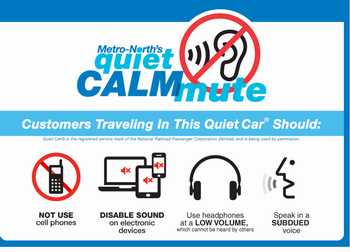
But as early as 2006 when I suggested the same idea to Metro-North, it was rejected outright.  Then serving on the CT Rail Commuter Council, I persisted and finally, in 2011 the railroad agreed to a trial with one car on each rush hour train dedicated to what it called a ‘Quiet CALMmute.’

Almost immediately the plan ran into trouble.  Not because it wasn’t wanted but because it wasn’t enforced.

There were no signs designating which were the ‘quiet’ cars and only occasional PA announcements before departure reminding folks who sat there of the quiet, library-like environment that was expected.  Most of all, many conductors refused to enforce the new rules.  But why?

Conductors seem to have no trouble reminding passengers to keep their feet off the seats, put luggage in the overhead racks or refrain from smoking.  But all that the railroad gave conductors to enforce the ‘Quiet Car’ rules were bilingual “Shhh cards” to give to gabby violators.

It seemed left to passengers to remind fellow riders what a ‘Quiet Car’ was for and confrontations resulted.

This spring the railroad surprised even me by announcing an expansion of the program:  every weekday train, peak and off-peak, would now have two ‘Quiet Cars’!  Two ‘Quiet Cars’ on a 10-car train gives everyone a choice.  That sounds great, but still without signage, education or enforcement, the battles continued.

A commuter recently emailed me about an evening train from Grand Central with a group of rowdy drunks in the ‘Quiet Car’.  When commuters asked the offending passengers to chill out or move their seat, the tipsy  group told the complainer, “screw you.”  The quiet-seeking commuters then asked the conductor for help but he simply declared the train was too crowded and the ‘Quiet Car’ was being eliminated on that run.  “Have fun” he told the drunks.  Really?

On Amtrak trains those violating Quiet Car rules have been thrown off the train and arrested.  Even NJ Governor Chris Christie had to move his seat on an Acela once for yabbering with his staff in the wrong car.

Nobody wants these kinds of altercations on Metro-North.  So why initiate and then expand such a passenger amenity as ‘Quiet CALMmute’ without proper education and enforcement?  A few signs and friendly reminders from conductors should make passengers aware that “train time may be your own time” (as the railroad’s old marketing slogan used to say), but it’s also shared time.

Commuters want ‘Quiet Cars.’  The railroad gave them to us, but until they can get their staff to enforce the rules, consistently, they might as well not exist.

If you’re in a ‘Quiet Car’ and the rules are not enforced, report it to Metro-North on their website complaint form.  If we all raise our voices, we can get some peace a quiet.

Republished with permission of Hearst CT Media.

Jim Cameron


About the author:
 Jim Cameron is founder of The Commuter Action Group, and a member of the Darien RTM.  The opinions expressed in this column are only his own.  You can reach him at CommuterActionGroup@gmail.com

For a full collection of “Talking Transportation” columns, visit www.talkingtransportation.blogspot.com