
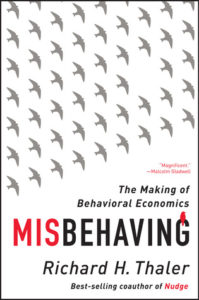
Reading Uncertainly? ‘Misbehaving: The Making of Behavioral Economics’ by Richard Thaler

This is the engaging story of the development and rise to practical significance of “behavioral economics,” the recognition that we “Humans” (as Professor Thaler calls us) are inevitably flawed in our dealing with finance and the market. It is also the personal biography of the author, along with many of the most important thinkers of the past 50 years.

The idea that our financial markets are “efficient,” as suggested by the “Econs,” the gurus we followed for many years, is destroyed by the realities of the human brain. First came Daniel Kahneman and Amos Tversky, who discovered our innate aversion to loss. Thaler notes that “ … losses hurt about twice as much as gains make you feel good,” noting, “Loss aversion has become the single-most powerful tool in the behavioral economist’s arsenal.”

But, Thaler also warns that, “… people who are threatened with big losses and have a chance to break even will be unusually willing to take risks, even if they are normally risk averse. Watch out!”

We need to be far more aware of the vagaries of the human mind when trying to guide ourselves and others toward the best balance of risk and reward: “The bottom line is that in many situations in which agents are making poor choices, the person who is misbehaving is often the principal, not the agent. The misbehavior is in failing to create an environment in which employees feel that they can take good risks and not be punished if the risks do not pay off.”

Unfortunately, we all tend to follow the herd: “It is better for reputation to fail conventionally than to succeed unconventionally.” Many years ago, IBM tried a better idea: it created a “Skunk Works” (from Al Capp’s L’il Abner cartoon) where employees with new and uncommon ideas could use corporate funds and help to work them out. If they succeeded, glory. If not, they could return, without blame, to their former employment.

Thaler’s sense of humor is always evident. Instead of watching our investment portfolios too closely, a uniformly bad habit, he suggests doing a crossword puzzle instead. He made a correct prediction about the collapse of the market in 2008: “Having made that one correct prediction, I am resolving not to make any more.”

And in American football, he urges teams to do the unexpected, such as “going for it” on fourth down. It changes the psychology on both sides echoing the, “And now for something completely different,” from Monty Python.

Thaler’s language is distinctly non-academic, a pleasure to read. He quotes Douglas Bernheim (2002): “As an economist, one cannot review the voluminous literature on taxation and saving without being somewhat humbled by the enormous difficulty of learning anything useful about even the most basic empirical questions.”

The last third of the book details the writing and reception of Nudge, the 2008 book he co-authored with Cass Sunstein. Their original title was “libertarian paternalism,” abbreviated, thank goodness, to “nudge,” the idea that we can encourage someone to do something that is in their best interests, by making it slightly easier.

At the end, Thaler asks “What Is Next?” He answers: “the only sensible prediction is to say what happens will surely surprise us.” Behavioral economics, the role of humans in what we do and how we live, is critical to both strategic and tactical planning.

And I did find a word I’ve never seen before: “corybantic.” It means frenzied, agitated, unrestrained: exactly how some human respond when their traditional beliefs and ideals are challenged.

Editor’s Note: ‘Misbehaving: The Making of Behavioral Economics’ by Richard Thaler is published by W. W. Norton & Co., New York 2015

Felix Kloman

About the Author: Felix Kloman is a sailor, rower, husband, father, grandfather, retired management consultant and, above all, a curious reader and writer. He’s explored how we as human beings and organizations respond to ever-present uncertainty in two books, ‘Mumpsimus Revisited’ (2005) and ‘The Fantods of Risk’ (2008). A 20-year-resident of Lyme, he now writes book reviews, mostly of non-fiction that explores our minds, our behavior, our politics and our history. But he does throw in a novel here and there. For more than 50 years, he’s put together the 17 syllables that comprise haiku, the traditional Japanese poetry, and now serves as the self-appointed “poet laureate” of Ashlawn Farms Coffee. His wife, Ann, is also a writer, but of mystery novels, all of which begin in a bubbling village in midcoast Maine, strangely reminiscent of the town she and her husband visit every summer.
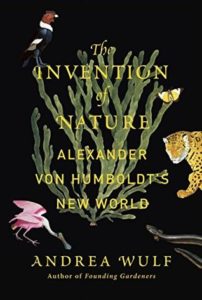
Reading Uncertainly? ‘The Invention of Nature’ by Andrea Wulf

the_invention_of_natureFor those who attended this year’s Florence Griswold Museum-sponsored Samuel Thorne Memorial Lecture, which took place on Nov. 12, this month’s book review will ring significant bells. Not entirely by coincidence, we venture, our esteemed reviewer, Felix Kloman of Lyme, selected ‘The Invention of Nature’ as his book of choice this month and its author — Andrea Wulf — was the speaker at this year’s lecture .
Who was Alexander von Humboldt, the subject of this engrossing new biography? I must admit I had only a fleeting memory of his name, but for many in the 1900s, he was acknowledged as a major icon of the previous century in science and philosophy. Humboldt was a well-born Prussian, and Wulf’s story of his life is one of an intensely curious man whose travels, meetings and writings influenced many of the key thinkers of those years.

Consider these names: Johan von Goethe, Friedrich Schiller, Simon Bolivar, Thomas Jefferson, Charles Darwin, John Muir, Henry David Thoreau, Ernest Haeckel, Joseph Banks, and George Perkins Marsh. This biography is an exultation of interconnections!

And connectivity was the theme of Humboldt’s life: “Everything seemed somehow connected – an (early) idea that would come to shape his thinking about the natural world for the rest of his life.” Nature, to him, was a “web of life and a global force … with plants and animals dependent on each other.” This “urge to understand nature, globally, as a network of forces and interrelationships” generated “ferocious activity” for his entire life.

It began with his remarkable initial expedition to South America, including a climb to the top of Chimborazo, an inactive volcano in what is now Ecuador, a search for a link to the Amazon River, then walking in Mexico and Cuba, and, finally, a visit to President Thomas Jefferson in Washington. As a note on those times, it took Humboldt and his fellow traveler three and a half days to move from Philadelphia to the capital city.

While he yearned to travel again to South America, and then to Asia, and Africa, his shortage of funds allowed him only one other extensive tour, from Prussia to Russia and its border with China. But he never lost his curiosity, even while writing his journals, publishing a later masterpiece of his thinking, Cosmos, and forever trading correspondence and ideas with everyone he had met.

Wulf writes “comparison not discovery was his guiding theme,” and Humboldt issued an early warning of three ways in which the human species adversely affected the climate, based on his travels: deforestation, “ruthless irrigation,” and the “great masses of steam and gas produced in the industrial countries.” Almost two centuries later, we still have not learned …

Charles Darwin and Humboldt had frequent communication, in person and through letters. They shared, according to the author, a “flexibility perspective … telescopic and microscopic, sweepingly panoramic and down to the cellular levels, and moving in times from the distant geological past to the future economy of native populations.”

Humboldt was an outspoken critic of colonialism and slavery, but he had to be cautious as he remained under the financial support of Prussian royalty. Those years featured the turmoil of revolutions, as Europe and the Americas shifted from absolute despotisms to emerging democracies, and often back again.

Wulf’s entrancing biography is reading history through the vision of one extraordinary man who saw “harmony in diversity.” Would that we had listened more closely to his words …

Editor’s Note: ‘The Invention of Nature’ by Andrea Wulf is published by Alfred A. Knopf, New York 2015

Felix Kloman_headshot_2005_284x331-150x150About the Author: Felix Kloman is a sailor, rower, husband, father, grandfather, retired management consultant and, above all, a curious reader and writer. He’s explored how we as human beings and organizations respond to ever-present uncertainty in two books, ‘Mumpsimus Revisited’ (2005) and ‘The Fantods of Risk’ (2008). A 20-year resident of Lyme, he now writes book reviews, mostly of non-fiction that explores our minds, our behavior, our politics and our history. But he does throw in a novel here and there. For more than 50 years, he’s put together the 17 syllables that comprise haiku, the traditional Japanese poetry, and now serves as the self-appointed “poet laureate” of Ashlawn Farms Coffee. His wife, Ann, is also a writer, but of mystery novels, all of which begin in a bubbling village in midcoast Maine, strangely reminiscent of the town she and her husband visit every summer.
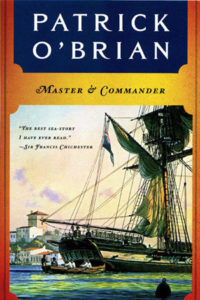
Reading Uncertainly? ‘Master and Commander’ by Patrick O’Brian

mastercommanderWhy is it that a fourth re-reading of this magnificent story of the Napoleonic Wars seems even more delicious than the first time around? There are 21 novels in this series and I’ve embarked on another voyage. “I give you joy,” as these sailors say to each other.

From listening to Locatelli’s C major quartet, that almost causes a duel, to the concluding words of acquittal in a naval court martial, we live life at sea with Jack Aubrey, the naval commander, but not quite yet a “Captain,” and the polymath physician and spy Stephen Maturin, an Irish-Catalan.

O’Brian uses a rich language that drives you to the dictionary. Ships and boats: frigate, ship-of-the line, sloop, long-boat, cutter, gig, jolly-boat, felucca, tartan, xebec, poluccas houario, barca-longa, bean-cod, cat, and herring-bus. Birds: upupa, epop (or hoopoe), ibis, mareotic grallatore. A flower: dianthus perfragans. An ant: tapinoma erraticum. Of an acquaintance, Maturin says: “I would not call him a gremial friend” (from the Latin, not a “close” friend).

And humor: a Frenchman sailed slowly “no doubt for fear of tripping over the lines of longitude.” Jack Aubrey trying to sound literate: “Alas, poor Borwick.” His sloop “the Sophie reeked of grilled sardines and fresh paint.” The sun shone “with idiot good humor.”

Or the two page delightful description of Maturin watching the mating of two praying mantises, the female then devouring the head and thorax of the male as the male ‘copulated on!” His conclusion: “You do not need a head, nor even a heart, to be all a female can require.”

On the word “death” in the English Articles of War, to be regularly read to the ship’s crew: “ . . . death had a fine, comminatory Leviticus ring, and the crew took a grave (my italics!) pleasure in it all. . . . “ I can hear O’Brian chuckling as he wrote that line.

Jack Aubrey is always urging speed: “There is not a minute to lose.” He repeats this counsel more than six times in this novel (and it is repeated in all the rest!)

And here is Maturin’s take on the human condition: “It seems to me that the greater mass of confusion and distress must arise from these less evident divergencies – the moral law, the civil, military, common laws, the code of honour, custom, the rules of practical life, of civility, of amorous conversation, gallantry, to say nothing of Christianity for those who practise it. All sometimes, indeed generally, at variance; none ever in an entirely harmonious relation to the rest; and a man is perpetually required to choose one rather than another perhaps (in his particular case) its contrary. It is as though our strings were each tuned according to a completely separate system – it is as though the poor ass were surrounded by four and twenty mangers.”

To which Jack Aubrey commented: “You are an antinomian.”

And Stephen Maturin replied: “I am a pragmatist.” A perfect description of the chaos two centuries later!

Finally, the author tossed a delightful tidbit my way, when Jack Aubrey said “ . . . how happy, felix, you would make me.” Yes, this Felix is basking in the delight of O’Brian’s words, looking forward to his fourth re-read of the remaining twenty novels.

Editor’s Note: ‘Master and Commander’ by Patrick O’Brian,  is published by W. W. Norton & Co., New York 1990 (first published in UK 1970.)

Felix Kloman_headshot_2005_284x331-150x150About the Author: Felix Kloman is a sailor, rower, husband, father, grandfather, retired management consultant and, above all, a curious reader and writer. He’s explored how we as human beings and organizations respond to ever-present uncertainty in two books, ‘Mumpsimus Revisited’ (2005) and ‘The Fantods of Risk’ (2008). A 20-year resident of Lyme, he now writes book reviews, mostly of non-fiction that explores our minds, our behavior, our politics and our history. But he does throw in a novel here and there. For more than 50 years, he’s put together the 17 syllables that comprise haiku, the traditional Japanese poetry, and now serves as the self-appointed “poet laureate” of Ashlawn Farms Coffee, where he may be seen on Friday mornings. His wife, Ann, is also a writer, but of mystery novels, all of which begin in a bubbling village in midcoast Maine, strangely reminiscent of the town she and her husband visit every summer.

Reading Uncertainly? ‘Lafayette in the “Somewhat” United States’ by Sarah Vowell

lafayette-in-the-somewhat-united-statesThis quote describes Sarah Vowell’s new interpretation of our history: “… I like to use whatever is lying around to paint pictures of the past …”
The Marquis de Lafayette just happens to be her tool in this decidedly non-academic, irreverent, and often sarcastic interpretation of the effect that a rich 19-year-old French aristocrat had on our so-called “Revolution.”

Her prose is idiomatic, unpretentious, and humorous – two jokes a page! She sees our colonists as “state-sponsored terrorists, with French financial backing.” The Americans? “A squirming polygon of civilians, politicians and armed forces begging to differ.”

And she concludes: “That, to me, is the quintessential experience of living in the United States: constantly worrying whether or not the country is about to fall apart.”

Is it true that Justice Scalia read this book just before he died of apoplexy?

Ms. Vowell traces the rush of a young man from Paris to these shores, whose persuasive words and evident riches made him a general in the revolutionary forces, a youngster who rushed into battles with little experience and who contributed to the “patriot soap opera” that was our revolutionary period.

This is the seamy, seedy, and often-hilarious underside of “the ironically named ‘United’ States” and their Revolution, one that Ms. Vowell calls “FUBAR!” (I had to look that one up in Google: it means “f—ed up beyond all recognition”).

Hers is a re-interpretation of our past, richly intermixed with her current opinions.

For example:  “To establish such a forthright dream of decency, who wouldn’t sign up to shoot at a few thousand Englishmen, just as long as Mr. Bean wasn’t among them? Alas, from my end of history there’s a big file cabinet blocking the view of the sweet-natured republic Lafayette foretold, and it’s where the guvment (sic) keeps the folders full of Indian treaties, the Chinese Exclusion Act, and NSA-monitored electronic messages pertinent to national security, which is apparently all of them, including the one in which I ask my mom for advice on how to get a red Sharpie stain out of couch upholstery.”

She manages to get in asides on everything: Chris Christie’s “Bridgegate” at Fort Lee (the town was named during the Revolution) and “… it must quiet the mind of Bruce Willis that even though his fellow Americans never nominated him for an Oscar, the French awarded him the Legion d’Honneur.” Another one on General Washington, who was six feet four inches tall: “Still it does get on my nerves how easy it is for tall people to make a good first impression.”

Why did the French want to support us? They had just recently been tossed out of Canada, retaining only the island of St. Pierre and Miquelon (they are still part of France …) and leaving a taste of language in Quebec. So why not send some young aristocrats to these shores, along with a few troops and some naval vessels? They agreed with many of the colonists that the Brits were “pig-headed Anglo-Saxon islanders.”

Yet this historical perambulation is an animated read. No chapter breaks, so it becomes a continuous ramble through early American history using the author’s distinctly tinted glasses. Michiko Kakutani in the New York Times called it a “cutesy-pie book.” Perhaps she is right, but its melange of historical and personal tidbits, from past and present, make it a fun trip.

Editor’s Note: ‘Lafayette in the “Somewhat” United States’ by Sarah Vowell is published by Riverhead Books, New York 2015.

Felix Kloman_headshot_2005_284x331-150x150About the Author: Felix Kloman is a sailor, rower, husband, father, grandfather, retired management consultant and, above all, a curious reader and writer. He’s explored how we as human beings and organizations respond to ever-present uncertainty in two books, ‘Mumpsimus Revisited’ (2005) and ‘The Fantods of Risk’ (2008). A 20-year resident of Lyme, he now writes book reviews, mostly of non-fiction that explores our minds, our behavior, our politics and our history. But he does throw in a novel here and there. For more than 50 years, he’s put together the 17 syllables that comprise haiku, the traditional Japanese poetry, and now serves as the self-appointed “poet laureate” of Ashlawn Farms Coffee, where he may be seen on Friday mornings. His wife, Ann, is also a writer, but of mystery novels, all of which begin in a bubbling village in midcoast Maine, strangely reminiscent of the town she and her husband visit every summer.

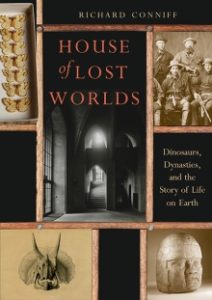
Reading Uncertainly? ‘House of Lost Worlds’ by Richard Conniff (of Old Lyme)

House_of_Lost_WorldsFor this month, a local author! Richard Conniff is a science writer, a contributor to The New York Times, and a resident of Old Lyme. He’s also a graduate of Yale University, one reason for his interest in the Yale Peabody Museum of Natural History, which is now celebrating its first 150 years.

It is the story of a museum and its directors, explorers, paleontologists, ecologists, anthropologists, biologists, ornithologists, primatologists, plus a few reactionaries and, of course, 14 million specimens. It is also the story of large egos listening to “the mute cries of ages impossible to contemplate”(some 50 million years).

He explores five themes: (1) a teaching dream of leaders at the start (George Peabody, the original donor, for whom “education was (his) Rosebud”), (2) the “grandiose personality” of O. C Marsh, its first director, (3) the demolition and movement of the original building in 1905 and its effects, (4) the rise of anthropology and ecology as sciences, and (5) the invitation to go see for yourself.

So how should we pronounce the name: “Pee-body” as Yalies and the donor said it, or “Pee-buh- de” as denizens of Cambridge slur the word?

The egos predominate, highlighting the single-mindedness and secrecy of many collectors.  Hiram Bingham, the sleuth of Machu Picchu, the “lost” Incan city, was one of the most notable. As the author notes, “if paleontologists were as aggressive as brontosauri they would have eaten each other.” In many respects they did: “Maybe academic life merely gives its verbally inclined thinkers the freedom to brood about it for too long, speak it too loudly, and pursue vengeance with wrath-of-God vigor.” They make this history continually exciting and amusing.

The Peabody Museum has expanded into a teaching, research, and study institution, whose practitioners take isolated pieces from the past (human, animal, mineral) to create a logical “story” to help guide us toward the future. But today they face modern visitors, “jaded and smartphone-addled, (who) expect special effects and instantaneous answers almost everywhere.”

In 1866, when the Peabody was created, there was no sign of a “Sixth Extinction” (now forecast by Elizabeth Kolbert), no “climate change,” only 32 million people in these United States (versus 320 million today), and only 1 billion on this earth (now 7.4 billion.)  Can the interest in and funding for museums like the Peabody, their teaching and research, help us alter our behavior for a more favorable future?

Like Alice, I am “curiouser and curiouser,” so I am off to the corner of Whitney Avenue and Sachem Street in New Haven to explore for myself …

Editor’s Note: House of Lost Worlds by Richard Conniff is published by Yale Univ. Press, New Haven 2016.

Felix Kloman_headshot_2005_284x331-150x150About the Author: Felix Kloman is a sailor, rower, husband, father, grandfather, retired management consultant and, above all, a curious reader and writer. He’s explored how we as human beings and organizations respond to ever-present uncertainty in two books, ‘Mumpsimus Revisited’ (2005) and ‘The Fantods of Risk’ (2008). A 20-year resident of Lyme, he now writes book reviews, mostly of non-fiction that explores our minds, our behavior, our politics and our history. But he does throw in a novel here and there. For more than 50 years, he’s put together the 17 syllables that comprise haiku, the traditional Japanese poetry, and now serves as the self-appointed “poet laureate” of Ashlawn Farms Coffee, where he may be seen on Friday mornings. His wife, Ann, is also a writer, but of mystery novels, all of which begin in a bubbling village in midcoast Maine, strangely reminiscent of the town she and her husband visit every summer.