Reading Uncertainly? ‘The Tide’ by Hugh Aldersey-Williams

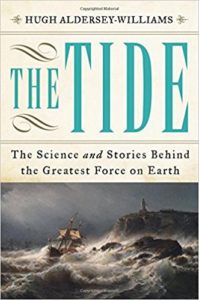
A present from a New Hampshire daughter, The Tide is a delightful, entertaining, and thought-provoking mix of lucid, often poetic, language with numerous literary quotations plus detailed scientific explanations of the tides that embellish our lives on this earth. It is Aldersey-Williams’s thought-experiment.

It is also his history of the oceanic tides, mixed with a bit of mathematics. But not more than you can handle. As he notes, “You may be relieved to know that I will leave the mathematics aside here.” And, given that many tell us the world’s tides are soon to be much higher, this is a most worthwhile book.

It is, as he states, “not a book about the sea” (sailors, ships, and winds), but rather a book “about the seas” and the ever-changing space between land and water. The tide, he explains, “offers an irresistible mathematical tease” as we attempt to understand and predict it. It is both a horizontal and a vertical force. That is a “scientific challenge” and “a physical; and psychological influence on our culture.” The classic story of King Canute’s (or Cnut, as the author spells it) attempt to stem the tide may have altered the English view of nobility.

This is the author’s story of watching tides around the world, from the English Channel to, of all places, Griswold Point on the Connecticut River, with a cousin, David Redfield. Tides are entrancing: they give us slow, relative motion that produces a “hallucinatory feeling.” Water is, after all, “an inelastic fluid (that) cannot be compressed or expanded.” I too have been mesmerized: by the 10-foot tides in Tenants Harbor, Maine; by the rising waters in Bosham, West Sussex, England, that regularly swamp cars in the local bar’s parking lot; and by the rushing tidal currents in the Straits of Shimonoseki, between Honshu and Kyushu, Japan, through which we once sent our Navy ship (at slack water, of course!)

He acknowledges the inevitability of climate change and global warming, and the fact they will lead to rising seas: “The greatest impact of rising sea levels and the changing tides that may accompany them will be on human habitation.” After all, we easily succumb to the human drive to cling to shores. “In the long term, if not the short, ‘managed retreat’ is our only option. The sea always wins in the end.”

Trying to ‘stop the sea? “It is a futility that Sisyphus would understand all too well.” So New York is a potential Venice … and New London too!

But do not be deterred by such pessimism. The Tide is full of rich, poetic language, as in this description of birds above the sea: “Once aloft, the birds first coalesce as an egg-shaped cloud low over the water, before gaining height and taking on ever more extravagant, twisted shapes like a pixelated flamenco dancer.”

It is enough to send me down to the end of Ely’s Ferry Road to watch the Connecticut River slip by the marshes of Essex.

Editor’s Note: ‘The Tide’ by Hugh Aldersey-Williams was published by W. W. Norton, New York 2016.

Felix Kloman

About the Author: Felix Kloman is a sailor, rower, husband, father, grandfather, retired management consultant and, above all, a curious reader and writer. He’s explored how we as human beings and organizations respond to ever-present uncertainty in two books, ‘Mumpsimus Revisited’ (2005) and ‘The Fantods of Risk’ (2008). A 20-year resident of Lyme, he now writes book reviews, mostly of non-fiction that explores our minds, our behavior, our politics and our history. But he does throw in a novel here and there. For more than 50 years, he’s put together the 17 syllables that comprise haiku, the traditional Japanese poetry, and now serves as the self-appointed “poet laureate” of Ashlawn Farms Coffee, where he may be seen on Friday mornings. His wife, Ann, is also a writer, but of mystery novels, all of which begin in a bubbling village in midcoast Maine, strangely reminiscent of the town she and her husband visit every summer.
Reading Uncertainly? ‘Being Mortal’ by Atul Gawande

Here is a challenge and a question.

The challenge: “Our decision-making in medicine has failed so spectacularly that we have reached the point of actively inflicting harm on patients rather than confronting the subject of mortality.”

The question: Can the medical profession change from its former “priestly doctor-knows-best” and its current “informative” models to a more jointly-responsible “interpretive” model in which patients and physicians work together to mold priorities and decisions?

Atul Gawande, a professor at Harvard Medical School and one of the most thoughtful and articulate observers of the medical scene today (frequently in The New Yorker), asks us to “ … confront the realities of decline and mortality,” not with fear but with intelligence and realism. Too often “the waning days of our lives are given over to treatments that addle our brains and sap our bodies for a sliver’s chance of benefit.”

It has not always been that way. In the past “elders were cared for in multi-generational systems” when we died much sooner and faster, but now we must endure multiple failures in our bodies during “long retirements. … We are already oddities living well beyond our appointed time.” Institutionalization means loss of privacy and control, too many medications whose combined effects we don’t understand, and too much passive entertainment. Even the advent of the much-heralded “assisted living” mechanism has been watered down and often corrupted.

Gawande proposes a future in which “geriatrics” will be taught to all physicians who, in turn, will discuss options with us realistically. For example, his illustration is the simple use of living plants, birds, dogs, and cats, plus smaller groupings of the aged to reduce “the plagues of nursing home existence: boredom, loneliness, and helplessness,” so that we can “renew the joy of life.”

But the good doctor seems to equivocate when it comes to the idea of “death with dignity,” or the option of physician-assisted suicide, now permissible to some degree in five states in the U. S. and in The Netherlands. “I am leery of the idea that endings are controllable,” he writes. Must we insist, legally, on palliative care for the terminally ill? Don’t we/they have an inherent right to select our own course of action, not only for terminal physical illnesses where courses of painful (and costly) procedures may give us only a few extra months, but also for forecasts of mental deterioration, such as dementia and Alzheimer’s?

An inability or unwillingness to take our own early action when capable may create enormous costs (mental and financial) to all of us. I am an advocate of considering options early enough, working with our physicians, but retaining the right to final decisions, including death.

(Read, for example, Derek Humphry”s Final Exit, Random House, New York 2002)

Doctor Gawande’s goal makes eminent sense, “The battle of being mortal is the battle to maintain the integrity of one’s life – to avoid becoming so diminished or dissipated or subjugated that who you are becomes disconnected from who you were or who you want to be.”

Editor’s Note: ‘Being Mortal’ by Atul Gawande is published by Henry Holt and Co., New York 2014.

Felix Kloman

About the Author: Felix Kloman is a sailor, rower, husband, father, grandfather, retired management consultant and, above all, a curious reader and writer. He’s explored how we as human beings and organizations respond to ever-present uncertainty in two books, ‘Mumpsimus Revisited’ (2005) and ‘The Fantods of Risk’ (2008). A 20-year resident of Lyme, he now writes book reviews, mostly of non-fiction that explores our minds, our behavior, our politics and our history. But he does throw in a novel here and there. For more than 50 years, he’s put together the 17 syllables that comprise haiku, the traditional Japanese poetry, and now serves as the self-appointed “poet laureate” of Ashlawn Farms Coffee, where he may be seen on Friday mornings. His wife, Ann, is also a writer, but of mystery novels, all of which begin in a bubbling village in midcoast Maine, strangely reminiscent of the town she and her husband visit every summer.

Reading Uncertainly: Chaos Monkeys: ‘Obscene Fortune and Random Failure in Silicon Valley, by Antonio Garcia Martinez

Let’s face it, we are all, every one of us, irrevocably married to this new and all-pervasive technology. We are computers and they are us. So isn’t it time that we learn something more about its source?
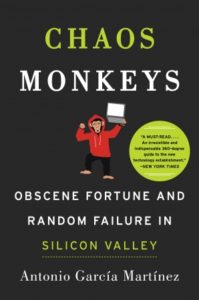
Antonio Garcia Martinez takes us on a four-year, inside-tour of Silicon Valley and San Francisco, an autobiography of life in the Valley: long-winded, discursive, sarcastic, cynical, opinionated, and always hilarious.

Martinez, an admitted “gleeful contrarian,” presents fascinating characters with enormous egos, from Zuck (Mark Zuckerberg), Sheryl (Sandberg), and Gokul (Gokul Rajaram); from start-ups to abrupt shutdowns; along with the organizations that shaped his life: University of California-Berkeley, Goldman Sachs, AdCharm, AdGrok, Facebook, Twitter, and, at last, Ayala, a cutter at anchor at Orcas Island in Puget Sound, prior to her escape into the Pacific Ocean. And people as well — since he is also a human being — including several female partners and two young children.

So exactly what is this “Valley?”

“It’s a society,” the author explains, “in which all men and women live in their own self-contained bubble, unattached to traditional anchors like family or religion, and largely unperturbed by outside social forces like income inequality or the Syrian Civil War.

‘Take it light, man’ elevated to life philosophy. Ultimately, the Valley attitude is an empowered anomie turbo-charged by selfishness, respecting some nominal ‘feel-good’ principals of progress or collective technological striving, but in truth pursuing a continual self-development refracted through the capitalist prism: hippies with a capitalization table and a vesting schedule.”

Wow!

His characters display both greed and credibility: they “ … spend their lives in a blizzard of meetings interspersed with email breaks.”

And what are the “chaos monkeys” of his title? They are the “software tools to test a product or a website’s resilience against random serve failures.” Beware the system!

Yet Martinez sees this mélange as being composed of human beings after all, noting, “The tech start-up scene for all its pretensions of transparency, principled innovation, and a counter-culture renouncement of pressed shirts and staid social convention, is actually a surprisingly reactionary crowd.” It is one “wired on caffeine, fear, and greed at all times.” And Facebook, Twitter, and Google have become “all-consuming new” religions. Technology is the Soma of our time.

Despite this cynicism, Martinez cannot help but admire Mark Zuckerberg: “I submit he was an old-school genius, the fiery force of nature possessed by a tutelary spirit of seemingly supernatural provenance that fuels and guides him, intoxicates his circle, and compels his retinue to be great as well …  The keeper of a messianic vision that, though mercurial and stinting on specifics, presents an overwhelming and all-consuming picture of a new and different world … the church of a new religion.”

The author suggests we consider similar leaders in history: Jefferson, Napoleon, Alexander, Joseph Smith, Jim Jones, and L. Ron Hubbard. The leaders and followers in the Valley are simply part of that natural human urge to believe and to be part of something bigger than oneself.

But the Martinez story doesn’t fade into a glowing future. Following Robert Frost’s admonition, the author in early 2016 concludes “a man occasionally reaches a fork in life’s road.”

His last sentence predicts a completely different future: “Thus do I bow off this stumbled-upon stage, hopefully forever, and disappear into the heaving swells of the Pacific Ocean, the only such sanctuary from social mediation we’ll soon have left.”

Sail on, skipper! I give you joy of your decision.

Editor’s Note: ‘Chaos Monkeys: Obscene Fortune and Random Failure in Silicon Valley’ by Antonio Garcia Martinez, is published by HarperCollins, New York 2016.

Felix Kloman

About the Author: Felix Kloman is a sailor, rower, husband, father, grandfather, retired management consultant and, above all, a curious reader and writer. He’s explored how we as human beings and organizations respond to ever-present uncertainty in two books, ‘Mumpsimus Revisited’ (2005) and ‘The Fantods of Risk’ (2008). A 20-year resident of Lyme, he now writes book reviews, mostly of non-fiction that explores our minds, our behavior, our politics and our history. But he does throw in a novel here and there. For more than 50 years, he’s put together the 17 syllables that comprise haiku, the traditional Japanese poetry, and now serves as the self-appointed “poet laureate” of Ashlawn Farms Coffee, where he may be seen on Friday mornings. His wife, Ann, is also a writer, but of mystery novels, all of which begin in a bubbling village in midcoast Maine, strangely reminiscent of the town she and her husband visit every summer.

Reading Uncertainly? ‘Notes From Old Lyme: Life on the Marsh and Other Essays’ by Sydney M. Williams

Another neighbor turns to words, to look at where and how we live.
Sydney Williams, formerly of Smith’s Neck in Old Lyme and now of Essex, gives us an engaging and thoughtful autobiography and personal peregrination, in fits and starts (brief essays), leading us from Madison, CT and Peterborough, NH, to Massachusetts, New Hampshire again, the U.S. Army, Greenwich, CT, New York City and on to Old Lyme, with side excursions to California, Colorado and Austria.

It is, as he calls it, “a memory of mindfulness” stimulated by “time to think,” a great asset of old age!

Williams is ever humorous and self-effacing as he draws us into his history using “The Great Outdoors,” “The World at Large,” “Books” (he is a voracious reader and quoter), and “Family and Friends.”

His analogies pop up on almost every page. A marsh is a “cacophony” of sight and sound, creatures and vegetation. The sea “as calm as a toad in the sun.” That one reminds me of a recent haiku of my own:

October Reverie
Glistening green toad,
Snoozing on the hot tarmac:
Sound of tires ahead?

Often a subtle jab: “On occasion we have caught sight of weasels, which, while common in Washington, are rarely seen in our marsh.”

He apologizes for his longest essay (11 pages) of political musings in which he bemoans the excessive partisanship and incivility in today’s governmental climate, the “fiction” of representative government (he suggests term limits on all elected offices, especially those in Washington), and stresses “the importance of  confronting differing opinions” with reason, candor, and civility. We live, he suggests, in “a world marked with uncertainty.”

Sydney Williams’s essays also stimulate personal reflections: I too have experienced education in New Hampshire (Concord vs. Durham), working the the bowels of New York City (I lasted but three years!), skiing at Vail, climbing Marin County’s Mt. Tamalpais, summers on the Jersey Shore (Mantoloking vs. Rumson), and residences in western and eastern Connecticut (Rowayton vs. Greenwich). But the most remarkable coincidence is that of rowing: Williams describes his paddling a single scull on the Lieutenant River, while I have rowed Hamburg Cove, the Connecticut River, Selden Creek, and Rogers Lake. He describes his rowing as being “almost Zen-like.” My car’s bumper sticker describes it as “kinetic meditation.”

He also refers to Yale’s Peabody Museum of Natural History, the subject of another Old Lyme writer, Richard Conniff, a review of whose House of Lost Worlds appeared on LymeLine.com on Aug. 22, 2016.

Read on, neighbors, and do check out Sydney Williams’s blog: www.swtotd@blogspot.om for his weekly observations.

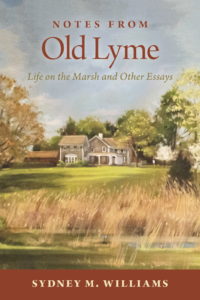
Editor’s Note: ‘Notes, From Old Lyme: Life on the Marsh and Other Essays’ by Sydney M. Williams is published by Bauhan Publishing, Peterborough, NH 2016.

Felix Kloman

About the Author: Felix Kloman is a sailor, rower, husband, father, grandfather, retired management consultant and, above all, a curious reader and writer. He’s explored how we as human beings and organizations respond to ever-present uncertainty in two books, ‘Mumpsimus Revisited’ (2005) and ‘The Fantods of Risk’ (2008). A 20-year resident of Lyme, he now writes book reviews, mostly of non-fiction that explores our minds, our behavior, our politics and our history. But he does throw in a novel here and there. For more than 50 years, he’s put together the 17 syllables that comprise haiku, the traditional Japanese poetry, and now serves as the self-appointed “poet laureate” of Ashlawn Farms Coffee, where he may be seen on Friday mornings. His wife, Ann, is also a writer, but of mystery novels, all of which begin in a bubbling village in midcoast Maine, strangely reminiscent of the town she and her husband visit every summer.

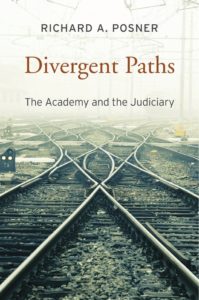
Reading Uncertainly? ‘Divergent Paths – The Academy and the Judiciary’ by Richard A. Posner

Judge and Professor Posner explores the apparent diverging paths of our judiciary, especially the Federal, from the academies that teach our would-be lawyers, some of them advancing to become judges. This is a sobering view. Forgive me for an extensive quote, but it summarizes in one page the 400 pages of his thesis:

“ . . . at this writing the United States exhibits an unprecedented array of failed social systems. The political system is in disarray – Congress is a mess, the executive branch poorly managed. The Supreme Court bears some of the responsibility for congressional malfunction because of its refusal to allow reasonable limitations on campaign expenditures and its refusal to outlaw, as a denial of equal protection of the laws, political gerrymandering.

Likewise in disarray is the medical industry (as in matters of cost and coverage, preventive medicine, and the care of the elderly and the poor); also education (other than in the elite private and public high schools and the elite colleges and universities), public pensions, immigration, federal taxation, and the nation’s transportation infrastructure.

Our prison systems and our criminal laws (especially sentencing) are an international disgrace, and the judges, including federal judges, are complicit. A number of state and local governments are seriously underfinanced. Our foreign and national security policies are pervaded by a degree of indecision unseen since the 1930s. Although admired by most Americans, our armed forces are plagued by serious cost, competence, and leadership problems.

Economic inequality has reached a dangerous level. There are too many guns in private hands. Conflict between religious and secular views on issues of public policy such as abortion, contraception, same-sex marriage, and the teaching of evolution is increasingly bitter. The government cannot get a handle on global warming or environmental regulation generally.

There are sectional tensions, racial and ethnic tensions along with sexual and religious ones, regulatory failures everywhere, bureaucratic incompetence, widespread corruption and fraud both public and private, and a weakening of family structure as reflected in the greatly increased prevalence of single-parent households. One can hardly expect the federal judiciary to be completely immune from so pervasive a national malaise, and it isn’t.

And this analysis was written before the death of Justice Scalia and the election of the loud-mouthed, newly elected president.

Is there any hope for us?

But there is!

From what he calls this gallimaufry (a confused jumble of things), Judge Posner extracts, first, notable deficiencies in our judicial system, followed later by his numerous suggestions for change. He is not an “originalist,” one who puts his faith entirely in earlier mandates such as our Constitution. “As society changes, so must the law,” is his thesis. He also acknowledges his own missteps: “Very wrong was I!” and “I don’t have a solution to this problem.”

At the end of Chapter 6, he summarizes his 55 “problems” and 48 reasonable and doable “solutions.” Best yet is his quote from Oliver Wendell Holmes: “certitude is not the test of certainty. We have been cocksure of many things that were not so  …  And this again means skepticism.” With this admonition in mind, Posner gives us a note of optimism.

Posner attributes much of our judicial problem to the “adversarial” nature of our system, in which lawyers tee off against one another in the courtroom, with judges as observers. He prefers the European “inquisitorial” approach, not in the sense of the Spanish Inquisition, but rather in the sense of judges acting as questioners and researchers, a third voice in the hearings.

He optimistically sees “the law” as a fluid, evolving instrument that “does not have a solid foundation. It is ultimately a collection of rules and procedures, highly malleable, often antiquated, often contestable, often internally conflicted, for managing social conflict – a set of aging, blunt tools.” Both we and the law can and should evolve. That is why we have judges, to help in interpretation.

But I do have a minor qualm with his writing. About halfway through his argument, he suggests a “good judicial opinion requires:

  1. No jargon.
  2. No footnotes.
  3. Forget citation form.
  4. Delete every superfluous word.
  5. Use adverbs and adjectives sparingly.
  6. Avoid section headings.
  7. Be grammatical.
  8. Brevity.
  9. Be candid as well as truthful.”

These are excellent admonitions, straight from Strunk and White’s Elements of Style. But Posner often fails to follow his own advice! Take footnotes, for example. In the 403 pages of his exegesis, he gives us 453 (!) footnotes, one of which is more than a page long. They are useful, perhaps, to legal minds, but to the uninitiated?

He frequently utilizes the word “utilization” instead of the simpler “use.” And he is the archbishop of parenthetical phrases, often inserting two or three within a single sentence (I confess to doing this myself – this one being an example.) His very last and very first sentences include those diverting asides. Am I being too pedantic? No. I fully agree with Posner’s recommendations.

Despite my minor reservations, Judge Posner’s analysis of our aging judicial system should be required reading.

Editor’s Note: ‘Divergent Paths’ by Richard A. Posner, is published by Harvard U. Press, Cambridge 2016.

Felix Kloman

About the Author: Felix Kloman is a sailor, rower, husband, father, grandfather, retired management consultant and, above all, a curious reader and writer. He’s explored how we as human beings and organizations respond to ever-present uncertainty in two books, ‘Mumpsimus Revisited’ (2005) and ‘The Fantods of Risk’ (2008). A 20-year-resident of Lyme, he now writes book reviews, mostly of non-fiction that explores our minds, our behavior, our politics and our history. But he does throw in a novel here and there. For more than 50 years, he’s put together the 17 syllables that comprise haiku, the traditional Japanese poetry, and now serves as the self-appointed “poet laureate” of Ashlawn Farms Coffee. His wife, Ann, is also a writer, but of mystery novels, all of which begin in a bubbling village in midcoast Maine, strangely reminiscent of the town she and her husband visit every summer.