Talking Transportation: “Getting There” – Grabbing The Best Seat

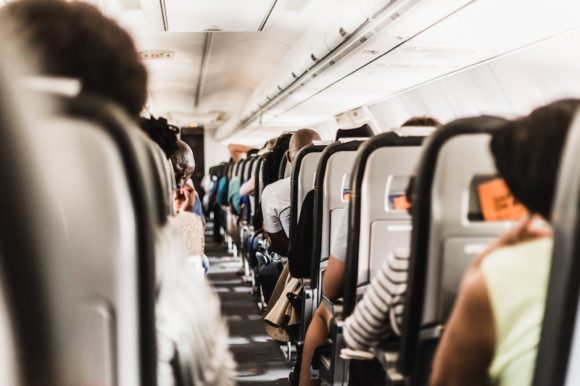
Photo by Gerrie van der Walt on Unsplash.

It was the folks at Cunard who said “Getting there is half the fun”.  And crossing the Atlantic in style on an ocean liner certainly was.  But whatever your mode of transportation, getting the right seat can make for an enjoyable or miserable trip.

On Metro-North, I usually go for a window seat.  However, on crowded trains, any seat is better than none.  But I can still get an “upgrade”, if I pay attention.

Heading into New York, I watch for people getting off the train in Stamford.  Their seat check usually has a torn corner, so I look for them when boarding.  And you’ll usually see those folks gathering their stuff just before arriving at the station.  That’s when I pounce.

Leaving Greenwich, Conn., I try to arrive early to board my train so I get my first pick of seats.  I usually opt for the window on a three-seat side.  That way, if someone else arrives just before departure, they can take the aisle seat and the train will have to be Standing Room Only before anyone opts for the dreaded middle seat.

But it’s on airplanes that seat selection is crucial.

Never go for an emergency exit row.  There may be more legroom, but the seat dividers are rigid and the arm rests can’t be raised.

Try to sit forward of the wing for minimal engine noise.  It’s not by chance that the cheapest seats are in the rear, next to the lavatories, where the jet noise is the loudest.

Some people prefer aisle seats so they can get up and walk around.  But a recent study showed occupants of those seats have the greatest chance of being sprayed with germs from other passengers and crew.  Consider wearing a face mask for your own protection.

Again, I prefer a window seat so I can see where we are going.  But even booking in advance these seats are hard to get, depending on the airline and your frequent flyer status.

Something like 20 percent of all airline revenue now comes from “add-ons” to ticket prices for things like seat assignments, checked bags, food and yes, seat assignments.

The travelers’ advocacy group Travelers United cites an example of a passenger flying from NY to Chicago on American Airlines who really wanted a window seat but was told it would cost an additional $42.  She refused, waiting until she got to the airport to check in to try again.  There the airline said her window seat would cost an extra $76 … more than her one-way airfare!

That she could fly 700 miles for 10 cents a mile is ridiculous and speaks to how much airlines are “unbundling” their products. Their profit comes not from the transportation but the amenities.  You can take Greyhound on that route for $54 (if you don’t mind a 22-hour trip).  But “riding the dog” comes with two free checked bags, seat-side power plugs and free Wi-Fi.

Families flying together have a particular challenge trying to get adjacent seats. But last fall Congress tossed air travelers a bone, requiring airlines to seat families together at no additional cost.

Whatever your mode of transportation, be it cruise ship or jetliner, planning ahead is key to scoring “the best seat in the house”.

Posted with permission of Hearst CT Media

Jim Cameron

About the author: Jim Cameron is founder of The Commuter Action Group, and a member of the Darien RTM.  The opinions expressed in this column are only his own.  You can reach him at CommuterActionGroup@gmail.com

For a full collection of “Talking Transportation” columns, visit www.talkingtransportation.blogspot.com

Letter From Paris: Macron & Merkel: Can This Power “Couple” Lead Europe?

Nicole Prévost Logan

On Sept. 26, 2017, Emmanuel Macron chose the Sorbonne University to develop his grand vision for Europe.  In that seminal speech he was urging his perceived partner German Chancellor Angela Merkel to join him in tackling the lofty goals of European reforms, speeding up the integration of the Eurozone through the creation of a parliament, a ministry of finances, and its own budget.   

Macron proposed to strengthen the common market and reduce the economic inequalities through the  harmonization of taxes, creation of a minimum wage, and reform of the “detached workers” system, which leads to employment of migrant workers at cheaper rates than would likely be available locally — a practice known as “social dumping.”  His approach is based on several principles: a Europe protected by well-managed  external borders and a strong defense; the opening of Europe to free trade, but with due regard for reciprocity, and solidarity among the European Union (EU) members regarding the treatment of refugees.

After an interminable six months, the “Great Coalition” between German Conservatives and Social Democrats has made it possible for Angela Merkel to start her fourth mandate. Barely a few hours after her confirmation as Chancellor on Friday, March 16, she met with French President Macron accompanied by several ministers.  The speed with which she came to Paris shows how important it was for those two heads of state to get to work. 

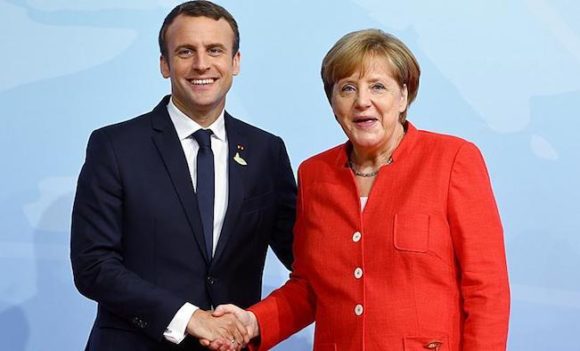
French President Emmanuel Macron and German Chancellor Angela Merkel.

Unfortunately, the geopolitical environment allowing them to be the driving force of a dynamic Europe has shifted and even deteriorated during that long waiting period and their task has become more difficult. Merkel is politically weaker.  The continent is now fragmented and the resistance from newly-created groups within the EU has become more aggressive.  Macron will have to downgrade his proposals and make adjustments.

The political context in which Merkel starts her fourth mandate is quite different from the one existing in 2013.  Only 52 percent of the population supported the new chancellor in 2017 versus 73 percent in the earlier elections.  Compared to the consensus Merkel was able to maintain previously, it is harder now for her to keep the lid over dissenting opinions.

Even though they are part of the “Great Coalition,” several ministers stand in disagreement with the chancellor, including Olaf Scholz (social democrat or SPD), vice-chancellor and minister of finances, who believes in tightening the budget; Horst Seehofer  (head of the conservative Christian Social Union or CSU in Bavaria), who was given the  “super ministry” of the interior, who intends to be harsher toward the immigration policy in the name of the reactivated concept of “heimat” (homeland); Jens Spahn, 37, minister of health (Christian democratic union, CDU or Merkel’s own party), who is also a critic of Merkel’s policy on migrants, and Andrea Nahles, leader of SPD in the Bundestag, wants to rush through social reforms in favor of the workers. 

Even more difficult for Merkel will be the meteoric growth of the far right party (Alternative for Germany or AfD).  In  2013 it did not have enough votes to have representatives  in the Bundestag.  To-day AfD holds 92 seats out of 709.   At a recent news cast on the ARTE channel, the violent tone of a AfD member at the Bundestag was incredible.

The “Countries of the North” (as they are now called) — Ireland, Iceland, along with the Scandinavian and Baltic states, as well as the Netherlands — believe in a strict budget and are inflexible about financial and monetary discipline. Mark Rutte, Prime Minister of TheNetherlands, speaking for the North countries , declared, “We have to adhere to the Maestrich criteria,” namely to keep the public deficit under 3 percent of the Domestic Gross Product.  On March 27, for the first time in 10 years, France saw her deficit fall down to 2.6 percent.  This was a significant accomplishment:  France is now a credible member of the “club.” 

The North countries ask that Italian and Greek banks clean up their toxic debts.  A “mutualization” of the debt (particularly of Greece’s sovereign debt) and financial transfers are a red line conservative parties from Germany or Holland are not willing to cross.  Like Macron and Merkel, however, Rutte sets as a priority a European Stability Mechanism (EMS) and a European Monetary Fund .

The recent Italian elections on March 8 were a blow for moderate centrists like Matteo Renzi, and the victory of two extremist, anti-system and xenophobe parties: the Five Stars (M5S) at the far left, and The League at the far right.  Italy joins now the eurosceptic countries like Austria and the Visegrad group (the former Iron Curtain countries of Eastern Europe.)  All these countries oppose the Macron/Merkel policies on trade, finances, democratic values and attitude toward the migrants.

Given this overview of the political landscape of Europe, it seems that the strategy of Macron and Merkel will be to start from the areas of agreement – passage toward Brexit, defense against terrorism, and protection against excessive Chinese investments in the name of the “Silk Road.”

The reactions of other EU members toward Macron’s “jupiterian” style and desire to reform are ambivalent.  In a March 20 interview published by Le Monde, Xavier Bettel  prime minister of Luxembourg said that a “directorate Paris-Berlin is out of the question, but added”  France and Europe are lucky to have him. Even if we do not agree with all his proposals, they are most welcome.” 

Editor’s Note: This is the opinion of Nicole Prévost Logan.

Nicole Prévost Logan

About the author: Nicole Prévost Logan divides her time between Essex and Paris, spending summers in the former and winters in the latter. She writes a regular column for us from her Paris home where her topics will include politics, economy, social unrest — mostly in France — but also in other European countries. She also covers a variety of art exhibits and the performing arts in Europe. Logan is the author of ‘Forever on the Road: A Franco-American Family’s Thirty Years in the Foreign Service,’ an autobiography of her life as the wife of an overseas diplomat, who lived in 10 foreign countries on three continents. Her experiences during her foreign service life included being in Lebanon when civil war erupted, excavating a medieval city in Moscow and spending a week under house arrest in Guinea.

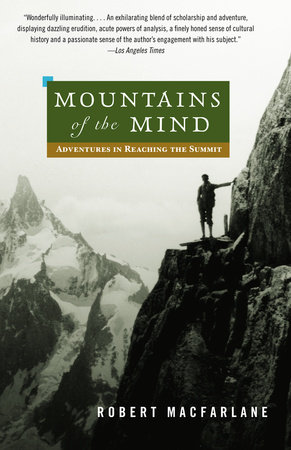
Reading Uncertainly? ‘Mountains of the Mind’ by Robert Macfarlane

Have you ever been mesmerized by a mountain?
I have … Mount Fuji, from the waters of Suruga Wan, Mounts Rainier and Baker from Puget Sound on a cloudless day, and even Mount Kearsarge in central New Hampshire when I actually climbed it with some of our family.

What is it about mountains that seem to entrance our minds?

Robert Macfarlane, a Fellow of Emmanuel College, Cambridge, gives us a meditation on these heights, an enthralling “mental stimulation that explores why “the unknown is so inflammatory to the imagination.”  And why is it that almost every “prophet” of all our religions has ‘habitually been up mountains … to receive divine counsel”?

What is “the mesmerism of high places”?  He explains: “ … the urge to explore space – to go higher – is innate in the human mind” and “ … the visionary amplitudes of altitude felt like the approximations of divine sight  … the spell of altitude.”

He writes “when we look at a landscape, we do not see what is there, but largely what we think is there … We read landscapes” as interpreted “in the light of our own experience and memory, and that of our shared cultural memory.”  In other words, landscapes are “romanticized into being,” mountains most of all.

“Contemplating the immensities of deep time, you face in a way that is both exquisite and horrifying, the total collapse of your present, compacted to nothingness by the pressures of pasts and futures too extensive to envisage … [plus] the appalling transience of the human body.”

Macfarlane’s chapters explore geology, fear, glaciers, heights, maps, theology, and conclude, inevitably, with Mount Everest and the attempt of George Mallory and Andrew Irvine in 1924. The author himself is also a climber as well as a student of mountains.

He cites John Ruskin with the idea that “risk-taking – scaring yourself – was, provided you survived, a potent means of self-improvement.”

“This is the great shift which has taken place in the history of risk.  Risk has always been taken, but for a long time it was taken with some ulterior purpose in mind: scientific advancement, personnel glory, financial gain.  About two and a half centuries ago, however, fear started to become fashionable for its own sake.  Risk, it was realized, brought its own reward: the sense of physical exhilaration and elation which we would now attribute to the effects of adrenaline.  And so risk-taking – the deliberate inducement of fear — became desirable; became a commodity.”

Macfarlane concludes, “mountains return to us the priceless capacity for wonder.”  He continues, “In ways that are for the most part imperceptible to us, we all bend our lives to fit the templates with which myths and archetypes provide us. We all tell ourselves stories, and bring our futures into line with these stories, however much we cherish the sense of newness, or originality, about our lives.”

Finally, “at bottom, mountains, like all wildernesses, challenge our complacent convictions – so easy to lapse into – that the world has been made for humans by humans.”

So, encourage your doubts and go climb a hill!

Editor’s Note:  ‘Mountains of the Mind’ by Robert Macfarlane was published by Vintage Books, New York 2004.

Felix Kloman

About the Author: Felix Kloman is a sailor, rower, husband, father, grandfather, retired management consultant and, above all, a curious reader and writer. He’s explored how we as human beings and organizations respond to ever-present uncertainty in two books, ‘Mumpsimus Revisited’ (2005) and ‘The Fantods of Risk’ (2008). A 20-year-resident of Lyme, he now writes book reviews, mostly of non-fiction that explores our minds, our behavior, our politics and our history. But he does throw in a novel here and there. For more than 50 years, he’s put together the 17 syllables that comprise haiku, the traditional Japanese poetry, and now serves as the self-appointed “poet laureate” of Ashlawn Farms Coffee. His wife, Ann, is also a writer, but of mystery novels, all of which begin in a bubbling village in midcoast Maine, strangely reminiscent of the town she and her husband visit every summer.

A la Carte Goes Colorful with Crispy Cod with Chorizo, White Beans and Cherry Tomatoes

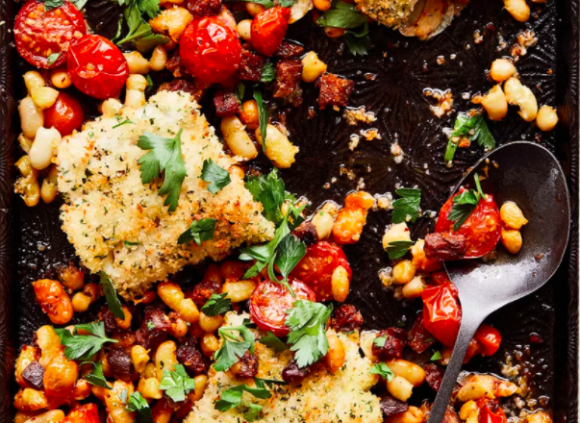
Crispy cod with chorizo, white beans and cherry tomatoes.

Back in January, I was invited to a dinner party. The food was incredible, beginning with an appetizer of a seared sea scallop, topped with shredded duck and enveloped with a sunny yellow hollandaise and an arugula in subtle vinaigrette. As an “intermission,” there was glorious white lasagna which melted in our mouths. The entrée was beef and carrots in Borolo, silken mashed potatoes and fresh green beans with pine nuts.

The chef had also sent to our tables of 12 a freshly made bread that had been low risen for two days before it was put in the oven. There were two desserts—one a cassata (a traditional Sicilian cake) and soufflé. All the savory dishes were created by Tom Cherry, who spent a lot of time and love on that dinner, although his real job is plastic surgery. The desserts were created by Bette Hu, who calls herself “just a home cook.” Actually, these two may be just “home cooks,” but, truth be told, I am a home cook. These two people are true artists.

I have said before that real chefs can make magic with a few pans, a few sharp knives and a working stove. While Tom and his wife Lynn have a Viking stove in emerald green with eight to 10 burners on his cooktop and a few ovens at his disposal, he could do that in my galley kitchen and electric stove. I, on the other hand, would need his Viking to be that proficient. As I left that evening, I tried to figure out how I could sneak that Viking into my car. I couldn’t/t!

People often ask me what I consider most important to have in a kitchen. In my last house in Old Lyme, I could hold 20 people in the kitchen as I cooked, had a 42-inch cooktop with six gas burners, two ovens and a warming drawer. The granite counter held 10 and part of the counter was four inches below the regular one, so I could make pastry without making my shoulders ache. My pantry took up another room.

Today I have a fair amount of counter space and a nice deep kitchen sink, but the cooktop has four electric burners, there are two ovens but one is very shallow and most of my pantry is in the hallway closet, along with coats. I have a lot of counter-top appliances, but I have learned how to use those electric burners so that they do not ruin the good pans I have collected over the years.

What I need most in my kitchen these days are my knives (on a magnetic bar so the knife block doesn’t take up counter top), those good pans and Silpat liners for my many, many nested sheet pans, the last of which I use often.

In a recent edition of Rachael Ray Everyday, I saw a recipe for a cod that can be made in a sheet pan that fits in my shallow oven. 

Crispy Cod with Chorizo, White Beans and Cherry Tomatoes

From Rachael Ray Everyday, February, 2018

Yield: serves 4

2 cans (15 to 15.5 ounces each) cannellini beans, rinsed
8 ounces cherry (or grape) tomatoes, halved
5 ounces cured chorizo, casing removed and meat chopped into small pieces
3 cloves garlic, thinly sliced
One-half teaspoon crushed red pepper
Salt and freshly ground pepper, divided
4 tablespoons olive oil
One-half cup panko
1 tabelspoon finely chopped fresh flat-leaf parsley plus one-quarter cup coarsely chopped
4 boneless, skinless cod fillets, 5 to 6 ounces each
3 tablespoons tartar sauce

Preheat oven to 450 degrees. On a large rimmed baking sheet, toss beans, tomatoes, chorizo, garlic and crushed red pepper with 2 tablespoon oil, 1 teaspoon salt and one-quarter teaspoon freshly ground pepper.

In a shallow bowl, toss panko and 1 tablespoon finely chopped parsley and season with salt and pepper. Brush the tops and sides of the cod fillets with tartar sauce. Press the tops and sides of the fillets into the panko mixture until coated. Arrange the fish to the center of the baking sheet. Arrange the bean mixture in an even layer around the fish.

Bake until panko is golden and the fish flakes easily with a fork, 10 to 15 minutes. Sprinkle with the coarsely chopped parsley and drizzle with the remaining 2 tablespoons oil.

Letter From Paris: Visit to Franco-American Museum in Blerancourt Sparks Review of Relationship Between the Two

Nicole Prévost Logan

La Fayette nous voilà (La Fayette, here we are) are the famous words General John J. Pershing , commander of the American Expeditionary Forces, is supposed to have pronounced  on July 4, 1917 during the commemoration near the tomb of the Marquis de La Fayette at the Picpus cemetery in Paris. The entry of the Americans in World War I was a way to return the favor to the French for being an ally throughout their history. The Franco-American museum in Blerancourt, in a concrete way, furthered this enduring amity.

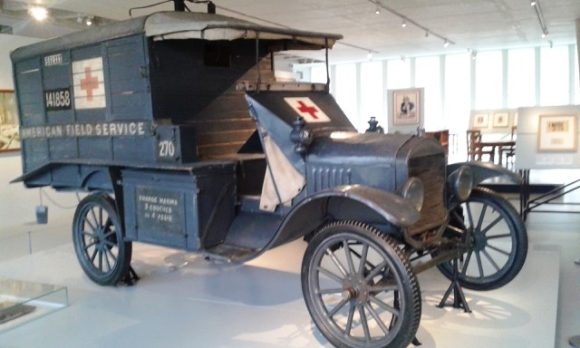
From the outbreak of the war even before America declared war on Germany on April 6, 1917, a segment of US public opinion, wanted the country to enter the conflict. Among the Americans living in Paris (there were 100,000 of them at the time), private associations such as the American Field Service,  intellectuals, writers, and artists offered to join the allied cause. Many young people volunteered as ambulance drivers.

Many volunteers served in ambulances like this one on display in the Museum of Blerancourt during the Great War.

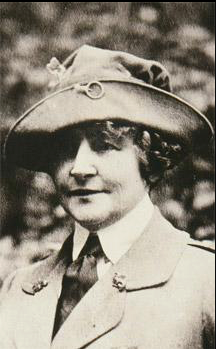
One of them was Anne Morgan (1873-1952)  third daughter of  John Pierpont Morgan, Sr., banker and art collector.

Anne Morgan

She started raising funds to equip the French army as early as 1915, and in 1917 chose the village of Blerancourt, which was in the midst of total devastation, to carry out her humanitarian aid to the wounded soldiers and civilian population. 

The Aisne department (a department in France is the US equivalent of a county) was one of the worst hit battle fields. It is sadly remembered for being the scene of three bloody campaigns all called Chemin des Dames in 1914, 1916 and 1917 . In April 1917 alone, 100,000 French soldiers died on that front. 

Morgan worked from the barracks she erected on the terraces of the Chateau de Blerancourt – a grand 17th century private residence built by the architect who designed the Luxembourg Palace, for Marie de Medicis.  In 1919, Morgan bought the ruins of the chateau and started its restoration. In 1923, she created the association of the Friends of Blerancourt and the following year founded what was to become the Franco-American Museum.

The restored 17th century elegant rooms of the chateau are quite fitting for the historical part of the museum.  French explorers -Jacques Cartier, Father Jacques Marquette-Cavelier de la Salle, Champlain and others  – left their trace in the geography books of the New World. Their names are still vivid but the lands they discovered – from Canada to Louisiana – have long severed ties with France.  Only the St Pierre et Miquelon archipelago remained part of the mother country.

La Fayette was the first Frenchman to enlist in the War of Independence in 1777. With a great deal of panache, in October 1781, the 6,000 men of Count of Rochambeau, joined the Continental Army of George Washington, later the fleet of Admiral de Grasse encircled the English forces.  The combined effort ended in the victorious battle of Yorktown and the rendition of the British.  

Was its support in the conflict beneficial to France?  Some historians do not think so.  Claude Moisy, former president of Agence France Press  (AFP), journalist and specialist in the political history of the US, is one of them and goes as far as to believe that France was caught in a fool’s game.  

During a talk Moisy gave to the France-England Association in 2007, he described the sequence of events, as he sees it: the US Congress had promised not to sign a separate peace with the English, but it did on November 30 ,1782, after secret negotiations.

The real objective for the American government was to resume, as soon as possible, trade and economic relations with Great Britain.  Washington had dispatched Benjamin Franklin to Paris. He soon became the coqueluche (the rage) of the Paris society and suspiciously close to it. The author describes Paris at that time as a “panier de crabes” (can of worms), crawling with spies and foreign agents.

The final peace treaty was only signed 10 months later in September 1783, with the participation of Holland and Spain.

2018, – the year of commemorations marking the 100th anniversary of the Great War- started appropriately with the “Cesars” selecting Au Revoir Là Haut, as best film and best director.  It is based on the 2013 Prix Goncourt novel by Pierre Lemaitre. Two soldiers- nicknamed “poilus” during the Great war-  experience the horror of trench war, including being buried alive .  (the writer may have been inspired by what happened to the poet and art theoretician  Guillaume Apollinaire, who was buried alive three times, underwent trepanation and died in 1918.).  The story continues after the war, when the two heroes, traumatized and disfigured by injuries, witness the sordid traffic of war memorials.

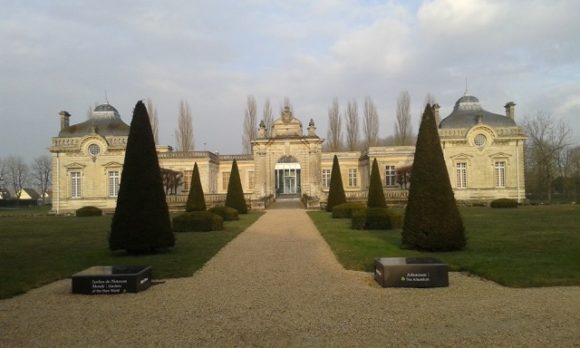
The Chateau de Blerancourt makes a charming picture.

The Blerancourt museum  is a lovely, luminous building,, located at about two hours drive north-east of Paris. The World war I activities of Anne Morgan -including her ambulance, uniform, wartime memorabilia and mobile library- are brought back to life. 

The Art department has just been renovated and contains more than 400 works. The collection  includes paintings by impressionist Childe Hassam, John Singer Sargent and many others.  The arrival of American troops in St Nazaire was caught in Art Deco style by French artist Jean Emile Laboureur in 1918.  Singer and dancer Josephine Baker, appears on the cover of the “Revue Nègre“.  She was born in St Louis, joined the Resistance and is an idol in France.

Editor’s Note: This is the opinion of Nicole Prévost Logan.

Nicole Prévost Logan

About the author: Nicole Prévost Logan divides her time between Essex and Paris, spending summers in the former and winters in the latter. She writes a regular column for us from her Paris home where her topics will include politics, economy, social unrest — mostly in France — but also in other European countries. She also covers a variety of art exhibits and the performing arts in Europe. Logan is the author of ‘Forever on the Road: A Franco-American Family’s Thirty Years in the Foreign Service,’ an autobiography of her life as the wife of an overseas diplomat, who lived in 10 foreign countries on three continents. Her experiences during her foreign service life included being in Lebanon when civil war erupted, excavating a medieval city in Moscow and spending a week under house arrest in Guinea.