Talking Transportation: Citizen Anger About Imminent Transport Funding Cuts Needs to be Directed at Legislature

In recent weeks I’ve been criss-crossing the state talking to folks about our transportation crisis:  the proposed fare hikes on trains and buses coupled with service cuts on the branch lines, and the multi-billion spending cuts at CDOT.

I call it the “Winter of our discontent” magical misery tour.

From Woodbridge to New Canaan, from Old Lyme to West Haven, I’ve talked to crowds large and small, explaining what’s going to happen July 1 and why.  Most folks knew something about our impending doom, but they all left unhappy about the cuts’ specific impact on their lives.

Like the First Selectwoman from Old Lyme who said taxpayers were going to have to spend $600,000 repairing a local bridge because, for the third year in a row, CDOT doesn’t have enough money to share with municipalities.

Or the manager of The Roger Sherman Inn in New Canaan who said she’d probably have to close if off-peak train service was cut on the branch, making it impossible for her cooks and waiters to get to work.

But the culmination of all these presentations was last Tuesday night’s public hearing in Stamford before an SRO crowd of 200+ angry residents.  I’d come more to listen than talk, but couldn’t resist and used my allotted three minutes to ask…

“What are we doing here?  Why are we at this hearing when nothing that you or I say tonight will do anything to change the inevitability of these fare hikes and service cuts?  This may be cathartic, but it’s just political theater.  The folks you should really be talking to are not from CDOT but your State Rep and State Senator.  The legislature created this funding problem and only they can fix it.  If they raise the gas tax and get serious about making motorists pay their fair share, none of these service cuts or fare hikes will happen”.

I was speaker number 11 of more than 80 who signed up to speak.  Some of them waited 4 hours for their few minutes in front of the mic.

But not the politicians.  As State Rep’s arrived, they were whisked by the CDOT Commissioner to the front of the speaker’s line, jumping the queue.  The Commissioner is no fool.  He knows who controls his budget and it isn’t the old guy with a walker complaining about the buses.

When the pols spoke it was the usual platitudes but no new ideas.  “Don’t raise fares, find other funding sources,” said one.  What funding sources?  To their credit, some of the pols did stay to listen, but others (including at least one gubernatorial hopeful) did their grandstanding and split.

One State Rep did have the guts to poll the crowd on their appetite for raising the gasoline tax and tolling our roads, both of which got loud support, much to his surprise.  The people have spoken so now’s the time for action.

By the way … what kind of message does it send when scores of New Canaan residents go to the Stamford hearing to oppose rail service cuts but take a chartered bus instead of the train?

People are angry.  But they need to direct their anger not at the CDOT but at the legislature, holding them accountable for their inaction.

Posted with permission of Hearst CT Media

Jim Cameron

About the author: Jim Cameron is founder of The Commuter Action Group, and a member of the Darien RTM.  The opinions expressed in this column are only his own.  You can reach him at CommuterActionGroup@gmail.com

For a full collection of “Talking Transportation” columns, visit www.talkingtransportation.blogspot.com

Family Wellness: Screens, Media and Family Life

How invasive is technology in our lives?  Photo by Alejandro Escamilla on Unsplash

The idea for this column came from a LymeLine.com reader, but there is also a general clamor for information about this topic that I am privy to in my work with families.

Anna and Rosalie Shalom were the picture of old school, imaginative play in their West Orange, New Jersey, home. The two, 5 and almost 3, labored in harmony at their task, preparing an elaborate pretend dinner to be served at the tiny table in their playroom. They set out play plates. They loaded them up with wooden fruits, vegetables, and dairy products. They sat down, ready to dig in. Ah, but first: they whipped out their pretend cell phones to make sure that no pressing pretend calls or texts required their attention. Their parents cringed. Where had they learned that? (See this article published in Time magazine about raising the screen generation)

Well, Anna and Rosalie aren’t in any imminent danger, but we probably understand why this was cringe-worthy for their parents.  I did observe real imminent danger posed by cell phone use just the other day – a young person almost struck by a car while crossing a busy Boston street, chatting on her phone.  (Coincidentally, I was on my way to a conference where topics around children’s phone, screen and media use abounded.)

So how have screens, phones and media affected family life?

Let’s start with a little context to this question.  According to The Moment, a time tracking app with nearly 5 million users, the average person spends four hours per day interacting with his or her cell phone.  The amount of time children 8-years-old and younger spend on phones or tablets had increased 10 fold between 2012 and 2017, according to a study by Common Sense, which also found that in 2017, 42 percent of kids in the same age group had their own mobile device, up from only 1 percent in 2011. I have to admit to shock and knee jerk dismay at these numbers.  It should be noted that TV usage still predominates for young people’s consumption of media. 

I think we all can think of many ways technology has made our lives easer.  What in the world did we do in the past when our car broke down on the road?  When Junior did not know what time play practice finished up?  When grandmother fell?

Media and technology are here to stay.  So what concerns do families have about media use?  Or “problematic media use,” as many psychologists have termed media use that interferes with “RL” (real life)? 

Real life includes when toddlers learn to play with each other (there is some evidence that excessive screen time results in decreased social and emotional development in young children).  Real life also includes the development of closeness and trust, learning logical reasoning, abstract thought, problem solving and creativity (see this story published in the Wall Street Journal about how cell phones hi-jack our minds).  Real life includes separating from parents during freshman orientation (see this article published in the New York Times about the mental health of college freshmen). 

So yes, there is evidence that excessive media use and dependency can interfere with “RL.”  But there still remains much research to do into the “who, what, when, why and how much” questions concerning family media use and screen time.

So what are we families to do while we wait for more research?  Families need to self-monitor as best they by can looking at their media usage and real (family) life.  Commonsensemedia.org may provide some help for us, as perhaps can Anya Kamenetz’s new book, The Art of Screen Time: How Your Family Can Balance Digital Media and Real Life.

I tend to be a bit of a technophobe, but will end on a positive note:  My son, a “digital native,” and my elderly mother bonded over his expertise in technology and her fear and ignorance of all things digital – enhancing both their “RLs” and strengthening their relationship.

Betsy Groth

Betsy Groth is an APRN, PMHS – BC and a pediatric nurse practitioner with advanced certification in pediatric mental health.

She is a counselor, mental health educator and parent coach in Old Lyme and writes a monthly column for us on ‘Family Wellness.’

For more information about Betsy and her work, visit Betsy’s website at betsygroth.com

A la Carte: St. Paddy’s Day Recipes for Any Day

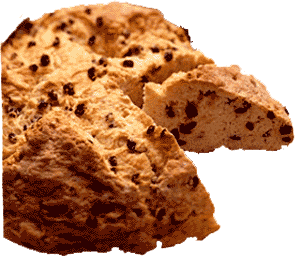
Irish soda bread

Remembering St. Patrick’s Day is easy since my second oldest grandchild was born in Massachusetts on the day before St. Patrick’s Day.

When we heard that Sydney had peeked into this world early that morning of March 16, we drove as quickly as we could, legally, and were at the hospital, without breakfast, in less than two hours. I had grabbed a few clementines and I peeled them and we ate them on the way up. Our daughter-in-law, Nancy, was holding this gorgeous baby girl, as proud father, Peter, sat next to her bed.

While Doug and I stared in wonder at all three of them, Nancy waited until I sat, then handled swaddled Sydney into my arms. As I touched her face, wondering how such a beautiful baby might be in my arms, she turned her little mouth and sucked on my finger. It must have been the clementines, but she has loved oranges ever since.

That little baby graduated from the University of Rochester with a degree in biomedical engineering and now lives in Boston, working on software for a computer start-up. I thought it might be fun to drive to Boston and meet Syd and her parents for dinner, until I realized that the last place I wanted be the day before St. Patrick’s Day might be Boston.

So, I will make a corned beef with vegetables (I’m not wild about the corned beef, but I love cabbage and carrots) and serve it with Irish soda bread and a grape nut pudding, the last must have been created in Boston, as corned beef was, too.

Irish Soda Bread

From Breads, Rolls and Pastries (Yankee Books, a division of Yankee Publishing Inc., Dublin, NH, 1981)
Yield: Makes 1 loaf
4 cups flour
1 tablespoon baking soda
1 to 2 tablespoons sugar
2 teaspoon salt
2 tablespoons caraway seed (optional)
1 cup raisins, currants or Craisins (optional)
2 cups buttermilk (or 2 cups milk soured with 1 tablespoon white vinegar for 10 minutes)
Melted butter

Preheat oven to 375 degrees and grease a baking sheet or loaf pan with melted butter.

Sift together flour, soda, sugar and salt. If used, blend in seeds and raisins and mix well. Stir in buttermilk to form soft dough (like biscuit dough). Turn out onto floured surface and knead gently for 1 minute. Roll into a ball and flatten top to form a loaf about 9 inches in diameter. With a floured butter knife or spatula, cut top of dough about one-inch deep into equal sections (one cut north and south through the center, the other east and west through the center. Place in baking sheet, brush with melted butter and bake 30 to 40 minutes.

Grape Nuts Custard

2 eggs
One-eighth teaspoon salt
one-third cup sugar
One-half teaspoon vanilla
2 cups light cream (you can use heavy cream)
2 tablespoons butter
One-quarter cup Grape Nuts cereal

Butter an 8-inch square pan and put aside. (You can double the recipe and butter a 9-inch by 13-inch pan.)
Preheat oven to 350 degrees.
Whisk eggs, salt, sugar and vanilla, and set aside.
Scald cream with butter.
Add about one-quarter cup of scalded milk to egg mixture, whisking quickly. Add another quarter cup of cream, again whisking. (This “tempers” the eggs so they don’t become scrambled eggs.) Add the rest of the cream, whisking.
Pour entire mixture into buttered pan. Sprinkle Grape Nuts evenly on top. Do not mix in.
Place the pan into a larger pan to which you have pour warm water half way up the smaller pan (this larger pan with water is called a “bain Marie,” or water bath). Place the bain Marie in oven until custard is set in the middle, about 25 to 35 minutes. Remove from the oven and bring to room temperature; cover with plastic wrap and refrigerate for at least 8 hours, or overnight.

Legal News You Can use: It Takes Two – Except When You’re in a Single Car Accident

Sponsored post:  One misconception people have about motor vehicle accidents is that “It takes two” – two or more vehicles to justify a claim.

Some drivers are embarrassed to say they were injured while sitting alone in their cars – as if it makes them appear foolish.

In truth, there are several major categories of single-car accidents – many of which involve negligence by a third party, even there’s no third party visible.

Here’s how it happens

  • A truck drops material on the road and drives on. You hit the lumber, or gravel, or boxes of merchandise and lose control. It’s a single vehicle accident because the truck is long gone.
  • A farm neglected to maintain its fences and several dairy cows wander onto the freeway.
  • The highway department failed to patch a pothole, or failed to erect a sign warning drivers about it.
  • Your mechanic, rotating your tires, replaced all the lug nuts but left two loose.
  • The “phantom collision”: another driver forces you off the road and into a utility pole without realizing it, and speeds away.
  • A county snow plow deposits a load of snow onto the highway, instead of carting it away.

Not every single-vehicle injury leads to a claim. If you fall asleep at the wheel and drive into a tree, that’s probably on you.

What sets these accidents apart is that you don’t file a claim against the other party’s insurance carrier. Instead, you present claims to your own insurer.

Much depends on whether your insurance policy contains a clause protecting you against actions by uninsured motorists, hit-and-runs, weather-related accidents and other situations. Most insurance policies do contain these low-cost protections.

You may learn, to your chagrin, that your auto insurance company does not rush to pay your medical expenses after a single-car accident injury. If they can deny, delay or diminish your claim, they will do so.

That’s when it’s advisable to have an experienced personal injury attorney on your side and ready to go to bat for you.

The Law Firm of Suisman Shapiro focuses on this area of the law. Visit their website at this link for more information.


Letter From Paris: Annual ‘Salon de l’Agriculture’ Prompts a Peek into Farming in France

Nicole Prévost Logan

The Salon de l’Agriculture (agricultural fair) is the most popular event of the year in Paris.  For two weeks, the Porte de Versailles is turned into an oversize farm   Four thousand animals – bovines, pigs, sheep and fowl – move in for the delight of both children and adults.  It is the largest agricultural show in Europe.

The French are emotional about their relationship with the countryside and never forget that they share a common rural ancestry and that, just a few decades ago, 25 percent of the population lived and worked on the land. The fair is an opportunity for rural and urban communities to get together and have a good time.

Food is a big attraction at the fair.  Thirty seven restaurants offer culinary specialties from each region: trip à la mode de Caen (tripe cooked in cider and calvados), boeuf bourguignon,  tartiflette (Savoyard gratin with Reblochon cheese, cream and pork), Toulouse cassoulet , bouillabaisse and hundreds more dishes, accompanied by the best wines.

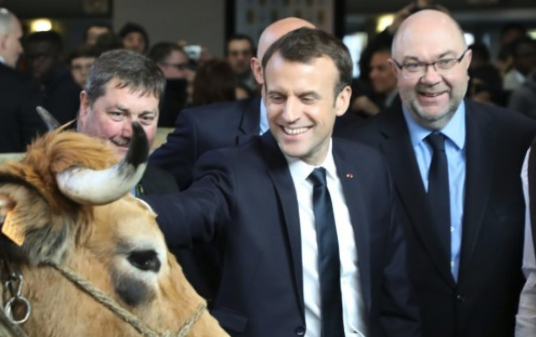
French President Emmanuel Macron meets the much-admired cow named Haute at the Salon de l’Agriculture.

Entertainment reaches its height with the competition for the best animal. This year the star of the show is Haute, a 700 kilo blonde cow of the Aubrac breed raised in Aveyron (a volcanic plateau in the south west), whose big black eyes are made-up with mascara.  Haute has a pedigree in the same way as a racehorse and her offspring are already in line to compete in the 2024 fair – the same year that the Olympics will be held in Paris. 

From the air, the French landscape looks like a beautiful tapestry with colored patches of fields, woods and clusters of roofs huddled around a church steeple. Behind this idyllic picture, it is hard to believe that there is a tough world of fierce competition, hard work, and for some, a struggle to survive . 

Among the 450,606 working farms in France to-day, many of them are small with less than 10 hectares (one hectare is equivalent to 2.47 acres.) Their owners find it hard to make a living. The average income of a farmer is 1,525 euros for month and can be as low as 500 euros, which is well below the poverty threshold.  There are many reasons for this. 

Food today represents only 20 percent of a family budget as compared to 34.7 percent in 1960.   The agri-business and chains of supermarket distributors, in order to increase their profit margin, force the farmers to sell their milk or meat at rock-bottom prices.

Farmers are deep in debt because of the necessity to invest but they have ways to show their anger and frustration, such as pouring manure or truck loads of raw eggs on public squares.  Another effective way is for them to launch an operation escargot (snail offensive.) They bring their five-mile an hour tractors on the highways with the expected result.   

European farmers could not survive without financial subsidies from Brussels.  In 1962, the Politique d’Agriculture Commune (PAC — Common Agricultural Policy) was set up by the European Union (EU) to assist and guide the agriculture of  its members.  The PAC is the second largest item in the EU budget and one of its pillars.  Methods and objectives have changed over the years.  

For a while, it requested farmers to lay fallow their cultivated land.  Quotas for milk were stopped in 2015 and sugar in 2017.  Today the PAC is putting more emphasis on the development of organic food and protection of farmers against the climatic vagaries.  France is the leading agricultural country in Europe with production valued at 71 billion ahead of Germany (56.7 billion), Italy (54.2 billion) and Spain (49 billion.) France remains the top beneficiary of financial assistance from the PAC. 

Most Europeans are hostile to the use of pesticides.  Brussels wanted to set a 10-year-moratorium on the use of the herbicide Glyphosate.  Macron fought and demanded three years.  Finally Brussels decided on a period of five years. 

In France, Monsanto has become the prime bad guy.  Europeans are also against genetically-modified food and the addition of hormones and antibiotics in meat.  The French are getting very finicky about the traceability of products   A couple of years ago, horse meat was found in prepared food produced in Eastern Europe.  The French public went up in arms.   Since then, on every package or can, the geographic origin of the product has to be indicated.

Macron, during his visit to the Agricultural Fair asked the crowd, “Did you know that that 70 percent of the meat you eat in French restaurants is imported?  It makes no sense when French meat is probably the best in the world.”  The president is not a protectionist but, in his eyes, free trade agreements have to be equally  beneficial for both sides.  At present, the signing  of  the Mercosur Treaty between Europe and four South American countries is stalled, leaving Europeans worried.

It is a “must” for each French president to visit the fair.  Macron outdid all his predecessors by mingling with the crowd for more than 12 straight hours.  Always eager to explain his policies, he did not hesitate to plunge into the fray and engage in heated discussions with angry farmers. 

The day before the opening of the Salon, Macron had invited 700 young farmers to the Elysees palace.  As always, his method was not to promise financial assistance, but help his guests find creative solutions to make their farms more competitive.

Editor’s Note: This is the opinion of Nicole Prévost Logan.

Nicole Prévost Logan

About the author: Nicole Prévost Logan divides her time between Essex and Paris, spending summers in the former and winters in the latter. She writes a regular column for us from her Paris home where her topics will include politics, economy, social unrest — mostly in France — but also in other European countries. She also covers a variety of art exhibits and the performing arts in Europe. Logan is the author of ‘Forever on the Road: A Franco-American Family’s Thirty Years in the Foreign Service,’ an autobiography of her life as the wife of an overseas diplomat, who lived in 10 foreign countries on three continents. Her experiences during her foreign service life included being in Lebanon when civil war erupted, excavating a medieval city in Moscow and spending a week under house arrest in Guinea.