
A la Carte: Bake the Best Big, Chewy Oatmeal Raisin Cookies!

Big and chewy oatmeal raisin cookies

A few days after I made banana bread (about six overripe bananas I had, to which I added five overripe ones from Noank friends), I decided it was time to make cookies. (By the way, all four of the banana breads left my homes to friends’ kitchens, because I didn’t want to eat them.) Alter all, I had already thawed two pounds of unsalted butter and, while looking for the chocolate chips (wafers, actually), I saw an unopened package of cinnamon chips and an unopened package of candied ginger.

So I searched for my favorite oatmeal cookie recipe and could not find it under any headings—oatmeal, cookie, cinnamon, nothing. And it wasn’t in my paper file, either. Is it possible I never wrote about them? Anything is possible, I guess, so I found the same book I had used for the banana bread and didn’t even have to use the index; I just leafed through the nearly 600 pages and it opened to Big and Chewy Oatmeal Cookies. I have probably made that recipe so many times that it had three or four different stains on it and maybe some of the pages were damp too.

As with many recipes, I double this one. They freeze beautifully. I pay little attention to raisins (not crazy about raisins, anyway) and for this recipe I use those two ingredients I love: cinnamon chips and candied ginger. How much of each?  The recipe calls for one and a half cups of raisins, so I use 1 cup of cinnamon chips and half a cup of candied ginger; I chop the latter coarsely with a sharp knife. But you can use any combination for this recipe or none at all if you just want a delicious oatmeal cookie

Big and Chewy Oatmeal Raisin Cookies

From The Best Recipe by editors of Cook’s Illustrated (Boston Common Press, 1999)

Yield: about 18 large cookies

1 and one-half cup all-purpose flour
One-half teaspoon salt
One-half teaspoon baking powder
One-quarter teaspoon freshly grated nutmeg
One-half pound (2 sticks) unsalted butter, softened
1 cup light brown sugar*
1 cup granulated sugar*
2 large eggs
3 cups rolled oatmeal
1 and one-half cups raisins (optional)

Adjust oven racks to low and middle positions and heat oven to 350 degrees. Line two large cookie sheets with parchment paper. (I use Silpat instead of parchment.)

Whisk flour, salt, baking powder and nutmeg in medium bowl.

Either by hand or with electric mixer, beat butter until creamy. Add sugars, beat until fluffy, about 3 minutes. Beat in eggs, one at a time.

Stir dry ingredients into butter-sugar mixture with wooden spoon or large rubber spatula. Stir in oats and optional raisins (or chips or candied ginger or dried cranberries).

Working with generous 2 tablespoons of dough each time, roll dough into 2-inch balls. (I often make smaller cookies.) Place balls on parchment- lined cookie sheets, leaving at least 2 inches between each ball.

Bake until cookie edges turn golden brown, 22 to 25 minutes. (Halfway through baking, turn cookie sheet from front to back and also switch them from top to bottom.) Slide cookies, on parchment, to cooling rack. Let cool at least 30 minutes before peeling cookies from parchment.

*I have found that three-quarter cups of both sugars is plenty sweet enough

Talking Transportation: Transport Cuts Will Hurt Us All

For weeks I’ve been writing about the CDOT’s impending bus and rail service cuts and fare hikes and their profound impact on commuters, local businesses and real estate values.  But with just weeks to go, the folks who can prevent this pain… our legislature… seem to be doing nothing.

 The deadline is July 1 this year when proposed CDOT cuts will go into effect:   A 10 percent fare hike on Metro-North will be matched with elimination of off-peak trains on the New Canaan, Danbury and Waterbury branch lines as well as Shore Line East.

How are local officials responding?  By complaining that the proposed cuts on them aren’t fair.  “Don’t cut my mass transit, cut someone else’s!”, seems the plaintiff cry.  “Why is my bus service being cut but Hartford and Stamford’s isn’t?,” one official asked me.

I told him he was asking the wrong question.  Instead he should be asking why any bus or train service was being cut.

It’s as if a crowd was trapped in a burning building with one narrow fire escape and everyone’s screaming “I deserve to survive. Let the others get burned” while nobody is working to douse the flames.

The answer isn’t to push away the pain onto others but to turn off the pain at its source.

Legislators can easily stop CDOT’s plans by just raising the gasoline tax four cents a gallon and diverting the car sales tax into the Special Transportation Fund.  Instead, they’re blaming everyone but themselves for the mess they got us into.

Remember:  it was the legislature that pandered to voters by lowering the gasoline tax 14 cents a gallon in 1997, a move that cost the STF $3.4 billion in lost transportation spending that could have repaired roads and fixed bridges.

Now the Republicans are so focused on the fall campaign they’re deceiving voters in a “big lie” PR move only Sean Spicer could enjoy: trying to argue that proposed highway tolls are “taxes”.

They are not.  Tolls would be a user fee, paid only by those who drive on those roads.  Train fares aren’t taxes, are they?  You only pay those fares if you take the train.

Do Republicans really think voters are that stupid?  Apparently so.

The pols are also piling on the CDOT for being late in opening the new Hartford Line, the commuter rail line between New Haven, Hartford and Springfield.  Our legislature can’t even deliver a budget on time, let alone understand the complexity of a $769 million railroad construction project that’s taken over a decade.

It’s not by chance the Republicans are known as the “party of no”.  For all their complaining they have offered no new ideas nor embraced the ones that thoughtful observers think are obvious:  asking motorists to pay their fair share with gasoline taxes and tolls.

Metro-North riders already pay the highest commuter rail fares in the US, fares that have risen 53% since the year 2000 … while motorists haven’t seen a gas tax increase in 20 years. How is that fair?

If the July 1 service cuts and fare hikes go into effect, commuters should know it’s their legislature that’s to blame.

Posted with permission of Hearst CT Media

Legal News You Can Use: Spousal Support Could be Affected by Tax Law Changes

Sponsored Content by Suisman Shapiro Attorneys-at-Law.  From property division to spousal support, financial issues have been some of the most significant factors for Connecticut couples going through a divorce. Alimony payments are already a contested issue in many divorces, leading to lengthy negotiations and even court battles. Spousal support issues could become even more complex, however, following the adoption of changes to the U.S. tax code in Dec. 2017.

While each state has an individualized approach to spousal support, there has also been a uniform federal tax approach to the finalized payments. In federal tax law, the payer of alimony has been able to deduct those payments from their income taxes. Meanwhile, the recipient of spousal support reports the income and pays taxes on it alongside their other income. However, as of Jan. 1, 2019, this situation will flip as alimony payers will no longer be eligible for a tax deduction. On the other hand, support recipients will no longer need to pay taxes on the income received.

This is expected to have a variety of impacts on the alimony payments that emerge from negotiations and court orders. The overall payments may be lower as the tax burden will now make those support bills much more expensive for the payer. For the recipient, the funds will no longer be eligible for investment in an Individual Retirement Account restricted to taxed income.

The changes are sending some couples to a family law attorney to seek advice about the impact of the changes and to act quickly to finalize a divorce in 2018 prior to the new law’s effective date. A divorce lawyer may be able to provide representation for a spouse seeking a divorce on a wide range of contentious matters, including child custody, spousal support and property division, to achieve a just settlement that protects a divorcing spouse’s assets.

The Law Firm of Suisman Shapiro focuses on this area of the law. Visit their website at this link for more information.

Family Wellness: Does Mindfulness Work for Families?

“Mindfulness” is certainly trending these days.  Books and workshops are in abundance, aimed at children, adults and families.

For some, the concept provokes rolling of the eyes, for others, curiosity, others still, an eagerness to share how helpful the practice has been for them. Perhaps in some it may provoke an urge to purchase new yoga pants and scented candles.

I believe it definitely has practical applications for healthy and happy relationships in families. Think of it as a “health habit.”

Let’s first define the term: 

“The quality of being conscious or aware of something,” and,  “A mental state achieved by focusing awareness on the present moment, while calmly acknowledging and accepting one’s feelings, thoughts and bodily sensations, as a therapeutic technique.”

Generally, I see mindfulness as being able to identify feelings (sometimes uncomfortable ones.)  Being able to hold these feelings helps us to act — or not act — in a healthy way.

Here are some examples of mindful parenting at different developmental stages:

  • CeeCee is  2-months-old and has been fussy since three weeks of age. This makes her parents anxious, maybe even a little angry. CeeCee is thriving and healthy. By practicing mindfulness, her parents are more able to accept their own feelings as “normal” and know that these feelings do not mean that they do not love her. They look forward to CeeCee having her own fussy baby in the decades to come, so that they can reminisce with her.
  • Ben is 3-years-old and cries when he is dropped off at preschool. At family parties, he attaches himself like Velcro to his mother’s leg and will not engage with anyone of any age.  His mother acknowledges and respects her own feelings that go back and forth between embarrassment, irritation, and too- deep sympathy for Ben in this horribly scary world.  Thus her calm, measured responses to him end up making him “braver;” they do not feed into his erroneous belief about the terrible danger at a family party, and do not make him feel like a “bad boy” for being shy.
  • Sara, 10-years-old, did not make the A team in soccer this year. Before she expresses any feelings around this, her parents check in on their own feelings of disappointment and anger at the coach and they restrain themselves from immediately calling the coach. Later over dinner Sara states, “I was not really one of the best players and I like the girls on the B team a lot.”
  • Nick, age 16, is enraged with his parents that he cannot have a house party unsupervised by his parents.  His parents are considering the following responses:   1) “What are you, crazy, you little jerk?” 2) “We are so sorry you are angry with us, so we’ve changed our minds” and/or 3) “It is all our fault we raised you to even consider such a request.”  They realize all these feelings are “OK” and it is also ok for Nick to be mad. It is not their job to make him “OK” with their decision right now. They shrug, acknowledge his disappointment and move on, feeling good about their family and themselves, knowing that Nick is a good kid. Perhaps they will process this at a later time.

Mindfulness has applications across the lifespan.  Young children tend to be “in the moment,” often joyful, which is a tenet of mindfulness, but they may have trouble with handling feelings that might be perceived as less positive.  Young children can learn to “stand next to” feelings of anger, sadness, disappointment and fear, and then move on.  The elderly, sometimes looking at the past, are perhaps a bit frightened about the future.  A practice of mindfulness can be a comfort to them at their stage of growth.

Hanna Rosin, in a humorous piece in Slate, wonders if the concept of mindful parenting just identifies another way for parents to fail (e.g., I forgot to bake for the bake sale AND I forgot to be mindful with the kids yesterday.)  She raises a valid point in a funny and engaging way.  But I believe that, in the long run, a bit of this practice in family life will do the opposite; it will relieve pressure on kids and parents, and perhaps grandparents as well.

Letter From Paris: The (Rail) Battle That Macron Must Win 

Nicole Prévost Logan

France is going through the labor pains of implementing a variety of overdue structural reforms if France is to be brought into the 21st century.  President Emmanuel Macron has tackled this objective at a dizzying speed since his election on May 7, 2017.  The pace of change was so fast that the opposition appeared unable to react until Macron turned to the reform of the SNCF (Société Nationale des Chemins de fer Français.) 

Now that process is developing into a major crisis.  Other groups  – university students,  Air France personnel, hospital staff,  garbage collectors, violent clashes at the Notre Dame des Landes “zad” (zone à defenre), etc. – joined the movement.  To overcome the spread of the social discontent  will be the first and decisive test for the French president. 

When the government announced a restructuring of the SNCF , which involved the status of the railroad workers or cheminots, dealing with the unsustainable debt, introducing competition, and the overall modernization of the rail network – the reaction of the unions was immediate and massive.

On March 18, four trade unions – CGT (Confédération Générale du Travail), UNSA (Union Nationale des Syndicats Autonomes), RAIL-SUD and CFDT (Confédération Française Démocratique du Travail) – announced  an innovative and deadly form of strikes: work stops for two days, then trains run for three days.  This schedule will be repeated for a total of 36 days during a period of three months until the end of June … longer if necessary. 
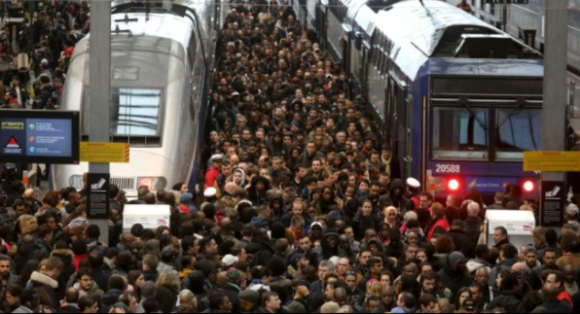
The platform at the Gare de Lyon in Paris on April 3, showing the rail strike’s devastating effect.

The French are bracing themselves for this monster strike, which will be hard for millions of working people, mainly commuters.  The specter of the 1995 strike, which paralyzed France for one month, looms over the country.  The collateral cost of a widespread strike is astronomical with the loss of work days; hotels and restaurants losing more than 30 percent of their profits; and factories momentarily having to close down and lay off employees, and the like.

Facing the angry unions was Minister of Transports Elizabeth Borne, who is a petite, remarkably qualified 57-year-old woman.  A product of the top elite school Polytechnique, part of the socialist government of Lionel Jospin, former head of the RATP (Régie Autonome des Transports Parisiens) and of the SNCF strategy from 2002 to 2005. Technocrat rather than politician, Borne knows everything, but communication is not her forte

The 150,000 cheminots occupy a special place in France and are at the heart of the nation’s DNA. This is why the government’s efforts to bring reforms have met resistance violence the like of which it may not have anticipated.  The aura surrounding  the cheminots has been significantly fed in popular culture by a couple of films. 

In Jean Renoir’s “La Bête Humaine”, 1938, Jean Gabin portrays a cheminot. He looks quite dashing as he leans out of the steam engine wearing goggles, his face smeared with black dust.  Sustained by a bottle of wine he shares with his jolly co-worker, his exhausting job is to feed the “beast” with coal in the deafening noise of an inferno while breathing  poisonous fumes. The indelible image of this hero inspired the population’s respect for the hard work of the cheminots. 

Jean Gabin as a cheminot in ‘La Bête Humaine,’ 1938.

The other film, which contributed to the collective adulation of the French for their cheminots, is La Bataille du Rail, 1946, played by non-professional actors.  It shows their courage against the Nazi occupants in provoking the derailment of many German trains.

The cheminots are fiercely attached to their special status including retiring at as early an age 52 with a very generous package of  guaranteed employment for life and free transport tickets for the extended family. The government is trying to be reassuring, saying that the changes will only concern the railroad workers hired in the future.  The cheminots will also benefit from a “social backpack” whereby they can take their special status with them in case of transfer to another job.

The SNCF is badly in the red: its debt of over 50 billion Euros increases by three billion every year and the infrastructure is in dire need of investment.  Although showing some signs of disfunction – trains are often late,  major break downs such as the ones which occurred last fall when the Gare Saint Lazare and Gare Montparnasse left passengers stranded for hours – the rail system is still one of the best in Europe.  The French people do not realize what an expensive luxury it is to have such a public transport system.  But this luxury comes at a price: its operation cost is 30 percent higher than the one of other European railroads.    

The cheminots have a visceral fear of the word” privatization.”  The government has repeatedly said that there will be no privatization.  The state will remain the sole share holder and the only change will be that, in the future, the SNCF will be run as a private company, according to directives approved by the European Council in 2001.

The opponents to reforms spread unfounded horror stories about the introduction of competition and problems it caused in other countries.  Besides, the SNCF’s structure, as a public company created in 1937, had already entered that process over the years.  Freight was privatized in 2003.  International lines – like Eurostar (to England) and Thalys (to Belgium, the Netherlands, Germany) – are run independently from the SNCF.   The Italian company Thello runs night trains between Paris and Venice.  All Trains à Grande Vitesse (TGV — high-speed train) tracks are scheduled to be shared with foreign companies by 2020, according to the guidelines approved by the European Union (EU) members.

Criticisms have been expressed about the overbuilding of TGV lines at a high cost and at the expense of other lines.  The announcement of  suppression of small lines provoked an outcry from public opinion well-orchestrated by the unions.  The dense network of TER (Transport Express Regional) and inter-city trains dates back to the days after WWII.  It was a time when half the French population lived and worked in the country versus less than only 4 percent today.  Each village wanted its gare (railroad station.)  Obviously, the time has come to adapt the network to the population’s current needs.  Since 2002, the small lines are the responsibility of the 12 “regions.”

Emmanuel Macron is dealing with the most challenging issue of his presidency to date.

With the one-year mark of his mandate approaching, Macron felt it was timely to take stock of  what has been accomplished to date by his government.  His first talk took place on Thursday, April 12, during the midday news.  The president was sitting on a tiny chair in an elementary classroom in Normandy.  In a relaxed atmosphere, the president answered the questions French people – including retirees – were asking regarding the erosion of their purchasing power.

Many people expected fireworks during the second event on the evening of Sunday, April 15.  The fireworks duly happened. 

Two journalists – Edwy Plenel from Mediapart and Jean-Jacques Bourdin, from RMC (Radio Monte-Carlo ) wanted only one thing: to tear Macron to pieces.  Interrupting him from the start, their questions were bundled with disinformation.  Insults and accusations flew.  Plenel went as far as saying, “Mr. President, you only won the election by default and your program was supported by just a handful of people.”  Bourdin treated the president as a criminal — as  he frequently does in respect of the person he is interviewing, bullying them into  a “Yes or No” answer.  When the exchange touched on the veil worn by Moslem women, both journalists blasted Macron for totally opposite reasons.

Macron’s performance was superb.  He kept his cool and managed not only to answer the questions at length, but also to explain the rationale for his policy.  Among all the information he disclosed, one was crucial — starting in 2010, the state will gradually take over the huge debt of the SNCF.

Editor’s Note: This is the opinion of Nicole Prévost Logan.

Nicole Prévost Logan

About the author: Nicole Prévost Logan divides her time between Essex and Paris, spending summers in the former and winters in the latter. She writes a regular column for us from her Paris home where her topics will include politics, economy, social unrest — mostly in France — but also in other European countries. She also covers a variety of art exhibits and the performing arts in Europe. Logan is the author of ‘Forever on the Road: A Franco-American Family’s Thirty Years in the Foreign Service,’ an autobiography of her life as the wife of an overseas diplomat, who lived in 10 foreign countries on three continents. Her experiences during her foreign service life included being in Lebanon when civil war erupted, excavating a medieval city in Moscow and spending a week under house arrest in Guinea.