Letter From Paris: Exhibition Explores Work of American Female Artist in Male World of French Impressionism

Nicole Prévost Logan

“Mary Cassatt (1844-1926) was the most French of all American artists,” said art historian Jerome Coignard.  She was the only woman – along with Berthe Morisot – to be recognized by the Impressionist movement and therefore permitted to show her works in their annual Salons. 

For 40 years she developed a personal and artistic friendship with Edgar Degas, which was somewhat surprising considering Degas was well known for his misogyny.  Her long association with the famous art merchant Paul Durand Ruel, especially after he opened a gallery on Madison Avenue, increased the exposure of impressionism in the US.

The Jacquemart-André Museum in Paris is currently holding a retrospective exhibition of monographs by Mary Cassatt titled, ‘An American Impressionist in Paris.’  It is a long overdue recognition of an artist whose works are found mostly in the US, but who is better known in France.  Jacquemart-André is one of the most elegant art galleries in Paris.  It was built in the 1860s as one of the townhouses of the imperial aristocracy in the “plaine Monceau” (an area of Paris in the 17th arrondissement.)

The property is slightly set back from Boulevard Haussmann, and on the upper level, opens up onto a vast courtyard under the watchful eyes of two stone lions.  The magnificent residence, with its eclectic furniture, boiseries (wood wall paneling), fireplaces and Gobelins tapestries, used to attract thousands of guests from the high society.

In the West Wing of the Metroplitan Museum in New York, paintings by Cassatt are hung in a gallery exclusively reserved for the works of other women.  Cassatt might have been upset by this apparent patronization by critics and art historians toward domestic scenes created by women.  She might have deemed it unfair because painters like Edouard Vuillard (1868-1940) or Pierre Bonnard (1867-1947) are famous for their paintings inspired by the intimacy of the home. 

Art historian Guillaume Morel comments that the many mother and child scenes painted by Cassatt were, in fact, more feminist than it appears at first.  He writes that she may have found herself endowed with a mission to represent scenes to which men did not have access.  Her “maternity scenes” effectively propelled her into modernism.

At the turn of the 20th century, women were tied to their homes, seemingly leading an indolent existence limited to feminine activities, primarily the care of small children.  They almost never ventured onto the public place – like a café, race track or a prostitute’s haunt.  The subject in “La Loge (The theater box)” (1878) is a departure from this tradition: a self-assured woman is by herself looking through her opera-glasses, and apparently unconcerned by the male spectator staring at her from another balcony.

Even in France, the obstacles inflicted on women artists were enormous: they were neither allowed in the Ecole des Beaux Arts nor were naked models permitted in their art classes.  Women could not copy the grands maitres (Old Masters) in museums like the Louvre.

The special talent of Cassatt was to have overcome these obstacles by taking advantage of her place in the privileged class, traveling extensively and establishing contacts with members of the artistic elite such as Isabella Stewart Gardner (Boston), Alfred Atmore Pope (Connecticut) or Henry Walters (Baltimore.)

From a very young age, she rebelled against the formal teaching offered in the few fine art institutions open to women.  She hated the idea of learning her craft through the use of castings and copies.  She showed an intrepid personality when she told her father she wanted to pursue her artistic education in Europe.  Her father admonished her, saying, “I would rather see you dead.”

And her response to her father’s threat?  She went anyway.

Cassatt was born in Pittsburgh into a well-to-do family.  Her father was an investment banker and her mother was educated in a school created by a former chambermaid of Marie Antoinette.  At the age of seven, she sailed for the first time to Europe with her family.  David McCullough, in his superb book titled The Greater Journey, published in 2011, describes the luxury steamers carrying less than 300 privileged passengers, who could afford the crossing in comfortable accommodations in an “interior richly embellished with satin wood, gilded ceilings … and indoor plumbing.”

The co-curator of the present exhibit held in Paris,  Nancy Mowell Mathews, rejects the expression “woman Impressionist.”  She comments, “Mary Cassatt did not paint differently from other Impressionists.  What she had in common with them was her taste for rough sketches, the unfinished feel of strokes and her daring cadrages (framing of the subject) mostly used in photography or  cinematography.”

Cassatt’s models – mostly members of her family – do not pose in a stilted attitude, but appear relaxed and natural.  In “The little girl in a blue armchair” (1878), the little girl is literally sprawling on a big, shapeless, overstuffed blue armchair.  And so is the small boy looking at us in the painting called, “Woman sitting with a child in her arms. 

“The Cup of Tea “(1880) is an unsurpassed exercise in Impressionist virtuosity.  Fast brush strokes  and the rejection of details are sufficient to render volumes.   The dramatic contrast between the fluffy, pink dress and the black of the solid armchair creates a strong composition.  In 1879, Cassatt was officially accepted in the Impressionist Salon.  The two following decades marked the summit of her career. 

Although Cassatt painted mostly in oils and pastels, Degas had also detected her exceptional talent as both draughtsman and engraver.  Her eaux-fortes (etchings) constitute a large part of her works, while “La Toilette” and “The letter ” (both dated 1891) show signs of japonism.  The engraving process with a pointe-sèche (dry point) is a painstaking and dangerous process since acid is used.

She was the friend of the most influential American feminists and joined their movement for equality, which had started in the US in 1840.  Toward the end of her life, she increasingly devoted her time to counseling American art collectors.  Among them was her close friend Lousine Hvenmeyer, wife of wealthy sugar baron, who owned more than 2,000 Impressionist works. 

After spending 60 years in France, she died in her estate, the Chateau de Beaufresnes in Le Mesnil Théribus, north west of Paris, although interestingly, she never took French nationality.
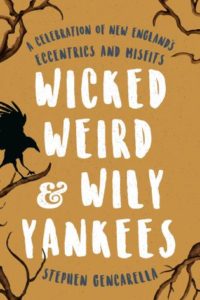
Reading Uncertainly? ‘Wicked, Weird & Wily Yankees’ by Stephen Gencarella

Editor’s Note: Stephen Gencarella, the author of ‘Wicked, Weird & Wily Yankees’ will be the guest speaker at the Lyme Public Library’s Annual Meeting on Tuesday, June 26, at 7 p.m.

What a pleasure: to read an engaging book by a close neighbor (Steve and his family live just down Tinker Lane from me) and to encourage other Lymies to do the same!


Steve, a professor at the University of Massachusetts in Amherst and the resident folklorist at the Connecticut River Museum, offers us a series of essays about unusual folk from New England, eccentric and out-of-the-ordinary men and women: hermits, healers, poets, mesmerists, fortune-tellers, prophets, reformers, bandits, visionaries, vagabonds, introverts, and misogynists.

In other words, most of us!

But what is eccentricity. The professor explains: “ … eccentricity is not an inherent quality but one always partially imposed from the outside, from the society that demarcates and gazes upon the eccentric … “[it] is always a matter of contested perspectives” and “ … tendencies to the reclusive or to the flamboyant quickly garner the label of eccentricity.”  He continues, “As tends to happen when history yields to folklore, this oddity began to grow in dimensions through the course of a century” of retelling stories of eccentrics.  And “the stories themselves are vagabonds.”

Among the locals described in these essays are a character at the Monkey Farm Café in Old Saybrook, William Gillette of Gillette’s Castle, that “Hadlyme stone heap,” and Elizabeth Tashjian, perhaps better known as “The Nut Lady” of Old Lyme.

Steve concludes with the counsel, “but that is precisely the challenge of eccentrics: to demand respect for the integrity and for the unique and unusual demands of every individual and to refuse to allow authority – however minor – to get away with discouraging people who hear a different drummer.”

We are all story-tellers!

But I was most impressed by the author’s continued use of the word “passing” as his euphemism for death: he uses it 31 times, by my count. It reminded me of that famous “Dead Parrot” skit from Monty Python, in which John Cleese presents an inert parrot nailed to a stick to Michael Palin, the man who had just sold it to him.

“E’s passed on! This parrot is no more! He has ceased to be! ‘E’s expired and gone to meet ‘is maker! ‘E’s a stiff! Bereft of life, ‘e rests in peace! If you hadn’t nailed ‘im to the perch, ‘e’d be pushing up the daisies! ‘Is metabolic processes are now ‘istory! ‘E’s off the twig! ‘E’s kicked the bucket, ‘e’s shuffled off ‘is mortal coil, run down the curtain and joined the bleedin’ choir invisible!! This is an ex-parrot!”

Does this usage “passeth all understanding” (Philippians)?

I pass … but do read these entrancing stories of eccentric Yankees!

About this book: ‘Wicked, Weird & Wily Yankees’ by Stephen Gencarella was published in May 2018 by Globe Pequot, Guilford, CT 2018.

Felix Kloman

About the Author: Felix Kloman is a sailor, rower, husband, father, grandfather, retired management consultant and, above all, a curious reader and writer. He’s explored how we as human beings and organizations respond to ever-present uncertainty in two books, ‘Mumpsimus Revisited’ (2005) and ‘The Fantods of Risk’ (2008). A 20-year resident of Lyme, he now writes book reviews, mostly of non-fiction that explores our minds, our behavior, our politics and our history. But he does throw in a novel here and there. For more than 50 years, he’s put together the 17 syllables that comprise haiku, the traditional Japanese poetry, and now serves as the self-appointed “poet laureate” of Ashlawn Farm Coffee, where he may be seen on Friday mornings. His wife, Ann, is also a writer, but of mystery novels, all of which begin in a village in midcoast Maine, strangely reminiscent of the town she and her husband visit every summer.

Talking Transportation: Connecticut: Love It or Leave It

The recent debate over tolling our highways should remind us of just how divided our state has become.  Not red vs. blue and not even just upstate vs. downstate.  The real divide is between those who commute by car vs. those who take mass transit.

I’ve written for years about the fact that riders on Metro-North pay the highest commuter rail fares in the US, and those fares will only keep going up.  Most rail riders have little choice, especially if headed to New York City.  What are they going to do … drive?

Yet every time the fares go up … and they have increased 55 percent since 2002 … ridership goes up as well.  Why?  Because conditions on the highways keep getting worse and worse.

But those who chose to drive, or must because there’s no viable mass transit option, seem literally to hate rail commuters.  I think it’s jealousy.  During the tolls debate, the venom was dripping and one Tweet in particular hit home.

“Just because your commute (by train) is so expensive doesn’t mean mine (by car) should be too (because of tolling),” read the post.

The driver had clearly missed the point.  We aren’t looking for tolls to subsidize rail fares, just to get motorists to pay for the upkeep of their roads and bridges before we have another Mianus River Bridge collapse, which we will.

But it gets worse.

The anti-toll forces now sound like Howard Beale, the deranged newsman from the movie “Network” who was “mad as hell and not going to take it anymore.”   Doubtless, much of this is directed at Governor Malloy who enjoys (suffers from?) the lowest popularity rating in the history of polling.  Sure, the economy of our state is in bad shape.   But Malloy didn’t create this economic mess.  He just inherited it and mishandled it.

And it will get far worse, whoever succeeds Malloy in the fall.  The solutions will be few and all will be painful.  Forestalling tolls and gasoline taxes today won’t stop the bridges from rotting.

But this opposition to tolls or modest gasoline tax increases to pay for roads has now been taken to a maniacal pitch predicting that “everyone is leaving the state,” conditions are so bad.   That’s fine with me.

I was recently at our town dump and saw a young man unloading a bunch of items.  “My parents are moving,” he told me.  “Everyone is leaving Connecticut!” he exclaimed.

“Really?”, I asked.

“It’s all Malloy’s fault,” he said, sounding like a Pied Piper leading a caravan down I-95 to some Promised Land.

I asked him one question:  “Did your parents sell their house?”   “Sure,” he said.  “And at a profit over what they paid for it.”

“Well,” I said, “I guess not everyone is leaving.  Your folks are moving out and someone else is moving in.”  Someone who wants to live here.

To those who hate it so much living in Connecticut, I extend an invitation:  please leave.  Enjoy your low-tax destination.  And don’t forget to pay those highway tolls as you drive down I-95 through NY, NJ, etc.

But enough already with the “I hate Connecticut” mantra.  Some of us actually like living here.  And losing ‘the haters” will only mean fewer cars on our roadways.

Posted with permission of Hearst CT Media.

Jim Cameron

About the author: Jim Cameron is founder of The Commuter Action Group, and a member of the Darien RTM.  The opinions expressed in this column are only his own.  You can reach him at CommuterActionGroup@gmail.com

For a full collection of “Talking Transportation” columns, visit www.talkingtransportation.blogspot.com

Family Wellness: New Beginnings

Spring is a time of renewal and rebirth.  Every year in New England nature reminds us of this.  Crocuses emerge, the landscape turns from brown to green and many animals have their babies: foxes, otters and black bears, just to name a few. 

I look fondly back on my grandmother’s stories about lambing season in Ireland.  Human babies are born year round, of course, but my thoughts went this month from lambs to human babies. 

Not only is birth the start of a new life but it is the start of a new (or newly reconfigured) family.  It is often a time of unimaginable joy, but it is also a time of stress.  Stress is defined as, “… bodily or mental tension resulting from factors that tend to alter an existent equilibrium.”

Few could argue that a new baby alters an existent equilibrium in ways that are delightful and challenging at the same time.  A new member (in this case tiny and cute) affects the family identity in that constellation in a whole array of ways: emotionally, physically, socially and economically.  All the resources, whether few or many, need to be allocated differently.

Just as adolescence has been described as the transition from childhood to adulthood, the transition to motherhood has been called “matrescence” by anthropologists — for more information, visit this link.  A similar term for the transition to fatherhood does not exist as far as I know, though it has received attention in both academic and popular circles and the media, with online forums such as fathersforum.com. Similarly some attention has been given to the transition to grandparenthood and “older-sibling-hood.”  (I am waiting for an especially gifted and precocious 3-year-old to blog about the challenges of losing attention to a tiny usurper in the house.)

Societies and cultures around the world have different constructs that help or hinder the development of a new family.  These constructs range from policies (paid parental leave) to the practical matters (village and neighborhood folks bringing food to the new family). 

Looking at and understanding how we can support families in transition at this stage of the family life cycle and the stressors that they face (stress being a challenge to equilibrium, not positive or negative) can only be a good thing.

Betsy Groth

Betsy Groth is an APRN, PMHS – BC and a pediatric nurse practitioner with advanced certification in pediatric mental health.

She is a counselor, mental health educator and parent coach in Old Lyme and writes a monthly column for us on ‘Family Wellness.’

For more information about Betsy and her work, visit Betsy’s website at betsygroth.com

Reading Uncertainly? ‘Moonglow’ by Michael Chabon

This is, at one and the same time, a work of fiction and the author’s actual family history, selectively combined and embellished. It is the story of Michael Chabon’s grandfather and grandmother, recreated as a totally engaging novel, covering more than five decades in Germany, Philadelphia, Baltimore, New York City, Florida and California.  He “recreates” these two antecedents, beginning with his grandfather’s work with the Office of Strategic Services (O.S.S.) in Germany in the waning day of World War II, followed by the meeting with his grandmother in Baltimore two years later, and then their fractured lives thereafter.

The key lies in Chabon’s candid Author’s Note: “In preparing this memoir, I have stuck to the facts except when facts refused to conform with memory, narrative purpose, or the truth as I prefer to understand it.” He went on later: “To claim or represent that I retain an exact or even approximate recollection of what anyone said so long ago would be to commit the memoirist’s great sin.” And so his imagination is unleashed …

This is a history, or really even slightly connected stories about his grandparents and their lives in these United States, as they allowed their interconnected emotions to respond to ever-changing stimuli. As Chabon confesses, perhaps there is nothing such as a defined “self”: “Maybe ‘self’ was a free variable with no bounded value.”

Chabon is rich with descriptive phrases. (1) a priest’s cassock: “White dust patterned the black cassock in big splotches like continents or the spots on a cow.”

(2) “The small room was all cross-hatchings of shadow like a lesson in shading a sphere, an arc of darkness wrapped around a circle of gray with a bright spot a bit off-center.  The bright spot was my grandmother; all the light in the sad little room seemed to be radiating from her.”

And describing his father reminded me of John le Carre’s father: ” … my big-talking, sweet-talking, fast-talking father was in and out of courtrooms, tax dodges, marriages, and my life … ” And as Chabon concludes, “That was only human, the common lot. But once your dream revealed itself, like most dreams, to be nothing but a current of raw compulsion flowing through a circuitry of delusion and lies, then that was the time to give it up.” His grandfather’s was with Wernher von Braun and space exploration.

Finally, a curious note. The chapter heads are safety matches formed into roman numerals. But two matches are lit, one in Chapter XX describing an O.S.S. excursion, and the other heading Chapter XXV, when his grandfather heads off to jail.  The connection: I do not know.

A rich and completely engrossing story!

Editor’s Note: ‘Moonglow’ by Michael Chabon was published by HarperCollins, New York 2016.

Felix Kloman

About the Author: Felix Kloman is a sailor, rower, husband, father, grandfather, retired management consultant and, above all, a curious reader and writer. He’s explored how we as human beings and organizations respond to ever-present uncertainty in two books, ‘Mumpsimus Revisited’ (2005) and ‘The Fantods of Risk’ (2008). A 20-year-resident of Lyme, he now writes book reviews, mostly of non-fiction that explores our minds, our behavior, our politics and our history. But he does throw in a novel here and there. For more than 50 years, he’s put together the 17 syllables that comprise haiku, the traditional Japanese poetry, and now serves as the self-appointed “poet laureate” of Ashlawn Farms Coffee. His wife, Ann, is also a writer, but of mystery novels, all of which begin in a bubbling village in midcoast Maine, strangely reminiscent of the town she and her husband visit every summer.