A View From My Porch: “Tin Soldiers and Nixon Coming.” Part 1 — The Shootings at Kent State University.

Tom Gotowka

Christina and I attended a program at Phoebe Griffin Noyes Library on Tuesday, April 29: “Oral History: Kent State, 1970,” presented by Mike Alewitz, who as a student anti-Vietnam War organizer at Kent State University and a founder and chairman of the University’s Student Mobilization Committee Against the War, witnessed the bloodshed that occurred there on May 4, 1970 — 55 years ago.

Mike is now a New London resident and Professor Emeritus of mural painting and street art at Central Connecticut State University. He was subpoenaed to testify before the Presidential Commission on Campus Unrest. (below)

Mike’s presentation was very moving and triggered fraught memories for Christina and me; and I am certain, for other members of the predominantly “Baby Boomer” audience of about 30 or so.

His remarks motivated me to take a fresh look at that other dark period in American history and expand on his observations. I examine the events and actions that may have precipitated what has often been regarded as the “Kent State massacre” in this “View;” and then consider the factors and incidents that led to America’s entry and increased involvement in Vietnam; and the War’s dire outcomes in a subsequent essay.

And so, these are my “lest we Americans forget ‘Views’.” 

Predisposing Events:

The 1967 March on the Pentagon:

The National Mobilization Committee to End the War, a coalition of anti-war groups organized what was, at that point, the largest antiwar rally ever staged for Saturday, October 21,1967 in Washington, D.C. The event began with more than 100,000 protesters gathered at a rally on the National Mall near the Lincoln Memorial.  

The March was notable for its diverse coalition of participants. This was an ecumenical crowd: white and middle-class, middle-aged, young students, some clergy, and a group of political and social activists; — including Norman Mailer, Benjamin Spock, folk singer Phil Ochs; and counter-cultural figures Jerry Rubin, and Abbie Hoffman, co-founders of the Youth International Party; — i.e., the Yippies; who have been described as a theatrical, anti-authoritarian, and anarchist youth movement of “symbolic politics”.

Near 6 p.m. about 50,000 streamed across the Arlington Memorial Bridge toward the Pentagon. 

There, most remained non-violent; but a smaller segment stormed ahead and scaled or toppled the fences surrounding the Pentagon; forcing their way onto the grounds past military policemen who were standing at 10-foot intervals.  Six hundred and eighty-two demonstrators were arrested.

Note: there is an iconic photograph from the March on the Pentagon (i.e., “flower power”), that shows protester George Harris placing a carnation into the barrel of an M14 rifle held by a soldier of the 503rd Military Police Battalion (Airborne); — taken by Bernie Boston for The Washington Evening Star.

Garden Plot:
The Department of Defense Civil Disturbance Plan (aka GARDEN PLOT) was a wide-ranging U.S. Army and National Guard plan to respond to major domestic civil disturbances within the United States. The plan was developed in the mid-1960s in response to a series of domestic civil disorders and provides Federal military and law enforcement assistance to local governments.

RMN and the Cambodian Incursion:

Richard M. Nixon defeated Hubert Humphrey in 1968; campaigning  on a platform of achieving “peace with honor” in Vietnam; and positioning himself as the “law and order” candidate, who would restore domestic peace and stability amid the protests, riots, and rising crime rates of the 1960s. 

By 1968, there were already over 500,000 American troops on the ground in Vietnam, and more than 31,000 Americans killed. This was the first televised war and television coverage was a major factor in American society ‘s perception of the war. 

He entered office against a backdrop of a well-organized anti-war movement, which he had denounced and demeaned during his campaign. 

In July, 1969 he promised to withdraw 150,000 troops; but despite that pledge, announced on a televised address on April 30, 1970 that American forces had invaded Cambodia after months of intense bombing to disrupt North Vietnamese supply lines 

His secret expansion of the War drew immediate worldwide condemnation and intensified protests by antiwar activists at Kent State and many other college campuses across the United States; with marches, rallies, and clashes with law enforcement.

The Kent State Shootings- Chronology of Events: 

  • On Friday, May1; — the day after Nixon’s announcement, an anti-war rally with about 500 students began late morning on the Commons, a traditional free speech area in the center of the campus. The rally started  peacefully but expanded into the town and escalated into vandalism of storefronts and violence between protesters and the local police force, who eventually succeeded in using tear gas to disperse the crowd from the downtown area; compelling them to move several blocks back to the campus. Additional demonstrations were expected through the weekend. 
  • By Saturday morning, Kent city officials and downtown businesses had received threats and abundant rumors of radical revolutionaries with caches of arms, plots to spike the local water supply with LSD, and of students building tunnels to blow up the town’s main store. 

Kent Mayor, LeRoy Satrom feared that local law enforcement would not be able to handle the anticipated disturbances; and declared a state of emergency. He requested assistance from Ohio Governor Jim Rhodes, who decided to call in the National Guard to occupy the Kent State campus and restore order. The Guard did not arrive until 10 p.m., and by that time, a large demonstration was underway and the boarded-up ROTC building was set afire. 

There were reports that some Kent firemen and police officers were struck by rocks and other objects while attempting to extinguish the blaze. Several fire engine companies were called in because protesters had cut the fire hose. The arsonists were never apprehended.

  • By Sunday morning, 1000 National Guardsmen were on campus. Governor Rhodes had flown in for a press conference at which he said, “We’re up against the strongest, best-trained, militant, revolutionary group that has ever assembled in America; — set on destroying higher education in Ohio.” 

During the day, a small group of students came downtown to help with clean-up efforts.  Mayor Satrom, under pressure from residents and business owners, ordered a curfew. 

Another rally began on the Commons near 8 p.m., and confrontations amongst the Guardsmen and demonstrators escalated. By 8:45 p.m., the Guardsmen had dispersed the crowd with tear gas; but the students reassembled for a sit-in at the busy Kent intersection of Lincoln and Main. 

At 11 p.m., the Guard announced that a curfew had gone into effect and began forcing the students back to their dorms. There were arrests, mostly for curfew violations; at least one student was slightly wounded with a bayonet.

School administrators, with the Governor’s backing, prohibited the rally scheduled for Monday, May 4th. 

  • Early Monday, University officials distributed 12,000 leaflets declaring that the rally event had been canceled. 

Defying the ban, about 2,000 students gathered again on the Commons, with another 1,000 behind them on “Blanket Hill”. A small contingent began ringing the campus’s iron Victory Bell just before noon, marking the start of the rally. A campus security officer, accompanied by three Guardsmen, approached the crowd in a National Guard Jeep, and ordered them to disperse. They were met with stones, curses, and the pealing bell.

At about the same time, more than 100 Guardsmen in gas masks assembled at the base of Blanket Hill. The Guard attempted to disperse the crowd via bullhorn. The protesters again ignored the order, and the Guardsmen began firing tear gas. They were then ordered to march forward up Blanket Hill; — with M-1 rifles “locked and loaded” and bayonets raised; compelling the protesters to move up the slope. 

The Guard crested the hill and started downward. The crowd scattered, many of them towards a nearby parking lot. The Guard following the moving crowd into the nearby practice football field and lobbed tear gas canisters at the demonstrators, who yelled and threw rocks and other debris at them. 

After several minutes, the Guardsmen begin to move back up Blanket Hill, having achieved their objective of clearing the Hill.

At 12:24 p.m., after again reaching the crest, the Guardsmen turned, aimed, and fired into the crowd of unarmed students. Twenty-eight Guardsmen fired 67 rounds over 13 seconds, killing four students and wounding nine others, one of whom suffered permanent paralysis.

Some claimed hearing an order to fire; but in repeated testimony, there was no evidence of an order.

Some said they fired because they were in fear of their lives. However, the students who had been shot by the Guard were from 70 to 495 feet away and were shot in their backs or sides.

Note: there is an iconic Pulitzer Prize winning photograph taken by Kent State photojournalism student John Filo showing teenager, Mary Ann Vecchio, kneeling over the bleeding body of Kent State student, Jeffrey Miller.

The Aftermath:

  • Kent State Administration immediately shut down the campus, and it remained closed for the remainder of the spring semester. 
  • The shootings triggered immediate and massive outrage on campuses around the country and increased participation in the student strike that began on May 1. Ultimately, more than 4 million students participated in organized walk-outs at nearly a thousand universities, colleges, and high schools.
  • All in all, the anti-Vietnam War protests had drastically intensified due to the U.S. invasion of Cambodia, coupled with the Kent State University shootings.
  • Nixon backed down on threats to escalate the War, but concerned that backing down might make him appear weak to the Soviets, called a secret worldwide nuclear alert as a show of force. 
  • On June 13, 1970, President Nixon  established the “President’s Commission on Campus unrest,” which became known as the Scranton Commission after its chairman, former Pennsylvania governor William Scranton. It concluded that “the shootings at Kent State were unjustified;” and said: “Even if the guardsmen faced danger, it was not a danger that called for lethal force. The 67 shots by 28 guardsmen certainly cannot be justified. Apparently, no order to fire was given, and there was inadequate fire control discipline on Blanket Hill. The Kent State tragedy must mark the last time that, as a matter of course, loaded rifles are issued to guardsmen confronting student demonstrators.”
  • The massive demonstrations against the War and the bloodshed at Kent State turned the Nixon White House into a fortress. Two rings of city buses parked bumper to bumper encircled the mansion, and the 82nd Airborne was stationed in the adjacent Executive Office Building. 
  • “If The Government Won’t Stop the War, We’ll Stop the Government.”—The 1971 May Day Protests:
    Woodstock hit the streets in  1971 for  a series of wide-ranging civil disobedience actions in Washington, D.C.; and Nixon responded with force. The protests began on Monday morning, May 3rd and ended on May 5th.

12,000 anti-war demonstrators came to Washington D.C. — the culmination of several weeks of activity in the City. They were met by 5,100 city police and 1,400 National Guard soldiers, with 10,000 more Army and Marine troops held in reserve.

The goal of the protests was to disrupt the functioning of the federal government through nonviolent action; with an immediate focus on snarling traffic to prevent government employees from getting to work on Monday morning. Small groups would block major intersections and bridges; and protesters roamed downtown D.C., dodging huge tear-gas barrages. They created small barricades and left disabled cars in roadways, or temporarily blocked intersections with mobile sit-ins.” 

By Monday night, more than 7,000 protesters had been arrested across the city; 5000 more were arrested on May 2, 4 and 5. Protesters filled jails beyond capacity; and were detained in makeshift open-air prisons and sporting arenas—The Washington Coliseum—the practice field for RFK Stadium.

These represent the largest mass arrests in U.S. history. 

Ultimately, however, only 79 people were convicted of any offence related to the protests.

Members of the Nixon administration would come to view the events as damaging because the government’s response was perceived as violating citizens’ civil rights.

Author’s Comments: The title is derived from the lyrics of the protest song, “Ohio,” which was written by Neil Young and recorded by folk rock supergroup Crosby, Stills, Nash, and Young in the immediate aftermath of the Kent State shootings. It became identified as one of the anthems of the anti-Vietnam War movement. In 2010, ‘The Guardian’ described the song as the “greatest protest record and the pinnacle of a very 1960s genre.” The lyrics evoke the turbulent mood of horror, outrage, and shock in the wake of the shootings “Tin soldiers and Nixon coming; this summer, I hear the drumming, four dead in Ohio. Gotta get down to it; soldiers are cutting us down…” (Abridged)

Editor’s Note: This is the opinion of Thomas D. Gotowka.

About the Author: Tom Gotowka is a resident of Old Lyme, whose entire adult career has been in healthcare. He will sit on the Navy side at the Army/Navy football game. He always sit on the crimson side at any Harvard/Yale contest. He enjoys reading historic speeches and considers himself a scholar of the period from FDR through JFK. A child of AM Radio, he probably knows the lyrics of every rock and roll or folk song published since 1960. He hopes these experiences give readers a sense of what he believes “qualify” him to write this column.

Sources: “Tin Soldiers and Nixon Coming”—Part 1:
Amadeo, K. “Vietnam War Facts, Costs, and Timeline. The Balance.” 09/20/2024.
Buhle, P. & Alewitz, M. (2002). ”Insurgent Images.” Monthly Review Press.
Glass, A. “Nixon signals U.S. troop withdrawals from Vietnam, July 25, 1969.” Politico. 07/25/2012.
Johnston, L. “May 4, 1970: A graphic timeline of the Kent State University shooting.” Cleveland. 05/02/2020.
Kimball, J. & Burr, W. “The Movement and the Madman.” PBS.; — American Experience. 03/28/2023.
McFadden, R. “Students Step Up Protests on War.” NYT. 05/09/1970.
National Archives. “Vietnam War U.S. Military Fatal Casualty Statistics.” The Defense Casualty Analysis System.04/29/2008.
Jones, N. Document Friday: “‘Garden Plot:’ The Army’s Emergency Plan to Restore Law and Order” to America.” National Security Archive. 08/12/2011.
Klein, C. “How Nixon’s Presidency Became Increasingly Erratic After Kent State.” History Vault; — This Day in History. 05/04/2020.
Levy, D. “Behind the Anti-War Protests That Swept America in 1968.” Time. 01/19/2018
Lynskey, D. (2010-05-06). “Neil Young’s Ohio – the greatest protest record.” The Guardian. 05/06/2010.
Mailer, N. (1968). “The Armies of the Night.” New American Library.
Pruitt, S. “Kent State Shootings: A Timeline of the Tragedy.” History.05/01/2020.
Rotondi, J. “How Nixon’s Invasion of Cambodia Triggered a Check on Presidential Power.” History This Week. 04/ 27, 2020
Rudin, J. “40 Years After Kent State: Remembering Ohio Gov. James Rhodes.” NPR. 05/03/2010.
Scranton, W. (1970). “The Report of the President’s Commission on Campus Unrest.” U.S. Government Printing Office. 1970.
Smith, D. “How this 1967 Vietnam war protest carried the seeds of American division.” The Guardian. 10/21/2017.
Thomas, C. “Bombing missions of the Vietnam War.” Environmental Systems Research Institute.09/ 25/2017.
Young, N. (1970) “Ohio.” [Lyrics] On “Highway 61 Revisited” [Single 45 rpm record]. NYC: Atlantic Records.

Talking Transportation: Transit-Oriented Recreation

Jim Cameron

The recent cool and weather aside, it’s officially summer!  Time to get out and enjoy our state’s wonderful parks and beaches and take advantage of TOR.

You know what TOD is, right?  Transit Oriented Development … building homes and offices near mass transit facilities.  Well, I’m going to suggest you think about TOR… Transit Oriented Recreation.

Did you know you can travel to many state parks and beaches by train and a connecting bus shuttle?  Details on this year’s program are still to come, but CDOT and DEEP have partnered since 2021 to offer ParkConneCT from Memorial Day through Labor Day.

In years past, beach and park shuttles meeting in-coming trains have been free on weekends and holidays, taking you to places like Sleeping Giant State Park in Hamden or Hammonasset Beach State Park in Madison.

While many state parks close their gates on weekends when their parking lots are full of cars, the shuttle buses can still deliver you to Mother Nature without the hassles.

The state’s modest marketing efforts to attract tourists seem to be working as the number of visitors was up 2% last year.  Officials say tourism brings Connecticut $18.5 billion each year … more than what’s seen in Maine, which bills itself as “Vacationland”.

And it’s clearly our beaches that are a main draw.  Who needs to endure I-95 when you can take the train to visit …

Sherwood Island State Park in Westport:  Just take Metro-North to Westport Station and grab the Sherwood Island Shuttle from the station to the park to enjoy swimming, picnicking and great views of LI Sound.

Silver Sands State Park in Milford:  Metro-North gets you to Milford Station where a walk or bike ride to the beach presents newly refurbished boardwalks, pristine beaches and bird-watching spots.

Bluff Point State Park in Groton:  Take Shore Line East or Amtrak to New London Station, then grab the SEAT (Southeast Area Transit) Rte. 11 bus to the beach where you can enjoy walks along the coast, biking and fishing.

Beyond TOR, how about TOE … Transit Oriented Entertainment?

You wouldn’t think of driving to NYC to see a Knicks or Rangers game.  You’d take the train, right?  Well, you can take Metro-North directly to Yankee Stadium too.  Or to Bridgeport to see Ringo Starr at the Hartford HealthCare Amphitheater … also walking distance from Amtrak and the Port Jeff Ferry.

Going to see a play at The Shubert in New Haven or Andrea Bocelli at the XL Center in Hartford?  Ditch the car and try mass transit.

And if you’re a railfan, visit the Essex Steam Train & Riverboat by training to Old Saybrook and hopping into a cab for the quick ride back into history.

If you’re city-bound, check out Metro-North’s “MTA Away” packages—train and event tickets, often at a discount—for venues both in NYC and the ‘burbs.  You can go star gazing or catch an outdoor concert in Forest Hills without a car.

Whatever your destination for summer fun, think twice before enduring the traffic and maybe consider taking mass transit.

Editor’s Notes: i) Jim Cameron is the founder of the Commuter Action Group and advocates for Connecticut rail riders. He writes a weekly column called ‘Talking Transportation,’ which is published by a number of publications in the state.
ii) ”Talking Transportation” recently won first place in the general column/commentary category in the Connecticut Society of Professional Journalists Excellence in Journalism Contest.

The Movie Man: Reflections on the Renaissance of Anakin Skywalker Actor, Hayden Christensen

Hoping Hayden Hears the ‘Voice of the People’

Kevin Ganey is ‘The Movie Man’

UPDATED 5/20 with an Editor’s Note. I was able fully nourish the wonder that came from the space soap operas of George Lucas. And now that I was an adult, I was also able appreciate the intellectual influences of Star Wars. These included anthropologist Joseph Campbell, Eastern spirituality, and the samurai movies of Akira Kurosawa. In addition, I finally understand why critics had hailed the original trilogy and bashed the prequels. Being aged 8, 11, and 14 respectively when they were released, they were simply my favorites because they were newer. Kids always think what is new is de facto better.

As I finished my senior year at Xavier High School, I experienced a renaissance: Star Wars.

My passion had returned for the adventures that took place a long time ago in that galaxy far, far away. I sought to live according to the unwritten rules of being a teenager, which forbade fandom of sci-fi and fantasy.

But as my second semester began, the scales fell from all our eyes. We realized the popularity contest was nonsense. We spent our whole lives longing for the days when we would be top dogs as seniors. Instead, we found ourselves casually conversing with those we once considered social lepers.

Throughout 2009, I rewatched the movies constantly. I picked up on the merited criticisms, no doubt …

But something stuck out to me: Hayden Christensen, the actor who played Anakin Skywalker.

I was well aware that older fans were critical of his performances. but after many re-watches I realized that these criticisms went too far. It all came down to the delivery of his lines. His tone of voice and his intonation were lifeless. But his facial expressions and the physicality of his performance were impressive when Anakin was not speaking.

One day it finally dawned on me: the poor performance was not Hayden Christensen’s fault. It was George Lucas’ writing and directing.

For all the praise I can heap on Lucas, I do have criticisms. I cannot deny that the man was better fit as the creative executive force driving the productions rather than directing.

Mark Hamill, Carrie Fisher, and Harrison Ford never hesitated to roast Lucas for his unnatural dialogue. They claim his direction was simply “Faster and more intensity.” Hamill boasts that he can still recall the cheesiest line of his audition to this day. The raw footage of the original movie is quite cringe-worthy. The editing saved the movie (and also won an Academy Award). For the remaining films of the trilogy, he opted to hire directors. He chose Irvin Kershner and Richard Marquand to helm The Empire Strikes Back and Return of the Jedi, respectively.

But when Lucas finally got to work on the prequels, he directed all three, himself. The editing room saved A New Hope, and Kirschner and Marquand were able to able to bring produce quality content. Now that Lucas was giving acting advice, the guardrails were down. Any actor, regardless of their potential talent, would be subject to Lucas’ direction.

By 2001, Hayden Christensen, was a rising star in Hollywood. He had appeared in a variety of material, including Canadian youth television (Are You Afraid of the Dark? is among the credits). He received a Golden Globe nomination for acting alongside Kevin Kline in Life as a House. He also portrayed defiled journalist Stephen Glass’s fall in Shattered Glass. He was certainly on the trajectory for a long and respected career. Lucas even compared him to James Dean.

But when Attack of the Clones and Revenge of the Sith were excoriated by the critics, so were Christensen’s performances. While the rest of the cast was also criticized, it was mostly directed towards Christensen. As a result, he appeared to experience the “Yips” and was unable produce better performances after Star Wars. He has mainly kept to independent films since.

But in recent years, Christensen has been shown much love and appreciation. He has always been happy to appear at conventions. He has received love for reprising the role of Anakin for Disney’s canon of Lucasfilm with Obi-Wan Kenobi and Ahsoka. This exposure has led to appearances on The Tonight Show.

Additionally, there have been promotions with WIRED and GQ. These appearances and promotions have accumulated millions of views online.

Much to my delight, it appears that Star Wars fans are experiencing a Hayden Christensen renaissance. I am grateful for the stock I bought all the way back in 2009.

The 20th anniversary of Revenge of the Sith arrived today.

I must ponder: “Why should this renaissance be confined to just Star Wars?” Did he not bring his talent to other movies and shows? Does that mean he can’t contribute to projects that fans of pure entertainment can enjoy? Perhaps he can lead a miniseries, as seems to be the trend now? Why has he not been considered for at least cameo appearances in any upcoming projects by A-list filmmakers?

If Lindsey Lohan can experience a second act, then why can’t Hayden Christensen?

I believe he still has much to bring to the table. I hope he can read the signs of the times and hear the voice of the people.

Editor’s Note: For the record, the publication day of this article—Monday, May 19—is the 20th anniversary of the release of ‘Revenge of the Sith.’

About the Author: Having lived in Old Lyme and Lyme since the age of three, Kevin has always had a passion for movies that is beyond simply watching, but understanding the craft of cinema and and experiencing films as if they were a musical album. Kevin also has his own website devoted to movie analysis, CityOfCinema.com, and also co-hosts a podcast, Moviehouse Mystics, with Koda Uhl (available on Apple Podcasts, Spotify, and YouTube.)

Talking Transportation: Some ‘Fun Facts’

Jim Cameron

Over the twenty years I’ve been writing this column, I’ve come across some “fun facts” about transportation. Try dazzling friends at your next BBQ with some of these gems.

HIGHWAYS:

  • The average distance driven on I-95 in Connecticut is 11 miles.

Some 180,000 vehicles drive all or part of the 112 miles that I-95 runs through our state.  But even factoring in true interstate drivers (think Florida to Maine), the average distance driven in Connecticut is tiny.  Why? Because we use I-95 like a local road to avoid Route 1, not just for interstate travel.

  • Trucks are banned from the Merritt Parkway.  But in 1943 trucks were allowed on that roadway as part of the war effort.

But trucks in those days were much lower, easily clearing the bridges.

AVIATION:

  • The supersonic Concorde was a real gas-guzzler.  In the 15 minutes from leaving the gate until takeoff, the jet burned two metric tons of Jet A gas… enough to fly a conventional jet for an hour to Paris.

Carrying just 100 passengers, The Concorde would burn about a ton of fuel per passenger crossing the Atlantic.

  • The busiest airport in the world is Atlanta’s Hartsfield International (ATL), handling 108 million passengers last year…almost 296,000 a day.

And most of them fly Delta, which hosts 165 of the airport’s 192 gates, a 86% share of the capacity.

METRO-NORTH:

  • Did you know that a fully loaded eight-car train on Metro-North can carry over 1000 passengers…more than double the capacity of a fully loaded 747.
  • The 24-mile-long Danbury branch line used to be electrified.  But the wires were ripped out in 1961 to save money by running diesels. The copper was sold as scrap.
  • Grand Central Terminal has 67 tracks and 44 platforms, more than any station in the world.

And never call it “Grand Central Station.” That’s the name of the post office and subway station nearby.

HIGH SPEED RAIL:

  • America’s only “high speed train” (Acela) can go up to 160 mph. But the average speed it runs traveling 456 miles from Washington DC to Boston is just 70 mph.
  • China has the largest high speed network in the world covering more than 29,000 miles and carrying 4 billion passenger trips.  Its trains run as fast as 260 mph.

TRANSIT FARES:

  • In Portland Oregon the trains don’t have “Senior” fares. Instead, seniors, veterans, active-duty military personnel, handicapped and low-income residents are called “Honored Citizens” and get 50 – 75% off regular fares.

SHIPPING:

  • The biggest container ships sailing today can carry over 24,000 containers. But those mega-ships are too big for the Panama Canal…but not for the Suez Canal, which has no locks.
  • New York’s Staten Island Ferry can carry over 6000 passengers per trip.  That added up to 25 million passengers in 2019…more than double the population of Greece.

And yes, the Staten Island Ferry is free. The old 50-cent fare was dropped in 1997 in a nod to the city’s efforts to make access to the tiny borough more affordable.

Talking Transportation: On Air Pollution and Transportation

Jim Cameron

Our air stinks. In fact, Fairfield County ranks in the top 25 of most polluted areas in the US, mostly due to ozone levels.

And while much of those noxious gases drift our way from New Jersey and New York City,  a large part of our pollution is home-grown:  it’s due to heavy volumes of traffic, especially diesel trucks, which emit nitrogen oxides (NOx) and volatile organic compounds (VOCs)—key ingredients in ozone formation.

Yes:  I-95 is hazardous to your health.

And all of this gets worse in the summer due to the heat which increases ozone production, often trapping it over our heads due to temperature inversions. By one estimate, almost 200 Connecticut residents die each year due to our air quality.

We will all remember back to June of 2023 when our sky turned orange due to smoke from Canadian wildfires. That created truly hazardous conditions that literally made breathing bad for you.  With global warming, we’ll see things like this happening again.

So, what does any of this have to do with transportation? Mother nature’s pains (like the Canadian wildfires) notwithstanding, it is transportation’s pollution that is the #1 source in our state, EPA blaming it for half of all our bad air.

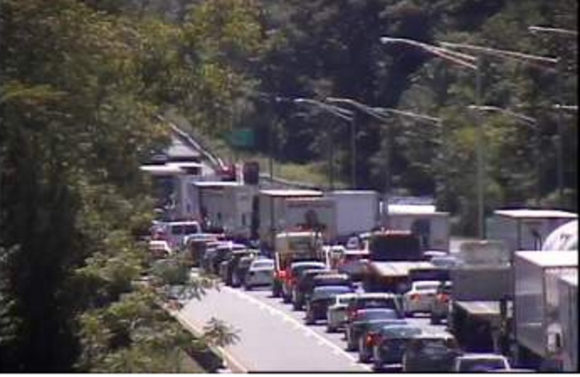
Trucks on I-91. Photo from CT DOT.

Trucks:
These are the vehicles responsible for most of our air pollution.  While medium to large trucks represent only 6% of traffic they cause 53% of nitrogen oxide (NOx) emissions, 45% of fine particulate matter (PM2.5), linked to respiratory and cardiovascular health issues, and 25% of greenhouse gas emissions.

Better air filters may help as does burning biodiesel and enforcing no-idling rules. But the real solution will be electric-powered trucks.  However, the Trump administration has slashed tax credits for new buyers and frozen plans for the rollout of charging stations.

Take the Train:
Riding Metro-North is five to six times more fuel efficient than driving.  Those electric trains’ power-generation gives them the equivalent of 125-160 mpg.  And that’s improved further by the trains’ regenerative braking which means that, even when stopping, they generate more power.

Getting more folks on the train also reduces highway traffic, making those vehicles more fuel efficient because they’re not spewing exhaust in stop-and-go traffic.

But our diesel locomotives (which run on the Danbury, Waterbury and Hartford lines) are a different matter.  For their runs in Connecticut they are big polluters, just like trucks.  The World Health Organization and EPA call diesel exhaust a Class 1 carcinogen, right up there with tobacco and asbestos.  New locomotives that are on order will improve that with battery operation and improved filtration.

Ships:
Yes, both commercial and pleasure craft contribute to air (and in this case noise and water) pollution, again because of their diesel engines.  It’s not by chance that wind-powered sailors refer to powerboaters as “stink potters” and “blow boaters”.  There are some electric-powered boats under development, but they’re more expensive and don’t offer the same range.

So, whether your travels take you on the open waters or (hopefully) open roads, remember that there’s more to the cost of your trip than fuel: there’s the cost to our shared environment. 

Editor’s Notes: i) Jim Cameron is the founder of the Commuter Action Group and advocates for Connecticut rail riders. He writes a weekly column called ‘Talking Transportation,’ which is published by a number of publications in the state.
ii)”Talking Transportation” recently won first place in the general column/commentary category in the Connecticut Society of Professional Journalists Excellence in Journalism Contest.