
Gardening with ‘The English Lady’: Tips for July, a Month That Offers ‘A Blind Date With Summer’

A garden in July can be a riot of color.

“July is a blind date with summer,” says Hal Borland. Such a wonderful description of a beautiful month, so let’s take a walk in the garden!

WATERING

A sprinkler can be an effective watering method. Photo by Anthony Lee on Unsplash.

Watering is so important during the heat of summer. If you planted trees or shrubs this spring, particularly evergreens, these plants require extra moisture to establish a strong root system. We have had an abundant amount of rain this spring and into the summer, however it is important to keep an eye on the weather.

Here in New England, plants require at least an inch of water per week.  If you are using a regular hose, you lose 40 percent of moisture to evaporation. However, a hose is necessary for a deep first watering when a plant goes into the ground and for containers.

Soaker hoses in your borders are the best method of watering, attached to a house spigot with a timer. By using this method of irrigation, moisture goes to the roots of plants where it is needed and not on the foliage, which can cause disease such as black spot and powdery mildew. Soaker hoses attached to a timer can be used efficiently not only in the borders of the garden but also in the vegetable garden, where annual vegetables, in particular, require a lot of water to produce a good crop.

In addition, composted manure added to the containers and copious amounts to the vegetable garden, helps to retain a good amount of moisture. Manure used as mulch for the vegetable garden adds more nutrition and, as mulch, it does not cap or form a hard crust, as do other mulches, so that water goes directly to the roots.

Water the lawn only when the green glow begins to fade.  An established lawn will bounce back after dry hot spells.

SOIL AND SOIL HEALTH

I want to emphasize the importance of soil and soil health, which has been severely neglected and abused with poisonous chemicals for years. Soil is the most important element of plant growth; it is not an inert medium that merely holds the plants erect, it is a living organism that needs to be replenished with nutrients.

The nutrient is composted manure, manure builds soils structure and its bacteria partners with the millions of microbes below the surface to produce nutrients for the roots of the plants. If you have not already done so, I strongly suggest that you carefully discard all chemical fertilizers, herbicides and pesticides.

The addition of composted manure to your soil in spring, early summer and early fall together with the addition of natural brown bark mulch, builds the carbon compound or humus component in the soil.  We are all carbon-based creatures, as is every living element, this is our lifeblood and the lifeblood of the soil in our gardens.

As we build the humus component by adding composted manure and fine bark mulch, we produce the healthiest possible growing environment and the strongest disease-resistant plants.  As we add the composted manure and natural fine bark mulch season after season, the humus component continues to build in the soil, continuously extracting carbon from the atmosphere into the soil.

ROSES

These beautiful plants flourish beautifully with the addition of composted manure and mulch applied on the soil about two feet away from the base of the plant; they need a deep watering at least once a week. Now, in July add another light layer of composted manure around the roses.

Manure is food for the roots of the roses and no other products are necessary for growth and bloom. Stop adding manure to the roses in mid-August, so that the roses can go into a slow dormancy through late summer and early fall, a natural part of their growth cycle.

An ‘Evelyn’ rose, the author’s favorite.

If you are a first-time rose-grower or adding to your rose collection, David Austin English roses are my personal preference.  The David Austin nursery is only 21 miles from my hometown in Shropshire in England and it was a fragrant pleasure to visit the nursery in June. David Austin roses are more trouble-free than many other roses and are repeat bloomers, with beautiful colors to enhance our senses with delicious fragrances.

Some of my favorite David Austin roses are:

A Shropshire Lad, a peachy pink
Abraham Darby, shades of apricot and yellow
Evelyn (my favorite) with giant apricot-colored flowers
Fair Bianca, a pure white rose
Heritage, a soft blush pink
Carding Mill begins as a peachy orange double flower, becoming an apricot-pink

A lovely combination to enjoy are climbing roses and clematis planted together as both enjoy the same planting environment with their heads in the sun and their feet (roots) cool, with manure and mulch. This combination looks great, climbing over a fence, wall or arbor.

Mulch  – do not use the artificially-colored red mulch, rubber mulch or cocoa mulch; use only natural brown bark mulch.  Do not mulch right up to the base of the plants, as this invites rodents to nest and gnaw on the stems or trunks of the plants.

Note: Do not use Cocoa mulch, produced by Hershey, this mulch has a Thorazine compound and other poisons, which are hazardous to pets who are attracted by the chocolate odor. Ingestion of this chocolate mulch can cause seizures and death within hours.

HYDRANGEAS

Blue hydrangeas. Photo by Gemma Evans on Unsplash.

Plant Hydrangeas in a sunny area if you live near the coast enjoying seas breezes and in part-sun away from the coast on the west or east aspect of the garden. Plant them in organically-rich soil with composted manure and add extra composted manure around the base now in July.

If you have the blue Hydrangea, add some peat or aged oak bark around the base — the acidity in the peat or oak bark encourages a deeper blue hue. Hydrangeas are a wetland plant and require plenty of water throughout the summer. We had a late spring and with all the spring and early summer rain and now good sunshine, the foliage and bloom of the hydrangeas is performing well. Watch out for powdery mildew and spray with the following recipe that you can mix yourself:

Two tablespoons baking soda, one tablespoon of vegetable oil, a squirt of dish soap with a gallon of water in a sprayer.  For any recipe spray you make, spray only in the morning when there is no wind and when the temperature and humidity combined do not go above 180.

Prune Hydrangeas immediately after they finish blooming in late August or early September but no later, as Hydrangeas set their buds for the next season by mid-September. If you prune after that time, you will lose next season’s bloom.   When you prune, cut out some of the old wood and the weakest of the new shoots.  In October, put more composted manure and brown mulch around the base to nourish and protect the roots through the winter.

Did you know that garlic is the antibiotic of the garden? I just love garlic to use in my recipes and it is an important anti-fungal element to protect your plants. I suggest that in early fall you should plant plenty of garlic if you do not already have some in the garden.

To avoid fungal diseases, plant garlic around strawberries, tomatoes and raspberries.

Plant garlic around mildew-prone plants to prevent mildew — such plants are summer phlox and bee balm.

Plant garlic under fruit trees to avoid scab and root disease.

Plant garlic next to ponds or standing water to control mosquito larvae, or pour garlic water into the water to deter adult mosquitoes.

Where you notice marauders where either insects or animals have been munching, make a garlic spray to apply on the plants:

Garlic spray recipe

4 large crushed garlic cloves, unpeeled
2 teaspoons of vegetable oil
1 squirt of mild dish detergent

Put all ingredients in two cups of hot water in the blender, blend, then leave overnight.

Then put in a gallon sprayer with cold water and spray in the early morning when there is no wind, observing the rule of 180 mentioned above.

Hot pepper spray recipe

To deter squirrels and chipmunks, try a hot pepper spray using either four hot chilies or one cup of cayenne pepper in two cups of hot water, mixed in the blender, leave overnight and then put in a gallon sprayer with cold water and spray the problem areas in the early morning.

This pepper spray works well on squirrels, chipmunks, and deer, as well as dogs and cats that may be leaving their deposits in the garden.

HAND CARE

Gardener’s hands are their tools of the trade so it’s important to take care of them. My hands remain healthy by indulging in a hot cream treatment once a week before bed.

Maureen’s hot hand cream recipe:

Combine Calendula cream with honey and essential oil of lavender heated in the microwave, apply generously and put on white cotton gloves for sleep.

When I wake up, my hands are unbelievably soft and smooth.

Wear gloves, when working in soil that contains manure or spreading manure. Manure is an organic product that contains bacteria,  bacteria is great for the soil but like many bacteria not healthy for you. The gloves I prefer are the soft leather farmer’s gloves that are washable.

FLAVORED OILS

Many herbs are at their peak right now and are ideal for using in flavored oils.  The oil I use as a base is organic olive oil. I harvest basil, parsley, sage, tarragon and oregano in a morning, rinse them well, pat them dry with a paper towel and then make the recipe

Chose an herb and add to two cups of oil.

For thyme and lavender, I use only the flowers with one cup of oil to a handful of blossoms.

Puree the herb mixture in a blender and store covered in a wide mouthed jar for three days, shake at least three times a day for the first two days and on the third day let the mixture settle to the bottom, then strain it through a paper coffee filter or cheese cloth into a clean jar.  You will now have a tinted but clear mixture.

Refrigerate each mixture and use within two to three weeks.  The herb oils I make are lavender, lemon, garlic, shallots and basil with olive oil as the base – these are my favorites and are great brushed on vegetables and meats for grilling.  The lavender oil is great with desserts. Rosemary and lemon oil taste excellent on salads.

MOLES

I know I have given you a few mole remedies in the past; but I have not given you the Exlax method for a while and I can attest to the fact that I have used this method as have many garden colleagues for years, as it works.  Buy Exlax whose main ingredient is Senna, a natural herb. Insert Exlax into the mole holes, and the moles and voles will be gone.

If you have dogs and cats, do not use the chocolate Exlax, use only the plain Exlax as chocolate is dangerous to pets.

In early April of next year, apply organic grub control, which means less grubs for the moles to feed on, and without their supply of grubs, the moles will go elsewhere for food. In addition, the white grubs of Japanese beetles can be diminished with the grub control.

Japanese beetles love our plants and there is a method to deal with them naturally. In the early morning, the Japanese beetles are drowsy and can be captured.  Lay a drop cloth under the plant or plants where you see them and gently shake the plant; the drowsy beetles will drop onto the cloth, which you gather up and drop them in a garbage bag and discard.

Many of us are committed to organic gardening without chemicals, which has enabled the earthworm population to once again increase; earthworms are a great boon to the garden soil as their castings add 50 percent nutrition to the soil together with 11 trace minerals.

SUMMER PHLOX

I just love my summer phlox and to keep the mildew problems at bay, I use the natural baking soda mix I mentioned above.  I have found that white Phlox Miss Lingard or white Phlox David are more resistant to mildew that other summer phlox.  Monarda commonly known, as Bee Balm, and Hydrangeas are also prone to be affected by powdery mildew, and this where the baking soda once again can be used.

For a second bloom on the Summer Phlox, prune off 10 to 20 inches from the flower stems just after the flowers have gone and within a few weeks, you will experience new growth.

KEEP YOUR GARDEN CLEAN

A healthy garden is a clean garden. Do not put any diseased items into your compost.

Deadhead all annuals and perennials for a second bloom and clean up all spent blossoms.

When Coreopsis and Spirea have bloomed, shear off dead flowers and they too will rebloom.

CONTAINERS
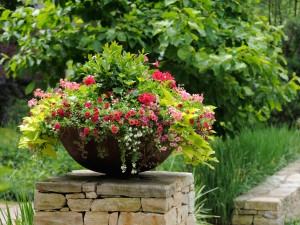
Make sure you have composted manure and fine bark mulch applied on top of the soil in your containers and keep them watered as containers dry out quicker than garden soil. In hot weather the containers will need to be watered daily, morning and evening watering is the best.

If you do not have time in a morning before you leave for work or errands, empty your ice cube trays on the containers; this provides slow release watering until you can get to them later.

Enjoy being in the garden, stay hydrated, continue to stretch and take time to ‘smell the Roses’ and I’ll see you in your garden in August!

Maureen Haseley-Jones

About the author: Maureen Haseley-Jones is a member of a family of renowned horticultural artisans, whose landscaping heritage dates back to the 17th century. She is one of the founders, together with her son Ian, of, ‘The English Lady Landscape and Home Company.’ Maureen and Ian are landscape designers and garden experts, who believe that everyone deserves to live in an eco-conscious environment and enjoy the pleasure that it brings. Maureen learned her design skills from both her mother and grandmother, and honed her horticultural and construction skills while working in the family nursery and landscape business in the U.K. Her formal horticultural training was undertaken at the Royal Botanic Gardens at Kew in Surrey.
Contact Maureen at maureenhaseleyjones@gmail.com

A la Carte: Luscious Lamb Never Disappoints

This was a rather lovely week — I actually spent an hour on a beach chair on the patio, reading and watching the birds on my feeders. I thought I had seen a Baltimore oriole, so I went to Johnson’s Hardware and bought a curlicue feeder that I could thread oranges, since I knew orioles like oranges.

At the same time, I filled the hummingbird feeder. Mostly I saw a lot of catbirds (whom I adore) and downy woodpeckers and finches, but no orioles that day or any other day. And, for the sixth year, no hummingbirds. Oh, well, my cat loves watching the birds from the window. She doesn’t care what they are.

Also last week my friend Tom Cherry made a lamb ragout with spring vegetables and, mask on, drove to my condo with a big portion for dinner. It was beyond delicious and, he says, is a recipe, from a 1971 Gourmet magazine. He also says it is not hard to make but is tedious. He will send me the recipe. His wife, Lynne, said this is why she married him.

So last weekend, still thinking about that lamb ragout, I went to Shop Rite for lamb chops for the grill. They didn’t have any, but someone found me a rack of lamb. It was $21, but it was almost eight ribs, so I cut it in half, froze one and grilled the other.

While I marinated it, I boiled some tiny potatoes. When they were done, I poured out the water allowed the potatoes to dry a bit and added some butter and salt. With a small salad, it was a delicious dinner And easy. Here is the recipe.

Rack of Lamb on the Grill

Yield: 2 servings

1 rack of lamb (around a pound)
Marinade of olive oil, lemon zest, stone ground mustard, minced garlic, a few shards of rosemary, salt and freshly cracked black pepper)
Mint jelly, optional

Mix the marinade in a small bowl. Rub the lamb, cover it with plastic wrap and refrigerate it for 8 hours or so.  Take it out of the fridge an hour before you are ready to grill it.

In a propane grill, turn the heat to high and place the rack fat side down, to sear the meat, about 5 minutes/* Do not leave the grill, because there may be flare-ups. Then turn the grill to about 425 degrees. meat side up, and cook for 13 to 15 minutes for medium rare (longer if you want medium to well-done).

With a temperature gauge, meat should be 120 degrees. (There is some carry-on cooking while you let it rest, so perhaps you should take it off a little earlier, if you want it rare.) Let it rest on a cutting board for up to 10 minutes. Then cut the rack into ribs and serve, with or without mint jelly.

* If using a charcoal grill, once the charcoal is almost gray, push some of it to one side and sear the rack on the hot side. Then move the lamb, meat side up, on the cooler side of the charcoal grill. 

Lee White

About the author: Lee White has been writing about restaurants and cooking since 1976 and has been extensively published in the Worcester (Mass.) Magazine, The Day, Norwich Bulletin, and Hartford Courant. She currently writes Nibbles and a cooking column called A La Carte for LymeLine.com and also for the Shore Publishing and Times newspapers, both of which are owned by The Day.

A View from My Porch:  Great Leaders and Great Speeches, Part 3: The Cold War 

Editor’s Note: This the third part of Thomas Gotowka’s series titled “Great Leaders and Great Speeches.’ The previous two parts can be found at these links:

A View from My Porch:  Great Leaders and Great Speeches, Part 1

A View from My Porch:  Great Leaders and Great Speeches, Part 2

Part 2 concluded with President Truman’s decision to use the atom bomb to bring the war with Japan to an end; which was “an awful responsibility that has come to us.” This essay continues with several events and associated speeches that illustrate the development and expansion of the Cold War between the United States and the Soviet Union.

Although discussed chronologically, they are not contiguous; and there may be several years between or amongst them.

This essay spans the period from Churchill’s “Iron Curtain” speech in 1946, through American “boots in the sands” of Cuba in 1961. As always, quotation marks delineate a passage taken directly from the text or transcript of a speech; and the essay includes my own, (and others’) analyses of the content. 

This is not intended to be an historical “play-by-play”, but a consideration of the “look and feel” of the United States through a review of some of the key events of that tense Cold War period. 

Some Jargon:

The Cold War was an ongoing and largely, but not always, political and rhetorical period of tension between the United States and the Soviet Union, and their respective allies. The Cold War began after the surrender of Nazi Germany; and continued as the uneasy wartime alliance between the United States and its allies, with the Soviet Union rapidly deteriorated.

The “Cold War” phrase first appeared in a 1945 essay in the London Tribune by George Orwell: “You and the Atomic Bomb,” wherein he expressed his grave concern about life in a troubled world with weapons capable of immense, and almost instantaneous, destruction. 

The “Iron Curtain”:

Sir Winston Churchill. Photo by Yousuf Karsh. Public domain.

On March 5, 1946, Winston Churchill gave a speech in Fulton, Missouri that is considered by many as the West’s earliest volley fired in Cold War hostilities. The now former Prime Minister was in Fulton to receive an honorary degree from tiny liberal arts Westminster College. 

He began with some flattery directed at President Truman, who shared the dais. “The United States stands at the pinnacle of world power. It is a solemn moment for the American democracy; for with this primacy in power is also joined an awe-inspiring accountability to the future”.

He continued: “It is my duty to place before you certain facts about the present position in Europe; from Stettin in the Baltic, to Trieste in the Adriatic; an iron curtain has descended across the Continent; and behind that line lie all the capitals of the ancient states of Central and Eastern Europe”.  All these famous cities. and the populations around them, lie in what I must call the Soviet sphere; and are subject to Soviet influence and a very high measure of control from Moscow”.

His use of the term ”iron curtain” had profound symbolic meaning; and was also used, from then on, in the West, to refer to the Soviet Union and its allies; expressing, as was Churchill’s intent, that those  living in Soviet-controlled Eastern Europe were oppressed, and denied basic human liberties.

Ironically, Nazi Minister of Propaganda Joseph Goebbels, in one of his many “manifestos”, expressed similar concern in the German newspaper, Das Reich, (The Empire) in February 1945. about an iron curtain falling if Germany lost the war. The term only really became in common use after Churchill’s speech.

The Hydrogen Bomb Soap Opera:

On Jan. 30, 1950, President Truman announced the development of a “hydrogen bomb”, which would get a significant portion of its explosive energy from fusion, or the joining of atoms, rather than fission, the splitting of atoms. “I have directed the Atomic Energy Commission to continue its work on all forms of atomic weapons, including the so-called hydrogen superbomb.” He continued, “Like all other work in the field of atomic weapons, it is being, and will be carried forward, on a basis consistent with the overall objectives of our program for peace and security.” 

The Trinity test of the Manhattan Project led by J. Robert Oppenheimer was the first detonation of a nuclear weapon. Photo by the United States Department of Energy / Public domain.

Opponents of development of the hydrogen bomb included J. Robert Oppenheimer, leader of the Manhattan Project to develop the atom bomb. He and others argued that little would be accomplished except the acceleration of the arms race.

The United States accelerated its program to develop the thermonuclear bomb after the Soviet Union detonated an atomic bomb in Kazakhstan in September, 1949, and immediately eliminated the monopoly held by the United States on nuclear weapons 

Then, and just weeks later, United States and British intelligence discovered that Klaus Fuchs, a German-born top-ranking scientist in the U.S. nuclear program, had spied for the Soviet Union, which meant that the Soviets knew everything that the Americans did about how to build a hydrogen bomb. 

About two years later, the United States detonated the world’s first thermonuclear weapon, the 10.4-megaton “hydrogen bomb”, at Eniwetok Atoll in the South Pacific, vaporizing the island and leaving a crater more than a mile wide. The blast measured about 1,000 times stronger than the two atom bombs dropped on Japan ending World War II. 

The detonation only gave the United States a brief advantage in the nuclear arms race with the Soviet Union because, on Nov. 22, 1955, the Soviets detonated their first hydrogen bomb. The nuclear arms race, which became central to the Cold War, had taken a dreadful step forward.

Both America and Russia built up their stockpiles of nuclear weapons. By the late 1970s, seven nations had constructed hydrogen bombs.

“We Will Bury You”:

Soviet First Secretary Nikita Khrushchev was ‘Time’ magazine’s 1957 Man of the Year. Photo by Time Inc., illustration by Boris Artzybasheff.  Time magazine archive, Public Domain.

While addressing the ambassadors from ‘Western Bloc’ nations (i.e., a coalition of countries aligned with the United States) at the Polish Embassy in Moscow on Nov. 18, 1956, Soviet First Secretary Nikita Khrushchev declared, “It doesn’t depend on whether or not we exist. If you don’t like us, don’t accept our invitations, and don’t invite us to come to see you. Whether you like it or not, history is on our side. We will bury you.”

The speech prompted the envoys in attendance from 12 NATO nations and Israel to leave the room. 

“We will bury you” was interpreted as a threat by the Western press. Khrushchev attempted to “walk back” his threat in succeeding years.

While speaking to the National Press Club in Washington on Sept. 16, 1959, Khrushchev stated that “the words, ‘We will bury you,’ should not be taken literally; as is done by ordinary gravediggers who carry a spade and dig graves and bury the dead. What I had in mind was the outlook for the development of human society. Socialism will inevitably succeed capitalism.”

The “Military-industrial Complex”:

In a televised farewell to the American people on Tuesday evening, Jan. 17, 1961, President Eisenhower expressed his concern about the “acquisition of unwarranted influence by what he called “the military industrial complex” This address occurred just days before John F. Kennedy’s inauguration, where he challenged Americans to, “Ask not what your country can do for you; ask what you can do for your country.”  

Eisenhower’s remarks were especially noteworthy because he had served as Supreme Commander of the Allied Forces during WWII. 

He urged his successors to balance a strong national defense with diplomacy in dealing with the Soviet Union. He was concerned about the emergence of a massive and permanent armaments industry; and warned that “the federal government’s collaboration with an alliance of military and industrial leaders, though necessary, is vulnerable to abuse of power”.

Eisenhower believed that the military-industrial complex tended to promote policies that might not be in the country’s best interest; and he specifically cited participation in the ongoing nuclear arms race.

The Bay of Pigs Debacle:

On Jan. 1, 1959, Fidel Castro drove his guerilla army into Havana and toppled the government of General Fulgencio Batista, a corrupt and despotic dictator, but an ally of American business interests. 

Castro proceeded to reduce American influence on the island and nationalized the American-dominated sugar and mining industries. (At that time, American corporations and wealthy individuals owned more than half of Cuba’s sugar plantations.) He also encouraged other Latin American governments to act in a similar manner. 

He established diplomatic relations with the Soviet Union; and the United States, Cuba’s primary sugar importer, responded by prohibiting further import of Cuban sugar. However, the Soviets then agreed to buy the sugar and prevent the collapse of the Cuban economy.

This new order on the island (i.e., “Cuba Sí, Yanquis No”) made American officials very concerned about a potential threat less than 100 miles from our mainland; and the State Department and the CIA began to develop plans to remove Castro. 

Consequently, President Eisenhower authorized the CIA, early in 1960, to train and equip a guerilla army of Cuban exiles that could serve as an invasion force that would overthrow the Castro regime. 

Chief Justice Earl Warren administers the Presidential oath of office to John F. Kennedy at the Capitol, January 20, 1961. Public domain. https://www.archives.gov.

President Kennedy, who was inaugurated on Jan. 20, 1961, inherited Eisenhower’s CIA campaign against Cuba. The new President is said to have had some initial doubts about the wisdom of the plan, and was uncertain whether Castro posed any real threat to the United States. He feared any “direct and overt intervention by the American military in Cuba”, which the Soviets would likely see as an act of war and be forced to retaliate. 

So, he gave his support to the plan, but only if it appeared that the invasion was purely an internal matter of Cuba, and not linked to the United States. The CIA assured him that our involvement in the invasion would be “masked” and remain secret. The action would appear to have been initiated by Cuban dissidents and exiles; and would spark an anti-Castro uprising on the island. They promised him that the invasion would be both “clandestine and successful”.

By April, Kennedy was determined to make an example of Cuba to prevent the spread of communism in the West, and the resultant extension of Soviet influence. He firmly believed that the Cuban leader’s removal would demonstrate to Russia, China, and doubtful Americans that he was serious about winning the Cold War. 

The Administration soon severed diplomatic relations with Cuba and accelerated invasion preparations. However, he raised his concern that the plan might be “too large to be clandestine. and too small to be successful”. The plan was intricate and complicated, and required that every phase work perfectly.

Nonetheless, on April 17, 1961, the CIA launched what they expected to be the definitive strike by “Brigade 2506”, the name given to the force of 1,400 American-trained Cuban exiles. 

Unfortunately, the preliminary stages of the invasion were fraught with failure, and it was too late to apply the brakes. The Brigade was gravely outnumbered by Castro’s troops, who had them pinned on the beach. They surrendered after less than 24 hours of fighting. 114 were killed.  and over 1,000 were taken prisoner.

This was a humiliating defeat for President Kennedy. The incident undermined his new Administration and set the stage for a difficult summit just two months later with Soviet Premier Nikita Khrushchev. The failed invasion also strengthened the position of Castro’s government, which began to openly proclaim its intention to adopt socialism and pursue closer ties with the Soviet Union. 

Note that Kennedy put the blame squarely on the CIA and himself for going along with the ill-conceived plan. On April 20th, he addressed a high-level media gathering: 

“The President of our great democracy, and the editors of such great newspapers, owe a common obligation to the people: an obligation to present the facts, to present them with candor, and to present them in perspective. It is with that obligation in mind that I have decided to discuss the recent events in Cuba. “It is clear that the forces of communism are not to be underestimated, in Cuba or anywhere else in the world. It is clear that this nation, in concert with all the free nations of this hemisphere, must take an even closer and more realistic look at the menace of external Communist intervention and domination in Cuba. We face a relentless struggle in every corner of the globe that goes far beyond the clash of armies or even nuclear armaments.” 

He then went on to detail the Bay of Pigs disaster and the developing threat of Cuba’s alignment with the Soviet Union.

Of some historic note, E. Howard Hunt, the CIA operative behind the development of Brigade 2506, resurfaced later at the center of Watergate, as one of the leading members of Nixon’s Special Investigative Unit, also known as the “plumbers”; who were hired to dig up dirt on Nixon’s opponents or enemies.  Hunt, G. Gordon Liddy, and a few other “plumbers” also plotted the Watergate burglaries and other clandestine operations.

Some Final Thoughts:

Many western observers were concerned with Churchill’s use of the “Iron Curtain” descriptor, as they still viewed Russia as a wartime ally; but the term became synonymous with the Cold War divisions in Europe, just as the Berlin Wall later became the physical symbol of that division. One wonders how Winston Churchill and the President of the United States chose to share the dais at tiny Westminster College to deliver a major policy speech. 

Tension between the United States and the Soviet Union increased steadily after the failed Bay of Pigs invasion. 

The next essay further considers Cold War activities in Cuba, the important “visuals of the Cold War. And the gradual “wind-down” of hostilities, and the collapse of the Soviet Union. God save the United States.”

Tom Gotowka

About the author: Tom Gotowka’s entire adult career has been in healthcare. He’ will sit on the Navy side at the Army/Navy football game. He always sit on the crimson side at any Harvard/Yale contest. He enjoys reading historic speeches and considers himself a scholar of the period from FDR through JFK.

A child of AM Radio, he probably knows the lyrics of every rock and roll or folk song published since 1960. He hopes these experiences give readers a sense of what he believes “qualify” him to write this column.

A la Carte: Not Your Normal Nachos … a Dipping Party with a Difference

Photo by Herson Rodriguez on Unsplash.

Last week, on Facebook, a friend sent me a terrific party idea that had me dreaming how much fun it would be. 

In a dining room (my friend says it is not her dining room table), someone plastic-wrapped an entire top of a dining room table, then dumped many big packages of tortilla chips around all the edges of the table.

In the center, there were big bowls of chopped onions, tomatoes, lettuces and chopped cilantro, along with sour cream and guacamole.

Just before the party began, they added pots of warm refried beans (black or pinto beans) and warmed queso (if it were me, it would be Velveeta).

Probably after a few Margaritas, the party would begin as the guests made their own nachos. 

Now, I would have done that on a big picnic table in the yard or on a deck or patio. Unfortunately, in the middle of a pandemic, big parties aren’t happening these days.

Maybe next summer, wouldn’t it be fun to do this?

Then again, with your own shelter-in-place family, you can do it this year. But this summer, consider dips with chips and fresh vegetables, outside, with no double-dipping. You can dip with toasted pita chips, tortilla chips or, best of all, sliced fresh vegetables.

My new Food Network magazine suggested five dips a bit more exciting than onion or warm artichoke. Here are three from the magazine’s July/August 2020.

Roasted Pepper Skordalia

Broil 2 large red bell peppers, turning, until charred, 15 minutes. Transfer to a bowl, cover and let steam 20 minutes. Remove skin, stems and seeds. Puree the peppers in a blender with ¼ cup each blanched almonds and lemon juice and 6 tablespoons olive oil; season with salt and pepper. Meanwhile, cook 2 russet potatoes (peeled and cut into chunks) and 6 smashed garlic cloves in salted simmering water until tender, about 12 minutes. Drain and return to the pot. Cook over medium heat, stirring, until dry, about 2 minutes; remove from the heat and mash. Fold in the pepper puree. Drizzle with olive oil, lemon juice and top with chives.

Beet Cashew Butter Dip

Put three medium beets on a sheet of foil and drizzle with olive oil; wrap in foil and place on a baking sheet and roast at 400 degrees until tender, about 1 hour and 20 minutes; let cool. Rub off the skins. Puree beets in a food processor with ¾ cup cashew butter, 3 tablespoons lemon juice, ½ of one jalapeno, 1 small chopped garlic cloves and 1 teaspoon each chopped ginger and ground cumin; season with salt and pepper. Add ½ cup fresh mint and puree until smooth. Drizzle with olive oil and top with more mint.

Tomatillo Guacamole

Cut 3 avocados, remove the pit and scoop out of the fruit. Smash the avocado and a pinch of salt in a medium bowl. Stir in 3 diced tomatillo (husked and rinsed). ½  cup diced cucumber, 2 chopped scallions, 3 tablespoons each chopped cilantro and pickled jalapeños and the juice of 1 lime; season with salt and to with more cilantro.

About the author: Lee White has been writing about restaurants and cooking since 1976 and has been extensively published in the Worcester (Mass.) Magazine, The Day, Norwich Bulletin, and Hartford Courant. She currently writes Nibbles and a cooking column called A La Carte for LymeLine.com and also for the Shore Publishing and Times newspapers, both of which are owned by The Day.

Legal News You Can Use: Filing a Motion for Contempt: What Do You Need to Know?

When Connecticut Family Courts hand down a final order, that order becomes law. If you do not agree with the ruling, you cannot choose to ignore it.

Instead, you must go through the courts to request a change. Your ex must do the same. Failure to abide by court orders may result in a contempt of court motion.

There are several reasons why parents file contempt of court motions, including but not limited to:

  • Child custody
  • Visitation
  • Child support
  • Health insurance
  • Medical bill payment

Filing a contempt of court motion

If you believe that your child’s other parent is in contempt of the court order, the first thing you need to do is file a form called Motion for Contempt.

This order does not automatically hold the other parent in contempt. Instead, it asks the parent to come to court to explain why he or she disobeyed the order in the first place. Once the court hears the explanation, it will decide whether he or she is guilty of contempt, what the appropriate punishment should be if guilty.

Hiring an attorney to file a Motion for Contempt

You do not need a lawyer to file a Motion for Contempt on your behalf, nor do you need an attorney to represent you at the hearing. However, many legal resources, including this one, highly recommend retaining the help of a qualified attorney who can help you with the process and fill out the forms appropriately.

A lawyer can also provide you with sound legal advice and ensure you do not do anything to jeopardize your case.

This post is sponsored by Suisman Shapiro Attorneys-at-Law.

Editor’s Notes: i) Suisman Shapiro is physically located at 75 State Street, New London, CT 06320. Their mailing address is 2 Union Plaza, P.O. Box 1591 New London, CT 06320.

ii) As Suisman Shapiro slowly begins to expand operations in their office building once again, the staff has made painstaking efforts to assure that their public spaces and work areas are thoroughly cleaned daily. Hand sanitizer is available at each entrance to our offices, and of course, everyone is carefully practicing social distancing.  Additionally, arrangements have been made for our clients to meet one-on-one with their attorney in a separate conference space. There is no need to enter the workspace or visit the reception area.  Prior to your appointment, your attorney will make specific arrangements with you regarding when and where to meet.

iii) Family law attorneys at Suisman Shapiro can discuss divorce issues with you and answer questions on the subject. Visit their website or call 800-499-0145 — lines are open 24 hours a day.