
A View from My Porch: Great Leaders and Great Speeches, Part 4: The Cold War Heats Up

Editor’s Note: This the third part of Thomas Gotowka’s series titled “Great Leaders and Great Speeches.’ The previous three parts can be found at these links:

A View from My Porch:  Great Leaders and Great Speeches, Part 1

A View from My Porch:  Great Leaders and Great Speeches, Part 2

A View from My Porch:  Great Leaders and Great Speeches, Part 3: The Cold War 

Part 3 concluded with President Kennedy’s humiliation with the disaster at the Bay of Pigs, which served to strengthen Castro’s government; and resulted in Cuba’s adoption of communism, and their development of close ties with the Soviet Union.

This essay is a review of two weeks in 1962 that brought the world dangerously close to nuclear war. In the next essay, I will explore the “Visuals” of that period: What were anxious Americans reading and watching during that tense era? I will then review the gradual “wind-down” of Cold War hostilities, and the collapse of the Soviet Union in a following essay.

My goal with these essays is that the reader gets a solid foundation in the fundamentals of the subject matter, which may even pique their curiosity enough to seek additional information.

The Cuban Missile Crisis Thriller:

Fidel Castro was so certain that the United States would make another attempt at military intervention after the Bay of Pigs that he looked to the Soviet Union for military assistance, which they eagerly provided.

Consequently, during routine surveillance flights over the island in September 1962, U.S. Intelligence found evidence of a general Soviet arms build-up on Cuba, including Soviet IL–28 bombers.

So, on Sept. 4, 1962, President Kennedy issued a public, televised warning against the introduction of offensive weapons on Cuba. Our Intelligence services had also discovered that, in July, Soviet Premier Nikita Khrushchev had reached an agreement with Castro to place Soviet nuclear missiles in Cuba to “deter” any future invasion attempt.

Despite the warning, photographs taken by a high-altitude U-2 spy plane over Cuba on Oct. 14 provided indisputable evidence that several missile sites were under construction and nearing completion. These sites could house Soviet medium-range missiles, capable of carrying nuclear warheads, and striking many major cities in the United States, including Washington, DC.

The President convened an emergency meeting of his senior military, political, and diplomatic advisers to discuss these developments and determine America’s response. He ruled out a “surgical” military strike early in the deliberations, concerned that it could miss some of the missile sites and would prompt Soviet retaliation, probably against a vulnerable West Berlin.

In lieu of the military strike, Kennedy and his advisers decided on a Naval quarantine and a “very strong” demand by the President that the bases be dismantled and missiles removed.

In an extraordinarily grave televised speech on Oct. 22, the President revealed the discovery of these missile bases to the American people.

“This Government, has maintained close surveillance of the Soviet military buildup on the island of Cuba. Within the past week, unmistakable evidence has established that a series of offensive missile sites is now in preparation on that ‘imprisoned’ island. The purpose of these bases can be none other than to provide a nuclear strike capability against the Western Hemisphere.”

Then, and evocative of the Monroe Doctrine, he continued with, “It shall be the policy of this nation to regard any nuclear missile launched from Cuba against any nation in the Western Hemisphere as an attack by the Soviet Union on the United States, requiring a full retaliatory response upon the Soviet Union.”

He announced that he was ordering a Naval “quarantine” of Cuba to prevent Soviet ships from transporting any additional offensive weapons to the island, and again affirmed that the United States will not tolerate these missile sites on Cuba. Kennedy said America will not stop short of military action to end this “clandestine, reckless, and provocative threat to world peace.”

Although he had no experience in “reality TV”, Kennedy was highly skilled in the use of that medium to communicate with Americans.  He had already demonstrated his presence and poise in the televised debates with then opposing presidential candidate, Richard Nixon.

The quarantine began on Oct. 23 and, after a few tense days, Soviet ships appeared to reduce speed or change course as they approached the quarantine “line.”

UN Secretary general U-Thant in 1963. Photo from Wikimedia Commons.

United Nations Secretary-General U Thant appealed privately to both Kennedy and Khrushchev at the request of more than 40 non-aligned nations and urged them to “refrain from any action that may aggravate the situation and bring with it the risk of war.”

In what turned into an amazing confrontation on Oct. 25, the usually soft-spoken and consummate diplomat, Adlai Stevenson addressed the United Nations Security Council on “Soviet Missiles in Cuba.”

In response, Soviet ambassador Zorin laced into the United States’ “lies” at great length, and refused to confirm or deny Stevenson’s allegations.

Stevenson responded, “I want to say to you, Mr. Zorin, that I do not have your talent for obfuscation, for distortion, for confusing language, and for doubletalk. And I must confess to you that I am glad that I do not!” Stevenson went on to denounce the Soviets for lying, and said he was prepared to wait for an answer on these missiles, “until hell freezes over, if that is your decision; and I am also prepared to present the evidence in this room.”

Zorin still refused to answer, and Stevenson’s aides placed large U-2 photographs of the Soviet missiles on easels around the room. The delegates in the room, and anyone watching the television coverage, were witness to the Soviets’ brazen provocation. The mild-mannered Stevenson had scored an enormous political and diplomatic victory for the United States. His dramatic and forceful exposure of Soviet duplicity ensured increased international pressure for them to back down.

During this crisis, our military forces went to DEFCON 2 & 3, the highest military alerts ever reached after WWII; and the military prepared for full-scale war with the Soviet Union.

On Oct. 26, the President learned that work on the missile bases was proceeding without interruption, and he considered authorizing bombing and an invasion of Cuba.

However, now under international pressure, the Soviets conveyed a proposal to the President to end the crisis: the missile bases would be removed in exchange for a pledge by the United States to not invade Cuba. They then increased their demands by calling for the dismantling of our missile bases in Turkey, which threatened the Soviet Union. Note that Kennedy and Kruschev communicated directly throughout the crisis.

While Kennedy and his team debated this turn of events, a U-2 spy plane was shot down over Cuba. To the dismay of his military advisers, Kennedy prohibited any military retaliation unless another surveillance plane was fired upon over Cuba.

To defuse the worsening crisis, Kennedy agreed to dismantle the missile bases, but at a later date; which he felt would prevent Turkey, a key NATO member, from protesting.

Finally, on Oct. 28, Khrushchev announced his government’s intent to dismantle and remove all offensive Soviet weapons from Cuba. and the United States stepped back from the brink of nuclear war.

Kennedy called off the quarantine in November, and by year’s end, removed our missiles from Turkey. The removal of what were obsolete Jupiter missiles had no detrimental effect on U.S. nuclear strategy.

The crisis was over, but the danger of nuclear war in the future had not abated.

Unfortunately, after shutting down their missile bases on Cuba, a humiliated Soviet Union began a massive nuclear buildup and eventually reached nuclear parity with the United States in the 1970s. They also built intercontinental ballistic missiles capable of striking any city in the United States.

I believe the following statement from President Kennedy illustrates his guiding principles in resolving this crisis: “Neither the United States of America nor the world community of nations can tolerate deliberate deception and offensive threats on the part of any nation. We no longer live in a world where only the actual firing of weapons represents a sufficient challenge to a nation’s security to constitute maximum peril.”

Kennedy continued, “Nuclear weapons are so destructive and ballistic missiles are so swift, that any substantially increased possibility of their use or any sudden change in their deployment may well be regarded as a definite threat to peace.”

Some Final Thoughts:

As I refreshed my memory of the Cold War era, I couldn’t help but consider Edmund Burke’s warning, which seems very relevant in light of the evidence of foreign interference in the 2016 election, and recent allegations of bounties in Afghanistan. Burke said “Those who don’t know history are doomed to repeat it.”

Kennedy’s interactions with his advisers had changed after the Bay of Pigs. He began to challenge their suggestions and insights to a much greater degree, and he demanded more options and better estimates of possible outcomes. Certainly, in this current COVID-19 crisis, we should better recognize what Adlai Stevenson characterized as “obfuscation, distortion, confusing language, and doubletalk” in our leaders.

Kennedy had been in office less than two years at the beginning of this crisis. However, he clearly demonstrated how great leaders must act in times of overwhelming crisis — accept responsibility, challenge your trusted advisers, communicate, and value your “intelligence gatherers”, but verify.

Kennedy’s strategic use of “quarantine” distinguished his action from a “blockade”, which assumes a state of war; and also enabled the United States to receive the support of the Organization of American States.

A succession of United States’ Administrations honored Kennedy’s pledge to not invade Cuba, but relations with them remained a “thorny” issue for our foreign policy until 2015, when formal “normalization” of relations occurred.

Unfortunately, the current Administration has not seen fit to honor prior agreements and alliances.

If you have any interest in the “art and science” of decision- making, I recommend The Essence of Decision: Explaining the Cuban Missile Crisis, by Graham T. Allison, who used the crisis as a case study for future analyses of governmental decision-making. The book became the founding study of Harvard’s John F. Kennedy School of Government.

God save the United States.

This is the opinion of Thomas D. Gotowka.

Tom Gotowka

About the author: Tom Gotowka’s entire adult career has been in healthcare. He’ will sit on the Navy side at the Army/Navy football game. He always sit on the crimson side at any Harvard/Yale contest. He enjoys reading historic speeches and considers himself a scholar of the period from FDR through JFK.

A child of AM Radio, he probably knows the lyrics of every rock and roll or folk song published since 1960. He hopes these experiences give readers a sense of what he believes “qualify” him to write this column.
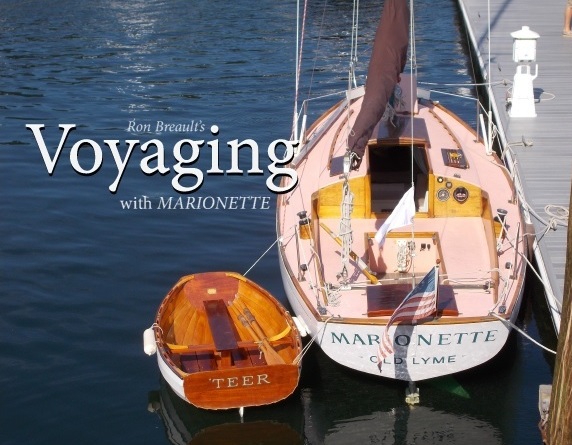
Reading Uncertainly: ‘Voyaging with Marionette’ by Ron Breault of Old Lyme


A quarter century ago, an elderly sailor glimpses an attractive middle-aged lady relaxing on the shore of the Connecticut River.  She’s a bit disheveled; her skirt is torn, revealing a bit of what’s underneath, but she’s lovely! He’s immediately smitten, and, like Henry Higgins in My Fair Lady, the sailor decides he must have an affair.

The sailor is Ron Breault, an Old Lyme resident and a Niantic Bay racer, and the Lady is not Eliza Doolittle, but Marionette, a 24 ft. Dolphin-class sloop. This book is his enthralling, copiously detailed story of their 25-year love affair.

Today she is “a woman of a certain age” and Ron’s a septuagenarian, but the mutual attraction continues. This book recounts their love life of the past quarter century as they both ask, “What next?”

Ah, the details!

The author has collected the most intimate details of this long-standing affair. He recounts almost every moment of their life together, restoring the lady’s youth, beauty, and speed, building her separate palatial quarters at his home in Old Lyme (with, of course, the complete approval of his wife, Chris), dressing her with a new suit of speedy clothes, and, to top it off, creating a tiny offspring.

The latter’s name is ‘Teer!  I thought: charioteer? musketeer? marketeer? profiteer? Ah yes, puppeteer: the perfect name for the child of Marionette! 

Everything about this voluptuous woman is described: her finery aloft and, mirabile dictu, everything underneath and below. Nothing is left to the imagination …

This loving couple then engage in both cruising and racing, two doing the tango from the Connecticut River to Niantic Bay, Fisher’s Island Sound, Block Island, Narragansett Bay, Buzzard’s Bay, the Canal, the waters of Massachusetts and New Hampshire, and, of course, the ultimate nirvana, Maine!

They detail their Penobscot Bay peregrinations from Tenants Harbor, Spruce Head, Rockland, North Haven, Vinalhaven, Isleboro, Eggemoggin Reach, Blue Hill, Deer Isle, Swans Island and on to Mount Desert, with both Southwest Harbor and Northeast Harbor. Plus numerous times in Camden, the heart of sailboat racing in Maine.

Are words insufficient for you?

Your sight is also addled with more than 700+ pictures and photos, and those who want more are directed to the author’s website: www.Dolphin24.org.

Ron and Marionette’s story illustrates superbly that famous conclusion drawn by Rat in Wind in the Willows: “Believe me, my young (and aged?) friend, there is nothing, absolutely nothing, half so much worth doing as simply messing about in boats.”

So ease your sheets, cruise downwind a bit, pop a brew or two and enjoy this love story.

Editor’s Note: ‘Voyaging with Marionette’ by Ron Breault is published by Whaler Books, Buena Vista, VA. 2020. To order a copy of this highly recommended book, visit marinermedia.com/product/voyaging-with-marionette/.

Felix Kloman

About the Author: Felix Kloman is a sailor, rower, husband, father, grandfather, retired management consultant and, above all, a curious reader and writer. He’s explored how we as human beings and organizations respond to ever-present uncertainty in two books, ‘Mumpsimus Revisited’ (2005) and ‘The Fantods of Risk’ (2008). A 20-year resident of Lyme, Conn., he now writes book reviews, mostly of non-fiction, a subject which explores our minds, our behavior, our politics and our history. But he does throw in a novel here and there.
For more than 50 years, he’s put together the 17 syllables that comprise haiku, the traditional Japanese poetry, and now serves as the self-appointed “poet laureate” of Ashlawn Farm Coffee, where he may be seen on Friday mornings. His late wife, Ann, was also a writer, but of mystery novels, all of which begin in a village in midcoast Maine, strangely reminiscent of the town she and her husband visited every summer.

A la Carte: Last Week, Pesto, This Week, Pasta … But ‘e Fagiole!’

Lee White

It was a nice week: a little rain, a lot of sunshine, my first trip to the beach and low humidity. One evening, friends and I had dinner at Filomena’s, outside under a big tent, and listened to the New London Big Band, minus about six members, play mellow jazz. The decibels of the speakers were just right, it threatened to rain but didn’t and the food, as usual, was yummy.

I cooked quite a bit at home, on the grill and even in the kitchen, since my condo is air-conditioned. I also spent some time at two different farm markets. At my CSA, I got carrots, blue green beans, some lettuces, flowers and some cheese.

At the Groton Farm Market in Washington Park, I bought some cranberry beans, basil and tomatoes. I asked whether the tomatoes at Whittles were local, and she said they were their own. “We don’t have many yet, but these are our own,” she explained. I was very surprised; this is the first time I can remember when local tomatoes arrived before sweet corn.

When I got home I tasted one of the tomatoes and there was no doubt it was local. As I made myself my first summer BLT, I thought what I might make with some of my harvest and I found pasta e fagiole (pasta and beans) that I had written about in 2005.

I looked up cranberry beans and saw that it took under half an hour until they softened. I found pepperoni links, some canned cannellini beans, ground beef and pepperoni in the freezer and a big can of fire-roasted Muir Glen diced tomatoes. I had frozen my own basil pesto and decided I would use that instead of parsley. 

On Sunday afternoon, I made the pasta and beans. It was really good, maybe even better than before, since so many of the ingredients were so fresh.

If you have air-conditioner, make it now. If not, save that recipe for fall or winter. 

Pasta e Fagiole

2 tablespoons extra-virgin olive oil
4 cloves garlic, minced
1 small onion, diced
A handful of baby carrots, diced into small pieces
3 stalks celery, diced small
1 pound ground beef (optional)
½ pound pepperoni, thinly sliced (optional)
1 can cannellini beans, drained and rinsed
About half of pound of cranberry beans, cooked
About half of pound of blue green beans, cut into 1 inch slices
1 28-ounce can diced tomatoes (preferably Muir Glen but another will do)
1 small can tomato paste
2 tablespoons basil pesto (optional, but delicious)
2 cups water
salt and pepper to taste
1 tablespoon finely chopped parsley
½ pound pasta (ditalini, tubetini or small elbow macaroni), cooked
freshly grated Parmigiano-Reggiano or romano cheese

In a large heavy-bottomed pot, brown onion. garlic and carrots in olive oil until light golden. Stir in celery and continue cooking until celery is tender. If using ground beef, add and cook until no longer pink. If using pepperoni, add now. Stir in beans, tomatoes, tomato paste and water.   Bring to a boil, then reduce to simmer, cover and cook about half an hour, stirring occasionally. Add salt and pepper, to taste, and parsley. Add pasta to soup and cook for an additional 5 minutes. Serve with freshly grated Parmesan or Romano.

About the author: Lee White has been writing about restaurants and cooking since 1976 and has been extensively published in the Worcester (Mass.) Magazine, The Day, Norwich Bulletin, and Hartford Courant. She currently writes Nibbles and a cooking column called A La Carte for LymeLine.com and also for the Shore Publishing and Times newspapers, both of which are owned by The Day.

A la Carte: Pesto is Perfect for Pasta … and More

Lee White

I am amazed how friends have managed to get tasks done during this pandemic isolation.

The Fitzgerald’s garden looks like something out of a French painting with pots of herbs on the fence,  homemade cushions with seating for friends and two gorgeous cocker spaniels lazing on my legs, adding to the ambience.

The Robertson’s grass look like a golf course and their bird-feeders have hovering mammas feeding fledglings.

Even my condos are so full of perennials they are about to spill onto the sidewalks.

I seem to do less house-cleaning and more reading, cooking and watching television. The house is clean (the kitchen always pristine), but the clutter gets to me. I do put the bills where they need to be, so I can pay them, and I get rid of junk mail quickly and take it — plus the newspapers — to the dumpster, but the magazines I put in neat piles and sometimes forget to read them.

Such was the case with the May/June  issue of Yankee, which probably arrived in April. I love Yankee, especially its columnists. I have known Amy Traverso, its senior food editor, for a long time and her articles and recipes are really good.

In that issue, she writes about The Blue Oar in Haddam, Conn., on our part of the shoreline. And in another, she has a recipe for strawberry shortcake, with the shortcake made with pistachios. Obviously, local strawberries are gone but I will use the shortcake recipe with pistachios — it uses heavy cream instead of butter, making the recipe easier to make.

Another piece is about Krista Kern Desjarlais and her two restaurants in Maine. You may remember her from her restaurant in Westerly called Three Fish. Decades ago, she was serving pastries that were not only delicious but picture-perfect. I wrote about her then and have followed her ever since. I ate at her Portland, Maine, tiny restaurant, Bresca, a few times and loved everything about it. 

In the magazine, she included a recipe for Pistachio Pesto. I make basil pesto every summer, package about two big tablespoons in plastic snack sizes, freeze the packages separated by paper towels and the little ones into a bigger plastic bag. (The paper towels allow you to separate the snack packs one at a time. You can warm the packets in your hands and they are warm by the time your pasta has boiled and drained.)

To make pesto, use any herb for the sauce. And if you are out of pine nuts (pretty expensive and difficult to find), use walnuts. The flavor will be different but still tasty. Krista suggests pistachios. I never thought of that.

Use the recipe below and, this summer, choose almost any herb you have and any nuts available. In addition to cooking pasta with pesto, use it in marinara or most other red sauce or in stew this winter, especially if you make pesto out of parsley.

Krista also uses a tablespoon each of lemon zest and lemon juice and a little shallot. All this sounds delicious, doesn’t it?

Photo by Artur Rutkowski on Unsplash.

Pesto alla Genovese

(from 365 Ways to Cook Pasta by Marie Simmons, Harper Collins, New York, 1988)

I triple or quadruple (or more) and freeze pesto in small zipper plastic bags. The pesto will last for more than a year and will thaw in minutes. 

Yield: 1 cup or enough for 1 pound of pasta

2 cups packed fresh basil leaves
1/3  cup pignoli (pine nuts)
1 large garlic clove, chopped
¼  teaspoon salt
½  cup extra-virgin olive oil
1/3 cup freshly grated Parmesan cheese

Finely chop basil, nuts, garlic and salt in a food processor. With processor still running, add oil in a slow, steady stream through the feed tube until mixture is thoroughly blended. Transfer to a bowl and fold in the cheese.

Freeze in tiny freezer bags. When ready to use, you can thaw the pesto in freezer bag between your hands.

About the author: Lee White has been writing about restaurants and cooking since 1976 and has been extensively published in the Worcester (Mass.) Magazine, The Day, Norwich Bulletin, and Hartford Courant. She currently writes Nibbles and a cooking column called A La Carte for LymeLine.com and also for the Shore Publishing and Times newspapers, both of which are owned by The Day.

Legal News You Can Use: I Am Me — The Feminine Side of Lawyering

Having a female lawyer can provide a level of personal comfort for some clients. Similar to seeking a female doctor, prospective clients routinely consider gender when seeking a lawyer’s legal advice and advocacy.

I am female and I am a lawyer, and oftentimes, clients say to me “I called you because I need to speak to a female about what has happened to me: only a woman will understand.”

Whether you are dealing with a life-changing event such as a divorce, you are the victim of a crime, accident or botched medical procedure, or you are grappling with the nearly impossible feat of work/life balance and facing workplace disparities or overt discrimination or harassment, your unique issue may be one where consulting and a retaining a female attorney may be most appealing.

Perhaps it is because women are natural listeners and problem-solvers, or because female attorneys tend to approach clients and their cases with empathy and a comforting, compassionate tone. We are smart, intuitive, collaborative and persistent.  Our ability to connect, on a personal level, with so many of our clients is likely because of these attributes, which work to the client’s advantage when in need of zealous advocacy.

Warning: underestimate a female attorney at your own risk.  Clients who are comfortable with their attorney willingly share the most important, more intimate details about a situation they are dealing with, arming their attorney with better-problem solving capabilities, which often leads to overall positive end results.

To their client’s advantage, female attorneys carry these attributes to the negotiating table or the courtroom, where we are well-organized and prepared, and we connect well with witnesses, judges and jurors, often having the tone and demeanor that not only commands respect but is viewed as credible and worthy of the fact-finder’s trust.

I recently read a piece published in 2020 Texas Law Review, “Reflections of a Lady Lawyer” by Lisa Blatt, which is relatable.  In speaking as a female lawyer, Blatt wrote “[w]omen don’t look or talk like Perry Mason, and you don’t want us to.”  When dealing with the situations in life that typically bring clients to seek a lawyer, there is comfort in having a lawyer who “gets you.”

I do not look or talk like Perry Mason.  I am me.  I am a female.  I am a mother.  I love my work.  I empathize with you.  I grapple with the work/life balance (and the inherent mother’s guilt) of maintaining a successful legal practice while driving the soccer carpool and being an attentive dance mom.  I hear you.  I represent you.

This post is sponsored by Suisman Shapiro Attorneys-at-Law.

Editor’s Notes: i) Suisman Shapiro is located at 75 State Street, New London, CT 06320. Their mailing address is 2 Union Plaza, P.O. Box 1591 New London, CT 06320.

Atty. Kristi Kelly

ii) Kristi Kelly concentrates her practice in labor, employment, and municipal law at Suisman Shapiro, the largest law firm in eastern Connecticut.  Living along the shoreline, raising her three children, Kelly is an attorney with whom the firm’s clients connect — they find her approach comforting in the most stressful times in their lives. Kelly regularly works with other female attorneys in the firm, Eileen DugganJeanette DostieCarolyn Kelly and Jillian Miller to meet client needs in many areas of law.  She is a VA accredited attorney and 2020 recipient of the Connecticut Bar Association’s Honorable Anthony V. DeMayo Pro Bono Award for her work to provide advocacy for veterans recovering from homelessness and mental illness to overcome barriers to housing, healthcare and income.