The Movie Man: Positive Thoughts on Dealing With the “Ambiguous Loss” of a Night at the Movies

Kevin Ganey is ‘The Movie Man.’

Around the start of 2019, I published a piece lamenting the rise of A-list movies being released through direct-streaming services such as Netflix. I figuratively begged the cinematic geniuses to never go down this path and always stick to theatrical releases.

I was frustrated to learn that my favorite filmmaker, Martin Scorsese, was releasing his highly anticipated crime-epic, The Irishman, via Netflix, (but he revealed the main reason for choosing the source of lazy date ideas was because Netflix was the only studio that would fund the picture for its de-aging effects.)

But nobody would have anticipated this “new normal” that we would come to experience due to the Coronavirus pandemic. Studios that planned for new releases suddenly needed to get creative in order to assure they did not suffer financial losses, so many of these flicks were released via streaming services.

The first one that I watched through this ‘New Normal’ was Pixar’s Onward and it did not feel the same. It was as if I stumbled upon a movie that had been released in the last few years but had slipped my mind when it came to catching (this accounted for the fact that I watched it mid-afternoon while the sun shone through the windows.)

The new Bond movie No Time to Die was scheduled for a theatrical release in April but was postponed to this coming November. I fear that it is highly likely that the 25th installment of Ian Fleming’s iconic spy (and Daniel Craig’s last run as the character) will be released via Amazon or Apple TV via purchase, something Albert R. Broccoli and Harry Saltzman (the original creators of the James Bond films) never could have imagined.

My biggest lament when I wrote my original piece was that we would be deprived of the movie-going experience, from purchasing your ticket at the box office (or scanning your previously paid ticket on your phone), picking out your snacks, finding your seats, and chatting with your friends as the commercials and movie trivia games were displayed before you. Then the lights went down for the previews and you shared your desire to see it or skip it, after that the lights went down even further for the feature presentation, and finally — after the credits — you walked out, letting it all soak in.

Now it’s just turning on the TV, finding the app, starting it (and pausing it in case you need to take a phone call or go to the bathroom, which can lead to distractions and never finishing the movie.) Assuming you do finish it, you look over to whomever you were sitting with (assuming this is someone you can invite into your home without fear of infection) and critiquing it amongst yourselves.

But guess what?

Life happens, and pandemics are part of life, even if they only occur once every century, and we need to adjust. We need to make sacrifices. The main sacrifice that we have had to make is to forfeit our ability to socialize, which is truly a burden on us as social creatures.

This has led to athletes competing in “bubbles” as fans are no longer allowed to spectate, concerts have been called off, and, as we have recently seen, political conventions could only be screened on TV (though some participants still deliver their speeches as if there is a crowd before them, leading to an awkward scene [you know which person I’m talking about …]) Of course, this also includes going to the movies.

We’ve seen so many industries that have been delayed because of this and need to take a break in order to safely get back to work. This also includes the production of highly anticipated films and TV series that probably will not be able to be completed until it is deemed safe for the cast and crew to assemble together, and will perhaps require creativity to present our heroes always standing six feet apart.

Imagine how romance scenes will be filmed as they keep their distance while confessing their undying love for each other?

My mother recently shared the term, “Ambiguous loss,” with me, which she teaches in her therapeutic horseback riding work. Basically it’s a loss like any other, but there is no tangible or concrete end, such as losing somebody during wartime and having no answer to where they are.

It is quite clear that we are in the middle of an “ambiguous loss” at the moment, as we wonder what will transpire in the coming months (or even years) as we anticipate the arrival of a vaccine to defeat COVID-19.

She also shared a phrase that is often thrown around as a way to console others, “Everything happens for a reason.” I had to balk at that because there are clearly some things that happen, which have no rhyme nor reason whatsoever. She agreed, having observed in recent years that words matter and can have negative consequences.

After much discussion, we ultimately decided that a better way to justify these losses is to consider them not as the end, but rather that they could lead to something better if we put the appropriate effort into them.

While we must make sacrifices in the meantime, they will lead us to appreciate everything that we cherished or even took for granted. I hope that from a cinematic perspective, we can appreciate movies in the way in which they have been historically presented to us: as an extension of the theater — accessible to all throughout the world for all time. While the theater is no longer a top venue of entertainment, I hope that we can eventually appreciate our movie-going experiences and treat them like a night out at the theater.

As we long for an unimpeded return to restaurants, concerts, and sports events, so too we should anticipate and celebrate the return of a night at the local cinema.

About the Author: Though no longer a resident of Lyme, Kevin knows he can never sever his roots to the tree of his identity. When not attending to his job in Boston, he is committed to ensuring a better grasp of current (and past) releases of cinema to his home community as he strives to leave his own mark in the same field that has always been his guide to understanding life. If you enjoy his published reviews here on LymeLine.com, follow him on his new website at ‘The City of Cinema and read more of his unique insights into entertainment.

A View From My Porch: Great Leaders and Great Speeches. Part 5: Cold War “Visual Aids”

Editor’s Note: This the fifth part of Thomas Gotowka’s series titled “Great Leaders and Great Speeches.’ The previous four parts can be found at these links:

A View from My Porch:  Great Leaders and Great Speeches, Part 1: Washington’s Farewell through Theodore Roosevelt

A View from My Porch:  Great Leaders and Great Speeches, Part 2: Nazi Aggression through “A Rain of Ruin from the Air” on Hiroshima

A View from My Porch:  Great Leaders and Great Speeches, Part 3: The Cold War 

A View from My Porch: Great Leaders and Great Speeches, Part 4: The Cold War Heats Up


The last essay concluded with President Kennedy’s humiliation of the Soviets and the resultant dismantling and removal of their offensive weapons from Cuba.
The United States had stepped back from the brink of nuclear war.

In this essay, I explore the “Visuals” of the Cold War. What were anxious Americans reading and watching during that tense era? I will then wrap up my treatise on the Cold War with a review of the gradual “wind-down” of hostilities, and the collapse of the Soviet Union.

As always, my goal is that the reader gets a solid foundation in the fundamentals of the subject, which may even pique their curiosity enough to seek additional information.

COLD WAR VISUALS & EVENTS:

Images played an important role in waging the Cold War and communicating its possible impacts to Americans. The importance of television, posters, cinema, and political cartoons in representing our Cold War enemy was recognized early. Public Service Announcements and posters often featured mushroom clouds and some reference to “We will bury you”.

I have strong memories of a large portion of the Cold War era, and, being familiar with the demographics of SE CT, I know that I am not unique. 

Americans feared that the Soviet Union would launch an unprovoked attack on the United States with nuclear weapons. I am only providing a small sample of what Americans were reading, watching, or hearing from their leaders during that tense era; and just a few of the events that also affected our collective angst.

Much of the following was created or supported by a series of independent government agencies involved in civil defense.

In the early 1950s, schools performed emergency “Duck and Cover” drills to prepare children to react in a manner that provided some protection in a nuclear attack. The animated character, “Bert the Turtle”, engaged the youngest Americans in preparing for these drills. Students were trained to dive under their desks and cover their heads. Desks were incredibly sturdy back then.

“I Led Three Lives” was a series that aired from 1953 through 1956 on American television, and covered the activities of Herbert Philbrick, a young professional in 1939 Boston, who infiltrated a Communist Party Cell in Cambridge, Mass.; and worked covertly with the FBI for nine years. His cover was so convincing that he was asked by Cell leaders to follow other comrades to assess their loyalty. Hence, his three lives: white-collar worker, Communist agent, and FBI operative thwarting Communist plots.

On Oct. 4, 1957, the Soviet Union successfully launched Sputnik1, the world’s first artificial satellite, and one of three in the Soviet “Sputnik” program that achieved orbit.  Sputnik1 remained in orbit until Jan. 4, 1958, when it dropped and burned in the Earth’s atmosphere. Many Americans feared the potential “sinister” uses that the Soviets could bring to bear on us with this expertise in rocket and satellite technology. 

However, more serious was the perception of American weakness and loss of scientific leadership, which then contributed to Kennedy’s election win, as he had emphasized the “space gap” and the role of the Eisenhower-Nixon administration in creating it.

Our government, the military, and the scientific community were caught off guard by the Soviet technological achievement; and, as a result, combined their efforts to catch and surpass the Soviets, marking the beginning of the “space race”. Our first satellite, Explorer1, was launched on Jan. 31, 1958; and, with more advanced communications technology than Sputnik, provided the first data transmitted from space, revealing the presence of radiation belts encircling the Earth, now known as the Van Allen Radiation Belt. 

In 1958, NBC presented “Ten for Survival”, a 10-episode television series on how to survive a nuclear attack. There were also several pamphlets accompanying the series, published by the Department of Defense Office of Civil Defense.

“AXIOM FOR SURVIVAL: If this country is attacked with nuclear weapons, you can protect yourself. But first, you must know what to do and how to do it.” The associated pamphlets covered subjects ranging from “dealing with the three main effects of a nuclear explosion (i.e., “Heat, Blast, Fallout, Heat”) to “preparing to live in a fallout shelter”.

During the Plenary Meeting of the United Nations General Assembly on Oct. 12,1960, Nikita Khrushchev, Soviet First Secretary of the Communist Party, removed his shoe, and raised it above his head as if to strike the desk, in protest at a speech by another delegate, who stated that Eastern Europe had been “deprived of political and civil rights due to the dominant influence in the region by the Soviet Union”.

Note that it was reported widely that he did strike the desk, but I could only locate photographs of a “threat to pound”, with shoe held above his head.
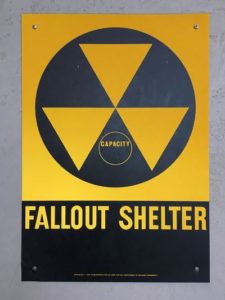
A fallout shelter sign in the United States of America. Photo by Geraldshields11. Published under the Creative Commons license.

Fallout shelters became that generation’s wine cellars and whirlpool tubs in essential home features and improvements. In a speech on “Urgent National Needs” delivered to a joint session of Congress on May, 25, 1961, President Kennedy stated that, “his Administration has been looking hard at exactly what civil defense can and cannot do. It cannot be obtained cheaply. It cannot give an assurance of blast protection that will be proof against surprise attack or guarantee against obsolescence or destruction. And it cannot deter a nuclear attack.” (Holy Cow!) 

Then, in July, after the Soviets imposed a blockade on West Berlin, Kennedy  said in a televised speech, that “in the event of an attack, the lives of those families which are not hit in a nuclear blast and fire can still be saved if they can be warned to take shelter, and if that shelter is available.”

Finally, on Oct. 6, he advised families to build shelters to protect themselves from atomic fallout in the event of a nuclear exchange with the Soviet Union. In another speech on civil defense issues, Kennedy assured the public that the government would soon begin providing such protection for every American.

The President went on say: “We owe that kind of insurance to our families and to our country. The time to start is now. In the coming months, I hope to let every citizen know what steps he can take without delay to protect his family in case of attack. I know you would not want to do less.” 

Congress approved $169 million to locate, mark and stock fallout shelters in existing public and private buildings. Note that this all occurred about a year before the Cuban Missile Crisis.

Periodicals like “Better Homes and Gardens”, “Life Magazine”, and “Popular Science” all included articles on fallout shelters, aimed at readers who were preparing to build the best possible shelter. How-to booklets were widely available, with instructions and diagrams in the finer points of building and equipping your family fallout shelter.

Even earlier, Eisenhower’s Federal Civil Defense Administration (FCDA) had urged American families to maintain a seven-day supply of food and water in case of an atomic emergency. The FCDA launched an initiative called “Grandma’s Pantry”, with slogans like “Grandma was always ready for an emergency.” They produced thousands of “Grandma’s Pantry” exhibits for use in stores, with advice on what should be in every American’s disaster pantry.

The “Mother of All Fallout Shelters”:

In 1955, President Eisenhower instructed the Department of Defense to develop emergency plans to relocate Congress and ensure continuity of government in the event of a nuclear strike. The Army Corps of Engineers selected the Greenbrier Resort property in White Sulphur Springs, W.Va., which was relatively close and accessible to Washington, D.C., but distant enough to be safe from an atomic bomb dropped on the Capital.

The Greenbrier had served as a confinement facility for Japanese, Italian, and German diplomats; and then as a military hospital during the second world war. 

Construction on the “super-bunker” Relocation Center began in 1957; and was completed in October, 1962, just as the Cuban Missile Crisis loomed. The Greenbrier bunker was buried 720 ft. underground. It would not survive a direct nuclear strike, but was capable of withstanding a blast 15 to 30 miles away and protecting its occupants from fallout.

The facility‘s two levels totaled about 115,000 square ft., “roughly the size of two football fields on top of one another”. Although the presence of the bunker was a closely-guarded secret, its largest halls, which were intended for sessions of Congress, were actually depicted as part of the Greenbrier Hotel complex, and would have been sealed off in the event of an attack.

All walls were concrete, three feet thick, and reinforced with steel. The entire structure was covered with a concrete roof and buried beneath 20 ft. of soil. It had a highly sophisticated ventilation system that was designed to circulate air and remove radiation.

The Bunker included a decontamination room, 18 rooms of dormitory space, each housing 60 people in metal bunk beds; a kitchen, and a 400-seat cafeteria, which was decorated with fake windows featuring scenic views. The upper level contained storage space and offices for Congressional leaders.

The bunker also had a hospital, operating room, pharmacy, crematorium, and a vast television, radio, and communications facility. The Relocation Center was maintained in a constant state of “readiness” by Forsythe Associates, which was later described by the Washington Post as an “obscure company ostensibly based in Arlington, Va.” These on-site employees claimed that their purpose was to maintain the hotel’s 1100 televisions.

The bunker remained a closely-guarded secret until 1992, when the Post published “The Ultimate Congressional Hideaway.” Given that its secure location was one of the primary guarantees for its defense, the bunker was quickly decommissioned and became the Greenbrier Cold War theme park. (To schedule a tour, call 844-690-4141. Adults: $39 per person Youth (10-18): $20 per person.)

The “Miracle on Ice” — some Cold War good news:

In 2005, the Olympic Center ice arena in Lake Placid where the Miracle on Ice took place was renamed the Herb Brooks Arena in the US ice hockey coach’s honor.

“Miracle” was a medal-round game between the United States and the heavily-favored Soviet Union that occurred during the men’s ice hockey tournament at the 1980 Lake Placid Winter Olympics. Our team of college players, the youngest team at that tournament, held on to beat the four-time defending gold medalists Soviet Union team of “amateurs” by a score of 4 to 3. 

Two days later, the United States secured the gold medal by beating Finland in their final game. The Soviet Union beat Sweden for the silver. (USA! USA!) 

The United States’ victory over the Soviets became one of the most iconic moments in sports; and, in 1999, was named by Sports Illustrated as the top sports moment of the 20th century. Perhaps as well-known as the final score was the call in the final seconds of the game by Al Michaels for ABC Sports, when he declared: “Do you believe in miracles? YES!” 

Some Final Scary Thoughts:

Most historians doubt that the Greenbrier bunker could have been used effectivelyMissile technology had so decreased the time between a “decision to strike” and the appearance of a bomb crater that a safe relocation of Congress in anticipation of an imminent attack was virtually impossible. An early relocation would have been provocative to the Soviets.

In his May, 25, 1961 speech, Kennedy also stated that “we will deter an enemy from making a nuclear attack only if our retaliatory power is so strong and so invulnerable that he knows he would be destroyed by our response. If we have that strength, civil defense is not needed to deter an attack. If we should ever lack it, civil defense would not be an adequate substitute.”

Thus, it was widely believed by Cold War strategists that war with the Soviet Union was largely prevented by the fear of mutually-assured destruction (i.e., the MAD Doctrine). In simple terms, the theory of deterrence assumes that, because a full-scale use of nuclear weapons by two or more opposing sides would cause the complete annihilation of both the attacker and the defender; the threat of using such weapons against the enemy prevents the enemy’s use of those same weapons. 

This deterrent concept assumes rational calculations by rational people; which I am not convinced that we still possess at the highest levels of Government.

Is “person, woman, man, camera, TV” ever really enough?

This is the opinion of Thomas D. Gotowka.

Tom Gotowka

About the author: Tom Gotowka’s entire adult career has been in healthcare. He’ will sit on the Navy side at the Army/Navy football game. He always sit on the crimson side at any Harvard/Yale contest. He enjoys reading historic speeches and considers himself a scholar of the period from FDR through JFK.

A child of AM Radio, he probably knows the lyrics of every rock and roll or folk song published since 1960. He hopes these experiences give readers a sense of what he believes “qualify” him to write this column.

A la Carte: It’s Almost Labor Day, But There’s Still Time for ‘Summer Vegetable Stew’

Lee White

Last weekend, between cooking (more basil pesto and Coca Cola chocolate cake), reading (finally finished Scott Turow’s The Last Trial) or watching television (not much left now except MSNBC and the third season of The Good Fight.)

I also spent some time on Facebook. My south-of-the-Baldwin-Bridge editor, Pem McNerney, who is no slouch when it comes to cooking, made something with tomatoes and eggplant. 

I love eggplant. Needless to say, I did not grow up with fresh vegetables. I doubt that my mom even knew what an eggplant was. I think the first time I tasted it may have been in the early 80s, and it was, of course, eggplant parmigiana.

When we moved to Old Lyme, my next door neighbor told me she had the original recipe from Fatone’s restaurant, where she once worked. I mentioned that Sam Gejdenson used to make it, and she said he learned it from the Fatones. She made it and it is still the best eggplant parm ever. She showed me how to make it, too. 

Today I love eggplant in every way imaginable.

I have made ratatouille, even before that adorable animated movie. I once cooked it whole, unpeeled on a charcoal grill, when its insides have the texture of a Three Musketeer candy bar and the skin has the snap of a warm-from-the-garden tomato.

I forgot to ask Pem for her recipe but I found one in an old cookbook by Michele Scicolone. For me, the star of the show is not just the eggplant, but because the recipe is so simple. It will be my favorite eggplant go-to until its summer bounty is a memory.

Summer Vegetable Stew

Photo by Monika Grabkowska on Unsplash.

From Italian Holiday Cooking by Michele Scicolone (William Morrow, New York, 2002

The author says you can add any vegetable to the mix, including zucchini, summer squash, celery and green beans. Sometimes she leaves out the cheese and adds basil or parsley. Best of all, she mentions it makes a wonderful sandwich stuffed into a fresh grinder roll.

Yield: serves 6

1 medium eggplant, trimmed and cut into bite-sized pieces
2 medium red bell pepper, cored, seeded and cut into bite-sized pieces
1 large onion, diced
2 large ripe tomatoes, diced
2 medium potatoes, peeled and cut into bit-sized pieces
2 tablespoons olive oil
Salt and freshly ground black pepper
¼  cup freshly grated pecorino Romano

In a large pot, combine all the ingredients except the cheese Add ¼ cup water, cover and cook, stirring occasionally, until the vegetables are very tender. 

Just before serving, stir in the cheese. Serve hot or at room temperature.

About the author: Lee White has been writing about restaurants and cooking since 1976 and has been extensively published in the Worcester (Mass.) Magazine, The Day, Norwich Bulletin, and Hartford Courant. She currently writes ‘Nibbles’ and a cooking column called ‘A La Carte’ for LymeLine.com and also for the Shore Publishing and Times newspapers, both of which are owned by The Day.

Reading Uncertainly: ‘Talking to Strangers’ by Malcolm Gladwell

I admit that I am easily drawn to the words of Malcolm Gladwell, having already absorbed his The Tipping Point (2002), Blink (2007), and Outliers (2011).  I was not disappointed!.

This is yet another intriguing and challenging mental exercise about the way in which our brains tend to mislead us,

Consider meeting someone new and engaging in conversation: afterwards, we think we have understood each other, but have we really?

Gladwell cites many past meetings that have resulted in gross misunderstanding: Cortes and Montezuma; Hitler and Chamberlain; Sandra Bland and the Italian police; Bernie Madoff and investors;, Sandusky and the Penn State authorities.

He suggests the fallacy lies in “… the assumption that we all follow in our own effort to make sense of strangers. We believe that the information gathered from a personal interaction is uniquely valuable.”

It is our instinctive desire to believe what a stranger tells us: our latent bias to trust what we hear. But the emotional responses to others can be and often are misleading.  Gladwell says, “We tend to judge people’s honesty based on their demeanor.” Hesitancy, looking away, stammering, all lead us to doubt, but even those traits are misleading.

We are inevitably a species, “a society (that) does not know how to talk to strangers.” When we look differently, act differently, dress differently, we create instinctive wariness, alarm and natural aversion. When the stranger looks, acts, dresses and sounds like us, our natural sympathies are aroused.

Gladwell’s conclusion? Misunderstandings are entirely natural. “We will never know the whole truth,” so “… what is required of us is constraint and humility.”

So take heed … listen; pause, and think!

Editor’s Note: ‘Talking to Strangers’ by Malcolm Gladwell is published by LittleBrown, New York 2020.

Felix Kloman

About the Author: Felix Kloman is a sailor, rower, husband, father, grandfather, retired management consultant and, above all, a curious reader and writer. He’s explored how we as human beings and organizations respond to ever-present uncertainty in two books, ‘Mumpsimus Revisited’ (2005) and ‘The Fantods of Risk’ (2008).

A 20-year resident of Lyme, Conn., he now writes book reviews, mostly of non-fiction, a subject which explores our minds, our behavior, our politics and our history. But he does throw in a novel here and there.

For more than 50 years, he’s put together the 17 syllables that comprise haiku, the traditional Japanese poetry, and now serves as the self-appointed “poet laureate” of Ashlawn Farm Coffee, where he may be seen on Friday mornings. His late wife, Ann, was also a writer, but of mystery novels, all of which begin in a village in midcoast Maine, strangely reminiscent of the town she and her husband visited every summer.

A la Carte: You Deserve Something Special! Triple-Ginger Pound Cake Beckons

Lee White

Last week I made the most delicious dinner I’d ever made. And the easiest. And so satisfying that no dessert—ice cream, cookies, cheesecake or crème brulee—was necessary.

Here’s what it was: a T-bone steak I’d bought and frozen when they were on sale, three sliced tomatoes. mashed potatoes from 20 tiny ones I’d purchased from Stone Acres in Stonington and two ears of sweet corn from Whittle’s in Mystic.

The steak was grilled almost black but the middle was blood red, just the way I like it. My next-door neighbor was also grilling at his patio and was concerned, I think, because my grill was smoking.

I took it off the grill and placed it on a plate and let it sit on the dining room table as I sliced and salted the tomatoes, mashed the potatoes with a little milk and butter, and then set everything down.

Those 10 minutes made all the difference, as they always do, allowing the juices to recede back into the meat.

I hope you are all having amazing, healthy and fresh food this summer. Healthy, you say? A steak?

Truth is it is probably the first time I have grilled a steak in six months, so a steak is just an extravagance after lots of chicken, vegetables, seafood and salad. I hope you are all getting food as fresh and local as I am and cooking it yourself, knowing exactly what the ingredients are and where they come from.

I bet you are playing with ingredients, too.  I received an incredible e-mail from Carol Sepowitz from New London, who used a recipe I’d found for poached cod. She’d bought the cod from Stonington Farm Market and used small yellow tomatoes, but didn’t have one of my ingredients.

“I made the cod for dinner,” she wrote, “but  had no coconut cream. I [did] have the Nature’s Promise organic frozen coconut fruit bars on the stick from Stop & Shop. When it came time to add the coconut milk, I let the fruit bar melt into the tomatoes and it made a wonderful poaching sauce adding to the spices. The fish was so good!” Isn’t that amazing?

I have always said home  cooks may be better than chefs. I like recipes from cook authors and restaurant chefs, but kitchen innovators are often people like Carol. 

Just because we are eating healthy, below is a not-too-sweet cake for dessert (or toasted for breakfast) when you want something you deserve.

Triple-Ginger Pound Cake

Makes 2 loaves

Photo by Sheri Silver on Unsplash.

3 and ½ cups all-purpose flour
1 tablespoon ground ginger
2 and ½ teaspoons baking powder
1 teaspoon salt
2 cups sugar
1 cup (2 sticks) unsalted butter at room temperature
2 large eggs
2 large egg yolks
1 tablespoon vanilla extract
1 and ¼ cups milk (do not use low-fat or nonfat; 2 % is okay)
½ cup minced crystallized ginger
3 and ½ tablespoons grated peeled fresh ginger

Preheat oven to 350 degrees.
Grease (or use Pam) two 9 by 5 by 3-inch loaf pans.
Sift flour, ground ginger, baking powder and salt into medium bowl. Using electric mixer, beat sugar and butter in large bowl until fluffy (at least two minutes).
Add eggs and yolk one at a time, beating after each addition.
Beat in vanilla.
Mix dry ingredients and milk alternately into batter.
Fold in crystallized ginger and grated ginger.
Divide batter between prepared loaf pans.
Bake cakes until tester inserted into the middle of the cakes come out clean.
Cool in pans 10 minutes or a little more. Cut around sides of pan to loosen.
Turn cakes onto rack and cool completely.
Can be prepared up to 1 month. Double wrap cakes in plastic and freeze.

About the author: Lee White has been writing about restaurants and cooking since 1976 and has been extensively published in the Worcester (Mass.) Magazine, The Day, Norwich Bulletin, and Hartford Courant. She currently writes ‘Nibbles’ and a cooking column called ‘A La Carte’ for LymeLine.com and also for the Shore Publishing and Times newspapers, both of which are owned by The Day.