A la Carte: Pork in a Pandemic, Roasted with Sauerkraut Gives Lots of Leftovers

Lee White

The pandemic has certainly made my days and weeks disappear.

Has it really been almost 11 months since our children went to school? Last January, would we have understood the phrase “remote learning”? Would we have known what the heck this thing called Zoom is?

Most seasons used to involve food. April meant that first sweet radish, sliced thin on sweet buttered French bread. The first salad made with soft Boston lettuce. The first platter of fried clams or a lobster roll sitting outside at Captain Scott’s or Fred’s Shanty or the Clam Castle. A hamburger or hot dog in someone’s yard on Memorial Day or the Fourth of July. Playing boules on summer Sundays.

Sure, I have cooked a lot. Honestly, I have cooked more than I ever thought I would. But so little of what I have cooked has been very seasonal.

Fortunately, I made corn chowder with corn I froze two summers ago. I didn’t bake as much since I’d no dinner parties and I was afraid I’d eat that pie in two days. Why open a bottle of wine when I would forget it in the refrigerator? 

And here I am, foraging in the big freezer in the garage. Wow, a pork roast dated 2019. I always made a pork roast on the last cool day in October. Here it is, almost February 2021, and I hadn’t made one yet.

But here it is. It’s a big one, enough for six to eight people. At the end of the recipe, I tell you how to make casseroles out of the rest.

Roast Pork Dinner … and Leftovers (for another day)

There is only one problem with this great pork and sauerkraut dinner: the pork is roasted over the sauerkraut, so you can’t make gravy from scratch. I use one of the gravy mixes you can buy at the market, preferably Knorr. To do a leftover casserole, make extra vegetables and mashed potatoes.

Yield: 2 for dinner; the casserole will feed 4 to 6 for dinner

Preheat oven at 350 degrees.

Large can of sauerkraut
6 pound (about) pork loin, bone-in (make sure butcher breaks chine so chops are easy to cut apart)
Salt and pepper, to taste
Apple sauce (24-ounce or so)
2 to 3 pounds Yukon potatoes
Fresh vegetables (broccoli, carrots, Brussels sprouts, beans, peas or a combination)
2 envelopes gravy mix

In the sink, place sauerkraut in a colander. With your hands, twist water out of the kraut as much as you can. 

In a large Pyrex baking dish, form sauerkraut into a flat loaf with your hands. Put the pork loin, bone down, onto the kraut. Season with salt and pepper. Place pork and sauerkraut onto the oven and cook for one and one-half or two hours.

Remove from the oven and, using two big forks, put kraut into another baking pan, placing the pork back onto the Pyrex baking dish. Mix apple sauce with sauerkraut in the smaller pan, and place both pans into oven. Bake for another hour.

While pork and kraut bake, make your mashed potatoes, vegetables and gravy mix. Serve.

***

After dinner, create the new casserole(s) in a freezer-safe, oven-safe container by layering the casserole(s) with mashed potatoes, vegetables, sauerkraut and small chunks of pork; pour leftover gravy on top. Place casserole(s) into a jumbo zippered plastic bag and freeze. When ready to serve, thaw, remove zippered plastic bag and roast in a 350 degree oven until hot. Serve with fresh gravy and apple sauce.

About the author: Lee White has been writing about restaurants and cooking since 1976 and has been extensively published in the Worcester (Mass.) Magazine, The Day, Norwich Bulletin, and Hartford Courant. She currently writes Nibbles and a cooking column called A La Carte for LymeLine.com and the Shore Publishing and the Times newspapers, both of which are owned by The Day. She was a resident of Old Lyme for many years but now lives in Groton, Conn.

Reading Uncertainly? ‘Brief Candle in the Dark: My Life in Science’ by Richard Dawkins

“But I digress …”

Ostensibly a continuation of his autobiography, this engrossing and superbly entertaining ramble by Dr. Dawkins, the noted Oxford zoologist, biologist, and humanist, stretches your knowledge and imagination. Is it possible to read an autobiography that is self-acknowledged as a, “Series of flashbacks, divided into themes, punctuated by digressions and anecdotes,” without losing your place, your mind and your direction?

Certainly!

And oh, those digressions: evidence of a perambulating and ever-curious mind. He drops names in his stories, recollections, and diversions, and it is fascination to follow his mind as it rambles over memory’s landscape, “… flitting like a butterfly as the interest takes me.”

Dawkins warns the reader early in his writing with a poem:

What is Life, if full of stress
We have no freedom to digress?
But if the prospect you enrages
You’d better skip the next few pages!

Neither is he reluctant to throw in a pun, trying to bridge the gap between literature and science, as in, “Où sont les C. P. Snow’s d’antan?” (a corruption of the question of one of France’s most famous poets Francois Villon’s question, Mais où sont les neiges d’antan?, which translates into English as the well-known line, “But where are the snows of yester-year?” taken from Villon’s poem Ballade des dames du temps jadis, which, in turn, roughly translates as, “Ballad of the Ladies of Times Gone By.” C.P. Snow refers to Charles Percy Snow, who was an acclaimed English novelist and physical chemist.)

Charles Darwin and natural selection lie at the core of his studies: ”Natural selection is a miserly economist, invisibly counting the pennies, the nuances of cost and benefit too subtle for us, the observing scientists, to notice,” and “gene survival” is our dominant “utility.”

Dawkins is also known for his acerbic reactions to religious dogma and beliefs, a member of a writing group that includes Bertrand Russell, Christopher Hitchens, Daniel Dennett, and Sam Harris. His conclusion: “I have tried but consistently failed to find anything in theology to be serious about. Yet he is equally candid about the ever-present “limitations of science.”

I’ve read his The Selfish Gene, The God Delusion, and The Greatest Show on Earth, and fully intend to continue to be challenged as well as enlightened by his words. His penultimate chapter, some 120 pages, is a review of the themes from his 12 books:

  • Explaining the gene as a replicator and a vehicle
  • Extending the phenotype
  • Genes as a ‘gigantic colony of viruses,” both amicable and malevolent
  • Survival requires avoiding “being too risk-averse” and being “too laid-back.”
  • Using a “functional story” as a ‘powerful aid to memory.”
  • The sonar of bats (Might he have suspected the global arrival of a coronavirus?)
  • “Only changes have surprise value” and “information is a mathematically precise measure of ‘surprise’ “
  • The “power of cumulative natural selection”
  • A cooperative gene is most likely to survive.
  • The “meme” (pronounced like “cream”) is the “new soup of human culture.”
  • And religion: “We have taken on board a convention that religion is off-limits to criticism.,” something that Dawkins resists. We can and should teach about it but we should never indoctrinate children in any particular religious tradition.

Dr. Dawkins’ parting poem, which speaks volumes of the man and his mind, is:

Still time to gentle that good night.
Time to set the world alight.
Time, yet new rainbows to unweave,
Ere going on Eternity Leave.

Editor’s Note:Brief Candle in the Dark’ by Richard Dawkins was published by HarperCollins, New York 2015.

Felix Kloman

About the Author: Felix Kloman is a sailor, rower, husband, father, grandfather, retired management consultant and, above all, a curious reader and writer. He’s explored how we as human beings and organizations respond to ever-present uncertainty in two books, ‘Mumpsimus Revisited’ (2005) and ‘The Fantods of Risk’ (2008).
A 20-year resident of Lyme, Conn., he now writes book reviews, mostly of non-fiction, a subject which explores our minds, our behavior, our politics and our history. But he does throw in a novel here and there.
For more than 50 years, he’s put together the 17 syllables that comprise haiku, the traditional Japanese poetry, and now serves as the self-appointed “poet laureate” of Ashlawn Farm Coffee, where he may be seen on Friday mornings.
His late wife, Ann, was also a writer, but of mystery novels, all of which begin in a village in midcoast Maine, strangely reminiscent of the town she and her husband visited every summer.

A la Carte: Something Different for Breakfast? Try These Savory Muffins

Lee White

Hopefully, by the time you read this, I will have an appointment for my first (and maybe my second) COVID vaccine, although that may not be the case.

My last missive from VAMS (Vaccine Administration Management System) says, “Thank you for registering … If you have not gotten that notice … ” How in heaven’s sake would someone know that they had not gotten that note if they haven’t gotten it? In any case, everyone I know has gotten an appointment and has had their first inoculation … but not me.

I am probably fine, but I would like the vaccine.

I get tested every seven to 10 days and have been pretty isolated. I am reading two to three books a week and watch too much television (even the documentary about Tiger Woods!), and cook, cook and cook. I have been eating healthy, even though I haven’t lost much weight.

I miss terribly not going out to restaurants and have not gotten much take-out either. I give myself props for that because I do know that good restaurants (and I know we have lots of good restaurants) use good ingredients, including butter, cream and sugar. I use way less of those ingredients.

My daughter Darcy cooks a lot and we talk every day about what we ate for our meals. I like it when I have already eaten so that her dinners don’t make me hungrier. This recipe came from a friend of hers, who had found it in the Jan/Feb issue of Relish.

Darcy, as always, changes ingredients and amounts, too. I do not until I have made it more than once. Overall, the recipe is good, but it needed a bit of sugar, so the one you see has a tablespoon or so of sugar. I did add a bit more broccoli than it called for.

Each morning, I eat one and it holds me until noon or 1 p.m.

Photo by Isabella on Unsplash.

Savory Muffins

Slightly adapted from Relish magazine
Yield: 12 muffins

Prepare a 12-cup muffin tin and use vegetable spray into each. Preheat oven to 400 degrees.

1 egg
1 cup milk (2 percent is fine)
¼ cup canola (or any vegetable) oil
2 cups all-purpose flour
1 to 2 tablespoons sugar
1 tablespoon baking powder
½ teaspoon salt
½ teaspoon dried mustard
1 cup shredded cheddar cheese
1 cup frozen or fresh broccoli florets, cooked in boiling water for three minutes, drained and chopped
2 scallions, chopped 

Mix together egg, milk and canola oil. 

In a large bowl, whisk together flour, sugar, baking powder, salt and mustard. 

Add the egg mixture and fold into the dried ingredients. 

Using a rubber spatula, mix in the cheese and broccoli. 

Using a large tablespoon, fill each muffin cup with the batter; slightly flatten each muffin 

Bake about 18 to 22 minutes, until golden and toothpick comes out clean.

About the author: Lee White has been writing about restaurants and cooking since 1976 and has been extensively published in the Worcester (Mass.) Magazine, The Day, Norwich Bulletin, and Hartford Courant. She currently writes Nibbles and a cooking column called A La Carte for LymeLine.com and the Shore Publishing and the Times newspapers, both of which are owned by The Day. She was a resident of Old Lyme for many years but now lives in Groton, Conn.

A View from My Porch: Thoughts on the Occasion of the Inauguration

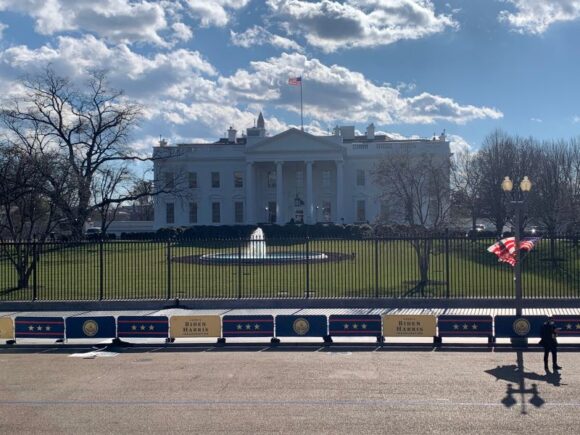
The White House on Inauguration Day. All photos by Erin O’Donnell.

At noon on this past Wednesday, Jan. 20, 2021, President-elect Joseph R. Biden was inaugurated in a ceremony on the West Front of the Capitol. This was the culminating event in what has been a hostile transfer of power from former President Donald Trump to President Biden. 

The Environment:

The then President Trump had claimed, repeatedly and without evidence, that the election result was fraudulent and “stolen” from him. Regrettably, many of his supporters have yet to acknowledge that this claim was untrue.

Consequently, there was a violent and dystopian siege on the Capitol by domestic terrorists, incited by his “Big Lie,” just two weeks before the Inauguration.

Unexpectedly, on Tuesday night, the then Senate Majority Leader Mitch McConnell affirmed that “… the president and other powerful people,” had provoked the violent attacks on the Capitol building. I am uncertain how firm he is in his conviction.

Fortunately, amidst all that turmoil, the Inauguration proceeded forward, albeit with immense security and what was  described officially as a “show of force” in place well in advance of the 20th. 

My outlet, in such chaotic and troubling times, has always been reviewing historic accounts of great men and women. I am a fan of the spoken word. A masterful presentation always stirs me. 

Motorcycles lead the parade up Pennsylvania Avenue following the Inauguration.

I’m going to reflect on the Inauguration in this essay; but, first, I’ll share a few written works and speeches that buoyed me during this chaotic period.

In 2005, a self-described “skinny Kid with a funny name” asserted to the American Library Association’s Annual Conference assembly that “the moment we persuade a child to cross the threshold into a library, we’ve changed their lives forever, and for the better.” The then-Senator Obama also said that “librarians are the ones who’ve been on the frontlines of the fight for privacy and freedom. Libraries remind us that truth isn’t about who yells the loudest, but who has the right information.” 

Likewise, Phoebe Griffin Noyes Library Director Katie Huffman has noted, “Libraries have long served as stewards of free speech, and we are proud and passionate to be a part of that tradition.”

One of my family’s most enduring favorites is “The Wind in the Willows” by Kenneth Grahame; in which he recounts the adventures of four friends, Mole, Water Rat, Badger, and the irascible Toad; on the river and in the wild woods. 

A particularly memorable passage, which is slightly abridged here, occurs when Rat convinces land-bound Mole to step into his boat and enjoy a day on the river.

Rat says, “Believe me, my young friend; there is nothing, absolutely nothing, half so much worth doing as simply messing about in boats. In them, or out of them, it doesn’t matter. Nothing seems really to matter; that’s the charm of it. Whether you arrive at your destination, or you reach somewhere else; or whether you never get anywhere at all, you’re always busy.”

Memorable Commencement Speeches:

In his 2014 commencement address at the University of Texas, Austin, retired Four-Star Admiral, William McRaven, provided this advice to the graduates: “If you want to change the world, start off each day by making your bed.”

He added, “You will have completed the first task of the day. That little sense of pride and achievement will encourage you to complete another task; and another, and another. And that will reinforce the fact that even the little things in life matter. If you can’t do the little things well, you won’t do the big things well.” 

Prior to appointment as Chancellor of The University of Texas System, his career included service as Head of the U.S. Special Operations Command; where he is known for orchestrating the mission, and leading the Navy SEAL team that conducted the successful 2011 raid that resulted in the death of Osama bin Laden.

An international celebrity, and another amphibian, gave the 1996 commencement address at Long Island University’s Southampton College School of Environmental Science. After acknowledging the importance of the environmental sciences in preserving the world’s ecosystems, Kermit the Frog (yes, really!) advised the graduates, “Never lose sight of the fact that you are not just saving the environment; you are saving the homes and lives of so many of my relatives.” He closed his address with the challenge, “You are no longer tadpoles. The time has come for you to drop your tails and leave this swamp.”
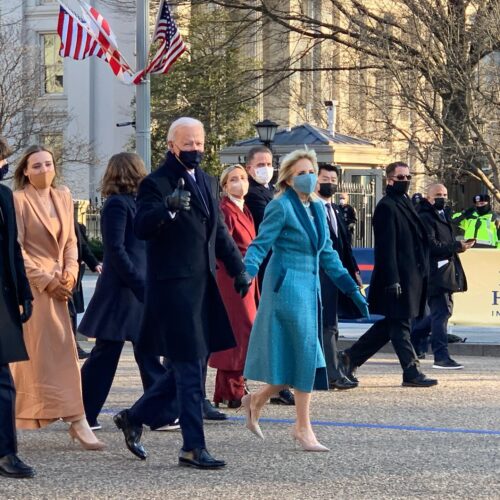
President Joe Biden and Dr. Jill Biden walk up Pennsylvania Ave. after the Inauguration on Wednesday, Jan. 20.

Reflections on the Inauguration:

There were several points in this two-day event at which I felt tears welling in my eyes. Thank you, Mr. President, and Madame Vice President. We needed that. 

I have been impressed with President Biden’s religious piety, and his pride in his family’s working-class background. He has experienced great loss in his past. His ability to convert that loss into honest and sincere empathy was demonstrated in his words on Tuesday evening, as the 400 lights around the Lincoln Memorial’s reflecting pool were lit to remember and honor the 400,000 Americans, who have died from COVID-19.

“To heal, we must remember,” Biden said. His predecessor, in contrast, never really acknowledged the tragic loss of life. 

In addition, a magnificent illuminated display of 200,000 American flags stood in the National Mall, to honor the COVID deaths. They were also in recognition of those thousands and thousands of people unable to attend the Inauguration in person amid the pandemic, and due to the intense security put in place after the violent attack on the Capitol.

Second Gentleman Doug Emhoff (third from left) and Vice President Kamala Harris (fourth from left) and their families walk up Pennsylvania Avenue after the Jan. 20 Inauguration.

President Biden was joined on the Capitol platform by former President(s) Barack Obama, George W. Bush, William Clinton, and former Vice President Mike Pence along with the former First (or Second) Ladies. President Carter and former First Lady Rosalynn Carter, who are age 96 and 93, respectively, were unable to attend the Inauguration, but had called then-President Elect Biden the night before.

President Trump refused to attend the Inauguration and bear witness to the ceremonial transfer of power, thus becoming the first outgoing president in over 150 years to leave the city before his successor had been sworn in. 

In his inaugural address, President Biden recognized the attempted insurrection, but asserted, “Democracy has prevailed.” He called for Americans to unite and confront the perilous challenges before them:- a deadly coronavirus pandemic, economic turmoil and divisions over American leadership.

The then-President-elect had told supporters as he departed from Delaware on Tuesday for Washington and the Inauguration, “These are dark times, but there’s always light.”

Marine One flies over Washington DC carrying former President and First Lady Donald and Melania Trump for the last time.

My hopes for this new Administration:

The President has promised to use the Defense Production Act and redouble the federal government’s support of COVID testing, vaccine production, and vaccine distribution.

He has also promised that the COVID-relief package passed at the end of 2020 was only a down-payment and that greater relief would be on the way. Keep your eye on the ball, Mr. President.

I hope this Administration will move beyond governance by Executive Order and actually pass some legislation.  

Finally, it is time to restore America’s greatness, its dignity, and its world leadership.

This is the opinion of Thomas D. Gotowka.

Tom Gotowka

About the author: Tom Gotowka’s entire adult career has been in healthcare. He’ will sit on the Navy side at the Army/Navy football game. He always sit on the crimson side at any Harvard/Yale contest. He enjoys reading historic speeches and considers himself a scholar of the period from FDR through JFK.

A child of AM Radio, he probably knows the lyrics of every rock and roll or folk song published since 1960. He hopes these experiences give readers a sense of what he believes “qualify” him to write this column.
A la Carte: Baby, It’s Cold Outside … so it Must be Time for Soup!

Lee White

It has been pretty cold outside and, for that matter, inside my condo. 

I keep my thermostat at 60 degrees, until friends are coming for dinner (which doesn’t happen these days because of the pandemic) or coming to watch the UConn women play basketball (my neighbors don’t have SNY network). When they visit, I turn the heat to 65. They wear their puffy jackets and I offer them down throws.

But to be honest, it has been cold enough that I often turn the heat to 65 during the day. Sometimes I forget to turn it back down at night. By the time I am in bed under my electric blanket and my down comforter, I boil.

So, often, I have to go back downstairs and turn the thermostat down. (I know, I can get a smart thermostat that does this for me, but I keep saying, “Yeah, just another two or three months and it will be warm again.” Also, I am mechanically inept and I don’t know how to put in a new thermostat.

What I do these days to keep myself just warm enough is with food. I make stews and soups and I roast a big chicken every couple of weeks.

This recipe below is from a magazine I had been hoarding for a few months because its cover promised “Time for Soup!” I love lemon soup and this reminded me how much I miss St. Sophia’s Greek Festival in New London.

There I always begin with its lemon soup, choose pastitsio for my entrée and finish with a piece of baklava. I have made baklava myself and maybe I should try pastitsio, too. In the meantime, here is a great recipe for the soup.

Greek Lemon Chicken Orzo Soup
From Food magazine, October, 2020
Yield: serves 4

6 cups low-sodium chicken broth
½ cup orzo
1 large egg plus 2 egg yolks
Kosher salt and freshly ground black pepper
5 tablespoons fresh lemon juice (from about 1 ½ lemons)
1 ¾ cups shredded rotisserie chicken (skin removed)
1 ¾ cups frozen peas and carrots

Bring the chicken broth to a boil in a medium saucepan over medium-high heat. Add orzo and cook 2 minutes less than the label directs.

Meanwhile, whisk the egg, yolks, ¾ teaspoon salt and ¼ teaspoon pepper in a medium bowl. Whisk in the lemon juice. Reduce hear under the orzo to low, scoop out 1 cup broth with a ladle and pour it into the egg mixture in a steady stream, whisking with the other hand. Then pour the egg mixture into the saucepan with the remaining broth and orzo in a steady stream, whisking constantly.*

Stir the chicken into the soup, increase the heat to medium and bring it to a gentle simmer, stirring often, Cook stirring, until the soup thickens slightly, about 4 minute. Stir in the peas and carrots and warm through.

*You need to warm up (or temper) your eggs before you add them to the broth or else you’ll get scrambled egg soup! Whisk the eggs with a little hot broth first, then slowly whisk them into the soup.

About the author: Lee White has been writing about restaurants and cooking since 1976 and has been extensively published in the Worcester (Mass.) Magazine, The Day, Norwich Bulletin, and Hartford Courant. She currently writes Nibbles and a cooking column called A La Carte for LymeLine.com and the Shore Publishing and the Times newspapers, both of which are owned by The Day. She was a resident of Old Lyme for many years but now lives in Groton, Conn.