A View From My Porch: Epic Poems of Folk and Rock Part 2 

In my previous essay, I discussed a few contemporary works of folk music, that, in my opinion, are natural successors to the epic poems of antiquity. I continue the “epic poems” theme in this essay, but shift to the epic works of conflict; focusing on the rock and roll genre, as influenced by the Vietnam War, which remains in my memory as a chaotic and tragic period of American foreign policy history. 

However, discussions regarding ending the war in Afghanistan, America’s longest war, are again underway; and so, it may be a good time to revisit how we ended what will, consequently, become “America’s Second Longest War”. 

Returning to the original theme, songs that were inspired by past conflicts include “Yankee Doodle” (mid-1700s); “When Johnny Comes Marching Home” (1863); “Over There” (1917); “We’ll Meet Again” (1939); and “Boogie Woogie Bugle Boy” (1941).

In advance of reviewing the songbook of the Vietnam War, I provide, in the following, an overview of how the United States became entangled in Vietnam. 

However, my goal is to present the War at the “boots on the ground” level; i.e., from the perspective of the “grunts and jarheads”. Note that these are not insulting terms. In Vietnam, ‘grunts’ were U.S. Army and Marine Corps infantrymen, or foot soldiers. ‘Jarheads’, on the other hand, are USMC personnel of any rank; and the term is an homage to the high and tight haircuts worn by Marines.

I don’t feel that you can appreciate the music without understanding the war.

Vietnam: The War formerly known as “America’s Longest” (1954 to 1975)

The war in Vietnam was extraordinarily unpopular with Americans. There was no “Pearl Harbor” or “Nine-Eleven” at its beginning; and most Americans probably had only limited knowledge of that part of Asia. Vietnam was the first truly televised war. Camera crews were on-site almost continually; and journalists often recorded their coverage right in the field. Thus, Americans had a very realistic view of the devastation and violence of the War. 

The Threat of Falling Dominoes:

This map shows the partition of French Indochina after partition under the 1954 Geneva Conference. This file by SnowFire is licensed under the Creative Commons Attribution-Share Alike 4.0 license.

After armed forces led by communist leader, Ho Chi Minh, defeated French colonial forces in 1954, and ended nearly 75 years of French colonial rule, world and regional leaders passed the Geneva Accords, which divided Vietnam into the communist North and a more democratic South. 

President Eisenhower warned that the situation in Vietnam was like, “a falling domino, whose loss would lead to rapid and widespread communist victories in neighboring countries.”

Ho Chi Minh then sought to unify the two Vietnams under his communist regime; and precipitated the conflict that placed North Vietnam, with its Viet Cong allies in the South, against South Vietnam and its principal ally, the United States. 

The United States provided funding, armaments, and training to South Vietnam’s government and its military. Unfortunately, tensions rapidly escalated into widespread armed conflict, and President Kennedy expanded our military aid and committed to deploy soldiers to the region.

In his 1961 inaugural address, Kennedy had stated his belief that “U.S. security may be lost piece to piece, country by country, as the result of the domino effect”.

After Kennedy’s death in 1963, his successor, Lyndon Baines Johnson, continued down the same path, and further increased troop deployments. 

“Domino” was then used by successive administrations to justify continued escalation of our involvement in Vietnam. Note that Congress never declared war, and never formally gave the President the authority to escalate our presence in Vietnam until early 1964; and only after the “Gulf of Tonkin Incident”, during which the North Vietnamese fired on two American ships in international waters. 

At the same time, the Soviet Union and China were pouring weapons and supplies into the North; and providing combat troops for North Vietnam’s campaign against the South. 

By 1969, more than 500,000 U.S. military personnel were stationed in Vietnam, and the bulging costs and casualties of the war finally proved too much for Americans to endure, and a poorly-conceived peace agreement was negotiated by the Nixon Administration’s national security advisor, Henry Kissinger, in 1972.

The Paris Peace Accords resulted in the withdrawal of all U.S. and allied forces, the release of Americans who were prisoners of war, and a very loose cease fire, which was almost immediately violated.

The end of the Vietnam War actually occurred on April 30, 1975, after the Saigon government surrendered to the North. Over the next 12 months, North and South were formally united under the control of North Vietnam’s communist government, becoming the Socialist Republic of Vietnam.

Vietnam has estimated that nearly 2 million civilians (i.e., both North and South) perished; and over a million North Vietnamese and Viet Cong fighters were killed. The U.S. military estimates that nearly 250,000 South Vietnamese soldiers died in the war.

The American Soldier in Vietnam:

Between 1964 and 1973, the U.S. military drafted 2.2 million American men from an eligible pool of about 27 million. Historian, Christian Appy, observes, in “Working-Class War”, that the average U.S. soldier was 19-years-old, and from a poor or working-class family, and had not attended college.

A large portion of U.S. troops were African-American men from the inner cities, boys from farming communities, and the sons of immigrants from factory towns. Many of these men enlisted or were drafted right out of high school. 

These young soldiers found themselves in a land of intense heat and humidity, flooded fields, and dense jungles. It could rain nonstop for days at a time during monsoon season. 

They were not welcomed by the local farmers and villagers, but viewed with distrust or hostility. To the Vietnamese, this was the “Resistance War Against America”. 

The fighting conditions in Vietnam were “dreadful” and strained our military tacticians. Unlike past conflicts, Vietnam combat was not “conventional”; rather, it was guerrilla warfare; and the jungles made this form of attack very effective. Tactics included ambushes, sabotage, “hit-and-run” raids on our supply operations, and booby traps. Some civilians, including women and children, actively assisted the Viet Cong guerillas.

A US “tunnel rat” soldier prepares to enter a Viet Cong tunnel. Public domain.

An additional problem was the extensive underground system of tunnels, which was used by the Viet Cong; and “tunnel rat” became an unofficial specialty for those who cleared and destroyed enemy tunnel complexes.

The final Vietnam War tally was 58,148 killed and 75,000 severely disabled. Of those killed, nearly two-thirds were younger than 21-years-old; and the Marines accounted for a third of all American casualties.

Many of our servicemen were exposed to the chemical defoliant, Agent Orange; and hundreds of thousands of Vietnam veterans have died from their exposure to dioxin, the deadly toxin in Agent Orange. Dioxin can cause multiple cancers, peripheral neuropathy, and has also been linked to an elevated risk for Parkinson’s Disease. 

Epics of the Vietnam War Era:

“Stars and Stripes”, the daily independent news source for the military, named Vietnam “the first rock and roll war”. It was the Sixties, these were young men, and the songbook was immense. 

In the next essay, I will review a series of songs from that era that provide some insight into how many Americans responded to the War and expressed their opposition. 

Editor’s Note: This is the opinion of Thomas D. Gotowka.

Author’s Notes: On April 25, 2021 the New York Times reported 571,753 COVID deaths in the United States; nearly a ten-fold increase over our Vietnam War combat deaths. I recall how intense our response was to Vietnam casualty reports, which were eventually updated almost daily on the then still-trusted evening news. I don’t believe that we’ve ever mourned COVID deaths with that same passion.

Anti-Vietnam War protests increased remarkably in the United States through the 1960s, and the draft became the focus of organized resistance. Despite our technological advantages, larger forces, and better weapons, the Viet Cong were able to hold us off and prevent the United States from achieving any sort of victory in Vietnam from winning.

The public was never really in support of the war.

Tragically, our returning soldiers were often treated with contempt. These servicemen usually did a one-year tour of duty. Men came back from Vietnam by themselves rather than with their units; and, as one soldier shipped out, another returned home.

I served during the Vietnam War era, but the entirety of my active duty was at the Naval Hospital at NAS Pax River, MD. My patients were primarily Naval Aviators, and their ground or flight deck support, returning from or going to the war zone.

At the very least, in 1982, the Vietnam Veterans Memorial was dedicated in Washington, D.C., inscribed with the names of 57,939 members of U.S. armed forces, who had died or were missing as a result of the war.

My close childhood friend was killed in action, and his name, Gary John Shea, is engraved on Panel 61E Line 2 of the Memorial. I have seen the engraving.

Tom Gotowka

About the author: Tom Gotowka’s entire adult career has been in healthcare. He’ will sit on the Navy side at the Army/Navy football game. He always sit on the crimson side at any Harvard/Yale contest. He enjoys reading historic speeches and considers himself a scholar of the period from FDR through JFK.

A child of AM Radio, he probably knows the lyrics of every rock and roll or folk song published since 1960. He hopes these experiences give readers a sense of what he believes “qualify” him to write this column.

A la Carte: Linguini with Rhubarb and Parmesan is a Perfect Combo, Who Knew?

Lee White

I am wild about rhubarb. 

I had wonderful friends who had an enormous rhubarb patch. When they were younger, they would bring arms full of the ruby and green fruit to me so I could make strawberry-rhubarb pies and puddings. (Yes, I know, rhubarb is a vegetable, just as tomatoes are a fruit, but we are free to call them whatever we like!)

They also showed me how to “stew” rhubarb and use it as a sauce with pork chops, chicken and fish. As they got older, and, although they continued to drive, had a problem getting up the driveway and into our somewhat steep steps into the house, I would come to their house and cut the rhubarb myself, then spend hours talking them in their cozy kitchen.

They are gone now. I no longer live in the same town and have no idea who bought their house. I could probably find out who did, and maybe drop over and ask if they might let me cut a few stalks.

No, this is New England; one doesn’t drop in on strangers.

A couple of years ago, because the season for rhubarb isn’t long, I started freezing rhubarb, fresh and stewed. I sweeten it a bit and serve it as a savory adjunct and with strawberries for dessert.

But in this new issue of Fine Cooking, there are some new ways to use rhubarb, including with pasta. I suggest you pick up a copy of this April/May issue, but this is one recipe I found absolutely delicious.

Linguini with Rhubarb and Parmesan
From Fine Cooking, April/May, 2021. “Spring Fling”

Yield: serves 6

12 ounces dried linguini
3 cups ¼-inch-thick slices fresh rhubarb
4 cloves garlic, thinly sliced
1/3 cup very good extra-virgin olive oil
6 ounces freshly grated parmesan cheese, about 1 ½ cups), more for garnish
1 cup chopped fresh flat-leaf parsley
1 teaspoon freshly ground black pepper

Photo by Heather Barnes on Unsplash.

Bring a large pot of well salted water to a boil. Cook the pasta according to package directions until al dente. Reserve 1 cup of pasta water before draining.

Place rhubarb in colander, and drain the pasta over it. Wipe the pot dry.

In the same pot, cook the garlic in hot oil over medium heat for 30 seconds or until lightly golden. Add pasta mixture. Remove from the heat.

Add the 6 ounces cheese and pasta water. Toss to coat. Return to medium heat.

Cook and stir until creamy, about 2 minutes. Add parsley and pepper. Toss to combine. Garnish with additional parmigiana and serve immediately.

About the author: Lee White has been writing about restaurants and cooking since 1976 and has been extensively published in the Worcester (Mass.) Magazine, The Day, Norwich Bulletin, and Hartford Courant. She currently writes Nibbles and a cooking column called A La Carte for LymeLine.com and the Shore Publishing and the Times newspapers, both of which are owned by The Day. She was a resident of Old Lyme for many years, but now lives in Groton, Conn.

A la Carte: Pasta, Pesto … and Chicken!

Lee White

I woke up to this sun-filled morning and decided that, for dinner, I wanted pasta with the basil pesto I still have from last summer’s batch.

I am happy just with pasta, but my body didn’t need, with its still pandemic 20 (extra pounds), five or six ounces of pasta.  I wondered if I still had Pam Anderson’s How to Cook Without a Book on how to make a thin chicken cutlet to go with that pasta. 

I looked in my bookshelf and I hadn’t given it away to the Book Barn. Not only that, I still have the column in my computer files, from 2014, but I hadn’t made it since my move to a condo.

So, I foraged into my garage freezer and found boneless, skinless chicken breasts and found the pesto from my kitchen freezer. That evening, I made the chicken with the Marsala pan sauce. This way I only needed two ounces of pasta. 

I took the tiny package of pesto and warmed the plastic in my hands. I drained the pasta, added the pesto, topped it with some fresh parmigiana, and placed it on a warmed plate with the chicken Marsala.

Show me a restaurant, who can do that as well as you (or I) can!

Sautéed, Boneless, Skinless Chicken Cutlets with Pan Sauce

Adapted from How to Cook Without a Book by Pam Anderson (Broadway Books, New York, 2000)

Yield: Serves 4

Photo by MadMax Chef on Unsplash.

2 tablespoons butter
1 tablespoon oil
4 boneless, skinless chicken breasts, each cut horizontally and opened (like a book)
Salt, ground black pepper and one-quarter cup flour poured into plastic bag
Pan sauce (see below)

  1. Heat butter and oil into an 11- to 12-inch skillet over low heat. While pan is heating, dredge breasts into flour mixture and shake out excess. (You will sauté them in batches single file, if necessary, so that they do not steam.)
  2. A couple of minutes before sautéing, increase heat to medium-high. When butter starts foaming and to smell ‘nutty,’ arrange the chicken breasts in the skillet. Cook, turning only once, until chicken breasts are rich golden brown, about three minutes per side.
  3. Remove chicken from skillet and place on warmed platter… 

Pan Sauce Possibilities

How to Make a Pan Sauce

  1. Measure pan sauces ingredient in a measuring cup (liquid always total ½  cup.
  2. Pour liquid into hot skillet once chicken cutlets (or pork or veal or fish, for that matter), scraping off good browned bits.
  3. Reduce liquid to ¼  cup.
  4. Tilt skillet and whisk in butter or cream, and spoon over each portion and serve.

Red Wine-Dijon Pan Sauce

Liquid  ¼ cup canned low-sodium chicken broth;  ¼  cup full-bodied red wine
Flavoring—1 teaspoon Dijon mustard
Fat—1 tablespoon butter

Measure broth, wine and mustard in a measuring cup. Following instruction for making a pan sauce above

Marsala Wine Pan Sauce

Liquid—1/2 cup Marsala wine
Fat—1 tablespoon butter

Follow instruction for making a pan sauce above

Balsamic Vinegar Pan Sauce

Liquid—1/4 cup balsamic vinegar; one-quarter cup canned low-sodium chicken broth
Fat—1 tablespoon butter

Combine vinegar and broth with a measuring cup. Follow instructions for making a pan sauce.

About the author: Lee White has been writing about restaurants and cooking since 1976 and has been extensively published in the Worcester (Mass.) Magazine, The Day, Norwich Bulletin, and Hartford Courant. She currently writes Nibbles and a cooking column called A La Carte for LymeLine.com and the Shore Publishing and the Times newspapers, both of which are owned by The Day. She was a resident of Old Lyme for many years, but now lives in Groton, Conn.

Letter From Paris: Restoration of Notre Dame Cathedral Symbolizes Hope for Both France, the World

Nicole Prévost Logan

April 15, 2021 was the second anniversary of the fire, which ravaged Notre Dame cathedral in Paris, and also the day when France reached 100,000 deaths from COVID-19. President Emmanuel Macron of France stressed that the reconstruction of the cathedral will be the symbol his country’s rebound from the pandemic.

Before giving the latest update of the most recent restoration process, here is a recap of what has been achieved over the past two years. The scope of the work is enormous.

For a long time, whenever I used to walk around the church prior to the 2019 fire, I had noticed that there was always scaffolding somewhere on  the church. It was a reminder for visitors that the cathedral was very old and fragile.

Throughout the centuries, it had suffered many fires and disasters. But the 2019 fire was the most catastrophic of all. It was a miracle that the cathedral survived that last tragedy.

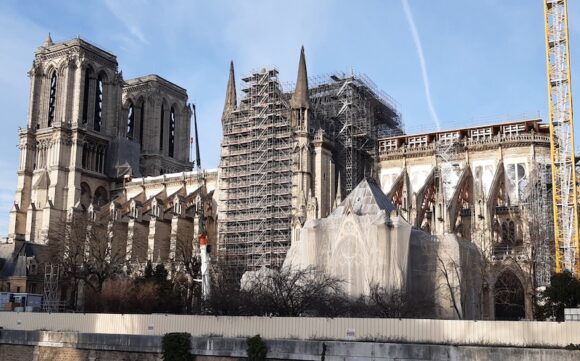
After the fire, with hardly a square inch of the stone building still visible under so much scaffolding, wooden frames, plastic wrapping, tarp covers, and other protective contraptions, it was almost no longer recognizable. It ended up looking like a sick old bird.

View of the cathedral showing some of the extensive scaffolding. Photo by Nicole Prévost Logan.

The gables and pinnacles at the end of the north and south transepts were in danger of toppling over with the force of the wind. Workers, dangling in the air like alpinists were doing their perilous job of wrapping the carved stones. Hovering over the cathedral cranes and other heavy machinery made the church look as if it was under perfusion.

The stained-glass windows were taken down and replaced by what looked like giant French doors. The collapse of the 19th century spire over the nave had left an enormous gaping hole at the crossing of the transept. Water – regardless of whether it is rain or the power spray used by firefighters – can cause lots of damage. It penetrates the stones, destroying the mortar between them .

The fire obliterated the roof. The lead dripped, spread and left a thick layer of toxic dust everywhere. For months, no one could go inside the cathedral because of the danger from the lead dust and also from the debris falling from the broken vault. A lonely robot, directed by remote control, was able to clear up the charred remains.

The organ and the three rose windows were thankfully preserved, but they will, however, require  lengthy restoration. The 7,800 pipes of the largest organ in the word have been pulled apart and so have been all the stained-glass pieces.

The stunning South Rose window in the cathedral. Photo by Nicole Prévost Logan.

It is particularly comforting to know that the Rose Window at the south end of the transept is intact. Given the light of the sun throughout the day, it is the Rose Window, which gives the cathedral its beautiful warm glow. Notre Dame would not be the same without the scenes of the triumphant Christ depicted through that magnificent window. In 1250, Louis IX, or Saint Louis, donated it after the end of the second crusade.

The April 15, 2019 fire left the cathedral in danger of collapse — in fact, it was a touch-and-go situation. The most urgent step was to consolidate the structure

A gothic cathedral is like a house of cards:- if one side weakens, the whole thing collapses. Because of its daring height and the fact that the outside walls are weakened by several tiers of windows, the structure is fragile.

The medieval master carpenters were real geniuses when they designed the 28 flying buttresses to reinforce the strength of the walls. An arch or beam extends from the walls of the church to a pier against the lateral forces arising from the roof and pushes the walls outwards.

Ken Follett in his 2002 book, The Pillars of the Earth, wrote a gripping story of the 12th century monks attempting to do something never done before, failing many times and starting all over again.

The earliest buttresses of Notre Dame date from the 12th century. They are massive and fairly close to the main structure. Later, during the flamboyant gothic period in the 14th century, the spans of the flying buttresses are longer and more decorated.

The first phase of the restoration — preservation and protection — lasted 15 months. President Macron appointed General Jean Louis Georgelin, former chief of staff under President Sarkozy, to supervise the work.

This photo shows the cathedral’s 14th  century flying buttresses prior to the fire. File used under the Creative Commons Attribution-Share Alike 3.0 Unported license.

The 28 damaged buttresses were reinforced by fitting custom-made wooden “centering frames” under each one of them. Each one of the buttresses had different dimensions, hence the fitting required utmost precision.

Then started the most difficult and dangerous operation: dismantling the scaffolding, which had been erected in May 2018 to repair the crumbling spire created by 19th century architect Eugene Viollet-le-Duc.

That scaffolding had melted, creating an ugly- and mean-looking black mass of 40,000 metal pieces glued together. Rope access workers (called cordists in French) had to pick the pieces by hand one by one, hanging from ropes high in the air. Sensors were placed under that unstable mass.

At one point the alarm sounded. Everybody fled. To disentangle that mass was like playing a giant pick-up sticks game, which involves removing sticks without disturbing the rest of the pile.

Twice the restoration work on the cathedral was interrupted: first when the scare caused by the lead contamination forced all activities to stop. Workers had to wear white haz-mat suits with masks connected to supplies of filtered air. They looked as clumsy as moon walkers.

Subsequently, the lock-down caused by the Coronavirus pandemic in March 2020 shut down operations for three months.

Five days before the fire, as a result of a near-miracle, the 10 ft. tall copper statues of the apostles and evangelists, climbing up the bases of the spire were air-lifted for restoration. Parisians enjoyed watching the ballet in the sky.

The statues are being restored in two workshops located near Perigueux. It takes four month to restore one statue. Pending the completion of the cathedral, all these art works will be exhibited  at the museum of architecture on Place du Trocadero.

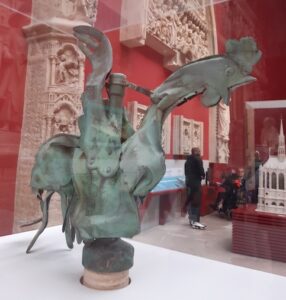
This rooster was on top of the spire. It is now exhibited in the Museum of Archaeology. Photo by Nicole Prévost Logan.

The rooster, pictured left, which used to sit at the top of the spire, will remain in the museum.  A replica will replace it.

Late in June 2020, chief architect Philippe Villeneuve climbed on an inspection tour of the cathedral. He was able to access the top of the vaults, which by then had been cleared of most of the debris.

Villeneuve was pleased to see that the limestone of the vault had resisted the damage caused by the fire itself as well as the water to extinguish the fire. For him, it was a milestone and he declared that the structure was now safe.

The first phase of conservation was over and one could look forward to the restoration to be launched at a later date.

In July 2020 came the decision everybody was waiting for. After months of deliberation and heated discussions between architects, historians and restoration professionals across the globe about how the future Notre Dame would look, a consensus was reached.

Based on a 300-page paper presented by Villeneuve and with the support of the public opinion, it was decided that the cathedral would be returned to its original appearance:- a spire identical to 1859 Viollet-le-Duc’s creation; a lead roof; and a wooden framework to support the roof.

A large part of the restoration work will be carried out using the methods of 13th century builders. Fortunately this type of savoir faire is kept alive in France thanks to a guild of crafted artisans, who are trained as Compagnons du Devoir.

All restoration will be done respecting the safeguards established by ICOMOS (the International Council for Monuments and Sites) founded by the Venice Charter of 1964 to protect historic monuments.

In 1991, UNESCO placed Notre Dame and the banks of the Seine within the area considered as part of the world heritage.

Within 24 hours of the fire, pledges to pay for the restoration poured in and reached close to one billion Euros. The two richest men in France raced to be the highest bidder. François Pinault pledged 100 million and refused to accept tax deductions. Bernard Arnault beat him with a sum of 200 million.

Arnault is the head of the LVMH (Louis Vuitton Moët Hennessy) luxury goods and champagne empire. The readers of this area might be interested to know that Antoine, one of the Arnault’s five children, is building a “cottage” in the Fenwick peninsula in Old Saybrook. He is married to Russian super-model Tatyana.

The Cathedral of Notre Dame de Paris prior to the fire. This file is licensed under the Creative Commons Attribution-Share Alike 2.0 Generic license.

At the two year mark since the fire, it is fitting to give the most recent update on the restoration process of Notre Dame. The task concerns the strengthening of the cathedral’s vault and the preparation of the future wooden framework, which will support the roof.

The scope of this phase to secure the building should be completed by next summer. It is just gigantic.

Most of the cathedral’s interior is now encased in metal scaffolding. An umbrella-like tarp has been installed above the gaping hole, where the spire once stood, for protection against the rain.

The vaults connecting the crossing of the transept were covered with platforms to enable rope-access workers to complete their job of removing the last fallen debris. This operation is still ongoing.

Most of those debris — stone, metal, glass — have been cleared up, analyzed, and used toward the creation of a 3D model, which is a replica of the original architecture and guiding the restorers in their mission.

Wooden scaffolding is being installed to stabilize the fragile areas of the cathedral’s vault, particularly the vaults adjacent to the crossing of the transept. Stonemasons apply plaster to the gaps and the exposed ends of the stones. They reinforce the most damaged areas with fiberglass.

The next step will be the insertion “of half-hangers” (also called “centring frames”)  under the six-rib vaults in the choir, the north transept and the nave. Note that the spire  crashed toward the West, onto the nave.

Above the vault and under the roof, other major work is in progress. The reconstruction of the 12-14th century wooden framework, called “the forest” is being prepared. Made-to-measure “half-hangers” and large-size triangular frames are being wedged under the roof to support it.

One thousand of the best oak trees have already been picked out in several French forests. A CNRS (National Center for Scientific Research) study of the use of timber led to surprising conclusions. Those conclusions differ from what one often reads in non-scientific publications.

The 13th century trees were much younger and smaller than often stated:  60 years, 39 ft. in height, and 12 ins. in diameter. Furthermore, the trees were not left to dry for 18 months but were used while still green, after being felled.

From the top of the cathedral, President Macron, accompanied by Paris Mayor Anne Hidalgo and Minister of Culture Roselyne Bachelot expressed huge thanks to the hundreds of people involved in the restoration: carpenters, scaffolders, rope access technicians, crane operators, master glassmakers, restorers, stonemasons, archaeologists, researchers and donors.

Macron reiterated his vision of the cathedral reopening to worship by 2024 in time for the Olympic games, while acknowledging the fact that the complete restoration will probably take several years longer.

A glimmer of hope is much needed for the weary French population. The latest curfew at 6 p.m., which applied to the whole country, should be lifted in early May, with café and restaurant terraces reopening by mid-May — that should really boost morale!

Legal News You Can Use: What To Do After a Car Accident

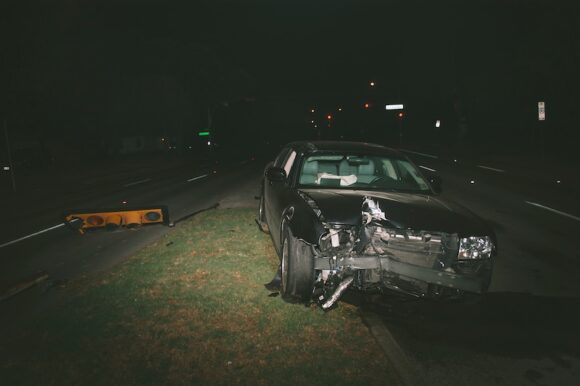
The steps you take after a car accident are critical. Photo by Matthew T. Rader on Unsplash.

Even though someone else’s reckless or negligent behavior may have caused you to suffer a car accident, there is no guarantee that you will receive the compensation you need to cover the costs of your injuries.

A car accident involving medical injuries can cost thousands of dollars, so how can you be sure you are doing what is necessary to secure the best possible outcome?

The steps you take after your car accident can help improve your chances of maximizing your compensation, making the process of recuperating from the accident easier for you and your family. Here are three steps everyone should take after a severe accident:

Contact the police

After a major accident, the police can help in many different ways. Their efforts can contain the accident and begin the process of cleaning up any wreckage that is on the road. The resulting police report can act as a major piece of evidence to support your injury claim.

They can also help provide you with any necessary medical assistance you need at the site of the accident.

Gather information

If you or a passenger are physically able to, collect as much evidence at the scene of the accident as possible. Take thorough photographs and videos of the accident, gather recorded witness testimony, and collect the contact information, license information, and insurance information of the other drivers involved in the accident.

Call an attorney

A personal injury attorney can help you pursue the compensation you need after an accident. They can handle the legal challenges of filing paperwork, accessing injury costs, and negotiating fair compensation while you focus on your health.

Your lawyer can also keep you from making mistakes that may reduce or eliminate your compensation, like accepting a low-ball settlement offer.

The action you take after your accident can define how well you recover from your injuries.  Make sure you do everything in your power to put yourself in the best possible position after your accident.

This is a sponsored post by 

Editor’s Notes: Suisman Shapiro is located at 75 State Street, New London, CT 06320. Their mailing address is 2 Union Plaza, P.O. Box 1591 New London, CT 06320. Visit their website or call 800-499-0145 — lines are open 24 hours a day.