A View from My Porch: Epic Poems of Folk and Rock Part 3 — The Rock and Roll War

Editor’s Note: This is the third column by Tom Gotowka under the heading, ‘Epic Poems of Folk and Rock.’ Find Part I  at this link and Part II at this one.

I continue the “epic poems” theme in this essay, but shift to the epic works of conflict; focusing on the rock and roll genre, as influenced by the Vietnam War.

In review, Part 1 presented several works of folk music that, I felt, were the natural successors of the epic poems of antiquity. In Part 2, I considered how America became entangled in the Vietnam War, as a prerequisite for this review of the music of that war.

Epics of the Vietnam War Era:

As noted last time, Stars and Stripes” called Vietnam “the first rock and roll war”. I present, in the following, some of the music that supports that contention. I provide some context for each song, and include a sample of the lyrics, trying to ensure that the sample still conveys the original message.

Some of the lyrics are a little gritty, and the context may be troubling, but they’re included to fully illustrate the era, not to offend the reader. So, here’s the war in six songs.

“Fortunate Son”: Creedence Clearwater Revival (1969)

Photograph of Creedence Clearwater Revival (1968). L-R: Tom Fogerty, Doug Clifford, Stu Cook, and John Fogerty.

When John Fogerty wrote the song, draft deferments were undoubtedly on every teenaged American boy’s mind. His lyrics support the men who served in Vietnam, but condemn the “children of privilege” (i.e., “millionaire’s son”), who used that privilege to “dodge” the draft.

Pulitzer Prize winning Vietnam War correspondent, David Halberstam, reported that the ways in which draft-age men received deferments favored those who were wealthier and more educated. For example, able both to remain in college full-time, and then pursue advanced degrees after graduation; and thus, qualifying for student deferments. 

In addition, those same young men could obtain deferments for physical problems, even untreated bone spurs, more easily than could poor or working-class men; and, “rather than trying to convince a draft board that they were physically unable to serve in the military, they could just get a note from their family doctors”. 

“Some folks are born, made to wave the flag;
they’re red, white and blue.
And when the band plays “Hail to the Chief”,
they point the cannon at you, Lord!
Some folks are born, silver spoon in hand;
Lord, don’t they help themselves?
But when the taxman comes to the door,
the house looks like a rummage sale.
It ain’t me, it ain’t me;
I ain’t no millionaire’s son.
I ain’t no fortunate one”.

“Feel Like I’m Fixing’ To Die Rag”: Country Joe McDonald ​(1965)

In this dark parody of the war, Country Joe (and the Fish) demonstrate the hopelessness that many Americans felt toward the War. The artist touches on, albeit, sarcastically, several important war themes in the full seven verses: the government notion that going to war was in the country’s best economic interest; and, consequently, the support from Wall Street, weapons manufacturers, and an “overly aggressive” Pentagon. 

The song also has the distinction of having been performed twice at Woodstock, and I have corroboration from a very reliable eye witness, my wife, Christina, who was present at those “3 Days of Peace & Music” in the Catskills, in 1969.

“Well, come on all of you big strong men,
Uncle Sam needs your help again.
He’s got himself in a terrible jam, way down yonder in Vietnam.
So put down your books, and pick up a gun,
we’re going to have a whole lot of fun.
And come on mothers throughout this land, pack your boys off to Vietnam.
Come on pops, don’t hesitate, send them off before it’s too late.
And then, it’s one, two, three, what are we fighting for?
Don’t ask me, I don’t give a damn.
Next stop is Vietnam!
And it’s five, six, seven,
open up the pearly gates.
Well, there ain’t no time to wonder why,
Whoopee! we’re all going to die.”

“Revolution”: The Beatles (1968)

Trade ad for Beatles’ 1964 Grammys. Public Domain.

John Lennon and Paul McCartney wrote the song to demonstrate their strong objection to the increasingly violent protests that had occurred in response to the war.

To illustrate, in April, 1965, Students for a Democratic Society (SDS), held its first national protest march in Washington, DC. Co-sponsored by Women’s Strike for Peace, 25,000 attended.  After this peaceful protest march, SDS grew increasingly militant, and their tactics then included the occupation of college administration buildings on campuses across the country. The 1968 violence at Columbia University is covered in “The Strawberry Statement”, by James Kunen (both book and movie).

On Oct. 21, 1967, over 100,000 protesters gathered at the Lincoln Memorial; and later that same night, over 35,000 of the group marched on to the Pentagon for a second rally, where they sparked a violent confrontation with the soldiers and U.S. Marshals protecting the Pentagon complex. Nearly 700 demonstrators were arrested. 

Notably, the demonstrations produced the famous “flower power” photograph of a protester placing a flower in a paratrooper’s M14 rifle barrel. 

On March 17, 1968, 10,000 protesters demonstrated in Trafalgar Square against American action and British support in Vietnam. This was followed by 8,000 protesters marching to the American Embassy in Grosvenor Square; where a fierce battle with riot police and mounted officers ensued.

In August 1968, the Democratic National Convention in Chicago, bore witness to a series of riots, involving tens of thousands of Vietnam War protesters, both during and before the convention. Eight protest leaders were tried on charges of criminal conspiracy and incitement to riot. 

The eight eventually became the “Chicago Seven”, after convictions were overturned because of procedural errors and Judge Hoffman’s “overt hostility to the defendants”.

Tragically, on May 4, 1970, just four days after President Nixon announced the escalation of the war into Cambodia, four students at Kent State were shot by National Guardsmen during a protest.

“You say you want a revolution.
Well, we all want to change the world.

You say you got a real solution.
Well, we’d all love to see the plan
You ask me for a contribution.
Well, we’re all doing what we can; but, 

if you want money for people with minds that hate;
all I can tell you is, brother, you have to wait.
When you talk about destruction,
don’t you know that you can count me out?
But if you go carrying pictures of Chairman Mao;
you aren’t going to make it with anyone, anyhow.”

“Ballad of the Green Berets”: Barry Sadler (1965)

The United States Army Special Forces, the “Green Berets”, are the Army’s special operations group, whose mission extends well beyond conventional warfare. 

In May 2004, a plaque was dedicated at Fort Campbell, honoring the 695 Green Berets killed in action, and the 79 missing in action during Vietnam.  Of the MIA, only three soldiers have been recovered. 

“Ballad” is a patriotic tribute to our soldiers in Special Forces, and one of the few popular songs of the Vietnam War era that portrays the military in a positive manner. 

Sadler served as a medic with the 5th Special Forces Group (Airborne), and his song, written to boost morale among our troops in Vietnam, also served as the inspiration for the John Wayne movie, “The Green Berets”.

“Fighting soldiers from the sky, fearless men who jump and die.
Men who mean just what they say; the brave men of the Green Beret.
Silver wings upon their chest; these are men, America’s best.
One hundred men we’ll test today, but only three win the Green Beret.
Trained to live off nature’s land; trained in combat, hand-to-hand.
Men who fight by night and day, courage peak from the Green Beret.”

“I Ain’t Marching Anymore”: Phil Ochs (1965)

Ochs was the “iron man” of “protest” singers; and, in his career, performed, as a “regular” at anti-war, civil rights, organized labor, and women’s rights events. 

I believe that this is his best; or at least his best- known anti-Vietnam War song; and it became an “anthem” at rallies and protests. 

The song is really a treatise on the entirety of American conflict, and he casts himself as a tired soldier, who has fought in each American war, beginning with the battle of New Orleans in the War of 1812. And on through both world wars.

He performed the song in August 1968, during the violent protests outside the Chicago Democratic National Convention, and, it is claimed, inspired hundreds of young men to burn their draft cards (really). He later described it as the highlight of his career.

“Oh, I marched to the battle of New Orleans,
at the end of the early British wars;
the young land started growing, and
the young blood started flowing,
but, I ain’t marching anymore.

I’ve killed my share of Indians, in a thousand different fights.
I was there at the Little Big Horn;
I heard many men lying, I saw many more dying;
but, I ain’t marching anymore.

Chorus: It’s always the old who lead us to war;
it’s always the young to fall.
Now look at all we’ve won with the saber and the gun.
Tell me, is it worth it all?

I stole California from the Mexican land,
and fought in the bloody Civil War.
I even killed my brothers, and so many others;
but, I ain’t marching anymore.

I marched to the battles of the German trench,
in a war that was bound to end all wars. 

I must have killed a million men, and now they want me back again;
but, I ain’t marching anymore.

I flew the final mission in the Japanese skies, and
set off the mighty mushroom roar.
I saw the cities burning, and 

I knew that I was learning;
that I ain’t marching anymore

Call it peace or call it treason,
call it love or call it reason;
but I ain’t marching anymore.”

“Born in the USA”: Bruce Springsteen (1984)

Bruce Springsteen performing at Roskilde Festival 2012. Photo credit: Bill Ebbesen. This file is licensed under the Creative Commons Attribution-Share Alike 3.0 Unported license.

I present “Born” as the anchor of the song list because Springsteen’s focus is on America’s poor treatment of returning Vietnam War veterans. The lyrics are an account of the disrespect those veterans faced on their return home to a society that was largely opposed to the war. 

This song may be one of the most misinterpreted songs in rock and roll history. Since its release, the song’s chorus has been omnipresent at political rallies; and heard as a celebration of American life. The anti–war message is rooted in the verses, and may have been lost early on, because the song was released about a decade after the war ended.

The song is consistent with what I noted last time in “Working-Class War”, by Christian Appy; who observed that the typical U.S. soldier in Vietnam was from a poor or working-class family; a large portion were from the inner cities and factory towns. 

In the first verse, Springsteen introduced the story of a young man, born into a failing American town, who was apparently abused by his family. In some trouble, he is ordered by the courts to enlist rather than serve time. His brother, or close friend, is killed in action. 

He returns home after the war, can’t find a job, and is treated with indifference by the V.A. The final verse describes his progression into despair.

“Born down in a dead man’s town; the first kick I took was when I hit the ground.
You end up like a dog that’s been beat too much,
until you spend half your life just covering up.
Got in a little hometown jam; so, they put a rifle in my hand.
Sent me off to a foreign land; to go and kill the yellow man.
I had a brother at Khe Sanh, fighting off the Viet Cong.
They’re still there, he’s all gone.
I came back home to the refinery; hiring man says “Son if it was up to me”.
I went down to see my V.A. man; he said “Son, what don’t you understand”?
In the shadow of the penitentiary; out by the gas fires of the refinery.
Nowhere to run, and nowhere to go.”

Author’s Notes:

Unlike Bruce Springsteen, I am not certain whether the courts can, or ever did, require enlistment in lieu of serving time for a criminal infraction.  If so, I can’t imagine that these individuals would be considered high value recruits. A large portion of the opposition to the war was the onus of the draft. I was not able to find reliable data on the portion of draftees, versus voluntary enlistees, in Vietnam, as opposed to prior, or subsequent (e.g., Afghanistan) wars.

I only included works that I could directly attribute to the writer’s reaction to the war. Clearly, there was a wealth of additional music that was popular at the time and was probably listened to regularly by soldiers in Vietnam.   For example, I included nothing by the Rolling Stones; and did not consider “We Gotta Get out of this Place”, by the British group, The Animals, although the song has been part of the sound tracks of many productions about the war. 

If you want to explore a very realistic production, I recommend “Hamburger Hill”, which is a highly accurate 1987 movie about the 1969 assault by the Army’s “Screaming Eagles” Battalion on a well-fortified enemy mountain position. The editors dramatically incorporated the music of the day into their soundtrack.

I was a “fortunate one” — the United States Navy and the military provided financial support and enabled deferments for over 10 years of advanced education. I had agreed, up front, to repay that support in service, which I’ve previously said was at a Naval Hospital.

My next “View” will be of the remarkable changes that have occurred in CT’s hospital and healthcare landscape I think that hospital advertisements on local newscasts now exceed those for replacement windows. 

Editor’s Note: This is the opinion of Thomas D. Gotowka.

Tom Gotowka

About the author: Tom Gotowka’s entire adult career has been in healthcare. He’ will sit on the Navy side at the Army/Navy football game. He always sit on the crimson side at any Harvard/Yale contest. He enjoys reading historic speeches and considers himself a scholar of the period from FDR through JFK.

A child of AM Radio, he probably knows the lyrics of every rock and roll or folk song published since 1960. He hopes these experiences give readers a sense of what he believes “qualify” him to write this column.

Gardening Tips for May from ‘The English Lady’: A Feast of Color Highlights the Merry Month of May

May brings ‘darling buds’ and ‘blooms on bulbs and trees.’“ 

OLD LYME — The darling buds of May” is such an apt phrase for one of the most enchanting months, bloom on bulbs and trees and the fresh foliage on trees winking in the sun. 

By now, you have probably removed most of the winter debris, pruned broken branches and re-edged borders. Do not however, apply that spring layer of composted manure as the soil needs to warm up to 60 degrees for the soil organisms to accept the bacteria of the manure in order to produce nutrients for the roots of the plants. 

When shopping for garden supplies, pick up a soil thermometer to check soil temperature and I am sure the right temperature will be reached in about two to three weeks. 

I am seeing our old nemesis, weeds springing up everywhere.  Pull them up by hand and try to get weeds complete with roots.  I say by hand, as using a tool breaks up the weeds, the result being hundreds more weeds from the broken pieces. 

Follow on the weeding with the organic corn gluten based weed pre-emergent by Bradfield Organics; this product will keep weeds away for quite a few weeks.   

When the soil warms to 60 degrees, apply composted manure around daffodils and other spring bulbs so that soil organisms will produce nutrients to feed the bulbs for next year’s bloom. Also do not cut down the daffodil foliage as the nutrition from the foliage goes into the bulb for bloom next spring. 

In a few weeks apply composted manure and a light layer of fine bark mulch on all maintained areas of the garden now, then again in July and before putting the garden to bed in October.  The manure and mulch will begin to build the humus component.  

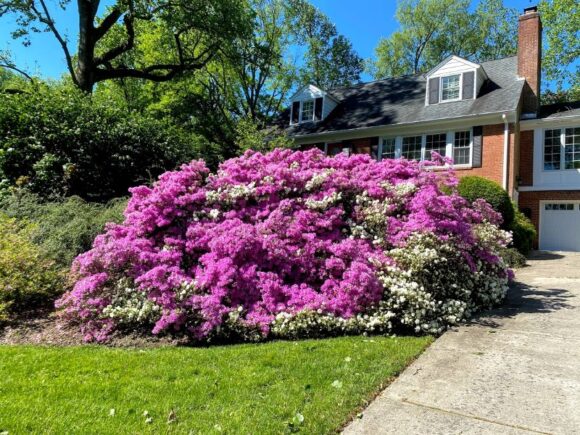
Rhododendrons create a blaze of color.

A note on mulch  – only use the natural brown mulch of natural non-colored wood; do not use the colored mulches, which contain chemicals, and do not use rubber mulch. 

A special word of caution on cocoa mulch. This product is highly toxic to dogs and cats — it is manufactured by Hershey and sold in many large garden centers.

It is made from the residue of chocolate products and others ingredients and contains a lethal ingredient that has resulted in the reported deaths of a number of cats and dogs that are attracted by the chocolate odor. It contains Theobromine, which is a Xanthine compound similar to the effects of caffeine and theophyliline. The symptoms for the animals are seizures and death within hours.   

I wrote about the carbon component in my April tips but wanted to emphasize its importance by stating it again. 

All living things including us are all carbon-based creatures. Humus brings carbon from the air into the soil.

Humus acts like a sponge and holds 90 percent of its weight in water. Because of its negative charge, plant nutrients stick to humus bringing nitrogen, calcium, phosphorus and other important elements to the plant, preventing these nutrients from washing away, acting like nature’s slow-release fertilizer.

Humus improves soil structure making it loose and friable, which helps plants to root in this environment with better access to nutrients, water and oxygen. Humus also helps to filter toxic chemicals from soil, much like carbon-based water filtration systems filter toxins from your water.

I recommend that you go online to Scientific American.com/article/Weed-Whacking Herbicide to check out the dangers of Round-Up. This is the most dangerous herbicide not only because of glyphosate, which is on the list by the World Health Organization as a chelating agent that causes cancer, but also because of the inert ingredients.

I ask that you are not swayed by the word ‘inert’ as the ingredients are anything but inert and those ingredients combined with Glyphosate are deadly to human cells. 

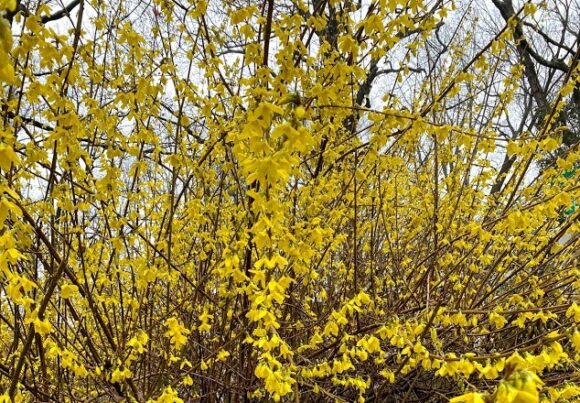
A yellow burst of color is offered by Forsythia in May.

Forsythia is in bloom with lovely fresh yellow blossoms.  If the bloom on your shrub is not as prolific as in previous years, prune out the old sparse wood after bloom ends.  

A favorite native tree is the Serviceberry tree, with its creamy panicle blooms, followed by small green leaves and within weeks, red fruit, and a delicious menu for our feathered friends. Before the birds eat all the fruit, pick some to make a delicious jelly for your morning toast.  

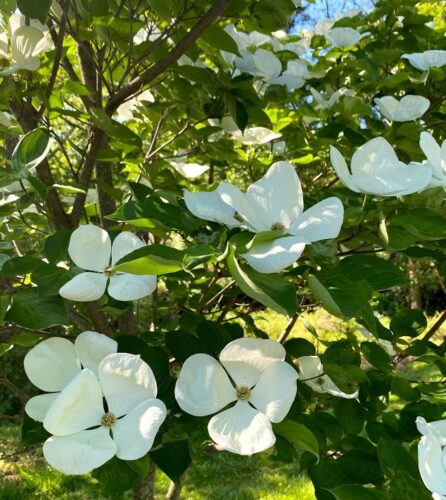
Here in my town of Old Lyme, the Magnolias, Cherries and Eastern Redbud are vying with one another to show their finery together with the graceful Dogwoods. Following the recent rains many of these trees are blooming at the same time or within a few weeks of one another. Their bloom will soon be over then we can look forward to rhododendrons, azaleas and mountain laurel into June. 

The graceful dogwood can be enjoyed in many locations this month.


The Carlesii Viburnum (also known as Korean Spice) is showing pink buds, opening to white flowers and their delightful fragrance fills the air outside my kitchen door. 

Covering the barn wall and scrambling up to the barn roof is my climbing hydrangea – bright green leaves emerging with hundreds of buds indicating that this beautiful climber will be laden with blossoms in summer. 

Tulips, creeping phlox, forget-me-nots, primroses and candytuft are bringing much-needed color to borders and rock gardens. 

May borders are often a delight to behold.

If you have not had time yet, for another week or two you can still prune your roses. Pull back the old mulch from around the base of the roses and in two weeks apply manure about six inches from the trunk of the plant. Then a week later reapply a layer of the brown natural mulch on top of the composted manure.

As well as building the humus component, these layers keep the roots cool, keep weeds at bay and help retain moisture. Do not mulch right up against the base of any plants as this encourages rodents to nest and gnaw on the plants. 

Beware of fungi that look like weird mushrooms in your mulch; this is a sign of Artillery fungus and can stick and invade the walls of your home and cause problems.  If you notice this fungus, you will need to remove all the mulch and get it off your property. 

Apply lime and manure around the lilacs, they like sweeter alkaline soil, thus the lime. By now, you may have already applied lime to the grass, which also enjoys sweeter soil and organic grub control to kill the Japanese beetle larvae – less food for moles. 

If you are making an organic vegetable garden this year, a garden measuring 16 ft. x 24 ft. can feed a family of four for a year, but keep the size within your needs and capability. Don’t work the soil if it is too wet or too dry.  

Double-digging is the best way to go; it takes time and effort but its well worth it – dig down about one foot and remove the top soil, put to one side, then dig down and loosen the next six inches of soil and add about three inches of composted manure then put back the top soil and add another three to four inches of manure.  

Do not rototill, as this will destroy soil structure. The gently loosened, aerated, fertile soil will give an excellent yield of fruits and vegetables in the garden. 

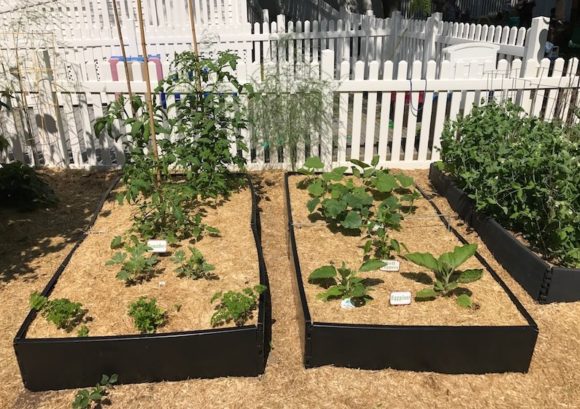
These vegetable beds are a work in progress.

I prefer 6 ft. x 4 ft. beds rather than rows; beds produce a larger yield of crops. In addition, beds make for ease of weeding and harvesting by having narrow, compacted soil or grass paths (having removed lawn from the area) in-between the beds. 

The vegetable garden should be situated on the south or southwest side of the property for maximum sun exposure. 

Make sure you remove as many weeds as possible by hand, before you even begin digging.  

You need a water source close by as vegetables require lots of water, particularly annual fruiting vegetables like tomatoes, which are hydroponics which means they are (mostly water). 

Rotate crops, by that I mean, do not plant the same vegetables in the same place as the previous year.  With this method you are preventing any soil-borne diseases from occurring.     

In the loosened soil, plant the vegetables plants so that they are touching, this forms a natural canopy, shading out weeds and helps retain moisture. 

I prefer to mulch the vegetable garden with composted manure, the reason being that manure, as mulch, does not cap. Capping is when mulch forms a crust, which does not allow water or air to penetrate to the roots of the plants.

Fence in the vegetable garden with a tall fence to keep animals out. At the base of the fence install eight inches of fine mesh chicken wire above ground and eight inches below ground to keep out the digging and burrowing animals. 

Organic insect control:

Insects do not like fragrance so plant fragrant plants like marigolds, nasturtium, lavender, nepeta and honeysuckle and roses to name a few.  

Encourage lacewings, which feed on aphids by planting marigolds and sunflowers,

Attract ground beetles by laying a log or a rock on the earth, under which the beetles can hide. These useful insects are nocturnal and eat slug and snail eggs, cabbage maggots, cutworms and even climb trees to feed on armyworms and tent caterpillars.  

Grass is now a vibrant shade of green, therefore when mowing, keep the blades of grass at about three inches; the taller blades attracts sunlight, promoting a healthier lawn. The taller blades also shade out weeds and help to retain moisture in the grass.   

When mowing, leave grass clippings on the lawn, the clippings are a natural source of nitrogen. If you have clover in the grass, clover is an added benefit as clover takes nitrogen from the air and fixes it in the soil providing additional nutrients for plant growth.

After flowering is over, prune flowering shrubs by 25 percent – do this task immediately before new buds set for next year. 

On a rainy day go shopping for any garden supplies that may be needed, then when the weather is dry you can be outdoors doing what you love and not indoors shopping. Buy good hoses — cheap ones will bend and crack.  

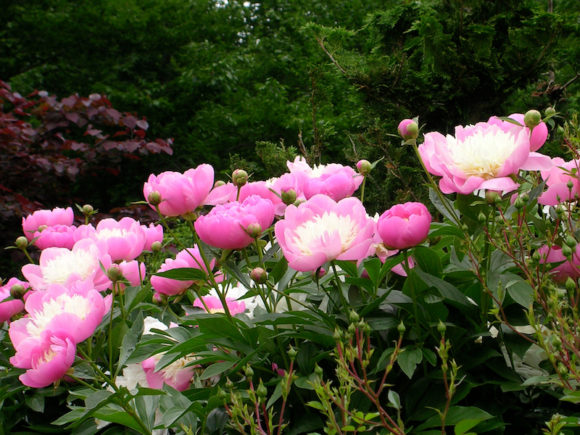
Peonies are becoming increasingly popular and are often, “a sight to behold.”

Peonies need plenty of water to produce flower buds. I have a 30 ft. long stand of Peonies in my field. The Peonies have been in the ground for over 40 years and are a sight to behold when in bloom. I give them lots of loving care with a light dressing of aged manure in early May. In a few weeks, I will pinch off the side buds while they are still small, leaving the terminal flower bud on each stalk, which will develop into a large main bloom.

Hydrangeas are a wetland plant and require plenty of water during the season, also applying manure and mulch around the base. If you have blue Hydrangeas and want a deeper color of blue, add some peat around the base of the plant — the acidity in the peat produces the color.   

If you need to prune a Hydrangea, which has become too large, then prune it immediately after flowering, in early September by about one third of the old wood and the weakest shoots. Do not wait, as Hydrangeas begin to develop bloom buds for next year later in September. 

If you wait to prune, you will not have bloom for next year. 

Blue hydrangeas start to develop their blooms for the following year in September of the current year. Photo by Gemma Evans on Unsplash.

My maternal grandmother’s favorite plant, the Lily of the Valley, soon will bloom tucked under the boxwood hedge on the north east side of the farmhouse near the front door. I love the delicate white flowers and fresh unique fragrance.  

When the lilacs have finished blooming, pinch off the withered flower clusters, do the same on the mountain laurel and rhododendrons in late June to ensure good blossoms next year. 

In mid-May apply composted manure, a light application of peat and fine bark mulch around all evergreens and rhododendrons, mountain laurel and azaleas; these plants are shallow-rooted and the mulch will keep the roots nourished, protected, warm and moist. 

Some annual seeds that may be planted outside in mid May are: Calendula, Coreopsis, Marigold, Nasturtium, Nicotiana and Zinnia.  

If you purchase annuals, on Mother’s Day weekend, place them in a sheltered spot on the south side of your home. Plant them no earlier than Memorial weekend as we can still get a late frost. 

Tuberous-rooted begonias, caladiums, cannas and elephant ears can be moved from porch or cold frame to a part shade area as the weather becomes warmer and there is no sign of frost in the forecast.   

If you staked trees, when they were planted last year, cut the stakes off at ground level. Do not pull them out of the roots as you could tear and therefore damage the root system.

Aphid tip: squish a few in your hand; dead aphids release a chemical that causes other aphids to drop off the plants. 

Another ants and aphids tip – if you drink mint tea, sprinkle an y left-over tea on the bugs, as they do not like the smell of mint.  

Mint spreads vigorously if left to its own devices so always plant this herb in a container. Photo by Eleanor Chen on Unsplash.

A word of caution on mint – plant mint only in containers, mint is tremendously invasive and can take over your garden.

When planting annuals, perennials, vegetables, trees, shrubs or evergreen, keep them watered but not drowned.   

Houseplants can be moved outdoors for their summer sojourn at the end of May.  However, do not put your African Violets outdoors as they will burn, but rather move them to a porch that is covered and shaded, or keep them indoors in a window that does not receive direct rays from the sun.

Wait until the soil warms up at the end of May to set out Dahlia tubers.  

Roses are not the troublesome creatures you have been led to believe. I prefer to plant David Austin roses; these shrub roses are repeat bloomers with lovely fragrances. Roses need at least four hours of sun per day, good air circulation, and excellent drainage. 

During their growing period from the beginning of June to mid August; add a little extra composted manure each month; it may be applied over the mulch.  Stop adding the manure in August so that the roses can go into a slow dormancy. 

Roses like the same growing conditions as Clematis and planted together in companionship planting, they flourish well together, with feet in the shade and head in the sun. Before you top up the soil around the roses, add water and check if the soil drains, roses need good drainage. Deep watering is recommended at least once a week. 

Plenty of stuff to keep you hopping, folks, and remember to keep your eye out for any pest trouble and when you spot it get on the ball immediately to avoid further problems. Carefully discard all herbicides and pesticides; these poisons have the same effect on your health as second-hand smoke.  

Your garden offers an anchor for peace and quiet enjoyment.  Enjoy the warmth, the gentle breeze, the earth’s fragrance and bloom and please remember to breathe. 

Contact Maureen at maureenhaseleyjones@gmail.com

About the author: Maureen Haseley-Jones, pictured left, is a member of a family of renowned horticultural artisans, whose landscaping heritage dates back to the 17th century. She is one of the founders, together with her son Ian, of, ‘The English Lady Landscape and Home Company.’ Maureen and Ian are landscape designers and garden experts, who believe that everyone deserves to live in an eco-conscious environment and enjoy the pleasure that it brings. Maureen learned her design skills from both her mother and grandmother, and honed her horticultural and construction skills while working in the family nursery and landscape business in the U.K. Her formal horticultural training was undertaken at the Royal Botanic Gardens at Kew in Surrey.

A la Carte: These Chicken Lettuce Wraps (After PF Chang’s) Make Perennially Popular Hors D’Oeuvres

Lee White

I can’t remember a more beautiful couple of weeks in May.

Years ago my husband and I would charter a sailboat in the Caribbean for a week in the winter. The mornings were cool in the morning, warm and cloudless in the afternoons and out of nowhere a cloudburst would appear for just 15 minutes. After that it was clear and sunny for a few hours and cooled down bedtime.

This past weekend’s weather was similar but even better since I was able to spend time with 30 friends I had not seen in almost two years, as we began our boules summer that didn’t happen in 2020.

(Boules, by the way, is sort of like bocce, but the balls are smaller-than-bocce balls, stainless steel and must be played on a gravel or dirt court, since the tiny wooden ball we tried to hit would be invisible on a grass lawn.) 

The first 2021 party was in Old Lyme, and the food was outrageously good—beginning with escargots in a ramekin lidded by a thin cracker that shattered, almost like the top of the burned sugar on top of crème brulée.

Dinner was lamb chops, two kinds of meatballs, couscous and ratatouille, then a cheese course and salad and a flan, or crème caramel, which made us moan.

Could most of us ever make a feast like this for 40 people? I sure could not.

But one of our hors d’oeuvre, which we ate as we played, we could.

Our host, Tim Boyd, said he got the recipe online from PF Chang’s restaurant. And the dessert was a flan made by Stacie Boyd — she says she will give me the recipe soon. I will send it to you next week.


PF Chang’s Chicken Lettuce Wraps

Yield: serves 4 (at least three for each; I might triple the recipe)

1 tablespoon olive oil
1 pound ground chicken
2 cloves garlic, minced
1 small onion, diced small
¼ cup hoisin sauce
2 tablespoons soy sauce
1 tablespoon rice wine vinegar
1 tablespoon freshly grated ginger
1 tablespoon Sriracha (optional, but it should be in everyone’s pantry)
1 8-ounce can whole water chestnuts, drained and diced
2 green onions, thinly sliced
Kosher salt and freshly ground black pepper, to taste
1 head of butter lettuce (romaine would be fine)

Heat olive oil in a saucepan over medium-high heat. Add ground chicken and cook until browned, 3 to 5 minutes, making sure to crumble the chicken as it cooks; drain excess fat.

Stir in garlic, onions, hoisin sauce, soy sauce, rice wine vinegar, ginger and Sriracha until onions have become translucent, about 1 to 2 minutes.

Stir in chestnuts and green onions until tender, 1 to 2 minutes; season with salt and pepper, to taste.

To serve, spoon large tablespoon of chicken mixture into center of lettuce leaf, taco-style.

About the author: Lee White has been writing about restaurants and cooking since 1976 and has been extensively published in the Worcester (Mass.) Magazine, The Day, Norwich Bulletin, and Hartford Courant. She currently writes Nibbles and a cooking column called A La Carte for LymeLine.com and the Shore Publishing and the Times newspapers, both of which are owned by The Day. She was a resident of Old Lyme for many years, but now lives in Groton, Conn.

A la Carte: Surprise! Creamy Cauliflower Rice with Shrimp is a Winning Combo

Lee White

I used to write about the surprises I often find in my garage freezer. I used to call it Lee’s Freezer Diary. The truth is that if I kept a diary, perhaps there wouldn’t be surprises, since the freezer often looked like Fibber McGee’s closet.

(For those younger-than-me readers, it was a radio show in the 50s and maybe in early television in the 60s. Fairly often, Fibber’s wife, Molly, would try to get something out of the closet and got nearly run down by the treasurers Fibber hoarded.)

When I moved from Old Lyme to a condo in Groton, I swore I wouldn’t go to all the food sales and buy way more than I’d need for the next two years and the overloaded freezer. I am better than I used to be, but a few times a year I still hoe it out. And the surprises are often real treasures: one-pound packages of shrimp, just a little icy, but ready to cook after two hours of thawing and drying the babies of excess water. 

A couple of weeks ago I got my Real Simple magazine. The food recipes are pretty simple and really easy to make. This shrimp dish is a real keeper and, in two weeks, I have made it twice. You do know that most of the shrimp we get has already been frozen, so feel free to buy lots when it is on sale and keep it frozen until you use it. 

Creamy Cauliflower Rice with Shrimp

From Real Simple, May, 2021, page 125

Yield: serves 4 (for me, it might serve 4, and it will be find nuked the second meal

3 tablespoons olive oil, divided
1 pound peeled and deveined medium shrimp, tails removed
¾ teaspoon kosher salt, divided
1 medium leek (white and light green parts only), thinly sliced (2 cups)
¼ cup dry white wine
1 12-ounce package fresh riced cauliflower (4 cups)
½ cup low-sodium chicken broth or vegetable broth
2 ounces fresh baby spinach (2 packed cups)
¼ cup heavy whipping cream
2 ounces Parmesan cheese, finely shredded (about ¾ cup) plus more for serving

Heat 1 tablespoon oil in a large skillet over medium-high heat.

Add shrimp and ¼ teaspoon salt; cook, stirring often, until firm and pink, about 3 to 4 minutes.

Add wine, cook, stirring constantly, until wine is fully absorbed, 1 to 2 minutes.

Stir in cauliflower and broth; cook, stirring often, until broth is fully absorbed, about 3 minutes.

Stir in spinach, cream and remaining ½ teaspoon salt; cook, stirring constantly, until spinach wilts, about 2 minutes.

Add cheese; cook, stirring constantly, until melted, about 1 minute.

Remove heat and stir in cooked shrimp. Serve immediately with more cheese, if desired.

About the author: Lee White has been writing about restaurants and cooking since 1976 and has been extensively published in the Worcester (Mass.) Magazine, The Day, Norwich Bulletin, and Hartford Courant. She currently writes Nibbles and a cooking column called A La Carte for LymeLine.com and the Shore Publishing and the Times newspapers, both of which are owned by The Day. She was a resident of Old Lyme for many years, but now lives in Groton, Conn.

Reading Uncertainly? One Old Man Reads Another — Kloman Reviews Angell’s Latest

What can I say? One old man reading another!

Roger Angell, the prolific editor and author from the pages of The New Yorker, begins by calling his latest book “a dog’s breakfast, because that’s what this book is. A mélange, a grab bag, a plate of hors d’oeuvres, a teenager’s closet, a bit of everything. A dog’s breakfast.”

Letters, essays from the magazine, the odd haiku, baseball memories – Angell paints an engaging “portrait of my brain at ninety-four.” And, best of all, he repeats a few of the immortal rhymed Christmas couplets started by Frank Sullivan in 1932 and that he continued from 1976 to 2012.

These annual odes to the known and the unknown inspired me to try my hand at a “Greetings, Friends” in 1954 for the Daily Princetonian and again in 1956 for my shipmates on the U.S.S. Zelima, a Navy refrigerator ship moored in Yokosuka, Japan, for the holidays. They were my last Christmas chanteys, deferring to far better poets.

And Angell gives us the perfect conclusion: his report on the fan-less Oriole-White Sox baseball game in Baltimore in April 2015: two teams playing at the soundless Camden Yards in the aftermath of that city’s disruptions.

Memorable names appear on almost every page: his step-father, E. B. (Andy) White, Harold Ross, John Updike, John McPhee, Saul Steinberg, Fiorello La Guardia, James Thurber, Chas. Addams, William Steig, Peter Arno, John Hersey, Vladimir Nabokov, all of whose stories, ideas, and cartoons remain engraved in our memories (at least if you are old enough!)

On aging: To his son on his birthday – “One always tries to weigh the meaning of these ten-year chunks, and the only answer is mortality.” Or: “the rule about age is never to think about it.”

On writing:  “Writing is a two-way process and the hard part isn’t just getting in touch with oneself but keeping in touch with that reader out there, whoever he or she is, on whom all this thought and art and maybe genius will devolve.”

On glee:  “ . . . us people over seventy-five keep surprising ourselves with happiness.”

On reference books: Angell still uses the Eleventh edition (1911) of the Encyclopedia Britannica, while I, some 12 years his junior, refer almost monthly to the Thirteenth.

Why is it that we derive so much pleasure from something written by an author near our own age? I do recall from a few years ago the advice to read a book when you are the same age as when the author wrote it. In this case, sound counsel!

This Old Man is a proper memory stimulant, just when I need it! I’m 88 … on to 94!

Editor’s Note: ‘This Old Man’ by Roger Angell is published by Doubleday, New York 2015.

Felix Kloman

About the Author: Felix Kloman is a sailor, rower, husband, father, grandfather, retired management consultant and, above all, a curious reader and writer. He’s explored how we as human beings and organizations respond to ever-present uncertainty in two books, ‘Mumpsimus Revisited’ (2005) and ‘The Fantods of Risk’ (2008). A 20-year resident of Lyme, Conn., he now writes book reviews, mostly of non-fiction, a subject which explores our minds, our behavior, our politics and our history. But he does throw in a novel here and there. For more than 50 years, he’s put together the 17 syllables that comprise haiku, the traditional Japanese poetry, and now serves as the self-appointed “poet laureate” of Ashlawn Farm Coffee, where he may be seen on Friday mornings.
His late wife, Ann, was also a writer, but of mystery novels, all of which begin in a village in midcoast Maine, strangely reminiscent of the town she and her husband visited every summer.