A la Carte: Twice the Usual Feast Today:- First Maple Gooey Butter Cake, Then Whole Coconut Curry Chicken

Lee White

Column #1

All winter, friends have been wailing about winter. When will it be over? Will summer ever come? Others complain about the cold. Some have slipped on ice. 

For me, winter on the Connecticut shoreline isn’t bad.

I grew up in Troy, N.Y. Went to college in Ithaca and Rochester, and lived and worked in Worcester, Mass.

Even the isolation during the pandemic wasn’t bad for me. I read a lot, I write a lot, I cook a lot, I learned about HGTV. My daughter installed Roku on my television.

And I get all my food magazines. 

Last week, my new Bon Appetit arrived and the cover showed a pale green cake topped with chocolate glaze showered with pale green powder. But the recipe called for mochiko (or sweet rice flour) and matcha. So I called Christine, who owns Fromage in Old Saybrook. “Oh, Lee,” she said, “I just sold the last package,” and said she’d have more by the end of the week.

Obviously, I wasn’t the only shoreline denizen who saw the magazine’s cover photo.

The next day I got my copy of Yankee magazine and saw a recipe requiring all the ingredients in my pantry and refrigerator. Wait until you try this one.

Maple Gooey Butter Cake
From Amy Traverso, Yankee magazine, March/April 2022, page 60
Yield: 12 servings

For the cake:
1 cup salted butter, melted, plus more for greasing pan*
2 ¾ cups all-purpose flour, plus more for dusting pan*
1 1/3 cups granulated sugar
2 teaspoons baking powder
½ teaspoon salt
1/3 cup  maple syrup, at room temperature
1 large egg, at room temperature
1 teaspoon pure vanilla extract

For the topping:
1 package (8 ounces) cream cheese, softened
¾ cup confectioners’ sugar, plus more for sprinkling
2 large eggs, at room temperature
½ cup maple syrup, at room temperature
¼ teaspoon maple extract (optional)

Preheat oven to 325 degrees and set a rack in the middle position. Grease a 9 x 13-inch baking dish with a thin layer of butter, then sprinkle with some flour, tilting the dish to coat evenly. Discard excess. 

In a large bowl, whisk together the flour, sugar, baking powder and salt.

In a medium ball, whisk together I cup melted butter, maple syrup, egg and vanilla. Add butter mixture to the dry ingredients and stir with a spatula until evenly combined. Use your hands to press this mixture into an even layer in the bottom of the prepared pan.

Now, prepare the topping: Using a stand or handheld mixture, beat the cream cheese with the confectioners’ sugar and eggs in a large bowl until smooth. Add maple syrup and maple extract (if using). Beat until smooth.

Pour topping over the cake base. Bake until edges are golden brown and center is puffed but still jiggles slightly when you shake it, 45 to 55 minutes. Cool to room temperature.

Sprinkle with additional confectioners’ sugar just before serving.

*I use PAM in the blue can for baking instead of buttering and flouring a baking pan.

Column #2

Almost eight years ago, I sold my big old 1690 cape and moved to a condo. And while I miss the house, without my husband, who died in 2009, I couldn’t keep up with the what an old house requires to stay gorgeous. 

Generally speaking, a condo is just fine for me, especially during the fall (raking all those leaves) and winter (shoveling all that snow). But this winter, with too much snow, the company hired for the complex couldn’t begin to do a good job.

Good thing I always have a refrigerator full of leftovers.

Last week I ate chili three different meals and made my new favorite: pasta with summer-frozen basil pesto, lots of little  tomatoes, tiny frozen sweet peas from Trader Joe’s and flurries of grated good parmesan.

But what I was hunkering for was chicken with red curry and coconut milk, and during those snowy days I couldn’t get into my garage to buy a chicken.

In the meantime, I found a recipe on the internet I had not made before. A few days later, I tried this recipe, adding carrots and fresh cauliflower: Using one pot, a can opener and a good knife, I had four more yummy dinners.

Whole Coconut Curry Chicken

Adapted from Modern Proper
Yield: serves 6

3 tablespoons olive oil
1 whole chicken (about 3 ½ pounds)
2 tablespoons salt
2 cans unsweetened coconut milk, divided
2 tablespoons red curry paste
1 small onion, thinly sliced
4 garlic cloves, thinly sliced
1 tablespoon grated fresh ginger
2 red bell peppers, sliced
1 cup cauliflower florets (optional)
1 cup carrots, cut into ½ inch dice (optional)
1 lime, zest and juice
Cooked rice for serving

Rinse and pat chicken dry inside and out with paper towels. Discard anything inside the cavity. Salt inside and out.

Heat olive oil in large Dutch oven over medium heat. Brown chicken until skin is golden and crispy on both sides. Remove chicken from the pot.

Add 1 can coconut milk, curry paste, onions, garlic and ginger. Bring to a simmer. Add chicken, cover and cook for 30-45 minutes over medium heat.

Uncover and add peppers (or any other vegetables you might like), lime zest and juice, the second can of coconut milk and continue to cook, covered, for another 10 minutes, or until internal temperature of the chicken reaches 165 degrees. 

When you are ready to serve, either shred the chicken or quarter the chicken from the carcass and serve in a bowl along with the broth and rice.

About the author: Lee White has been writing about restaurants and cooking since 1976 and has been extensively published in the Worcester (Mass.) Magazine, The Day, Norwich Bulletin, and Hartford Courant. She currently writes ‘Nibbles’ and a cooking column called ‘A La Carte’ for LymeLine.com along with the Shore Publishing and Times newspapers, both of which are owned by The Day. She was a resident of Old Lyme for many years but now lives in Groton, Conn. Contact Lee at leeawhite@aol.com.

A la Carte: This Five-Way Chili is All The Way From Cincinnati!

Lee White

I get excited when I see old recipes in my computer and haven’t made in decades. 

Friends asked if I could make dessert for 12. I wanted it to be yummy and attractive and decided on a flan, or custard. I’d made it often as a dish but not in years. When you take it out of the oven and turn it onto a slightly oval plate, the caramel waves over and stays that way for hours.

I had all the ingredients but didn’t read the instructions carefully, so there were problems.

I came close to over-toasting the coconut, although I caught it in time and tossed it onto a cool granite counter so it continued to the right golden color.

Then I cooked the cup of sugar into a skillet. Then I sat down to read.

Uh-oh, it burned.

Used another skillet and another cup of sugar. I paid attention and it worked.

As I turned the caramel into the cake pan, I realized I’d misread the recipe: it needed 1 ½ cups of sugar and I should have used an 8-inch pan, not the 9-inch. The recipe worked, but I had not remembered my maxim: like a carpenter reads twice and cuts once, I had not read twice and cooked once. (With elbow grease, I saved the first skillet!)

This weekend I wanted something easier, something that require little precision.

I made a big pot of marinara with sweet and hot sausage. Then I made Cincinnati 5-Way Chili. I love this dish and a note by Kathy Gunst on Facebook reminded me that I have it in my own computer files. Recipes like this one gives me absolution: if you don’t have all the spices and don’t want to add spaghetti and prefer to deep-six the beans, it’s still delicious!

Cincinnati 5-Way Chili
Adapted from USA Cookbook by Sheila Lukins (Workman, New York, 1997)

Photo by American Heritage Chocolate on Unsplash.

Yield: serves 6 

2 tablespoons olive oil
1 cup chopped onion
2 cloves garlic, minced
2 pounds ground beef (or 1 pound ground beef and 1 pound ground lamb)
2 tablespoons unsweetened cocoa powder
2 tablespoons chili powder
2 teaspoons cumin
¼ teaspoon each of ground cinnamon, ground allspice, coriander and ground cardamom
1 28-ounce can plum or crushed tomatoes (Muir Glen if you have it)
2 tablespoon tomato paste
2 tablespoon red wine vinegar
2 tablespoons honey
salt and freshly ground black pepper, to taste
1 pound spaghetti or linguine
2 cans (15 ½ ounces each) dark red kidney beans, rinsed and drained, for garnish
4 to 6 scallions (3 inches green left one), thinly sliced on the diagonal, for garnish
½ (one-half) pound grated Monterey Jack cheese, for garnish

Place oil and onions in a heavy pot over low heat, and cook, stirring, until wilted, 10 minutes. Add garlic and cook for 2 minutes, stirring often. Crumble in the beef (or beef and lamb, if you are using) and raise the heat to medium. Brown well, stirring often to break up the clumps, 10 minutes. Remove any excess fat from the pot.

Add cocoa and all the spices to the meat and cook, stirring, for 1 minute. Add tomatoes and their juice, tomato paste, vinegar and honey. Bring to a simmer and cook, uncovered, until the flavors are well blended, 20 to 30 minutes.

Adjust the seasoning, then season generously with salt and pepper, to taste. (You can now turn off the heat and cover the chili until ready to serve, up to 3 or 4 hours. If not ready to use until tomorrow, refrigerate. Bring to a simmer before serving.)

Shortly before serving, bring a large pot of salted water to a boil. Cook the spaghetti or linguine until just tender, about 10 minutes. Heat the beans in a covered saucepan over low heat.

Drain pasta thoroughly. Divide the pasta among six shallow pasta bowls. Top with the chili, then the kidney beans, scallions and grated cheese.

Serve immediately.

About the author: Lee White has been writing about restaurants and cooking since 1976 and has been extensively published in the Worcester (Mass.) Magazine, The Day, Norwich Bulletin, and Hartford Courant. She currently writes Nibbles and a cooking column called A La Carte for LymeLine.com and the Shore Publishing and the Times newspapers, both of which are owned by The Day. She was a resident of Old Lyme for many years but now lives in Groton, Conn. Contact Lee at leeawhite@aol.com.

A la Carte: Caramelized Coconut Budino Makes a Luscious Dessert

Lee White

I am going to a dinner party next Saturday evening in Madison. There may be 12 people. I may have met half of them. Most are flying in to see their daughter and son-in-law in their new house into which they moved just three weeks ago.

The last time I moved, it took me months to unpack boxes, never mind ready to host a dinner party in less than a month. And many of the invitees are flying in from Florida and Pennsylvania and will be staying for a few extra days in their house. I probably wouldn’t have been able to find the boxes of sheets and towels. 

In any case, as I am one of the locals who will be at the dinner party, I told Lisa I would make the dessert. Although the age range of the visitors run from 20 to 80, and assuming no one is lactose-intolerant or on a diet, this gorgeous and luscious dessert will feed 12 and still looks pretty a day or two. It is, in a way, a flan, but the chewy coconut does more than just feel like snowdrops on one’s tongue.

I will also make some little cookies, maybe shortbread, to those who don’t much care for flan.  

Caramelized Coconut Budino
Adapted from More Cooking in the Wine Country by Joanne Weir (Simon and Schuster, New York, 2001)

Yield: Serves 8

2 ½ cups very finely grated sweetened coconut
2 cups sugar, divided
8 eggs
3 cups whole milk
3 tablespoons all-purpose flour

Preheat oven to 325 degrees

Have ready an 8-inch round cake pan and a larger one in which to place the 8-inch cake pan. 

Place coconut on a baking sheet and bake in the oven until light golden, tossing occasionally, 10 to 12 minutes. Let cool slightly. Place in food processor and pulse until finely ground. Reserve. Increase oven temperature to 375 degrees.

In a large, heavy stainless-steel frying pan, melt 1 cup of the sugar over medium heat. Do not stir with a spoon; instead, swirl the pan to melt the sugar uniformly. Cook until sugar starts to turn golden brown. Immediate remove the pan from the heat and pour mixture into the 8-inch round cake pan, turning the pan so the caramel coats the bottom and sides. Set it aside.

Whisk eggs together in a bowl. Add the remaining 1 cup of sugar, the milk, coconut and flour and stir together until well mixed.

Pour coconut mixture into the caramel-lined, pan, and place in a larger pan. Pour boiling water into the larger pan to a depth of 1 inch. Bake in the oven until set and a skewer goes into the center and comes out clean, 55 to 65 minutes.

Remove can pan from the larger pan and let it sit for 10 minutes. Then invert the coconut budino onto a serving plate and serve.

About the author: Lee White has been writing about restaurants and cooking since 1976 and has been extensively published in the Worcester (Mass.) Magazine, The Day, Norwich Bulletin, and Hartford Courant. She currently writes Nibbles and a cooking column called A La Carte for LymeLine.com and the Shore Publishing and the Times newspapers, both of which are owned by The Day. She was a resident of Old Lyme for many years but now lives in Groton, Conn. Contact Lee at leeawhite@aol.com.

A View from My Porch — The Shady History of Connecticut Tobacco, Part 1: The Age of Discovery to the Jamestown, Virginia Colony

The Shady History of Connecticut Tobacco. Photo by Shaun Meintjes on Unsplash.

It’s been a while since my last View, which was A Primer on The American Rescue Plan. Since then, I have spent some time thinking about tobacco; and frankly, that’s a subject on which I have rarely, if ever, reflected.  Then again, it’s not COVID, or its aftermath; and has nothing to do with the events of Jan. 6, 2021, or their aftermath.

George Burns in 1961. American comedian, actor, singer, and writer.  NBC/photographer-Elmer W. Holloway. 

To explain, Christina and I saw an excellent production of Say Goodnight, Gracie late last year at the venerable Ivoryton Playhouse with a CDC-compliant and COVID-cautious audience. 

Goodnight is a one-man play based on comedian George Burns’ reminiscences of his life with Gracie Allen. George was usually seen with a cigar in hand, and it became one his trademarks; and a prop in the Ivoryton production. If your knowledge of vintage television extends no further back than Seinfeld, the Burns and Allen Show was broadcast from 1950 to 1958; and Burns used “Say goodnight, Gracie” as the sign-off at the end of each episode.

Moreover, the New York Times carried a story by Corey Kilgannon in mid-November regarding a group of Morehouse College students, who traveled from Atlanta in the early-1940s to earn money for tuition by working on tobacco farms in Connecticut’s Farmington River Valley. Martin Luther King, Jr. was one of those students; and, in January, the United States commemorated what would have been the civil rights leader’s 92nd birthday.

If you’ve read any of my past columns, you know that I enjoy reading history; and especially enjoy ferreting out what’s unique. All that said, I have never used any tobacco product. 

My treatise on CT tobacco, which is presented in two parts, is not a review of the well-documented health risks associated with first- or second-hand tobacco smoke; but, ultimately, an historic review of how tobacco became a cash crop in Connecticut.

In doing my research, I was amazed at how often tobacco intersected the course of history. 

I became acquainted with tobacco farming in the late-1970s while serving my active duty at a Naval Hospital in Southern Maryland. At the time, there were several large farms growing “sot weed”, as it’s also been called, in both Calvert and St Mary’s counties; much of it in the latter by Amish and Mennonite farmers, who grew it both as a market commodity and for personal use.  

To provide some context for Part 2, which explores tobacco farming in CT, I am going to examine–albeit at a high level–the development of the international tobacco trade, beginning with the early voyages of the European explorers.

Discovery of Tobacco in the New World

Spanish and Portuguese explorers were introduced to Nicotiana tabacum in the late 15th and early 16th centuries by the indigenous peoples of the Americas and the Caribbean, who had already cultivated, consumed, and traded it for hundreds of years. The explorers returned to Europe with bales of tobacco and, more significantly, began large scale tobacco cultivation and export from their colonies in the New World.

Note that tobacco was unknown to Europe before those voyages. 

The English were probably first introduced to tobacco by Sir Walter Raleigh in 1586, on his return with the settlers rescued from the ill-fated Roanoke Island colony. However, it is likely that the use of tobacco had been passed onto British sailors by Spanish and Portuguese sailors well before the Roanoke rescue.
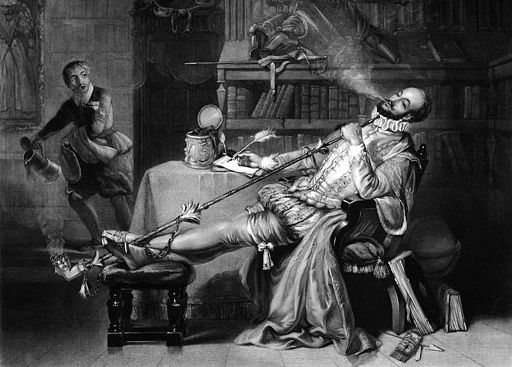
“Raleigh’s First Pipe in England” – an illustration included in Frederick William Fairholt’s Tobacco, its history and associations. 1859. 

Sir Walter became an avid and influential advocate of tobacco, and many other English nobles then also indulged. He is said to have presented tobacco to Queen Elizabeth I; and, of course, smoking then became the rage in the Royal Court.

Recreational use of the addictive stimulant soon covered England and much of Europe in smoke; and, unfortunately, many believed that it had health benefits and that smoking cured all manner of illnesses, including gout, hysteria, and cancer; and when applied externally, could be used for bites from poisonous reptiles and insects, ringworm, and to increase the growth of hair. 

Pipe-smoking then grew rapidly across all levels of English society and the English demand for tobacco became the greatest in the Old World. One historian described it as a “insatiable.” Note that the use of cigarettes as the primary vehicle for consuming tobacco did not become commonplace until well after the Industrial Revolution. 

However, the English had a serious problem — availability of tobacco. By the late 1500s, not a single English tobacco plantation existed in the New World, which meant that obtaining it relied on trade, smuggling, or capturing vessels bound for Portugal or Spain. This supply problem is cited by many historians as one of the precipitating factors in the decision to establish a permanent colony in the Americas. 

King James I, in his 1604 “Counterblaste to Tobacco,” voiced his opposition to the “noxious weed” and his concern that tobacco smoking had serious social and health implications. He then raised the taxes on tobacco in an effort to reduce use.

The Tobacco Mystique

Despite the King’s “Counterblaste,” tobacco developed an “aura” amongst the “smoking public.” For example, the opening speech of Moliere’s Don Juan begins, “There is nothing like tobacco. It’s the passion of the virtuous man; and whoever lives without tobacco isn’t worthy of living.”

A century later, Sir Arthur Conan Doyle continued in that vein in The Red Headed League, wherein a contemplative Sherlock Holmes, while considering a complex problem, informed Dr. Watson that, “It is quite a three pipe problem, and I beg that you won’t speak to me for fifty minutes.”

Finally, in World War I, General John Pershing appealed from France: “You ask me what we need to win this war”; and I answer “tobacco, as much as bullets.”

The King Addresses England’s Tobacco Deficit

In 1606, King James I granted a charter to the Virginia Company of London to establish permanent colonial settlements in the New World. Although their primary motivation was the hope of reproducing the wealth and riches that the Spanish brought home after they looted the Aztec empire; the Company also supported the English national goals of offsetting the expansion of other European nations abroad, finding a sea passage through the New World to India and Asia, and converting the indigenous peoples to the Anglican religion.

Their journey began that December and in May,1607, three ships with over 100 male colonists and another 40 crew members arrived in the New World to start a settlement at Jamestown, which they named after their king.

Location, Location, Location

Jamestown was selected because its waters were deep enough to enable the English to secure their ships at the shoreline, its position was defensible, and there was no native inhabitation. The reasons for the latter quickly became obvious.

The settlement was on a mosquito-infested, swampy peninsula, downstream from nearly 15,000 native Algonquians, who lived in more than 100 villages, and were ruled by a powerful leader, Powhatan (the “Powhatans.”)

Immediate Problems

The settlers arrived without sufficient food supplies and an inadequate group of skilled farmers, skilled tradesmen, and laborers. Their group included a large number of wealthy members of the gentry, whose background did not include much manual labor. 

Their water source was brackish and unsanitary, and they developed typhoid and dysentery. Worse still, mosquitoes in the marsh carried malaria. Their governing council, which was proscribed by the king, lacked authority and was ineffective. 

They had landed during a prolonged drought, which made finding fresh water and planting any crops at all very difficult. 

Relations with the Powhatans, whose harvests were also impacted by the drought, were tenuous; and degraded into open conflict, as the English, who were forced to rely on them for most of their food; eventually escalated from trade, to raiding the smaller villages. 

By the end of 1607, Jamestown was close to failing, and only the periodic arrival of supply ships from England held the colony together.

At this point, I am going to change tack from this play-by-play analysis of the trials and tribulations of the settlers, and discuss the activities of some key people who made the venture succeed (spoiler).

Captain Christopher Newport

Newport was an English seaman and privateer, who was captain of the largest of the three ships that carried the earliest settlers to Jamestown; and in overall command of the convoy on that first voyage. He also made several supply trips between England and Jamestown, which, as noted above, “held the colony together.” 

In 1609, he became Captain of the Company’s newly launched “Sea Venture,” which was the flagship of a new larger convoy carrying settlers, provisions, and the first group of government officials to Jamestown. On that voyage, the “Sea Venture” sailed into a fierce storm, ran aground, and was forced to temporarily land in Bermuda to make repairs.

Captain John Smith

Smith became the colony’s leader in 1608, the fourth in a succession of council leaders. His administration had the advantage of the King’s second charter, which created a much stronger form of governance under the now “Governor” John Smith, and included a period of military law that carried harsh punishments for those who did not obey.

Smith quickly instituted the policy: “He that will not work, will not eat.” Unfortunately, he was injured in late-1609 and returned to England. His departure was followed by a period of warfare with the Powhatans and the deaths of many settlers from starvation and disease.  

John Rolfe

Rolfe arrived in Jamestown in 1610 with the “Sea Venture” convoy along with 150 other settlers. He began cultivating tobacco, using seeds from Trinidad, or the West Indies, and began development of Virginia’s first profitable export. Note that how Rolfe came by the tobacco seed is not known.

In 1614, Rolfe married Powhatan’s daughter, Pocahontas. The couple traveled to London in 1616 with their infant son Thomas, with the expectation of stimulating investment in the Jamestown settlement. Pocahontas, who was christened Rebecca before the voyage, was presented to English society as an example of the “civilized savage.”

She died before returning to Virginia. Their marriage created a climate of peace between the colonists and the Powhatans; which continued for eight years as the “Peace of Pocahontas.”

Virginia Tobacco was an Unqualified Success

Rolfe’s new and milder tobacco proved immensely popular in England, helping to break the Spanish monopoly and creating a stable economy for the colony. 

By 1617, the colony was exporting 20,000 pounds of tobacco annually; doubling that amount in the following year. Historian Lee Pelham Cotton estimates that by 1640, London was importing nearly a million and a half pounds of tobacco per annum from Virginia.

James I’s “noxious weed” had become the economic staple of Virginia; and would ensure the survival of the colony.  By the beginning of the 17th century, the Virginia Colony became the wealthiest and most populated British colony in North America, which was probably the impetus for commissioning further settlements in the New World.

Indentured Servitude and Slavery

From the beginning (i.e., about 1500), the Portuguese had enslaved the indigenous natives in their colony of Brazil to work on their sugar cane, cocoa, and tobacco plantations The import of African slaves began mid-16th century, but the enslavement of indigenous peoples continued well into the 17th and 18th centuries. 

The British hesitated to establish slavery in Virginia because they relied on indentured servants for the grueling labor in the tobacco fields. However, the growing demand for Rolfe’s tobacco resulted in a huge need for more field laborers; and, unfortunately, coincided with declining numbers of indentured servants willing to emigrate from England. The number of slaves increased significantly thereafter.

Author’s Notes:

In Part 2, I will review the expansion of English settlements into New England, with particular focus on how tobacco developed as a cash crop in Connecticut

I will also consider Martin Luther King, Jr.’s experience in the early-1940s as a college student “working tobacco” in the Farmington River Valley.

I will present the literature and the cinema that romanticized Connecticut tobacco; and finally, contrast the 1998 Tobacco Settlement with the more recent Opioids Settlement 

However, before I close this essay, I wish to share my opinion that Disney got it all wrong. 

The 1995 production of “Pocahontas” tells the story of Captain John Smith’s romance with Pocahontas, which progresses, much to the disapproval of her father, Chief Powhatan. Smith’s fellow Englishmen plan to rob the Native Americans of their gold. As the story continues, her father tried to execute Smith by clubbing him to death. Pocahontas prevented the bloody killing by resting her own head on his.

Of course, I could not corroborate any of this; but, refer you to the section above on John Rolfe.

What’s troubling is that, given Disney’s probable incorrect review of history, it may also be possible that Davy Crockett was not the “King of the Wild Frontier.”

Editor’s Note: i) This is the opinion of Thomas D. Gotowka.
ii) The photo published above of George Burns is in the public domain in the United States because it was published in the United States between 1927 and 1977, inclusive, without a copyright notice.
iii) The photo published above of Sir Walter Raleigh is available from the New York Public Library’s Digital Library under the digital ID 1107712: digitalgallery.nypl.org→digitalcollections.nypl.org. {{PD-US}}

Tom Gotowka

About the author: Tom Gotowka’s entire adult career has been in healthcare. He will sit on the Navy side at the Army/Navy football game. He always sit on the crimson side at any Harvard/Yale contest. He enjoys reading historic speeches and considers himself a scholar of the period from FDR through JFK. A child of AM Radio, he probably knows the lyrics of every rock and roll or folk song published since 1960. He hopes these experiences give readers a sense of what he believes “qualify” him to write this column.

 

A la Carte: A Soup for Snow? Try This Intriguing Sweet Potato-Coconut Soup

Lee White

What do you do on a Sunday when there is nearly three feet of snow on your front door? Obviously, the meteorologists were right this time …

Is there enough food in my house to keep me a day or two from starvation?

Sure, there is.

But what would I be in the mood for?

Yes, my friends, I had stocked up on produce with what I wanted to cook: three different soups. I also made tiramisu on Sunday, just because I happened to have mascarpone in the refrigerator and, while milk chocolate was not in any supermarket, I have some Ghirardelli cocoa mix in the pantry, too.

Amid all the produce, I bought a sweet potato bigger than my shoe size, a seven. Tonight, I am making a soup to finish up the coconut milk I used yesterday. You may, as I did, forget the parsley relish, since I am out of fresh parsley.

Sweet Potato-Coconut Soup with Spice Relish

Adapted from a recipe by Bobby Flay in September 12, 2010 issue of Parade magazine
Yield: 4 to 6 portions

Spicy Relish
1 tablespoon canola oil
1 tablespoon unsalted butter
pinch of red-pepper flakes
½ small sweet potato, peeled and cut into a small dice
salt and pepper to taste
¼ cup finely chopped fresh flat-leaf parsley

Sweet Potato-Coconut Soup
1 ½ tablespoons canola oil
1 small red onion, chopped
2-inch piece of fresh ginger, grated (ginger gums up your Microplane; cut in tiny dice instead)
pinch of red-pepper flakes
3 cups homemade chicken stock (out of my own, I used the store-bought, low-sodium broth)
½ cup water
1 ½ pounds sweet potatoes, peeled and cut into large dice
1 ½ cups unsweetened coconut milk
1 tablespoon honey
large pinch of ground cinnamon

For relish, heat oil and butter over medium heat. Add red-pepper flakes; heat for 10 seconds. Add diced sweet potato, salt and pepper to taste. Cook, covered, stirring occasionally, until softened, 15 minutes. Uncover, increase heat to high and cook until diced potatoes are golden brown, 5 to 7 minutes. Transfer to a bowl and stir in parsley.

For soup, heat oil in a saucepan over medium heat. Add onion and ginger; cook until soft, 5 minutes. Add red-pepper flakes and cook for 30 seconds. Add stock and water, bring to a boil. Add sweet potatoes, bring to a simmer. Cook until potatoes are soft, 20 to 25 minutes. Cool for 20 to 25 minutes.

Transfer mixture to a blender and process until smooth. Return to saucepan; simmer over low heat. Whisk in coconut milk, honey and cinnamon. Cook until thickened and warmed through. Season with salt and pepper.

Ladle into bowls, top with a spoonful of a spicy relish.

About the author: Lee White has been writing about restaurants and cooking since 1976 and has been extensively published in the Worcester (Mass.) Magazine, The Day, Norwich Bulletin, and Hartford Courant. She currently writes Nibbles and a cooking column called A La Carte for LymeLine.com and the Shore Publishing and the Times newspapers, both of which are owned by The Day. She was a resident of Old Lyme for many years but now lives in Groton, Conn. Contact Lee at leeawhite@aol.com.