A la Carte: Lemony Shrimp and Risotto Makes a Luscious Entrée

Lee White

I used to wonder about people who won’t go out if the weather is crappy, especially if it is snowing. I grew up where there is snow most days from mid-November until the end of March. I don’t remember having any snow days, but maybe we did.

In any case, I never saw a school bus and, to this day, I have never been on one. From kindergarten until junior high school (now called middle school), I walked to school, came back for lunch, then back to the school until it was time to go home. Walking.

My parents decided, after junior high school, that I would go to a different (but still public) high school. It was about seven miles from our house, so my father drove to school every morning. After school, I walked through RPI, down gazillion steps (called The Approach) into the city, then often took a town bus home.

And this was before 4-wheel, or all-wheel-drive, cars. I can still hear the sound of chains on the tires of cars and buses. Today I can’t imagine not having an all-wheel-drive car.

I also can’t imagine not going out if I want to make something for which I don’t have in my freezer, refrigerator or pantry. But when I went to bed last night, I thought I’d wake to snow or ice or heavy rain; I knew I had the shrimp, the rice and most everything except a bulb of fennel and the arugula.

Had I decided I wouldn’t go out in the crappy weather (I am one of those people, these days), I would use some fresh parsley and leave out the fennel. As it turned out, it was 47 degrees, had not snowed and there was not a chance of freezing rain.

A quick trip to the market and I had all the ingredients for this luscious entrée. And, by the way, it will be almost as good in the microwave the next day.  

Lemony Shrimp and Risotto
Adapted from Giada De Laurentiis

5 tablespoons extra-virgin olive oil (divided)
2 teaspoon kosher salt (I use sea salt), divided
½ teaspoon freshly ground black pepper, divided
1 pound extra-large shrimp, peeled and deveined
1 small fennel bulb, chopped (about 1 cup)
1 small onion, chopped (about 1 cup)
1 large clove garlic, smashed and peeled and chopped
1 cup arborio rice (about 6 ½ ounces)
¼ cup dry white wine
3 cups low-sodium chicken broth, plus more if needed
¼ cup fresh lemon juice (from 1 large lemon)
Zest of 1 large lemon
3 cups arugula

Yield: 4 servings

Heat 2 tablespoons oil in a heavy large saucepan over medium heat. Add shrimp and sprinkle with ½ teaspoons salt and ¼ teaspoon pepper. Cook until shrimp is just opaque in the center, about 3 minutes. Remove pan from the heat. Transfer shrimp and juices to a bowl to cool.

Add remaining 3 tablespoons oil to the pan. Add fennel and onions. Cook until tender, about 4 minutes. Add garlic and cook until aromatic, 30 seconds. Add wine.

Cook until wine is absorbed, stirring often, about 2 minutes. Add broth, lemon juice, zest and remaining salt and pepper. Increase heat and bring to a boil, stirring often.

Reduce heat to medium-low. Simmer until rice is just tender, but still has some chew and the risotto is creamy, stirring often, 13 to 14 minutes.

Mix in arugula. Stir until arugula wilts, about 30 seconds. Add shrimp. Mix in additional broth, if needed, ¼ cup at a time, until risotto is creamy.

Spoon risotto into 4 shallow soup bowls.

About the author: Lee White has been writing about restaurants and cooking since 1976 and has been extensively published in the Worcester (Mass.) Magazine, The Day, Norwich Bulletin, and Hartford Courant. She currently writes Nibbles and a cooking column called A La Carte for LymeLine.com and the Shore Publishing and the Times newspapers, both of which are owned by The Day. She was a resident of Old Lyme for many years but now lives in Groton, Conn. Contact Lee at leeawhite@aol.com.

Gardening Tips for February from ‘The English Lady,’ Lift Your Spirits by Thinking Spring … and Beyond

Lift your spirits in these winter months by starting to plan how you would like your garden to  look in the summer or fall. Photo by Jan Canty on Unsplash.

Maureen Haseley-Jones is “The English Lady.”

Hello everyone, with all the pain and suffering we are all experiencing right now with the pandemic still upon us, I wanted to lift your spirits and cause you to begin planning for this season in your garden.

Mother Nature’s gifts of renewal, growth and nourishment tell us that in this wonderful pastime called ‘gardening,’ we can escape from the trials and tribulations of our world. Each day we move gradually from the dark into light, to a longer brighter day, and finally, we welcome spring.

Paper-white narcissi have a beautiful fragrance. Photo by Jonathan Diemel on Unsplash.

A few weeks ago, I retrieved my second batch of Narcissus from the brown paper bag in the refrigerator and planted them on pebbles, with just enough pebbles to anchor the bulbs in place or you may use potting soil. I use tall glass vases and it is most important keep the pebbles moist with enough water to cover the bottom of each bulb.

I brought my Rosemary plant indoors in September, Rosemary is not hardy outdoors in  zone six. I spray the plant twice weekly with warm water and run a cold-water humidifier and two germ guardian air cleaners with UV lights for personal health and the health of my plants.  

After planting the paper-white Narcissus, I placed them in a dark, cool closet until the foliage is about four inches tall. Today, I moved them from the dark closet to a cool room with indirect light and where the temperature remains at about 65 degrees. When the buds are almost ready to open, I will place them in a brighter area to be enjoyed, not only for their bloom but also the heady fragrance, which permeates the house.   

The new bloom gets me out of the winter doldrums and their gentle fragrance lifts my spirits. I know that the severe changes occurring with global warming combined with pollution in the air, water and the earth, are severely damaging our planet. 

Your own  personal contribution to saving our planet is to tend the soil organically with compost, manure and natural brown mulch, which builds the humus component in your soil. Your plants and vegetables will thrive, as will you.  Throughout the year allow your garden to anchor you, connecting heart, body, mind and spirit to Mother Nature’s life-giving bountiful gifts and spiritual energy.  

The bitter cold harsh winds of January and February extract moisture from trees and shrubs, especially the evergreens. Winter winds are more harmful to plants than cold temperatures, not only causing plant breakage but also soil erosion. 

Cover any roots that become exposed during the winter with topsoil. Photo by Markus Spiske on Unsplash

For that reason, it’s helpful to have a few bags of topsoil and mulch in the garage. With these items on hand, any roots can be covered when they become exposed by wind or frost heave. Roots exposed to the elements for any length of time can kill the plant, so when you notice exposed roots, quickly cover those areas with soil and mulch.

When spring arrives, and the earth warms up, the plant can be resettled in place together with composted manure and the natural brown mulch to provide protection and nutrition.

On a sunny day this month, take a walk round the garden and breathe in the freshening air and as you walk, make some notes and decide what worked for you last year and what you will never try again. 

Later, when you are back indoors, relaxing in your armchair, browse through the catalogues that began arriving a few months ago. You have already begun making lists of plants that you are thinking of buying. 

A word of caution, however, when gazing at the photos, which are meant to tempt you with their lovely but “doctored up” pictures of plants. Don’t be fooled!

Instead, decide that this season in the garden will be for sensible and organized change. Do not allow your imagination to run amok and be caught up in the fantasy of the brightly-colored, high-maintenance garden pictures shown in the catalogues. 

Suit your garden to your lifestyle that will work within your time frame and physical abilities. If you follow that construct, you will have the time to sit, relax and smell the roses, without being overwhelmed or disappointed.    

As you sit and plan for the coming season, it’s important to keep your budget in mind. It’s hard to believe as you look outside at the muted landscape, that in a few months, sunshine and gentle breezes will warm the soil. 

When the soil is dry enough to tread on, winter debris may carefully be cleared away. Then with a clean palette, make a clean edge on the borders; this simple task makes such a difference to the look of a garden. Then in mid -April, add that lovely layer of manure and compost (the ratio being three parts manure to one part compost). 

With that prep done, you are ready for the fun stuff, the placing and planting!  

For those of you who are vegetable gardeners and look forward to a bountiful year with fruits and vegetables; spring rain, extra irrigation and sunshine will produce a  delicious bounty. As spring moves along, so will the appearance of both good and bad insects, moles, voles and other critters, that can be dealt with naturally. My remedies for these problem, I will give in an upcoming gardening letter.

Your memory of your garden from last season may be lost in the enthusiasm of a new season, therefore, I am asking you to be kind to yourself. If last year you became overwhelmed with too much gardening, and not enough time to relax and smell the roses, the following are some suggestions you might follow to avoid that problem:

For example, send some of your borders back to grass.

If you are tired of mowing all your grass areas, spread wildflower seeds in the grass and enjoy the pleasure of a prairie meadow.

Make some of the high-maintenance, perennial borders, into mixed shrub borders. To accomplish this, take out some of those high-maintenance perennials and donate them to a worthy cause. 

In their place, plant small and medium size evergreen shrubs; some green, some blue and some of the lovely evergreen gold species. With these shrubs and their year-round beauty, add small flowering deciduous trees and shrubs that begin flowering in April and successively through June. The Carlesii viburnum, also known as Korean Spice, is a favorite small shrub of mine, with its white buds that open to a pale pink with the most delightful fragrance.  

Add a Ben Franklin tree with its white, cup-like blooms and gold center that flowers in August through September. 

Nestle three Blue Mist shrubs in the mixed border; this plant will delight with purple blooms and fragrant leaves into September. 

On a fence or trellis, plant white autumn clematis.

Add a groundcover as an evergreen framework – my favorite is Myrtle with its glossy leaves and miniature blue flowers that bloom in April.    
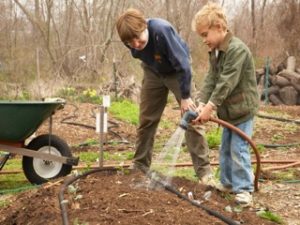
It is never too soon to introduce youngsters to the wonders of the garden.

I feel it is never too soon to introduce your children and grandchildren to the wonders of the garden and begin by introducing them to the garden fairies. Through the years, I have asked children to draw a picture of the garden fairy and make a list of questions to ask the fairies, who live in the wild patch in the garden. 

We all have a wild patch in the garden; and at this point you are probably saying, “Maureen, my garden is one large ‘wild patch.’ Children became so excited and enthused about their lists and pictures of the fairies, as what you are showing them is the transformation of science into magic. These days we seem to have forgotten about fairy tales, dreams and magic; it’s way past time to bring those wonderful energies back into our lives and into the lives of our children.  

In spring and on into summer I would find my children or their friends impatiently checking the garden wanting to see their planting efforts come into bloom. In the vegetable garden, they gathered to check what was ready to eat from the produce they had planted. I have found that this introduction to the garden has inspired these children when they become adults to plant and tend gardens of their own enthusiastically.

My son Ian is a great example of this as he has partnered with me through the years in the garden – and, in him, the old adage that ‘the student is better than the teacher’ has certainly proved to be correct. Ian is a designer par excellence and I invite you to check his website LandscapesByIan.com and his Facebook page for lovely examples of his work. 

In my March gardening tips, I’ll offer you some suggestions of ornamental trees, shrubs and long blooming perennials. With that list in hand, it is a good idea to obtain your plants from local garden centers that carry tried and true plants that will flourish in Zone 6.  

On the other hand, if you feel that over the years, you have been throwing good money after bad in your garden. You are feeling desperate as you feel that your garden no matter what you do, never looks right. If that is the case then get in touch with a landscape company (for example, LandscapesByIan.com), who will keep your budget in mind whether you want to do your own work, or wish for a design to install yourself.  

Let your imagination run wild as you start to plan your garden … and then bring it back to reality as you start to consider what is really manageable.

On the other hand, when you are planning your garden for this coming season, there are important facts to keep in mind:  

What are the plants requirements for sun, shade, soil, and water? 

Will they survive in this zone, Zone 6?  

What are the growth patterns of the plants? Do they grow fast or slow?  

You do not want a 50 ft. tree up against the house with tremendous roots that will play havoc with your house foundation.  Or do you want that lovely but very large, Catawbiense Rhododendron, all 10 ft. of it, climbing through your dining room window in five years? 

To find those facts, either check the plants in a book, on the Internet or read the labels attached to the plants in the nursery. 

Check every aspect of the plant before you buy.  The red or green Lace Leaf Japanese Maple looks lovely in spring but is it something you can enjoy, without its leaves in the winter? Personally, I not only enjoy the foliage of plants and trees but also the shape and bark of trees without foliage in winter.  

For those of you just beginning to garden, I must be honest and dispense with the myth that gardening is always a relaxing hobby. At the end of that first day of digging, lugging soil, manure and fertilizer, and planting everything at the proper depth; you will feel exhausted.  

Then you remember that you still need to water the newly-installed plants as you drag your tired body to switch on the hose. Thank goodness, the mulching can wait until tomorrow or next weekend, right? Right!   

Watering can be meditative … by any method. Photo by Anthony Lee on Unsplash.

Watering, by the way, can be meditative. Imagine that the hose is your umbilical cord so that, as you nourish the earth and the plants, the earth can nourish you. 

By now the sun has gone down, and you trudge indoors muttering to yourself, “What the heck did I get myself into”?  To this comment I say, “You did not have to tackle all of the garden in one day”.  

In gardening, there is always tomorrow, or next week, and even though the label says to plant it by the end of May or June, believe me folks, a few weeks later does not matter, the garden will wait for you.  

You may be saying to yourself at this point, “Maureen, are you trying to put us off gardening?” No folks, but I would remiss, as someone who has gardening in my blood (as well as manure!) for over 400 years to tell you, however reluctantly, not only the pleasures, but some of what can cause aches and pains.

The idea is not to bite off more than you can chew. For first-time gardeners, don’t scatter your energies all over the garden, but rather tackle and complete one area at a time. That area should be priority one until it is complete.  

If you have a new home with no landscaping, some hardscape may be required. Hardscape is walls, walkways, patios, ponds, decks and so on. The sound and look of a water feature in the garden is delightful. A water feature need not be elaborate, a fountain is fine – the reflection of water is Mother Nature’s mirror.

If you are not able to do this construction yourself, get in touch with a landscape contractor now, so that a plan can be created right away, then installed and ready by spring. I say to connect now as many landscape products are short on supply this year.   

All of these endeavors mean you getting yourself in shape physically, so get off that couch, put away the catalogues and your plant lists, stretch, then wrap yourself up in warm gear and take that walk.   

As you walk, look at the trees in winter, the elegant shape of them, the lichen on the stonewalls, and the moss tucked in cracks and crevices. Clear your mind and allow nature’s spirit to surround you. As you walk, look at a garden or two in your neighborhood; gardens which you have admired when they were in bloom and see what they look like in winter.  

I remember one of my professors when I studied at the Royal Botanic Gardens at Kew saying, “In winter, you can tell a really good landscape by its bones, without the flesh of flora and foliage.” 

In spring, get in touch with those neighbors whose gardens you admired and ask them some of the secrets of their garden. They will be happy to talk with you not only of their successes but their failures – true gardeners are realists when they speak about their gardens and love to share.  

Well folks, I’ve given you plenty to think about right now so enjoy your daydreaming of the season to come and I’ll see you next month in your garden.

About the author: Maureen Haseley-Jones is a member of a family of renowned horticultural artisans, whose landscaping heritage dates back to the 17th century. She is one of the founders, together with her son Ian, of, The English Lady Landscape and Home Company. Maureen and Ian are landscape designers and garden experts, who believe that everyone deserves to live in an eco-conscious environment and enjoy the pleasure that it brings. Maureen learned her design skills from both her mother and grandmother, and honed her horticultural and construction skills while working in the family nursery and landscape business in the U.K. Her formal horticultural training was undertaken at the Royal Botanic Gardens at Kew in Surrey.

A la Carte: Winter Vegetable Soup for a Wintry Day

Lee White

Over the years, I learned a lot about buying cookbooks. Never mind the first one I ever had: it was a cookbook that was part of the first (and only) encyclopedia we order for our daughter. I bet no one under fifty years old has ever bought one.

My second was Craig Claiborne’s New York Times Cookbook. It was one hell of a cookbook and still is. I learned to cook from that one. I began to buy chefs’ cookbooks. Like a kid, I loved the pictures. One, the French Laundry Cookbook by Thomas Keller, was gorgeous, but I never cooked a single recipe from it.  The recipes looked easy, just eight or seven ingredients, but embedded were words like “see page this or see page that.” To finish the entrée or dessert I would have had to make two or three different recipes first.

Today I buy cookbooks written by the brilliant Jacques Pepin and television star Ina Garten; I own books from the Moosewood Collective along with Sheila Lukins and Julee Rosso. These people are cooks, teachers and recipe writers, rarely restaurant chefs.

Jacques buys most of his ingredients from farmers’ markets or Stop and Shop. Ina Garten shops in the Hamptons. They both have their own gardens. Sheila Lukins cooked for her own little shop called The Silver Palate. New Haven’s own Claire Criscuolo’s Claire’s Corner Copia books are treasures.

So here’s the deal: in the recipe below, there are 18 ingredients, but nine are veggies, a bunch, literally, are herbs and there is some liquid. Most of them are probably in your own kitchen. The soup will feed eight to 10 people and cost you maybe $15. And I found that recipe  from Yankee magazine, which couldn’t be more New England-ish.

This soup is delicious.

Roasted Winter Vegetable and White Bean Chowder
From In the Thick of It by Nadine Nelson (Yankee, January-February, 2022)

2 ½ cups diced butternut squash
2 ½ cups sliced carrots
2 cups diced russet potatoes
1 cup diced parsnips
1 fennel bulb, diced
2 tablespoons plus 3 tablespoons olive oil
2 teaspoons kosher salt, divided
3 cups diced onion
1 cup diced celery
5 fresh thyme sprigs
1 fresh rosemary sprig
1 bay leaf
1 teaspoon freshly ground black pepper
2 tablespoons flour (all-purpose or gluten-free)
8 cups vegetable stock (chicken stock if you are not a vegetarian)
2 14-ounce cans cooked white beans, drained
2 cups sliced mushrooms, any kind
2 cups milk of your choice (2 percent is fine)
Fresh thyme sprigs and ground paprika or smoked for garnish

Heat oven to 425 degrees. In a large bowl, toss five veggies in 2 tablespoons olive and and 1 teaspoon kosher salt. Divide vegetables between two large rimmed baking sheets and roast until tender and browned, about 40 minutes, turning them a few times while roasting.

While vegetables are roasting, prepare the soup base: heat 3 tablespoons olive oil in a large pot over medium-high heat, then add onions, celery, thyme, rosemary, bay leaf, black remaining and 1 teaspoon salt, then cook, stirring occasionally, until soft, about 6 minutes.

Stir in the flour and cook, stirring constantly, for 1 minute. Add stock and beans.

Bring to a boil, then reduce heat to a simmer and cook for 10 minutes. Add mushrooms and milk, bring to a simmer, and stir in roasted vegetables.

Taste and add additional salt and pepper, if desired.

Serve hot, garnished with fresh thyme and a sprinkle or paprika. 

About the author: Lee White has been writing about restaurants and cooking since 1976 and has been extensively published in the Worcester (Mass.) Magazine, The Day, Norwich Bulletin, and Hartford Courant. She currently writes Nibbles and a cooking column called A La Carte for LymeLine.com and the Shore Publishing and the Times newspapers, both of which are owned by The Day. She was a resident of Old Lyme for many years but now lives in Groton, Conn. Contact Lee

A la Carte: Count on Chicken Chili on a Cold Day!

I have four definites before I give you a recipe:

  1. I have made the recipe and it was good
  2. Someone I knew had made this recipe and gave me the recipe and I understood the intranets and trusted them
  3. The ingredients were available or that a substitute would work for you
  4. I tinkered with the recipe and felt the tinkering made the recipe even better.

This was not the case with the tourtière you read last week.

I had not made a tourtière, or French-Canadian meat pie, in decades because my husband really didn’t like the cinnamon-blend so I never made it again. But my husband is gone and I love the spice blend (like the sauce the Olney, R.I. diners serve with hot dogs in the Ocean State), so I decided to make a tourtière from a recipe on the Internet. I sent the column before I made the tourtière.

I was gob-smacked. Either my palate had changed (which can happen  to anyone) or the spice blend sucked or my taste memory was faulty.

I drove down to my friend Rich Swanson’s house. He didn’t think the pie wasn’t bad (was he just being kind?), but he gave me an individual spiced lamb pie he’d made that might give me something I’d remember. That day I thawed the pie and had it for dinner with some broccoli, and there was that tourtière-flavor I remembered. 

“Will you give me that recipe?”  I begged over the phone.

“Yes,” he said, but it might take him some time to make the right amount of seasoning for a full-sized pie. “Take your time, Rich,” I said.

Unless you are a kid and it is Christmas morning, waiting for something wonderful is easy.

So, today, I am giving you a  recipe for chicken chili that I have made many times. Because it serves 12, you can halve the ingredients for six people; whether it is for six or 12, it freezes well.

Chicken Chili

Adapted from Ina Garten’s  “Barefoot Contessa Parties!” (Clarkson Potter, New York, 2001)
Serves 12

If you call this recipe a stew, make it a day or two earlier and refrigerate, warm it up and serve over rice, everyone will love it.

8 cups chopped onions (6 onions)
One-quarter cup good olive oil, plus extra for chicken
One-quarter cup minced garlic (8 cloves)
4 red bell peppers, cored, seeded and large-diced
4 yellow bell peppers, cored, seeded and large-diced
2 teaspoons chili powder
2 teaspoons ground cumin
½  teaspoon dried red pepper flakes, or to taste
1 teaspoon cayenne pepper, or to taste
4 teaspoons salt, plus more for chicken
4 28-ounce can whole peeled plum tomatoes in puree, undrained  (I used Muir Glen diced tomatoes)
½  cup minced fresh basil leaves
8 or more split breast chicken, bone in, skin on (thighs or a combination would be fine, too)

For serving: chopped onions, corn chips, grated cheddar cheese, sour cram

Cook onions in the oil over medium-low heat for 10 to 15 minutes, until translucent. Add garlic and cook for 1 more minute. Add bell peppers, chili powder, cumin, red pepper flakes, cayenne and salt. Cook for 1 minute.

Crush tomatoes by hand or in batches in a food processor fitted with a steel blade (pulse 6 to 8 times). Add to the pot with the basil. Bring to a boil, then reduce heat and simmer, uncovered, for 30 minutes, stirring occasionally.

Preheat oven to 350 degrees.

In the meantime, rub the chicken with olive oil and place them on a baking sheet. Sprinkle generally with salt and pepper. Roast chicken for 35 to 40 minutes, until just cooked. Let cool slightly.

Separate the meat from the bones and skin, and cut into three-quarter chunks. Add to the chili and simmer, uncovered, for another 20 minutes. Serve with toppings, or refrigerate and reheat gently before serving.

Lee White

About the author: Lee White has been writing about restaurants and cooking since 1976 and has been extensively published in the Worcester (Mass.) Magazine, The Day, Norwich Bulletin, and Hartford Courant. She currently writes Nibbles and a cooking column called A La Carte for LymeLine.com and the Shore Publishing and the Times newspapers, both of which are owned by The Day. She was a resident of Old Lyme for many years but now lives in Groton, Conn. Contact Lee at leeawhite@aol.com.

A la Carte: For Lee, Winter and Widowhood Mean it’s Time for Tourtière

Lee White

Before the holiday season, Nancy Harmon Jenkins, a wonderful cookbook writer who lives mostly in Maine and visits Italy often, talked about the French-Canadian tourtière

I made it a few times for my husband but he really didn’t like the seasoning. He said the same when I made Cincinnati Five-Way Chili (chili with beans, onions, seasoning, spaghetti and cheese). Doug had pretty good catholic (small “C”) food preferences and so, after the tourtière discussion (and all the time, really), I just made food he enjoyed.

In any case, I love all those spices and I adore savory pies like chicken and beef pot pies.

But now it is winter and widowhood, so I can cook anything I like and share the bounty with friends.

The recipe looks long, but if you use a pre-made crust (preferable Oronoco frozen pie crusts), this recipe is a snap. As for the spice blend, quadruple or quintuple it and save in a tight-lidded jar for tourtière or Cincinnati Five-Way Chili for next time!

Tourtière (French-Canadian Meat Pie)
Adapted from Chef John on allrecipes.com 

Photo by Rebecca Matthews on Unsplash.

2 pre-made frozen pie crusts, thawed
Spice blend
2 teaspoons kosher or sea salt
1 teaspoon freshly ground black pepper
1 teaspoon ground thyme
½ teaspoon ground sage
½ teaspoon ground cinnamon
½ teaspoon ground ginger
¼ teaspoon ground nutmeg
¼ teaspoon ground mustard
1/8 teaspoon ground cloves
1 pinch cayenne pepper

Filling
1 large russet potato, peeled and quartered
1 teaspoon kosher or sea salt
1 tablespoon butter
1 large onion, finely chopped
1 pinch salt
4 cloves garlic, crushed
½ cup finely diced celery
1 pound each ground pork and beef
1 cup potato cooking water, plus more as needed

Egg wash
1 large egg and 1 tablespoon water, stirred

Place potato quarters in a saucepan, cover with cold water. Add 1 teaspoon salt. Bring to a boil over high heat; reduce heat. Simmer until cooked through. Remove potato and mash; save water.

Melt butter over medium heat. Add onions and salt and stir until onions turn golden, 10 to 15 minutes. Stir in garlic, celery and spice blend and stir until onions coated with spices, 30 seconds. Add meat and ladle ¾ cup of potato water into skillet. Cook until meat is browned and has an almost paste-like texture. Continue, stirring, until meat is tender and most liquid is evaporated, 45 minutes. Stir in potatoes and remove from heat. Bring to room temperature.

Preheat oven to 375 degrees. Fill bottom crust with meat mixture and smooth out. Brush edges of bottom crust with egg wash, then place top crust on the pie and press lightly around edges to seal. Trim excess dough from crust. Crimp edges of the crust and brush entire surface of pie with egg wash. Place in preheated oven. Bake until well brown, about 1 hour. Let cool to almost room temperature before serving.

About the author: Lee White has been writing about restaurants and cooking since 1976 and has been extensively published in the Worcester (Mass.) Magazine, The Day, Norwich Bulletin, and Hartford Courant. She currently writes Nibbles and a cooking column called A La Carte for LymeLine.com and the Shore Publishing and the Times newspapers, both of which are owned by The Day. She was a resident of Old Lyme for many years but now lives in Groton, Conn. Contact Lee at leeawhite@aol.com.