A la Carte: Got to Grill? Try Chicken with Peach BBQ Sauce for a Tasty Change

Lee White

I spent a lot of time in the past couple of weeks driving. I wasn’t going long distances; rather I had errands so I did a couple, got home for lunch, and finished the rest a hour or two later. 

While my husband and I frequently went out for breakfast (always on weekends), now that I am husband-less (and have been for more than a decade), I do most of my reading, writing and thinking in the morning. Sometimes I look at the mantel clock and notice it is 11 a.m. Well, I wonder, is it going to be late breakfast or an early lunch? 

It is usually an early lunch. I often have enough leftovers from dinner the night before.

Today I have some leftover chicken salad (made from a roast chicken a couple of days ago), so I plate the chicken salad with some lettuce, sliced grape tomatoes and, to drink, an enormous glass of V-8.

And I muse about dinner. 

It will be chicken again, mostly because I love chicken and I’d thawed some skinless, boneless breasts this morning. (I really do not like boneless, skinless chicken, but this is what I found first in the freezer.)

Over the weekend, I took the cover of my Weber, cleaned the grills, found the tongs I left last fall and looked to make sure there were no squirrel nests in the lava rocks. I have plenty of propane.

I love this recipe. 

Photo by photo_ reflect on Unsplash.

Grilled Chicken with Peach BBQ Sauce
Adapted from Gwyneth Paltrow’s “My Father’s Daughter” (Hachette Book Group, New York, 2011)
Yield: serves 4

1 cup chopped peeled fresh peaches (I used canned, without added sugars), chopped
½ cup ketchup
1 tablespoon fresh lemon juice
2 garlic cloves, minced
1 ½ teaspoons adobo sauce from canned chipotle chiles in adobo or 1 teaspoon soy sauce*
Kosher (or sea salt) and freshly ground black pepper to taste
4 skinless, boneless chicken breasts
Vegetable oil

Combine first 5 ingredients in a small saucepan. Season lightly with salt and pepper and bring to a boil over high heat. Reduce heat to low, simmer until peaches are very soft and flavors meld, about 10 minutes. Remove pan from heat; let cool.

Pour peach mixture into a blender and puree until smooth. Season to taste with salt and pepper. Place half the sauce in a medium bowl; add chicken and turn to coat.

Let marinate at room temperature for 20 minutes, or cover and chill for up to 8 hours, turning occasionally. Cover and refrigerate remaining sauce.

Prepare a grill to medium-high heat. Brush grill rack with oil. Grill chicken until browned and almost cooked through, 4 to 5 minutes per side. Slice crosswise.

Serve with remaining sauce alongside.

* I have at least four cans of chipotle in adobe in my pantry. I sometimes make omelet or scrambled eggs with cheese cream and a mashed chipotle. It is a bit on the spicy side, but it’s delicious.

About the author: Lee White has been writing about restaurants and cooking since 1976 and has been extensively published in the Worcester (Mass.) Magazine, The Day, Norwich Bulletin, and Hartford Courant. She currently writes Nibbles and a cooking column called A La Carte for LymeLine.com and the Shore Publishing and the Times newspapers, both of which are owned by The Day. She was a resident of Old Lyme for many years but now lives in Groton, Conn. Contact Lee at leeawhite@aol.com.

Gardening Tips for May from ‘The English Lady’, ‘One of the Most Enchanting Months’

Color is bursting out all over in the Merry Month of May.

Maureen Haseley-Jones is “The English Lady.”

“The darling buds of May” is such an apt phrase for one of the most enchanting months, bloom on spring bulbs and flowering trees, the Amelanchier, the Dogwood and the Cherry to name a few and the new awakening foliage on trees winking in the sun.

By now, you have probably removed most of the winter debris, pruned broken branches and re-edged borders. However, do not apply the composted manure before the soil warms up to 60 degrees.

The soil needs to reach that temperature for the soil organisms to work with the bacteria of the manure which produces nutrients for the roots of the plants.  I suggest, when shopping for garden supplies, pick up a soil thermometer to check soil temperature as I am sure the soil temperature will reach 60 degrees in a few weeks.

As I walk around my garden, I am noticing our old nemesis — weeds — emerging everywhere.

Pull these up by hand, without breaking them together with the roots.  Using a tool breaks the weeds, and as a result, the broken weed pieces will take root and you will face hundreds more of these creatures to get rid of.

Follow on the weeding with an organic corn, gluten-based weed pre-emergent by Bradfield Organics; this product will keep weeds at bay for quite a few weeks.

When the soil warms to 60 degrees, apply composted manure around daffodils and other spring bulbs so that soil organisms will produce nutrients to feed the bulbs for next year’s bloom. Also, a reminder to not cut down the Daffodil foliage as the nutrition from the foliage is absorbed into the bulb for bloom next spring.

Also in a few weeks, when the soil has warmed up, apply composted manure and a light layer of fine bark mulch to all maintained areas of the garden, again in July, and before putting the garden to bed in October.  The manure and mulch will begin to build the humus component.

Regarding types of mulch … only use the natural brown wood mulch of natural, do not use the colored mulches, which contain chemicals, and do not use rubber mulch.

A word of caution on Cocoa Mulch. This product is highly toxic to dogs and cats.  It is manufactured by Hershey and sold in many large garden centers.  It is made from the residue of chocolate products and other ingredients and contains a lethal ingredient that has resulted in the reported deaths of cats and dogs that are attracted by the chocolate odor. This mulch contains Theobromine, which is a Xanthine compound, with similar effects to those of caffeine and theophylline.  The symptoms, which animals experience, are seizures and death within hours.

I wrote about the carbon component in my April tips, but wanted to emphasize its importance by stating it again to build the humus component in your soil .

All living things, including us, are all carbon-based creatures. Humus brings carbon from the air into the soil.

Humus acts like a sponge and holds 90 percent of its weight in water. Because of its negative charge, plant nutrients stick to humus bringing nitrogen, calcium, phosphorus and other important elements to the plant, preventing these nutrients from washing away, acting like nature’s slow- release fertilizer.

Humus improves soil structure making it loose and friable, which helps plants to root in this environment with better access to nutrients, water and oxygen. Humus also helps to filter toxic chemicals from soil, much like carbon-based water filtration systems filter toxins from your water.

I also recommend that you go online to Scientific American.com/article/Weed-Whacking Herbicide to check out the dangers of Round-Up. This is the most dangerous herbicide not only because of Glyphosate, which is on the list by the WHO as a chelating agent that causes cancer, but also because of its inert ingredients. I ask that you are not swayed by the word ‘inert’ as the ingredients are anything but inert and those ingredients combined with Glyphosate are deadly to human cells.

A yellow burst of color is offered by Forsythia in May.

Forsythia is in bloom, lovely fresh yellow blossoms.  If the bloom on your shrub is not as prolific as in previous years, prune out the old sparse wood after bloom ends.

A favorite native tree of mine is the Amelanchier with its creamy panicle blooms, followed by small green leaves and within weeks, red fruit, which is a delicious treat for our feathered friends. Before the birds eat all the fruit, you may want to pick some of the fruit which makes a delicious jelly for your morning toast.

“The graceful Dogwood.” Photo by Tabitha Turner on Unsplash.

Here in my town of Old Lyme, the Magnolias, Cherries and Eastern Redbud are vying with one another to show their finery together with the graceful Dogwoods.  Following the recent rains many of these trees are blooming at the same time or within a few weeks of one another. Their bloom will soon be over then we can look forward to rhododendrons, azaleas and followed by mountain laurel in early June.

Another favorite of mine is the Carlesii viburnum (also known as Korean Spice) is showing pink buds, opening to white flowers and their delightful fragrance fills the air outside my kitchen door. This viburnum grows to about five feet and can be tucked into many a border particularly in an area where you walk by and can enjoy the fragrance.

Covering the barn wall and scrambling up to the barn roof is my climbing hydrangea – bright green leaves emerging with hundreds of buds indicating that this beautiful climber will be laden with blossoms in summer.

Tulips, creeping phlox, forget-me-nots, primroses and candytuft are bringing much needed color to borders and rock gardens.

If you have not had the opportunity yet, for another couple of weeks you can still prune your roses.  Pull back the old mulch from around the base of the roses and in two to three weeks apply manure about six inches from the trunk of the plant. Then a week later reapply a layer of the brown natural mulch on top of the composted manure.

As well as building the humus component, these layers keep the roots cool, keep weeds at bay and help retain moisture. Do not mulch right up against the base of any plants as this encourages rodents to nest and gnaw on the plants.

Beware of fungi that look like weird mushrooms in your mulch; this is a sign of Artillery fungus, which can adhere to the walls of your home and cause problems.  If you notice this fungus, you will need to remove all the mulch and get it off your property.

Apply lime and manure around the lilacs, they like sweeter alkaline soil, thus the lime. By now, you may have already applied lime to the grass, which also enjoys sweeter soil and organic grub control to kill the Japanese beetle larvae – less food for moles.

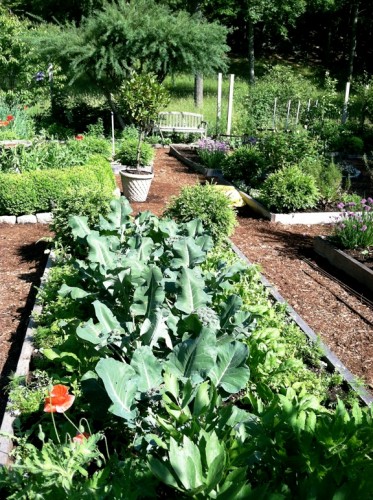
If you are making an organic vegetable garden this year; a garden measuring 16 x 24 ft. can feed a family of four for a year; but keep the size within your needs and capability.  Don’t work the soil if it is too wet or too dry.

Double-digging is the best way to go; it takes time and effort but its well worth it – dig down about one foot and remove the topsoil, put the soil to one side, then dig down and loosen the next six inches of soil and add about three inches of composted manure then put back the topsoil and add another three to four inches of manure.

Do not rototill the vegetable garden, as this will destroy soil structure. Gently loosened, aerated fertile soil will give an excellent yield of fruits and vegetables in the garden.

I prefer 6 x 4 ft. beds rather than rows; beds produce a larger yield of crops. In addition, beds make for ease of weeding and harvesting by having narrow compacted soil or grass paths (having removed lawn from the area) in-between the beds.

Vegetable gardens are hard work but bring great joy … and produce!

The vegetable garden should be situated on the south or southwest side of the property for maximum sun exposure.

Make sure you remove as many weeds as possible by hand, before you even begin digging.

You need a water source close by as vegetables require lots of water, particularly annual fruiting vegetables like tomatoes, which are hydroponics which means they are (mostly water).

Rotate crops, by that I mean, do not plant the same vegetables in the same place as the previous year.  With this method you are preventing any soil born diseases from occurring.

In the loosened soil, plant the vegetables plants so that they are touching, this forms a natural canopy, shading out weeds and helps retain moisture.

I prefer to mulch the vegetable garden with composted manure, the reason being that manure, as mulch, does not cap. Capping is when mulch forms a crust, which does not allow water or air to penetrate to the roots of the plants.

Fence in the vegetable garden with a tall fence to keep animals out. At the base of the fence, install eight inches of fine mesh chicken wire above ground and eight inches below ground to keep out the digging and burrowing animals.

Organic insect control

Insects do not like fragrance so plant fragrant plants like marigolds, nasturtium, lavender, nepeta and honeysuckle and roses to name a few.

Encourage lacewings, which feed on aphids, by planting marigolds and sunflowers,

Attract ground beetles by laying a log or a rock on the earth, under which the beetles can hide. These useful insects are nocturnal and eat slug and snail eggs, cabbage maggots, cutworms and even climb trees to feed on army-worms and tent caterpillars.

“A vibrant shade of green. Photo by Chris Zhang on Unsplash.

Grass is now a vibrant shade of green so when mowing keep the blades of grass at about three inches; the taller blades attracts sunlight, promoting a healthier lawn. The taller blades also shade out weeds and help to retain moisture in the grass.

When mowing, leave grass clippings on the lawn, the clippings are a natural source of nitrogen. If you have clover in the grass, clover is an added benefit as clover takes nitrogen from the air and fixes it in the soil, as additional nutrients for plant growth.

After flowering is over, prune flowering shrubs by 25 percent – do this task immediately before new buds set for next year.

On a rainy day, go shopping for any garden supplies that may be needed, then when the weather is dry, you can be outdoors doing what you love and not indoors shopping.  Buy good hoses, cheap ones will bend and crack.

Peonies need plenty of water to produce flower buds.  I had a 30-foot-long stand of Peonies in my field. The Peonies have been in the ground for over 40 years and are a sight to behold when in bloom.  I gave them lots of loving care with a light dressing of aged manure in early May.  In a few weeks, I  pinch off the side buds while they are still small, leaving the terminal flower bud on each stalk, which will develop into a large main bloom.

Hydrangeas are a wetland plant and require plenty of water during the season, also applying manure and mulch around the base. If you have blue Hydrangeas and want a deeper color of blue, add some peat around the base of the plant, the acidity in the peat produces the bright blue color.

If you need to prune a Hydrangea, which has become too large, then prune it immediately after flowering, in early September, prune by about 1/3 of the old wood and the weakest shoots. Do not wait, as Hydrangeas begin to develop bloom buds for next year later in September.  If you wait to prune it is likely that you will not have bloom for next year.

The beloved Lily of the Valley is such a sweet-scented flower,

My maternal grandmother’s favorite plant, the Lily of the Valley soon will bloom, these lovely flowers are tucked on the small hill on the west side of my apartment, and I am so looking forward to gathering a few fragrant blooms for indoors.

When the lilacs have finished blooming, pinch off the withered flower clusters, and do the same on the mountain laurel and rhododendrons in late June to ensure good blossoms next year.

In mid May, apply composted manure, a light application of peat and fine bark mulch around all evergreens and rhododendrons, mountain laurel and azaleas; these plants are shallow- rooted and the mulch will keep the roots nourished, protected, warm and moist.

Some annual seeds that may be planted outside in mid May are: Calendula, Coreopsis, Marigold, Nasturtium, Nicotiana and Zinnia.

If you purchased annuals on Mother’s Day weekend, place them in a sheltered spot on the south side of your home. Plant them no earlier than Memorial weekend as we can still get a late frost.

Tuberous-rooted begonias, caladiums, cannas and elephant ears can be moved from porch or cold frame to a part shade area as the weather becomes warmer and there is no sign of frost in the forecast.

If you staked trees, when they were planted last year, cut the stakes off at ground level do not pull them out of the roots as you could tear and therefore damage the root system.

Aphid tip: squish a few in your hand; dead aphids release a chemical that causes other aphids to drop off the plants.

Another ants and aphids tip – if you drink mint tea, any leftover tea sprinkle on the bugs, as they do not like the smell of mint.

A word of caution on mint – plant mint only in containers, mint is tremendously invasive and can take over your garden.

When planting annuals, perennials, vegetables, trees, shrubs or evergreen keep them watered.

Houseplants can be moved outdoors for their summer sojourn at the end of May.  However, do not put your African Violets outdoors as they will burn, move them to a porch that is covered and shaded, or keep them indoors in a window that does not receive direct rays from the sun.

Wait until the soil warms up at the end of May to set out Dahlia tubers.

Roses are not troublesome creatures after all! Photo by Bailey Chenevey on Unsplash.

Roses are not the troublesome creatures you have been led to believe.  I like to plant David Austin roses; these shrub roses are repeat bloomers with lovely fragrances.  Roses need at least four hours of sun per day, good air circulation, and excellent drainage.

During their growing period from the beginning of June to mid August; add a little extra composted manure each month; it may be applied over the mulch.  Stop adding the manure in August so that the roses can go into a slow dormancy.

Roses like the same growing conditions as Clematis and can be planted together in a companionship planting, growing well together, with feet in the shade and head in the sun. Before you top up the soil around the roses when planting, add water and check if the soil drains, roses need good drainage.  Deep watering is recommended at least once a week.

Plenty of stuff to keep you hopping, folks, and remember to keep your eye out for any pest trouble and when you spot it get on the ball immediately to avoid further problems. Carefully discard all herbicides and pesticides; these poisons have the same effect on your health as second-hand smoke.

Your garden offers an anchor for peace and quiet enjoyment.  Enjoy the warmth, the gentle breeze, the earth’s fragrance and bloom and please remember to breathe and stretch before any garden labor.

Enjoy and I will see you in your garden next month. If you would like, my son Ian of LlandscapesbyIan will be happy to talk to you and answer gardening questions or you may have him visit your home for a consult.  The apple does not fall far from the tree and in my humble opinion Ian is more talented and creative than me.

About the author: Maureen Haseley-Jones is a member of a family of renowned horticultural artisans, whose landscaping heritage dates back to the 17th century. She is one of the founders, together with her son Ian, of, The English Lady Landscape and Home Company. Maureen and Ian are landscape designers and garden experts, who believe that everyone deserves to live in an eco-conscious environment and enjoy the pleasure that it brings. Maureen learned her design skills from both her mother and grandmother, and honed her horticultural and construction skills while working in the family nursery and landscape business in the U.K. Her formal horticultural training was undertaken at the Royal Botanic Gardens at Kew in Surrey.

A la Carte: Summer Means Picnics; Picnics Mean Cole Slaw & Potato Salad! Lee Shares Favorite Recipes for Both

Lee White

I have a friend who lives in Noank and she asked me some time ago why she should keep her large Cuisinart. I literally blanched. 

There are two reasons to keep your kitchen counter appliances. One, of course, is because you use them fairly often enough that you want them close to you. The second is perhaps you adore them, as I love mine, and consider them — if not as pets — but as best friends in the kitchen. 

On the other hand, if you have a terrific yet very small kitchen, sometime things have to go.

I have just a galley kitchen, but it has a bay window a shelf below it. That shelf was utilitarian but incredibly ugly, covered with the same humble tiles on the floor.

I asked woodworker Josh Friedman in New London to make maple board the exact size as the shelf. Now the shelf holds large and small Cuisinarts, a 6-quart KitchenAid mixer, an Instant Pot, a Slow Cooker, a Ninja Pro blender and two tiny grinder (one for spices, one for coffee).

I use all of them the gadgets constantly. I keep them shinier than my desk. They are my own pieces of art.

This weekend I was asked to make cole slaw and potato salad for an indeterminate number of friends. Using my big Cuisinart thin slicing disk for the cabbage and the grater disk for the carrots. I used my Instant Pot for the potato salad. Both dishes were ready for the refrigerator within half an hour.

With summer coming, my counter appliances will keep my kitchen cool. 

Zimny’s Cole Slaw
Yield: serves 10 to 15. 

Photo by Jacques Bopp on Unsplash.

1 cup good store-bought mayonnaise
5 ½ (one-half) tablespoons unseasoned rice vinegar
3 tablespoons sugar
1 tablespoon Chinese five-spice (or celery spice, if you don’t have five-spice)
One-half teaspoon kosher salt
Freshly white pepper to taste
About 6 to 8 cups green and red (Savoy) cabbage, shredded in a food processor
2 carrots, shredded in food a processor*

Using whisk, blend mayonnaise, vinegar, sugar, five-spice, salt and pepper.

Combine cabbage and carrots. Pour dressing over vegetables and stir well. Cover and refrigerate for at least a few hours. It is even better on the second or third day. 

Lee’s Favorite Potato Salad
Yield: Serves 6 to 8

2 pounds of potatoes (I love The Little Potato Company’s tiny potatoes; no need to peel them)
1 small onion, thinly diced
2 stalks of celery, finely diced
About 3 to 4 tablespoons bottled Italian salad dressing (I love Wish Bone brand, full fat)
Salt and pepper to taste
About 4 tablespoons Hellman’s mayonnaise (full fat) 

In a large pot of water, bring potatoes to a boil and simmer until tender, about 10 minutes.

Drain water and, in the same pot, toss potatoes with onions and celery and stir. Wait a few minutes before you add the Italian dressing and mayonnaise and toss. Add salt and pepper to taste. Allow to cool on the counter at room temperature before covering and refrigerating.

About the author: Lee White has been writing about restaurants and cooking since 1976 and has been extensively published in the Worcester (Mass.) Magazine, The Day, Norwich Bulletin, and Hartford Courant. She currently writes Nibbles and a cooking column called A La Carte for LymeLine.com and the Shore Publishing and the Times newspapers, both of which are owned by The Day. She was a resident of Old Lyme for many years but now lives in Groton, Conn. Contact Lee at leeawhite@aol.com.

A View from My Porch: The Shady History of Connecticut Tobacco — The Finale

Tom Gotowka digs deeper into The Shady History of Connecticut Tobacco. Photo by Shaun Meintjes on Unsplash.

It’s been a little while since the publication of Part 1 of The Shady History of Connecticut Tobacco , but during that hiatus, there has been other remarkable news covered in the media.

Decisions regarding COVID mitigation were moved to municipal leadership, including school superintendents. Judge Ketanjii Brown Jackson, who was nominated to the Supreme Court by President Biden, was confirmed by the Senate, and became both the first African-American woman and native Floridian to serve on the “highest court” in the U. S. Federal Judiciary. 

Without provocation, Russia brutally and relentlessly attacked Ukraine; arousing support for the courageous citizens defending their homeland by nearly the whole of the free world, and the emergence of President Volodymyr Zelensky as a leader somewhat reminiscent of a wartime Winston Churchill.

Locally, Old Lyme announced the availability of American Rescue Plan economic recovery and community initiative grants for small businesses and non-profits.

Finally, and much closer to my home, my son landed in Bahrain on an extended U.S. Navy mission with a multi- national coalition task force charged, “to provide reassurance to merchant shipping in the Middle East.” On some days, reciting the lyrics to Bob Dylan’s “A Hard Rain …” is a good distraction for his parents, along with, “Oh, where have you been, my blue-eyed son?”

Part 1 Redux:

The prior essay provided some historic context for the development of tobacco farming in Connecticut. I reviewed the initial stages of the international tobacco trade, beginning with the early voyages of the Spanish and Portuguese explorers in the “Age of Discovery”. I considered how the English developed their insatiable appetite for what King James I called a “noxious weed.”

I reflected on England’s dependence on Spain as their primary source for tobacco; which resulted in a substantial trade deficit that has been cited by many historians as a precipitating factor in the decision by King James to establish a permanent colony in the Americas in 1607.

Unfortunately, the Jamestown, Va. colony was nearly doomed to fail when the settlers disembarked onto a swampy and infertile peninsula infested with malaria – carrying mosquitos; and absent the wealth and riches that the Spanish brought home after looting the Aztec empire; nearly became a financial disaster for investors.  

The colony was on the brink of disaster by1610, when John Rolfe arrived in a convoy with additional settlers and supplies. Rolfe began cultivating tobacco and developed the colony’s first profitable export. His tobacco proved immensely popular in England; and by 1617, the colony’s tobacco exports had broken the Spanish monopoly, and strengthened the colony’s economy. 

In this essay, I review the expansion of English settlements into New England, focusing on how tobacco developed as an important cash crop in Connecticut; and discuss how Martin Luther King, Jr.’s experience on a tobacco farm in Connecticut’s Farmington River Valley in the 1940s so remarkably impacted his life.

I’ll consider both the key features of the tobacco farms landscape that we observed near West Simsbury; and the romanticization of Connecticut tobacco in literature and cinema. 

The Connecticut Colony:

Connecticut began as several separate settlements by the English separatist Puritans (the “Pilgrims”) from Plymouth, Mass. and England; all of which united under a single royal charter as the Connecticut Colony in 1663. 

One of the earliest of these adventurers was William Holmes, who in 1633 brought a party of traders from Plymouth aboard the colony’s “great new barke.” After sailing up the Connecticut River and past a hostile Dutch fort downstream from what is now Hartford, he established the first English settlement in Connecticut at the convergence of the Farmington and Connecticut rivers at present-day Windsor. 

Despite the challenge of smallpox and some sporadic combative relations with local native Americans, the Windsor settlement succeeded, and eventually contained what later became the “daughter towns” of Barkhamsted, Bloomfield, Enfield, the Granbys, Litchfield, Simsbury, Suffield, and others. 

Connecticut’s Tobacco Valley:

When the first settlers came to the Connecticut River Valley, tobacco was already being grown and consumed by native Americans (i.e., the Podunk peoples), who used it in pipes. The Windsor area’s exceptionally fertile sandy loam soil and hot, humid summers were perfect for growing tobacco; and, in less than 10 years, the settlers had imported tobacco seeds from Virginia and harvested their first tobacco crop.

The earliest Connecticut tobacco variety, ‘shoestring,’ was mainly for use in pipes, but, given the settlers’ English heritage, was also brewed and consumed as a tea.  

By 1700, tobacco was being exported to European ports; and in the mid-19th century, Connecticut’s Tobacco Valley, which runs from Hartford to Springfield, had become the center for tobacco agriculture in the state. Note that tobacco farms also flourished in Connecticut’s Farmington River Valley towns, westward from Windsor to Simsbury.  

Cigars:

Photo by Alexandre Trouvé on Unsplash.

The origin of cigars has been traced back to the 10th century Mayan civilization in Central America. There is no record of the Mayans trading with the early Windsor settlers.

Connecticut folklore credits General Israel Putnam, of Brooklyn, Conn., who fought with distinction at the Battle of Bunker Hill, with increasing the popularity of cigars in New England when he returned from an expedition to Cuba in 1762 with thousands of Havana cigars.

“Don’t fire until you see the whites of their eyes” is often attributed to Putnam at Bunker Hill.

‘Shoestring’ was replaced with ‘Broadleaf,’ a variety from Maryland, favored because the leaf was much larger, produced greater crop yields, and was suitable for cigars — although used primarily for the two outside layers, the binder and the wrapper.

Note that most cigars are comprised of three separate components: the shredded filler, the binder leaf that holds the filler together, and a wrapper leaf, which is often the highest quality leaf used.

Connecticut ‘Broadleaf’ was grown in direct sunlight, which toughened the leaf and produced a more rugged look — much rougher in texture and appearance. This eventually put Connecticut farmers at a disadvantage against others producing a more pristine leaf for cigars. 

The Origins of Connecticut Shade Tobacco:

By the turn of the 20th century, cigar makers were using tobacco from Sumatra, which competed fiercely with Connecticut-grown wrapper tobaccos, and threatened the livelihood of Connecticut growers.

Science:

W. C. Sturgis, a Connecticut botanist, had already grown Sumatra tobacco from seed in 1899, reproducing the thinner leaf. During the initial trials, natural sunlight scorched the leaves. Learning that the tobacco-growing season in Sumatra occurred predominantly in overcast weather or under jungle shade, however, he erected cheesecloth tents over the experimental crops to block direct sunlight.

Botanists from the United States Department of Agriculture (USDA) also began experimenting with tropical tobacco varieties. 

Marcus Floyd, the USDA’s leading tobacco expert at the time came to Connecticut to oversee the first crop of this experimental tobacco, now known as “shade tobacco.”

Results exceeded expectations; the tobacco leaves were more refined, and a golden leaf emerged after curing and aging; and today is considered the gold standard of cigar wrapper leaves.

Connecticut appropriated $10,00 in 1921 (over $158,000 today) for the Tobacco Research Station in Windsor to investigate cigar wrapper tobacco production and disease control. 

Note the Connecticut Agricultural Experiment Station, the first such operation in the United States, had been established in 1875.  

Connecticut’s Transition to Shade:

Connecticut farmers were accustomed to the simple cultivation process and single harvest of broadleaf tobacco. In contrast, Connecticut tobacco historian, Dawn Byron Hutchins estimates that each shade tobacco leaf is handled 12 times before it becomes part of a cigar.

She describes the cultivation of shade-grown tobacco as more labor-intensive and more complicated. To wit, the growing season begins in May with weeding and transplanting seedlings. As the plants grow, they are fastened to guide wires, and then cloth tents are spread over them to increase humidity, protect the tender plants from direct sunlight, and maximize the short New England growing season. 

The remainder of cultivation takes place by hand. Field workers spend weeks in high humidity and extreme heat moving among the rows, pulling off shoots and tobacco worms. Multiple harvests of leaves are brought to barns, where workers sew the leaves together to string on wooden lath. The laths are then hung in the rafters of barns to cure.

After curing, the tobacco is moved to sorting sheds and warehouses, where processing continues throughout the rest of the year.

“Working Tobacco”:

Prior to the First World War, the Greater Hartford-Springfield area was able to fulfill the need for seasonal tobacco workers with residents and immigrants. When war broke out, however, many workers were drafted, while those remaining home took jobs at munitions and other defense-related plants, which promised higher wages.

Consequently, Connecticut’s tobacco farms began to employ migrant laborers from the South and the Caribbean. 

The Connecticut Tobacco Company advertised in the New York World in 1915 for “500 girls to work as sorters”. The planters “gathered up 200 girls of the worst type, who straightaway proceeded to scandalize Hartford” (sic). The blunder was managed and Emmett J. Scott, secretary-treasurer of Howard University, included the incident in his 1920 book, “Negro Migration During the War”.

The Company then sought assistance from the National Urban League (NUL), who already served as a clearinghouse and civil rights advocate for African American migrants to the North. They placed advertisements in African American newspapers like The Chicago Defender, which was circulated in the South. Unfortunately, this program was similarly unable to produce a reliable labor force. 

Marcus Floyd (see USDA above), president of the Connecticut Tobacco Company since 1911, then began investigating recruitment of a special group of Southern workers: college or college-bound students. At that time, students from historically black colleges were already accompanying their professors north to work seasonal service jobs at New England resorts.

College students provided Connecticut growers with an English-speaking, educated work force, “who, as seasonal workers, would have only limited impact on the local communities”. 

The NUL introduced Floyd to Dr. John Hope, the first black president of Morehouse College. A deal was struck, and Floyd recruited the first Morehouse students for the 1916 season at Hazelwood plantation on the Windsor/East Granby border.

The Hartford Daily Courant reported in August 1916 that “students were paid $2.00 per day, and, in turn, paid $4.50 per week for room and board. Students could clear $100 for the entire summer,” which is equivalent in purchasing power to more than $2,500 today. Roundtrip transportation was covered for those who completed the entire season.

Recruiters also sought student workers from other historically black colleges, including Florida A&M, Morris Brown College, Howard University, Livingstone College, and Talladega College. Growers minimized their labor problems by developing residential camps or building dormitories on their tobacco farms and providing religious and social opportunities.

A Morehouse dormitory was built in 1938 in Simsbury, and was expanded in 1946. 

Martin Luther King, Jr.:

Martin Luther King, 1964. Photo by the Nobel Foundation. Public Domain.

After qualifying for early admission to Morehouse College, MLK left the South to work the summers of both 1944 and 1947 on the Cullman Brothers tobacco farm in Simsbury to earn money for tuition. 

“For him and a lot of the students, it’s their first time out of the South and away from segregation,” said Clayborne Carson, senior editor of “The Papers of Martin Luther King Jr.,” which included MLK’s teenage letters home describing the liberating experience of escaping the segregated South.

He was struck by the distinction between the segregation on the train ride from Atlanta to Washington D.C. and the freedom he experienced after changing trains for Connecticut. “After we passed Washington, there was no discrimination at all,” he wrote to his father; adding that up North, “We go to any place we want to and sit anywhere we want to.” 

He wrote in his autobiography, “It was a bitter feeling going back to segregation after those summers in Connecticut. It was hard to understand why I could ride wherever I pleased on the train from New York to Washington and then had to change to a Jim Crow car (i.e., racially restricted) at the nation’s capital to continue the trip to Atlanta. I could never readjust to the separate waiting rooms, eating places, and rest rooms; partly because the “separate was always unequal”; and partly because the very idea of separation did something to my sense of dignity and self-respect.”

Corey Kilgannon wrote in the New York Times that the dream of equality that MLK first glimpsed in Simsbury helped reshape his world view. He adds, “It was during those summers that King began his path to becoming a minister. He decided to attend Crozer Theological Seminary in Pennsylvania, and explained in his 1944 application that he felt, “An inescapable urge to serve society.”

He was ordained as a minister at Ebenezer Baptist Church in 1948. 

Literature and Cinema: 

The 1952 novel, East of Eden, by John Steinbeck is set primarily in the Salinas Valley, although an early portion of the novel is set on a Connecticut tobacco farm.  This is a very cruel story and describes the overlapping fates of several generations of two families, the Trasks and the Hamiltons; and the toxic relationship of bible-thumping Cyrus with his sons, Adam, and Adam’s violent half-brother, Charles.

Many reviewers cite East of Eden as Steinbeck’s best work and an allegory for the story of Cain and Abel. The 1955 movie, which is based on the fourth and final part of the novel. starred James Dean and Raymond Massey. 

The 1958 novel, Parrish, by New London native, Mildred Savage, tells the story of the shade tobacco industry in the Connecticut River Valley in the 1940s and 1950s, and the violent conflict between the established growers, who had owned vast farms for generations, and a ruthless outsider, Judd Raike, who threatened them through hostile and underhanded acquisitions of their farm lands.

Parrish McLean and his mother work for the Sala Post tobacco farm, which is engaged in a brutal conflict with Raike. Mrs. McLean marries Raike, who then insists that the recalcitrant Parrish learn the business from the ground up; and the story proceeds from the point of view of Parrish, who still has a relationship with Sala. 

The 1961 movie starred Troy Donahue (as Parrish), Claudette Colbert, and Karl Malden. It was filmed in Windsor and includes some amazing aerial panoramas of the shaded fields and farm landscapes of the time (available via Phoebe.)

I can’t close the book on Windsor without mentioning the 1941 Joseph Kesselring Broadway play and 1944 Frank Capra movie, Arsenic and Old Lace, starring Cary Grant. Arsenic was based on events at the Archer Home for Elderly People and Chronic Invalids on Prospect Street in Windsor, Conn. Sixty men died between 1907 and 1917 while in the care of Amy Archer-Gilligan. Most were proven to be victims of arsenic poisoning.

Tobacco Farms Landscape:

I mentioned last time that I was first introduced to tobacco farming when I did several years of active duty in the late 1970s at a Naval Hospital in Southern Maryland. I “mustered out” to Connecticut, and we settled in West Simsbury. We had anticipated dairy farms, and a variety of fresh fruits and vegetables, but we also got fields of shade tobacco. I reminisce a little on our initial impressions in what turned out to be our final stop in an unplanned odyssey amongst the tobacco-centric regions of the eastern United States.

Making the Shade:

Tobacco fields are arranged in a grid pattern, set with posts and connecting wires. Cheesecloth was stretched across the top and along the sides. Currently, nylon mesh is used in lieu of cheesecloth. The shade diffuses sunlight, encapsulates heat and humidity, and creates an environment whose temperature is much higher than outside the shade. 

Tobacco Barns:

Tobacco barn in Simsbury, Connecticut used for air curing of shade tobacco. By Sphilbrick – Own work, CC BY-SA 3.0, https://commons.wikimedia.org/w/index.php?curid=11530818

Adjoining the fields are very distinctive, vertically-sided weathered barns, raised for curing tobacco, which is hung on stalks in the barn’s rafters. The barns are constructed with long narrow boards, which are hinged at the top. Called “Yankee hinges”, they are designed to swing open when needed in order to lower the temperature and increase air flow in the barn.

Note that there are barn designs other than the “Yankee hinges,” which are also used for curing tobacco. They include horizontal siding with top-hinged vents and gable-end doors, or a series of large doors along one of the long sides of the building with the other sides of the building vented.

Epilogue:

Tobacco production in Connecticut today is a fraction of what it was at its peak in the 1930s, when 30,000 acres of farmland grew tobacco; reflecting an overall decline in cigar smoking from a century ago, and greater public awareness of smoking-related disease.  At present, just over 2,000 acres are dedicated to tobacco production. 

The method of growing tobacco under shade is now common in many areas, including the Dominican Republic, Nicaragua, and Cuba.

Connecticut seed tobaccos are also grown in a number of other countries; most notably, Ecuador.

The three-story Morehouse dormitory, mentioned earlier, which originally housed hundreds of tobacco workers, was still in service when we arrived in West Simsbury, but was weathered and in the early stages of disrepair and dilapidation. It was destroyed by fire in 1984 as part of a training exercise for volunteer firefighters.

In spring 2021, the vacant 288-acre site of the 1940s Cullman Brothers tobacco farm in Simsbury, then called Meadowood, was slated for a development of hundreds of homes. As noted above, MLK worked the summers of 1944 and 1947 on the farm.

Richard Curtiss, a history teacher at Simsbury High School, initiated a student project to investigate what was then a local legend. Research not only included books and old newspaper articles, but gathering oral history from people like 105-year-old Bernice Martin, who said that MLK attended her church in Simsbury, The First Congregational Church; and had been recruited to sing in the choir.

The students put their findings in a video, Summers of Freedom, which was covered by the CBS Evening News and other major outlets; and residents then followed with a grassroots citizen petition process and special town meeting that put the question of the Meadowood purchase on a referendum in May 2021.

Residents authorized $2.5 million for the purchase and preservation of the 288-acre Meadowood property by a resounding 87 percent. The property has since been nominated for historic designation.

The stage had already been set for that referendum on Martin Luther King, Jr. Day in January, with the unveiling of a permanent MLK memorial. The memorial was made up of five glass panels representing the different stages of MLK Jr.’s life. It was made possible by groups of Simsbury High School students, who raised $150,000. It will now be listed as a destination on Connecticut’s Freedom Trail. 

If you have read any of my past columns, you know that I enjoy reading history; and especially enjoy ferreting out instances of the unique. I anticipate expanding on the folklore that surrounds the life of General Israel Putnam, cited above as an “influencer,” who played a significant role in increasing the popularity of cigars.  

A prominent member of the expat community and chronicler of the local zeitgeist lamented, after publishing the first essay in this series, “The British role in the whole [tobacco] business is not a glorious one”! 

All that said, I have never used any tobacco product.

Sources: 

  • Connecticut Valley Tobacco Historical Society
  • Connecticut Valley Agricultural Museum
  • Preservation Connecticut
  • Simsbury and Windsor Historical Societies
  • The Connecticut Agriculture Experiment Station
  • Holt’s Cigar Company
  • Cigar Aficionado
  • New York Times,  Nov. 12, 2021; article by Corey Kilgannon

Editor’s Note: This is the opinion of Thomas D. Gotowka.

Tom Gotowka

 About the author: Tom Gotowka’s entire adult career has been in healthcare. He will sit on the Navy side at the Army/Navy football game. He always sit on the crimson side at any Harvard/Yale contest. He enjoys reading historic speeches and considers himself a scholar of the period from FDR through JFK. A child of AM Radio, he probably knows the lyrics of every rock and roll or folk song published since 1960. He hopes these experiences give readers a sense of what he believes “qualify” him to write this column.

A la Carte: Can’t Imagine Grilling a Salad? Then Try This, But Don’t Forget Blue Cheese & Basil!

Lee White

When I was little, my mother used to call me Sarah Bernhardt. I had no idea who Sarah Bernhardt and she told me Bernhardt was a famous actress in the early 1900s. 

I think today my mom would call me a drama queen. She also suggested I not wish my life away, that someday I would wish I could get those years back.

I thought about this again as I was reading my newest food magazines, wishing it were summer again so I could write about late June strawberries, July’s sweet corn, August’s tomatoes, and earthy fall squashes.

Look, I’m doing it again, and it is only mid-May.

On the other hand, it is time to fire up the grill. I saw a recipe for grilled kebabs of cake and fresh pineapple on skewers tossed with brown sugar, vanilla and little salt. I have a fresh pineapple on the counter and a few slices of pound cake. 

I also have romaine in the crisper and some blue cheese, too.

I can wing the dessert, but here is a recipe for the entrée.

Photo by Petr Magera on Unsplash.

Grilled Romaine Salad with Blue Cheese and Basil
From Food magazine, May/June, 2022
Yield: serves 4 to 6

Dressing:
1 tablespoon fresh lemon juice
1 tablespoon sherry vinegar
1 teaspoon capers
Kosher salt
6 cloves garlic
1 tablespoons Worcestershire sauce
½ teaspoons hot sauce
6 oil-packed anchovy fillets (or a teaspoon or two anchovy paste)
½ to ¾ cup extra-virgin olive oil

For the salad:3 romaine lettuce hearts, halved lengthwise
Extra-virgin olive oil for tossing
Kosher salt
1 lemon, halved
20 fresh basil leaves
1 cup crumbled blue cheese
Sliced rotisserie chicken (optional)

Preheat grill to medium. Make dressing: in a blender combine lemon juice, vinegar, capers, 1 teaspoon salt and the garlic. Blend until smooth. Add Worcestershire sauce, hot sauce, anchovies and ½ cup oil until smooth. Taste for seasoning. Blend in up to ¼ cup more oil if needed. Set dressing aside.

Make the salad: In a large bowl, toss 4 of romaine halves with a little olive oil and season with salt, put them in a single layer on the grill and cook 3 minutes per side (the romaine should feel slightly warm and tender). Spoon a little dressing on each of 4 to 6 plates.

Finely chop rest of the romaine and add to a medium bowl. Add remaining dressing, a touch of lemon juice and the basil leaves. Toss to coat.

Top the grilled romaine with the remaining dressing. Garnish with blue cheese and serve immediately, topped with diced chicken, if desired.

About the author: Lee White has been writing about restaurants and cooking since 1976 and has been extensively published in the Worcester (Mass.) Magazine, The Day, Norwich Bulletin, and Hartford Courant. She currently writes Nibbles and a cooking column called A La Carte for LymeLine.com and the Shore Publishing and the Times newspapers, both of which are owned by The Day. She was a resident of Old Lyme for many years but now lives in Groton, Conn. Contact Lee at leeawhite@aol.com.