
Letter From Paris: A New Spire – and Rooster – Set to Rise Above Notre Dame Cathedral

Nicole Prévost Logan

The spire and the rooster of Notre Dame will soon be back in the sky of Paris. 

The 2019 fire destroyed Notre-Dame’s wooden roof and spire but left the outer structure largely intact. This photo was taken on April 15, 2019 from the Quai de Montebello by Wandrille de Préville.This file is licensed under the Creative Commons Attribution-Share Alike 4.0 International license.

On April 15, 2019, the world watched in horror as the spire of Notre Dame was consumed by flames and finally crumbled down. It left a gaping hole in the cathedral at the center of its vault. 

Four years later, the installation of a tabouret — (literally, a stool) — which, in this case, is a huge wood contraption intended to serve as the base of the new flèche  (or spire), marked the beginning of a crucial stage in the restoration of the church. 

The first flèche (spire) was erected in 1220-30 and removed at the end of the18th century. In 1859, architect Eugène-Emmanuel Viollet-le-Duc , carried by the revival of medieval art inspired by Romanticism and the publication in 1831 of “Notre Dame de Paris” by Victor Hugo , brought the dilapidated cathedral back to life and rendered it more medieval than before with new features like chimeras and gargoyles. His main creation was the flèche.

By the spring of 2018, the spire was in a state of disrepair. The 12-ft.-tall copper statues of 12 apostles and four evangelists, including a St. Thomas, which was the architect’s self portrait, were lifted by cranes creating something like a ballet in the sky. Scaffolding was put in place at the base of the spire to start the future restoration. It is believed that it was the exact place where the fire originated in April 2019 and spread to the wood frame or forêt under the roofs.   

After heated debates between the world’s architects, engineers and art historians, it was decided to reconstruct the spire identical to its original appearance , including Viollet-le- Duc’s own vision of medieval art.  

After all these years spent stabilizing the structure, putting robots to work to remove debris and toxic lead dust, recreating the stone sculptures, which had exploded under intense heat; reviving the brilliant colors of the stained glass windows; cleaning up the 15th century organ; and stripping walls, columns and 16th century paintings from the dark, slimy layer of dirt accumulated by tens of millions of visitors tramping through the building for centuries, five-star General Jean Louis Georgelin — appointed to oversee the restoration project by the French government — was able to announce, “Now, for the first time, we are starting to rebuild.”

Reconstruction is well underway in 2023 at the Cathedral of Notre Dame. Photo by Sylvia Logan.

TF1, one of the main French TV channels, aired a series of fascinating videos over several days during the week of April 14. Senior international reporter and historian Michel Izard took the viewers through the step by step restoration process of the new flèche, which will soar again into the sky by the end of 2023.

At 40 meters (131 ft.) from the ground, the installation of the tabouret at the intersection of the transept and nave is an impressive piece of work, weighing 80 tons and measuring 15 by 13 meters (49 x 43 ft.) The two beams of solid oak 10 meters long (33 ft.) are placed in the form of a  cross. At the center a poinçon (a tool used to make holes ) will act as the spinal cord of the structure.. 

The installation of the spire was preceded by months of intense work in workshops outside Paris. For this operation, the best know-how and the best trees were required. France is lucky to have both. One thousand trees were selected in the oak forests of Lorraine. Those trees were out of the ordinary for the length of their trunks uninterrupted by branches.

After being felled, the 250-year-old trees had to be “squared” by hand, using an axe. It is a skill transmitted through generations. The few lumberjacks, who still know how to do this type of work are usually foreign. They live in the forest. The video showed a lumberjack from Croatia squaring the trunks in 1985. The Association of Carpenters Without Borders helps preserve the ancient wood-working methods.  

The trees are worked while still green and soft, then dried for a period of one and half years. For the carpenters, working the wood while still alive, is a challenge. Working manually allows them to respect the grain of the wood and know each knot. 

The logs of unusual length of 20 meters (or 60 ft.) had to be processed in special sawmills since very few mills are equipped to accommodate such operations.  

A trial run of assembling the 110 pieces of the tabouret was carried out while they were lying flat on the ground, then that piece was dismantled to be lifted and put together again on top of the transept, at 30 meters (99 ft.) from ground level. This huge object was to be put in place with the precision of a Swiss watch-maker and fitted with specific measurements calculated in millimeters. As previously mentioned, the wood was still “alive” and allowances had to be made on occasion for a few millimeters resistance, since the wood — not being totally dry — could contract   

Around 30 carpenters were selected from among the best in the world. They seemed enthusiastic and proud to work on Notre Dame. “We are going to go much higher,” one of them said with much excitement. Many of them are Compagnons du Devoir et du Tour de France, an élite school of craftsmen, who are taught methods used by generations of artisans going back to the Middle Ages.

The prestige of this school is comparable to the élite Grandes Ecoles. The school used to function in 49 countries but today, it is particularly active in France. The Compagnons learn a trade under a master as apprentices. They share their knowledge by traveling throughout France and live in hostels. In the Middle Ages, they helped build castles and churches. UNESCO wrote their charter.

This view of Notre Dame Cathedral before the devastating fire clearly shows the spire, which was destroyed in the fire and is now being reconstructed. Photo by Robin Garnier on Unsplash.

Carpenters from four different companies from several countries are taking part in the spire’s reconstruction. The video showed carpenters from The Netherlands and England. Hank Silver and Miles Jenners, respectively from Vermont and Massachusetts, were beaming during an interview. They emanated pride for having being selected. They gave up their jobs to come to Paris. Today 1,000 people are working on the Notre Dame site, half of them inside the cathedral.  

Women were also present on the flèche worksite. They variously draw épures  (working draughts), are architects or site supervisors. Women were not accepted in the Compagnons du Devoir until 2005. 

Like their 13th century medieval ancestors,  the carpenters find the pencil and plumb-line their most dependable tools. But they also use oversized tools fabricated especially for this work. They need to use circular saws, mortaiseuses, to create notches, and laser beam to ensure the lines are straight.

Under the tabouret described above, a temporary floor was installed at 26 meters (85 ft.) from ground level. 

It is at 31 meters (102 ft.) under the tabouret, that we find the complex vaulting system, which makes the gothic architecture so unique. The vault arches and rib vaulting rest on four pillars and on pieds de gerbe (sheaf foot) placed on top of each pillar that will support the whole weight of the spire structure.

The skilled grutier (crane driver) does a perilous job when he lifts and carries each stone of the ronde de pierre which supports the vault. The arches meet at the center at the clé de voûte or keystone. A medallion representing the Virgin Mary will again be painted with an azure background dotted with gold stars. 

Similar to the wood cintres (half hangers), which had been custom-made to reinforce the flying buttresses in the early stage of the Notre Dame restoration, four large, custom-made pieces of wood or cintres each weighing one and a half tons were laid at the bottom of the hole left by the collapse of the spire in 2019 in order to reinforce the vaulting arches, which had also collapsed.  

The 320-tons flèche, carved out of solid oak , will soar again into the sky at a height of 96 meters (315 ft.) The intricate framework will be pulled upward by giant beams.  

The Cathedral of Notre Dame de Paris prior to the fire. This file is licensed under the Creative Commons Attribution-Share Alike 2.0 Generic license.

The viewer of the video is invited to start his or her virtual ascent of the flèche. At 60 meters (197 ft.) one reaches an openwork balcony decorated with floral motives. From there, the view over Paris is breathtaking.

As one continues the virtual ascent, at 89 meters (292 ft.), one reaches a tiny platform big enough to stand with two feet … and free of vertigo. 

The original rooster from the Notre Dame Cathedral s now exhibited at the Cité of Architecture and Patrimoine.
Photo by Nicole Prévost Logan. 

A copper rooster will again be perched on top of a rod and pivot in the wind. This will only be a replica. In 2021, a photo showed chief architect Philippe Villeneuve cradling the damaged rooster rescued from the debris. The original bird is now safe and permanently on display at the Cité de l’Architecture et du Patrimoine, Place du Tocadéro. In 1935, relics of the Holy Cross were placed inside the rooster, as well as relics of St Denis and Ste. Geneviève, patrons of Paris. 

The wood framework of the new spire will be protected from rain by 140 tons of lead. On the video, the workers are shown doing what seems like a very dangerous process when, in a bucket, they mix the lead, which has been melted to a temperature of 320 degrees.

None of the construction of the spire will be shown to the public until completion. Like a rocket about to take off to the moon, the structure will be hidden behind scaffolding.   

The flèche will be completed at the end of 2023.  During that time, work will continue around the cathedral. Light will again pour into the apse choir as the tall windows are reinstalled. The tarp covering the whole structure, like a giant umbrella, will be removed. There will be a last chance to have a close look on the newly-refreshed colors of the rose windows before the scaffolding is dismantled.  

The stone work will return to its original, blonde color. For the first time, one will be able to see a Notre Dame not seen since eight centuries ago.  

The fire at Notre Dame provoked a new awareness of the danger of fires and drastic measures are being taken in 90 French churches to prevent from the danger of fire such as coupe-feu or firewalls, treating charpente or framework under the roofs with fire-resistant products and amplifying the alarm system.  

On April 16, French president Emmanuel Macron climbed up to the tabouret with his wife Brigitte. Two days later, on TV,  he reiterated the  promise made just one day after the fire that the cathedral would be whole again in 2024 .

By comparison, Notre Dame is 96 meters high (315 ft.), much smaller than Cologne cathedral with its 157 meters (515 ft.) spire. The latter’s construction ceased in 1473 and was not finished until 1880. Therefore it remained incomplete during medieval times.

Before the fire, Notre Dame received between 30,000 and 45,000 visitors per day or about 13 million a year – numbers comparable to the Louvre’s. This museum is thinking of capping the numbers of visitors at 30,000 a day.

Food for thought — perhaps it might be a good idea to apply the same rule to the cathedral both to preserve its pristine beauty and also remind the visitors that it is first and foremost a place of prayer and worship.

tor’s Note: This is the opinion of Nicole Prévost Logan.

Nicole Prévost Logan

About the author: Nicole Prévost Logan divides her time between Essex and Paris, spending summers in the former and winters in the latter. She writes an occasional column for us from her Paris home where her topics will include politics, economy, social unrest — mostly in France — but also in other European countries. She also covers a variety of art exhibits and the performing arts in Europe. Logan is the author of ‘Forever on the Road: A Franco-American Family’s Thirty Years in the Foreign Service,’ an autobiography of her life as the wife of an overseas diplomat, who lived in 10 foreign countries on three continents. Her experiences during her foreign service life included being in Lebanon when civil war erupted, excavating a medieval city in Moscow and spending a week under house arrest in Guinea.

A View From My Porch: Finding Fenway — A Feline Interest Story 

Tom Gotowka

Nearly a year ago, Christina and I announced in LymeLine that we were “on the lookout for two adoptable kittens; we hope to find a pair of orange tabby sisters.” Our plan was to name them Fenway and Wrigley.

We had lost Finn, our pet of more than 15 years, as a result of an inoperable and inexplicable carcinoma of the lung, which appeared on a radiograph at an emergency visit. 

Finn was a rescue, and had spent her early months in our daughter’s NYU freshman dormitory; remaining there until expulsion appeared inevitable (i.e., the kitten’s, not the daughter’s). Devan, the freshman, was visited by her older sister, Erin, who convinced her to relocate the kitten to Old Lyme, where she remained with us. 

Those who have also had long-term pets know just how soon they become important members of the household; and how long they are mourned, when lost. 

We never really anticipated what would then lay before us as we set out on our search for kittens. 

We began our quest near the beginning of this year with the municipal animal shelters in southeast Connecticut, and then eventually, with both Finn’s and another veterinary practice, who suggested that we wait until early-summer, when kittens are often more plentiful. 

Although we were persistent with the municipal shelters and on waiting lists at several, we were unsuccessful and decided to investigate the private animal rescue shelters in the same area, where there are several. 

We learned that these shelters tend to be non-profit and/or charitable organizations that are highly reliant on volunteers, although some had a few paid staff. They are “no-kill”, and so, do not terminate healthy or treatable animals, limiting euthanasia for incurably ill animals or those who could pose a danger to public safety. 

Fenway is found, but the Gotowkas are still looking for Wrigley. This image is not Fenway but rather a file photo of another kitty by Michael Sum on Unsplash!

Adoptions at these shelters may require payment of a nominal fee (e.g., $200 to $250 per kitten) to cover expenses for veterinary services incurred by the organization while the animal was in residence. These can include a health examination, neutering, various vaccinations, and treatments for problems like fleas, ticks, ear mites. 

We felt confident that our history and experience with pets, relationships with veterinarians, and sensible and stable lifestyle would make us very suitable candidates for adopting rescued kittens. 

In addition, the “PBS News Hour” reported in February that, “Rescue shelters are feeling the pressure of too many potential pets and not enough people adopting them. Many shelters are at capacity and understaffed; pets adopted during the pandemic were returned, and inflation had made owning and caring for a pet more expensive, leaving some owners struggling to afford rising costs.” While this may have been the situation in many parts of the country, it was apparently not so for kittens in this area, as we were to experience.

The first shelter we explored had stated that their mission was, “To stop the proliferation of homeless cats living hard lives and struggling to find food and shelter on the streets of our local communities.” Their application process seemed daunting, and included the disclaimers that the organization, “Reserves the right to deny an adoption request for any, or no reason, and may choose not to reveal specific reasons;” and that they “Promote age-appropriate adoptions.”

I did some further research on this shelter, and found several unhappy reviews that cited age as a factor. A few examples follow: 

  • “To adopt a kitten from this shelter you must be no older than 60.”
  • “We were told that at 60 and 65, we were too old to adopt any of their cats that aren’t two years of age.” 
  • “When we visited, we witnessed them declining another couple because they were “too old to adopt a young cat.”
  •  (In contrast): “During this process, we walked into a section with a volunteer, June, who immediately exclaimed, “We do not let anyone under the age of 25 adopt!”

Christina and I were shocked and surprised that this organization apparently had such discriminatory age restrictions in place. We were both already “of a certain age”, and so we were discouraged and decided to regroup before exploring other similar shelters.

Frankly, these practices “fly in the face” of conventional wisdom, which is supported by several scientific studies, that pets are important for the health of older adults, especially for those who are single, living alone, and a little isolated. Pets offer socialization and companionship to lonely seniors; and provide a strong sense of purpose that may reduce stress and assist them maintain a regular routine. However, as I describe below, our explorations unexpectedly came to an end.

Celestial Interference?

We were returning home from Chester on a nice February Saturday. On the spur of the moment, we pulled into a local market in Deep River. While I wandered a few aisles on the hunt for dinner ideas, Christina checked out the bakery and bulletin board. Nothing appealed in the bakery, but there was a listing that stated, “Looking for a good home for our cat.” We called on Sunday and learning that we were not the first respondents, arranged a visit on Tuesday.  

This retired couple was moving from Connecticut to care for the wife’s elderly brother in Florida. The brother’s circumstances did not allow them to bring their pet. Faye was not a kitten, but very young; perhaps a toddler, if it was human. Faye was a long-hair with remarkable coloring — pure white with a black saddle, crown, and tail. They said she was a rescue from a litter that was abandoned in a box behind their apartment complex. 

The couple was childless and doted on Faye. They shared her veterinary records with us, which were very complete, and arranged a site visit in Old Lyme; where we passed muster. They delivered Faye about a week later. The cat’s parting from her former owners was smooth, if not a little emotional for them. 

After several weeks transition in her new digs, she now answers to Fenway. She is a nice, playful pet; has very expressive ears, and communicates well when dinner is late. There is a very active fox population in our neighborhood, so Fenway will be exclusively indoors. We are discussing whether we will resume our search for Wrigley.  Cats are social animals and tend to be happier in pairs. 

In closing, Christina is a retired professor of Human Development and Ageing and corroborates the value of pets for older adults, which I touched on above.

Sources:

Cirrillo, Anthony. “The value of pet ownership for older adults” US News and World Report. 10/16/2019
Moeller, Philip. “10 reasons older people need Pets” US News and World Report. 01/07/2010
Norris, Courtney. “Animal shelters struggle as many pets adopted during pandemic are returned” PBS News Hour (transcript). 02/20/2023
Cleveland Clinic. “The Health Benefits of Pets” Health Essentials Newsletter. 02/09/2023

About the author: Tom Gotowka is a resident of Old Lyme, whose entire adult career has been in healthcare. He will sit on the Navy side at the Army/Navy football game. He always sit on the crimson side at any Harvard/Yale contest. He enjoys reading historic speeches and considers himself a scholar of the period from FDR through JFK. A child of AM Radio, he probably knows the lyrics of every rock and roll or folk song published since 1960. He hopes these experiences give readers a sense of what he believes “qualify” him to write this column.

Gardening Tips by ‘The English Lady’ for April, the ‘Month of Activity’

Those April showers that come our way
They bring the flowers that bloom in May.
And when it’s raining, let’s not forget,
It isn’t raining rain at all, it’s raining violets.

Al Jolsen

Maureen Haseley-Jones

April is the month of activity in the garden, and our old nemesis, weeds are beginning to rear their heads, so we need to extract the little devils before they take hold and are difficult to remove.  

Having said that, I must point out the benefits of many weeds. Nettles are food for butterflies, clover extracts nitrogen from the air and fixes it in the soil, and oil from jewel weed soothes poison ivy rash. The young foliage of Dandelions is great in salads, it is healthy and contains many nutrients and when the foliage is cooked, it tastes like spinach. I also do not want to forget our songbirds and other wildlife, who depend on weed seeds as a food source. 

Weeds must be pulled gently so the weed and roots do not break apart for if this happens thousands of weed seeds will reseed and you will find yourself with an endless cycle of unnecessary weeding. When careful weeding has been accomplished, apply an organic weed pre-emergent, with a corn gluten base by Bradfield Organics; this natural product will keep weeds at bay for about six weeks. 

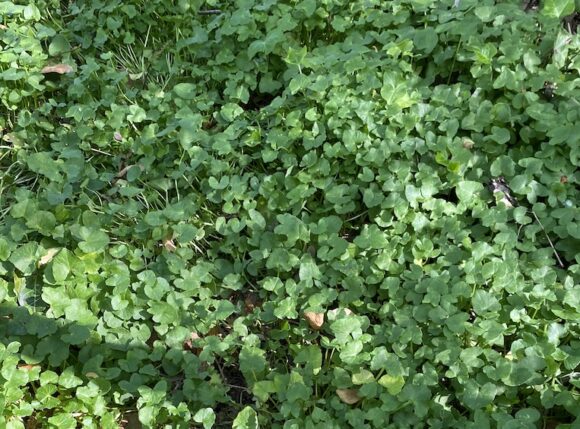
Surprisingly, weeds, like the clover in the photo above, can have many benefits.

Plant bare root roses at the end of April and plant container roses in mid- May.  In the middle of May when the soil temperature has reached 55 degrees, add manure and on top of manure, add a fine bark mulch about one foot from the base of the roses. Check my March tips to remind yourself on pruning roses. 

Be careful clearing winter debris from around rhododendrons, mountain laurel and azaleas; these evergreens have shallow roots and do not grow well when the roots are exposed. If the winter weather did erode soil around some roots, add some soil to cover the exposed roots, at the same time resettle the plant in place, then in the middle of May apply manure and fine bark mulch as well as some peat, which adds much needed acidity for evergreens.

Plant Gladioli corms at two-week intervals in late April. Planting in two-week intervals ensure you will get a succession of bloom. Plant the corms eight inches below the surface; this extra depth helps to keep the heavy blooms erect.

The Red Lily Beetle will soon begin to appear, so I suggest applying organic Neem oil on the Lilies when they are about four inches above ground, which helps prevent and deal with this beetle problem.

Soil Solarization is an effective way to control many soil-borne problems, specifically the tomato blight that causes fruit rot. Covering the soil with clear plastic at the end of April for one to two months can generate high enough temperatures in the top six to 12 inches of soil to kill pests, nematodes, weed seeds and many disease organisms like the tomato blight. This process has proved invaluable for home gardeners and the beneficial effects last for several seasons.  

To solarize, dig a trench several inches deep around the bed, and spread a thin, clear plastic film (1-4mils) over the bed.  Press the plastic into close contact with the soil and seal the edges by filling the trench with soil.  Leave the plastic on the soil until you are ready to plant tomatoes or other vegetables in about six weeks.  

When the soil temperature reaches 55 degrees, manure all the borders with composted manure in bags from the garden center or aged manure from the bottom of the farmer’s pile, then mulch with a fine, brown, hardwood mulch. 

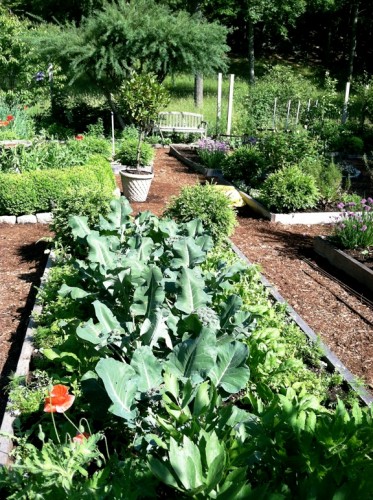
Follow Maureen’s tips as to what to do now to achieve a vegetable garden like this come the summer.

In the vegetable garden after preparation and planting, then it is time to mulch. Mulch with the composted manure, which will not ‘cap’ — this means that it does not form a crust like other mulches so that air and water can get through to the roots of the plants where it is needed.      

If you did not apply an organic grub control on the grass in March, apply now to keep the grubs down, which will cut down on the mole population.    

The soil is the most important component of the growing business; compost, organic manure and peat alter the soil to rebuild its structure. The ratio to use is one part compost to three parts manure and apply peat to the planting mix in the ratio of one part peat to three parts manure when planting evergreens. And as mentioned above, peat adds the acidity, which evergreens need.

Good soil structure assists with drainage and prevents compaction. Meanwhile, the rich nutrients, which are the result of these changes, break down and encourage the soil animals beneath the surface to work at full capacity. In a light soil such as sand, humus — which is the combination of manure, mulch and carbon from the atmosphere — binds the sand particles together and in heavy soil, such as clay, it keeps the clay particles separate to make room for air and drainage.  

Growing conditions in April are very favorable for new plant-root development and it is the ideal time to transplant evergreen shrubs and new evergreens. Apply composted manure and peat together with the topsoil in the planting hole. Then give the roots a workout with your hands before planting which releases. Opening up the roots in this way enables the roots to reach into the surrounding soil for nutrients and water and not dry out in the heat of summer.    

Many years ago, when I moved into my farmhouse on the shoreline, I discovered that my soil was sandy, which is good for drainage but sadly lacking in nutrients. I began adding a few inches of manure to all planted borders in April, July and October. The result today is when I put a spade in the ground to check the color of the soil in spring, it is, ‘black gold’.  

Gloves should be worn when handling manure, which contains bacteria; the bacteria is great for the plants and the soil but not good for your health. These natural soil amendments tend to be slow acting; gradually making the nutrients available to the plants and the rewards are infinite. Composted manure is applied in spring around mid May when the soil temperature has reached 55 degrees and when the plant shows about six inches of growth. This method allows for the nutrients and soil animals to become active at the time when plant growth is occurring at a rapid pace. 

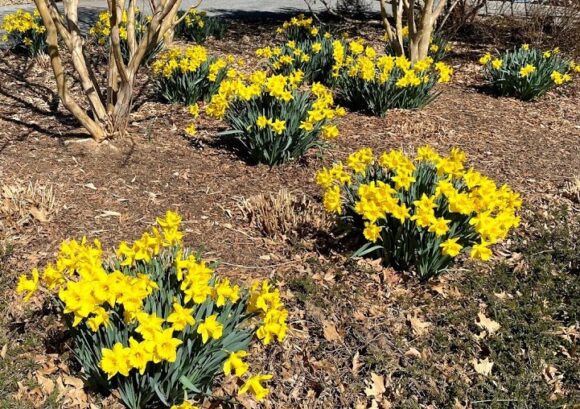
Daffodils are blooming; what a lovely sight to see! Photo by Sarah Mitchell-Baker on Unsplash.

When the Daffodil bloom has past, do not cut the leaves from Daffodils or any of your spring flowering bulbs, the leaves send down energy into the bulbs to store for next season’s bloom. 

April is the time to tackle a new lawn or patch seed, use only good quality seed and organic fertilizers.   

Do not be lulled into complacency with a few back-to-back warm days; we can still get frost, so I caution that you not to plant annuals until Memorial weekend.  Do not cultivate around the perennials in the borders until mid-May. Do not panic if you were not able to get the April tasks done until May, your garden will wait for you and the constancy that is Mother Nature will continue to keep your patch of earth flourishing. 

Enjoy the pleasure of being outdoors in warmer temperatures, inhaling the pungency of awakening soil and your connection with Mother Nature. Do not overdo it; warm up the body before the garden labor and stay well hydrated with lots of water. We are inexorably entwined with the earth and know that even the smallest gesture of a garden has positive rewards; the effects are not only on you but on our planet. 

I will return with more gardening tips in May when you will be out in the garden in full force.

About the author: Maureen Haseley-Jones is a member of a family of renowned horticultural artisans, whose landscaping heritage dates back to the 17th century. She is one of the founders, together with her son Ian, of, The English Lady Landscape and Home Company. Maureen and Ian are landscape designers and garden experts, who believe that everyone deserves to live in an eco-conscious environment and enjoy the pleasure that it brings. Maureen learned her design skills from both her mother and grandmother, and honed her horticultural and construction skills while working in the family nursery and landscape business in the U.K. Her formal horticultural training was undertaken at the Royal Botanic Gardens at Kew in Surrey. 

Gardening Tips for March from ‘The English Lady’

‘Those March winds shall blow, and we shall have snow and what will the Robin do then, poor thing?
He’ll hide in the barn and keep himself warm and hide his head under his wing’.  

Maureen Haseley-Jones

March is a month of ‘wait and see’ as we anticipate walking around our gardens. This morning I walked outside, into a westerly breeze and a gentle sun. I took a deep breath and as I did, I caught the rich fragrance of the soil beginning to awaken.

All of us are itching to get into the garden and I believe that foray will be earlier than last year since frost did not penetrate deep into the ground. 

The sodden soil will dry out in the next few weeks, but I urge you to tread gently as you tend the soil, which is our precious commodity of Mother Nature. In that regard I am asking that you do not till the soil as tilling damages soil structure and can break friable root systems. 

I am asking you to be patient right now. I know you are chafing at the bit to get your hands into the soil, however, I suggest you continue planning for the upcoming season. Planning means organizing, which prevents gardening mistakes.  

When you go outdoors, check the trees in your garden to decide what might need pruning, which limbs need to be removed or the canopy lifted to allow more sunshine into that area of the garden. Now is the time to call in an arborist, as tree branches without foliage takes less time for arborists to do the tree work and the work is therefore less expensive.

If you would like branches with blossom like these, it’s time to think about trees.

What to look for with trees:

Are there broken or dead limbs? What branches require cabling? If a tree appears to be 50 percent dead, then it should be removed. 

A medium shade area can be changed to a dappled shade area, allowing more sunlight in by thinning out the upper tree branches or tree canopy.

Perhaps you would like a tree removed to transform a shade area to a sunny spot which allows for a larger choice of plants available to you.  

I always hesitate to remove a healthy tree but sometimes a tree may have been planted too close to the house and consequently the roots have undermined your home’s foundation and the shading over the roof has resulted in mold and mildew. 

There is an art to tree work … knowing how, when and why to cut. Work on the trees should be carried out by a professional so that at the completion of the work, the effect is both practical and aesthetically pleasing. An experienced arborist will also take into consideration the health of the trees. Having the work done by an arborist avoids injury: falls from ladders or perhaps tree branches or trees falling on you.

PRUNING

This is a task that you may feel you are able to accomplish yourself. 

March is the month to prune evergreens before the new growth appears. 

Hedges can be sheared for shape, so that any stubby ends will be concealed by new spring growth.  Please keep to the natural shape of the shrub – no round balls. 

Prune Spirea to six inches from the ground.

In April, prune Lavender to three inches.

In late March, prune Sweet Pepper Bush (Clethra), cutting out the oldest branches.

Lilac – Prune back all old branches to various lengths before leaf growth begins, from two to five feet, keeping to a natural shape. Sprinkle lime around the base of the Lilac and add manure in May.  Lilacs enjoy alkaline soil and receive benefits from a small amount of lime sprinkled about a foot away from the base of the Lilac.  

Prune Butterfly Bush to two feet from the ground and in May apply composted manure around the base. 

Prune Forsythia after it has bloomed, pruning out sparse flowering old wood.

Prune forsythia after enjoying its yellow burst of spring color.

Prune roses when the forsythia blooms.  If the roses have only been in the ground for one year, do not prune, wait until October.

Do not remove the protective mulch from around the base of the roses, wait until mid May, and then apply a dressing of manure and fine bark mulch.  

You may be asking, ‘Why wait until May to apply manure?’ The answer is that the soil needs to warm up to 55 degrees otherwise the nutrient benefits of the manure bacteria that works with plant roots and soil organisms are not activated. I suggest you invest in an inexpensive soil thermometer to check the soil temperature. At a soil temperature of 55 degrees, apply a three to four-inch layer of composted manure. 

When April arrives, carefully begin to clear away winter debris, treading carefully on the soil to avoid damaging soil structure and friable root systems. When you have cleared away the debris, make a clean edge to the borders with a sharp spade; this makes such a difference to the look of your garden. 

The best tool to use is a sharpened lawn-edger, the blade is a half-circle nine inches wide and 4.5 inches deep with a flat top – this tool creates a deep edge. Face the bed and thrust the edger down to its full depth and push the cut soil into the bed. Continue along and then remove the spade and surplus clumps of soil and grass.

Edging was one of the first lessons I was taught at our family nursery in England; my great grandfather was a strict taskmaster standing over me until I got the edge correct. 

When you start planning a new flower bed, think about where you may choose to sit to enjoy the bloom, fragrance and structure of your plantings. 

If you are contemplating the location of a new planting bed or expanding an existing one, here are some tips:

Think in terms of where you spend your leisure time outdoors, and where you may choose to sit, in close proximity to the new bed, to enjoy the bloom, fragrance and structure of your plantings. 

From indoors are you able to view and enjoy the new border?

Is it an area where there will not be drainage problems, erosion concerns or water pooling?

Is it convenient to tend and enjoy where you place a bench or chair?

Will you be able to water it with relative ease?

For an informal garden I prefer a curved bed – a curved line gives grace and fluidity. I lay out a garden hose in the desired shape and size of bed, adjust the hose until you are satisfied with the gentle curves. 

As previously mentioned, the best tool to use to edge or cut out a new bed is a sharpened lawn-edger.

MANURE

Many of you, who have been my radio listeners and lecture audiences, know how I feel about that wonderful natural product. Manure is not a fertilizer – it builds soil structure, aids in drainage and its bacteria encourages the millions of soil animals below the surface to come alive and work with the manure bacteria to produce nutrients for the roots of the plants.

Types of manure:

Poultry manure – I know the odor can be rather objectionable, however, this manure contains about 2 percent nitrogen, one of the highest levels in any manure. If you have access to poultry manure, allow it to age for two months and then add it to the garden.

Horse manure is about 0.5 percent nitrogen. If you obtain horse manure from a stable, which has sawdust on its floors – it should be pretty weed free. What I have done in the past is obtain horse and cow manure from stables and farms in April.  When you get it home, spread manure out in a flat area (not in a planting bed) then cover it with a tarp for a month. Using this method, the tarp will suffocate the weed seeds and the sun on the tarp encourage the manures to continue to decompose. A week before using horse and cow manure, remove the tarp to allow the sun to further decompose it. 

Cow manure is 0.25 percent nitrogen and is the most available manure.  If you get horse and cow manure from the farm, ask the farmer to give you manure from the bottom of the pile so that it is already partially decomposed. 

Compost pile – If you do not have a compost pile, maybe it could go on your list for this season. Vegetable waste from the kitchen, plus grass clippings, and wood pruning can be added to the pile. The high temperature in the compost kills the weed seed and cooks all those other necessary ingredients.  The ratio of compost and manure for your garden is one part compost to three parts manure – but if you do not have compost – manure will do the trick. 

**DO NOT apply fresh manure to the garden, as it will burn the plants.  If you do not have a source of manure from a farm, purchase composted manure in bags from the garden center.

Manure builds soil structure and aids in drainage. Its bacteria encourage the myriad of soil animals below the surface to come alive and produce plant root nutrients.

To produce the best-planting environment, resulting in a soil that is ‘black gold’ apply three inches of composted manure to all planted areas in May, July and October.    

Natural fine bark Mulch can be added later in May. Do not use buckwheat mulch as it flies everywhere. Do not, I repeat do not use cocoa mulch, which is poisonous to dogs and cats and please do not use the chemically colored red mulch.  The benefits of natural fine bark mulch are, that mulch helps to retain the beneficial moisture in the soil and aids to retard weeds as does Bradfield organics, a corn gluten weed pre-emergent.  

THE HUMUS COMPONENT
I know I have written about the importance of the Humus component for the soil but I feel I must continue to stress this fact. In 1937 Franklin D Roosevelt told us ‘that the nation that destroys its soil destroys itself.’

Unfortunately, America has not heeded that warning. Precious soils in this country and around the world are being destroyed by dangerous practices used in industrialized agriculture as well as poisonous chemicals, which completely disrupts our eco system and poisons all living things.

In your own garden you can build and retain a rich growing environment by building the Humus component. We are all carbon-based creatures as is all life on earth. Not only humans but also our soil microbes need carbon to flourish. To attract carbon from the atmosphere into your soil you need to build the humus component. 

HOW TO BUILD THE HUMUS COMPONENT
Do not till soil — tilling breaks up soil structure.  

Step 1
Add composted manure three times – in spring when the soil has reached a temperature of 55 degrees.  If the soil has not reached that temperature, the soil organisms are not able to work with the bacteria in the manure to produce nutrients for the roots of the plants.  

This year, as we have not experienced deep frost therefore, the soil temperature may reach 55 degrees by the end of April or early May.  Add the manure again in July to continue to nourish your growing plants and again in October to protect and nourish your plants and roots through winter. Manure is not a fertilizer; it builds soil structure and works with all the soil animals to keep a healthy disease- free growing environment.  

Step 2
Add wood chips in the form of brown fine bark mulch or wood chips that you produce from your garden; these are aged wood chips combined with leaves, twigs and branches. 

These two major steps build the humus component. If you do this in your own garden – not only, will you be helping to heal the planet but also produce the healthiest of gardens. 

A question I am often asked is ‘can I put manure over mulch in my summer garden’? The answer is ‘yes’ – the manure together with nature’s moisture and your own irrigation enables the manure to find its way easily into the soil and to the roots of your plants.     

WHAT EXACTLY DOES HUMUS DO?

Humus acts like a sponge and can hold 90 percent of its weight in water. Because of its negative charge – plant nutrients stick to humus for nitrogen, calcium, phosphorus and minerals, which prevents these from washing away and acts as nature’s slow- release fertilizer throughout the year.

Humus improves soil structure making it loose and friable, which helps plants to root in this soil to get better access to nutrients, water and oxygen. It also helps to filter toxic chemicals from the soil, mulch, like carbon-based water filtration systems filter toxins from your water. 

We are not able to control industrialized agricultural practices – but in your own garden you can make a difference, if you feed the soil, it will feed the plants. 

Once again, I’m getting a little ahead of myself. So back to a cloudy day at the end of March, when you may gradually begin to remove protective covering from shrubs and small trees. In exposed garden areas, where wind is a problem, leave the covering on until mid April. Cold wind is more damaging and drying to plants than extreme cold and frost.   

FROST HEAVE:

If some perennials, trees and shrubs have heaved out of the ground, cover the roots with fresh topsoil or mulch until mid May when they can be settled back in place.   
I just walked around the corner of my house to check on my trellis on the chimney where I have roses and clematis planted together. Roses and clematis are a delightful combination in a companion planting.

This planting method means that the rose and the clematis planted together have the same growing needs, ‘feet in the shade and heads in the sun.’ Beginning in May, add manure and mulch around the base of both. Discontinue feeding roses and clematis in mid August; this enables both plants to go into a necessary slow dormancy. 

BACKSCRATCH:
When the lawn has dried out in April, rake lightly and remove excess debris such as leaves and dead twigs.  Raking gently raises the mat of the lawn, which enables the emerging grass to breathe again. Aerating machines are useful to develop a healthy lawn.  Puncture holes with the aerator and pull out plugs of soil every four to six inches; following this treatment, root development takes off and thatch is reduced.  Do not use the large thatching machines, as these machines damage the grass.  

GRASS FERTILIZER:
In April, apply organic fertilizer, lime and organic grub control before the grass begins to grow. Reseed bare or sparse spots after gently loosening the soil, liming and fertilizing, then cover the seed with salt hay to keep the seed warm and to prevent wind from blowing the seed away.  Water the seed for the first three weeks. Do not blast the area with water, which scatters the seeds. As with lilacs, grass enjoys alkaline soil which is why we use lime together with the fertilizer and grub control.  

MOLES: 
To keep the mole population to a minimum in your garden; apply organic grub control once a month from March for two months; less grubs, less food for the moles. When you see signs of moles, find the mole holes and insert Exlax, which contains Senna, an organic herb. The moles eat the Exlax, become dehydrated from defecation and die.  Apply organic pre-emergent crabgrass killers in March and April.  

VOLES:
Spread castor oil around the base of plants and keep mulch away from the base of the plants so that voles, which are canny creatures, are not able to hide there and gnaw on plants and roots. 

DEADHEAD:
Do not cut off the leaves of the crocus as they bloom; the leaves make food for the bulbs for next season’s bloom.

DAFFODILS:

When the green shoots emerge, spread composted manure around the plants.    

DAFFODILS FOR DISPLAY INDOORS:

The stems release a sap like “goop” that harms other flowers.  Before adding Daffodils to an arrangement, cut the stems at an angle, and leave them in a vase half filled with lukewarm water for a couple of hours.  Discard that water and add the Daffodils to the other flowers.  If you recut the stems, you will need to repeat the process. Change the water in the vase often.  

PERENNIALS:

In May when perennials are about four inches above soil level and when the soil is 55 degrees, apply composted manure around them to encourage healthy growth.    

DIVIDING PLANTS:

At the end of April or beginning of May, you can divide late blooming perennials that have been in the ground for four years or more; these new divisions encourage stronger bloom.

Discard the older, inner parts of the clumps and plant the new outside portions.  Do not plant the new divisions any deeper than they were originally in the ground. 

When dividing Irises – barely cover the root system so they do not fall over – if Irises are planted too deep they will not bloom.

Pansies: pick the flowers regularly to encourage more bloom.   

March is the time to plant the following seeds indoors: gaillardia, salvia, marigold, zinnia, petunia, snapdragon, stock and verbena. Before planting these seeds, soak them in warm water and plant them in sphagnum moss or coir. Coir is the outer shell or fiber of the Coconut, either of these two mediums prevents a disease called “damping off”, which can cause seeds to rot before germination.

Cover pots and seed trays loosely with plastic wrap, which creates a mini greenhouse, providing moisture which seeds require to germinate.  

NOTE: Remove the plastic once the seeds have germinated, as the soil needs to drain and needs air circulation around the emerging stems.  

If you are going away on business, or on vacation reapply the plastic wrap over the pots and trays and prop some sticks or skewers in the corners. While you are away the seedlings will stay moist, and the sticks or skewers ensure that the seedlings do not encounter the plastic. 

March is the time to start tuberous begonias, and caladiums indoors.

DORMANT SPRING SPRAYING of fruit trees, flowering cherry, crabapple, hawthorn, mountain ash and lilac can be done before the leaf buds open. 

Call a professional company and request that they use only organic products.  

Houseplants – repot them if they need repotting in April.    

GERANIUMS: The plants that you brought indoors at the end of last season, check them for new side shoots, then cut them back to four inches and repot them in clean pots about an inch and a half larger with fresh potting soil.   

Well, fellow-gardeners, I know you are getting excited to be in your gardens this season and I hope that these tips have given you plenty to think about to keep you busy for a while. See photos of lovely gardens that my son Ian has designed and if you wish to contact Ian for a consultation, visit his website at LandscapesbyIan.com.

Enjoy being outdoors in spring sunshine and I look forward to seeing you in your garden in April.  

About the author: Maureen Haseley-Jones is a member of a family of renowned horticultural artisans, whose landscaping heritage dates back to the 17th century. She is one of the founders, together with her son Ian, of, The English Lady Landscape and Home Company. Maureen and Ian are landscape designers and garden experts, who believe that everyone deserves to live in an eco-conscious environment and enjoy the pleasure that it brings. Maureen learned her design skills from both her mother and grandmother, and honed her horticultural and construction skills while working in the family nursery and landscape business in the U.K. Her formal horticultural training was undertaken at the Royal Botanic Gardens at Kew in Surrey. 

A View from My Porch: Connecticut Adopts FDA Food Code — A Primer for the Curious 

Tom Gotowka

The Connecticut (CT) General Assembly passed the adoption of the Food and Drug Administration (FDA) Food Code into law in 2018; and it finally went into full effect on the 17th of February.

The law requires some changes for both the food service establishments (FSEs) operating in the state, and for the inspection and permitting processes conducted by the local health departments charged with regulation. For Lyme and Old Lyme, this latter is, of course, Ledge Light Health District (LLHD) along with seven other communities in Southeast CT.

In this essay, I review some of the key changes that occurred with the full enactment of this Food Code. 

The U. S. FDA publishes the Food Code as a model to assist local health departments develop or update their own food safety rules; and thus ensure that local rules have a sound scientific basis, reflect best practices, and are consistent with national food regulatory policy.

The FDA Food Code was first issued in 1993, and updated and re-issued every two years until 2001; but then moving to a four-year interval. 

Implementation did not alter the major components of CT’s food safety rules and best practices, since CT’s regulations were generally consistent with the FDA’s.  The rules still stress hand-washing along with proper cleaning and sanitizing of food preparation surfaces and equipment.

However, there are changes in temperature standards for food preparation and storage, the classification of food service establishments, and the methods for scoring and documenting inspections. 

The former CT Code required that cold foods be held at 45 degrees F. or lower, and hot foods held at 140 degrees F. or higher. The FDA Code requires 41 degrees F. or lower and 135 degrees F. or higher, respectively. 

Perhaps more important are the changes in classification of FSEs. The class affects the frequency of required inspection and the qualifications required for on-site supervisory staff. I review the classification system under the newly enacted definitions in the following. Note that this is at a high level and the examples listed for each class are only for illustration and not all-inclusive.  

Class 1 establishments provide hot or cold beverages and/or commercially prepackaged foods that are not “TCS” (i.e., foods that do not “require time and temperature control for safety”); and limited preparation or heating of commercially packaged precooked foods. This includes coffee and donut shops, and convenience stores. (inspected annually.) 

Class 2 establishments are “cook and serve” operations that offer a limited menu of “TCS” food prepared or cooked and served almost immediately. This includes fast food shops like McDonalds and Burger King. (inspected twice/year.)

Class 3 establishments are “cook and serve” operations that offer an extensive menu of “TCS food requiring complex preparation, including, but not limited to, handling of raw ingredients. This includes full-service restaurants, diners, delicatessens, and supermarket food services serving pizza and sushi. (inspected three times/ year.) 

Class 4 establishments serve a population that is highly susceptible to food-borne illnesses, and includes daycare centers, convalescent and nursing homes, and hospitals.  (inspected four times/ year.)

All Class 2, 3, and 4 establishments are required to have a Person In Charge (PIC), who has qualified as a Certified Food Protection Manager (CFPM) through a CT Department of Public Health (DPH)-approved testing organization and is fully onsite during peak hours of operation. The PIC can appoint an alternate, who does not need to pass an exam, but is only onsite during off peak hours when limited/no food preparation is occurring. 

New inspection forms are used and no longer yield a numerical score that is posted in the establishment; but rather, a simple pass or fail. Any cited violations are categorized as “Priority”, “Priority Foundation”, and “Core”; and align with the risk of that violation as it relates to foodborne illness, and the time allowed for corrective action 

Further, other changes include date-labeling of foods and notification of allergens on menus, both of which were not previously well-enforced. Product date marking will be required to ensure all refrigerated food is consumed within seven days.

My sources include: 

  • Food Protection Program-related documents  on both the  CT DPH and LLHD websites. 
  • Communications to affected food service establishments regarding the FDA Food Code from LLHD and several other CT Health Departments/Districts. 
  • Abundant Q&A with Ms. Katie Baldwin, RS (i.e., a registered sanitarian), the Supervisor of Regulated Facilities, and the local subject matter expert regarding the Food Code at LLHD.
  • The U.S. “FDA Releases 2017 Food Code” dated 02/09/2018.
  • The U.S. FDA “Benefits Associated with Complete Adoption and Implementation of the FDA Food Code” dated 06/11/2020

Author’s Comments: After the CT General Assembly passed the adoption of the FDA Food Code into law in 2018, LLHD began implementation of some of the new requirements with the FSEs in their catchment area — well in advance of the eventual Feb. 17 effective date. These included:  

  • Updated food establishment risk classification categories.
  • Changes to hot and cold temperature requirements.
  • Requirement to employ Food Protection Managers in Class 2, 3, and 4 FSEs.

Consequently, there was no difficult transition in February; as they were already operating under the new regulations. 

Finally, there are executive level staff changes at LLHD in the offing this summer. 

LLHD Health Director, Stephen Mansfield announced last July that he will retire in 2023; his final day on the job will be July 6, 2023. He has been with the organization for 25 years, the last eight as Director. 

His replacement, Ms. Jennifer Muggeo, recently marked 18 years of service with LLHD. Mr. Mansfield expanded her role several months ago from overseeing financial operations to the Deputy Director position. 

I have been on LLHD’s Board of Directors for the past several years and am comfortable saying that he leaves a very strong organization, which very visibly demonstrated its worth to SE CT during the recent pandemic.

I observed an organization with sound financials, which focused on staff development and opportunity; and held the respect of CT’s broader public health community. I had interactions with a few members of the more clinical staff, and felt their clear and prideful commitment to both the organization and the public’s health.

About the author: Tom Gotowka is a resident of Old Lyme, whose entire adult career has been in healthcare. He will sit on the Navy side at the Army/Navy football game. He always sit on the crimson side at any Harvard/Yale contest. He enjoys reading historic speeches and considers himself a scholar of the period from FDR through JFK. A child of AM Radio, he probably knows the lyrics of every rock and roll or folk song published since 1960. He hopes these experiences give readers a sense of what he believes “qualify” him to write this column.