
Gardening Tips From ‘The English Lady’ for July: The Month of ‘Hollyhocks and Hammocks, Fireworks and Vacations’

Maureen Haseley-Jones

OLD LYME — Watering is so important during the heat of summer. If you planted trees or shrubs this spring, particularly evergreens, these plants require extra moisture to establish a strong root system. We have had an abundant amount of rain this spring and into the summer, however it is important to keep an eye on the weather.  

Here in New England, plants require at least an inch of water per week. If you are using a regular hose, you lose 40 percent of moisture to evaporation. However, a hose is necessary for a deep-watering when a plant goes into the ground and for containers.

Soaker hoses in your borders are the best method of watering, attached to a house spigot with a timer. By using this method of irrigation, moisture goes to the roots of plants where it is needed and not on the foliage, which can cause diseases such as black spot and powdery mildew. Soaker hoses attached to a timer can be used efficiently not only in the borders of the garden but also in the vegetable garden, where annual vegetables require a lot of water to produce a good crop. 

In addition, composted manure when added to the containers together with copious amounts to the vegetable garden, helps to retain a good amount of moisture. Manure, used as mulch for the vegetable garden adds more nutrition and the manure as mulch does not cap or form a hard crust, so water goes directly to the roots where it is needed. 
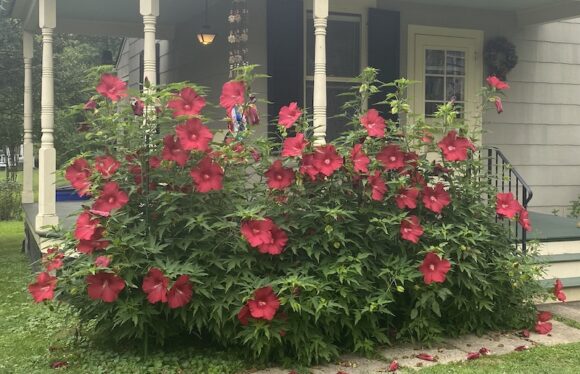
These colorful hibisci make a stunning show during July.

LAWNS – water the lawn only when the green glow begins to fade.  An established lawn will bounce back following dry hot spells. 

I want to emphasize the importance of soil and soil health, which has been severely neglected and abused with poisonous chemicals for years. Soil is the most important element of plant growth; it is not an inert medium that merely holds the plants erect, it is a living organism that needs to be replenished with nutrients. The nutrient is composted manure; manure builds soil structure and together with its bacteria partners joins the millions of microbes below the surface to produce nutrients for the roots of the plants.

If you have not already done so, I strongly suggest that you carefully discard all chemical fertilizers, herbicides and pesticides.

The addition of composted manure to your soil in spring, early summer and in early fall, together with natural brown bark mulch, builds the carbon compound or humus component in the soil.  We are all carbon-based creatures, as is every living element — carbon is our lifeblood and the lifeblood of the soil in our gardens.

As we build the humus component by adding composted manure and fine-bark mulch we are producing the healthiest possible growing environment and the strongest disease-resistant plants. As we add the composted manure and natural fine bark mulch season after season, the humus component continues to build in the soil, continuously extracting carbon from the atmosphere into the soil. 

Add a light layer of composted manure around the root of roses in July.

ROSES – flourish beautifully with the addition of composted manure and mulch, applied on the soil about two feet away from the base of the plant. Roses also require deep watering at least once a week. Now, in July add another light layer of composted manure around the roses. Manure is food for the roots of the roses and no other products are necessary for growth and bloom. Stop adding manure to the roses in mid-August, so that they can gradually move into a slow dormancy through late summer and early fall, which is a natural part of their growth cycle.    

If you are a first-time rose-grower or adding to your rose collection, David Austin English roses are my personal preference.  The David Austin nursery is only 21 miles from my hometown in Shropshire in England; it was a fragrant pleasure to visit the nursery in June. 

David Austin roses are more trouble-free than many other roses and are repeat bloomers, with beautiful colors that enhance our senses together with delicious fragrances.    

Some of my favorite David Austin roses are:
> A Shropshire Lad, a peachy pink
> Abraham Darby, shades of apricot and yellow
> Evelyn (my favorite) with giant apricot-hued flowers
> Fair Bianca, a pure white rose
> Heritage, a soft blush pink
> Carding Mill Valley, which begins as a peachy orange double flower, changing to an apricot-pink

A lovely combination to enjoy are climbing roses and clematis planted together since both enjoy the same planting environment with their heads in the sun and their feet (roots) in the cool manure and mulch. This combination looks great, climbing over a fence, wall or arbor.

MULCH – do not use the artificially-colored red mulch, rubber mulch or cocoa mulch; use only natural brown bark mulch. Do not mulch right up to the base of the plants, as this invites rodents to nest and gnaw on the stems or trunks of the plants.

Note: Do not use Cocoa mulch, produced by Hershey, this mulch has a Thorazine compound and other poisons, which are hazardous to pets that are attracted by the chocolate odor. Ingestion of this chocolate mulch can cause seizures and death within hours.  

HYDRANGEAS:  Plant Hydrangeas in a sunny area if you live near the coast, which allows them to enjoy gentle seas breezes. Away from the coast, plant Hydrangeas in part-sun on the west or east aspect of the garden. Plant them in organically rich soil with composted manure and add extra composted manure around the base now in July. 

If you have the blue Macrophylla Hydrangea, add some peat or aged oak bark around the base as the acidity in the peat or oak bark encourages a deeper blue color. Hydrangeas are a wetland plant and require plenty of water throughout the summer. We had a late spring and with all the spring and early summer rain and good sunshine, the foliage and bloom of the hydrangeas is performing well. Watch out for powdery mildew and spray with the following powdery mildew recipe you can mix yourself:

Two tablespoons baking soda, one dessert spoon of vegetable oil, a squirt of dish soap with a gallon of water in a sprayer. For any recipe spray you make at home, spray only in the morning when there is no wind and when the temperature and humidity added together do not go above 180. 

Encourage a deeper blue in Macrophylla Hydrangeas by adding some peat or aged oak bark around the base to increase acidity. Photo by Gemma Evans on Unsplash.

Pruning Hydrangeas – Prune Hydrangeas immediately after they finish blooming in late August or early September but no later, as Hydrangeas set their buds for the next season by mid September. If you prune after September, you will lose next season’s bloom. When you prune, cut out some of the old wood and the weakest of the new shoots. In October put more composted manure and brown mulch around the base to nourish and protect the roots through the winter. 

Did you know that garlic is the antibiotic of the garden? I love garlic to use in my recipes and it is an important anti-fungal element to protect your plants and I suggest planting more garlic in early fall. 

To avoid fungal diseases plant garlic around strawberries, tomatoes and raspberries to avoid fungal diseases. 

Plant garlic:
> around mildew-prone plants to prevent mildew on such plants as summer phlox and bee balm.
> under fruit trees to avoid scab and root disease.
> next to ponds or standing water to control mosquito larvae or pour garlic water into the water to deter adult mosquitoes. 

Where you notice marauders have been munching, like insects or animals, make a garlic spray to apply on the plants including vegetables. 

GARLIC SPRAY RECIPE

4 large, crushed garlic cloves, unpeeled
2 teaspoons of vegetable oil
1 squirt of mild dish detergent

Put all ingredients in 2 cups of hot water in the blender, blend, then leave overnight, then put in a gallon sprayer with cold water and spray in the early morning when there is no wind, observing the rule of 180.  Observing the rule of 180 is when the temperature and humidity when added together do not go above 180.

HOT PEPPER SPRAY RECIPE

To deter squirrels and chipmunks try a hot pepper spray using either four hot chilies or one cup of cayenne pepper in two cups of hot water, in the blender, blend and leave overnight then put in a gallon sprayer with cold water and spray the problem areas in the early morning.

This pepper spray works well to deter squirrels, chipmunks, deer as well as dogs and cats that may be leaving their deposits in the garden. 

HANDS: Gardener’s hands are their tools of the trade so it’s important to take care of them. My hands remain healthy by indulging in a hot cream treatment once a week before bed. 

Hot Hand Cream Recipe:
Combine Calendula cream with honey and essential oil of lavender heated in the microwave, apply generously and put on white cotton gloves for sleep. When I wake up my hands are soft and smooth as you can only imagine. Wear gloves, when working in soil that contains manure or when spreading manure. Manure is an organic product that contains bacteria; bacteria is great for the soil but like many bacteria not healthy for you. The garden gloves I prefer are the soft leather farmer’s gloves that are washable.  

Many herbs are at their peak rin July and are ideal for using in flavored oils.

FLAVORED OILS – Many herbs are at their peak right now and are ideal for using in flavored oils. The oil I use as a base is organic olive oil. I harvest basil, parsley, sage, tarragon and oregano in a morning, rinse them well, pat them dry with a paper towel and then make the recipe. Then choose an herb and add to two cups of oil.  

For thyme and lavender, I use only the flowers with one cup of oil to a handful of blossoms.  

Puree the herb mixture in a blender and store covered in a wide mouthed jar for three days, shake at least three times a day for the first two days and on the third day let the mixture settle to the bottom, then strain it through a paper coffee filter or cheese cloth into a clean jar.  You will now have a tinted but clear mixture.  

Refrigerate each mixture and use within two to three weeks. The herb oils I make are lavender, lemon, garlic, shallots and basil with olive oil as the base – these are my favorites and are great brushed on vegetables and meats for grilling. The lavender oil is great with desserts. Rosemary and lemon oil taste excellent on salads. 

MOLES & JAPANESE BEETLES: I know I have given you a few mole remedies in the past; but I have not given you the exlax method for a while. I can attest to the fact that I have used this method as have many fellow gardeners for years, as it works well.  Buy Exlax, the main ingredient of which is Senna, a natural herb. Insert Exlax into the mole holes, the moles and voles eat it, then die of dehydration.  

If you have dogs and cats, do not use the chocolate Exlax only the plain Exlax, as chocolate is dangerous to pets.  

In early April of next year, apply organic grub control, which means less grubs for the moles to feed on, and without their supply of grubs, the moles will go elsewhere for food. In addition, the white grubs of Japanese beetles can be diminished with the grub control.  

Japanese beetles love our plants and here is a method to deal with them naturally. In the early morning, the Japanese beetles are drowsy and can be captured. Lay a drop cloth under the plant or plants where you see them and gently shake the plant; the drowsy beetles will drop onto the cloth, which you gather up and drop them in a garbage bag and discard.   

Many of us are committed to organic gardening without chemicals, which has enabled the earthworm population to once again increase; earthworms are a great boon to the garden soil as their castings add 50 percent nutrition to the soil together with 11 trace minerals.  

SUMMER PHLOX – I just love my summer phlox and to keep the mildew problems at bay, I use the natural baking soda mix I mentioned above. I have found that white Phlox Miss Lingard or white Phlox David are more resistant to mildew than other summer phlox. Monarda, commonly known, as Bee Balm and Hydrangeas are also prone to be affected by powdery mildew, and this is where the baking soda recipe once again can be used.  

For a second bloom on the Summer Phlox, prune off 10 to 20 inches from the flower stems after the first bloom has gone by and within a few weeks you will experience a new bloom. 

KEEP YOUR GARDEN CLEAN – a healthy garden is a clean garden. Do not put any diseased items into your compost. 

Deadhead all annuals and perennials for a second bloom and clean up all spend blossoms.  

When Coreopsis and Spirea have bloomed, use garden shears to shear off dead flowers and they too will rebloom.

CONTAINERS – Make sure you have composted manure and fine bark mulch applied on top of the soil in your containers and keep them watered as containers dry out quicker than garden soil. In hot weather the containers will need to be watered daily, morning and evening watering is the best. If you do not have time in the morning before you leave for work or errands, empty your ice cube trays on the containers; this provides slow-release watering until you can get to them later.  

Enjoy being in the garden, stay hydrated, continue to stretch and take time to ‘smell the Roses’.

If you have any gardening questions, please email me at MaureenHaseleyJones@gmail.com and I’ll see you in your garden in August.

Also if you would like a garden consultation, contact my son Ian at LandscapesByIan.com. He has a brilliant gardening mind and, if I might say (yes, perhaps slightly tongue in cheek!), ‘The apple does not fall far from the tree.’

About the author: Maureen Haseley-Jones is a member of a family of renowned horticultural artisans, whose landscaping heritage dates back to the 17th century. She is one of the founders, together with her son Ian, of, The English Lady Landscape and Home Company. Maureen and Ian are landscape designers and garden experts, who believe that everyone deserves to live in an eco-conscious environment and enjoy the pleasure that it brings. Maureen learned her design skills from both her mother and grandmother, and honed her horticultural and construction skills while working in the family nursery and landscape business in the U.K. Her formal horticultural training was undertaken at the Royal Botanic Gardens at Kew in Surrey. 
Gardening Tips for June from ‘The English Lady’: “If a June Night Could Talk, it Would Probably Boast it Invented Romance”

Maureen Haseley-Jones

We have had a few cool nights recently, which is just wonderful since I can sleep with the windows open — at least when the smoke from Canada blows away!  I cannot remember the last time we had a real spring like we are experiencing this year, with plenty of gentle rain. This beneficial rain is wonderful for all the spring plant growth and such a pleasure.  

I am so in awe of the miracle of Mother Nature; the symbiotic relationship between plants and all of God’s creatures.  As I looked out of the window from my old home a few years ago, I could see the buds opening on my long border of Peonies, which had been planted by the original homeowner in the early 1900s.  As I looked, I was reminded of the special relationship between ants and peonies. 

A question often asked of me is “Maureen, should I worry about ants on my peonies?”

My answer, “That’s not a problem, lots of ants on the peonies just demonstrate that you have healthy plants with big buds producing bountiful nectar, which attracts the ants”. By the way, ants are very useful creatures; their presence indicates that there are aphids and whiteflies in the area and ants feed on these troublesome insects. 

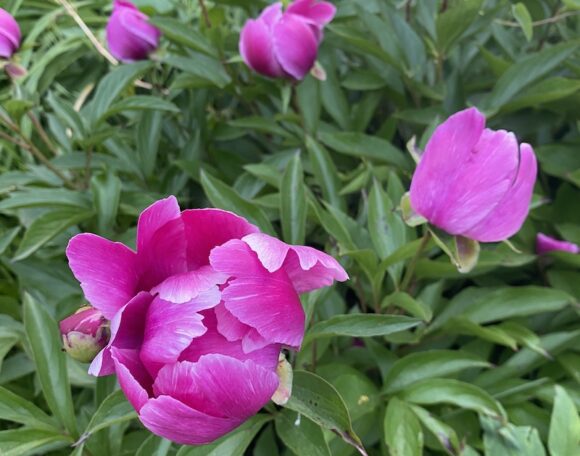
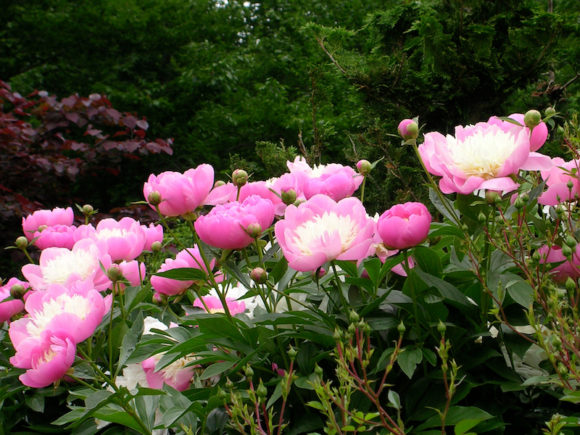
Peonies may have a short flowering period but during it, they create a truly stunning display.

Please ensure that Peonies get plenty of water and check the pH of the soil, which should register between 6.5 and 7.0. In early June, I pinched off the side buds on the peonies, as by doing this, it ensures big terminal blooms on the plant. When the bloom has past, apply a light application of composted manure to encourage the soil animals and the manure bacteria to keep the soil healthy.

Do not cut the peonies down to about six inches until after the first frost in November. In September, plant or transplant Peonies and in the process barely cover the pink eyes on the roots with soil, just enough so the plant does not fall over.

Beginning in spring, many insect pests appear in the garden; a useful creature against the pests is the lowly toad. I suggest putting some toad houses in and around your borders. You can purchase toad houses from the garden center if you wish. Or you can do as I do, which is to use an old clay pot that is cracked and make sure that the crack is two to four inches wide for a door so the toad can enter. Also put a small saucer as a floor under the pot with some rocks, and keep the rocks damp, so that your friendly bad-bug eater has his or her ideal home environment and will snack on hundreds of pesky bugs.

MULCH:

Mulch your gardens this month when the ground has warmed up to 55 degrees.  When mulching, be careful mulching around trees. Apply the mulch at least six inches from the base of the trunk — any closer can cause rot and disease in the bark and roots of the tree.  Also, trees that are mulched too close to the trunk invite mice and other rodents to come nest and gnaw on the trunk. Your garden can be mulched to a depth of between two and three inches and I use natural fine dark brown hardwood mulch. Please do not use dyed red mulch, which is poisonous. Keep your garden natural, herbicide and pesticide free.


June is the month when Roses begin to bloom.  I prefer to use David Austin roses in my garden and in my designs. I find that David Austin roses are the most-trouble free Roses and offer great rewards, being repeat bloomers with wonderful fragrances and colors.  

Some of my favorite David Austin roses are: 
‘A Shropshire Lad’, a soft peachy pink.
‘Abraham Darby’ with blooms producing petals that are a blend of apricot and yellow. 
‘Fair Bianca’ a pure white.
‘Heritage’ a soft clear pink. 

An ‘Evelyn’ rose, the author’s favorite.

And my absolute favorite is ‘Evelyn’. Evelyn has a large apricot saucer shaped bloom with a fragrance that is second to none offering a luscious, fruity tone that reminds me of fresh peaches and apricots.  

Feed your roses with composted manure, keeping the manure and mulch about six inches away from the base of the rose and adding a few more inches of manure once a month until mid- August.  At that time stop feeding so the roses can gently move into a much-needed slow dormancy. You do not need any other Rose food except the manure and, of course, the mulch, which attracts carbon from the atmosphere to produce the humus component.

Japanese Beetles are attracted to roses, therefore; Japanese Beetle traps should be placed far away from your borders on the perimeter of the property. 

A tip for keeping cut roses fresh: cut the roses in the early morning, cutting just above a five-leaf cluster and place stems in a container of lukewarm water.  Inside the house, recut the stems at a one and half inch angular cut, under warm running water, then place cut roses in a vase filled with warm water.  Do not remove the thorns on cut roses, removing the thorns reduces their indoor life by as much as three days.  

Hydrangeas: need plenty of water. In the fields, where they were originally discovered, were wetland areas. Then, fortunately for us, some gardeners introduced them into their gardens and ‘the rest is history’.  Apply aged manure around the Hydrangeas, which should be planted in full sun and spaced at least four feet apart for good ventilation and to prevent mildew from occurring. If you have blue Hydrangea macrophylla and want a more vibrant shade of blue, add some peat moss on top of the manure. The acidity in the peat will produce a lovely deep shade of blue. 

Wisteria: regular pruning through spring and summer is the main factor to help this arrogant vine to flower. Prune several times during the growing season, which means pruning every two weeks by at least six inches on each stem.  

Clematis wilt: if you have this problem with clematis, you will notice it early because the shoots wilt and die. This disease is impossible to cure, as it is soil-borne. Soil-borne means that it is not possible to plant another clematis of that species in that area of the garden. However, you can plant the Viticella clematis variety. The Viticella clematis are vigorous, free-flowering blooms and are not susceptible to wilt.  Some good choices of this variety are Blue Belle and Etoile Violette — both are purple — and Huldine, which is white,  

CONTAINER GARDENS:

The most unexpected objects make interesting containers. Photo by Annie Spratt on Unsplash.

If you have room for one pot, you have room for a number! By placing them close together with different shapes and sizes, you can create your own miniature garden. Apart from regular pots, the most unexpected objects make interesting containers. A friend who cut down trees this past winter, left the stumps and hollowed them out to make containers, one large and two smaller stumps together, and it made an interesting combo. 

Check in your basement, shed or barn to see if you have an old wheelbarrow, even if the wheelbarrow has a wheel missing like mine, which I painted with eco-conscious paint and then placed near the kitchen door filled with bright colored vines, miniature grasses and small perennials.

Or you may discover a large old ceramic jar, which is what happened to me when I came across an old two-foot-tall ceramic vinegar container in the barn, replete with a hole where the vinegar tap was inserted, making it ideal for drainage. The jar planted with multi-colored perennials looked great on my newly-painted, blue bench beside my red milk shed.  

LAWN CARE:

Do not forget to add organic grub control through July, so that you help to keep down the mole infestation; remember no grubs, less food for the moles.  

POWDERY MILDEW:

Keep an eye open for powdery mildew, especially after a rain when humidity returns.  My recipe for powdery mildew is as follows:

In a sprayer, mix two tablespoons of baking soda, one tablespoon of vegetable or horticultural oil in a gallon of water and spray the mildew.  Hydrangeas and Summer phlox are particularly prone to this problem.  To held counteract the mildew problem, I recommend Phlox Miss Lingard or Phlox David, which are the white Phlox and are the most mildew resistant. 

Mint needs to be kept under control — it spreads wildly in the yard if left to its own devices.

Monarda, commonly known as Bee Balm, are also affected by mildew and the one I have found to be the most resistant is “Cambridge Scarlet”. However, please be careful when introducing Monarda into the garden; this plant, like Purple Loosestrife and Evening Primrose are extremely invasive and can take over your entire border.

Regarding invasive plants; if you plant mint, plant it only in containers, otherwise that too will wildly spread throughout your borders.

I hope these tips are useful to you during this busy time of year in the garden. Stretch, hydrate and enjoy the burgeoning promise of your garden and I’ll see you next month.

If you would like some more gardening advice, contact my son Ian at LandscapesByIan.com. I am sure you would enjoy speaking with him as he is full of knowledge and, as the old saying goes, “The apple does not fall far from the tree!”

About the author: Maureen Haseley-Jones is a member of a family of renowned horticultural artisans, whose landscaping heritage dates back to the 17th century. She is one of the founders, together with her son Ian, of, The English Lady Landscape and Home Company. Maureen and Ian are landscape designers and garden experts, who believe that everyone deserves to live in an eco-conscious environment and enjoy the pleasure that it brings. Maureen learned her design skills from both her mother and grandmother, and honed her horticultural and construction skills while working in the family nursery and landscape business in the U.K. Her formal horticultural training was undertaken at the Royal Botanic Gardens at Kew in Surrey. 

A Special Memorial Day ‘View from Our Porch’: Town Budget Meeting Reflections

By Christina J. & Thomas D. Gotowka

This “View” was supposed to be “Electric Vehicles: Can Elon overcome the legacy of the Beach Boys?”, but Christina encouraged me to ignore the plan and provide some follow-up on last week’s annual town budget meeting. 

We were troubled by the article by Elizabeth Regan and published on May 16 in The Day, which characterized the meeting and the residents’ interactions with the BOS as disorderly, e.g., “the room erupted”; “Moderator Vicki Lanier called for calm; let’s try to keep some order in this meeting”; and “lengthy debate about what constitutes an ‘assault weapon’ turned Monday night’s meeting into a fight about guns”. 

This essay begins with our reflections on what we thought were the key issues and concerns raised by residents that Monday evening; but as the topic developed, it became clear that this ‘View” was something that was appropriate for consideration on Memorial Day.

We felt that the gathering was nothing more than a typical New England town meeting, which historian Frank Bryan describes in Real Democracy as a public forum that enables residents to share their opinions on issues; “while engaging in deliberation and democratic decision-making” regarding laws and budgets. The residents of Old Lyme seemed very serious about their participation; and there were appropriate questions and comments when information appeared incomplete or absent.

Many were shocked that the proposed FY23/24 budget included expenditures of $29,500 for 7 patrol rifles,10 Glock 45s, and ammunition; listed under “Public Safety”. Those expenditures generated discussion and questions about exactly what comprised the “7 patrol rifles”, and why do we need them? Some expressed alarm that the patrol rifles might be AR-15s. 

Old Lyme is not immune to School Violence:

Selectman Matt Ward, who was a Connecticut (CT) State Trooper for 20 years, and a part-time police officer in Old Lyme; and Resident Trooper Matt Weber justified the expenditures as essential because our schools are vulnerable; — “shootings happen everywhere, including close to home”. Mr.  Weber’s comments were in The Day, not in person at the meeting. 

Surely, none of us living in Connecticut can be indifferent to the terrible school shootings that have impacted our confidence in the safety of our children while in school. 

Just in the past decade, they have included, Sandy Hook Elementary School in Dec. 2012, where 20 children and 6 adults were murdered; Marjory Stoneman Douglas High School in Parkland, Fla., in 2018, where 14 students and 3 staff members were murdered, and 17 seriously injured.

Just last year, we witnessed a mass shooting at a supermarket in Buffalo where 10 people, all of whom were African-Americans, were murdered and three seriously injured; and another at Robb Elementary School in Uvalde, Texas, where 19 children and two teachers were murdered. The slow response by Uvalde Police Department, which cost lives, remains under investigation

A few months ago, on March 27, three children and three adults were murdered at the Covenant School in Nashville, Tenn.

The Numbers:

The data are daunting and gut-wrenching. The Centers for Disease Control and Prevention recently released the most current national mortality data and reported 45,222 firearm-related deaths in the United States in 2020, which is a new peak.

Worse yet, the previous analysis, which examined data through 2016, showed that firearm-related injuries were second only to motor vehicle accidents, both traffic-related and non-traffic-related, as the leading cause of death among children and adolescents. That gap narrowed; and in 2020, firearm-related injuries became the leading cause of death in that age group

Further, the United States has far higher rates of firearm death than any of the two-dozen other high-income countries that were studied, which included Australia, Canada, Germany, Italy, Japan, Norway, Spain, and the United Kingdom. We kill each other with firearms 25 times as often as the study group. 

Finally, according to the Gun Violence Archive (GVA), the rate of mass shootings escalated during COVID and has persisted since; and 2021 became the worst year for mass shootings since tracking began in 2013 with 690 across 44 states and Washington, DC.

Incredibly, by May 1, of this year, there were already 235 mass shootings in the United States; which puts us on track to pass 700, which would be a new peak. 

There is no doubt in our minds that we have a problem in this country with gun violence. 

M-4s, Not AR-15s:

Our elected officials initially seemed unwilling to specify the exact rifle model that was to be purchased, and that led to concerns from residents. 

Eventually, Selectman Ward informed us that Old Lyme Police Department’s (OLPD) patrol rifles would be M4s. He emphasized that the rifles would not be routinely carried by officers on patrol, and would remain locked and secured in police vehicles and only deployed with authorization from a supervisor. This was corroborated by two members of OLPD who attended the meeting in uniform.

An advantage of the M4 is that it is also used by CT state police, with whom we already have a close working relationship. 

As we understand, equipping the OLPD with M4s in this manner will enable more rapid deployment of armed officers for containment of an active incident. The Resident Trooper stated, “It’s going to be my Old Lyme officer that’s the first one in that door.”

After some additional discussion and a motion to remove the firearms from the budget failed to achieve the required two-thirds majority, those in attendance voted to approve the proposed budget with no change. 

Through the Looking Glass:

These expenditures were presented as having been endorsed by the Old Lyme (OL) Board of Selectmen and approved by the OL Board of Finance (BOF). However, a BOF member said at the meeting that the board received no information from the OLPD describing the purchase, nor did they respond to a request to explain the need for the weapons.

In contrast, The Day reported that the Resident Trooper told them in March that his department, “… is requesting Colt M4 carbine semiautomatic rifles.”

All in all, and borrowing from Lewis Carroll’s Alice, the situation becomes, ‘curiouser and curiouser.’

Perhaps more eloquently stated, former Old Lyme Selectwoman Mary Jo Nosal, in a response to The Day, stated, “The crux of the issue is not whether these arms are necessary but the lack of transparency and justification for the need for what would be a new purchase for the town.”

America’s Rifle?

The shooters in Uvalde and Buffalo used AR-15 style weapons. The CT State Police reported that Adam Lanza used a similar .223-caliber Bushmaster XM-15 E2S semi-automatic rifle at Sandy Hook.

In 2020, the National Shooting Sports Foundation estimated that 19.8 million AR-15 style rifles were in circulation in the United States; surging from about. 8.5 million since a federal assault weapons ban expired in 2004.

In 1993, and again after Sandy Hook, the CT General Assembly passed laws prohibiting the sale of certain “military-style” weapons, including the AR-15 and its many variations.

About 80,000 AR-15s purchased prior to 1993 were “grandfathered in” and then re-grandfathered” after Sandy Hook.

Governor Lamont has announced that he is seriously considering repealing the exemption. 

We Need a Plan:

The outcome of the meeting demonstrates that residents acknowledge America’s gun violence problem and the attendees now realize, “Shootings happen everywhere, including close to home.” While approving the purchase of the proposed firearms for OLPD is a step towards containment of an active shooter incident, we have not touched on prevention or deterrence.

Last June, after the Uvalde school shooting, the Region 18 Board of Education approved armed school security guards, who would be retired, trained police officers., However, the school district did not purchase firearms. 

Rather than have another Old Lyme Arms Summit in 2024, Reverend Steve Jungkeit, senior minister at the First Congregational Church of Old Lyme, called for a, “Wider conversation about public safety.”  He said, “I don’t feel safer as a human being by having a lot more guns out there, even carried by people that I trust because good people do make errors of judgment.”

Elections:

Per The Day, — “with little publicity”, town officials, proposed amendments to local ordinances that would have changed the Old Lyme Town Clerk and Tax Collector from elected to appointed positions; and lengthened the current respective four-year terms to six. The vote from the floor was virtually unanimous in rejecting the proposed change. 

Author’s Thoughts:

We are concerned that it appears that Old Lyme is now using an honor system rather than verification of identification in order to confirm a person’s status as an “elector or citizen eligible to vote” in important Town Meetings. 

We know that Old Lyme’s BOS have been reticent in the past to comment on social issues, but it seems that it is time to make a statement in support of developing some common-sense rules and enforceable regulations to curb gun violence and make our children safe in school.

After all, “shootings happen everywhere, including close to home”. 

Sources:

Boschma, J., Merrill, C., and Murphy-Teixidor, J. “Mass Shootings in the US”. CNN.  5/04/2023

Bryan, Frank. “Real Democracy: The New England Town Meeting and How It Works”. University of Chicago Press. 2010

Carroll, Lewis. “Alice’s Adventures in Wonderland” & “Through the Looking-Glass”. London: Macmillan & Company. 1865 &1872.

Goldstick, J. E., Cunningham, R.M., and Carter, P.M. “Current Causes of Death in Children and adolescents in the United States” NEJM. 05/19/2022

Lallanilla, M. “What Makes the AR-15 Rifle ‘America’s Gun’?” LiveScience. 09/17/2013

Loh, M. “America has 20 million AR-15 style rifles in circulation, and more guns than people in the country”. Business Insider. 05/30/2022

Pazniokas, M. “Lamont may go alone in seeking end to ownership of AR-15s in CT”. CT Mirror.12/09/2022

Regan, E. “Some in Old Lyme oppose arming police with semiautomatic rifles”. New London Day. 05/16/2023

South, E.C., Hemenway D., Webster, D.W. “Gun violence research is surging to inform solutions to a devastating public health crisis”. Preventive Medicine, 10/27/2022.

Vigdor, N. “State Police: All 26 Newtown victims shot with assault rifle”. CT Post. 01/24/2013

Gardening Tips from ‘The English Lady’ for May, ‘The Gateway to Summer’

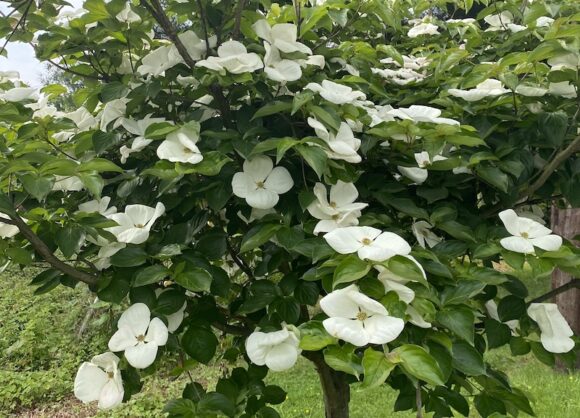
Dogwood is just one of the ‘darling buds of May,’ which comes into full bloom before the month is over.

“The darling buds of May” is such an apt phrase for one of the most enchanting months, which brings bloom on spring bulbs and flowering trees — the Amelanchier, the Dogwood and the Cherry to name a few — and new, awakening foliage on trees winking in the sun.  

Maureen Haseley-Jones

By now, you have probably removed most of the winter debris, pruned broken branches and re-edged borders. However, do not apply the composted manure before the soil warms up to 60 degrees. The soil needs to reach that temperature for the soil organisms to work with the bacteria of the manure, which produces nutrients for the roots of the plants.  I suggest, when shopping for garden supplies, pick up a soil thermometer to check soil temperature as I am sure the soil temperature will reach 60 degrees in a few weeks. 

As I walk around my garden, I notice our old nemesis, weeds, emerging everywhere.  Pull these up by hand, without breaking them together with the roots. If you use a tool, it breaks the weed and the broken weed pieces will take root and you will face hundreds more to get rid of soon.  Follow on the weeding with an organic corn, gluten- based weed pre-emergent by Bradfield Organics; this product will keep weeds at bay for quite a few weeks.   

Compost, Humus, Mulch, Manure & More

When the soil warms to 60 degrees, apply composted manure around daffodils and other spring bulbs so that soil organisms will produce nutrients to feed the bulbs for next year’s bloom. Also, a reminder to not cut down the daffodil foliage as the nutrition from the foliage is absorbed into the bulb for bloom next spring. 

Humus brings carbon from the air into the soil.

Also in a few weeks when the soil has warmed up, apply composted manure and a light layer of fine bark mulch to all maintained areas of the garden, again in July and finally in October before putting the garden to bed. The manure and mulch begin to build the humus component. 

Regarding types of mulch, only use the natural brown wood mulch — do not use the colored mulches, which contain chemicals, and do not use rubber mulch. 

A word of caution on Cocoa Mulch. This product is highly toxic to dogs and cats.  This product is manufactured by Hershey and sold in many large garden centers.  It is made from the residue of chocolate products and other ingredients and contains a lethal ingredient that has resulted in the reported deaths of cats and dogs that are attracted by the chocolate odor. This mulch contains Theobromine, which is a Xanthine compound with effects similar to those of caffeine and theophylline. The symptoms, which the animals experience, are seizures and death within hours.   

I wrote about the carbon component in my April tips but wanted to emphasize its importance by stating it again for you to build or continue to build the humus component in your soil . 

All living things, including us, are all carbon-based creatures. Humus brings carbon from the air into the soil.

Humus acts like a sponge and holds 90 percent of its weight in water. Because of its negative charge, plant nutrients stick to humus bringing nitrogen, calcium, phosphorus and other important elements to the plant, preventing these nutrients from washing away, acting like nature’s slow-release fertilizer.

Humus improves soil structure making it loose and friable, which helps plants to root in this environment with better access to nutrients, water and oxygen. Humus also helps to filter toxic chemicals from soil, much like carbon-based water filtration systems filter toxins from your water.

I also recommend that you go online to read this article in Scientific American to check out the dangers of Round-Up. This is the most dangerous herbicide not only because of Glyphosate, which is on the list by the World Health Organization as a chelating agent that causes cancer but also because of its inert ingredients. I ask that you are not swayed by the word ‘inert’ as the ingredients are anything but inert and those ingredients combined with Glyphosate are deadly to human cells. 

Flowering Trees & Plants

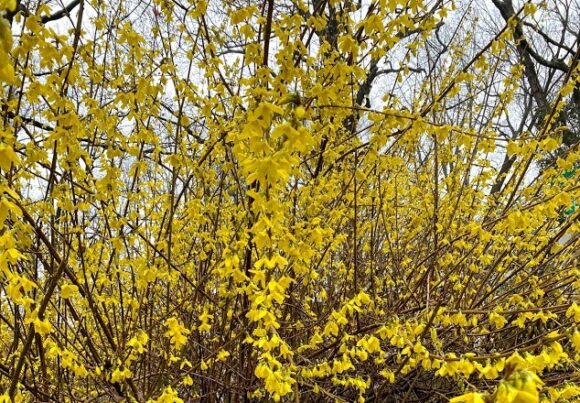
Forsythia is in bloom, lovely fresh yellow blossoms.  If the bloom on your shrub is not as prolific now, as it was in previous years, prune out the old sparse wood after bloom ends.  

Forsythia offers a yellow burst of color in May.

A favorite native tree of mine is the Amelanchier (common name is Shadblow Serviceberry so named for the Shad that run in the rivers at this time to swim upstream to spawn). This early spring blooming tree has creamy panicle blooms, followed by small green leaves and within weeks, red fruit, which is a delicious treat for our feathered friends. Before the birds eat all the fruit, you may want to pick some of the fruit which makes a delicious jelly for your morning toast.  

Here in my town of Old Lyme, the magnolias, cherries and Eastern redbud are vying with one another to show off their finery together with the graceful Dogwoods.  Following the recent rains, many of these trees are blooming at the same time or within a few weeks of one another. Their bloom will soon be over, then we can look forward to rhododendrons, azaleas and followed by mountain laurel in early June. 

Another favorite of mine is the Carlesii viburnum (also known as Korean Spice) with pink buds, opening to white flowers and their delightful fragrance fills the air outside my kitchen door. This viburnum grows to about five feet and can be tucked into many a border particularly in an area where you often walk by to inhale the fragrance. 

Covering the barn wall and scrambling up to the barn roof is my climbing hydrangea – bright green leaves emerging with hundreds of buds indicating that this beautiful climber will be laden with blossoms in summer. 

Tulips, creeping phlox, forget-me-nots, primroses and candytuft are bringing much-needed color to borders and rock gardens. 

If you have not had the opportunity yet, you can still prune your roses for another couple of weeks.  Pull back the old mulch from around the base of the roses and in two to three weeks, apply manure about six inches from the trunk of the plant. Then a week later reapply a layer of the brown natural mulch on top of the composted manure.

As well as building the humus component, these layers keep the roots cool, keep weeds at bay and help retain moisture. Do not mulch right up against the base of any plants as this encourages rodents to nest and gnaw on the plants. 

Beware of fungi that look like weird mushrooms in your mulch; this is called  Artillery fungus, which can adhere to the walls of your home and cause problems.  If you notice this fungus, you will need to remove all the mulch and get it off your property. 

Apply a small amount of lime and about three inches of manure around lilacs — they like sweeter alkaline soil, indicating the use of the lime. By now, you may have already applied lime to the grass, which also enjoys sweeter soil and organic grub control, which eliminates the Japanese Beetle larvae and therefore lessens moles as this cuts off their food source.  

Vegetable Gardens

A well-maintained 6 ft. x 24 ft. vegetable garden is documented as can feed a family of four for a year.

If you are making an organic vegetable garden this year; a garden measuring 16 ft. x 24 ft. can feed a family of four for a year; but keep the size within your needs and capability.  Don’t work the soil if it is too wet or too dry.  

Double digging is the best way to go, this takes time and effort but its well worth it – dig down about one foot and remove the topsoil, put the soil to one side, then dig down and loosen the next six inches of soil and add about three inches of composted manure then put back the topsoil and add another three to four inches of manure.  

Do not rototill the vegetable garden, as this destroys soil structure. Gently loosening the top few inches of the soil to aerate it, makes it friable and results in an excellent yield of fruits and vegetables. 

I prefer 6 ft. x 4 ft beds rather than rows; beds produce a larger yield of crops. In addition, beds make for ease of weeding and harvesting by having narrow compacted soil or grass paths (having removed lawn from the area) in-between the beds. 

The vegetable garden should be situated on the south or southwest side of the property for maximum sun exposure. 

Make sure you remove as many weeds as possible by hand, before you even begin digging.  

You need a water source close by as vegetables require lots of water, particularly annual fruiting vegetables like tomatoes, which are hydroponic which means they consist of a large amount of water. 

Rotate crops, by that I mean, do not plant the same vegetables in the same place as the previous year.  Using this method helps to prevent any soil- born diseases occurring.     

In the loosened soil, plant the vegetables plants so that they are touching, this forms a natural canopy, shading out weeds and helps retain moisture. 

I prefer to mulch the vegetable garden with composted manure, the reason being that manure, as mulch, does not cap. Capping is when mulch forms a crust, which does not allow water or air to penetrate to the roots of the plants.

Fence in the vegetable garden with a tall fence to keep animals out. At the base of the fence install eight inches of fine mesh chicken wire above ground and eight inches below ground to keep out the digging and burrowing animals. 

Organic Insect Control

Insects do not like fragrance so plant fragrant plants like marigolds, nasturtium, lavender, nepeta, honeysuckle and roses to name a few.  

Encourage lacewings, which feed on aphids by planting marigolds and sunflowers,

Attract ground beetles by laying a log or a rock on the earth, under which the beetles can hide. These useful insects are nocturnal and eat slug and snail eggs, cabbage maggots, cutworms and even climb trees to feed on armyworms and tent caterpillars.  

Mowing Tips

Following all the rain, your grass is hopefully a vibrant shade of green, therefore when mowing keep the blades of grass at about three inches tall; the taller blades attracts sunlight, promoting a healthier lawn. The taller blades also shade out weeds and help to retain moisture in the grass.   

Is your lawn “a vibrant shade of green?”

When mowing, leave grass clippings on the lawn, the clippings are a natural source of nitrogen. If you have clover in the grass, clover is an added benefit as clover takes nitrogen from the air and fixes it in the soil, as an additional nutrient for plant growth.

After flowering is over, prune flowering shrubs by 25 percent – do this task immediately before new buds set for next year. 

On a rainy day go shopping for any garden supplies that may be needed, then when the weather is dry, you can be outdoors doing what you love and not indoors shopping.  Buy good hoses, cheap ones will bend and crack.  

Peonies, Hydrangeas, Lilacs & More

Peonies need plenty of water to produce flower buds.  I had a 30 ft. long stand of Peonies in my field. The Peonies have been in the ground for over 50 years and are a sight to behold when in bloom.  I gave them lots of loving care with a light dressing of aged manure in early May.  In a few weeks, I  pinch off the side buds while they are still small, leaving the terminal flower bud on each stalk, which develops into a large main bloom.

Peonies are a perennial favorite.

Hydrangeas are a wetland plant and require plenty of water during the season, with the addition of manure and mulch around the base. If you have blue Hydrangeas and want a deeper color of blue, also add some peat around the base of the plant, the acidity in the peat produces the bright blue color.   

If you need to prune a Hydrangea, which has become too large, then prune it immediately after flowering, in EARLY SEPTEMBER, prune about 1/3 of the old wood and the weakest shoots. DO NOT WAIT, as Hydrangeas begin to develop bloom buds for next year later in September.  If you wait to prune it is likely that you will not have bloom for next year. 

The beloved Lily of the Valley is a delightful, sweet-scented flower,

My maternal grandmother’s favorite plant, the Lily of the Valley (pictured right in photo) will bloom in another couple of weeks. These lovely flowers are tucked on the small hill on the west side of my apartment, and I am so looking forward to gathering a few fragrant blooms to enjoy indoors.   

When the lilacs have finished blooming, pinch off the withered flower clusters, and do the same on the mountain laurel and rhododendrons in late June to ensure good blossoms next year. 

In mid-May apply composted manure, a light application of peat and fine bark mulch around all evergreens and rhododendrons, mountain laurel and azaleas; these plants are shallow- rooted and the mulch will keep the roots nourished, protected, warm and moist. 

Some annual seeds that may be planted outside in mid May are: Calendula, Coreopsis, Marigold, Nasturtium, Nicotiana and Zinnia.  

Frost – If you purchase annuals, on Mother’s Day weekend, place them in a sheltered spot on the south side of your home. Plant them no earlier than Memorial weekend as we can still get a late frost. 

Tuberous-rooted begonias, caladiums, cannas and elephant ears can be moved from porch or cold frame to a part shade area as the weather becomes warmer and there is no sign of frost in the forecast.   

If you staked trees, when they were planted last year, cut the stakes off at ground level, do not pull them out otherwise the roots of the trees could tear and be damaged.

Aphid tip: squish a few in your hand; dead aphids release a chemical that causes other aphids to drop off the plants. 

Another ants and aphids tip – if you drink mint tea, any leftover tea sprinkle on the bugs, as they do not like the smell of mint.  

A word of caution on mint – plant mint only in containers, mint is tremendously invasive and can take over your garden.

When planting annuals, perennials, vegetables, trees, shrubs or evergreens keep them watered.   

Houseplants can be moved outdoors for their summer sojourn at the end of May.  However, do not put your African violets outdoors as they will burn, move the violets to a porch that is covered and shaded, or keep them indoors in a window that does not receive direct rays from the sun.

Wait until the soil warms up at the end of May to set out Dahlia tubers.  

Roses are Red … and a Multitude of Other Colors

Roses are a constant delight in the garden. Photo by Lena Albers on Unsplash.

Roses are not the troublesome creatures you have been led to believe.  I like to plant David Austin roses; these shrub roses are repeat bloomers with lovely fragrances.  

Roses need at least four hours of sun per day, good air circulation, and excellent drainage.  During their growing period from the beginning of June to mid August; add a little extra composted manure each month; it may be applied over the mulch.  Stop adding the manure in August so that the roses can go into a slow dormancy. 

Roses like the same growing conditions as Clematis and can be planted together in a ‘companion planting’, which means they grow well together, with feet in the shade and head in the sun. Before you top up the soil around the roses when planting, add water and check if the soil drains, roses need good drainage.  Deep watering is recommended at least once a week. 

Plenty of stuff to keep you hopping folks and remember to keep your eye out for any pest trouble and when you spot it get on the ball immediately to avoid further problems.  Carefully discard all herbicides and pesticides; these poisons have the same effect on your health as second-hand smoke.  

Your garden offers an anchor for peace and quiet enjoyment.  Enjoy the warmth, the gentle breeze, the earth’s fragrance and bloom and please remember to breathe and stretch before any garden labor.  

Enjoy and I will see you in your garden next month.

If you would like, my son Ian of LandscapesByIan would be happy to talk to you and answer gardening questions or you may request him to visit your home for a consultation. The apple does not fall far from the tree and, in my humble opinion, Ian is more talented and creative than I!

About the author: Maureen Haseley-Jones is a member of a family of renowned horticultural artisans, whose landscaping heritage dates back to the 17th century. She is one of the founders, together with her son Ian, of, The English Lady Landscape and Home Company. Maureen and Ian are landscape designers and garden experts, who believe that everyone deserves to live in an eco-conscious environment and enjoy the pleasure that it brings. Maureen learned her design skills from both her mother and grandmother, and honed her horticultural and construction skills while working in the family nursery and landscape business in the U.K. Her formal horticultural training was undertaken at the Royal Botanic Gardens at Kew in Surrey. 

A View From My Porch: Just Another Day at the Beach — A Treatise on Connecticut Beach Access

Tom Gotowka

I will introduce this topic by acknowledging the courage of Ms. Kathleen Tracy and her co-plaintiffs, who have seen the most recent beach access case against the Miami Beach Association (MBA) through to its conclusion. That specific lawsuit, which really began with a fence in 2016, ultimately required more than six years of effort and anguish; and certainly, some considerable expense. 

There has been substantial media coverage of this and the earlier, nearly identical cases, so I thought it would be worthwhile to devote this “View” to an impartial chronicle of Old Lyme’s beach access skirmishes, based on that coverage — a post mortem, if you will. 

My objectives are to provide a basic understanding of how Connecticut has ensured the public’s access to its beaches, and to review 70 years of the Sound View / MBA experience. 

Prologue:

It has been more than a century and a quarter since H. J. Hilliard deeded the property then referred to as “Long Island Avenue”, and now comprising the whole of Sound View Beach and the adjacent Miami Beach, to the “unorganized general public for its perpetual use”. Despite that, members of the MBA have erected fences over the years to impede entry from Sound View, only to be repeatedly ordered to take them down. 

I begin this essay with a review of what I believe are the key events that played a role in assuring the public’s access to beaches in Connecticut and then turn to an Old Lyme “play-by-play”.          

Public Access to Connecticut Beaches:

One cannot review this topic without considering the endeavors of Connecticut activist, Ned Coll, who founded an anti-poverty and social justice agency in Hartford, the Revitalization Corps, in memory of assassinated President John F. Kennedy. Ned presented himself in every conflict as the “everyman”.

He was shocked by both the poverty and racism that he felt had kept impoverished minority residents isolated in Hartford; and the apparent indifference shown by those living in the suburbs. He wanted to confront the reality of that city vs. suburb divide, and determined that the best place to demonstrate it was probably at the private beaches in the more affluent shoreline communities, that in the late -1960s, were nearly all in private hands or limited to town residents.

A master showman, who had the willing support of the media, Coll began gathering busloads of children from Hartford’s North End in the early 1970s; and then proceeded to Long Island Sound for a day at the beach. He challenged local officials to keep the kids off the sand and out of the water. To publicize his efforts, he walked the shoreline from Old Lyme to Greenwich, even landing on a few beaches in a rubber raft. He became the face and catalyst of the contentious issue of blocking public access to Long Island Sound. 

He continued his beach trips for several years; and managed to keep the state focused on his cause. Nonetheless, the individual who got the beaches opened to the public was a Rutgers law student, Brenden Leydon, who was stopped by security while jogging on the Greenwich Point Park beach. Leydon sued the town and won. Ned Coll provided expert testimony.

In 2001, in “Leydon vs. Greenwich”, the Connecticut Supreme Court overturned the Greenwich ordinance that banned non-residents from entering the park and its beach. The court found that the beach constituted a public forum and non-residents’ access to it was protected under the First Amendment, which guarantees a citizen’s rights to free speech and association; and informed the towns on the Connecticut shoreline that they could not prohibit access to the beachfront.

Later, in 2019, the Department of Energy and Environmental Protection ordered the Shenecossett Beach Club in Groton to remove a portion of the fence it had placed along a stone jetty and a sign that said “Members only.” The legal basis for this order was that the Beach Club was violating the Public Trust Doctrine (PTD), which holds that private ownership ends at the mean high-water-line and the general public can use the area of the beach that is waterward of that line, i.e., coastal states hold the submerged lands and waters waterward of the mean high-water-line in trust for the public.

The doctrine, which is found primarily in state Common Law, is one of the main underpinnings of environmental law in the United States and requires states to manage certain natural resources for the benefit of the general public. Public Trust Doctrine provides assurance that they may freely use these lands and waters, whether they are beach, rocky shore, or open water. The PTD has been re-confirmed by the CT Supreme Court in a line of cases that date back nearly 100 years. 

The Sound View Beach Border Chronicles:

File photo of the now infamous fence (right in photo heading towards Long Island Sound) installed by the Miami Beach Association Sound View (public) Beach is to the left of the now-removed fence.

The MBA, a private beach community, was founded in 1949. They installed their first beach boundary fence in 1952 to mark the end of the Sound View public beach and the beginning of “private” Miami Beach. 

Then, in early 1953, the New London District Superior Court, in a decision on Rose Vitello et al, v. Nunzio Corsino and Miami Beach Association”, issued an injunction that prohibited the fence, proclaiming that the entire length of Sound View and Miami Beaches must remain open to the public, as spelled out by H. J. Hilliard. 

The “New London Day” reported that the MBA put up another fence in the late-1980s, only to be “promptly” removed by the Town. However, then First Selectwoman Bonnie Reemsnyder stated, “the town has concerns about the fence, but its attorneys have advised against taking legal action”; and so, “it would now be up to members of the public to challenge the fence, just as they did in the early 1950s.” 

In 2016, near the end of the beach season, the MBA put up a chain-link fence and levied a “clean beach fee” that would be charged at an entry point. Sound View resident Kathleen Tracy challenged the legality of the fence and fee in 2018 in “Kathleen Tracey et al v. Miami BeachAssociation”.

In July, 2019, Superior Court Judge Kimberly A. Knox heard testimony and ruled that, “Nothing but the recent imposition of a fee has changed since1953, when an injunction was issued; making the entire length of Sound View and Miami Beaches open to the public.” The fence must come down and the fee be abolished, although the fence was allowed to remain while an appeal was pending.

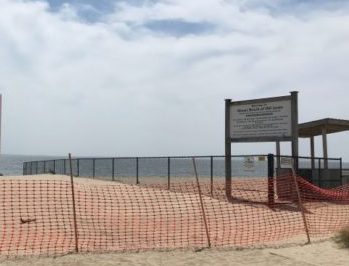
A few weeks ago, in mid-April; and after the Connecticut Supreme Court refused to review the Superior Court’s decision (above), the fence was again removed. In full, Knox ruled that the Association is prohibited, “now and hereinafter,” from maintaining or establishing any other fence or boundary, and from charging fees and issuing permits for the use of the beach.

Leave Nothing Behind but your Footprints:

I believe that the fundamental issue that prompted the MBA’s construction of fences and the 2016 “clean beach” fee was the regrettably bad behavior that some of the “unorganized general public” exhibited while visiting the beach. 

The MBA described a mess that went well beyond the little bit of litter and trash left behind, using the word, “Filthy!”and describing rude and disrespectful behavior; and inappropriate interpersonal behaviors that are better indulged in private.

Sound View Beach apparently witnessed the same, but also noted a significant increase in calls for police service.The MBA reported that they spend about $40,000 to $45,000 per year on beach security, and $13,000 on cleaning the beach, while the town covers only about $20,000.

A Meeting of the Minds:

The leaders of the two beach communities met with Old Lyme’s Board of Selectmen in July, 2021 and presented data describing the problems at the two beaches from an informal “task force”; and suggested some possible solutions, which included making it more expensive for out-of-towners to park at the beach by increasing rates in town-owned parking, and raising permit fees for private parking lots.

First Selectman Timothy Griswold requested that the two leaders put some action steps in writing with quantifying data to be presented at a future meeting. Then-Selectwoman Mary Jo Nosal said the informal “task force” should be an official group that represents the residents of Old Lyme. I am not certain whether either of those requests went any further.

Author’s Thoughts:

Conflicts regarding beach access are not unique to Old Lyme. Public access advocates are worried about a new attack on the right of way to the beaches of the 1.5-mile-long Napatree Point in Watch Hill. Officials of the Watch Hill Fire District, which owns a portion lot of the Point, have recently put the Town on notice that they do not accept the validity of a 2008 town resolution enshrining into law “a right of way for access by the public to pass and re-pass to and from Napatree Point in perpetuity”.

Watch Hill runs the risk of being only known as the home of Taylor Swift, who, I am told, sings songs.

In closing, a few words on sportsmanship. Some of my life has involved ice hockey programs for boys and girls from the newest skaters through high school and college. The games are intense and emotions can run high. At the games end, and regardless of the outcome, both teams will skate the length of the rink in parallel lines, bumping gloves, with a “good game!”

In contrast, “The Day” reported that when the fence came down for the last time, Ms. Tracy extended her hand to the President of MBA’s Board of Governors and said, “Let’s just move on; can we do that?”

He ignored the gesture.

In the NFL, if a player is flagged for unsportsmanlike conduct, the penalty is 15 yards, and an automatic first down, when committed by the defense.

Robert Frost claimed that “good fences make good neighbors”. Well, maybe in New Hampshire, but in Old Lyme?

Well, let’s see …

Sources:

  •  Burian,H. “Old Lyme woman takes legal action to rid Miami Beach of Fence”. NBC-CT. 08/23/2017.
  • Collins,D. “War over public access to Napatree Point heats up in Westerly”. New London Day. 04/19/ 2023
  • Condon, T. “Edward T. “Ned” Coll dies; Hartford activist fought racism, poverty, and closed beaches”. CT Mirror. 12/19/2022
  • Crawford, A. “Racism Kept Connecticut’s beaches white Up through the 1970s”. Smithsonian Magazine. July,2018
  • Drelich, K. “DEEP: portion of Shenecossett Beach Club fence must be removed”. New London Day. 10/26/2019
  • Hewett, C. “Fence to come down at Sound View Beach after court ruling”. The CT Examiner. 04/12/2023.
  • Howard, L. “Miami Beach fence comes down after court ruling”. New London Day. 04/13/2023
  • Kahrl, A. W. “Free the beaches: the story of Ned Coll and the battle for America’s most exclusive shoreline.” Yale University Press. 2018
  • Regan, E. “Old Lyme beach officials recommend higher parking fees to discourage out-of-towners”. New London Day. 07/07/2021
  • Regan, E. “Closing time at issue in Sound View parking lot”. New London Day. 07/20/2021
  • Florin, K. “Debate over beach rights heats up in Old Lyme.” New London Day. 07/03/2017.
  • Florin, K. “Sound View resident takes legal step to fight Miami Beach fence in Old Lyme.” New London Day. August 21, 2017.
  • Florin, K. “Judge: Old Lyme beach fence must come down.” New London Day. 01/14/ 2020.

Editor’s Note: This is the opinion of Thomas D. Gotowka.

About the author: Tom Gotowka is a resident of Old Lyme, whose entire adult career has been in healthcare. He will sit on the Navy side at the Army/Navy football game. He always sit on the crimson side at any Harvard/Yale contest. He enjoys reading historic speeches and considers himself a scholar of the period from FDR through JFK. A child of AM Radio, he probably knows the lyrics of every rock and roll or folk song published since 1960. He hopes these experiences give readers a sense of what he believes “qualify” him to write this column.