
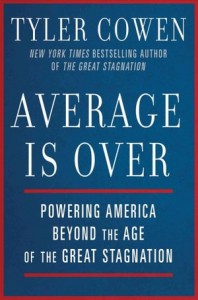
Reading Uncertainly? ‘Average is Over’ by Tyler Cowan

Average_is_Over_by_Tyler_CowanTired of vapid novels featuring uninteresting characters that cannot manage in this complex world of ours? Then try Tyler Cowan’s, Average Is Over, (Dutton, New York 2013), which has the sub-title, Powering America Beyond the Age of the Great Stagnation, to give you a jolt of reality! I read it earlier this year.

Cowan gives us a fresh, both pessimistic and optimistic, view of our future, using frequent analogies to the game of chess in this engaging book. We appear to live in a current situation of diminished job opportunities with low wages for most and extremely high wages for the few.

As Cowan states, “It’s becoming increasingly clear that mechanized intelligence can solve a rapidly expanding repertoire of problems,” but at the cost of growing unemployment. And the larger question is “can mechanized intelligence” help us solve the problem of supporting our population of 7.2 billion, possible increasing to 10 billion by 2050? We already recognize the scarcity of “quality land and natural resources, intellectual property, or good ideas about what should be produced, and quality labor with unique skills.” But are we actually “overloaded with information,” stunting our ability to deal with the future?

Cowan writes a wide-ranging challenge to our futures, pointing out that, “Risk taking in humans . . . tends to bring out sweat and emotion.” It also stimulates both fear and hope, as those involved in risk management can confirm. Four of his chapters warrant serious attention.

Chapter 5, Our Freestyle Future, confirms the radical changes in the availability and quality of information. He notes the “most frequently consulted ‘doctor’ in the U.S. today is Google!” Cowan concludes that “human-computer teams are the best,” that “the person working the smart machine doesn’t have to be an expert in the task at hand,” and that “knowing one’s own limits is more important than it used to be.”

Chapter 6, Why Intuition Isn’t Helping You Get a Job, suggests we should “be skeptical of the elegant and intuitive theory,” and that “we should revel in messiness.” I particularly like that latter admonition, given the clutter in my own office. He also warns “the advances of genius machines (IBM’s Watson, for example – my comment) come in an uneven and staggered fashion.”

Chapter 9, The New Geography, confirms that “outsourcing” has always been a practice. It goes in all directions. And “immigration is vital to the future economic vitality of the United States.” After all, we are all foreigners … save for the few remaining native Americans. But can we, globally, manage increasingly free movement of our species?

Perhaps his most challenging chapter is 10, Relearning Education, in which he challenges almost all the current models. MOOCs (Massive Open On-line Courses) create an entirely “new world of competitive education, based on interaction with machine intelligence.” Cowan predicts the future of education will be underwritten by the following concepts: online education will be extremely cheap; it will be more flexible; there will be major profits from teaching innovations; and, finally, it will allow much more precise measurement of learning.”

Our “human instructors” will be “much more important for motivation, psychology, and teaching pacing” than in the past. They will become “a mix of exemplars and nags and missionaries.” With three of our children and their spouses involved in education, this chapter has special pertinence.

There is nothing, my friends, nothing quite so stimulating as a complete challenge to old convictions!

Felix Kloman

Felix Kloman

About the author: Felix Kloman is a sailor, rower, husband, father, grandfather, retired management consultant and, above all, a curious reader and writer.  He’s explored how we as human beings and organizations respond to ever-present uncertainty in two books, ‘Mumpsimus Revisited’ (2005) and ‘The Fantods of Risk’ (2008).  A 20-year resident of Lyme, he now writes book reviews, mostly of non-fiction that explores our minds, our behavior, our politics and our history.  But he does throw in a novel here and there. For more than 50 years, he’s put together the 17 syllables that comprise haiku, the traditional Japanese poetry, and now serves as the self-appointed “poet laureate” of Ashlawn Farms Coffee, where he may be seen on Friday mornings.
His wife, Ann, is also a writer, but of mystery novels, all of which begin in a bubbling village in midcoast Maine, strangely reminiscent of the town she and her husband visit every summer.

Letter from Paris: Gambling on Impressionism

Nicole Prévost Logan

Nicole Prévost Logan

One could describe the exhibit as intimate.  Only 80 paintings hang in the small rooms of the Musée du Luxembourg, some of them never seen before.  The style is familiar. the colors are soft, the scenes are peaceful — we are in the Impressionists’ world to meet old friends: Monet, Manet, Degas, Sisley, Pissarro, Eugene Boudin, Renoir, Berthe Morisot, Mary Cassatt.

poster for Musee_de_luxembourg_ExhibitThe title of the exhibit is, “Paul Durand-Ruel. The Impressionist Gamble – Manet, Monet, Renoir,”  and it tells the endearing story of the first art dealer in history … and also one of the most influential.


The artwork is stunning: in “Le Pont à Villeneuve -la-Garenne,”  Sisley creates the fluidity of the water by using multicolor brush strokes and in Renoir’s dance scenes, 1883, couples twirl around happily, women’s eyes bright, their ruffled dresses contrasting with the dark suits of their older escorts.   “Liseuse” by Monet  shows a young woman sitting on the grass, enveloped by vegetation, spots of light dots her pink dress and in “Le Foyer de la Dance,” Degas’ dancers warm up, others are stretching, while, in the foreground, a little old lady, slouching in a chair is reading a newspaper.  Nearby another painting is identical, except for the empty chair — the little old lady is gone.

The story behind the artwork is equally fascinating.  Durand-Ruel (1831-1922) became an art dealer by accident.   Attracted to a military career, he entered Saint Cyr (equivalent of West Point) but  renounced for medical reasons.  He was struck by the paintings of Eugene Delacroix exhibited at the 1855  Exposition Universelle (World’s Fair). He became fascinated by the artists who were refused access to the official Salon of the Academy of Fine Arts because of their innovative techniques.

In 1871, Paul met Monet and Pissarro in London where they had taken refuge from the Franco-Prussian war.  After his return to Paris, he visited Manet in his studio, liked his work so much that he bought 23 of his paintings at one go.  The Luxembourg exhibit includes two of Manet ‘s major works:  “Clair de Lune at Boulogne” and “Le Combat du Kearsage et de l’Alabama”.

Left alone after the his wife’s death, he turned his art dealership into a family business with his five children.  He opened galleries in London, Brussels, New York and later, Berlin.

In 1874, a group of young artists – who were given, at that time, the collective term of ‘Impressionists’ – showed their work for the first time together in the studio of   photographer Nadar.

Durand-Ruel fought to help the artists, both morally and financially, and became their friend. He borrowed money to purchase their paintings. He offered his living room on Rue de Rome to a penniless Monet and lent him money to move to Giverny. Years later, when he was rich and famous, Monet wrote, “We would have starved to death without Paul. ”

In 1886, the American Art Association invited him to organize an exhibit in New York.  It was a success and became the first official recognition of the Impressionists.

One cannot help compare the story of such a life to the speculation around art today and to the giant art fairs (like Art Basel) when  intermediaries are commissioned by owners with deep pockets.

The exhibition at the Musée de Luxembourg continues through Feb. 8, 2015.

Nicole Prévost Logan

Nicole Prévost Logan

About the author: Nicole Prévost Logan divides her time between Essex and Paris, spending summers in the former and winters in the latter.  She writes a regular column for us from her Paris home where her topics will include politics, economy, social unrest — mostly in France — but also in other European countries.  She also covers a variety of art exhibits and the performing arts in Europe.  Logan is the author of ‘Forever on the Road: A Franco-American Family’s Thirty Years in the Foreign Service,’ an autobiography of her life as the wife of an overseas diplomat, who lived in 10 foreign countries on three continents.  Her experiences during her foreign service life included being in Lebanon when civil war erupted, excavating a medieval city in Moscow and spending a week under house arrest in Guinea.

Letter from Paris: New European Union Commission Leadership Faces Rocky Road

Nicole Prévost Logan

Nicole Prévost Logan

On Nov. 1, following the mandate of Manual Barroso (2009-2014) from Portugal, the 12th Commission of the European Union (EU) moved into its headquarters at the Berlaymont  in Brussels.

The selection process of the Commission – the key institution of the EU and a formidable machine employing 25,000 persons – has greatly changed since its beginnings in 1951.  The mandate was shortened from nine years to five ;  whereas the president of the Commission used to be designated by the Council of Ministers (equivalent to the present European Council), he (or she) )  is now elected by the Parliament.  A major turn in the composition of the Commission took place in 2004 with the addition of 10 new members from Central and Eastern Europe.  The present rule assigning one commissioner per country creates an odd situation: Malta, with a population of 400,000, has the same representation as Germany with a population of 82 millions.

Jean-Claude Juncker from Luxemburg, a member of the European People’s Party, was elected by the Parliament with 422 votes out of 751 as the new president of the Commission.  Angela Merkel strongly supported him.  Linguistically and culturally he stands half way between France and Germany – a real asset for the most important official of the EU.

Upon his return from the G20 summit meeting in Brisbane, Australia, in mid November, Juncker had to face the “Luxleaks” crisis exposed by the press.  Forty international newspapers, including Le Monde, the Guardian and the Suddentsche Zeitung, investigated the tax breaks granted by Luxemburg to 340 multinationals, like Google, Apple or Amazon.  Yuncker’s critics said that, while he was serving as prime minister and minister of finances, Luxemburg became the leading tax haven of Europe.  To put an end to these practices, the “rulings” – holding companies and other devices used for tax “optimization” – were suspended.  As the new president of the Commission, Yuncker reaffirmed his commitment to fight tax evasion.

The post of commissioner of economy and budget was given to Pierre Moscovici, the former French minister of economy. The choice seems ironic since France almost flunked the rule imposed by the Pact of Stability and Growth requiring a deficit of 3 percent of the GDP (France’s deficit has reached 4.4 percent)

The new High Representative of the European Union for Foreign Affairs is Federica Mogherini , 41,  a diplomat with an impressive record.  Her intention to improve relations with Russia was not appreciated by some of the Eastern European countries.

Tibor Navracsics, a former minister with the ultra conservative Hungarian government was to become commissioner of culture, but his nomination was voted down by the Parliament.

It is a tumultuous time for the new team of the EU.  In the guidelines he presented to the plenary session of the Parliament in July 2014, Jean-Claude Yuncker set his priorities as follows: a plan of public and private investment of 300 billion over three years to stimulate the economy, harmonizing budgetary policies of the member states and coping with the explosive surge of refugees.

Nicole Prévost Logan

Nicole Prévost Logan

About the author: Nicole Prévost Logan divides her time between Essex and Paris, spending summers in the former and winters in the latter.  She writes a regular column for us from her Paris home where her topics will include politics, economy, social unrest — mostly in France — but also in other European countries.  She also covers a variety of art exhibits and the performing arts in Europe.  Logan is the author of ‘Forever on the Road: A Franco-American Family’s Thirty Years in the Foreign Service,’ an autobiography of her life as the wife of an overseas diplomat, who lived in 10 foreign countries on three continents.  Her experiences during her foreign service life included being in Lebanon when civil war erupted, excavating a medieval city in Moscow and spending a week under house arrest in Guinea.

Talking Transportation: Promises Still Not Kept

Someone once said:  “Judge me by my actions, not my words.”  So let’s do just that, comparing recent rhetoric to reality when it comes to Metro-North.

EXPANDED SERVICE:     During the election campaign much was made of a promised expansion of off-peak train service, growing from one train an hour to two.  But when the new timetable came out Nov. 9, riders found that the 14 newly added weekday trains don’t stop at five stations:  Southport, Greens Farms, East Norwalk, Rowayton and Noroton Heights.

Despite pleas from the CT Commuter Rail Council, the Connecticut Department of Transportation chose to skip those stations to save 10 minutes’ running time between New Haven and Grand Central Station.  There was never an expectation that the new trains would be semi-express, just a promise of expanded service.  What happened?

ADEQUATE SEATING:     Though we now have more rail cars than ever before, thanks to delivery of the new M8s, many trains still don’t have seats for every passenger.  The railroad’s own “Passenger Pledge” promises every effort to provide adequate seating, and Metro-North’s statistics claim that 99.6% of all trains have enough cars.   So why the standees?

ON TIME PERFORMANCE:         Yes, safety should always come first.  But October saw only 86.7% of trains arrive “on time” (defined as up to six minutes late).  In the morning rush hour, On Time Performance was only 82%.  And this is despite three timetable changes since the spring, lengthening scheduled running times to reflect new Federal Railroad Administration (FRA) speed restrictions.  They keep moving the ‘target’ and still can’t get a bulls-eye.

SAFETY:       After taking its lickings from the Federal Railroad Administration and the National Transportation Safety Board, Metro-North has proclaimed it’s a new day at the railroad, that a new “culture of safety” is ingrained in its employees.  But in early November, a collision was avoided by seconds after track crews erected bridge plates in front of an oncoming train at Noroton Heights.  And there have been at least three incidents of conductors opening train doors that were off the platform where commuters could have fallen and been injured.

RELIABLE SERVICE:        The new M8 cars are performing well.  But diesel push-pull service on the Danbury and Waterbury branch lines has been unreliable.  September saw several locomotive fires and break-downs, stranding passengers or forcing “bustitutions” (bus substitutions).

COURTEOUS EMPLOYEES:      Most Metro-North staff do a great job under often-times difficult circumstances.  But there are clearly some employees who either hate their jobs, their customers or both.  Hardly a week goes by without The Commuter Action Group hearing complaints about surly conductors snapping at passengers.  Yet it’s hard to complain because these staffers violate railroad rules requiring them always to wear their name badges.

It’s been a year since a sleepy engineer drove a train off the tracks in the Bronx, killing four and injuring 70.  As Metro-North President Joe Giulietti himself acknowledged, the railroad has lost the trust of its customers.  Rebuilding goodwill, like the infrastructure, will take years.

Jim Cameron

Jim Cameron


JIM CAMERON has been a Darien resident for 23 years.  He is the founder of the Commuter Action Group and also serves on the Darien RTM.  The opinions expressed in this column are only his own.  You can reach him at CommuterActionGroup@gmail.com   For a full collection of “Talking Transportation” columns, see www.talkingtransportation.blogspot.com

Letter From Paris: The Dangers of Drones

Nicole Prévost Logan

Nicole Prévost Logan

Something strange happened lately in the skies of France:  drones were spotted over several nuclear plants, including one dangerously close to Paris in Nogent sur Seine.  A few days later more drones flew over nuclear complexes.  A wave of anxiety gripped the public opinion.  Who was manipulating those machines?  Was the country under threat?

Greenpeace was immediately suspected of being the one to operate the unmanned contraptions.  As a pro-environmental watchdog this international association has a history of peaceful action against nuclear power.  In 2012, a paraglider had landed on a nuclear installation to prove that the installation was not well protected.  In July 2013, 29 activists broke into Tricastin nuclear plant, in southern France.  Yannick Rousselet, head of the anti-nuclear Greenpeace campaign, vehemently denied any involvement this time in a television interview.

If Greenpeace had nothing to do with it, the question remained, who did?  A few days later, three individuals suspected of operating the drones, were arrested.  So, for now, the fear is defused.  But it was a wake-up call of a potential danger.

The most advanced drone technologies are found in Israel and the US.  To obtain current and accurate information, I interviewed a French engineer who used to work with a German company manufacturing drones.  He told me that 10 years ago, all of them were built for military use, mostly for reconnaissance and surveillance.  They included the HALE (High Altitude Long Endurance), MALE (Medium Altitude Long Endurance), tactical drones and portable drones for use in ground combat.  The Israeli Watchkeeper with sensors and camera can fire missiles and bombs from sometimes thousands of miles away.  Today drones have become a necessity in wars taking place in huge territories such as Mali.

France is at the cutting-edge of research but lacks funds to develop its ideas.  As an example, Dassault designed the NEURON and produced one model, whereas the American PREDATOR, built in 2010, has already flown one million hours.

European countries are catching up with drone technology.  On Nov. 5 of this year, François Hollande and David Cameron attended the signing of an agreement between Dassault Aviation and BAE Systems (British Aerospace and Marconi Electronics Systems) for a new generation of drones.  Germany and Italy will be part of the project in the future.

miniature-drone

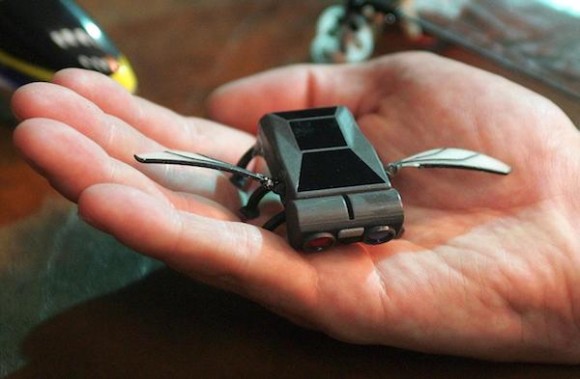
Today civilian drones exist in all sizes and degrees of complexity.  Drones called “Insects” (see photo above) are so small that they can be held in the palm of the hand.  The  Chinese DJI Fantom flies like an helicopter with quadrotors,  carries a remote camera and is very popular with the general public.  Drones have become invaluable at times of natural disasters to test the strength of bridges, in mapping, archaeology and multiple other uses.

But they can be dangerous, for example, causing the crash of commercial airplanes by entering the reactors.  When a drone fell less than six feet from Angela Merkel during her political campaign in Sept. 2013, people realized that a drone was anything but a toy.

Nicole Prévost Logan

Nicole Prévost Logan


About the author:
 Nicole Prévost Logan divides her time between Essex and Paris, spending summers in the former and winters in the latter.  She writes a regular column for us from her Paris home where her topics will include politics, economy, social unrest — mostly in France — but also in other European countries.  She also covers a variety of art exhibits and the performing arts in Europe.  Logan is the author of ‘Forever on the Road: A Franco-American Family’s Thirty Years in the Foreign Service,’ an autobiography of her life as the wife of an overseas diplomat, who lived in 10 foreign countries on three continents.  Her experiences during her foreign service life included being in Lebanon when civil war erupted, excavating a medieval city in Moscow and spending a week under house arrest in Guinea.