
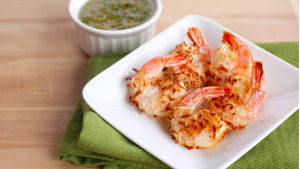
Simple, Real Food: A Favorite New Year’s Eve Feast

Coconut shrimp and pineapple dipping sauce

Coconut shrimp with pineapple dipping sauce

The holidays are upon us and winter is now in full swing. Time for entertaining and planning what to make for New Year’s. I for one, do not love New Year’s Eve (does anyone over a certain age?) but my husband and I often make a gourmet meal and have a really good bottle of champagne (Veuve Clicquot, anyone?) and enjoy a quiet, cozy evening at home.

I have many entertaining menus up my sleeve and focus heavily on appetizers as they are so creative and fun to eat.

Here is a sample of one such menu that is sure to make your guests or maybe just your significant other happy.

This recipe can be cut in half as well as frozen, both the shrimp and the sauce freeze well.  If you  decide to make this ahead and freeze the shrimp, do not defrost, simply drop them into the hot oil.

Coconut Shrimp with Pineapple Dipping Sauce

Serves 12

Ingredients

1 cup flour

3/4 tsp. salt

1 tsp. cayenne

3 to 4 egg whites, lightly beaten

2 1/4 cups unsweetened coconut

1 1/2 pounds large shrimp, peeled, de-veined, butter-flied

2 cups vegetable oil, for frying

Dipping sauce:

1/4 cup canned pineapple, drained

1 scallion, white part only, thinly sliced

2 Tb. apricot preserves

1/4 cup cilantro leaves

1 Tb. lime juice

1/2 jalapeno, chopped

Salt

Procedure

1. Combine the flour, salt and cayenne on a flat baking sheet. Place the egg whites and coconut on two separate baking sheets. Dredge the shrimp in the flour mixture, then the whites, then in the coconut. Press the coconut onto the shrimp. Chill for at least an hour.

2. Heat the oven to 200. In a medium saucepan heat the oil until moderately hot but not smoking. Working in batches, fry the shrimp until golden about 2 minutes. Drain on paper towels. Transfer to a baking sheet and keep warm in the oven.

3. In a processor combine the pineapple, scallions, apricot preserves, cilantro, lime juice, jalapeno and salt to taste. Process until blended and taste, adjust seasoning.

4. Serve the shrimp on a platter with the sauce in a small serving dish.


Burrata on Crostini with Caramelized Shallots and Bacon

Serves 6 to 8

Ingredients

¼ cup olive oil

1 cup thinly sliced shallots

¼ cup balsamic vinegar

1 Tb. brown sugar

1 baguette

12 slices applewood- smoked bacon

1½ pounds burrata, sliced into 12 slices

extra virgin olive oil

parsley, chiffonade

Fresh pepper

Procedure

  1. Heat the olive oil in a large skillet over medium high heat. Add the shallots and sauté for about 5 minutes stirring often. Add the balsamic and brown sugar and simmer the shallots until the bottom of the pan is dry about 6 minutes. Set aside.
  2. Heat the oven to 400. Slice the bread into ¼ inch slices and place on a baking sheet. Drizzle with olive oil and rub with the garlic clove. Toast for about 8 to 10 minutes until golden.
  3. Cook the bacon on a rack on a baking sheet in the oven until down but not crisp about 15 minutes. Drain on paper towels. Cut in half.
  4. Place a slice of burrata on each crostini, then a piece of bacon and then a spoonful of the shallots. Drizzle with the extra virgin oil and then grind some pepper over each one before serving, garnish with parsley chiffonade.


Pan-Roasted Duck Breasts with Port Wine and Balsamic Glaze

Serves 4 to 6

Ingredients

1/2 whole duck breast per person

Salt, pepper

2 shallots, diced

4 garlic cloves, minced

½ cup Tawny port

1 cup chicken stock

¼ cup balsamic vinegar

1 Tb. honey

Procedure

  1. Heat the oven to 450.
  2. Score the fat on the duck and season the meat side with salt and pepper. Heat a medium cast iron or stainless steel skillet over medium high heat. Sear the duck skin side down until golden brown about 5 minutes. Place the duck on a rack fat side up in a roasting pan and roast in the oven for 5 to 8 minutes. Transfer to a cutting board and cover to keep warm. Reserve the fat from the roasting pan.
  3. Heat a medium skillet and add 2 Tb. of the duck fat to the pan. Sauté the shallots and garlic for about 3 minutes. Add the wine to the pan and de-glaze, reduce the port to half and add the stock, reduce to about 2/3 cup. Add the vinegar and honey and cook until thickened. Season with salt and pepper and taste for seasoning. Remove from the heat.
  4. Slice the duck breast and arrange on a plate pour the sauce over and serve.
  • Chicken breasts can be used in place of the duck.


Arugula, Endive Salad with Simple Vinaigrette

Serves 6 to 8

Ingredients

1 bunch arugula, washed and spun dry

1 head endive, julienne

2 cups mixed greens

1 lemon, juiced or vinegar of your choice

1 Tb. Dijon mustard

3 Tb. chopped mint

1/3 to 1/2 cup virgin olive oil

Salt, pepper

Procedure

1. Combine the arugula, endive and greens in a large bowl and toss.

2. Combine the lemon, Dijon and mint in a small bowl and whisk add the oil slowly while whisking, season to taste with salt and pepper.

3. Toss some of the dressing with the greens and reserve any leftover for another salad.

Amanda Cushman

Amanda Cushman

Editor’s Note: Amanda Cushman of Simple Real Food Inc., is a culinary educator who has cooked professionally for over 30 years.  She has taught corporate team building classes for over 15 years for a variety of Fortune 500 companies including Yahoo, Nike and Google.  She began her food career in the eighties and worked with Martha Stewart and Glorious Foods before becoming a recipe developer for Food and Wine magazine as well as Ladies Home Journal.  Having lived all over the United States including Boston, NYC, Miami and Los Angeles, she has recently returned to her home state of Connecticut where she continues to teach in private homes as well as write for local publications. 

Amanda teaches weekly classes at White Gate Farm and Homeworks and is also available for private classes.  Her cookbook; Simple Real Food can be ordered at Amazon as well as through her website www.amandacooks.com 

For more information, click here to visit her website.
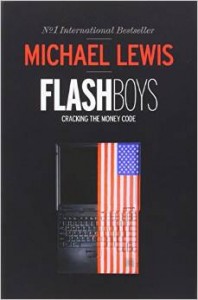
Reading Uncertainly: ‘Flash Boys’ by Michael Lewis

Flash_BoysWhat on earth is “the stock market?” It is something in which I have participated for almost 60 years, first as a most modest buyer of stocks, then through the investments of growing pension and profit-sharing funds, and finally, today, trying to stretch my dwindling IRA to cover our modest expenses as my wife and I enter our eightieth years. Throughout this time I’ve maintained a trust that the “market system” is reasonably fair.


Michael Lewis pops that balloon. In his mesmerizing story of high frequency trading on the world’s stock markets, but especially in the U. S., we learn that customers are “prey,” that “people are getting screwed because they can’t imagine a microsecond” (a millionth of a second), that “moral inertia” is the dominant trait, and that “ the entire history of Wall Street was the story of scandals.”

And yet, what the so-called high-speed traders were (and are) doing is “riskless, larcenous, and legal.”  The story seems to be the result of “human nature and the power of incentives,” plus the incredible complexity of today’s markets, a complexity whose outcomes are totally unpredictable — witness the recent series of “flash sales” in which markets drop precipitously and then recover, all within moments.

And how do the brokers, banks and traders respond, other than in their natural, self-admiring language?  They have learned the “art of torturing data” to try and persuade their customers they are entirely honest!  Lewis’s conclusion … “the stock market at bottom is rigged!”

But where on earth can we safely invest our funds?  My mattress is already stuffed!

Felix Kloman

Felix Kloman


About the author:
 Felix Kloman is a sailor, rower, husband, father, grandfather, retired management consultant and, above all, a curious reader and writer.  He’s explored how we as human beings and organizations respond to ever-present uncertainty in two books, ‘Mumpsimus Revisited’ (2005) and ‘The Fantods of Risk’ (2008).  A 20-year resident of Lyme, he now writes book reviews, mostly of non-fiction that explores our minds, our behavior, our politics and our history.  But he does throw in a novel here and there. For more than 50 years, he’s put together the 17 syllables that comprise haiku, the traditional Japanese poetry, and now serves as the self-appointed “poet laureate” of Ashlawn Farms Coffee, where he may be seen on Friday mornings.  His wife, Ann, is also a writer, but of mystery novels, all of which begin in a bubbling village in midcoast Maine, strangely reminiscent of the town she and her husband visit every summer.

Letter from Paris: Chinese Make Increasing Inroads into France

Nicole Prévost Logan

Nicole Prévost Logan

china-franceChinese president Xi Jiping , wearing oversize headphones, appeared on the cover of the French weekly Nouvel Obs on Dec. 4.  “Are they spying on us?” asked the magazine.


The same week, huge parabolic antennae showed up on the roof of an inconspicuous building four miles from Paris.

Some people found the picture rather amusing and did not take this disclosure too seriously.  But not everybody.  In fact, the way China is making inroads into the French economy is somewhat disturbing for many.

This week, the International Monetary Fund announced that China surpassed the US as the largest economy in the world.  The sheer size of this sub-continent, which represents over one fifth of the world population, is rather frightening for a small country like France.  The economic strategy of China starts with the creation of partnerships with foreign companies, then a growing participation in their capital, and finally their acquisition.  It is by absorbing the ideas, the know-how and the technology of older countries, that China was able to race to the number one slot.  French officials and heads of private companies facilitate China’s grand design.

Economic relationships between the two countries have existed for years, but what is new is its accelerating pace.  In 2007, China had no high-speed trains.  Then it turned to France (Alstom), Germany (Siemens) and Japan ( Shinkansen) to obtain the transfer of their technologies.  Today China has the longest fast train network in the world.

In 1992, Donfeng Motor Corporation and Peugeot-Citroen, the leading carmaker in France entered in a joint venture and started manufacturing cars in China.

In March 2014, China Donfeng became an equal share holder of Peugeot-Citroen, thereby bringing to an end the 200-year-old family dynasty.

France sold the idea of Club Med and the Shanghai-based Fosun company is currently fighting to win a bid for its acquisition.

For the French, it feels like selling the family jewels when they see their prestigious wines of Bordeaux or Burgundy, along with their chateaux, being bought by the Chinese.

But the most unsettling development so far just took place on Dec. 4.  Emmanuel Macron, Minister of the Economy, signed an agreement with a Chinese consortium granting it 49.99 percent of the capital of the Toulouse airport.

It is a disastrous business move by the French government.  Toulouse is the country’s fourth largest airport.  Extensive work has just been completed at a high cost.  The airport has been a money-making undertaking, so why sell it for a dismal 308 million – the price of one Airbus?

The answer is simple: France is under extraordinary pressure from Brussels to lower its deficit.  It needs money.

The new giant facility will handle 20 million passengers a year, multiplying by five the number of Chinese tourists visiting France, with direct flights to several Chinese provinces.  Anybody, who has ever been to the “pink city” (pink is the color of the stone) on the banks of the Garonne with its quaint historical districts, will feel shocked by this decision.

Besides, Toulouse is the European capital of aeronautics as well as an important center of nuclear and spatial research.  A large Chinese presence in the neighborhood understandably makes some people nervous.

Nicole Prévost Logan

Nicole Prévost Logan


About the author:
 Nicole Prévost Logan divides her time between Essex and Paris, spending summers in the former and winters in the latter.  She writes a regular column for us from her Paris home where her topics will include politics, economy, social unrest — mostly in France — but also in other European countries.  She also covers a variety of art exhibits and the performing arts in Europe.  Logan is the author of ‘Forever on the Road: A Franco-American Family’s Thirty Years in the Foreign Service,’ an autobiography of her life as the wife of an overseas diplomat, who lived in 10 foreign countries on three continents.  Her experiences during her foreign service life included being in Lebanon when civil war erupted, excavating a medieval city in Moscow and spending a week under house arrest in Guinea.

Talking Transportation: The Toughest Job in Transportation

Who do you think has the toughest job in transportation?  Airline pilots?  Long-haul truck drivers?  Metro-North conductors?    To my thinking, the toughest job is being an airport TSA agent.

Forget the recent furor over revised Transportation Security Administration rules soon to allow small knives in carry-on luggage.  The plastic knives the flight attendants distribute in snack-packs in-flight are already sharp enough to slit a throat.  By not worrying about every pen-knife and nail clipper, TSA agents should have more time to concentrate on truly lethal weapons.

A far bigger threat to aviation security is liquid explosives and non-metal knives.  Ceramic knives are undetectable on magnetometers, which is why the TSA brought in those full-body scanners we love so much.

But I think a bigger threat to aviation safety is the public’s anger at the TSA agents who are just doing their job.  After a thorough TSA screening at an airport last month I saw an angry passenger literally curse at the agent.  That passenger wasn’t pulled aside and given a retaliatory body cavity search. To her credit the agent kept her cool and didn’t even get into a verbal fight.  Could you be so thick-skinned?

It’s been 13 years since 9/11.  Have we forgotten what can happen when determined, armed terrorists take over a plane?  The TSA screens 1.8 million passengers a day.  If just one of those fliers got an undetected weapon onto a plane and blew it up, imagine the uproar.

Remember the holy triad of service:  fast, good and cheap.  You can achieve any two of those, but not all three.  Clearly, the top priority is “good” security.  So in this era of sequestration, we’re unlikely to see quality compromised for speed or lower cost.

If you want to fly, put up and shut up:  put up with the long lines while the agents do their jobs properly to keep you safe and keep your mouth shut.

What do all these TSA inspections do, aside from create long lines and frustrated fliers?  They turn up an amazing amount of weapons.  The TSA’s weekly blog makes for fascinating reading.

In one recent week alone the TSA intercepted 32 firearms, 27 of them loaded, and 10 stun guns.  There were clips of ammo, brass knuckles and (no surprise) sheer stupidity:  a passenger flying out of San Juan told the ticket agent that her bag contained a bomb and she was going to blow up the plane.  After an inspection by the TSA, her bag didn’t have a bomb.  But as a result of her threat, the ticket counter, checkpoint and terminal were closed for nearly an hour, inconveniencing thousands.  And there were, as the TSA blog put it, “consequences” for the flier.

Holiday travel is stressful enough without compounding things by arguing with those just trying to keep you safe.

Jim Cameron

Jim Cameron


Editor’s Note: Jim Cameron is founder of The Commuter Action Group, and a member of the Darien RTM.  The opinions expressed in this column are only his own.  You can reach him at CommuterActionGroup@gmail.com   For a full collection of “Talking Transportation” columns, see www.talkingtransportation.blogspot.com

Letter from Paris: The UK and Europe: Divided, We Stand Together … for the Moment

Nicole Prévost Logan

Nicole Prévost Logan

France and the rest of Europe look at the United Kingdom with some envy: the UK is currently enjoying a three percent growth in its economy, unemployment as low as six percent, a paired down number of civil servants and the dynamism of the City as a world financial center.  No wonder young entrepreneurs and students are flocking to Britain from the continent.

This week the spotlight was on Prime Minister David Cameron.  On Nov. 28, he gave a resounding speech to an industrial audience in the West Midlands.  The main thrust of his message was to stress the inability of his country to absorb hundreds of thousands of refugees and job seekers.  He announced that, if reelected in May 2015, he will renegotiate the terms of the UK’s membership of the European Union (EU).  In the case of refusal, he would organize a referendum on “Brexit” (the colloquial expression for British exit).

To control immigration, his demands include the expulsion of  immigrants still jobless six months after their arrival in England and a four year waiting period for new immigrants before they can receive benefits, tax  credits or social housing .

David Cameron’s position in regards to the surge of immigration should not be singled out. An increasing flow of migrants is taking place around the world, from Australia  to America.  In Europe, the phenomenon is compounded because of several circumstances: sub- Sahara persons fleeing for political or economic reasons, refugees escaping the Middle East military conflicts and finally, the recent surge of migrants from Eastern to Western Europe (228,000 this year — the highest number ever registered.)

According to the “Schengen Zone Agreement”, Rumania and Bulgaria, which joined the European Union in 2007, had to wait until Jan. 1, 2014, to enjoy full rights to travel and apply for work within the Schengen space.  This explains the spectacular increase in the number of immigrants from those countries to England during the past nine months – increases respectively of 468 percent of Rumanians and 205 percent of Bulgarians.  Government corruption, hard to integrate “Romas” and a lagging economy in both those countries explain why other EU members are reluctant to open the flood gates too soon.  This week David Cameron sent a special message to the Polish Prime Minister, Ewa Kopacz, to reassure that his demands would not apply to job seekers from her country.

On Nov. 25, the Pope, speaking in the EU Parliament in Strasbourg,  admonished the Europeans for being too egoistic and urged them to coordinate their immigration policies.  The Mediterranean, he said, should not become a cemetery.  Stressing human dignity, the Pope puts immigration at the center of his message.  The choice of Lampeduza as his first trip out of Rome was symbolic.

David Cameron is under pressure from the Euro-skeptics  and the conservative UKIP (UK Independence Party).  It is clear he is ready to moderate his demands since he does not want to sever links with the EU.  The desire to negotiate is also strong on the other side of the English Channel.

Nicole Prévost Logan

Nicole Prévost Logan


About the author:
 Nicole Prévost Logan divides her time between Essex and Paris, spending summers in the former and winters in the latter.  She writes a regular column for us from her Paris home where her topics will include politics, economy, social unrest — mostly in France — but also in other European countries.  She also covers a variety of art exhibits and the performing arts in Europe.  Logan is the author of ‘Forever on the Road: A Franco-American Family’s Thirty Years in the Foreign Service,’ an autobiography of her life as the wife of an overseas diplomat, who lived in 10 foreign countries on three continents.  Her experiences during her foreign service life included being in Lebanon when civil war erupted, excavating a medieval city in Moscow and spending a week under house arrest in Guinea.