Letter From Paris: Nous Sommes Tous Charlie

Our French correspondent Nicole Prévost Logan was in Paris last Wednesday when the horrific shootings at the Charlie Hebdo office occurred and for the subsequent days of terror in the environs of Paris. This column reflects her thoughts on the tragedy.  She writes:
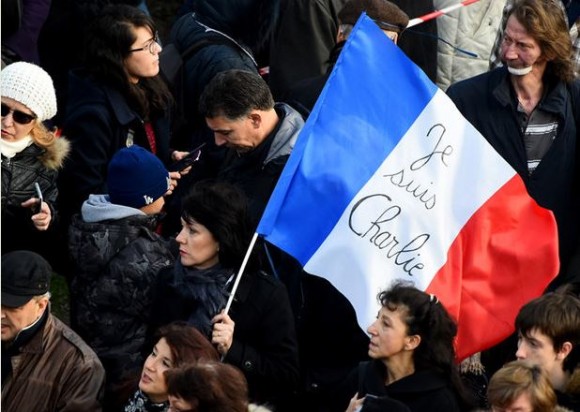
Je_suis_Charlie_v3

They were a talented, irreverent, friendly and humorous bunch of cartoonists and journalists.  They were like family.  We knew them by name.  Charb, Cabu, Wolinski (Stéphane Charbonnier, Jean Cabut,  Georges Wolinski) and the others were also incredibly courageous.  Round the clock they had to be protected by police and body guards.  In 2011, their office was blown up in an explosion.  Charb, leader and editor-in-chief of the Charlie Hebdo weekly satirical newspaper, was on the ‘Wanted’ list of Al-Qaeda as someone to be eliminated.

On Wednesday, January 7, at noon, I was walking by the Bastille, near my apartment, when police cars, ambulances, Red Cross vehicles, fire trucks – their sirens howling – seemed to be converging on the square.  Strange, I thought.  When I met my daughter for lunch, she told me that the entire editorial board of Charlie Hebdo had been shot.  Being “connected” with her smart phone, she was able to follow every minute of the crisis

The crisis lasted for three days with the pursuit of the two Kouachi brothers by tens of thousands of police and special forces.  Two more attacks (related, as it turned out later) occurred in Montrouge and Porte de Vincennes with the taking of hostages by a third terrorist Amedy Coulibaly.  Seventeen people died during the 72 hours, including four Jewish hostages  who had been held in a Kosher supermarket.
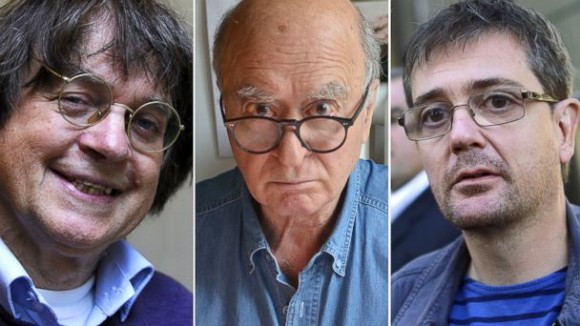
From left to right, Charlie Hebdo victims Cabu, Wolinski and Charb

From left to right, Charlie Hebdo victims Cabu, Wolinski and Charb.

The emotion in France was intense.  The French have always relished Charlie Hebdo’s iconoclastic derision aimed at everyone … women, Jews, Moslems, blacks, no exceptions … and their making fun of politics, religion and other serious topics.

The tragic end of an entire editorial staff of a newspaper at the point of a gun in the name of a principle explains the incredible shock wave of sympathy with spread around the world in a few hours.  A journalist from Los Angeles said in his grief at the talent lost that, in one throw, more cartoonists were killed than the total number existing in the US.  The victims have become the heroes, for having pushed to the extreme the right to say, write or draw anything in a free democratic society.

One may quote Voltaire, “I may not agree with what you say but I will fight to death for your right to say it.” Humor rather than violence or a call to violence, this was their motto.  This weekend France became a libertarian banner and the world seemed grateful to France for doing what no one else dared to do.  This attack and the planet’s reaction that it triggered can be seen as a fight for a secular state threatened by obscurantist developments, both in the regions where ISIL is taking hold and against terrorism anywhere in the world.

The French opinion from all parties, (except the Front National) is that president François Hollande managed the crisis superbly.  He was on the front line at all times.  He scared the police forces beyond belief when he came to the Charlie Hebdo street barely one hour after the attack, even before the area was made secure.  Hollande was at the helm of the operations and gave the green light for the two final assaults  to be perfectly synchronized.  He addressed the nation several times, avoiding grandiloquence and photo-op opportunities.

Instead of being belligerent and declaring “at war” status, what he stressed was the national unity and the need of inclusion of the overwhelmingly moderate Moslem population (about four million or 6.8 percent of the population, by 2012 figures.)  He urged the leaders of that community – imams, clergy, intellectuals and associations – to speak up and to join the march organized on Sunday. Hassan Chalghoumi, imam of the mosque of Drancy, a neighborhood with a majority of immigrants, declared on television, “What they have done is not Islam, we strongly condemn their acts.”  This is important because the problem of “integration” in France (one remembers the hostility caused by the ban on the veil) is a difficult process.

For three days, men in black, super-equipped with helmets, bullet-proof vests, shields and heavy arms, occupied our television screens.  We learned more about the elite groups which carried out the assaults.  In Dammartin-en-Goële,  it was the GIGN  (Groupe d’Intervention de la Gendarmerie Nationale), part of a 400-strong military elite corps based in Versailles.  At the Kosher market of the Porte de Vincennes, RAID (Recherche pour Assistance Intervention Dissuasion) is part of the police.  It was the first time ever that GIGN and RAID collaborated.

A question was immediately raised: how was it possible that Cherif and Saïd Kouachi and Amedy Coulibaly, young French men with murky pasts of convictions, prisons terms, and, most of all, trips to Syria and several months training in Yemen with the most  dangerous groups of Al-Qaeda (AQPA) in the Arabian Peninsula, included on the US “no fly list,” could have been overlooked by the DGSE  (Direction Generale de la Securite Exterieure)?  Pierre Martinet, one of the heads of  the DGSE explained that the data about all these people has been collected, but they do not have the manpower to put several thousands potential terrorists under surveillance.

Gilles Keppel, a Middle East specialist and professor at Sciences Po) revealed that France has been designated as the prime enemy. There are about 1,200 French Jihadists, the largest group in Europe.  The era when terrorists learnt how to fly planes is over — today the social networks have created another situation when Al-Qaeda is less an organization than a system.  Private individuals make decisions, hence the difficulty in controlling them.

In an interview Monday morning, Laurent Fabius, Minister of Foreign Affairs, summarized the priorities:  control the calls for violence on the internet; in prison, separate radical islamists to prevent their radicalization of other prisoners; and intensify the coordination of intelligence agencies within Europe and around the world.  The Socialists are reluctant to introduce legislation comparable to the Patriot Act in the US at the expense of the rule of law.
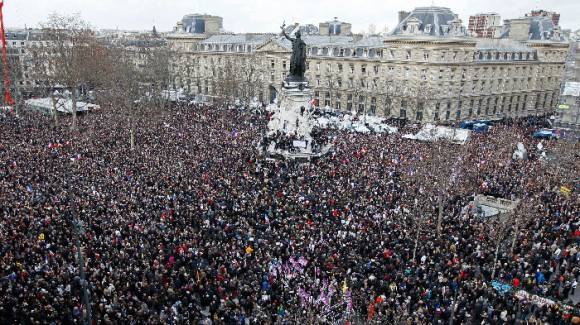
Millions gathered Sunday to pay tribute to the victims of the previous week and stand together in defense of the right to free speech.

Millions gathered Sunday to pay tribute to the victims of the previous week and stand in solidarity in defence of the right to free speech.

Sunday, January 11, saw the march of the century.  Forty heads of state participated in the demonstration.  François Hollande led the march, accompanied by Angela Merkel and 40 other heads of state.  Some commentators wondered whether Benjamin Netanyahu’s presence was politically motivated or also to defend the principle of freedom of expression.

Four million people were on the streets, almost half of them in Paris.  The crowd, including many children, was calm and disciplined, sang La Marseillaise, and applauded the police – probably for the first time in French history.

3_pencils_97.5KB

Nicole Prévost Logan

Nicole Prévost Logan

About the author: Nicole Prévost Logan divides her time between Essex and Paris, spending summers in the former and winters in the latter. She writes a regular column for us from her Paris home where her topics will include politics, economy, social unrest — mostly in France — but also in other European countries. She also covers a variety of art exhibits and the performing arts in Europe. Logan is the author of ‘Forever on the Road: A Franco-American Family’s Thirty Years in the Foreign Service,’ an autobiography of her life as the wife of an overseas diplomat, who lived in 10 foreign countries on three continents. Her experiences during her foreign service life included being in Lebanon when civil war erupted, excavating a medieval city in Moscow and spending a week under house arrest in Guinea.
Talking Transportation: “Getting to the Airport”

The old Cunard line used to say that “getting there is half the fun.”  But anyone who’s endured the challenges and indignities of air travel know that getting to the airport can sap your strength, if not your wallet.  Consider the alternatives.

A car service is certainly convenient.  But at $110 one way to LaGuardia,  $140 to JFK and $150+ to Newark, getting to the airport can often cost more than your air fare. (Mind you, these are the advertised rates, so I wouldn’t be shy about asking for promotions and discounts when you call to book.  It’s a competitive business.)

But car services aren’t just expensive, they’re also wasteful.  Couldn’t solo travelers share a car with others in a “limo-pool”?  Is one passenger in a Lincoln Town Car an efficient use of limited space on I-95?

How about Connecticut Limousine? Now there’s a misnomer!  Since when is a cramped van a limo?  And try explaining that name on the receipt on your expenses to your company’s accountant.  “Really, boss … it was just a van!”

Being thrifty, on a few occasions I’ve actually rented a car at the airport, driven home and then dropped the car the next day in Stamford.  A day’s car rental is about half the cost of a car service.

Some regular fliers hire neighborhood teens to drive their own car to the airport, drop them off and drive the car home, repeating the process on their return.  That’s less expensive than a car service, but puts double the miles on your car.

My preferred airport transfer is in my own car. Airport parking is $39 a day. Not cheap, but certainly convenient. And nobody complains about my cigar smoking en route to the airport.

Another alternative, believe it or not, is Metro-North. Get off at 125th Street and catch a cab or livery and you’re at LaGuardia in about 15 minutes.  There’s also a new Express Bus, the M60, that whisks you from 125th St to LGA in about 20 minutes.

If you’re heading to Newark, definitely consider Amtrak.  Many Northeast corridor trains stop at Newark Airport where a convenient connection to the airport monorail has you at the terminals in just minutes.  The train sure beats the Cross-Bronx and GWB any day. And fares are as low as $28 one way.

Mind you, New York’s three airports aren’t the only choices. Westchester County’s White Plains airport offers non-stop jet service to many cities on a variety of major carriers including JetBlue.  Hartford’s Bradley Airport offers another alternative, including low-fare carriers like Southwest … if you don’t mind an hour plus drive to get to the airport, north of Hartford.  One faithful reader extols the virtues of New Haven’s Tweed Airport where US Air flies to Philly where you can connect to most anywhere.

Clearly, the trip to and from the airport can start and end a trip on a very sour, and expensive, note.

Jim Cameron

Jim Cameron

Jim Cameron is founder of The Commuter Action Group, and a member of the Darien RTM.  The opinions expressed in this column are only his own.  You can reach him at CommuterActionGroup@gmail.com   For a full collection of “Talking Transportation” columns, see www.talkingtransportation.blogspot.com

Talking Transportation: The Myth of the Third Rail

Metro-North’s mangled and much-maligned service in Connecticut is made all the more challenging by a technological quirk of fate.  Ours is the only commuter railroad in the US that operates on three modes of power … AC, DC and diesel.

On a typical run from, say, New Haven to Grand Central, the first part of the journey is done “under the wire”, the trains being powered by 13,000 volt AC overhead wires, or catenaries.  Around Pelham, in Westchester County, the conversion is made to 660 volt DC third rail power for the rest of the trip into New York.  Even diesel trains must convert to third-rail as their smoky exhaust is banned in the Park Avenue tunnels.

And there’s the rub: Connecticut trains need both AC and DC, overhead and third-rail, power pick-ups and processors.  That means a lot more electronics, and added cost, for each car.  While the DC-only new M7 cars running in Westchester cost about $2 million each, our new dual-mode M8 car designed for Connecticut cost $2.5 million each.

So, some folks are asking, “Why not just use one power source?  Just replace the overhead wires with third-rail and we can buy cheaper cars.”  Simple, yes.  Smart, no.  And here’s why.

There’s not enough space to lay a third-rail along each of the four sets of tracks in the existing right of way.  All four existing tracks would have to be ripped out and the space between them widened.  Every bridge and tunnel would have to be widened, platforms moved and land acquired.  Cost?  Probably hundreds of millions of dollars, years of construction and service disruptions.

Even with third-rail, the Connecticut Department of Transportation (CDOT) would still be required to provide overhead power lines for Amtrak.  That would mean maintaining two power systems at double the cost.  We’re currently spending billions just to upgrade the 80-year old catenary, so why then replace it with  third rail?

Third-rail AC power requires substations every few miles, meaning further construction and real estate.  The environmental lawsuits alone would kill this idea.

DC-driven third rail is less efficient.  Trains accelerate much faster using overhead AC voltage, the power source used by the fastest trains in the world … the TGV, Shinkansen, etc.  On third-rail, speeds are limited to 75 miles an hour as opposed to 90 mph under the wire.  That means, mile for mile, commute time is longer using third rail.

Third rail ices-up in bad weather and can get buried in snow causing short circuits.  Overhead wires have problems sometimes, but they are never buried in a blizzard.

Third-rail is dangerous to pedestrians and track workers.

The idea of conversion to third-rail was studied in the 1980s by consultants to the CDOT.  They concluded that, while cumbersome and costly, the current dual-power system is, in the long run, cheaper and more efficient than installing third-rail.  This time, the engineers at the CDOT got it right.

Jim Cameron

Jim Cameron


Editor’s Note: Jim Cameron is founder of The Commuter Action Group, and a member of the Darien RTM.  The opinions expressed in this column are only his own.  You can reach him at CommuterActionGroup@gmail.com  For a full collection of “Talking Transportation” columns, see www.talkingtransportation.blogspot.com

Reading Uncertainly: ‘Fire and Ashes’ by Michael Ignatieff

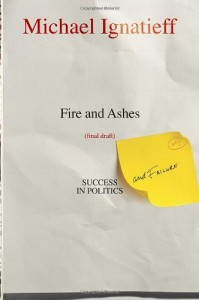
Fire and Ashes by Michael Ignatieff

I admit to a lifelong fascination with the people and territory of that land just north of the United States.  I first drove through Alberta and the Yukon in 1952, on my way to Alaska, and then sailed up the St. Lawrence River on a Navy cruiser to Quebec City in 1954. Since then I’ve spent considerable time in Vancouver, Calgary, Toronto, Ottawa, Montreal and Quebec, with side excursions to Victoria, Banff, Edmonton, Trenton, and Beaconsfield. So it was only natural to buy an early copy of Michael Ignatieff’s description of his six-year foray into Canadian politics.

Who can ignore this description of Canada: “ten provinces and three territories strung out like birds on the wire of the forty-ninth parallel?” And its political uniqueness: “ . . . the fact that we didn’t have capital punishment or a right to bear arms; that we believed in group rights to protect the French language and aboriginal title to land; the fact that we believed a woman’s right to choose should prevail; the fact that a bilingual national experiment, always under stress, forced us constantly, as a condition of survival, to try and understand each other and reach common ground.”

Ignatieff first ran for Parliament in 2005, resigning a professorial chair at Harvard and returning to the land of his birth after many years abroad. He later became the leader of Canada’s Liberal Party, one with which his family had early close connections, only to lose a national election in 2011. The book is his analysis of those years and the nature of politics in a democracy. He concludes with a “renewed respect for politicians as a breed and with reinvigorated faith in the good sense of citizens,” and “ . . . what is right about the democratic ideal: the faith, constantly tested, that ordinary men and women can rightly choose those who govern in their name, and that those they choose can govern with justice and compassion.”

But how can mere mortals stand for leadership positions? “Politics tests your capacity for self-knowledge more than any profession I know,” Ignatieff says, going on to offer “self-dramatization is the essence of politics,” playing on a perpetual stage. He also urges development of listening skills: “listening, being deeply able to deeply listen to your fellow citizens, is the most under-rated skill in politics.” And “standing” is equally important: “When you first enter politics, your first job is to secure your standing, the authority to make your case and ensure a hearing.” That is especially true for newcomers, who will certainly be attacked for their “lack of experience.”

He also argues for civility in political life, something all too lacking recently. But is it possible to treat someone, civilly, as an “adversary” when that person treats you as an “enemy?”

The “virtues” of successful politics include “adaptability, cunning, rapid-fire recognition of Fortuna, the keen intuition that a situation has changed and that what was true is no longer so, together with the noble capacity to lead, to charm, to inspire.” Politics is then “the baffling combination of will and chance that determines the shape of life.”

I now know something more about my Canadian friends and their country. Oh, Canada!

Editor’s Note: Michael Ignatieff’s ‘Fire and Ashes’ is published by Harvard University Press, Cambridge 2013

Felix Kloman

Felix Kloman

About the author: Felix Kloman is a sailor, rower, husband, father, grandfather, retired management consultant and, above all, a curious reader and writer.  He’s explored how we as human beings and organizations respond to ever-present uncertainty in two books, ‘Mumpsimus Revisited’ (2005) and ‘The Fantods of Risk’ (2008).  A 20-year resident of Lyme, he now writes book reviews, mostly of non-fiction that explores our minds, our behavior, our politics and our history.  But he does throw in a novel here and there. For more than 50 years, he’s put together the 17 syllables that comprise haiku, the traditional Japanese poetry, and now serves as the self-appointed “poet laureate” of Ashlawn Farms Coffee, where he may be seen on Friday mornings.  His wife, Ann, is also a writer, but of mystery novels, all of which begin in a bubbling village in midcoast Maine, strangely reminiscent of the town she and her husband visit every summer.

Letter from Paris: The Magic of Merkel

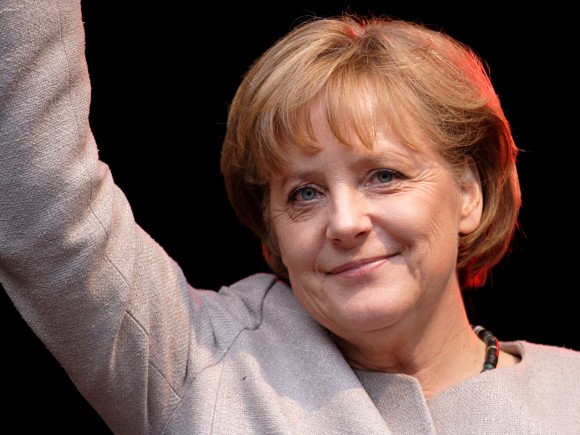
Angela Merkel

Angela Merkel

She has been the German chancellor for 13 years, longer than any of her predecessors since the creation of the country in 1949.  Forbes magazine puts her #1 on the world’s list of powerful women.

The key to understanding Angela Merkel and the successful way she runs her government lies in her upbringing.  She was born in 1954 in Hamburg.  When she was three, her father – a Lutheran pastor – moved the family east of Berlin in order for him to head a home for mentally disabled children.  Growing up in one of the most repressive countries in the world, she always feared being spied on by the East German State Security Service – commonly known as the ‘Stasi’ – and was careful not to put the life of her family in danger.  No wonder the wire-tapping of her cell phone last July hit a raw nerve.

Between a distant father and the dreary atmosphere of East Germany, she found security and stimulation in hard scientific work.  She obtained a doctorate in physics and wrote her thesis on quantum chemistry.  She also became an excellent Russian speaker — a skill she has used in her relations with Putin.  Her Polish ancestry – her mother came from Gdansk (formerly Danzig) – will undoubtedly make her close to the new president of the European council, Donald Tusk.

She is a shrewd politician, pragmatic enough to adjust to changes.  She likes consensus and has accepted a coalition between her Christlich Demokratische Union (CDU – Christian Democratic Party) with the Sozialdemokratische Partei Deutschlands (SPD – Social Democratic Party).  She treats politics like a science , taking a long time before reaching a decision, thus giving a comforting stability to her performance.  She wants power, but hates being in the spotlight.  This is why she preferred the “Merkozy” (Merkel-Sarkozy) days to being alone in dealing with the European Union.

Merkel has a difficult task to accomplish.  Her obsession with the rule of balanced budgets is creating austerity, which many members of the Euro zone now reject.  Her policy is increasingly being criticized by economists.  Emmanuel Macron, the new French Economic Minister, and Wolfang Schäuble his German counterpart, strongly disagree with her positions and think that growth is more important than austerity.  Marcel Fratzscher, professor of macro economics and finances at the university of Humboldt, also thinks that the priority is to invest in the crumbling German infrastructure.

Germany is perceived abroad, and particularly by the US, as carrying Europe financially.  However, this assessment should be corrected by keeping  in mind that the European Central Bank capital is made up of the contributions from the national banks.  The Deutsche Bundesbank contributes 19.99 percent, Banque de France 14.1 percent, Banca d’Italia 12.3 percent and so on. The burden of the debt is shared by all the countries of the Euro zone.

On Dec. 10, 2014, Angela Merkel was reelected by an astounding 99 percent of the votes as head of the CDU, which she has led since 2000.   After a 10-minute-long standing ovation, the party members proceeded to enjoy three more days of the Cologne Congress.  Today, an overwhelming  64 percent of  Germans would like her to run for a fourth mandate as chancellor in 2017.

Nicole Prevost Logan

Nicole Prevost Logan

About the author: Nicole Prévost Logan divides her time between Essex and Paris, spending summers in the former and winters in the latter.  She writes a regular column for us from her Paris home where her topics will include politics, economy, social unrest — mostly in France — but also in other European countries.  She also covers a variety of art exhibits and the performing arts in Europe.  Logan is the author of ‘Forever on the Road: A Franco-American Family’s Thirty Years in the Foreign Service,’ an autobiography of her life as the wife of an overseas diplomat, who lived in 10 foreign countries on three continents.  Her experiences during her foreign service life included being in Lebanon when civil war erupted, excavating a medieval city in Moscow and spending a week under house arrest in Guinea.