Talking Transportation: Is Metro-North Irreplaceable?

What is Connecticut’s relationship with Metro-North?  Client – vendor?  Shared partnership?  Stockholm syndrome?  Or is the railroad a “fanged sloth” hanging around our neck?

All of those analogies has been made to the state’s 30+ year relationship with Metro-North, part of New York’s Metropolitan Transportation Authority (MTA).  But given their dismal safety record and deteriorating service in recent years, many have asked, “Is it time to fire Metro-North and find someone else to run our trains?”

I posed that very question almost four years ago and people were shocked, not knowing that such a thing was even possible.  Now there are even laws being considered in Hartford to rid us of the railroad.

But even though Metro-North works for us, CDOT’s Commissioner Jim Redeker says they should not … in fact, cannot … be replaced.

Redeker recently testified that Metro-North is uniquely qualified and staffed to run a commuter rail operation of its size and that there are no other potential competitors he’d consider as operator, let alone try to build our own agency from scratch.  On this point he’s probably right.

Where he’s wrong is in arguing that replacing Metro-North would mean we wouldn’t be allowed to run “Our trains” into “Their station,” Grand Central Terminal (GCT).

There are plenty of railroads with operating rights on others’ tracks.  New Jersey Transit has no trouble getting into Penn Station.  Virginia Railway Express runs into downtown DC.  Does Commissioner Redeker really think that our Congressional delegation couldn’t force the MTA to give us access to GCT?  It wouldn’t be an easy fight, but this is certainly no deal-breaker to replacing Metro-North.

Alternative #3 is to renegotiate our contract with the railroad.  This opportunity only presents itself every five years, and 2015 is one of those windows.  Maybe we should get them to commit to service standards, as their current contract has no metrics to measure their performance.  But again, Commissioner Redeker seems reticent to fight for our state or its commuters.

He reminded lawmakers that the last time Connecticut arbitrated the contract, we were out-smarted and ending up with a worse deal than we’d had before.  The MTA’s army of lawyers took us to the cleaners, costing us millions more in payments to Metro-North each year.  Apparently the Commissioner thinks we’re not smart enough to negotiate a better deal, so why even try?

So, just to recap … our Commissioner of Transportation says we have no real options, that we have to work with Metro-North, but we’re probably not savvy enough to get any better deal than we have now.  So let’s just wave the white flag before the battle begins and keep paying $70+ million a year for lousy train service.

Now there is inspired leadership!  Declare defeat and just walk away.  Let the “fanged sloth” continue to hang around our necks.  We really have no choice.  Suck it up because Metro-North, our vendor, is running the show.

Jim Cameron

Jim Cameron

About the author:
Jim Cameron is founder of The Commuter Action Group, and a member of the Darien RTM.  The opinions expressed in this column are only his own.  You can reach him at CommuterActionGroup@gmail.com   
For a full collection of “Talking Transportation” columns, see www.talkingtransportation.blogspot.com


Letter from Paris: Patrick Modiano receives 2014 Nobel Prize for Literature

Nobel_prize_for_Literature_2014

…”all those wasted years during which one did not pay enough attention to trees, to flowers”…) says the main character  in Modiano’s latest novel ‘Pour que tu ne te perdes pas dans le quartier’ (which translates roughly as, “To avoid getting yourself lost in the neighborhood”)

France had the distinctive honor of receiving two Nobel prizes in 2014:   Jean Tirole was the recipient of the Prize for Economics for his work on the financial crisis and the banking system while Patrick Modiano received the Prize for Literature.  He will join an illustrious pantheon of writers from Gunter Grass (Germany) ), Toni Morrison and Nadine Gordimer (South Africa), Wole Soyinka (Nigeria), Gabriel Garcia Marques (Columbia) and Alexander Solzhenitsyn (Soviet Union)  to Albert Camus (France) or Ernest Hemingway (USA).  Modiano is the 16th laureate from France, giving that country the largest number since beginning of the Nobel awards in 1900.

The press release issued by the Swedish Academy of Sciences selected the French writer, “For the art of memory with which he has evoked the most ungraspable human destinies and uncovered the life-world of the Occupation.” The prize was a recognition of his abundant literary production (30 novels)  centered on the protagonists’ search of their own past, in the urban setting of Paris, going back to World War II.

He writes like a sleep walker, plodding through a mysterious, sometimes disjointed sequence of events looking for his lost childhood when he was tossed around from one home to another.  Since his first novel, ‘La Place de l’Etoile,’ published in 1968, he has created a world where autobiographic notes are interwoven with the “bad dream” of the Occupation.

Modiano is a tall (6′ 6” ) man of 69 with a kind face and fluttering hands as he speaks.  During a 45-minute acceptance speech in Stockholm, his modest personality must have made him endearing to the distinguished audience, particularly when he dedicated his award to his Swedish grandson.

A writer, he said, is usually a poor speaker, who leaves his sentences unfinished, because he is used to editing his text over and over again.

He explained that he belonged to a generation when children were not allowed to speak up and, if they were given a chance to speak, they expected to be interrupted at any time.

During an interview he gave in his study, surrounded by thousands of books, he asked, “Why would I write another book when so many have been already written?”  Then he added,  “It is probably at the sight of his own bookcases that a discouraged Scott Fitzgerald took up drinking.”

He claims, with incredible modesty, that “It is with bad poets that one obtains prose writers.”

According to Alice Kaplan, head of the French department at Yale University, Modiano can be labelled as the Marcel Proust of modern times.

Claire Duvarrieux, head of the ‘Books’ department of the daily newspaper, Liberation, describes the works of Modiano as a collective memory of France during the war, the German Occupation, collaboration, the persecution of the Jews and finally, the war in Algeria.

With Louis Malle, he co-wrote the scenario of Lacombe Lucien in 1974, one of the best French “New Wave” films.

Nicole Prévost Logan

Nicole Prévost Logan

About the author: Nicole Prévost Logan divides her time between Essex and Paris, spending summers in the former and winters in the latter. She writes a regular column for us from her Paris home where her topics will include politics, economy, social unrest — mostly in France — but also in other European countries. She also covers a variety of art exhibits and the performing arts in Europe. Logan is the author of ‘Forever on the Road: A Franco-American Family’s Thirty Years in the Foreign Service,’ an autobiography of her life as the wife of an overseas diplomat, who lived in 10 foreign countries on three continents. Her experiences during her foreign service life included being in Lebanon when civil war erupted, excavating a medieval city in Moscow and spending a week under house arrest in Guinea.

Letter From Paris: Marcel Duchamp at the Pompidou Center

Marcel Duchamp i(1887-1965) is well known in America. Most people have heard of his readymades like the famous (or infamous) Fontaine, which is, in fact, a public urinal. Stiglitz immortilized the original in a 1917 photograph before it disappeared for ever. The bicycle wheel set on a kitchen stool is a familiar sight for MOMA vistors.

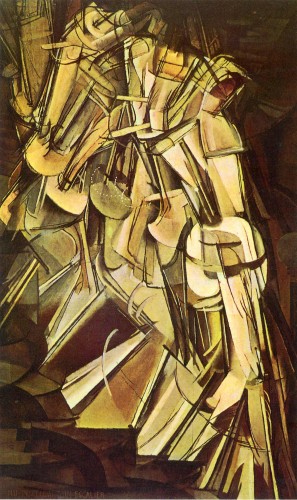
Nude descending a staircase No. 2

Nude going down a staircase No. 2

Since his first trip to the US in 1915, the artist made multiple visits to that country, avoiding the two World Wars. He acquired American nationality in 1955. It was at the 1913 Armory Show that his cubist painting ‘Nu Descendant un escalier No. 2′ (Nude going down a staircase No. 2) became a huge success.

Some critics have labelled Marcel Duchamp as the creator of modern art while others say he destroyed it when he advocated “non-retinal” painting. Volumes have been written about him. In an amazingly short time – since he abandoned art for chess at age 36 – he was able not only to produce art, but also to integrate into it the latest discoveries of science and modern technology.

The Marcel Duchamp exhibit at the Pompidou Center just closed its doors after several successful months. It was a monographic approach consisting of about 100 paintings and drawings little known in France (most of them are part of the Louise and Walter Arensberg collection at the Philadelphia Museum of Art) covering the 1912 to 1923 period and leading to his main creation, ‘Le Grand Verre.’

Born in Normandy, Duchamp belonged to a talented family of six children. The mother was a distant figure, which may explain his alienation from women. ‘Sonate,’ 1911, represents the three sisters playing musical instruments. The mother stands stern and erect . Strangely enough she seems to be enjoying the concert, although she is deaf.

He had a deadpan sort of humor and provocation was his tool. He enjoyed playing tricks on the Regardeurs (viewers), giving wrong titles to his works. He relished plays on words, for example, he called himself Rose Selavy (Eros – that’s life) in the photograph Man Ray took of him. To put a moustache and a goatie on Mona Lisa was a virtual iconoclastic gesture and he made it even more outrageous by giving it the title of LHOOQ (if the letters are pronounced in French the meaning is shockingly vulgar) .

Duchamp joined his two brothers Jacques Villon and Raymond-Duchamp in the Puteaux group of Cubists. ‘Dulcinea’ and the ‘Joueurs d’échecs’ are among his superb cubist paintings. Borrowing the technique of chronophotography and cinema, he introduced time and movement in ‘Jeune Homme Triste dans Un Train 1911-12,’ where the real accomplishment was to show a person in a train in motion while also suggesting his sad mood.

La Mariée mise a nu par ses célibataires,’ meme (also called Le Grand Verre) was his major work. It consists of two free-standing glass panels. In the lower register, nine Moules Maliques* (an officer, a gendarme, a priest, etc) stand beside a chocolate-crushing machine, which rotates non-stop. By means of sexually-related devices, gas travels up toward the mariée, who is hanging limply at the top, having gone from the virgin to the bride stage. The work alludes to the universal themes of erotic love and the inaccessible woman.

* I am not even attempting to translate these nonsensical words!

Nicole Prévost Logan

Nicole Prévost Logan


About the author: Nicole Prévost Logan divides her time between Essex and Paris, spending summers in the former and winters in the latter. She writes a regular column for us from her Paris home where her topics will include politics, economy, social unrest — mostly in France — but also in other European countries. She also covers a variety of art exhibits and the performing arts in Europe. Logan is the author of ‘Forever on the Road: A Franco-American Family’s Thirty Years in the Foreign Service,’ an autobiography of her life as the wife of an overseas diplomat, who lived in 10 foreign countries on three continents. Her experiences during her foreign service life included being in Lebanon when civil war erupted, excavating a medieval city in Moscow and spending a week under house arrest in Guinea.

Letter from Paris: Ten Days Later

US Foreign Secretary John Kerry pays his respects at the memorial to the Charlie Hebdo victims.

US Secretary of State John Kerry pays his respects at the makeshift memorial in Paris to the Charlie Hebdo victims.

Ten days after the assassination at the Charlie Hebdo office including the magazine’s editor and leading cartoonists, France is on high alert. Threats against persons and acts of vandalism are multiplying. The Jewish community is scared, the Muslims feel stigmatized, the Catholics are worried. It would be exaggerated however to describe – the way a Fox News journalist claimed – that certain areas of Paris, such as the 11th arrondissement, are dangerous and should be avoided. Incidentally, the journalist quickly withdrew his remark.

Prime minister Manuel Valls and minister of the Interior Bernard Caseneuve have launched maximum security measures: the Vigipirate alert system (at first created by president Giscard d’Estaing in 1978) now includes 10,000 troops from the Foreign Legion, the army and the police. They are positioned throughout France to protect monuments, schools and places of worship, as well as strategic points like airports or railroad stations. On Thursday, Francois Hollande was on the air force carrier Charles de Gaulle in Toulon to review the 2,000 troops before their departure for manoeuvers in the Indian Ocean. France has currently nine Rafales in Jordan and two Mirages in Saudi Arabia.

The criminal investigation has been fast and efficient. In lightning speed, they uncovered more ramifications of the jihadists’ organization, extended to their families, friends and acquaintances, with the “Buttes-Chaumont connection” at the center. The Belhoucine brothers are on the list of suspects. A large number of individuals have been taken for questioning and nine are currently in police custody . In the Paris region, five caches of weapons have been located and searched.

Reinforcement of the legal system to control the jihadists’ travels and activities is being studied by the government. Measures such as the creation of special files on terrorists similar to the ones kept on sexual offenders and withdrawing the French nationality of returning jihadists are being considered. Voting on a new law should take place as early as the beginning of February. Control of internet has become a priority. The social networks constitute a counter culture expressed in simple manichean terms to be accessible to the largest possible numbers. Calls for violence and hatred never stop.

The recent events have marked the French. On Wednesday, January 14, after a powerful speech by the prime minister at the National Assembly, all the deputies stood up to observe a minute of silence. Then one voice started singing the Marseillaise and soon everybody followed in unison. The last time this happened was on November 11, 1918! At the Institut du Monde Arabe and during all the official ceremonies, the president and the prime minister reiterated their basic point: the French government is not against Islam nor the Muslim population. Around the world, French diplomatic representations and economic interests are under attack. The TV news shows the fury of violent mobs shouting their hatred in the streets of Niger — quite a contrast from the calm of the people in the streets of Paris on January 11.

Laicite (secularism) is a specificity of France, and the outcome of a tumultuous history, starting with the 16th century wars of religions, opposing monarch and church. It took a whole century for the Catholic Church to accept the separation of church and state in 1904. That principle was enshrined in the first article of the 1958 constitution at the outset of the fifth Republic. It is alien to most of the other countries and should be “formatted” (to use a computer science term) in order to be understood beyond our borders.

US Secretary of State John Kerry paid a visit to Paris, saw the places where the violent attacks took place on January 7 and used warm words (in French) to express his support of France.

Nicole Prévost Logan

Nicole Prévost Logan

About the author: Nicole Prévost Logan divides her time between Essex and Paris, spending summers in the former and winters in the latter. She writes a regular column for us from her Paris home where her topics will include politics, economy, social unrest — mostly in France — but also in other European countries. She also covers a variety of art exhibits and the performing arts in Europe. Logan is the author of ‘Forever on the Road: A Franco-American Family’s Thirty Years in the Foreign Service,’ an autobiography of her life as the wife of an overseas diplomat, who lived in 10 foreign countries on three continents. Her experiences during her foreign service life included being in Lebanon when civil war erupted, excavating a medieval city in Moscow and spending a week under house arrest in Guinea.

Reading Uncertainly? “The Sixth Extinction: An Unnatural History” by Elizabeth Kolbert

The_Sixth_Extinction

Rats! Is there a real possibility that rats may be the species that survives the human race? Elizabeth Kolbert suggests such an outcome in her engrossing perambulation around this modest earth on which we live, since we may well be living at the start of the “Sixth Extinction.”

Science tells us the earth has experienced five earlier “extinctions,” when many living creatures, small and large, disappeared because of a major change in the earth’s constitution or because of an errant asteroid. But these five occurred approximately 450, 375, 250, 200 and 60 million years ago, in a universe that is 13.5 billion years old.

So we are minute upstarts on this planet. But, as a thinking and intensely curious species, we’ve tried to understand that long past, plus our present and a most uncertain future.

Kolbert’s question: are we creating our own Sixth Extinction?

Like Pogo, she suggests “the cataclysm is us!” “Since the start of the industrial revolution,” she writes, “humans have burned through enough fossil fuels—coal, oil, and natural gas—to add some 365 billion metric tons of carbon to the atmosphere. Deforestation has contributed another 180 billion tons. Each year we throw up another nine billion tons or so . . . . The concentration of carbon dioxide in the air today . . . is higher than at any other point in the last eight hundred thousand years. . . . It is expected that such an increase will produce an eventual average global temperature rise of between three and a half and seven degrees Fahrenheit . . . (triggering) the disappearance of most remaining glaciers, the inundation of low-lying islands and coastal cities, and the melting of the Arctic ice cap.”

Then add to that “ocean acidification.”

We know that all species on this planet are interdependent, but are humans also an “invasive species?” Yes, we seem to be collective problem solvers (much like ants, according to E. O. Wilson) but we seem to be unable to solve our biggest problem: us! “Though it might be nice to imagine there was once a time when men lived in harmony with nature, it is not clear he ever did!”

Is it possible, then, as Kolbert suggests, “ . . . a hushed hundred million years from now, all that we consider to be the great works of man – the sculptures and the libraries, the monuments and the museums, the cities and the factories – will all be compressed into a layer of sediment not much thicker than a cigarette paper?”

Kolbert visits locations all around this earth – some 11 countries – very much like Alan Weisman’s research for his Countdown, exploring current rates of extinction. One is on an island in the Great Barrier Reef of Australia, looking at the erosion of coral. Another is the decline of bats in the eastern United States. Still another is the Panamanian golden frog. Together, she says, they indicate we are a part of the Anthropocene epoch, during which we may well become extinct.

This is a sobering analysis of current practices and signs. She acknowledges the possibility that “human ingenuity will outrun any disaster that human ingenuity sets in motion.” But I’m left with the likelihood that our friend the rat, who has hitchhiked to almost every piece of this earth with us, and who successfully scavenges our debris, may survive us. As Ratty pronounced, in Kenneth Grahame’s The Wind in the Willows (my paraphrase), “Believe me, my young friend, there is nothing – absolutely nothing — half so much worth doing as simply messing about with humans.”

Her book is “one of 2014’s best” according to The Economist.

HFK_headshot_2005_284x331About the author: Felix Kloman is a sailor, rower, husband, father, grandfather, retired management consultant and, above all, a curious reader and writer. He’s explored how we as human beings and organizations respond to ever-present uncertainty in two books, ‘Mumpsimus Revisited’ (2005) and ‘The Fantods of Risk’ (2008). A 20-year resident of Lyme, he now writes book reviews, mostly of non-fiction that explores our minds, our behavior, our politics and our history. But he does throw in a novel here and there. For more than 50 years, he’s put together the 17 syllables that comprise haiku, the traditional Japanese poetry, and now serves as the self-appointed “poet laureate” of Ashlawn Farms Coffee, where he may be seen on Friday mornings. His wife, Ann, is also a writer, but of mystery novels, all of which begin in a bubbling village in midcoast Maine, strangely reminiscent of the town she and her husband visit every summer.