Letter From Paris: Greece Given Four Month Debt Deal Extension … But Then What?

Nicole Prévost Logan

Nicole Prévost Logan

During the last week of February 2015, intense negotiations took place between the Greek government and the three members of the “Troika” – the International Monetary Fund (IMF), the Central European Bank (CEB) and the Eurozone.  On Feb. 27, the Bundestag, by a massive majority, approved the four month extension of aid to Greece.

It looked very much like a “déjà vu”scenario: Greece deep in debt, Greece kept alive thanks to several rounds of loans, Greece repeating its promises to curb public spending, and put a stop to fraud, corruption and tax avoidance.  The creditors, however, wanted to give the new government of Alexis Tsipras. a chance to prove itself.  The objective was to strike a compromise between austerity reforms and measures granting some respite to the most vulnerable segment of the population.  The Greek government had five days left before running out of money.
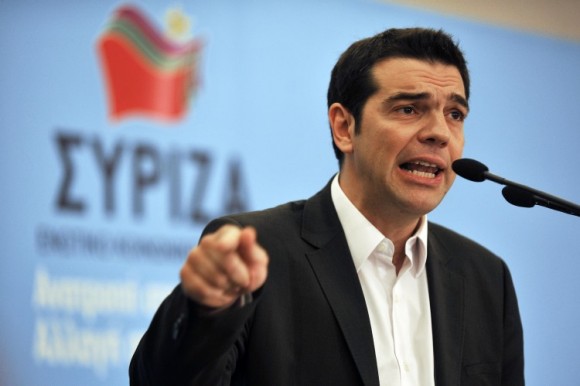
Greek President Alexis Tsipras

Greek Prime Minister Alexis Tsipras

Greece joined the Eurozone on Jan. 1, 2001.  Before 2000, the Greek deficit was about 13 percent of the Gross Domestic Product (GDP.)  By some miracle, in order to meet the criteria for joining the European Union (EU), the deficit was brought down to 3 percent, or more precisely to 3.07 percent.  Eurostat, the statistical office of the EU, the Organization for Economic Co-operation and Development (OECD) and other organizations, pondered over the figures.  The situation was confusing, especially after the Goldman Sachs experts helped Greece with some “creative accounting” by deducting currency swaps and derivatives amounting to 2.8 billion from the calculation of the deficit.

Before 2012, Greece’s creditors were mostly private banks, such as the Société Générale in France.  In March of that year, the banks agreed to cancel 70 percent of their loan or 107 billion.  In 2010 and 2012, the “Troika” granted two rounds of loans, amounting respectively to 110 and 141 billion.  Germany supports 30 percent of the Greek loan, France 23 percent (or 40 billion) and Italy 20 percent.  The participation of the Eurozone members is proportional to the size of their population.  The loans’s maturity is 30 years, 10 percent of the loan carries zero interest and the remainder has interest as low as 2 percent in 2015.  It is important to note these facts in order to counter a lot of disinformation available on the internet.

The discussions, held in Brussels, went well until the disastrous final press conference when the new Greek minister of finances Yanis Varoujakis posturing as a cool Bruce Willis, (to use the Le Monde expression) first demanded that the “Troika” change its name and then asked for a “restructuring” of the debt.  His tour of European capitals, ending in Berlin (where he should have started) was not much appreciated by the German Minister of Finance Wolfgang Schauble, who commented, “We agreed not to agree.”  Varoujakis retorted, “We did not even agree not to agree.”

At a time when refugees and migrants try desperately to reach Europe, the immigration policy of the Tsipras’s recently-elected Syriza party is quite unsettling.  Their plan calls for the retention centers, where refugees and migrants have been held until now, to be turned into “open centers;” to grant citizenship to 150,000 second generation children born in Greece; and to provide housing, schooling and medical care.  How are these programs going to be financed?  The wall built to protect the border between Turkey and Greece fell into disrepair after recent floods.  Maintaining this wall is not a priority announced the government.

There is pretty much a consensus about Greece’s inability to ever pay back its debt.  The creation of the European Funds of Stability and Finances in 2013 to “mutualize” the debt will help Europe absorb the Greek default with more serenity.

But it is far from a done deal.  In four months, before your know it, there will be fierce opposition to write off the debt.  Countries like Portugal or Spain are struggling through austerity and are are not about to continue bailing out Greece.

Nicole Prévost Logan

Nicole Prévost Logan

About the author: Nicole Prévost Logan divides her time between Essex and Paris, spending summers in the former and winters in the latter.  She writes a regular column for us from her Paris home where her topics will include politics, economy, social unrest — mostly in France — but also in other European countries.  She also covers a variety of art exhibits and the performing arts in Europe.  Logan is the author of ‘Forever on the Road: A Franco-American Family’s Thirty Years in the Foreign Service,’ an autobiography of her life as the wife of an overseas diplomat, who lived in 10 foreign countries on three continents.  Her experiences during her foreign service life included being in Lebanon when civil war erupted, excavating a medieval city in Moscow and spending a week under house arrest in Guinea.


Talking Transportation: Why We Love to Hate the DMV

What three letters strike fear in the hearts of every Connecticut motorist?  DWI?  NSA?  No, the DMV, our beloved Department of Motor Vehicles.

I had the pleasure of getting my new “verified” drivers license at their Norwalk office recently, girding myself for what the DMV’s own website promised would be a two and a quarter hour ordeal.

Arriving at 1 p.m. to a full parking lot, I knew I was in trouble.  After 11 minutes in the first line titled “Information,” I received my number, A104, and was told to wait.  At that point the automated system was calling A70 along with D759 and a few B numbers.  As numbers were called, people would scurry to the assigned window, but as time wore on, people moved from griping to just bailing out, leaving some numbers called but nobody appearing. That helped move things along.

My number was finally called at 2:15 p.m. for a transaction that lasted all of four minutes.  The clerk was pleasant and efficient.  I paid my $72 fee (set by the legislature) on a credit card, waited another six minutes for my picture, and was out the door at 2:37 p.m.

There are 2.6 million active drivers licenses in Connecticut and 430,000 are renewed each year, most of them by mail.  But every six years your renewal requires a new photo and more recently, an in-person visit, thanks to Homeland Security’s “Real ID” program.

As of October 2020, only “verified” drivers’ licenses (or a passport) will get you past the TSA and onto a plane.  “Verified” means your license has been issued after you show the DMV a slew of documents … passport, W2, birth certificate, bank statement, pilot’s license… proving both legal residency and identity.

You can opt for a normal license and even have it issued at AAA, if you want.  But as that 2020 deadline draws closer and people realize their driver’s license is really an ID card giving you permission to fly, the lines will get even longer.

My approval for a new license took just minutes because I had more than enough documentation.  But anyone ahead of me in line lacking even one crucial certificate slowed up the process.

Add to the mix the thousands of undocumented aliens seeking drivers’ licenses now allowed under a new law, and you get the sense that the DMV is getting very busy.

The agency has added staff, but the offices are still jammed.  The DMV says that Wednesday and Friday mornings have the shortest waits, but who’s got a job that lets them take off that much time for a paper chase?

All told my experience at the DMV wasn’t too bad.  The clerks were as speedy as their cumbersome process allowed and they even had a nice little coffee and snack stand in the waiting area.  I just am grateful this is only necessary once every six years.

Seeya in 2021!

Jim Cameron

Jim Cameron


Jim Cameron is founder of The Commuter Action Group, and a member of the Darien RTM.  The opinions expressed in this column are only his own.  You can reach him at CommuterActionGroup@gmail.com  

For a full collection of “Talking Transportation” columns, see www.talkingtransportation.blogspot.com

Legal News You Can Use: The Do’s and Don’ts of a “Good” Divorce

We are delighted to introduce a new column today, which will be a monthly feature written by attorneys at Suisman Shapiro Attorneys-at-Law in New London.  This month’s column discusses ‘The Do’s and Don’ts of a “Good” Divorce’ and is written by Attorney Robert G. Tukey.  He is a Director at Suisman Shapiro whose practice concentrates in family law.

The Do’s and Don’ts of a “Good” Divorce

Divorce_photoUnfortunately, more than 40 percent of marriages in the U.S. will end in divorce.  Divorce can be financially and emotionally devastating and especially stressful for children involved.
If you are faced with the prospect of divorce, it is in your family’s best interest to approach it from an amicable perspective.  As many divorced couples understand, it is possible to have a healthy breakup and start a new life.

Do be respectful and maintain a cordial relationship with your spouse. Try to keep the lines of communication open.  Be reasonable about expectations, and cooperate with your spouse to achieve the best results for your family.

Do put your kids first, and ensure they know they are not the cause of the divorce.  Make sure you and your spouse send a consistent and coordinated message to your children.

Do get professional counseling if needed, for yourself and your children.

Do document everything.  Understand your assets and liabilities.  Get appraisals, and make copies of important documents.

Don’t draw your children into your arguments, and never question them about your spouse’s activities.  Always be respectful of your spouse in front of the children, and remember the Golden Rule: if you do not have anything nice to say, say nothing at all.  Kids do better when they maintain close relationships with both parents.

Don’t violate custody or visitation agreements, including the Automatic Orders that attach to every divorce. These Automatic Orders include not taking the child(ren) out of state without written permission or consent from the other party, maintaining an open line of communication between the child(ren) and the non-custodial parent, maintaining  the child(ren) on any existing medical coverage, and completion of the Parenting Education Program for the benefit of the child(ren).

Don’t attempt to shield property or assets from your spouse.  All items of value must be disclosed.  Your credibility is your most important attribute, which cannot be restored should untruthfulness be exposed during the divorce process.

Do hire an experienced attorney.  Beware of online divorce websites, which promote do-it-yourself divorce as a cheap and easy alternative to working with an attorney.  While the Internet can be a good resource for information, you can also receive bad advice online.

There are many nuances in divorce and custody cases that make “cookie cutter” divorce kits inappropriate.  It’s very important to protect your interests by hiring a knowledgeable attorney, because there are numerous things that cannot be changed after final judgment.

Do explore your options regarding alternative dispute resolution such as mediation or arbitration. In addition to facing the emotional trauma of separating a family unit, the process of dividing years of accumulated assets can be complicated and overwhelming. Divorce through the Connecticut State Court can take months, or even years, of time-consuming and expensive Court appearances.

The process of mediation is an attempt to resolve disputes outside of Court with the help of a neutral third party who can achieve a common ground and a mutually agreeable resolution.  If the parties are unable to reach consensus, arbitration allows the parties to efficiently present their respective positions to an impartial, neutral third party decision-maker, similar to a trial judge, called an Arbitrator.

Through arbitration couples have much more control over scheduling and privacy. Both spouses and their attorneys agree on the Arbitrator, hearing time, and location. They also approve the rules and procedures ahead of time. The Arbitrator’s decision is binding, so appeals rarely become an issue in the future. The proceedings can be completely confidential and only the final decision will be approved and filed with the court.

Editor’s Note: Attorney Robert G. Tukey is a Director at Suisman Shapiro whose practice concentrates in family law. Contact him via email at rtukey@sswbgg.com or via phone at (860)442-4416 with questions regarding divorce and custody matters.

Letter from Paris: ‘Loi Macron’ Indicates a Sea Change in French Politics

Nicole Prévost Logan

Nicole Prévost Logan

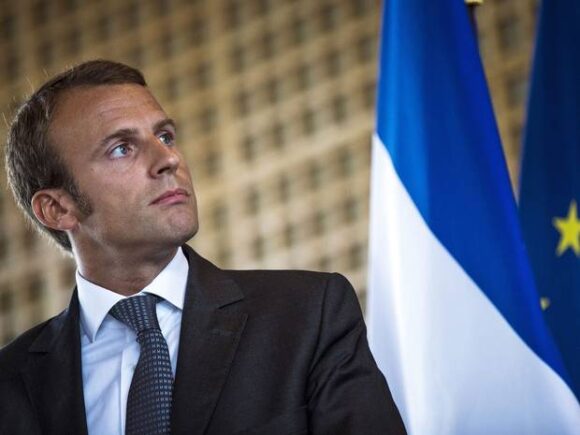
In January 2015, in a forceful declaration, French president François Hollande officially announced a break with the Socialist program, which had been the basis of his 2012 presidential campaign.  It was a sharp turn toward a more liberal, market-oriented policy.  The Loi Macron, named after the young (33-year-old) Minister of Economy Emmanuel Macron, was to embody the new trend.

Emmanuel Macron

Emmanuel Macron

Expecting that the law would not pass, the government decided to use a joker – the article 49.3.  It was a gamble since, in the event that the motion de censure (vote of no confidence) of the opposition succeeded, the government of Manuel Valls would be disavowed and fall.  But the motion de censure received only 234 votes when it needed the absolute majority of 289.  The law passed.

The article 49.3 is included in the constitution of the Fifth Republic.  It allows the government to act in force to push a text through the Parliament without the need of a vote. It is a powerful but dangerous device.  It has been used 82 times since 1958.

The last time was in 2006 when Dominique de Villepin, under the presidency of Jacques Chirac, tried to promote the Contrat Premiere Embauche, or CPE (first hiring contract). The students demonstrated in the streets.  Shortly thereafter the CPE received national funerals.  The champion of article 49.3 was Michel Rocard who in the late 1980s used it 28 times.

After 200 hours of consultations and 1,500 amendments granted by the government, it looked as though each article had been accepted separately.  And yet, by the time of the final vote on Feb. 17, the far right (Front National), the far left (Front de Gauche), most of the right (UMP), and the 40 Frondeurs, or splinter group from within the Socialist party, joined in an alliance to put road blocks to stop the government’s proposal. Manuel Valls and Emmanuel Macron made their concluding speeches among jeers and interruptions.  On the face of many deputies could be seen a rather despicable sarcasm.

In fact, the manoeuvre of the government deserves to be applauded since, to push a text in force, was the only way for the Executive to succeed.  The Loi Macron reperesents an enormous task attempting to reform the fabric of French society.  It meant dismantling the century-old system of privileges and protected niches enjoyed by whole segments of the population, including the five million civil servants, known as notaires — in France, notaires are a specific type of French attorneys overseeing all legal transaction while collecting taxes on behalf of the government, doctors, veterinarians, taxi drivers, auction houses officials, etc.

All the professions are regulated and benefit from a a special satus.  The right to work on Sundays, and allowing intercities busses were hard-won victories.  Only indirectly, the Loi Macron dealt with unemployment and ways to jump-start the economy.

The law is insufficient and has its defects, but is a step in the right direction. It represents a real effort to bring changes and to satisfy Brussels. Angela Merkel, in Paris for more discussions about the Ukraine, expressed her satisfaction.

Nicole Prévost Logan

Nicole Prévost Logan

About the author: Nicole Prévost Logan divides her time between Essex and Paris, spending summers in the former and winters in the latter.  She writes a regular column for us from her Paris home where her topics will include politics, economy, social unrest — mostly in France — but also in other European countries.  She also covers a variety of art exhibits and the performing arts in Europe.  Logan is the author of ‘Forever on the Road: A Franco-American Family’s Thirty Years in the Foreign Service,’ an autobiography of her life as the wife of an overseas diplomat, who lived in 10 foreign countries on three continents.  Her experiences during her foreign service life included being in Lebanon when civil war erupted, excavating a medieval city in Moscow and spending a week under house arrest in Guinea.

Letter from Paris: Minsk 2 – Another Truce for Ukraine … Maybe

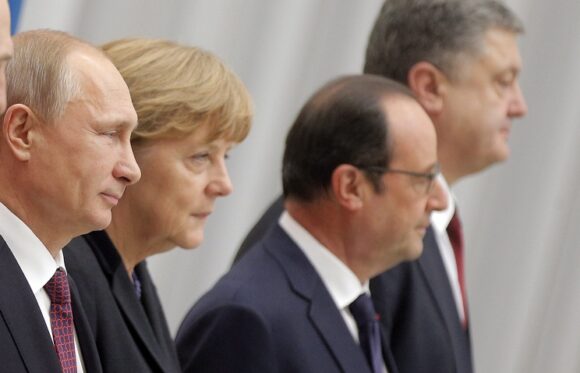
From left to right, Vladimir Putin, Angela Merkel, François Hollande and Petroshenko.

From left to right, Vladimir Putin, Angela Merkel, François Hollande and Petro Porosnhenko. Photo credit EPA/Maxim Shipenkov.

After a 16-hour long marathon of negotiations on Feb. 11, and a great deal of suspense, Angela Merkel and François Hollande wrenched out a hard-won agreement for a cease-fire in Ukraine from Petro Porosnhenko and Vladimir Putin starting on Saturday, Feb. 14 at midnight.  All parties to the agreement were extremely cautious and hoped that “Minsk 2” would last longer than “Minsk 1” signed in September 2014.

More than 5,500 people have died in the conflict during the past 10 months, which makes it the deadliest in Europe since World War II.  There was a sense of relief that the agreement went through and thus a disaster had been avoided.  In the morning, Putin joked that he had had better nights but felt satisfied.

To continue the negotiations rather than slamming more sanctions on Putin, as some Washington pundits advocate, was the objective of Minsk 2.  Sanctions have a cost for Europe (for example, the Russian government retaliated to earlier sanctions by blocking the import of produce from Western Europe.)  More dangerously, they exacerbate the nationalism of Putin and enhance his popularity in Russia.

In the face of a threatening strategy of Daesh* making well planned inroads to destabilise Europe by recent acts of terrorism, Russia and the European Union (EU) have a common enemy.  For decades, the extremist Moslem opposition in Chechnya and Central Asia has been a great fear for the Russian government..

The talks in Minsk started in a polar atmosphere.  Throughout the night, Petro Poroshenko’s and Vladimir Putin’s teams moved like a choreographed ballet.  Early in the morning, Putin left the room, slamming the door, only to reappear a few minutes later. The Franco-German duo is to be credited with an unflappable tenacity to reach an agreement.  The two worked perfectly together.  Merkel needed Hollande since she wants to avoid making foreign policy decisions alone and prefers,“Leading from the center,” to use a formula coined by the German Minister of Defence Ursula von der Leyen.

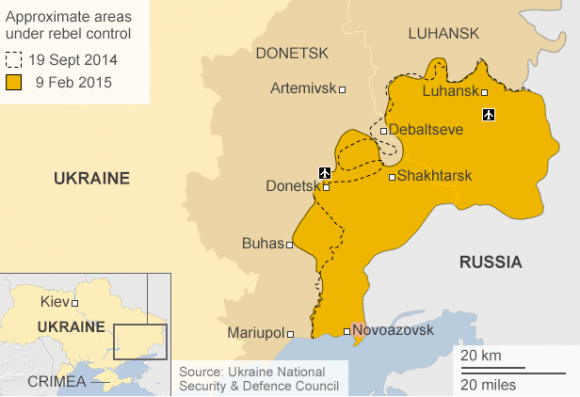
Screen Shot 2015-02-18 at 12.37.33 AM

Minsk 2 includes modified provisions to make the process move forward.  The buffer zone – cleared from all heavy armaments – has been widened from 30 km to 70 kms.  The European Council for Stability and Security will be monitoring the application of the agreement.  Putin expressed his demands for the autonomy of the Luhansk and Donestk regions..

The EU widely considers that Ukraine is both a corrupt and failed state.  It cannot afford to help it financially nor envisages its adhesion to the EU any time soon.  Kiev does not want to lose the industrial and mining Donbas region, but its action is disorganized.  For many months, Putin has claimed that he never intervened in the conflict taking place in Eastern Ukraine.

One wonders whether he really controls the Russian separatists, so different from the sophisticated Maidan crowd.  The Donbass miners and blue collar workers are products of massive transfers of population forced by the Soviets at the time of the German offensive to compensate for the relocation of highly skilled workers to the Ural Mountains.  Another headache for Putin is the presence among the Russian separatists of clans whose leaders have political ambitions .

It is hard to understand Putin’s strategy.  Obviously he does not want NATO to choke him nor nuclear misssiles to be installed in the area.  He does not have the means to support the Donbas.  His priority should most likely be to allow a corridor from Rostov on Don, through Mariopol on the Sea of Azov and then leading to the Crimea.  At present his only access to the Crimea is through the Straits of Kerch, which is some distance away.

*The new nickname for ISIS widely used in France, Australia and some other countries because ISIS supposedly dislikes it intensely — it is a loose acronym of the Arabic description of ISIS, which does not acknowledge any statehood for the organization but rather can be roughly translated as, “One who crushes something underfoot,” or, “One who sows discord.”

Nicole Prévost Logan

Nicole Prévost Logan

About the author: Nicole Prévost Logan divides her time between Essex and Paris, spending summers in the former and winters in the latter.  She writes a regular column for us from her Paris home where her topics will include politics, economy, social unrest — mostly in France — but also in other European countries.  She also covers a variety of art exhibits and the performing arts in Europe.  Logan is the author of ‘Forever on the Road: A Franco-American Family’s Thirty Years in the Foreign Service,’ an autobiography of her life as the wife of an overseas diplomat, who lived in 10 foreign countries on three continents.  Her experiences during her foreign service life included being in Lebanon when civil war erupted, excavating a medieval city in Moscow and spending a week under house arrest in Guinea.