
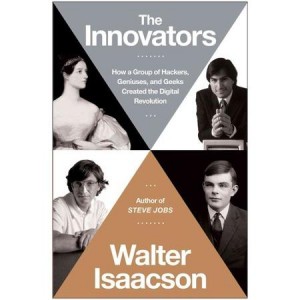
Reading Uncertainly? ‘The Innovators’ by Walter Isaacson

The_InnovatorsThis is the remarkable and intricate story of the computer, the Internet and the World Wide Web, all of which transformed and continue to alter this globe. It is a story of human collaboration, conflict, creativity and timing, from Ada, Countess of Lovelace in 1843 to the more familiar names of Vannevar Bush, Alan Turing, John Mauchly, John von Neumann, Grace Hopper, Robert Moore, Bill Gates, Paul Allen, Tim Berners-Lee, Larry Page, Sergey Brin, and, of course, “Watson,” the almost-human Jeopardy contestant of IBM.

Isaacson stresses the importance of the intersection of individual thinking combined, inevitably, with collaborative efforts.  Ideas start with non-conformists, in many of whom initiative is often confused with disobedience. But it is in collaboration that we have found the effectiveness of the Web, a “networked commons.”

These changes have come about through conception and execution, plus “peer-to-peer sharing.” Isaacson cites three co-existing approaches: (1) Apple with its bundled hardware and software, (2) Microsoft with unbundled software, and (3) the Wikipedia example of free and open software, for any hardware. No one approach, he argues, could have created this new world: all three, fighting for space, are required. Similarly, he believes that a combination of investment works best: Government funding and coordination, plus private enterprise, plus “peers freely sharing ideas and making contributions as a part of a voluntary common endeavor.”

In his concluding chapter, Isaacson raises the question of the future for AI, artificial intelligence. Stephen Hawking has warned, yet again, that we may create mechanisms that will not only think but also re-create themselves, effectively displacing homo sapiens as a species. But Isaacson is more optimistic: he sees and favors a symbiotic approach, in which the human brain and computers create an information-handling partnership. Recent advances in neuroscience suggest that the human brain is, in many ways, a limited automaton (see System One of Kahneman). But our brain, with its ability to “leap and create,” coupled with the computer’s growing ability to recall, remember, and assess billions of bits of information, may lead us, together, to better decisions.

His final “five lessons” are worth inscribing:

  1. “Creativity is a collaborative process.”
  2. “The digital age was based on expanding ideas handed down from previous generations.”
  3. “The most productive teams were those that brought together people with a wide array of specialties.”
  4. “Physical proximity is beneficial.”
  5. To succeed, “pair visionaries, who can generate ideas, with operating managers, who can execute them.”

Isaacson’s final lesson:  humans bring to our “symbiosis with machines . . . one crucial element: creativity.” It is “the interaction of humanities and sciences.”

And we wouldn’t have LymeLine without the Innovators!

Editor’s Note: “The Innovators” is published by Simon & Schuster, New York 2014.

Felix Kloman_headshot_2005_284x331-150x150

About the author: Felix Kloman is a sailor, rower, husband, father, grandfather, retired management consultant and, above all, a curious reader and writer. He’s explored how we as human beings and organizations respond to ever-present uncertainty in two books, ‘Mumpsimus Revisited’ (2005) and ‘The Fantods of Risk’ (2008). A 20-year resident of Lyme, he now writes book reviews, mostly of non-fiction that explores our minds, our behavior, our politics and our history. But he does throw in a novel here and there. For more than 50 years, he’s put together the 17 syllables that comprise haiku, the traditional Japanese poetry, and now serves as the self-appointed “poet laureate” of Ashlawn Farms Coffee, where he may be seen on Friday mornings. His wife, Ann, is also a writer, but of mystery novels, all of which begin in a bubbling village in midcoast Maine, strangely reminiscent of the town she and her husband visit every summer.


 

Legal News You Can Use: Choosing Quality Nursing Home Care

Choosing a nursing home for a loved one requires careful research.

Choosing a nursing home for a loved one requires careful research.

As our population ages so does the need for safe and healthy nursing home care.  Whether the purpose is to treat physical ailments, provide rehabilitation, or care for a patient dealing with dementia, nursing homes are here to stay – even with alternatives like assisted living and home care assistance.  So how do we choose the right nursing home for our loved ones?

Of course, the first consideration may be based on the availability of a bed or room.  Sometimes there is no vacancy.  That aside, what should we be looking at?  Forget the nice entry and lobby furnishings – these things tell us nothing about the quality of care.  We should be able to determine what the track record of care has been for the facility(s) we are considering.

The first step in a thorough investigation should start with the “Connecticut Department of Public Health’s Survey of Nursing Homes” which includes information on “official” staffing which has been reported to the state.  Note well any deficiencies. However, the latest report was published in 2011-2012, and staffing statistics often change over time.

A number of other online listings such as the Medicare.gov Nursing Home Compare site, show “deficiencies” for each facility reported by inspectors.  They also show ratings for health inspections, staffing and other quality measures that may be useful in assessing the level of care at each home.  Be especially aware of the same types of deficiencies that are found in subsequent years.  Some of the deficiencies we are particularly concerned with in a legal sense deal with medication errors, malnutrition, falls, abuse, and bed pressure sores (decubitus ulcers).  Tragically, in our law practice we have seen cases of bedsores down to the bone due to neglect.

Of course, it’s most important to visit prospective facilities in person. Multiple visits to a particular home of interest, at different times and shifts, may reveal what really takes place.  Do not rely on advertising and marketing materials!

When interviewing a prospective nursing home, ask for a copy of their Admissions Agreement to take home and review. Especially look out for a mandatory binding arbitration provision.  This provision usually prevents a lawsuit when the facility has injured a patient through its own negligence or neglect.  Arbitration clauses are usually heavily biased in favor of the facility and should be avoided if possible.

Once your loved one is settled in to a nursing home, one of the most important things a family can do is to visit frequently and regularly. If there is any suspicious activity going on, keep a journal or diary, and take pictures.  Photos of happy occasions (e.g. birthdays, anniversaries, holidays) whenever the family gets together, as well as photos of problems, may be important later on to illustrate that the patient was originally doing well, and that the family cares and is not just looking to capitalize on a law suit.

The age of a patient does not give any facility the right to cut a person’s life short through neglect or abuse, or to make their remaining years full of unnecessary pain and suffering.  The last years of life may be the most precious, and it is important for your loved one to retain their dignity and respect.

Editor’s Note: Attorney Matthew Shafner is a Director at Suisman Shapiro Attorneys-at-Law in New London, and a nationally recognized lawyer in the fields of personal injury, asbestos injury, maritime injury and workers compensation law. Please contact him via email at mshafner@sswbgg.com or via phone at (860) 442-4416 with questions about laws regarding nursing home negligence.

Talking Transportation: Malloy’s Transit Land Grab

Don’t look now, but Governor Malloy is trying to take your land, or at least control of the land around your local train or bus station.

When the Connecticut Department of Transportation (CDOT) recently tried to shove a private development down the throats of Stamford under the guise of, “transit oriented development,” in replacing the garage at the train station, city fathers were justifiably upset.  They voted through a zoning change giving them some say on the project, as well they should.

As revenge Governor Malloy is now proposing a statewide “Transit Corridor Development Authority” (TCDA) that would bigfoot the towns and cities, giving the state control over land, buildings and development within a half-mile of all transit stations.

Your favorite coffee shop across from your Metro-North stop could be torn down and replaced with offices.  Parking lots could be enlarged with fees set by the CDOT, not the towns where the lots reside.  If the state wants to erect a building taller than local zoning laws allow, too bad … they can and will.  As one critic described it, this is, “eminent domain on steroids.”

The TCDA would be run by political appointees, a majority controlled by the Governor and not answerable to the local residents whose land would be affected.  The agency could issue its own bonds financed by rents and taxes on the very structures they want built.  And the agency would continue with this power forever, under, “perpetual succession”.

The TCDA would have the power to condemn property that it alone claims it needs to further its goals.  Town and regional planning and zoning boards can just go pound sand, powerless to stop them.

Because train and stations are usually in the downtown of cities and towns, those municipalities would lose control of the development destiny of their very core.  The Governor’s bill would have us believe that Hartford, or this new agency of political hacks, knows what’s best for us, not our elected mayors and first selectmen.

It has been proven that the private developer chosen for the Stamford garage project just happened to have donated $165,000 to the State Democrats  before and after his selection.  Yet, there’s nothing in the Governor’s TCDA bill (HB 6851) to prevent such “pay for play” activities.

Were Dannel Malloy still mayor of Stamford, he would scream bloody murder if a bill like this were introduced in Hartford.  But as Governor, he seems to have no qualms at telling 169 towns and cities in this state that he knows best … that Hartford will determine if skyscrapers built by private developers should be plopped down in your town and mine.

“Transit oriented development” makes sense and should be encouraged.  We all need to promote housing and commercial growth focusing on our train and bus stations.  But this is a local issue, not a state right.

If we are to preserve the local identity and feel of our communities, we must stop the Governor’s land grab and keep control of our destiny.  Tell your State Representative and State Senator you oppose HB 6851 and Malloy’s land-grab.

Jim Cameron

Jim Cameron

About the author: Jim Cameron is founder of The Commuter Action Group, and a member of the Darien RTM.  The opinions expressed in this column are only his own.  You can reach him at CommuterActionGroup@gmail.com   For a full collection of “Talking Transportation” columns, see www.talkingtransportation.blogspot.com

Reading Uncertainly? ‘On Aggression’ by Konrad Lorenz

On_Aggression_book_coverAre we naturally “aggressive?”  What a way to greet the spring!  Today’s headlines seem to indicate that we simply cannot avoid creating friction among human beings.  This sent me backwards in time to re-read Konrad Lorenz’s monumental On Aggression, first published in German in 1963 and in English in 1966.

Lorenz defines aggression as, “the fighting instinct in beast and man, directed against members of the same species.”  The forms, objectives and examples of aggression include:

  • behavior
  • preservation of the species
  • physiology of instinctual motivation
  • the process of ritualization
  • how instinctive impulses function
  • mechanisms evolution has “invented” to channel aggression to harmless paths
  • social organization (“anonymous crowds”)
  • bonds of “love and friendship”
  • the “virtue of humility”
  • counter-measures against the malfunctions of aggression (including examples among fish, birds and four-legged mammals).

He concludes: “aggression . . . is really an essential part of the life-preserving organization of instincts.”  And our own-species aggression is “essential for its preservation.”

The “principle of the bond” seems to require some degree of aggressive behavior: we apparently need something in common to be defended against outsiders, such as territory, brood, opinion and, most dangerously, ideology. Aggression thus becomes “necessary to enhance the bond.”

And “ the danger to modern man arises not so much from his power of mastering natural phenomena as from his powerlessness to control sensibly what is happening today in his own society.”

Is there a ray of hope?  Lorenz thinks it is possible.

First, our, “insatiable curiosity is the root of exploration and experimentation …  a linking of cause and effect … the conscious foreseeing of the consequences of one’s action.”  This “unrelenting demand for causal understanding” may well lead to a “scientific enlightenment [that] tends to engender doubt in the value of transitory beliefs long before it furnishes the causal insight necessary to decide whether some accepted custom is an obsolete superstition or still an indispensible part of a system of sacred norms.”  Our inquiring minds may often be too far ahead of how we react!

And why are our young so often at the center of disruptive behavior?

Lorenz suggests an answer.  “During and shortly after puberty, human beings have an indubitable tendency to loosen their allegiance to all traditional rites and social norms of their culture, allowing conceptual thought to cast doubt on their value and to look around for new and perhaps more worthy ideals … At the postpuberal age some human beings seem to be driven by an overpowering urge to espouse a cause and, failing to find a worthy one, may become fixated on astonishingly inferior substitutes.”  Shades of the Middle East today, one might venture …

But he is, nevertheless, optimistic  — Lorenz suggests some preventive steps to counter our natural aggressive instincts.  First, he reiterates the famous Chilton/Socrates admonition to “Know thyself,” acknowledging some obstacles:

  1. unawareness of our evolutionary origin
  2. reluctance to admit that our “behavior obeys the laws of natural causation” (there is no “free will!”)
  3. a heritage of “idealistic philosophy”

His conclusion: “Truth, in science, can be defined as the working hypothesis best fitted to open the way to the next better one.”  Nothing is “absolute!”  And, finally, allow humor to play a major role: do not take ourselves too seriously.

There is nothing quite like stepping back in time to re-read some earlier thoughts …

HFK_headshot_2005_284x331About the author: Felix Kloman is a sailor, rower, husband, father, grandfather, retired management consultant and, above all, a curious reader and writer. He’s explored how we as human beings and organizations respond to ever-present uncertainty in two books, ‘Mumpsimus Revisited’ (2005) and ‘The Fantods of Risk’ (2008). A 20-year resident of Lyme, he now writes book reviews, mostly of non-fiction that explores our minds, our behavior, our politics and our history. But he does throw in a novel here and there. For more than 50 years, he’s put together the 17 syllables that comprise haiku, the traditional Japanese poetry, and now serves as the self-appointed “poet laureate” of Ashlawn Farms Coffee, where he may be seen on Friday mornings. His wife, Ann, is also a writer, but of mystery novels, all of which begin in a bubbling village in midcoast Maine, strangely reminiscent of the town she and her husband visit every summer.

Nibbles: Now is the Time to Bake a Spice Cake

On Sunday, March 1, I decided that winter was done. That afternoon, though, I drove to the Ward’s home in Madison to celebrate Zimmy’s 90th birthday. There would be around 40 of us and the food promised to be yummy. I had bought my Coca-Cola Cake and a slow-cooker full of Cincinnati four-way chili. Both were good but Eugenia’s baked rigatoni along with chopped liver, potatoes Lyonnaise and Norma’s  gorgeous jelly roll, 18-inches long ringed with beautiful berries were even better.

It was snowing as I drove my car out of the garage and the light precip turned into serious snow (I’d worn real shoes instead of the knee-high mukluks’ I lived in for more than a month.) By the time I got to Madison, there was an inch on the ground. The party was fabulous, but by late afternoon, people began to head home.

When I got into my car, it was a serious snowstorm, and I had “miles to go before I sleep,” as Robert Frost wrote. The usual 45 minutes tuned into two and a half hour, never seeing a white or yellow line. All I could do was follow the cars in front of me. Fortunately, I made it home safe and sound.

Obviously, my decision that winter was over made God laugh. Once home I made a cup of tea and warmed my toes with a blanket. After watching “Downtown Abbey,” my new decision would be to make a spice cake the next day.

Old-Fashioned Spice Cake

Adapted from Linnea Rufo, Bee & Thistle Inn, Old Lyme, CT

Yield: serves 10 to 12 people

old_fashioned__spice_cake1 cup sugar
One-half cup (1 stick) butter
One-half cup currants or raisins or dried cherries (optional)
One-half cup candied ginger, chopped
2 eggs
2 tablespoons molasses
2 cups flour
1 teaspoon baking soda
1 teaspoon cinnamon
One-quarter teaspoon cloves
One-half teaspoon ginger
One-teaspoon salt
1 cup milk

  1. Preheat oven to 350º F. Grease a 10-inch tube pan.
  2. Cream butter and sugar until light and fluffy. Beat in eggs, one at a time, blending well after each addition.
  3. Whisk together flour, baking soda, cinnamon, cloves, ginger and salt. Stir dry ingredients into egg mixture alternately with milk, beginning and ending with dry ingredients.
  4. Pour batter into prepared tube pan. Set on the middle rack of the oven and bake for 1 hour and 5 minutes, or until cake pulls away from sides of pan and a tester inserted in the center comes out clean.
  5. Cool cake in the pan, set on a rack, for 10 minutes. Remove cake from pan and spread on icing at once, while cake is still warm.

Espresso Icing

1 and one-half cups of confectioners’ sugar
1 tablespoon of espresso
1 tablespoon milk

Whisk icing ingredients together.