
Legal News You Can Use: Is Your Teen Gearing Up For A Driver’s License?

Teen_with_drivers_licenseYoung people ages 15-24 represent only 14% of the U.S. population. However, they account for 30 percent ($19 billion) of the total costs of motor vehicle injuries among males and 28 percent ($7 billion) of the total costs of motor vehicle injuries among females.1

The risk of motor vehicle crashes is higher among 16- to 19-year-olds than among any other age group. In fact, per mile driven, teen drivers ages 16 to 19 are nearly three times more likely than drivers aged 20 and older to be in a fatal crash.2

According to the Center for Disease Control (CDC), the leading causes of teenage crashes are as follows:

  • Driver inexperience
  • Driving with teen passengers
  • Nighttime driving
  • Not using seat belts
  • Distracted driving
  • Drowsy driving
  • Reckless driving
  • Impaired driving

Confronted with these staggering statistics, it is only right that we take steps to address this with our children.

While the prospect of getting a driver’s license is an exciting step for teenagers, parents have to be mindful of the risks associated with young drivers in their formative years.  Unfortunately, the worry over executing the parallel park during the road test should be the least of parents’ concerns.  It is ever so important for parents to instill in their teenagers the responsibility that comes along with driving an automobile.  This is especially true considering the wide range of distractions present now as compared to the recent past.  For instance, we all recognize the growth of multi-media applications regularly accessed and used by teens on their cell phones, IPods or tablets.

Parents must be resolute in setting forth ground rules with their young drivers.  Driving is, after all, a privilege – one that perhaps we take for granted, but that endows us with civic and personal responsibility.  Do our young people truly internalize these concepts? Do they understand the power inherent with operating a motor vehicle? Do they consider the consequences of aggressive driving? We were all there once.  Our focus at sixteen or seventeen was the freedom and fun associated with getting a driver’s license.  I would submit that young folks today have similar interests.

You should not be timid or embarrassed to lay down strict rules with your teenage drivers.  Our children are the center of our lives and we’ll do anything to protect them and ensure their safety.  It’s not important to be the cool parent.  Perhaps consider one or more of the following suggestions for ground rules:

  1. Your teenager does not have to get his/her license at the very moment he/she is eligible. If he/she is not working or not participating in an activity that would require transportation not otherwise available, perhaps consider waiting.  This would be especially true for parents who feel that their child is not ready for the responsibility that comes along with driving.
  1. While it may seem obvious, reinforce the seriousness of driving under the influence. The topic should not be taboo, but rather one that parents should broach with their children.
  1. You should determine the friends that you trust to drive your teenager. Whether it’s to after-school practice, the movies or a part-time job, make sure you are comfortable with the friend or teammate who is driving your child.  Once again, do not be afraid to prohibit your child from travelling with another teenager who you don’t fully trust.
  1. Take the opportunity to establish a vested interest in the eyes of your teenager. If your child has a job, perhaps mandate that he/she contribute to the car payment, insurance or repairs.  The obvious benefit is that the teenager will appreciate the privilege of driving.
  1. Practice good driving habits as parents. For the first 16-18 years of his/her life, your child has been observing you driving.  We can be an example for our children by practicing good driving habits.

Driving can be an amazing and fulfilling adventure for a teenager.  In many cases it ushers in rich experiences, both for social and vocational advancement.  It must, however, be approached with care and responsibility and the parents’ role is vital. If we try our best to send this strong message of responsibility and safety, it will go a long way toward ensuring that the driving experience of our young people is fruitful.  Being the caring and loving parent is more important than being the cool parent.

Editor’s Note: Attorney Bryan Fiengo is a Director at Suisman Shapiro whose practice concentrates in the areas of criminal law (including DUI defense), employment law and general litigation. To contact Bryan Fiengo, email him at bfiengo@sswbgg.com or call (860) 442-4416.

Suisman Shapiro Attorneys-at-Law is the largest law firm in eastern Connecticut, serving the community for over 75 years with a wide range of legal services.

1Finkelstein EA, Corso PS, Miller TR, Associates. Incidence and Economic Burden of Injuries in the United States. New York: Oxford University Press; 2006.

2Insurance Institute for Highway Safety (IIHS). Fatality facts: teenagers 2012. Arlington (VA): The Institute; 2012 [cited 2014 Sept 29].
Letter from Paris: The Rise of Islam in Europe; Reactions and Results

Nicole Prévost Logan

Nicole Prévost Logan

As we were driving toward Baden Baden in Germany, our tour director pointed to the brand new mosque rising above the red-roofed houses. “This mosque was not there last year,” he commented.  On a recent river cruise through five European countries — Belgium, The Netherlands, Germany, France and Switzerland – it was impossible not to notice the increasing presence of Islam — or at least our perception of it.

In the tense international context of conflict with the Islamic State, there is a feeling in Europe of being caught in a two-pronged threat, both from within and abroad. This is why many believe that it is more important than ever for the Muslims living in Europe, moderate in the majority, to speak up with a loud voice against Daesch violence.

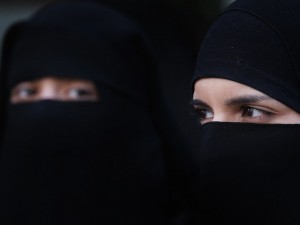
muslim_womenThere are more than 40 million Muslims in Europe, which translates to an average of 8 percent of the population.  France has the largest percentage with 10 percent versus 0.6 percent in the US.  The Muslim inhabitants are mostly concentrated in urban areas, where they can sometimes reach 20 percent and even 30 percent as in Basel, Switzerland.

For an American readership it is hard to grasp the impact of such a concentration on the urban landscape.  Living in Europe, one has to adjust to the changing profile of the Muslim community.  Take, for instance, the recent announcement made by the rector of the Great Mosque of Paris that the number of mosques existing today — 2,000 — in France needs to be doubled.

In early April,  L’Union des Organisations Islamiques de France (UOIF — the Union of Muslim Organizations of France) held its 33rd annual gathering at Le Bourget, north of Paris.  For three days, thousands flocked to this event, bringing their families and looking forward to do some shopping or attending seminars.  French Prime Minister Manuel Valls expressed some concern that the Muslim Brotherhood, which conceived this event, might exert too much influence on the crowds.

One forum attracted many visitors and one, an older man, said, “At the mosque, I am a Muslim — in the street I am a lay person.  When I became French, I accepted the 1905 law of separation of Church and State and I respect the idea of a secular State.”  A young lawyer retorted, “I was born in France, which gave me some rights.  Today I demand that these rights be respected.”  This heated exchange epitomizes the contrast of attitudes between generations of immigrants.

A disturbing trend is the radicalization of the European Muslim community by the Salafists – a conservative Sunni sect.  They want Islam to return to its original form with a strict application of the Sharia.  A journalist describes how, 20 years ago, a suburb outside Montpellier had a theater and drama workshops, where young people loved to practice on the stage.  Today the theater is run down and empty. The Salafists have ordered the premises to be closed, and forbade the women to appear in public.  Le Monde published an article describing the growing number of Salafists in Dusseldorf, but also stressing the distinction between Salafist true believers and “pseudo Salafists,” who are potential jihadists.

Once more France is in the line of fire for its military interventions in several parts of the world.  Recently the screens of TV5 Monde, a television station broadcasting programs in the French language to 200 countries, turned black for 20 hours.  One viewer, in Zarhle, Lebanon, said, “I am not even French, but for me the programs offered by TV5 Monde represent culture, a window onto the free world.”

One can only hope that the ongoing destruction of archaeological sites, the attacks on journalists and the hacking of channels of communication with their social networks, are not going to be followed by further cyber attacks.

Nicole Prévost Logan

Nicole Prévost Logan

About the author: Nicole Prévost Logan divides her time between Essex and Paris, spending summers in the former and winters in the latter. She writes a regular column for us from her Paris home where her topics will include politics, economy, social unrest — mostly in France — but also in other European countries. She also covers a variety of art exhibits and the performing arts in Europe. Logan is the author of ‘Forever on the Road: A Franco-American Family’s Thirty Years in the Foreign Service,’ an autobiography of her life as the wife of an overseas diplomat, who lived in 10 foreign countries on three continents. Her experiences during her foreign service life included being in Lebanon when civil war erupted, excavating a medieval city in Moscow and spending a week under house arrest in Guinea.

A Letter From Paris: Munich Museum Celebrates Tragically Truncated Careers of Two German Artists

Nicole Prévost Logan

Nicole Prévost Logan

The promise of two young men to become among the most important German artists of the 20th century was cut short when Franz Marc (1880-1916) and August Macke (1887-1914) were both killed on the front at the outset of World War I.

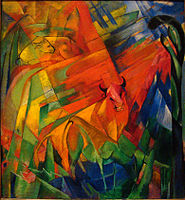
Animals in a Landscape by Franz Marc, 1914.

Animals in a Landscape by Franz Marc, 1914.

The Lenbachhaus museum of Munich, built at the turn of the (20th) century when Munich was the capital of German art, will hold an exhibit in May entitled. “Two Friends.” It shows how Marc and Macke met in 1910, discovered their mutual works with enthusiasm and struck a friendship, which was to last until their death.

The eve of the “Great War” was a time of artistic explosion, not limited to the Impressionists, Cézanne and other great French masters. All of Europe, including the Russian giants like Malevich, or Tatlin, was set ablaze and the German schools of painting played an important role in the cross-pollinization of the art movements.

In 1905 Ernest Ludwig Kirchner (1880-1938) founded Die Brucke (the bridge) in Dresden. The human figures he painted are very distinctive with an angular and depraved look. The Nazis called him “degenerate.” Die Brucke was part of a larger German Expressionist movement based at the Sturm gallery in Berlin and characterized by the rejection of any form of academism, the acerbic satire of the bourgeois decadence, and the crude, almost perverted, representation of the bohemian life the artists led in their studios.

In 1909, Wassily Kandisky (1866-1944) wanted to distance himself from the Neue Künstlervereinigung München (NKVM — the Munich New Artist’s Association) painters and settled in Murnau, a small village on the edge of Bavarian Alps with a group of artists including his companion Gabriele Munter and Alexej Jawlensky. For Marc and Macke, it was a pivotal moment to meet them there.

Even before knowing each other, Marc and Macke had shared a love for painting animals, particularly cats. Both were fascinated by the artistic developments taking place in France. In 1907, and again in 1908 Macke was in Paris and visited the galleries of Bernheim-Jeune, Ambroise Vollard and Durand Rueil, to see Pissaro, Monet, Dégas, Renoir and Seurat. Marc travelled several times to France from 1903 onwards, spending long hours at the Louvre, where he was particularly attracted to Van Gogh’s paintings.

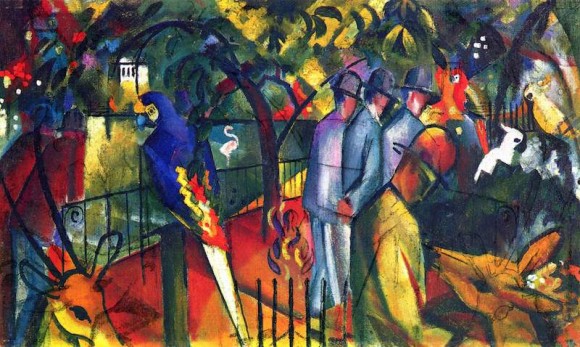
Zoological garden by August Macke, 1912.

Zoological Garden by August Macke, 1912.

August Macke’s city scenes showed silhouettes of slim and elegant women, admiring the latest fashion at shop windows and a sophisticated urban population sitting at cafes or strolling leisurely in a park. Macke looked for harmony in humans and in nature. His colors were vibrant and the atmosphere serene in sharp contrast with the violent, even depressive paintings of the Expressionists like Otto Dix, George Grosz or Max Beckman.

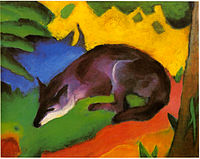
Blue black fox by Franz Marc.

Blue black fox by Franz Marc.

Before becoming an artist, Marc had thought of becoming a theologian. In 1909, he left Munich for the wilderness of Bavarian Alps to paint animals and eventually moved closer to Murnau. He sought the essence and the purity of animal through a theosophical view of the cosmos. Instead of being naturalistic, his representation of deers or tigers was increasingly stylized. The young wild horses seemed to bask in their freedom. In 1911 Wassily Kandisky and Marc created Der Blaue Reiter (The Blue Rider) group, named after the themes of horses and cavaliers found in their paintings.

At a time when the abstraction was like a tidal wave – Picasso and Braque in France, Paul Klee in Switzerland, or Mikhail Larionov in Russia – it is not surprising that Marc and Macke were drawn to these new forms. Robert Delaunay and Italian Futurist Gino Severini became their inspiration.

But sadly this was to be a brief adventure, since both artists were killed prematurely in the war.

Nicole Prévost Logan

Nicole Prévost Logan

About the author: Nicole Prévost Logan divides her time between Essex and Paris, spending summers in the former and winters in the latter. She writes a regular column for us from her Paris home where her topics will include politics, economy, social unrest — mostly in France — but also in other European countries. She also covers a variety of art exhibits and the performing arts in Europe. Logan is the author of ‘Forever on the Road: A Franco-American Family’s Thirty Years in the Foreign Service,’ an autobiography of her life as the wife of an overseas diplomat, who lived in 10 foreign countries on three continents. Her experiences during her foreign service life included being in Lebanon when civil war erupted, excavating a medieval city in Moscow and spending a week under house arrest in Guinea.

A Letter From Paris: A Look at Little (But Oh, So Powerful) Luxembourg

Nicole Prévost Logan

Nicole Prévost Logan

Although Luxembourg is a minuscule country, with only 476,000 inhabitants, it is one of the world banking powerhouses occupying second place with 2.4 trillion euros under its management. It is one of the founding members of the European Union (EU) and has been an active participant at every step of its construction. How did this happen?

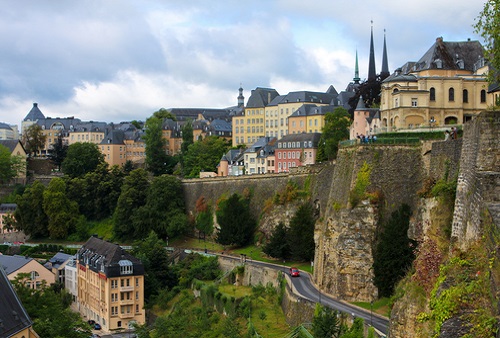
The capital occupies a spectacular site on a rocky ridge overlooking the precipitous ravines of the Petrusse and Alzette rivers. From the Roman streets (Cardo and Decumanus) intersecting in the Marchė aux Poissons (fish market) to the all-glass museum of contemporary art designed by I. M. Pei, a visitor to Luxembourg can admire many periods of architecture including the ducal palace built in a rare 15th century Spanish-Moorish style.

Luxembourg's Ville Haute has a stunning location

Luxembourg’s Ville Haute has a stunning location.

After centuries of domination by neighbors, including France, the Netherlands and Belgium, the 1839 Treaty of London granted the Grand Duchy of Luxembourg both its independence and definitive borders. Grand Duke Henri is the incumbent ruler of the reigning Nassau-Weilbourg dynasty .

The vocation of Luxembourg was at first to be an impregnable fortress. In 963, Count Sigefroi chose the rock of Bock to build a fort. When, in 1684, Napoleon laid siege to the town, he turned to his renowned military architect Vauban to expand the fortifications, which are still visible today, with ramparts, towers, tunnels, bastions and casemates (military blockhouses), all dug out of the cliffs.

Luxembourg has also enjoyed another vocation — to be chosen sometimes as the ruler of Europe. In 1308, Count Henry VII was elected King of Germany by the Prince Electors and soon afterward crowned as head of the German Holy Roman Empire. Since December 2014, the EU President – its highest executive – is Jean Claude Juncker, former Prime Minister of Luxembourg.

Luxembourg has been closely associated with the process of unification of Europe. Robert Schuman, born of a French father and a Luxembourg mother, was among the founding fathers of Europe. In 1947, the BENELUX convention, which created a customs union, was signed between Belgium, the Netherlands and Luxembourg. In 1950, Schuman and Jean Monet from France created the ECSC (European Coal and Steel Community). In 1957, Luxembourg, France, Germany, Italy, the Netherlands, and Belgium signed the Treaty of Rome, creating the EEC (European Economic Community).

The 1985 “Schengen Space” agreement, abolishing borders within Europe, took its name from a small Luxembourg village. The ‘quartier européeen’ has sprung up as a small Manhattan on the Kirchberg plateau with the sky scrapers of the European institutions like the European Investment Bank, the European Court of Justice, and most of the 150 international banks emblematic of modern Luxembourg.

In the 19th century, the discovery of iron ore brought Luxembourg into the industrial age. On the eve of World War I, it was the sixth producer of steel in the world. But, with the decline of steel metallurgy after the 1970s, Luxembourg had to reinvent itself and turned toward financial activities, which today constitute more than 30 percent of the country’s GDP. In 2001 the “Clearstream” scandal raised the suspicion of tax evasion.

Currently the trend is toward increasing transparency in the banking business. In early March of this year, during an official visit to Luxembourg by French president Hollande, “tax optimization” was discussed. It was decided that, by 2017, the exchange of information will become automatic between the two countries.

The policy of Brussels, led by Juncker, is to launch a program of “quantitative easing” or QE (similar to the one carried by the Federal Reserve in the US), of 3,000 billion into the European economy. Countries are now scrambling to qualify for the bail-out funds by presenting their most innovative projects.

Nicole Prévost Logan

Nicole Prévost Logan

About the author: Nicole Prévost Logan divides her time between Essex and Paris, spending summers in the former and winters in the latter. She writes a regular column for us from her Paris home where her topics will include politics, economy, social unrest — mostly in France — but also in other European countries. She also covers a variety of art exhibits and the performing arts in Europe. Logan is the author of ‘Forever on the Road: A Franco-American Family’s Thirty Years in the Foreign Service,’ an autobiography of her life as the wife of an overseas diplomat, who lived in 10 foreign countries on three continents. Her experiences during her foreign service life included being in Lebanon when civil war erupted, excavating a medieval city in Moscow and spending a week under house arrest in Guinea.

Talking Transportation: Rethinking First Class

Any regular reader of this column knows that I hate flying.  I love travel, but getting there by air is a pain … and getting worse.  Our local airports are vying for third-world status.  The security searches by the TSA make a colonoscopy look like fun.  And once on the plane, the airlines’ seats and service make The Fung Wah Bus seem like a viable alternative.

Why is it that airlines are all vying for the cheapest products instead of the best?  Why this race to the bottom where low-cost-carriers like Spirit and Southwest are the models instead of overseas service exemplars like Singapore and Emirates?

I, for one, am willing to pay more to get more.  I may not opt for first class, but I will only fly in business class on flights to California.  It’s worth it.

But the legacy carriers like American and United ask for $1600 one-way from NY to LAX, and they get it.  Their business class is full thanks to frequent flyer upgrades. But now there’s a cheaper, better alternative:  JetBlue.

When JetBlue began as a low-cost carrier in 2000, it found a loyal following by offering high frequency, friendly and comfortable flights.  Today they are an international carrier serving 87 destinations with more than 200 aircraft.  And they have one of the hottest terminals at JFK, T5.

And 10 of their newest planes, A-321’s, now offer a new product, “Mint”, with truly first class seating at lower-than-business class fares.  I finally had a chance to sample the service on a recent flight to LAX.

First, there’s the seating. There are just 16 seats with full, six foot lie-flat beds. I lucked out and got one of the four “private cabins” with 22-inch wide seats and a sliding door to the corridor.  My TV was a 15-inch flat-screen with live satellite feed, movies and SiriusXM Radio.  I had two AC outlets and a pair of USB plugs keeping all my gear fully-charged.

When I boarded, I found a welcome note, written by hand, from the flight crew thanking me for my business.  Also awaiting was a full duvet and pillow, an amenities kit and free Wi-Fi, coast to coast.

After take-off came the usual beverages and a most unusual meal … the choice of three tapas-like entrees from a menu of five on offer, prepared by Saxon+Parole.  The lobster mac-and-cheese was to die for.  But they also had Kosher, vegan and gluten-free options.  And coming soon, an on-board cappuccino machine.

The service was amazing.  This was one of the best flights ever, and I’ve logged miles for decades on five continents.  And the ticket was only $599 one-way.  I’d gladly have paid more.

The bad news is this amazing product is only available on flights from JFK to LAX (seven a day) and San Francisco (five times daily).  Rumor has it they may also add transcon flights from Boston, but you won’t by flying “Mint” on your way to Orlando anytime soon.  To the Caribbean, maybe.

So kudos to “New York’s hometown airline” for continuing to be innovative in offering more for less and making flying fun again!

Jim Cameron

Jim Cameron

About the author: Jim Cameron is founder of The Commuter Action Group, and a member of the Darien RTM.  The opinions expressed in this column are only his own. 

You can reach him at CommuterActionGroup@gmail.com   For a full collection of “Talking Transportation” columns, see www.talkingtransportation.blogspot.com