
Talking Transportation: Collecting Fares Using the Honor System

Connecticut’s newest mass transit system, CTfastrak, is off to a great start.  The bus rapid transit system running from New Britain to Hartford is carrying up to 10,000 passengers daily.  Mind you, that’s coming off of its debut week when all rides were free.

In fact, it’s the fare collection process on CTfastrak that makes it innovative:  it’s on the honor system.

Unlike most buses, CTfastrak passengers pay before getting onboard, purchasing tickets ($1.50 for two hour’s use) at the stations or online.  This reduces the “dwell time” at each stop as passengers can board through any door. A similar system is running in NYC on certain “Select Bus” routes and seems popular.

But without paying a fare to the bus driver as you board, how do they know you have a ticket?  Ah, there’s the rub.  The “honor system” relies on “Fare Inspectors” making random checks.  Getting caught without a valid ticket means a $75 fine, though in these early days they’re mostly giving warnings.

Only a handful of US transit systems have adopted the honor system for fare collection, including the San Diego Trolley and the MUNI subway in San Francisco. In Minneapolis getting caught on a bus without a ticket is a $180 lesson in “doing the right thing”.

In Los Angeles, the Metro had so many problems with free-loaders they converted to turnstiles. Even a $250 ticket for fare evaders didn’t encourage payment, resulting in a $9 million loss in ticket sales. And the fare there is only $1.50.

On Metro-North, fare evasion doesn’t seem to be a problem.  If you don’t have a ticket, they’ll just throw you off the train (at the next station, of course).  Or get an MTA cop to issue a fine.

Until a few years ago you could buy a ticket on the train for the same fare as on the platform.  That meant wasted time for conductors and a “money room” at Grand Central processing a million in cash each week.  Now if you don’t have a ticket and buy one on the train, there’s a $5.75 – $6.50 penalty… even on a $2 ticket.  Senior citizens get a break, as do those boarding at stations that don’t have ticket machines.

The bigger problem on Metro-North is uncollected fares. The railroad admits it loses money by not collecting all tickets … but less money than it would cost to properly staff trains with enough conductors to collect them all.

Most infuriating is when trains from Grand Central leave Stamford.  Everyone can see that dozens of commuters got off there and scores more got on.  But the new arrivals’ tickets are seldom collected unless conductors have issued seat checks to the original NY passengers.

Watching someone traveling from Stamford to, say, Bridgeport get a “free ride” is like watching someone shoplift in a store.  You just know you’ll be paying more to subsidize their larceny, with neglectful conductors as their willing accomplices.

href=”https://www.ftc.gov/faq/consumer-protection/get-my-free-credit-report”>credit report before quoting us a fare?
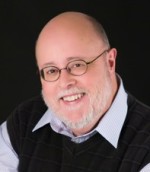
Jim Cameron

Jim Cameron


About the author:
Jim Cameron is founder of The Commuter Action Group, and a member of the Darien RTM.  The opinions expressed in this column are only his own.  You can reach him at CommuterActionGroup@gmail.com   For a full collection of “Talking Transportation” columns, see www.talkingtransportation.blogspot.com
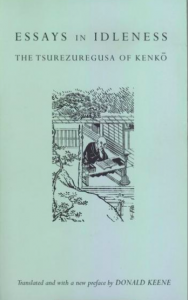
Reading Uncertainly? Kenko, “Essays in Idleness,” from The Tsurezuregusa of Kenko, (1332?)

KenkoOccasionally, I find myself compelled to drift into the past, seeking older words of wisdom. I was therefore drawn to Kenko, a Japanese Buddhist priest who wrote these words some 700 years ago: “The pleasantest of all diversions is to sit alone under the lamp, a book spread out before you . . . “ How true!

In these Essays, he leads with repeated cautionary admonitions: “The most promising thing in life is its uncertainty,” following that later with “A man is more likely to seem a true master of his art if he says, ‘I cannot tell for certain.’ “  And he concludes: “The one thing you can be certain of is the truth that all is uncertainty.” Yet today how often do we hear politicians, commentators, and ourselves state “absolutely,” “exactly,” “emphatically,” “certainly,” and unequivocally.” So much for uncertainty …

Here are a few more delicious Buddhist quotations:

  • “People tend to exaggerate even when relating things they have actually witnessed, but when months or years have intervened, and the place is remote, they are all the more prone to invent whatever tales suit their fancies, and, when these have been written down, fictions are accepted as fact.”
  • “What a foolish thing it is to be governed by a desire for fame and profit and to fret away one’s whole life without a moment of peace. Great wealth is no guarantee of security. Wealth, in fact, tends to attract calamities and disaster. Even if, after you leave enough gold to prop up the North Star, it will only prove a nuisance to your heirs . . . . The intelligent man, when he dies, leaves no possessions.”
  • “If you trust neither in yourself nor in others, you will rejoice when things go well, but bear no resentment when they go badly. You will then have room on either side to expand, and not be constrained.”
  • “In everything, no matter what it may be, uniformity is undesirable. Leaving something incomplete makes it interesting, and gives one the feeling that there is room for growth.”

So this brief comment is deliberately left incomplete, to encourage you to try Kenko!

Editor’s Note: Kenko, “Essays in Idleness,” from The Tsurezuregusa of Kenko, (1332?), as edited and translated by Donald Keene, is published by Columbia University Press, New York, 2nd edition, 1998.

Felix Kloman_headshot_2005_284x331-150x150About the author: Felix Kloman is a sailor, rower, husband, father, grandfather, retired management consultant and, above all, a curious reader and writer. He’s explored how we as human beings and organizations respond to ever-present uncertainty in two books, ‘Mumpsimus Revisited’ (2005) and ‘The Fantods of Risk’ (2008). A 20-year resident of Lyme, he now writes book reviews, mostly of non-fiction that explores our minds, our behavior, our politics and our history. But he does throw in a novel here and there. For more than 50 years, he’s put together the 17 syllables that comprise haiku, the traditional Japanese poetry, and now serves as the self-appointed “poet laureate” of Ashlawn Farms Coffee, where he may be seen on Friday mornings. His wife, Ann, is also a writer, but of mystery novels, all of which begin in a bubbling village in midcoast Maine, strangely reminiscent of the town she and her husband visit every summer.

Legal News You Can Use: What Do You Mean — I Don’t Have Enough Insurance?

Car Crash
In our personal injury practice we frequently deal with clients injured in automobile accidents. Frequently (and sadly), we often have to explain to severely injured people that their insurance may be inadequate to compensate them for their injuries. Thus, part of our initial client consultation is spent reviewing – and trying to simplify – Connecticut’s laws dealing with liability and uninsured/ underinsured motorist coverage.

Our job is to zealously advocate for our clients . . . and to provide good counsel.  So, let’s cover some basics (different rules may apply for commercial and fleet policies):

1. What is “liability coverage”?
This coverage protects the negligent operator and/or owner of a vehicle for injuries caused by negligent operation of the vehicle up to the amount of the purchased coverage limit. This coverage is generally found in Part A of your policy.

2. What is uninsured motorist (UM) coverage?
Connecticut law (C.G.S. 38a-336) provides that that each automobile liability insurance policy shall provide uninsured motorist coverage with limits equal to the policy’s “liability” limits. Uninsured motorist coverage provides protection and compensation to the driver and/or passengers in a vehicle if they sustain injuries and the negligent tortfeasor (“the bad guy”) does not have insurance. This coverage is generally found in Part C of your policy.

3. What is underinsured motorist (UIM) coverage?
UIM coverage provides protection for the same occupants in the event that the tortfeasor does not have enough insurance. Connecticut law requires that the tortfeasor only needs $20,000 in liability coverage.

4. What’s the cost for UM/UIM coverage?
When the liability limits and UM/UIM limits are the same most companies charge a premium for UM/UIM coverage that’s significantly less than the liability premium. Check Part C of your policy declarations page and compare that premium to Part A; it’s often 60-75% less. It’s less because insurance company actuaries have determined that you are less likely to use UM coverage than liability coverage.

5. Should I purchase UM/UIM coverage which is lower than my liability coverage?
The short answer: No. Connecticut Law allows you to reduce your UM/UIM coverage. Don’t do it.  UM/UIM coverage is designed to protect the operator, passengers and family members (and in some circumstances, pedestrians) associated with your vehicle. The cost is much cheaper than the liability coverage premium.

6. Can I purchase higher UM/UIM coverage?
Yes you can . . . and should. Generally, as you purchase more insurance the premium cost becomes cheaper per $1,000 purchased.  Connecticut law allows you to purchase UM/UIM coverage which is double your liability limits. Thus, if you have a $100,000 liability policy, you may elect to purchase $200,000 in UM/UIM coverage. If you can afford it, you should do so for your own protection.

7. What’s the difference between straight UIM coverage and conversion UIM coverage?
Under Connecticut law your insurance carrier is allowed to reduce from your UIM recovery any amount paid to you by the tortfeasor. Here’s how it works:  let’s assume that you have an injury for which $100,000 is fair compensation. Further assume that the tortfeasor has a $25,000 liability policy and that you have a $50,000 straight UIM policy.  You would think that you could collect $25,000 from the tortfeasor and $50,000 from your UIM carrier. Wrong!  If you have a straight UIM policy your carrier can deduct the $25,000 from your $50,000 policy, leaving you with $25,000 from the tortfeasor and $25,000 from your carrier. . . to compensate you for your $100,000 injury. Conversion coverage eliminates the ability of your carrier to claim a credit for money you receive from the tortfeasor. Thus, you could collect $25,000 from “the bad guy” and the full $50,000 from your policy.  Better yet, if you had double UIM conversion coverage ($50,000 x2 = $100,000), you could receive $25,000 from the tortfeasor and up to $100,000 from your carrier, thus fully compensating you for your loss.

There are many local insurance agents who can arrange coverage for you. The intent of this article is to simply better educate you on the need for, and issues surrounding, uninsured motorist and underinsured motorist law, so that you can make a better informed decision to protect you and your passengers in the event that the need to use such coverage should arise.

Suisman Shapiro Attorneys at Law is the largest law firm in eastern Connecticut, serving the community for over 70 years with a wide range of legal services.  John A. Collins III is the Managing Partner of the firm and a Director/Shareholder who concentrates in the areas of Personal Injury Law and Civil Litigation. For more information, visit www.suismanshapiro.com or call (860)442-4416.

Suisman Shapiro is located at 2 Union Plaza, P.O. Box 1591, New London, CT  06320

Talking Transportation: Personalized Airfares

Last time we were talking about mass transit systems collecting fares on the honor system.  This time, something completely different.  But to understand it, consider this analogy:

Let’s say you’re in a store shopping for a commodity.  You and another shopper each select one of the same items at the same time and head for the cashier.  But before you can pay, the cashier asks for your name and some identification.

You’re from Darien or New Canaan and a new customer.  The other shopper is from Hartford, but a regular at the store.  The cashier plugs in that info and you’re told that your purchase will cost 10 percent more than the other shopper’s.

What?  Well, welcome to the world of “personalized prices”.

You may not realize it, but this happens all the time when you’re buying gasoline, thanks to “zone pricing” where gas stations charge higher prices in more affluent communities, not just in Connecticut but nationwide.

And giving discounts to “best customers” is also quite common.  Monthly pass holders on Metro-North pay only half of what their peak fares would cost purchased separately.

But never before have these concepts been combined in some secret algorithm to apply to purchasing airline tickets … until now.

IATA, the International Air Transport Authority, has petitioned the US to allow its 250 members to capture and use new kinds of personal information about would-be flyers before quoting them a fare.

Most frightening of these could be some sort of “means test.”  In other words, as in a bazaar when the salesman sizes you up and asks, “How much do you want to pay?” the airline would figure out that answer itself based on your zip code and flying patterns.

So if you live in a rich town, they’ll assume you can pay more and quote you higher fares while folks in poorer communities are offered discounts.

To his credit, our US Senator Richard Blumenthal along with others in Washington are questioning the fairness, if not the legality, of all this.  They’ve written to the US Transportation Department asking if this plan isn’t hurting more consumers than its helping.

Airline flights have never been fuller.  Because they’ve shrunk their fleets and customer demand has come back, almost 80 percent of all seats are full on domestic and international flights.

Gone are the glory days of my mis-spent youth when students could fly “stand-by” hoping for an empty seat just before departure in return for a 50 percent discount. That only worked because planes were empty.

Today the incentive to get a cheap seat is to book early, weeks in advance, not to show up at the last minute hoping to find an empty seat.  There are none.

But to price the same seat bought at the same time at two different prices simply because of shoppers’ demographics seems unethical … if not illegal.

Airlines are not allowed to discriminate on the basis of race, gender, national origin.  So why would we allow them to, in effect, look at our credit report before quoting us a fare?

Jim Cameron

Jim Cameron


Editor’s Note:
Jim Cameron is founder of The Commuter Action Group, and a member of the Darien RTM.  The opinions expressed in this column are only his own.  You can reach him at CommuterActionGroup@gmail.com   For a full collection of “Talking Transportation” columns, see www.talkingtransportation.blogspot.com

Reading Uncertainly? ‘Let Me Be Frank With You’ by Richard Ford

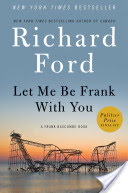
let me be frankLet me be frank with you, Frank: you are a bystander, a passive yet sensitive observer of the daily stream, but frustratingly disconnected!

“Frank,” of course, is Frank Bascombe, Richard Ford’s complex and compelling character who has now reached the age of 68. Ford first introduced him to us in The Sportswriter in 1986, when he, his wife and son moved from New York to “Haddam,” New Jersey (in reality Princeton, without the university) as he tried a new career as a novelist. That failed, his wife divorced him and he lost his son.

Frank resurfaced in Independence Day in 1995, when he took his second son for a quick tour of the Halls of Fame in Springfield and Cooperstown, just before the Fourth of July. This one included a delicious put-down of the town of Deep River! He had then become a real estate agent in Haddam.

And in our Millennium Year of 2000, in The Lay of the Land (published in 2007), Frank found a new wife, only to see her depart, had prostate surgery and, in this three-day story, tried to celebrate Thanksgiving as a 55-year-old in his new home on the Jersey Shore, still working in real estate.

Let Me Be Frank With You is the fourth in the series (doesn’t this remind you of John Updike’s Rabbit Angstrom?) and we find Frank back in Haddam, his second wife returned, as he interacts, still passively, with four unusual characters.

The first is Arnie Urquhart, a college classmate whose Jersey Shore house (it used to be Frank’s) has been demolished by Hurricane Sandy (Sandy, it seems, is a major character in this set of novellas). The second is Charlotte Pines, a woman he finds knocking on his Haddam door, an ex-resident of that house in which her family was killed. Then we reconnect with Ann Dykstra, his former wife, who has returned to Haddam to an “extended care facility” to cope with her onset of Parkinson’s. And finally we share Frank’s visit with Eddie Medley, an old friend who is in the final stages of dying.

Throughout these sessions Frank remains the foil, yet a remarkable observer of every facial tic, bodily motion and surrounding sights, smells and sounds: crows jousting in a tree, a trash truck grinding debris, auto horns, laughter next door. He just never seems connected. He’s open to everything …

But his stock answers in conversation are: “I don’t know. Maybe.” “It makes me realize how remote I am.” “All is frankly enigma.” He is an aloof reporter experiencing a syncopation of senses and sounds, in the middle of brief conversations.

Frank acknowledges his advancing age: “ . . .  the ‘gramps shuffle’ being the unmaskable, final-journey approaches signal.” And “as you get older things slide away, like molasses off a table top.” And “ . . . life’s a matter of gradual subtraction.” And someone asking of you “Are you okay?” He thinks: “No more grievous words can be spoken in the modern world.”

His self-description: “I am: a man who doesn’t lie (or rarely), who presumes nothing from the past, who takes the high, optimistic road (when available), who doesn’t envision the future, who streamlines his utterances (no embellishments) and in all instances acts nice.”

But Frank winds into all this a marvelous sense of humor, often acidic: An “extended care facility: Nothing’s bleaker than the stingy, unforgiving one-dimensionality of most of these places; their soul-less vestibules and unbreathable antiseptic fragrances, the dead-eyed attendants and willowy end-of-the-line pre-clusiveness to whatever’s made life be life but that now can be forgotten.”

Hurricane Sandy seems to be the primary stimulant of Frank’s aging recollections. As he notes, “There’s something to be said for a good, no-nonsense hurricane, to bully life back into perspective.”

But Ford’s Frank Bascombe lives on! Will we see a fifth view of him one day soon … perhaps at 80?

Editor’s Note: Let Me Be Frank With You by Richard Ford is published by Harper Collins, New York 2014.

Felix Kloman_headshot_2005_284x331-150x150

About the author: Felix Kloman is a sailor, rower, husband, father, grandfather, retired management consultant and, above all, a curious reader and writer. He’s explored how we as human beings and organizations respond to ever-present uncertainty in two books, ‘Mumpsimus Revisited’ (2005) and ‘The Fantods of Risk’ (2008). A 20-year resident of Lyme, he now writes book reviews, mostly of non-fiction that explores our minds, our behavior, our politics and our history. But he does throw in a novel here and there. For more than 50 years, he’s put together the 17 syllables that comprise haiku, the traditional Japanese poetry, and now serves as the self-appointed “poet laureate” of Ashlawn Farms Coffee, where he may be seen on Friday mornings. His wife, Ann, is also a writer, but of mystery novels, all of which begin in a bubbling village in midcoast Maine, strangely reminiscent of the town she and her husband visit every summer.