
A View From My Porch: A Short History of the Halls Road Overlay District (HROD), Why it is ‘a Worthy Project’

Tom Gotowka

Feb. 16, 2025—Prologue:
I read a fluorescent green flyer Sunday morning that was seeking signatures on an online petition; which I ignored.

The flyer disparaged the Halls Road Overlay District (HROD) and, of course, had no author or organization. It was anonymous; and began “BEWARE!” and then went on saying something about “A WOLF IN SHEEP’s CLOTHING!!” that may have been on the “tip of an iceberg.”

Then, Anonymous speciously claimed that the proposal included “dense housing” — i.e., “eighty bedrooms per acre;” which was false; but has unfortunately also appeared in other similar attacks. 

Anonymous continued with a recommended list of websites to visit and “scroll through for pertinent information;” and that may have been “the straw that broke the camel’s back.” Further, the Halls Road Improvements Committee (HRIC) noted last week in LymeLine that “there have been a wave of posts on social media and elsewhere making claims that misrepresent the actual content of the HROD proposal and distort its possible impact on our community. The true facts will not support these assertions, nor the emotional appeals based on horrifying and totally false claims.”

Nonetheless, that flyer and a few Letters to the Editor, comments, and essays in LymeLine inspired me to devote this “View” to the proposed HROD. 

I present the project’s key milestones in roughly chronological order in this “View — and rather than a detailed play-by-play on the activities of the HRIC team since its inception (see HRIC section below); I consider their vision, which is detailed in “The Master Plan.” 

Note that this essay reflects my observations, opinions, and interpretation of available HRIC documents and materials.

Halls Rd. is a unique thoroughfare within the “friendly confines” of Old Lyme. Located amongst four Interstate 95 entrances and exits and zoned commercial-only, it is Old Lyme’s principal retail and commercial district and has a 1950s and 60s strip mall look, with deep set-backs and large parking lots lining the roadway.

Within the past few decades, Halls Rd. assumed the appearance and function of an interstate service area. Traffic is dense and moves at a very fast pace from traffic light to traffic light on this “Halls Road Raceway.” There are no sidewalks or safe crosswalks. Bicycling is dangerous.

The Halls Road Improvements Committee (HRIC):

In 2015, Old Lyme’s Board of Selectmen (BOS) appointed a committee to address some developing community concerns regarding Halls Rd. The BOS’ charge became complex and has required interaction with several Connecticut agencies and cooperation with many Town commissions and departments. 

HRIC Milestones:

  • In collaboration with the Yale Urban Design Workshop, the HRIC conducted an objective evaluation of the existing conditions on Halls Rd. Several public meetings were held at which the community was encouraged to voice their concerns and wishes; and it was determined that residents wanted the Town’s commercial area to look more like Old Lyme — and specifically, have the “look and feel” of Lyme Street.
  • Working with the New England-based BSC Group for their expertise in civil and environmental engineering and strategic planning for communities like Old Lyme, the HRIC initiated development of a long-range plan for Halls Rd. 
  • “A formal ‘Master Plan’ is an important tool in seeking grants for work on Halls Rd., for encouraging investment, and for setting budgets” and “broad goals designed to insure the future of Old Lyme’s main shopping district.”
  • AI Engineers of Middletown, CT developed design and engineering materials for the new “Bow Bridge.” Designs were presented at workshops and residents voted their preference. 
  • Advance CT conducted an economic development study via surveys and workshops in 2020 on behalf of Old Lyme’s Economic Development Commission, and found that, “Over 80 percent of respondents supported additional development in the Halls Rd. area.”
  • Developed Halls Rd. Overlay District (HROD) Design Guidelines for new construction or updates to current properties. (also see below)
  • On June 17, 2024, provided a status update to the Old Lyme Board of Selectmen. 
  • On January 10, 2025, the Planning Commission voted unanimously that the proposed zoning overlay was consistent with Old Lyme’s Plan of Conservation and Development, which was adopted in February, 2021

Approvals:

  • Any work along a state motorway requires a DOT “encroachment permit.” In practice, such permits are usually sought in connection with applications for relevant grants administered by DOT.
  • Septic and groundwater approvals are regulated by Ledge Light Health District.

The ‘Halls Road Master Plan’ Vision:

Create a walkable, bike-able, mixed-use town center along Halls Rd. —  one that is an attractive place to live, work, browse, meet, and do business. The envisioned changes include:

  • Roadway and sidewalk improvements, including pedestrian lighting, to create safe pedestrian and bike routes along Halls Rd. from Lyme Street to Rte. 156 and the Baldwin Bridge — connecting Halls Rd. to the Arts, Historic and municipal center(s) on Lyme St.
  • Improvements to existing public green space that could include trails, a riverside park, and new town green.
  • A new “Bow Bridge” — reminiscent of Childe Hassam’s 1908 impressionist landscape, “Bridge at Old Lyme,” which features the original bridge, spanning the Lieutenant River at the old bridge abutment, connecting to trails through the green space. Note that this pedestrian- and biker-friendly bridge was consistently the single, most popular element suggested in town-wide surveys conducted at the beginning of the planning process.
  • Further, CT DEEP owns a triangle of property on the east bank of the Lieutenant River and is prepared to deed this property to the Town; but has requested that a fishing pier and 8 parking spots be included in the project. Note that Project design work for the bridge and trails was fully-funded with grants that covered concept design, surveys, permitting, and construction documents.
  • The Harbor Management Commission has requested that a floating dock be added to the pier. 
  • Residential alternatives for seniors considering a “downsize,” who might otherwise have limited options for remaining in Old Lyme — and/or young people looking to move into the community. 

These include small apartments above businesses with first floor retail; but could possibly include town houses. — but that is not a “given.” 

  • New commercial buildings in the HROD must include mixed use with retail/offices on the first floor and residential on the second. 
  • Current property owners can choose to stay put without modification; but if they want to take advantage of the HROD, must include mixed use.

The Jargon:

A mixed-use neighborhood includes both housing and commercial/retail spaces; and often provides housing options and services accessible to all income levels. 

It is not uncommon to find pharmacies, restaurants and cafes, delis, dry cleaners, and grocery and hardware stores within walking distance. 

Waxing poetic, mixed use neighborhoods offer a lifestyle option for those who do not have a desire to live in the suburbs or in places that are dedicated to residential uses only.

The vibrant nature of mixed use neighborhoods derives from the fact that these areas are more active for more hours of the day, rather than just a few hours in the morning and a few in the evening.

Design Guidelines:

New guidelines and supportive “Village District” zoning are designed to attract retail and residential investment that will serve the needs of Old Lyme and create a ‘look and feel’ on Halls Rd. that is in keeping with the rest of the town; but still require conformance with current zoning and established architectural standards.

The HROD includes a Design Review Committee as a first step for developers to ensure that the scale and design of any proposed construction is consistent with the aesthetics and character of Old Lyme prior to going before the Zoning Commission for project approval. 

Author’s Thoughts:

I was impressed with the depth and detail included in project documents supporting this thoughtful and well-planned initiative.

This is a worthy project and the end result will be important. Nevertheless, I discovered in my research that the discourse on HROD was surprisingly mean-spirited; and I wondered where that attitude was coming from. 

I used “the friendly confines,” phrase above to describe Old Lyme; Chicago Cubs fans will recognize that it was coined by Hall of Fame shortstop Ernie Banks as the nickname for Wrigley Field—”Win or lose, it’s always a good afternoon at the Friendly Confines.”

Editor’s Note: This is the opinion of Thomas D. Gotowka.

About the Author: Tom Gotowka is a resident of Old Lyme, whose entire adult career has been in healthcare. He will sit on the Navy side at the Army/Navy football game. He always sit on the crimson side at any Harvard/Yale contest. He enjoys reading historic speeches and considers himself a scholar of the period from FDR through JFK. A child of AM Radio, he probably knows the lyrics of every rock and roll or folk song published since 1960. He hopes these experiences give readers a sense of what he believes “qualify” him to write this column.

Sources— HROD:
BSC Group. “Halls Road Master Plan for the Town of Old Lyme, CT.” June, 2021
HRIC. “Frequently Asked Questions.” 
HRIC. “Halls Road Overlay Zone.: Perceptions and Realities.”
HRIC. “HROD Design Guidelines.
HRIC. “Project Status Update from Halls Road Improvement Committee.” LymeLine.06/22/2024
Todd, J&R. “Op-Ed: Reject HROD— Don’t Compromise Old Lyme’s Identity: “Thoughtful, Transparent Planning” Needed.” LymeLine. 02/05/2025
Margules, H. “Op-Ed: Support HROD—Inevitable Halls Rd. Will Change, Optional Overlay Positions Old Lyme to Better Manage Its Future: Other Choice is Leave it to Chance.” LymeLine. 02/08/2025.
HRIC. “Statement from Old Lyme’s Halls Road Improvement Committee: “Setting the Record Straight on the Halls Road Overlay District (HROD).”LymeLine. 02/14/2025.
Literature in the Lymes: ‘The Crazies: The Cattleman, the Wind Prospector, and a War Out West’ by Amy Gamerman

Jennifer Petty Hilger

Even if it wasn’t the name of the mountain range in which the story takes place, it would be a great name for the people in this book. It’s a good story and thanks to a good storyteller, it makes a great book. That’s not, as we know, always the case so we’re lucky the right person sunk her  teeth into this.

Investigative prowess doesn’t always transfer from article to book but it does inThe Crazies. Amy Gamerman’s real-life talents as a reporter and writer for the Wall Street Journal helped her gather this information and transform it into a modern, western saga about trying to control the uncontrollable forces of nature with power and money. 

It serves us well as she weaves the stories, the real life sagas, of the past and present dramas of the people involved in one of the largest, craziest lawsuits in recent days. Oil tycoons, cattle farmers, ancient pioneers, regular struggling laymen, Hollywood celebrities, poachers … who isn’t involved? Everyone’s case holds some weight. 

If it’s my land, why the hell can’t I do what I want with it?  Rick Jarrett wants to harvest the ‘million dollar wind’ that blows through Big Timber,  Montana with 500 ft. turbines on his small parcel of land. “The wind that blew alike on the rich and poor had the power to make Rick Jarrett a wealthy man.”

His tycoon neighbors don’t want to look at these eyesore turbines. The hell with the townies and their right to make money off of their own land. 

Just because you have 80 bazillion dollars and don’t want to be staring at something ugly, why do you get to say no to it?  “I like people … I just don’t want to be around them,” said Russell Gordy, the owner of 155,000 acres of land he spent $96 million amassing. 

Many Hollywood celebrities, who have made Big Timber—the nearby town—their hideaway home, feel similarly. Much is at stake for the big-monied hermits, who have no interest in the locals and their poverty.

Additionally The Crazies are held sacred by The Crow, whose ancestors are, perhaps, the original indigenous people in North America. The first burial ground dating back between 12,707 and 12,556 years was found on a cliff west of The Crazies’ Walsall Peak. The remains of a child found with a stunning array of tools and objects were found in 1968. The DNA links the boy to a human, who lived 40,000 years ago near Beijing. He is the most ancient American ever discovered. The Crazies aren’t ill-named.

Nothing about this lawsuit and its participants is cut-and-dried and that’s what makes it a good story.

There is nothing new about the basic human desire for control—and money is rarely outvoted.

About the author: Jen Petty Hilger grew up in New York and London, England, but finds herself happily quiet living by the water in Old Lyme. She and her husband have six children between them and a myriad of rescued animals.

Legal News You Can Use: Your Essential Checklist for a Smooth CT Home Purchase

The thrill of house hunting can quickly turn into a maze of complexities. With the right knowledge and expert guidance, you can confidently navigate the path to homeownership, turning potential pitfalls into stepping stones. Ready to unlock the secrets of a smooth property purchase? Let’s begin your journey to stress-free closing with this essential checklist.

Decode the purchase agreement

Your first crucial step is understanding the purchase agreement. This document outlines the terms and conditions of your property transaction. Pay close attention to contingencies, timelines and obligations. If legal jargon leaves you puzzled, consider seeking professional help to ensure your interests are protected.

Conduct a thorough title search

A clean title is your safeguard against future legal issues. Invest time in a comprehensive title search to uncover any potential problems. Do not forget to explore title insurance options – it is a small price to pay for long-term peace of mind.

Prioritize property inspections

Knowing every detail is crucial when it comes to your future home. Schedule necessary inspections and carefully review the results. Ensure the seller provides all required disclosures. Understanding your property’s condition can save you from costly surprises down the road.

Review financing terms

Securing the right mortgage is critical. Carefully examine your loan documents, understanding interest rates, repayment terms and any potential penalties. If the financial terminology seems overwhelming, do not hesitate to seek clarification from experts.

Prepare for closing day

As the big day approaches, review all closing documents in advance. Verify that all agreed-upon repairs or credits are accounted for. Having a legal professional by your side can provide invaluable peace of mind during this crucial phase.

Follow up post-closing

Your journey does not end at closing. Record all necessary documents and obtain your final title policy. Keep your closing packet in a safe place – you never know when you might need to reference it in the future.

Empowering your homeownership journey

By following this essential checklist, you are well on your way to a smooth Connecticut home purchase. Remember, when in doubt, seeking advice from experienced real estate attorneys can make all the difference in turning your homeownership dreams into reality.

This is a sponsored post by Suisman Shapiro Attorneys-at-Law.

Editor’s Notes: i) Suisman Shapiro is located at 75 State Street, New London, CT 06320. Their mailing address is 2 Union Plaza, P.O. Box 1591 New London, CT 06320. Visit their website or call 800-499-0145 — lines are open 24 hours a day.

ii) If you are involved purchasing a house, the attorneys at Suisman Shapiro can assist you. Reach an attorney specialized in the matter at the number above .

The Movie Man: ‘A Complete Unknown’ Draws You In, Keeps You There—Overall a Great Movie

I am generally wary of biopics, as I think they are simply made for Oscar bait.

Kevin Ganey is ‘The Movie Man.’

Your team could definitely catch the attention of the Academy of Motion Picture Arts and Sciences if you are seeking to re-create an aesthetic of a bygone era (be it costumes, set design, makeup, music, or even using production technology from any particular era to make it resemble films made in that time). This is on top of your actors’ working impressions of iconic public figures, hoping it be deemed more worthy of praise than creating a new character for audiences.

However, this is not the case with A Complete Unknown, which tells the story of the rise of music legend Bob Dylan. The first indication that I was enjoying this movie was that I was emotionally invested in the characters right from the start (a lesson I learned from the shortcomings of Gladiator II).

I never listened to Bob Dylan’s music, simply because I had no interest. But I was aware of his merit and influence on pop culture (after all, he was awarded the Nobel Prize for Literature in 2014). The title is seems appropriate for me, as this movie was the first time I listened to more than one song in one sitting. This was also my introduction to the debate surrounding Dylan’s controversial choice of using electric music at the 1965 Newport Folk Festival.

A Complete Unknown covers the rise of Dylan from his arrival in New York City in 1961 to said controversial performance. Dylan is depicted as possessing a genius beyond human capacity, which comes with the cost of social skills.

The theme woven throughout this picture is that Dylan is always seeking to be his own authentic self, and is willing to disrespect anyone, friends or business acquaintances alike, in order that he does not become a product of the music industry’s arsenal. Ironically, he will not share details about his background with anybody, even his girlfriend Suze Rotolo (renamed Sylvie Russo, at Dylan’s request, played by Elle Fanning).

While I did not think too much of Timothée Chalamet’s delivery of his lines (seems easy to imitate Bob Dylan’s nasal, high-pitched voice), my opinion changed when I learned he (and every other actor playing a musician in this movie) sang and played the instruments, himself. Upon learning this, my appreciation for his overall performance increased. It is one thing to imitate a historic figure’s speaking characteristics, but it is another to imitate their singing ability.

One particular performance that deserves praise is Edward Norton as Pete Seeger, who seemed to carry a wholesome and folksy vibe with him in every scene that put you at peace, even in the midst of a conflict. Norton’s performance, in my opinion, will be referenced in years to come as a metric for creating a character that is impossible to dislike.

We can also appreciate the little details in this movie (Easter Eggs, as we call them), as they reinforce the themes explored throughout its runtime. One I think of in particular is Dylan’s overgrown fingernails. That, alone, adds more depth to his character than extra dialogue, as it tells us that Dylan is non-traditional to his core.

Overall, this is a great movie worth the reader’s time and money. Compared to other movies I have reviewed, I do not consider it essential to screen it in a theater if there is the ability to stream it, as the reader could enjoy it from the comfort of their own living room if they simply wanted to stay in.

But I will reiterate that the best way to experience a movie is always in the theater. If you can, make screening A Complete Unknown an occasion that is worthy of getting out of the house and meeting up with friends. Doing so will give you more of an experience than just watching it at home.

About the Author: Having lived in Old Lyme and Lyme since the age of three, Kevin has always had a passion for movies that is beyond simply watching, but understanding the craft of cinema and and experiencing films as if they were a musical album. Kevin also has his own website devoted to movie analysis, CityOfCinema.com, and also co-hosts a podcast, Moviehouse Mystics, with Koda Uhl (available on Apple Podcasts, Spotify, and YouTube).

Letter From Paris: Global Delight Greets Reopening of Notre Dame Cathedral After Incredible Renovation

Nicole Prévost Logan

Editor’s Note: This article is based on the transcript of a talk on the reopening of Notre Dame de Paris given by Nicole Prévost Logan to the residents of Essex Meadows on Dec.10, 2024.

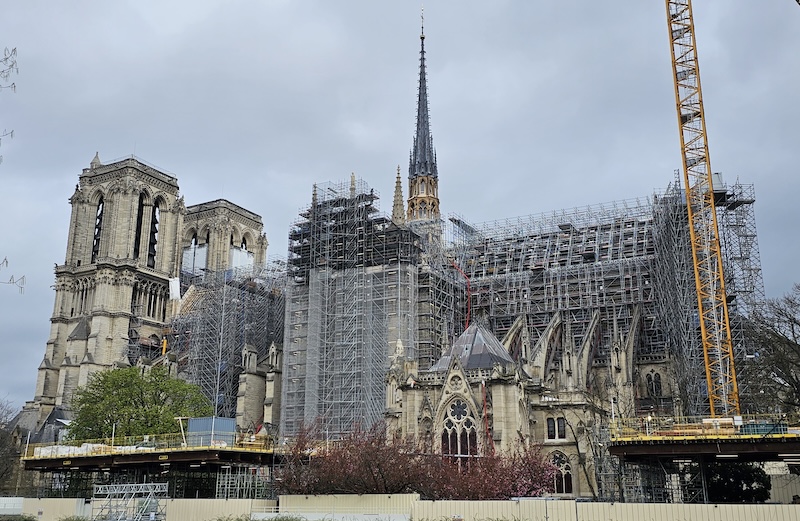
The Cathedral of Notre Dame was under extensive scaffolding during its restoration. Photo by Philip Logan.

The reopening of Notre Dame has been covered by the world media, including the New York Times, the Financial Times, National Geographic and many other publications. Striking images of the restored cathedral have been made available to all of us in numerous TV programs. The interest shown by the American public is particularly impressive. 

My children and myself, dividing our time between the US and France, have been privileged to watch first-hand the restoration process. I was able to make three slide presentations in Connecticut, respectively in 2019, 2020 and 2023, using the photographs sent by my children from Paris, including the professional shots taken by my architect son. It had become a family project to cover the story.  

December 7 was a day which will live in infamy, said FDR, but it marked also the joyous celebration that we had all been waiting for: the official reopening of the cathedral. I must admit I was glued to my computer to see the live report of the event on the French TV channels.

France is living through difficult times with the political deadlock and the frigid relations between Ursula Von der Leyen, president of the EU Commission and President Macron. Von der Leyen turned down the invitation to attend the ceremony and chose to be in Uruguay to promote a trade agreement with South America, which France and other EU countries strongly oppose.

Contrasting with the Middle East and Ukraine, which are being devastated and tens of thousands of people killed, the restoration of Notre Dame of Paris is an uplifting source of inspiration.  Carried out by an international surge of enthusiasm, the cathedral, not only survived after being on the verge of collapse for several months but resurrected to become more beautiful than ever . 

Before the fire of April 15, 2019, the monument was a decrepit old building.  During the years I lived in Paris, I always saw it disfigured by scaffoldings. The apse and its flying buttresses were in bad shape and had to be repaired. The 19th century spire was crumbling and metal scaffolding had been erected to fix it.  In fact, it is likely that the fire was caused by a short occurring in that pre-2019 scaffolding .

On the very evening of the fire, French President Emmanuel Macron made a promise to have the church reopened within five years. Philippe Villeneuve, chief architect of Notre Dame since 2013, supported that view. The excellent Sixty Minutes CBS show, aired on Dec. 1, 2024, stressed the importance of the president’s vision and continued support.

Another important remark made in Sixty Minutes was the excellence of the architects, artists, and artisans, who carried out the project, many of them part of The Companions du Devoir , an association dating back to the Middle Ages. They became a model and attracted the best arts and crafts workers in the world. 

One of them was a carpenter named Jackson Dubois from New York (a good name for a carpenter since “bois” means wood in French.)  Dedication and pride characterized the more than 2000 people, working on the restoration site of the cathedral and of the many other places throughout the country.  These workers were motivated by the importance of sharing their knowledge. Tools, methods and materials  were traditional. Much of the work was done by hand, and nails were not used in the making of the wooden framework for the roof and spire.

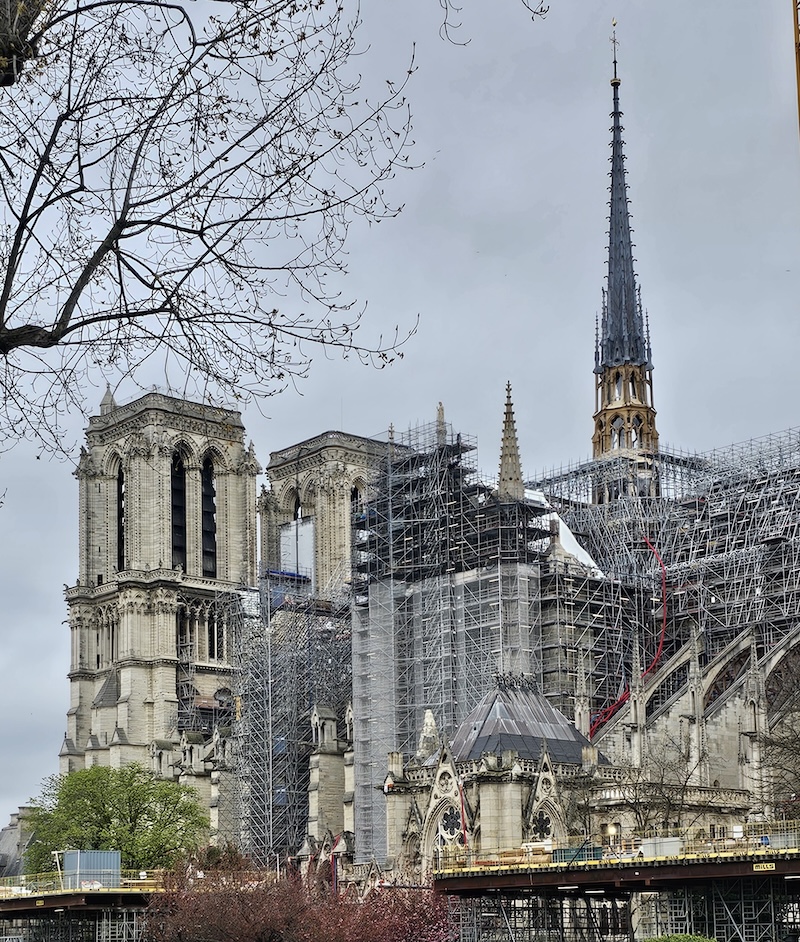
The sheer amount of work involved in the restoration is almost unfathomable. Photo by Philip Logan.

The restoration work of the cathedral was helped by an amazing amount of donations reaching 840 million Euros contributed by 240,000 donors around the world, the Americans coming in second place. Two of the richest men of France—Bernard Arnaut, the owner of luxury good LVMH, and François Pinault, another billionaire, who owns Gucci—competed.  

Arnaud gave 200 millions and Pinault donated “only” 100 million, but Pinault boasted that he did not ask for tax deduction. Two years ago Peter Bulkeley, during a fascinating tour of Fenwick in Old Saybrook, pointed out the house under construction of Francois Henri Pinault, the son of the billionaire and now head of the Christie’s auction house. Pinault’s summer “cottage”  overlooking the Sound in Fenwick has now been completed.

CTA BBC commentator summarized the Notre Dame project thus: no public funds, on time and on budget.  

The objective of the incredible task accomplished since the 2019 fire was not only to restore the cathedral but also to integrate into the reconstruction new features to prevent any future safety threat or any disaster such as a fire.

Here are two examples. In order to avoid the run-off of rain water from the lead roof, special filters have been installed to filter that water so that toxicity will be reduced to zero.  Dozens of thermal cameras have been installed in the new oak framework of the roof and of the spire.  If a fire were to start, it would immediately be detected and water pipes activated to spray a mist over the area. “A fire will never happen again” declared Philippe Jost who now supervises the completion of the work at Notre Dame.

Among the events which have taken place in the cathedral, an incident is rarely mentioned. General De Gaulle, on August 26 1944, after walking down the Champs Elysees was scheduled to attend a thanksgiving mass at Notre Dame. As he approached the church, snipers started shooting. Unperturbed, the general continued to walk.

Another view of the Cathedral of Notre Dame during its reconstruction.. Photo by Philip Logan.

Should there be an admission price to enter the cathedral? Rachida Dati, French Minister of Culture and former mayor of the seventh arrondissement in Paris, suggested five euros . An interesting clipping was published in The Day discussing the pros and cons. 

As a frequent visitor to Notre Dame my own experience has been of a disorganized system to face the huge lines.  Everyone—that is people going to mass, individual tourists, groups—all entered through the same main portal. A single church attendant would try to handle crowds. Inside the monument, people attending mass were bothered by the herds of visitors tramping through the aisles with their cameras flashing non-stop.

The Catholic church made an alternative decision to an entrance fee: at no time there will be more than 3,000 persons inside the building , each person will have only 45 minutes allowed in, reservations will be required three days in advance, different access doors will be used for individuals versus groups, church-goers or tourists.

Hopefully this will help alleviate the nuisance caused by the even larger of visitors expected in 2025. Our cultural heritage should to be treated with care. The cave of Lascaux, in south west France, had to be closed because human presence was detrimental to the mural paintings.  The Pope himself, in his letter read during the opening of the cathedral,  insisted that entrance had to remain free.  

I have always seen long lines of people wanting to see the view from the top of the cathedral.  Someone commented : if they want to see Paris they should climb on the Eiffel Tower . Did you know that until 1889, when the Eiffel Tower was built, Notre Dame was the tallest building in Paris?

The first impression of the recent visitors to the cathedral is its luminosity. Light is pouring in. The stone, which used to have turned dark grey with grime, soot and lead dust is now blonde. Colors are the new magic. It is a shock to see the vivid blues of the stained glass Rose windows, For the first time one is surprised to see the Viollet le Duc mural paintings in some of the 26 chapels The scenes of Christ life on the carved wall which separate the choir from the deambulatory, now has colors. 

In the Soviet Union, bells were silent for 70 years. People felt quite emotional when hearing them again. It was the same feeling in France after five years of silence. Emmanuel is the largest of all the Notre Dame bells. It dates from the 17th century, in Louis XIV time. It hangs in the South Tower and weighs 14 tons. It plays a low sharp F note. The eight smaller bells are in the North tower.  Sound is important in a cathedral, as remarked the first violinist in the Radio France symphony orchestra which performed in concert in the cathedral The “reverberation”-or  time during which the sounds lingers on- is seven seconds

Guillaume Bardet, designer of the liturgical furniture, created a minimalist altar, cast in bronze. The altar was produced in a foundry in the Rhone Valley region . The 1500 chairs, made of solid oak  were designed and created in the Vautrin workshop, in the Landes region.  The metal work decorating the spire was created in a Normandie foundry . The excellence of the artisans working in all these workshops in the country were an important part of the restoring team.

A final touch to the restoring process was the laying of the new, beautifully waxed checkerboard marble floor. 

Now for the official opening of the cathedral.  I listened and watched every minute of the proceedings so shown on the French TV, I could share with the details you in the US.

Actually three events were happening simultaneously.   The ceremony was  strongly affected by an uninvited guest: the Darragh storm  After a brief photo op, the guests , fighting wind and a pouring rain, struggled from their cars to enter the building. The large tent with hundreds of chairs where French president had been scheduled to make a speech, was now empty.

Fifty royals, chiefs of state, and personalities from France and the entire world had been invited. An important moment for diplomatic and political exchanges. President Zelensky was greeted with loud applause. The Baltic states were all present. Prince Albert II of Monaco was there without his wife and so was Prince William of the United Kingdom, representing his father King Charles III. The presidents of Finland and Poland were there.

President-elect Donald Trump alighted from his massive armored black car. He was wearing a yellowish tie. The cameras never left him. After shaking many hands, he reached the front row in the knave. 

How to sit the guests on that row must have given the protocol people an ulcer. Macron was first, then Trump, then Brigitte Macron and, next to her, Jill  Biden and her daughter Ashley. The President of Georgia and her husband—she leads the pro-Europe movement in that country—were the last. Twenty years ago she renounced French nationality to become Georgian.

Elon Musk entered and disappeared from the camera’s field. I saw him later gazing at the beautifully restored arched ceiling and keystones. The presence of certain personalities shocked some, for being out of place in a religious monument.  There were two noticeable absentees: Ursula Von der Leyen, president of the EU Commission, and Pope Francis.

The second theme of the ceremony was praise for all those who saved the cathedral and carried out the restoration. This is what Macron did in a brief speech. It was the first time since the Concordat of 1905, separating Church and State, that a French president has spoken inside a cathedral. The tempestuous weather left him no choice The arrival of the firefighters—in their intervention red suits—and of the Companions who worked on the site, were greeted with long and loud applause.

Finally, in the third place, the guests were invited to witness the powerful rituals marking the transmission of the secular to the religious authority over the cathedral. The Most Reverend Laurent Ulrich knocked three times with his crosier on the main portal before entering the cathedral. Emmanuel Macron returned the keys of to the archbishop.

The archbishop thanked profusely Macron for his continued support and for being there every step of the way.  One remembers how the president, apparently not afraid of heights, climbed to the very top of scaffolding over the new spire. From now on Philippe Jost, as Director of the Etablissement Public, will supervise the completion of the restoration work.

“Organ wake up” the archbishop pronounced those words three times. In a dramatic way, the lights went on the 18th century great organ with its shiny 8000 pipes. Three organists sat in succession at the console in response to the exhortations of the archbishop and filled the cathedral with the most beautiful chords in the world. “This the breath of God”, concluded the bishop. When played at its fullest volume, the organ—called grandes orgues in French—makes a gothic cathedral soar.

* * * 

The restoration of Notre Dame is not over. One can still see the giant cranes and the scaffoldings around the apse. The wood braces, which had been put in place to reinforce the flying buttresses, will be removed, and some contemporary stained glass windows will be installed.

The creation of a “in situ” museum is now being proposed. It would be located in parts of the Hotel Dieu hospital opening on the cathedral square and contain medieval artifacts.  

Editor’s Note: This is the opinion of Nicole Prévost Logan.

Nicole Prévost Logan

About the author: Nicole Prévost Logan divides her time between Essex and Paris, spending summers in the former and winters in the latter. She writes an occasional column for us from her Paris home where her topics will include politics, economy, social unrest — mostly in France — but also in other European countries. She also covers a variety of art exhibits and the performing arts in Europe. Logan is the author of ‘Forever on the Road: A Franco-American Family’s Thirty Years in the Foreign Service,’ an autobiography of her life as the wife of an overseas diplomat, who lived in 10 foreign countries on three continents. Her experiences during her foreign service life included being in Lebanon when civil war erupted, excavating a medieval city in Moscow and spending a week under house arrest in Guinea.