While Edward Berger’s Conclave brings an iconic cast of beloved actors, who deliver superb performances and offers thought-provoking themes, I do not believe it should be prioritized when asked for recommendations on recently released films. It is certainly worth watching, but not as soon as possible.
So often when we think of the depiction of the Catholic Church in media, it is often portrayed as an ancient institution that most of us do not relate to. Whether it is a historic film set at any point in the last two millennia, or the Church is a backdrop for sequences including a ritual (perhaps the baptism scene in The Godfather), or perhaps culture wars are at the heart of the matter, the Church appears to be irrelevant to the viewer.
Or, if the character is along the lines of Mother Teresa, Pope John Paul II, Mother Cabrini, or St. Francis of Assisi, we consider them to be heroes that have achieved a transcendent level of humanity that none of us could imitate. But Conclave reminds us, whether we are practicing Catholics or not, the Church is a human institution, dealing with familiar human matters that any of us will recognize.
One line perfectly encapsulates these themes, which are interwoven throughout the entire film: “We are mortal men. We serve an ideal. We cannot always be ideal.”
Ralph Fiennes leads the star-studded cast (which also includes John Lithgow, Stanley Tucci, Lucian Msamati, and Isabella Rossellini) as Cardinal Thomas Lawrence, Dean of the College of Cardinals, tasked with overseeing the papal conclave after the sudden death of the pope. We witness an ancient tradition taking place in buildings constructed during the Renaissance era but accompanied by contemporary technology (which I considered to be an incredible juxtaposition).
Here we witness the politics within the Church as groups with differing interpretations of pastoral care vie for positions of power, and we see the ugliness that leaders stoop to in order to achieve their goals, despite their positions as spiritual leaders. Lawrence perfectly encapsulates a hero we can relate to. He is a protagonist handed an important task that deals with the one thing he does not want: power.
He reminds me of Pope Benedict XVI, who also held Lawrence’s position when he was Cardinal Joseph Ratzinger, and submitted several letters of resignation from 1981 until he was tasked with overseeing the 2005 conclave. Hoping the new Pope would grant his request to return to Germany for academic purposes, he was ironically chosen to lead.
I anticipated the film to move in this historic direction but was surprised by the film’s choice for a twist ending. Without revealing any spoilers, it bore relevance to the theme of wrestling with uncertainty, but I cannot help but wonder if there were better options to pursue.
Uncertainty is the overall theme. As we stress over the uncertainty of the future—especially regarding secular matters—the film reminds us that uncertainty is even experienced in an institution that is founded on the hope of the resurrection of the historical Jesus and has spent 2000 years professing dogmas to better understand salvation. Even the most learned scholars and leaders struggle to understand what specifically should be done in this current chapter of history.
The viewer must contemplate the overall history of the Church as the cardinals squabble about who should take the seat of the successor to St. Peter the Apostle. As the protagonists fret that rigidly dogmatic clerics may end up in charge, they console themselves that, despite the possibility of leadership implementing harmful pastoral care, there have been worse Popes in the past (think of the Borgia Popes during the Renaissance, when the Church was run by the Mafia).
While Conclave certainly had my interest and I consider it a decent movie worth watching, I do not consider it necessary to watch as soon as possible. Perhaps it will be a movie for a rainy day in the future, but it is not a movie that requires a trip to the theater, especially during awards season.
About the Author: Having lived in Old Lyme and Lyme since the age of three, Kevin has always had a passion for movies that is beyond simply watching, but understanding the craft of cinema and and experiencing films as if they were a musical album. Kevin also has his own website devoted to movie analysis, CityOfCinema.com, and also co-hosts a podcast, Moviehouse Mystics, with Koda Uhl (available on Apple Podcasts, Spotify, and YouTube).
While I personally do not consider Robert Eggers’ horror films to be my cup of tea (mainly due to his non-traditional narrative style), I cannot deny his artistic merit and accomplishments with every film he has released (including The Witch and The Lighthouse).
His most recent film, Nosferatu, a remake of F. W. Murnau’s iconic 1922 silent movie of the same name (also an adaptation of Bram Stroker’s 1897 Dracula novel), is cut from the same cloth. I emphasize this simply because of my opinion, but the critic within me is obliged to promote and share his accomplishments with others who seek new movies worth checking out.
I first discovered Murnau’s original “Symphony of Horror” through pop culture references as a child (one that comes to mind is the title character flicking the lights in the SpongeBob episode that depicts the first 24-hour shift at the Krusty Krab). Even at a young age I could appreciate the creepy factor in this silent movie, particularly the famous shot of Orlok rising from his coffin.
The appearance of Count Orlok, alone, is enough to chill you to the bone. When I learned Eggers planned to direct a new adaptation of this classic, I knew that, despite my opinions, he was the one contemporary filmmaker who should be trusted with this task.
Again, I am not a fan of Eggers’ non-traditional style of directing but can acknowledge his talent. His unusual choices for cinematography leave you scratching your head, but you are captivated and eagerly anticipate what will happen next.
It reminds me of The Green Knight, another movie I reviewed years ago. I noticed that Eggers also makes use of sound to further unsettle his audience (to great effect), as well as emphasizing silence to set the viewer on the edge of their seat.
I was also impressed by the cinematography, particularly the depiction of scenes lit by only candle or fireplace, or even just the moon. His non-traditional methods also apply to his depiction of the vampire tropes we have come to understand throughout the history of movies.
But above all, we cannot overlook the acting. Every performer delivers, especially Lily Rose-Depp (daughter of Johnny Depp) as Ellen Hutter, whose performance shall certainly be hailed as an iconic Scream Queen in the years to come.
And a special round of applause must be given to Bill Skarsgård as Count Orlok, particularly his voice. After his success as Pennywise the Clown in the It movies, Skarsgård has proved he is not a one-hit-wonder, and with this performance has cemented his legacy in Hollywood and will certainly add more iconic performances to his resume for the rest of his career.
Because this is a horror movie, many readers will automatically rule out seeing it simply due to personal preferences. Make no mistake, there are plenty of horror movies whose merits go beyond the confines of the genre and are worth checking out (think of The Shining and The Silence of the Lambs).
However, I do not think I will go to great lengths to persuade somebody to subject themselves to discomfort and disgust to experience this accomplishment. I will certainly attempt to sway people into getting out of their comfort zone and give it a shot, despite knowing my efforts will be futile.
But for those of us who are fans of horror movies, it is absolutely worth the price of the ticket (or streaming subscription.)
About the Author: Having lived in Old Lyme and Lyme since the age of three, Kevin has always had a passion for movies that is beyond simply watching, but understanding the craft of cinema and and experiencing films as if they were a musical album. Kevin also has his own website devoted to movie analysis, CityOfCinema.com, and also co-hosts a podcast, Moviehouse Mystics, with Koda Uhl (available on Apple Podcasts, Spotify, and YouTube).
Lazlo is an 800-year-old demon with a terrible work ethic, a movie star human ‘glamor’ and a wicked sense of humor. He’s selfish, lazy, snarky, maybe secretly kind of nice and in big trouble. His high-ranking, evil father is punishing Lazlo by making him work a thankless job in the devil’s bureaucratic offices. A Hell’s ‘“Hell,” if you will.
While Lazlo runs up thousands of dollars in expense tabs doing nothing; he is supposed to be supervising the curse of a particular family; the Drakefords.
The Drakeford Curse has been mutating the family with horrific outcomes since colonial times and Maggie, the current heir, is about to face ruin. Maggie is 19 and entering her darkest hours as a Drakeford. At the family compound in upstate New York, she is slowly transmogrifying.
The Witchstone is an, as yet, unidentified totem at the center of what will unfold between Lazlo and the younger Drakefords. Lazlo , Maggie and young George, known as Lump, travel from upstate to New York City and then Europe. Lazlo takes the Drakefords in search of a way to break the curse. Or does he? Since he also tells his boss he specifically isn’t doing that. Then he tells someone else he might be thinking about, maybe not thinking of, not doing that. Smarmy to the last, we should definitely not trust a demon but we sorta do.
Demons from many sides intervene to stop the trio as they travel from fancy Italian hotel to cursed demon empress’s castle to holy church and every hell hole in between. Neff’s cast of demonic characters is unrivaled. I don’t usually root immediately for a movie to erupt from a book but this would be so great visually. Some of these creepy crawlers on the subway or tunneling underneath Central Park just scream for an agent.
Best of all, the very end made me want a sequel—like a Bond flick with a forked tail.
About the author: Jen Petty Hilger grew up in New York and London, England, but finds herself happily quiet living by the water in Old Lyme. She and her husband have six children between them and a myriad of rescued animals.
“The thinnest yellow light of November is more warming and exhilarating than any wine they tell of.” Henry David Thoreau
‘The English Lady’ is Maureen Haseley-Jones
Over the next few weeks, with the soil remaining above 40 degrees, it is an ideal time to divide summer blooming perennials, which have been in the ground for three years or more. Dividing perennials gives them a new lease on life and encourages more prolific bloom next season and the rule on transplanting also covers dividing.
Early spring blooming perennials such as Iris can be divided while the soil is still quite warm and, with adequate moisture, there will be enough root growth to anchor these divisions before frost heave becomes a problem.
Welcome to Fall everyone! I love the cool breezes and soft sunshine and the soil is still warm for you to plant through mid-November.
When dividing Iris cover the horizontal root divisions (the rhizomes) with just enough soil so they do not topple over, any deeper and they will not flower, and add composted manure around them when planted.
PLANTING AND TRANSPLANTING PLANTS
When planting a tree or shrub, dig a hole at least one and a half times as wide, not deep, as the root ball. An important rule to remember when planting and transplanting is not to plant the tree or shrub any deeper than it is in the container or wrapped in burlap. Or when transplanting any plant, tree, shrub and perennial is not to plant any of these plants any deeper than it was originally in the soil; planting too deep can be the death of plants.
If you are unable to dig to any depth for a plant in the case of ledge in your garden, berm up the soil on the ledge and plant so that part of the root ball is above the soil grade, mounding soil around it.
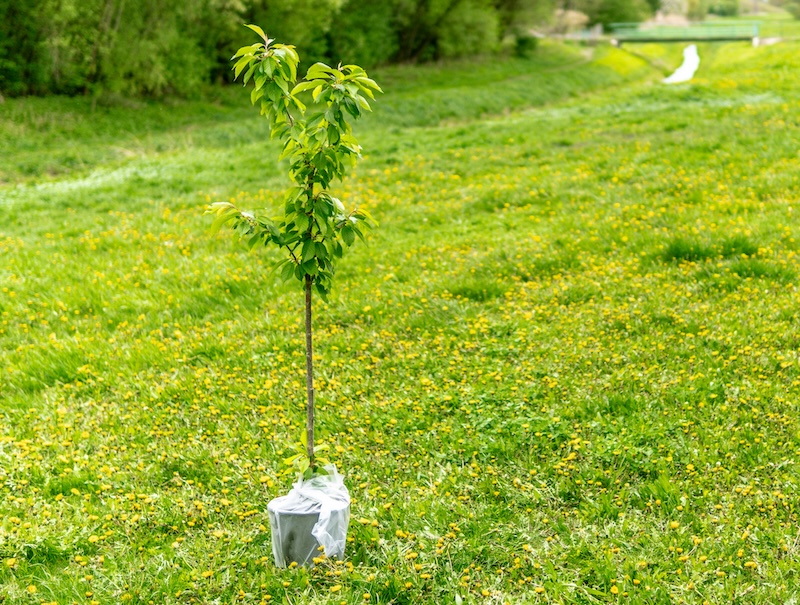
When you are planting a young tree, it is important to handle it with care. Photo by George Bakos on Unsplash.
Handle your tree or shrub by its root ball, not by the trunk or branches. After planting and transplanting add composted manure with one part compost to three parts manure. If you do not have compost, manure is excellent. Water deeply, slowly and thoroughly when planting and at least twice a week through the fall until the first hard frost, which in this area of New England is usually about the second week of November.
The following trees are not good candidates for fall planting: Birches, Larches, Gingko, Oaks, Magnolia, and all flowering fruit and flowering trees as well as the Eastern Red Cedar. These trees have fleshy roots and their feeder roots are not large when young and therefore take time to establish and are susceptible to frost heave.
Perennials that do not like to be planted in fall are: Artemisia, Lambs Ears, Foxglove, Penstemon, Anemone, Campanula, Kniphofia, Lupines, Scabiosa, Ferns and Grasses.
Plant garlic this fall – garlic is the antibiotic of the garden. Plant it under fruit trees to avoid scab and root disease, near to ponds or standing water to control mosquito larvae or pour garlic water into ponds, bird baths and fountains to deter adult mosquitoes.
WORDS OF WISDOM
At this point I want to reiterate what Franklin D Roosevelt said in 1937; ‘The nation that destroys its soil destroys itself’. America has not heeded that warning. Precious soils in this country and around the world are being destroyed by dangerous practices in industrialized agriculture and poisonous chemicals, which completely disrupts our ecosystem and poisons all living things.
HUMUS
The Humus component – good news for organic gardeners – in your own garden you can build and retain a rich, growing environment by building the Humus component. We are all carbon-based creatures as is all life on earth. Not only humans but also our soil microbes need carbon to flourish. Attracting carbon from the atmosphere is necessary to build the humus component.
To begin the process of humus – add composted manure three times through the year – early May, July and now in October/November. Manure builds soil structure and provides a rich planting environment for the following season by encouraging the millions of soil animals down below to manufacture nutrients for the roots of the plants.
Plus add mulch in the form of natural brown fine bark mulch or wood chips that you produce from your garden – aged wood chips with a combination of leaves, twigs and branches.
With manure and fine bark mulch, you are building the humus component. The manure and mulch attract carbon from the air, which builds the richest organic planting environment – the humus component.
Mulching the garden and in particular any plants planted, divided or transplanted this fall with two inches of fine bark mulch, when the ground to cools in late October, will keep warmth and moisture in the soil and protect the roots of your plants through the winter.
Humus brings many benefits to the garden.
You are probably asking what are the benefits of humus? Here are the reasons:
Humus acts like a sponge and holds 90 percent of its weight in water.
Because of its negative charge – plant nutrients stick to humus with nitrogen, calcium, phosphorus and other elements, which prevents these from washing away, and acts as nature’s slow- release fertilizer.
Humus improves soil structure making it loose and friable, which helps plant roots in the soil and makes for better access to nutrients, water and oxygen.
Humus also helps filter’ toxic chemicals from the soil, much like carbon-based water filtration systems that filter toxins from your water.
We cannot control industrialized agricultural practices – but in your own garden you can make a difference. Grow the soil and the soil will grow the plants.
Mulch and peat, which provides acidity, and is particularly important for any newly planted broadleaf evergreens installed in September. As mentioned previously, evergreens are shallow-rooted, and can heave above ground in hard frosts. I suggest that you store a few bags of topsoil and mulch in the shed or garage. When you see exposed roots after frost heave, cover them with the soil and mulch until the plant can be resettled next spring.
Now let’s look at what should be done now in the vegetable garden focusing first on cover crops. Last week I cut down the finished crops and dug them lightly into the soil.
This year, my choice for a cover crop in one area of the vegetable garden, is Alfalfa, which has 3.4 percent nitrogen content, and on the opposite side of the garden I will plant Buckwheat, which has 1.4 percent nitrogen content, which provides nectar for beneficial insects. I will then cover the seeds with organic, composted manure. There are many cover crops to choose from; I use white clover and rye grass in alternate years. In spring, when the earth is workable not too wet or cold, the cover crop is turned into the earth as ‘green manure’.
There is nothing better than your own homegrown organic vegetables – good for you and for the environment.
The less hectic pace of fall provides an opportunity to rethink your gardens. The garden’s pre-winter grooming can wait for a few weeks. You may feel that you would like a professional design, having thrown good money after bad and nothing looks right.
If that is so then contact someone that you trust to work with you to create a plan in the fall and winter, which can be phased in beginning next spring. Engage someone who will listen to your wants and stays within your budget. My son, Ian of Landscapes by Ian.com, always says, ‘It is not what you do in the garden, but how it makes you feel’.
SPRING BULBS
Early November is the time to plant spring bulbs. When purchasing Daffodils, choose early, mid-season and late blooming Daffodils, by doing so you will have a succession of bloom. Be adventurous this year and go for masses of a single color for the greatest impact. No matter how small your planting area, it is the intensity that counts, with two or three dozen red Tulips or a hundred Daffodils planted on your woodland edge.
Buying daffodils in large numbers is less expensive, it’s true the bulbs are usually smaller but that is not a problem because daffodil bulbs grow larger each year they are in the ground. Even though many say that the bulbs should be spaced six inches apart, there is no reason they cannot touch.
A sea of daffodils is always a joy to behold in a yard.
Apply some composted manure or bulb food on the soil where bulbs are planted. Wear gloves when you plant bulbs as they contain a skin irritant, which may cause a rash.
The general rule is to plant bulbs about three times as deep as the bulb is tall and with the pointed end up. This method is appropriate for most bulbs, although tulips should be planted about 12 inches down if you want to produce bloom for a second year. Daffodils should be planted no less than nine inches down, which is below the frost line. I suggest that you do not plant the bulbs singly for the most colorful impact, but plant in groups of odd numbers, 5,7 or 9 bulbs as odd numbers are harmonious in nature.
Small bulbs like crocus, can be tossed gently into a shallow trench with composted manure on the bottom of the trench, about three inches deep and plant them where they land, pointed side up. For larger bulbs like tulips and daffodils dig a trench about nine inches deep and three or four feet long with composted manure as the base and scatter these larger bulbs in the trench, also with the pointed end of the bulb faces up!
Personally, I treat Tulips as annuals because their first year’s bloom is the best, after that first year the bloom is never as full and vibrant; the only exception to this is the parrot tulip, which I find, flourishes for years.
A word of caution -Tulips are the ‘caviar’ of the bulb family. The best method to prevent them from becoming a tasty item on the rodent’s menu is to soak them in an organic deer-repellent, which also repels rodents. Allow the tulip bulbs to dry before planting.
If you are unable to plant your bulbs immediately when purchased, keep them in a cool, dry place in paper bags. The best time to plant spring bulbs in the Northeast is in mid-November.
Observe Mother Nature; plants in nature do not grow in straight lines but in gentle curves that connect harmoniously with the earth.
TREE WORK
Choose a licensed arborist. This work is much less expensive to have done in the fall after the foliage has fallen, then the arborist is able to see more clearly what needs to be done and the work goes faster – meaning less labor time and therefore, it is less expensive.
If you have deep shade and want more sunlight in an area, ask the arborist to thin out the tree’s canopy and prune lower branches to make for a sunnier area, this will give you more choice of plants, that grow in dappled rather than deep shade.
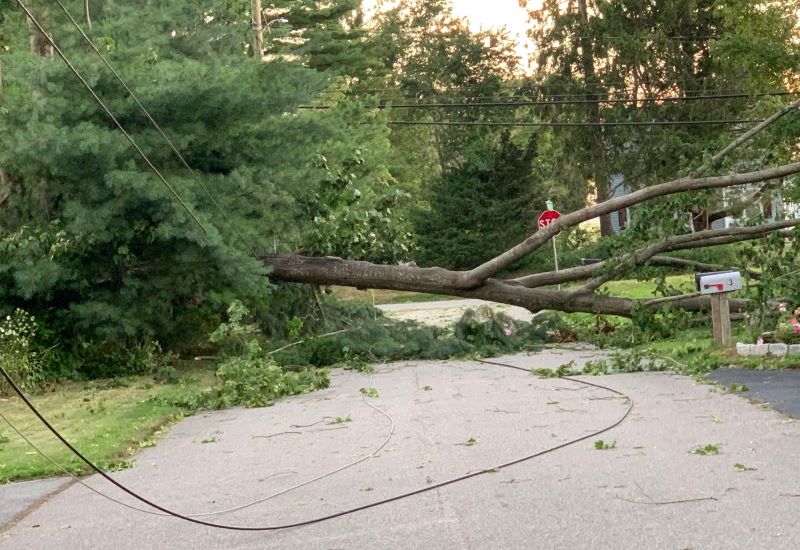
Badly-damaged trees, such as the one in the photo above, require removal. Photo by Jay Graves.
If you have a badly-damaged tree, meaning over 50 percent damaged or diseased, then have it removed, which may allow for a sun garden or perhaps the vegetable garden you have always wanted.
I do not cut down my spent perennials in fall, leaving them up so that I am able to enjoy the browns, grays, and yellows and faded greens, which blend gently with winter’s muted landscape. The seed heads of the perennials are wonderful snacks for the birds and in the dead of winter, what better sight than a red cardinal on the Winterberry bush in the snow.
Also wait until next April to cut down ornamental grasses; their graceful foliage is lovely to enjoy with the icicles on them shining in the pale winter sun.
Any spent perennials that show disease should be cut down but if the plant is more than one third diseased it should be dug up and discarded. Then throw the diseased material in the garbage not in the compost. Clean up any fallen plant debris from the soil and ONLY if it is disease- and weed-free, can it be added to the compost pile.
PEONIES
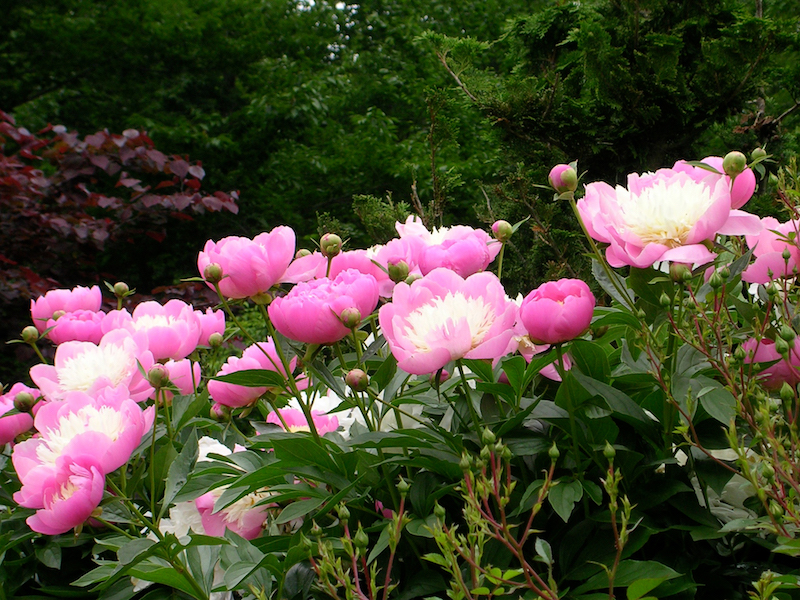
Peonies need careful attention at this time of year to create a display like this next year.
In November, after the first hard frost, cut down peonies to within six inches from the ground and add some composted manure around the base of the plant.
SIGNS OF FROST
You can foretell a hard frost when you notice the afternoon temperature falling fast under a clear sky. Assess the wind by taking a long strip of plastic, like a shopping bag from the supermarket, and hang it from a tree branch. If the bag flutters about a foot in either direction, you do not have to worry about frost, but if it blows vigorously then frost is on the way. If you still have plants in the garden that are of concern, cover them with salt hay, newspapers or light weight old quilts and put a brown paper bag from the grocery store over smaller plants like herbs, anchored down with rocks.
Your houseplants should be indoors by now. After their summer sojourn outdoors, then wash the pots thoroughly and add fresh potting soil. Then replant the plant at the same depth it was at originally and into the sink or shower and allow water to wash the foliage and water the plant well. If the plant has outgrown its pot, transplant it to the next size clean pot, only one and a half inches larger.
Enjoy the pleasant Fall weather and if you have any gardening questions, feel free to email me at MaureenHaseleyJones@gmail.com and I will see you in your garden in November.
About the author: Maureen Haseley-Jones is a member of a family of renowned horticultural artisans, whose landscaping heritage dates back to the 17th century. She is one of the founders, together with her son Ian, of, The English Lady Landscape and Home Company. Maureen and Ian are landscape designers and garden experts, who believe that everyone deserves to live in an eco-conscious environment and enjoy the pleasure that it brings. Maureen learned her design skills from both her mother and grandmother, and honed her horticultural and construction skills while working in the family nursery and landscape business in the U.K. Her formal horticultural training was undertaken at the Royal Botanic Gardens at Kew in Surrey.
Editor’s Note:We are delighted to welcome a guest author to our ‘Literature in the Lymes’ column today and it is none other than the talented daughter of Jennifer Petty Hilger, our regular book reviewer. Campbell Mann is a writer from Lyme, Conn. After training as an operatic mezzo-soprano at The Boston Conservatory, she has since worked as a poet and mixed-media artist. She currently lives in Brooklyn, N.Y., with her partner and a variety of indoor philodendrons.
Campbell Mann
It is difficult, perhaps impossible, to find a 21st century reader unfamiliar with Frankenstein.
Mary Shelley’s seminal novel, first published in 1818 when its author was 20, has since towered over Gothic and post-Gothic literature for more than two centuries. It is rivaled in magnitude of popular absorption perhaps only by Stoker’s Dracula (a work, which is heavy-laden in its own right with Shelley’s influence, along with that of her husband Percy and the couple’s notorious, occasional friend, the poet Lord Byron).
It has inspired endless and near-constant adaptation—practically every decade of the past century has seen its own half-dozen film and television versions. And while some of these are faithful to the novel, most are wildly extrapolated—the green-skinned, bolt-necked icon of American Halloween bears little resemblance to Shelley’s wretch.
I say this not to argue for literary purism—it is entirely to be expected for a 206-year-old story to be vastly altered in so much time—but merely to highlight our vast distance from the source. Most, while they know Frankenstein, do not know Frankenstein.
Admittedly, Frankenstein can be a difficult text. It possesses many of the qualities that often deter readers from Georgian literature at large; it is verbose, dense, confusing at times in structure and syntax. But in spite of this, it glistens with a modernity that is striking even now. It is gripping, tense, emotionally radiant, and immensely readable. It is haunting and stunningly profound.
As in many 19th century novels, Shelley places us first within the exterior of a frame narrative. We are loosely in the 18th century, as an Arctic-bound research ship finds itself trapped in the ice floes. The expedition’s leader, Captain Robert Walton, begins a series of letters to his sister, Margaret, detailing the strange occurrences of the recent days. First, an enormous figure has been seen driving a pack of sled-dogs in the distance, unnerving the captain and crew. A starving, freezing man is then pulled from the ice, who introduces himself as Victor Frankenstein. In Walton’s eyes, Victor sees a glimpse of something—passion, or obsession—and begins to warn him of its consequences with his own tale.
Born into a wealthy family from Geneva, Switzerland, Victor Frankenstein spends his youth enraptured by the potential power of alchemy and science. Shortly before he leaves to pursue his interests formally at the University of Ingolstadt, his mother dies, pushing his obsession deeper into the mysterious forces of life and death.
At Ingolstadt he excels and soon longs to further his own secret theories, body-snatching corpses and vivisecting feral animals until he has created an eight-foot-tall humanoid creature, whom Shelley calls the wretch. But naturally, Victor has not thought this through. As the wretch gurgles painfully to unnatural life, his creator abandons him and flees in terror.
The narrative’s long remainder details the ways in which Victor and the wretch relate to the world and one another. Of course, it is far more complicated than that, but that is the most broad stroke of it. There is violence, loss, and pain on all fronts.
Shelley tells us, over and over in endless ways, that these two beings are inextricably bound to one another. What do we owe to our children? What do we owe to each other, and to ourselves? What if our actions are not the whim of a moment but profound and material choices, with consequences borne not by us alone?