

Talking Transportation: Why Ferries Aren’t the Answer for Commuting in Connecticut

Bridgeport to Port Jefferson Ferry

Bridgeport to Port Jefferson Ferry

Recently, NYC Mayor DeBlasio announced a $325 million plan to reintroduce ferry boat service to the five boroughs charging the same fare as subways.  The mayor says these boats could carry 4.5 million passengers a year.

So why don’t we have ferries in Connecticut?  There are several reasons:

SPEED:  In open water, fast ferries on the Sound could make 30 knots (35 mph).  But if they must sail up inlets to the downtown areas of Bridgeport, Norwalk or Stamford, that speed is cut to 5 knots, extending travel time.

DOCKING: To keep to their competitive speeds, docks would have to be located close to the Sound.  That’s expensive real estate. And what about parking at those docks… and drive-time on local roads to reach them? Again, more travel time.

FREQUENCY: Metro-North offers trains to midtown New York every 20 minutes in rush hour carrying 800 – 1000 passengers per train. No ferry service anywhere in the country can compete with that frequency of service. Will travelers really be willing to wait an hour or two for the next boat?

COMFORT: In nice weather, a boat ride to work sounds idyllic. But what about in a Nor’easter?  The bumpiest ride on the train pales by comparison.

FARES:  The most optimistic of would-be ferry operators in CT estimate their fares will be at least double those charged on the train.  And people say Metro-North is too expensive?

OPERATING COSTS: Fast ferries are gas guzzlers, the aquatic equivalent to the Concorde.  When the Pequot tribe built high-speed catamarans to ferry gamblers to their casino in Connecticut to lose money, the service proved so expensive to run that the Pequots dry-docked the ferries in New London.

ECONOMICS: The final reason I don’t think ferries make economic sense is that nobody else does either!  Ferry operators (like the near-bankrupt NY Waterways) aren’t stupid. They’ve looked at possible service from coastal Connecticut, crunched the numbers and backed off. In a free market economy, if a buck could be made running ferries, they’d be operating by now. They aren’t operating, and there are lots of reasons why, many of which I’ve listed.

The only place ferries are run successfully is where they’re heavily subsidized (everywhere), have a monopoly (for example, getting to downtown Seattle from an island suburb), don’t duplicate existing transportation routes (like from Bridgeport to Port Jefferson), or offer advantages of speed because they operate on extremely short runs (from Hoboken to midtown).  Our situation here in Connecticut passes none of those tests.

You already know I’m a train nut. (The bumper sticker on my car reads “I’d Rather Be on the Train.”)  And I do love an occasional recreational sail on the Sound.  But it’s unrealistic to think that commutation by ferries is in our future.

Jim Cameron - Chairman of the CT Metro-North / Shore Line East Rail Commuter Council

Jim Cameron

About the author: Jim Cameron is founder of The Commuter Action Group, and a member of the Darien RTM.  The opinions expressed in this column are only his own.  You can reach him at CommuterActionGroup@gmail.com

For a full collection of “Talking Transportation” columns, visit www.talkingtransportation.blogspot.com
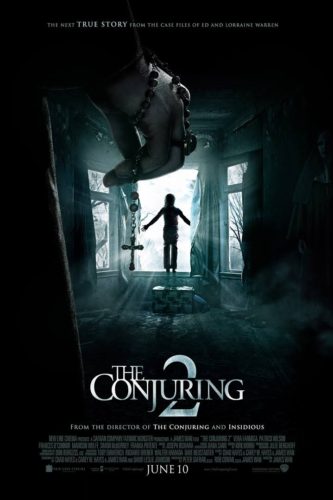
The Movie Man: “The Conjuring 2” … Enter If You Dare

Conjuring_2 A little disclaimer: unless you like “jump” moments in movies, avoid The Conjuring 2 (there’s a lot of them).

The sequel to the highly successful 2013 film, The Conjuring, tells the story of another paranormal case tackled by real-life demonologist couple, Ed and Lorraine Warren (Ed passed away in 2006, while Lorraine still lives in their family home in Monroe, Connecticut). The Warrens are perhaps best known for investigating the claims of the Amityville Horror.

For those who are not familiar with this legend, as well as the references and parodies throughout pop culture, 23-year-old Ronald DeFeo, Jr. murdered his parents and four siblings in the middle of a 1974 night, claiming he was coaxed into committing the acts by “voices.” A new family, the Lutzes, eventually moved into the home a year later, had their priest bless the home, and claimed that during the blessing, he heard a masculine voice tell him to “get out,” accompanied by a slap across the face, bleeding hands, and flu-like symptoms. The Lutzes only lasted 28 days in the house before they took off.

Upon researching the Warrens, it came as no surprise that they were subject to a great deal of scrutiny and controversy, as many skeptics claim there are holes in their stories regarding their investigations. This can be said about the Amityville Horror, as well as another case that took place in Seymour, Connecticut, and was featured on Discovery Channel’s A Haunting program. The list goes on and on. However, even if you do not believe any piece of their stories, you cannot deny the horror that is embedded in them, and they will be sure to keep you up at night, worrying about all you cannot see.

I am not writing this as a way to propose or criticize claims about ghosts and the supernatural, although I have had certain experiences in allegedly haunted locations that have made me a believer in regards to the supernatural. The only form of apologetics I will engage in is quoting Hamlet, in regards to those who consider themselves to be “rationalists”, in saying:

“There are more things in heaven and earth, Horatio, [t]han are dreamt of in your philosophy.”

The Conjuring 2 opens with Ed and Lorraine investigating Amityville with the Lutzes. Lorraine goes into a trance and witnesses the massacres that took place in said home, as well as other frightening supernatural images, including a large nun with a demonic appearance. After this investigation, she urges Ed that they not take any cases for a while. Unfortunately, due to their newfound popularity, a family all the way across the Atlantic is able to plead to them for help, claiming a poltergeist is harassing them, and has taken a special interest in their daughter, Janet. Much to Lorraine’s chagrin, they take on the case in hopes of defeating the evil spirit.

There is something about director James Wan’s take on depicting this story, especially through his cinematography involving slow zoom-in’s and “jump” stills in which we suddenly see something that has transcended our senses, as if it has taken off a mask that allowed it to remain unseen (or a ring, for those of us who are fond of J. R. R. Tolkien’s stories of Middle Earth?). The soundtrack proves to be unique amongst all other forms of music, focusing mainly on violins and cellos reaching low and shrill notes. But what helps make this a great horror film is not the amount of disturbing images or loud sounds, but in its stories that are woven in and out of the main plotline, depicting Ed and Lorraine’s marriage bond, and the victim family’s sad home-life.

I have said this to many people in the past, and I will say it again: too often Hollywood makes horror films that are comprised of excessive blood and gore, and hires models, not to act, but to read lines. If you want a good horror film, you need a good story and good actors, and most of all a good portrayal of everyone’s relationships. Just because you have beautiful college girl in nothing but her underwear screaming loudly and blood sprays on her does not guarantee a critical success. Perhaps a financial success, and maybe some experience for up-and-coming actors trying to get their feet in the door, and at the very most cementing a scene from the film into pop culture (but not for good reasons).

A great film for anyone who appreciates cinema, is fond of ghost stories, loves to be on the edge of their seat, or repeatedly scared to death. Enter the theaters, if you dare…

Kevin Ganey

Kevin Ganey

About the Author: Kevin Ganey has lived in the Lyme/Old Lyme area since he was three-years-old, attended Xavier High School in Middletown and recently graduated from Quinnipiac University with a degree in Media Studies. Prior to his involvement here at LymeLine.com, he worked for Hall Radio in Norwich, as well as interned under the Director of Communications at High Hopes Therapeutic Riding Center. Kevin has a passion for movies, literature, baseball, and all things New England-based … especially chowder.

Legal News You Can Use: What Parents of Teens and Tweens Should Know About Social Media

CautionSocialNetworkSponsored Post: Social media has forever changed our society. Nowhere is this shift more prevalent than in the arena of parenting. The exponential growth of the internet generally, and social media specifically, has created relatively uncharted territory for parents of teens and “tweens.”

According to the American Academy of Pediatrics (AAP), 22 percent of teenagers log on to their favorite social media site more than 10 times per day. More than half of adolescents log on to a social media site more than once a day, creating an environment where a large part of this generation’s social and emotional development is occurring while on the internet or cell phone.

Consider this reliance on social media in conjunction with a U.S. National Institute of Mental Health study (The Teen Brain: Still Under Construction). This study indicates that an adolescent brain is constantly being “revived” and “upgraded” until their mid to late twenties. If our children do not use social media responsibly, it can be a recipe for disaster. Not only can they be victims of irresponsible social media behavior, they can also be perpetrators.

The explosion of social media applications has also created new ways for online sexual predators to find victims. Several social media sites claim to be able to verify age to ensure safety for our children, but the reality is that this verification cannot be done effectively. Predators posing as teenagers on Facebook, Instagram, SnapChat, and in chat rooms permeate the internet and pose dangers to our children.

Some parents may try to forbid their children from even having an account on one of these sites, but it can be difficult to keep them away from social media. Should you decide to allow your children to access social media, you should implement some guidelines to protect your child. The website Protectkids.com suggests some “Rules N Tools” for social networking sites such as:

  • Teach your child to never give personal information over the internet
  • Pay attention to the photos your child posts online
  • Regularly ask your child about their online activities and friends
  • Instruct your child never to plan a face-to-face meeting with someone they met online
  • Act like a child; search blog sites children visit to see what information is posted
  • Establish rules on how your child can use the computer and how much time they can spend online

You should also set parental controls on all computing systems, instruct your child to use privacy settings on their accounts so they will limit who is able to see their social media profiles, and stay up to date on anti-virus and anti-spyware software which gives you the ability to view online activity. For an in-depth discussion of these topics, Protectkids.com has a wealth of helpful information to make your child’s use of the computer safer.

The dangers do not stop there.  There are a variety of crimes children can commit with their use of the internet, social media and cell phones. The previously referenced AAP article states rather ominously, “What goes online stays online.”

Your child may send a threatening text in anger, send or post a photo meant to embarrass another person, send sexually suggestive words or pictures, or use social media to bully someone. All of these behaviors can violate laws and lead to criminal charges. Even if a post is deleted, other people can easily capture the image or video and cause it to proliferate across multiple sites.

The most dangerous behavior is the transmission of sexually explicit images or videos. Should your child send such an image, it could be considered the transmission of child pornography. If they receive such an image, it could be considered possession of child pornography. Not only could this behavior result in criminal charges, it could result in a civil lawsuit demanding monetary damages as well.

Our office once represented an individual who was accused of making an offensive, threatening post on a social media site. Realizing their mistake, they removed the post. However, another individual had already taken a screenshot of the post and forwarded it to law enforcement. Imagine being the parent of this child and having the SWAT team show up at your door to arrest your child because of a post they made on social media. While this is an extreme example, it is a real one.

In closing, work with your child to discuss how they should behave online and set acceptable parameters for internet use. Stay vigilant by monitoring their access and utilizing appropriate filters and anti-spyware software. Talk with them so that a mistake made during their formative years will not be one which they will have to carry with them into adulthood.

About the author: Attorney Michael A. Blanchard is a Director at Suisman Shapiro whose practice concentrates in criminal and family law. Please contact him via email at mblanchard@sswbgg.com or via phone at (860) 442-4416 with questions regarding these laws.

Talking Transportation: Big Brother Comes Along for the Ride

Big_BrotherHere in my car, I feel safest of all.  I can lock all my doors.  It’s the only way to live, in cars.*

* Quote from Gary Numan, “Cars”, 1979

You may feel that your car is your last private refuge in this busy world.  But there’s someone along for the ride:  Big Brother.  And you’d be surprised what he knows about you, thanks to modern technology.

Cell Phones:
Your cell phone is constantly transmitting its location, and services like Google Dashboard’s location history can show exactly where you were at any date in time.  Don’t want to be tracked?  Turn off your cellphone.

E-Z Pass:
Even when you are nowhere near a toll booth, E-ZPass detectors can monitor your location.   Want to stay anonymous? Keep your E-ZPass wrapped in aluminum foil in your glove box.

Highway Cameras: 
The extensive network of traffic cameras on our interstates and parkways is used mostly to monitor accidents.  But State Police can also watch individual vehicles. The cameras are even available to the public online.  But state law specifically forbids using these cameras to write speeding tickets.

License Plate Readers (LPRs): 
This is the newest and most powerful tracking tech, as I saw in a ride-along a few years ago with my local PD.  These cameras mounted on police cars can scan up to 1,800 license plates a minute as cars drive by at speed.

As the plate number is recognized, it is transmitted to a national crime computer and compared against a list of wanted vehicles and scofflaws.  If it gets a “hit,” a dashboard screen in the cop car flashes a red signal and beeps, detailing the plate number and infraction.  In just one hour driving through my town, we made stops for outstanding warrants, lack of insurance and stolen plates.  (Some towns also use LPR’s for parking enforcement in train station parking lots, forgoing the need for hang-tags or stickers.)

While this may lead to very efficient law enforcement, LPRs also have a potentially darker side: the data about plate number, location and time can be stored forever.

Faced with a string of unsolved burglaries, Darien police used their LPR to track every car entering the targeted neighborhood and looked for patterns of out-of-town cars driving through at the time of the burglaries and made an arrest.

But the American Civil Liberties Union (ACLU) is concerned about how long cops can store this data and how it should be used.  They laud the Connecticut State Police policy of only storing data for 90 days.

In the early days of LPRs in 2012, an ACLU staffer filed an FOI request for his car’s plate number and found it had been tracked four times by 10 police departments in a database that had 3 million scan records.

So enjoy your car.  But realize that none of us have any privacy.

Jim Cameron

Jim Cameron

About the author: Jim Cameron is founder of The Commuter Action Group, and a member of the Darien RTM.  The opinions expressed in this column are only his own.  You can reach him at CommuterActionGroup@gmail.com  

For a full collection of “Talking Transportation” columns, see www.talkingtransportation.blogspot.com

Letter From Paris: The Grand Palais in Paris to Old Lyme — CT Impressionist Exhibits Both Sides of ‘The Pond’

Nicole Prévost Logan

Nicole Prévost Logan

Talking with Jan Dilenschneider is entering a beautiful world of marshes, rushes swaying in the breeze, ponds reflecting the sky,  and clusters of trees taking on the many hues from the painter’s palette contrasting with the softness of the wild flowers.

Dilenschneider is a Darien artist who has recently been making inroads on the Paris art scene. She was one of only a very few artists to participate in the “Art Paris Art Fair” held in March 2016 at the Grand Palais and, in a switch of continents, she will have a solo exhibition at the Sill House Gallery of the Lyme Academy College of Fine Arts in October of this year. For an artist, whose work so closely resembles Impressionism, to exhibit her paintings in the same year both in Paris and in Old Lyme – the home of the American Impressionism –  is a remarkable and very special event.

A classic work by Jan Dilenschneider.

A classic work by Jan Dilenschneider.

For the past three years, Dilenschneider has shown her work in Paris at the upscale Galerie Pierre-Alain Challier in the Marais district, close to the Picasso Museum. I was treated to a private showing of Jan’s paintings by the gallery’s owner, who knows her well.  Then I had the pleasure of meeting Jan personally at the Grand Palais.  Thanks to the badge Challier obtained for me, I was able to enter the giant steel and glass 1900 structure through the cavernous entrance reserved for the exhibitors. 

The Paris artistic calendar is overcrowded and art professionals are scrambling to find a time slot.  The “Journal des Arts” describes the artistic events taking place in the spring as a “galaxy in fusion.”  The last weekend in March is particularly in demand.  It was therefore a real breakthrough for “Art Paris Art Fair” to be able to establish itself under the nave of the Grand Palais at that time.  The Fair has a special format — only galleries can participate, not individual artists.  This year, 143 major galleries from from 22 countries around the world showed their collections.  All media are allowed, including sculpture, design, photographs or digital art.

"Trees with broken color" by Jan Dilenschneider

“Trees with broken color #2,” oil on canvas, 36″ x 36″, by Jan Dilenschneider.

As I approached the Challier space, several potential buyers were looking at the gallery’s collection.  A striking blonde woman was standing in front of one of her paintings – an icy white and blue landscape – being interviewed by a French television team from the Canal Sat network channel “Luxe.”  It transpired the woman was Dilenschneider and after the TV crew left, she and I started chatting and did so for a long time.  I immediately liked her as a person and was attracted to her sunny personality.  Her passion for nature was contagious.

“Any work starts from the abstract, and the abstract is never far under the painting,” she explained, adding, “Each artist makes a contribution to art history.”  In one of the handsome catalogues the Galerie Pierre-Alain Challier has published relating to her exhibits, she writes, “If I were to have lunch with four artists, I would choose Wolf Kahn, Henri Matisse, Franz Kline and Michelangelo.”

In a video series named “Nec plus ultra,” produced by the “Magazine de l’art de vivre” of TV 5 Monde, Dilenschneider is shown caught in the throes of her creating process.  She paints with gusto, happily digging into the colors lying heavily on her palette.  She uses spatulas, all sizes of brushes, and even squeegees to diversify her technique.

Painting is her way of meditating, which she says she can do eight hours a day.  Even when she is not painting, she is taking photographs from trains, at airports … wherever she is, to be used in her future work.   

Dilenschneider has a remarkable way with words and writes, “I become the water, I become the trees, I become the birds and reeds — but I don’t need to tell you [that] — my paintings already do.  Living on Long Island Sound, the beauty of the world is my inspiration.”

She wants to make people enjoy the beauty of nature and is happy to use her privileged situation to make an impact.  With the help of her influential husband, whose communications counseling company is based on the 57th floor of the Chrysler building in New York City, she has created the “Janet Hennessey Dilenschneider Scholar Rescue Award in the Arts.”  This year she rescued a Syrian artist, her husband and two sons.

Although she has been painting since the age of 17, she has not exhibited her work until recently.  Thus, she has long been a hidden treasure, which now finally all can enjoy.

Editor’s Note (i): Dilenschneider’s exhibition at Lyme Academy College of Fine Arts opens Friday, Oct. 7.

Editor’s Note (ii): This is the opinion of Nicole Prévost Logan.

Nicole LoganAbout the author: Nicole Prévost Logan divides her time between Essex and Paris, spending summers in the former and winters in the latter. She writes a regular column for us from her Paris home where her topics will include politics, economy, social unrest — mostly in France — but also in other European countries. She also covers a variety of art exhibits and the performing arts in Europe. Logan is the author of ‘Forever on the Road: A Franco-American Family’s Thirty Years in the Foreign Service,’ an autobiography of her life as the wife of an overseas diplomat, who lived in 10 foreign countries on three continents. Her experiences during her foreign service life included being in Lebanon when civil war erupted, excavating a medieval city in Moscow and spending a week under house arrest in Guinea.