
Reading Uncertainly? ‘The Best of Saki’ by H.H. Munro

The_Best_of_SakiYet another trip to our home library to retrieve an aging paperback read many years ago.

Hector Hugh Munro, the English author also known as “Saki,” wrote these delicious satirical skewerings of the English upper classes just before the First World War. Despite the enormous changes that have taken place since then, in Blighty and the rest of the world, these 49 short stories remain pungent, pithy and provoking, stirring regular outbursts of noisy laughter.

Do read them on your spring porch or in a secluded back room, otherwise your spouse may think you’ve lost it (again!)

Munro’s first admonition: beware all aunts: they are forever dangerous and demanding.

Then revel in his extraordinary names, such as Mavis Tellington, Loona Bimberton, Arlington Stringham, Lestor Slagby, Brimley Bomefields, Crefton Lockyer, Septimus Brope, Groby Lington, Sir Lulworth Quayne, Dora Bittholz, Framton Nuttel, Bassel Harrowcluff, Kenelm Jertom, Jane Thropplestance, James Cushat-Prinkly, Octavian Ruttle and, perhaps best of all, Crispina Umberleigh. I wish we’d had these names at hand before we named our children. Loona and Crispina for the ladies; Crefton and Framton for the boys!

Just a few quotes:

  • “It is the penalty and safeguard of genius that it computes itself by troy weight in a world that measured by vulgar hundredweight.”
  • “There was something alike terrifying and piteous in the spectacle of these frail old morsels of humanity (two old ladies) consecrating their last flickering energies to the task of making each other wretched.”
  • “ … (He) discovered how the loss of one’s respect affects one when one has gained the esteem of the world.”
  • He was “feverishly engrossed in the same medley of elaborate futilities that had claimed his whole time and energies …”
  • He was “one of those lively cheerful individuals on whom amiability had set its unmistakable stamp, and, like most of his kind, his soul’s peace depended in large measure on the unstinted approval of his fellows.”

Do step into the past of Merrie Olde England for a few hours.

Editor’s Note: ‘The Best of Saki’ by H. H. Munro was published by Picador, London 1976.

Felix Kloman_headshot_2005_284x331-150x150About the Author: Felix Kloman is a sailor, rower, husband, father, grandfather, retired management consultant and, above all, a curious reader and writer. He’s explored how we as human beings and organizations respond to ever-present uncertainty in two books, ‘Mumpsimus Revisited’ (2005) and ‘The Fantods of Risk’ (2008). A 20-year resident of Lyme, he now writes book reviews, mostly of non-fiction that explores our minds, our behavior, our politics and our history. But he does throw in a novel here and there. For more than 50 years, he’s put together the 17 syllables that comprise haiku, the traditional Japanese poetry, and now serves as the self-appointed “poet laureate” of Ashlawn Farms Coffee, where he may be seen on Friday mornings. His wife, Ann, is also a writer, but of mystery novels, all of which begin in a bubbling village in midcoast Maine, strangely reminiscent of the town she and her husband visit every summer.


Talking Transportation: America’s Mass Transit Mecca

Portland, Oregon, with Mount Rainier providing a stunning backdrop.

Jim Cameron names Portland, Ore., (with Mount Rainier providing a stunning backdrop) the most mass-transit intensive city in the US.

What’s the most mass-transit intensive city in the US?  By the numbers, New York City.  But for a glimpse of the real future of mass-transit,  the winner is clearly Portland, Oregon.

Portland has only 632,000 residents but 2.3 million in its metro area.  Yet it has, per capita, what I think is the largest, most extensive and best integrated systems of light rail, streetcars and bike lanes in the nation.

LIGHT RAIL: It was 1986 when Portland opened its first light-rail line.  Today the system covers 60 miles (including the airport, 12 miles from downtown).  In 2001 a downtown streetcar system was added.  It proved so successful that Portland now manufactures streetcars for other American cities.

Like the city’s extensive bike-rack equipped bus network, all of Portland’s mass transit operates on the honor system:  you buy tickets before boarding and only show them if a inspector boards, looking for proof of payment.

To encourage ridership, fares are ridiculously cheap.  For $2.50 you can roam the system for 2 ½ hours.  An unlimited day pass is $5 or $26 a month (about the cost of a round-trip to NYC on Metro-North).  “Honored Citizens” (seniors, Medicare or disabled) get a monthly pass for $7.50!

DON’T EVEN THINK ABOUT DRIVING: To further encourage use of the ubiquitous mass transit, driving in downtown is difficult and expensive.  The main transit corridors have one lane for streetcars, one lane for bikes and just one lane for cars.  Parking is really expensive, both by meter on the streets and in lots.  And yes, the freeways crawl just like in LA.

TECHNOLOGY: The bus and rail system offers free apps for trip-planning which use GPS to tell you exactly how long you’ll wait for the next trolley, directions by line to your destination and expected travel time.  And yes, you can buy and show your ticket using your smartphone.

BIKES ARE KING:     The city’s unofficial motto is “Keep Portland Weird”, and the residents work hard to do so.  Outside of Europe or Asia I have never seen so many people on two-wheels traversing a community.

There are so many dedicated bike lanes that when a new bridge was built crossing the Willamette River, the bridge was built for everything except cars and trucks:  a mass transit-only bridge!

When a new Medical Center was planned on a downtown hill, designers realized it would be foolish to waste land on parking, so they built an aerial tram from unused industrial land on the waterfront.  Hospital employees and patients alike take light rail or bike to the base station (where a free 400-space bike-lot is usually full) and are skyward in minutes.

So if you are ever disillusioned by the sorry state of mass-transit in our area, take heart.  The future is now in Portland!

Jim Cameron

Jim Cameron

About the author: Jim Cameron has been a Darien resident for 25 years.  He is the founder of the Commuter Action Group and also serves on the Darien RTM.  The opinions expressed in this column are only his own. 

You can reach him at CommuterActionGroup@gmail.com

Legal News You Can Use: Workers’ Compensation: How it Works

hph-workers-compensation-insurance-compressed
Sponsored Post:
The day begins like almost any other. You arrive at the workplace, spend a few moments interacting with your co-workers and begin the daily task. Maybe it’s a job that you’ve done a thousand times, or perhaps the demands of that day result in your performing an assignment for the first time. And then “it” happens ~ you feel a twinge in your back or shoulder; there is an ache in your hands that doesn’t subside; or there is an exposure to a substance that is foreign to you. What do you do then?

The origin of Workers’ Compensation
 in Connecticut dates over a century, the original Act becoming part of the Law in 1913. As the result of a “Contract of Employment” (whether written or implicit) with the employer, he/she/the business will cover medical benefits and lost wages for an employee who suffers an injury out of and in the course and scope of their employment. There are, essentially, three different types of injuries covered in Workers’ Compensation. They are:

(1) Accidental injuries. These are injuries that can be located in time and space; e.g., the lifting of heavy equipment, which results in an Employee screaming in pain.

(2) Repetitive trauma injuries. These are claims that arise not from one injurious situation, but are cumulative over time. Examples would include repetitive computer work with one’s hands, or kneeling on steel every day for years.

(3) Occupational disease/exposure. These injuries are those where there is a clear link between the workplace and substances to which the individual is exposed; e.g., asbestos in a shipyard; a dental hygienist contracting Hepatitis.

When an employee has sustained, or has reason to believe they have sustained, an injury related to their employment, what are the next steps?

(1) Report the injury. In accidental injuries and repetitive trauma claims, there is a one year Statute of Limitations for reporting of the injury. In Occupational Disease claims, the general rule is that the injury needs to 
be reported within three years of when the employee knew, or should have known, of the connection between the occupational exposures and the medical condition alleged.

The better approach is to report the injury to your employer at the first opportunity, or when you have reason to believe there is a connection between work activities and your injury. Employers and insurance carriers become increasingly skeptical about the validity of an injury claim when there is a delay in reporting an injury.

(2) Obtain medical treatment. Any significant injury requires treatment from a medical provider. Even if you have to use your own insurance at an initial appointment, treatment and opinions on causal connection should be obtained. Insurance companies can sort out the issues at a later date. Again, employers and insurance carriers are more likely to be skeptical about an injury if there is a significant delay in obtaining medical treatment.

(3) File notice of the injury. In Connecticut, the Form 30-C is the vehicle to place employers and their carriers on notice that an individual has suffered an injury or illness related to their employment. The Form 30-C should be sent via Certified Mail and is the ultimate protection for an injured worker. Also, note that Connecticut General Statutes Section 31-290a protects the injured worker from retaliatory actions or discrimination by an employer for asserting their rights to Workers’ Compensation benefits.

Now that the claim has been properly filed, what benefits are obtainable for the injured worker? Clearly, medical treatment is paid for by the employer or insurance carrier with no deductible for the injured worker. Other “indemnity” benefits may also be appropriate, including:

(1) Temporary total disability benefits. If an injury results in lost time from work, a weekly (or bi-weekly) monetary payment, based upon earnings in the preceding 52 weeks, is payable to the injured worker until they are able to return to their job, or some other work within their restrictions.

(2) Permanent partial disability benefits.  
If an injury results in permanent impairment to a body part; e.g., following a surgery, the injured worker is entitled to obtain a “rating” for their loss of use from their Attending Physician. Additional benefits
 are payable pursuant to Connecticut General Statutes Section 31-308b. In certain, specified situations, an injured worker may also be entitled to a disfigurement award, depending on the site of the injury.

(3) Wage loss benefits. If, as the result of
 a work-related injury, the injured worker is capable of work, but cannot perform the same job and there is a resulting loss of income, the injured worker is eligible for a period of wage loss. This, too, is controlled by the Connecticut General Statutes, and appears at Connecticut General Statutes Section 31-308a.

(4) Death benefits. Where an injury results in the death of the injured worker, benefits are payable to the surviving spouse and/or other dependents of the decedent.

Being pro-active in reporting an injury and obtaining medical care will be beneficial to any injured worker.

This article represents an overview of the Workers’ Compensation System. While the System was designed to be user-friendly, complexities often arise which may dictate hiring a Lawyer.

Attorney James P. Berryman

Attorney James P. Berryman

About the author: Jay Berryman is a Director at Suisman Shapiro Attorneys at Law in New London, CT, the largest law firm in eastern Connecticut. He concentrates in Workers’ Compensation Law and Social Security Disability claims. Attorney Berryman was named by “Bench- mark Plaintiff” magazine as a Local Litigation Star, and his department at Suisman Shapiro was selected by the 2013-15 editions of U.S. News – Best Lawyers® “Best Law Firms” among all law firms in Connecticut for Workers’ Compensation – Claimants.

For more information, visit www.suismanshapiro.com or call (860) 442-4416. Suisman Shapiro is located at 2 Union Plaza, P.O. Box 1591, New London, CT 06320.

A la Carte: Weeknight Red Curry

Red Thai curry

Red Thai curry

It was a nice quiet birthday, beginning with my daughter-in-law and three of my granddaughters and ending with pineapple rice with chicken at Spice Club in Niantic and a terrific movie at the Niantic Theater.

With some trepidation, I drove from home to Newbury, Massachusetts, Friday of Memorial Day weekend. The traffic began on I-95 in East Lyme to 290 in Worcester, continued on 495, then, finally, back to 95. I watched young Casey play tennis at her school. We all went to their house while Casey changed. Nancy and I had a nice glass of red wine and then drove to Flatbread in Amesbury for salad and pizza (one of the pizzas was topped with fiddleheads and golden beets). (My middle granddaughter, Laurel, drove; even one glass of wine makes me a bit tipsy.)

With no traffic on the way home, I was home in just over two hours. I watched a little television I’d DVRed and went to bed early. On my birthday, friend Sarah and I had met at the Spice Club for Thai food and then we walked to see Love and Friendship, a new film from one of Austen’s smaller books. Don’t miss it!

Today I decided to make another. I always have cans of unsweetened coconut milk in the pantry and red curry paste in the refrigerator. (I am not sure red curry paste ever has an expiration date; in any case, I have had little opened cans, covered, in the fridge for half a decade.) I went through some recipes I’d clipped once from Cooking Light. I found a package of cod in the freezer and, as always, a finger of ginger there, too. Dinner was ready in less than an hour.

Weeknight Red Curry*

Yield: 4 servings

1 large shallot (half a small onion will do)

6 garlic cloves

1 2-inch piece of ginger, peeled and cut into pieces

2 tablespoons vegetable oil

2 tablespoons red curry paste

2 teaspoons ground turmeric

1 (14.5 oz.) can canned tomatoes (I always use diced Muir Glen)

1 (13.5 oz.) can unsweetened coconut milk

1 pound mixed vegetables, cut into 1-inch pieces (frozen veggies are fine)

1 pound firm white fish, skin removed

Cooked rice noodles, cilantro leaves with stems and lime wedges (for serving)

Pulse shallot, garlic and ginger in a food processor to finely chop. Heat oil in a large saucepan over medium heat. Add shallot mixture and cook, stirring often, until golden brown, about 4 minutes. Add curry paste and turmeric and cook, stirring, until paste is darkening in color and mixture starts to stick to pan, about 3 minutes. Add tomatoes. Cook, stirring often and scraping up brown bits, until tomatoes start to break down and stick to pot, about 5 minutes.

Stir in coconut milk and season with salt. Simmer, stirring occasionally to prevent sticking, until mixture is slightly thickened and flavor meld, 8 to 10 minutes. Add vegetables and pour in enough water to cover. Bring to a simmer and cook, stirring occasionally, until vegetables are crisp tender, 8 to 10 minutes. Season fish all over with salt and nestle into curry (add a little more water if it is very thick). Return to a simmer and cook just until fish is cooked through, about 5 minutes.

Spoon curry over rice noodles and top with cilantro and a squeeze of lime.

*I use vegetable or chicken stock instead of, or with, water for more flavor.


Nibbles: Pittsfield Rye Bread

A few weeks ago I watched a movie in New London called “Deli Man,” part of the International Film Series. I grew up with a terrific Jewish deli in Troy, New York. It, and thousands, is gone now, primarily because Jewish immigrants insisted that their children go to college and “make something of themselves.” As a result, there are few now, even in New York City, where there are more Jews than in Israel. Gone, also, is H&H and Ess-a-Bagel.

On a drive home from Massachusetts, I stopped in Worcester to get some rye bread, bulkies (hard rolls) and bagels at Widoff on Water Street. It, too, is gone. Instead, hoping against hope, I drove to the Big Y in Norwich. Happily, it (and many other Big Ys) still carry superb Pittsfield rye bread—marbled, seeded, unseeded, and dark rye (pumpernickel). I had a toasted slice with butter and placed the rest into the freezer for another day.

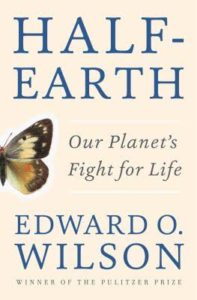
Reading Uncertainly? ‘Half-Earth: Our Planet’s Fight for Life’ by Edward O. Wilson

Half_EarthEdward O. Wilson, the remarkable professor emeritus at Harvard, who is known for his studies of ants, for the third time asks, “Who are we?” His first question was partially answered in The Social Conquest of Earth (2012) in which he analyzed the confusion of human existence, as our convoluted and introspective species tries to come to grips with our brief existence. Two years later, in The Meaning of Human Existence (2104), he described how, either deliberately or inadvertently, we are destroying other species even as we begin to recognize that we depend on them as much as they depend on us.

Now, concluding his trilogy, Wilson suggests a possible plan of action for homo sapiens. He continues his habit of short, punchy chapters, only one of 20 pages and most of 10 or less, even one of three. Instead of plunging into more verbiage, the reader must pause and think. His thesis: in order to survive we must commit “half of the planet’s surface to nature” in order to save “the immensity of life forms that compose it,” including us. A tall order, but is it possible?

Wilson begins with this earth’s extensive history of life extinctions. We’re lucky to be here! Should we worry? After all, the oldest major “extinction event,” at the end of the Ordovician period, happened some 455 million years ago and the most recent was a mere 66 million years back, when an enormous asteroid crunched into the Yucatan. Are we now coming close to a “Sixth Extinction”, the end of the current Anthropocene Era, as so clearly described by Elizabeth Kolbert in her The Sixth Extinction (2014)? Both Kolbert and Wilson recite alarming facts, plus suppositions, about our human relationships with other living creatures, large and small, on this earth. Are we the ultimate problem? They seem to think so.

To begin, “our population is too large for safety and comfort.” It is time to reduce, not expand, our footprint. “The biosphere does not belong to us; we belong to it.” But to acknowledge that, we must “… find our way as quickly as possible out of the fever swamp of dogmatic religious belief and inept philosophical thought.” We still understand too little about other species: some two million are “known” but there are perhaps some five to 100 million yet to be discovered. It is this enormous biodiversity that is the strength of this planet.

What then to do? Wilson suggests “… in order to save biodiversity it is necessary to understand how species interact with one another to form ecosystems.” But our enormous egos (and religions) tell us we are “Number One” when we are actually a small part of the action. His Solution: “Increase the area of inviolable natural resources to half the Earth or greater.” This will require a “fundamental shift in moral reasoning concerning our relation to the living environment.” We must “reduce the amount of space required to meet all the needs of an average person … habitation, fresh water, food production and delivery, personal transportation, communication, governance, other public functions (i.e. education), medical support, burial, and entertainment.” And note that this “average person” now lives in Asia and Africa as well as Europe and North America, with enormous current differences.

How will this take place? Here in Lyme, our Lyme Land Conservation Trust (www.lymelandtrust.org) has preserved in some fashion 3,000 acres of land and water resources in our small town. It and comparable efforts in this country and around the world are effective bottom-up programs. But Professor Wilson argues that these are not enough: we will need top-down guidance plus massive re-education for everyone. Is this economically possible? Do we have a choice?

Professor Wilson is obviously an optimist: “So we stumble forward in hopeful chaos.” Elizabeth Kolbert had her own conclusion: “The history of life consists of long periods of boredom interrupted occasionally by panic.”

Half-Earth and its sister volumes should be required reading for all of us. Perhaps we can wake up and change.

Editor’s Note: ‘Half-Earth: Our Planet’s Fight for Life’ by Edward O. Wilson is published by W. W. Norton, New York 2016.

Felix Kloman_headshot_2005_284x331-150x150About the Author: Felix Kloman is a sailor, rower, husband, father, grandfather, retired management consultant and, above all, a curious reader and writer. He’s explored how we as human beings and organizations respond to ever-present uncertainty in two books, ‘Mumpsimus Revisited’ (2005) and ‘The Fantods of Risk’ (2008). A 20-year resident of Lyme, he now writes book reviews, mostly of non-fiction that explores our minds, our behavior, our politics and our history. But he does throw in a novel here and there. For more than 50 years, he’s put together the 17 syllables that comprise haiku, the traditional Japanese poetry, and now serves as the self-appointed “poet laureate” of Ashlawn Farms Coffee, where he may be seen on Friday mornings. His wife, Ann, is also a writer, but of mystery novels, all of which begin in a bubbling village in midcoast Maine, strangely reminiscent of the town she and her husband visit every summer.