
A La Carte: Corn Chowder with Lobster Makes Perfect Ending to Beach Day

Corn chowder

There are beach days and there are beach days.

I am not sure there has ever been a summer that didn’t include a salt-water vacation.

As a baby, toddler and teenager, there was Belmar, N.J. I had Angrist and Kasdan cousins who lived there full-time, although the two Angrist brothers worked in New York City, one as a librarian at CCNY and the other a pathologist at Albert Einstein medical school.

Charlie’s wife, Claire Kasdan Angrist, was a teacher of French as Asbury High School. Her twin brother had a son, who became a well known movie director. Claire and her sister, Sylvia Angrist, had married brothers. Claire and Sylvia used to play Scrabble in French.

And every day the sun shone, there was the beach.

Today is July 4, 2017. And today was a beach day as glorious as any I can remember.

Today, too, were two beach stories in The Day. On the front page was a story about the Miami Beach Association fencing in Old Lyme to stop a “significant increase in the inappropriate behavior of persons using the beach.” The second story, first page of the second section, was a feature saying Groton’s Eastern Point Beach “concession stand still serving up favorites”

My beach used to be Old Lyme. You needed a beach pass and there were very few parking places, but it wasn’t fenced.

Today, my beach is the one in Groton. As a City of Groton citizen, and an old woman, too, it costs $11 for the season. The beach is gorgeous and huge. And on this gorgeous, sunny Fourth of July, as I left the beach to go home to write this column, there are dozens more parking places available and the $1.75 foot-long hot dog is as good as it ever was, as long as a gull doesn’t get to it first.

Summer doesn’t get much better than this. And just imagine, fresh tomatoes and sweet corn are still to come. I still have packets of the latter in the freezer and I bought some lobster to go with it.

Corn Chowder

Adapted a lot from an 1964 edition of Joy of Cooking

One of the best things about this recipe is there is neither butter nor heavy cream in this recipe. Sure, some salt pork for flavoring, but this is pretty healthy.

Yield: serves 6 to 8 as a main dish with a salad and maybe some good bread

2 tablespoons olive oil
6 to 8 ounces salt pork, diced
One-half cup chopped onions
One-half cup chopped celery
1 green pepper, seeded and chopped
1 and one-half cups peeled diced raw potatoes (with Yukon Gold, you needn’t peel)
2 cups water
One-half teaspoon salt
One-half teaspoon paprika
1 bay leaf
3 tablespoons flour
1 cup milk*
6 to 8 ears of fresh corn, blanched for 2 minutes in boiling water, then drained in iced water
Meat from claws and tail of one and one-half to two-pound cooked lobster, cut into small chunks
3 cups hot milk*
Chopped fresh tarragon, and more for garnish
Salt and pepper to taste

Pour oil into a heated, heavy-bottomed stock pot, add salt pork and sauté until browned.

Add onions, celery and green pepper and sauté until translucent.

Add potatoes, water, salt, paprika and bay leaf and simmer until potatoes are soft, around 15 minutes.

Add flour and 1 cup of milk and stir until mixture is thick.
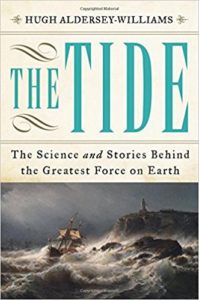
Reading Uncertainly? ‘The Tide’ by Hugh Aldersey-Williams

A present from a New Hampshire daughter, The Tide is a delightful, entertaining, and thought-provoking mix of lucid, often poetic, language with numerous literary quotations plus detailed scientific explanations of the tides that embellish our lives on this earth. It is Aldersey-Williams’s thought-experiment.
It is also his history of the oceanic tides, mixed with a bit of mathematics. But not more than you can handle. As he notes, “You may be relieved to know that I will leave the mathematics aside here.” And, given that many tell us the world’s tides are soon to be much higher, this is a most worthwhile book.

It is, as he states, “not a book about the sea” (sailors, ships, and winds), but rather a book “about the seas” and the ever-changing space between land and water. The tide, he explains, “offers an irresistible mathematical tease” as we attempt to understand and predict it. It is both a horizontal and a vertical force. That is a “scientific challenge” and “a physical; and psychological influence on our culture.” The classic story of King Canute’s (or Cnut, as the author spells it) attempt to stem the tide may have altered the English view of nobility.

This is the author’s story of watching tides around the world, from the English Channel to, of all places, Griswold Point on the Connecticut River, with a cousin, David Redfield. Tides are entrancing: they give us slow, relative motion that produces a “hallucinatory feeling.” Water is, after all, “an inelastic fluid (that) cannot be compressed or expanded.” I too have been mesmerized: by the 10-foot tides in Tenants Harbor, Maine; by the rising waters in Bosham, West Sussex, England, that regularly swamp cars in the local bar’s parking lot; and by the rushing tidal currents in the Straits of Shimonoseki, between Honshu and Kyushu, Japan, through which we once sent our Navy ship (at slack water, of course!)

He acknowledges the inevitability of climate change and global warming, and the fact they will lead to rising seas: “The greatest impact of rising sea levels and the changing tides that may accompany them will be on human habitation.” After all, we easily succumb to the human drive to cling to shores. “In the long term, if not the short, ‘managed retreat’ is our only option. The sea always wins in the end.”

Trying to ‘stop the sea? “It is a futility that Sisyphus would understand all too well.” So New York is a potential Venice … and New London too!

But do not be deterred by such pessimism. The Tide is full of rich, poetic language, as in this description of birds above the sea: “Once aloft, the birds first coalesce as an egg-shaped cloud low over the water, before gaining height and taking on ever more extravagant, twisted shapes like a pixelated flamenco dancer.”

It is enough to send me down to the end of Ely’s Ferry Road to watch the Connecticut River slip by the marshes of Essex.

Editor’s Note: ‘The Tide’ by Hugh Aldersey-Williams was published by W. W. Norton, New York 2016.

Felix Kloman

About the Author: Felix Kloman is a sailor, rower, husband, father, grandfather, retired management consultant and, above all, a curious reader and writer. He’s explored how we as human beings and organizations respond to ever-present uncertainty in two books, ‘Mumpsimus Revisited’ (2005) and ‘The Fantods of Risk’ (2008). A 20-year resident of Lyme, he now writes book reviews, mostly of non-fiction that explores our minds, our behavior, our politics and our history. But he does throw in a novel here and there. For more than 50 years, he’s put together the 17 syllables that comprise haiku, the traditional Japanese poetry, and now serves as the self-appointed “poet laureate” of Ashlawn Farms Coffee, where he may be seen on Friday mornings. His wife, Ann, is also a writer, but of mystery novels, all of which begin in a bubbling village in midcoast Maine, strangely reminiscent of the town she and her husband visit every summer.

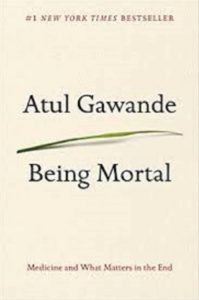
Reading Uncertainly? ‘Being Mortal’ by Atul Gawande

Here is a challenge and a question.

The challenge: “Our decision-making in medicine has failed so spectacularly that we have reached the point of actively inflicting harm on patients rather than confronting the subject of mortality.”

The question: Can the medical profession change from its former “priestly doctor-knows-best” and its current “informative” models to a more jointly-responsible “interpretive” model in which patients and physicians work together to mold priorities and decisions?

Atul Gawande, a professor at Harvard Medical School and one of the most thoughtful and articulate observers of the medical scene today (frequently in The New Yorker), asks us to “ … confront the realities of decline and mortality,” not with fear but with intelligence and realism. Too often “the waning days of our lives are given over to treatments that addle our brains and sap our bodies for a sliver’s chance of benefit.”

It has not always been that way. In the past “elders were cared for in multi-generational systems” when we died much sooner and faster, but now we must endure multiple failures in our bodies during “long retirements. … We are already oddities living well beyond our appointed time.” Institutionalization means loss of privacy and control, too many medications whose combined effects we don’t understand, and too much passive entertainment. Even the advent of the much-heralded “assisted living” mechanism has been watered down and often corrupted.

Gawande proposes a future in which “geriatrics” will be taught to all physicians who, in turn, will discuss options with us realistically. For example, his illustration is the simple use of living plants, birds, dogs, and cats, plus smaller groupings of the aged to reduce “the plagues of nursing home existence: boredom, loneliness, and helplessness,” so that we can “renew the joy of life.”

But the good doctor seems to equivocate when it comes to the idea of “death with dignity,” or the option of physician-assisted suicide, now permissible to some degree in five states in the U. S. and in The Netherlands. “I am leery of the idea that endings are controllable,” he writes. Must we insist, legally, on palliative care for the terminally ill? Don’t we/they have an inherent right to select our own course of action, not only for terminal physical illnesses where courses of painful (and costly) procedures may give us only a few extra months, but also for forecasts of mental deterioration, such as dementia and Alzheimer’s?

An inability or unwillingness to take our own early action when capable may create enormous costs (mental and financial) to all of us. I am an advocate of considering options early enough, working with our physicians, but retaining the right to final decisions, including death.

(Read, for example, Derek Humphry”s Final Exit, Random House, New York 2002)

Doctor Gawande’s goal makes eminent sense, “The battle of being mortal is the battle to maintain the integrity of one’s life – to avoid becoming so diminished or dissipated or subjugated that who you are becomes disconnected from who you were or who you want to be.”

Editor’s Note: ‘Being Mortal’ by Atul Gawande is published by Henry Holt and Co., New York 2014.

Felix Kloman

About the Author: Felix Kloman is a sailor, rower, husband, father, grandfather, retired management consultant and, above all, a curious reader and writer. He’s explored how we as human beings and organizations respond to ever-present uncertainty in two books, ‘Mumpsimus Revisited’ (2005) and ‘The Fantods of Risk’ (2008). A 20-year resident of Lyme, he now writes book reviews, mostly of non-fiction that explores our minds, our behavior, our politics and our history. But he does throw in a novel here and there. For more than 50 years, he’s put together the 17 syllables that comprise haiku, the traditional Japanese poetry, and now serves as the self-appointed “poet laureate” of Ashlawn Farms Coffee, where he may be seen on Friday mornings. His wife, Ann, is also a writer, but of mystery novels, all of which begin in a bubbling village in midcoast Maine, strangely reminiscent of the town she and her husband visit every summer.

Legal News You Can Use: How do you Hold an Impaired Driver Accountable After an Accident?

SPONSORED POST: In fatal motor vehicle accidents, the National Highway Traffic Safety Administration collects blood alcohol content levels for analysis in the Fatality Analysis Reporting System.  This reporting requirement applies to all states.
However, authorities do not have as standardized an approach to non-fatal crashes. After responding to the scene of an accident, police authorities may request testing of a driver who exhibits signs of intoxication. Yet is this enough? There are many influences that may render a driver unfit to get behind the wheel, including prescription drugs, opioid medications, or marijuana use, which may not be as noticeable as the effects of alcohol.

Significantly, an analysis of federal crash data from 2015 indicates that more drivers in fatal motor vehicle accidents had been under the influence of drugs, legal or illegal, than alcohol. Specifically, the data indicated that 43 percent of drivers had been drug impaired, compared to 37 percent who were driving under the influence of alcohol.

This begs the question of whether a crash victim will be able to hold a negligent driver accountable under the law. In Connecticut, an individual may file a personal injury lawsuit against a negligent driver. By a preponderance of the evidence standard, the crash victim must prove that the named defendant(s) breached the duty of safe driving incumbent upon all licensed drivers.

In a personal injury case, a reasonableness standard is used to evaluate the actions of an allegedly negligent driver. Examples may include failing to obey traffic laws, driving inappropriately for traffic or road conditions, or getting behind the wheel when drugs or alcohol render you unfit to drive.

The Law Firm of Suisman Shapiro focuses on this area of the law.

Source: Washington Post, “Study on drug-impaired driving gets pushback — from other safety advocates,” Fredrick Kunkle, May 1, 2017

Letter From Paris: (Old Hand) Putin Meets (New Kid) Macron With Surprising Results

Nicole Prévost Logan

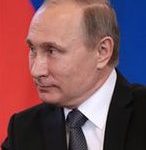
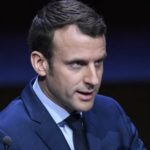
The hour-long press conference held jointly by long-standing Russian President Putin and newly-elected French President Macron in the Palace of Versailles on May 29, was a spectacle not to be missed.

Vladimir Putin

Emmanuel Macron

Putin had been absent from the high-powered week during which US President Donald Trump met with heads of state at the new NATO headquarters in Brussels and at the G7 summit in Taormina, Sicily. Macron seized an opportunity to invite the Russian president. The timing, location and format of the encounter of the two presidents were a smart move on the part of Macron.

He was not organizing a “state visit” – lest he offended Angela Merkel – but asking the Russian leader to be present at the inauguration of an exhibit marking the 300th anniversary of the visit of Tzar Peter the Great to France. The two presidents met in the grandiose 17th century palace of the French monarchs. Putin would probably find similarities between the ornate rooms and his elegant home town of St. Petersburg.

The visit was organized under the sign of culture and meant to revive the historical ties between the two countries. Macron mentioned how much Peter the Great had wanted to open up his country to the West and learn about its military architecture, crafts, and sciences. Putin contributed proudly an even earlier historical fact – the marriage at Queen Ann of Kiev, daughter of Grand Prince Yaroslav the Wise, to French King Henry I, in 1051.

During the press conference, the supposedly “novice” French president appeared self-assured, and totally in charge of the proceedings. He described how he envisaged cooperation with Russia. His road map for Syria was to guarantee humanitarian aid to the population and emphasize that the use of chemical weapons would constitute a red line that would be met with an immediate response from France.

Macron added that failed states lead to chaos. Hence the necessity to keep Bachar el Assad until ISIS is eradicated. In Ukraine, he stressed that an agreement should be reached within the framework of the Minsk accord. The objective there is both to stop progression of the spheres of influence of Russia in the region and the escalation of violence. He did not say the word ‘Crimea,’ however, implying that its return to the Ukraine was not on the agenda.

In his statement, Macron declared that during their three-hour-long conversation they covered all topics, including areas of disagreement. As he mentioned the treatment of homosexuals and transgenders in Chechnia, he turned toward Putin and told him to his face, “We will monitor the progress you make in that area.”

During his talk, Putin looked fidgety, ill-at-ease, squirming, and with shifty eyes. He mumbled his comments. He did say though that he would be ready to engage in a dialogue. Then, turning toward the audience of international media, he almost pleaded with them, saying, “You have to convince public opinion that the sanctions are stifling Russia. Tell the world they have to be lifted.”

French journalists raised questions about the spread of fake news on the social networks and in magazines like Sputnik and Russia Today intended to destabilize the leader of the En Marche movement during the campaign. Macron retorted that those people are not journalists and will not be treated as such.

Journalists also asked what the French government was going to do about the hacking of 70,000 documents belonging to then-candidate Macron 40 hours before the first round of the vote. Macron responded that he was not going to dwell on those events, adding, “What I want to do is to move on.”

From the exchanges between the two protagonists, it was clear that Macron was in control of the situation. His message was clear and direct. The days when Putin disregarded the EU as being too weak were now over. The power dynamic was the correct one for Macron to use and Putin understood that.

This was a textbook situation where the two protagonists, although not liking each other, could work out a resolution from which both could profit. Since 1990, Putin — a major player behind the war in Syria — has been shattered by the implosion of the Russian empire. Moreover, since sanctions are hurting his country severely, the give and take of negotiation is therefore possible.

Now, we can only hope that effective action will match the quality of this performance by Macron.

Editor’s Notes:
i) This is the opinion of Nicole Prévost Logan.
ii) Nicole is, in fact, now back in Essex, but events in France are currently moving so fast that she’s continuing to write for us from this side of the Atlantic in an effort to keep readers over here up to date.  Merci, Nicole!

Nicole Prévost Logan

About the author: Nicole Prévost Logan divides her time between Essex and Paris, spending summers in the former and winters in the latter. She writes a regular column for us from her Paris home where her topics will include politics, economy, social unrest — mostly in France — but also in other European countries. She also covers a variety of art exhibits and the performing arts in Europe. Logan is the author of ‘Forever on the Road: A Franco-American Family’s Thirty Years in the Foreign Service,’ an autobiography of her life as the wife of an overseas diplomat, who lived in 10 foreign countries on three continents. Her experiences during her foreign service life included being in Lebanon when civil war erupted, excavating a medieval city in Moscow and spending a week under house arrest in Guinea.