A La Carte: Apricots and Almonds Make Great Galette!

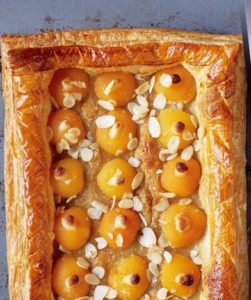
Apricot and Almond Galette

My mother always wanted to live in San Diego, but as far as she got was Troy, NY.

She was born in the beginning of the 20th century, died in the beginning of the 21st century and was buried in an ecumenical cemetery not more than 20 blocks or so from where she lived her whole life.  San Diego, she said, correctly, had the perfect climate: fairly sunny, warm in the daytime and cooler at night. No snow ever.

For me, almost any season is okay. I like the autumn smell of wood smoke in the air and in winter, curling up with two cats as I read long, meandering novels. Spring never seems to linger too long and, now, we bid adieu to summer.

No matter the season, I love to cook. I am still having such fun with all the summer vegetables. I eat two or three tomatoes a day. I am grilling zucchini and summer squash outside or sautéing them with a little butter and garlic and salt on the cooktop in the kitchen. Last night I roasted a spaghetti squash, then tossed the innards with chopped tomatoes, basil and a little butter. Today I will make a frittata with sweet peppers for a 9:30 am meeting at my house.

Next weekend I will make a little dessert with fresh peaches and almonds. The recipe below, from calls for apricots, but any stone fruit will do.

Apricot and Almond Galette

From Bon Appetit, June, 2017

Yield: 4 servings

One-half cup blanched almonds
One-third cup sugar, for more for sprinkling
1 large egg
4 tablespoons unsalted butter, at room temperature
One-half teaspoon almond extract (optional, but I do love almond extract)
One-half teaspoon pure vanilla extract
Pinch of salt
1 tablespoon all-purpose flour (plus more for surface)
1 package frozen puff pastry, preferably all-butter, thawed
12 apricots (about 1 and one-quarter pound), halved and pitted (or other stone fruit, quartered if large)

Place a rack in middle of oven and preheat to 425 degrees. Pulse almonds and one-third of sugar in a food processor until very finely ground. Add egg and pulse to combine. Add butter, almond extract (if using), vanilla extract, salt and 1 tablespoon flour; pulse until almond cream is smooth.

Roll out pastry on a lightly floured surface just enough to smooth out any creases.

If you are using a package of pastry than as 2 sheets, stack and roll out to a one-quarter- to one-third rectangle.

If your package contains a single 16-inch to 10-inch sheet of puff pastry, halve it crosswise and roll out one half on a lightly floured surface until rectangle is one-quarter to one-third inch thick, saving remaining half for another use. Transfer to a parchment-lined (or Silpat-lined) baking sheet. Fold over edges of pastry to make a one-half inch border around sides. Prick surface all over with a fork (this keeps the pastry from rising too much when baked and helps it cook through. (Spread almond cream over pastry, staying inside borders. (Chill dough in the freezer for a few minutes if it becomes too soft to work with.) Set apricots, cut sides up, on top of the cream. Sprinkle lightly with sugar.

Bake until pastry is golden brown and puffed, 15 to 20 minutes. Reduce oven temperature to 325 degrees and continue to bake until pastry is deep golden brown and cooked through and apricots are softened and browned in spots, 15 to 20 minutes longer.
Reading Uncertainly? ‘Payoff’ by Dan Ariely

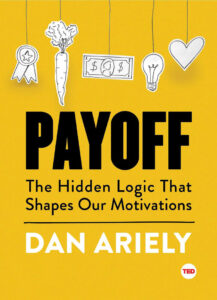
What is “motivation” and how does it affect our daily activity? Is motivation “central to our lives”? Dan Ariely, a professor of behavioral economics at Duke University, explores the human feeling of identification with and empathy for others, suggesting these two feelings help stimulate motivation, while their absence destroys it.


This brief book (103 pages) combine stories from Dr. Ariely’s personal life and his continuing work studying our strange behaviors. It continues his earlier work: Predictably Irrational, The Upside of Irrationality, and The (Honest) Truth About Dishonesty, all of which I’ve read with fascination.

At the very start, the author describes his own teenage accident in Israel, in which he sustained severe burns over some 70 percent of his body, leading to three years of hospitalization and slow and painful recovery. It was then he began to discover the idea of motivation, enlarged later when he helped a friend’s two teenage children, similarly injured.

As he writes, “I also realized how many of our motivations spring from trying to conquer a sense of helplessness and reclaim even a tiny modicum of control over our lives.” Any success in such an effort becomes a “feeling of accomplishment.” This then leads to the need to “look closely at the positive side of motivation,” creating pleasure and affection for your own handiwork.

But does financial reward motivate us? Ariely suggests “money matters far less than we think.” We should avoid “overemphasizing the countable dimension and beware (my italics) treating the uncountable dimension as if it were easily countable.” This skewers the old adage that if you can’t count it, it doesn’t exist!

He continues: “In short, these findings suggest that when we are in the midst of a task, we focus on the inherent joy of the task, but when we think about the same task in advance, we over-focus on the extrinsic motivators, such as payment and bonuses. This is why we are not good predictors of what will motivate us and what will crush our motivation. This inability to intuit what will make us happy at work is sad.” Trust and goodwill seem to be far better inspirations than cash … Is it possible that large bonuses are actually counterproductive?

Dr. Ariely concludes: “We are certainly far from grasping the full complexity of motivation, but the journey to understand  … (its) nuances … (is) exciting, interesting, important and useful.”

As usual, brevity enhances comprehension. A short book motivates continued reading!

Editor’s Note: ‘Payoff ‘ by Dan Ariely is published by TED Books, New York 2016.

Felix Kloman

About the Author: Felix Kloman is a sailor, rower, husband, father, grandfather, retired management consultant and, above all, a curious reader and writer. He’s explored how we as human beings and organizations respond to ever-present uncertainty in two books, ‘Mumpsimus Revisited’ (2005) and ‘The Fantods of Risk’ (2008). A 20-year resident of Lyme, he now writes book reviews, mostly of non-fiction that explores our minds, our behavior, our politics and our history. But he does throw in a novel here and there. For more than 50 years, he’s put together the 17 syllables that comprise haiku, the traditional Japanese poetry, and now serves as the self-appointed “poet laureate” of Ashlawn Farms Coffee, where he may be seen on Friday mornings. His wife, Ann, is also a writer, but of mystery novels, all of which begin in a bubbling village in midcoast Maine, strangely reminiscent of the town she and her husband visit every summer.

A la Carte: When it’s Humid and Hot, Salmorejo Hits the Spot

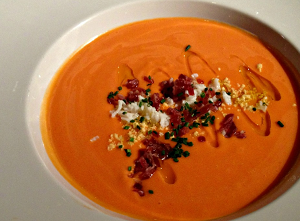
Salmorejo

Yes, it has been humid and hot, hot, hot.

Usually at this point in late summer, I am sort of done with the beach. Last Saturday I went out to dinner with friends and to see a movie (“Wind River” is terrific. Don’t miss it.). Because we  had decided to go to see the movie in Mystic, although it is not our favorite destination cinema hall (don’t like the recliners that don’t “recline” our legs), we had wine at my condo before the movie.

Nancy mentioned that I was pretty tan and had I been at the beach that afternoon. “No,” I explained, “this was pretty much left over from my four days at the New Jersey shore. Anyway, it was too hot to go to the beach,.”

As September begins to beckon, I think about cooking. Sure, I cook during the summer, but I grill meats, vegetables and desserts on my Weber, prepping salad and eating inside. Of course, produce is gorgeous this time of year and, finally, there are tomatoes.

Last week I stopped at Becky’s in Waterford and bought tomatoes, beets and a pint of those yellow cherry tomatoes. Maybe they are called Sun Gold. In any case, I ate the full pint by the time I got off I-95.

Last night I looked over my new issue of Food & Wine, the issue about Spain. I looked up the recipes and found one for a tomato soup. It sounded divine. I had enough tomatoes to double the recipe. It should be served cold. I love cold soup, especially when the weather is still sticky and hot, so I would happily eat it for a couple of days. And the recipe uses no heat, just a blender.

Salmorejo

From Food & Wine, September, 2017

Yield: serves 4

2 and one-half pounds vine-ripened tomatoes, cored and chopped
One-half pound rustic white bread, crust removed, cubed (2 and one-half cups)
2 garlic cloves
1 teaspoon sherry vinegar
One-quarter cup extra-virgin olive oil, plus more for serving, if you like
Kosher salt
2 hard-boiled eggs, peeled and chopped
One-half cup chopped serrano ham (prosciutto will do nicely)

In a blender, puree the chopped tomatoes with the bread, garlic, vinegar and one-half cup of water at high speed until very smooth. about 1 minute. With the blender on, drizzle in the one-quarter cup of oil until incorporated. Season with salt, Cover and refrigerate until the soup is cold, at least 30 minutes.

Divide the soup among 4 bowls. Garnish with chopped eggs and ham, then drizzle with olive oil and serve.

Make ahead: The soup can be refrigerated for up; to 2 days.

Legal News You Can Use: Proving Negligence in a Car Accident Case

Photo by Samuel Foster on Unsplash

SPONSORED POST: To recover compensation in a car accident case, a plaintiff must satisfy the required elements of a negligence claim: duty, breach, causation and damages. Specifically, the plaintiff must persuade the jury that the defendant breached his or her duty of care, resulting in injury, by a preponderance of the evidence standard.

Element Two: Breach of Duty

As we discussed in a recent post, every licensed driver has a duty of care to operate his or her vehicle in a responsible manner. That duty includes abiding by traffic laws and paying attention to traffic and road conditions. Thus, the most contested element of a car accident case is usually not whether a duty existed, but whether the defendant driver’s actions breached that duty.

Types of Evidence in a Car Accident Claim

A plaintiff may use both direct and circumstantial evidence in a car accident case. Thanks to technology, there may be direct evidence of a defendant driver’s actions. For example, street cameras may have recorded the driver running a stop sign or red light. If a crash victim suspects that the other driver was texting behind the wheel, a subpoena to the driver’s cell phone carrier may confirm that suspicion. Many newer motor vehicles also contain an Event Data Recorder (EDR), or “black box,” which may have recorded speed and braking patters immediately before the collision.

Creating a Trial Narrative With Expert Testimony

Suisman Shapiro also has established relationships with accident reconstruction specialists. These professionals may offer testimony that interprets circumstantial evidence, such as skid marks, vehicle resting positions, EDR data, and the driver’s memories immediately before the crash. However, none of this evidence may be apparent without the skilled investigative efforts of a personal injury attorney.

The Law Firm of Suisman Shapiro focuses on this area of the law.

Source: Washington Post, “Study on drug-impaired driving gets pushback — from other safety advocates,” Fredrick Kunkle, May 1, 2017

A La Carte: You Can’t Beat Beets!

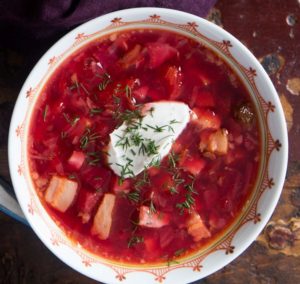
Borscht

Not everyone likes beets. This is hard for me to understand. What’s not to like with beets. My mother didn’t like vegetables. I found this later in life, when I asked my mother why we I didn’t have vegetables, canned or fresh, except for sweet corn and tomatoes in the summer and canned green beans and canned peas in the fall, winter and spring. Simple, she explained. She didn’t like vegetables.

She did, however, like borscht. It was one of five or six dishes she actually made. Even later in my life I found out that she did like borscht but that she never made it from fresh beets. Rather, she used canned beets.

I love beets and I especially love borscht. I make it often and, in my everlasting quest for fresh tomatoes (maybe by the time you read this, there will be local and fresh tomatoes), I am finding beets. Last week I went to White Gate Farm in East Lyme, a place I visit rarely because I find the prices exorbitant, figuring that if any place had tomatoes, they would. They didn’t, but I did see beautiful beets. I bought two bunches (beets are always inexpensive), and that evening I made borscht.

This is my mother’s recipe and requires three ingredients: beets, onions and lemons. To this, you add water, salt and pepper. If you want a bit of sophistication, top perhaps with fresh dill fronds. My family ate in icy cold, with a warm boiled potato and a big dollop of sour cream. I dispense with the potato and just spoon a tablespoon or two of the sour cream into the soup. It turns it a gorgeous dark pink.

Borscht

Yield: serves 6

6 good sized beets, peeled and cut into 2-inch cubes*
1 large onion, peeled and quartered
Juice of one lemon
Salt and pepper, to taste
Fronds of dill (optional)
Sour cream for serving

Place beets and onion into a good-sized soup pot, with cold water to cover.

Bring to a boil, then bring to a simmer for about 45 minutes, or until beets are soft. Add lemon to soup and allow it to cool. Using the grating or slicing tool of a food processor, process the beets and onions. Add vegetables back into the dark, red broth and warm the soup. Add salt and pepper to taste. Refrigerate. To serve, pour cold soup into bowls (I love to use white bowls), stir in sour cream, add dill fronts and serve.

*I would love a few recipes for beet greens. I throw them into the disposal, but I know many think that is sacrilegious.