

Letter From Paris: The State of the Continent – A Snapshot of European Politics

Nicole Prévost Logan

Is the far right forging ahead in Europe?

The political landscape of the European Union (EU) has shifted somewhat to the right during the past few months.  At the core of this trend is the fear of losing one’s identity following the recent surge of migrants.  Angela Merkel’s decision in 2015 to open wide Germany’s borders – and hence Europe’s – has had a lasting impact.  Max Leonard, director of the European Council on Foreign  Relations, based in London, has suggested that the trauma resulting from the decision for Europeans can be compared to that of the 9/11 attack for Americans.

Sebastian Kurz

In Austria , the legislative elections, held on Oct. 17,  gave 31.5 percent of the votes to the conservative People’s Party (OVP) led by Sebastian Kurz.  At age 31, Sebastian Kurz may become the youngest ever Chancellor of that small alpine country of eight million people with a robust economy.  He is not xenophobic nor racist and disapproves of anti-semitism.  However, Kurz may have to strike an alliance with the far right Freedom Party (FPO), which finished in third place behind the declining social democrats (SPO).

To understand Austria, one needs to remember a few facts: it  has been subjected to a flux of Kosovar and Bosniac refugees following  the late 1990s conflict in the Balkans;  it has never been a colonial power and does not have a bad conscience with regard to the economic fate of sub-Saharan migrants. According to French political commentator Christine Okrent, Austria has never gone through the process of “denazification” and considers itself to have been a victim during World War II.  The nostalgia of its past as part of the Habsburg Austro-Hungarian empire still lingers.

Andrej Babis

To complete this snapshot of European politics, the Oct. 20 and 21 legislative elections in the Czech Republic saw Andrej Babis’ party arrive in first place. The 63-year-old tycoon – nicknamed Trump 2 –  proclaims to be anti-immigration, but pro-Europe and pro-NATO. He shares his ideas with the other members of the central European “Visegrad group” (Poland, Hungary and Slovakia.)

Angela Merkel, after her somewhat disappointing results in the last September elections, is reaching out to the Christian Social Union (CSU) and the Greens in order to give her Christian Democrat party (CDU) a comfortable majority. These negotiations may keep her off the front stage until the end of the year.   

In France, Marine Le Pen has practically collapsed after the disastrous debate against Emmanuel Macron on May 3 between the two rounds of the presidential elections. She has become an inaudible adversary in the National Assembly.  Marion, her even more right-wing niece, was clever enough to jump ship last spring.  Marine’s co- president, highly educated Florian Philippot, was ejected from the National Front (FN).  Several legal pursuits for financial “improprieties,” both for her activities as European deputy and in France, are still looming against her. 

After six years of being in the limelight , Marine Le Pen is now in the process of redefining herself. 

Editor’s Note: This is the opinion of Nicole Prévost Logan.

Nicole Prévost Logan

About the author: Nicole Prévost Logan divides her time between Essex and Paris, spending summers in the former and winters in the latter. She writes a regular column for us from her Paris home where her topics will include politics, economy, social unrest — mostly in France — but also in other European countries. She also covers a variety of art exhibits and the performing arts in Europe. Logan is the author of ‘Forever on the Road: A Franco-American Family’s Thirty Years in the Foreign Service,’ an autobiography of her life as the wife of an overseas diplomat, who lived in 10 foreign countries on three continents. Her experiences during her foreign service life included being in Lebanon when civil war erupted, excavating a medieval city in Moscow and spending a week under house arrest in Guinea.


Legal News You Can Use: Why Many Car Accidents Happen Close to Home

Part of the reason many accidents occur near home is because driving in familiar places can cause drivers to rely on memory instead of what is happening around them. This auto-pilot phenomenon can prevent people from remaining vigilant while driving, potentially causing them to miss important visual cues. It is imperative that drivers combat this phenomenon by staying awake and alert as unpredictable elements, such as other drivers, crossing animals or mechanical failure, can always cause an accident. However, because others are also likely driving on auto-pilot, motorists should also ensure that they always buckle their seat belt no matter how far they are driving.

Further, fatal car accidents are more likely to occur at certain times of times of the day, particularly when workers are heading home or when residents are out running errands. For example, 16 percent of fatal accidents that occurred in 2013 took place between 3 p.m. and 6 p.m.. Further, 31 percent of car accidents in 2013 occurred between 6 p.m. and midnight.

Car accidents that occur on interstates, local highways or even rural roads can result in serious injuries or even death. If the accident occurred due to another driver’s negligence or risky driving habits, those who suffered injuries could seek compensation for the damages they sustained in the incident, including recovering the cost of their medical bills, lost income and pain and suffering. However, some insurance companies may attempt to settle the claim for less than what the injured individuals need. In such an event, filing a lawsuit against the at-fault motorist with an attorney’s help might be advisable.

The Law Firm of Suisman Shapiro focuses on this area of the law.
Sponsored post.

A la Carte: Mushrooms by the Million? Sounds Like Soup!

I am such a spoiled princess, even if I don’t have anyone around to spoil me.
Because the temperature is dipping into the 40s at night, I opened two windows in the living room and one in the bedroom. Since I had turned on the central air in late May and hadn’t yet turned it off on the first of October, I thought I would go into this slowly. (Actually, I am not a spoiled princess in the winter—I like cold weather and keep my thermostat at around 60 degrees until late March or early April.)

Once I feel if a snap of coolness, I begin to think about what to cook for the next two seasons. In the late spring, summer and early fall, I buy a lot of fresh produce at farm markets let those ingredients speak for themselves, eating them raw, like tomatoes, sweet peppers and salads with a whisper of dressing, or simply grilled with a little olive oil and fresh herbs.

Last week I began dream of squashes and roasted vegetables and soups. I was at BJs, loading up on bags of flour and sugar (pies, cookies, cakes) and saw big containers of mushrooms. Soup, I thought. Lots of soups on the cooktop and in my slow cookers (I am also thinking about an Instant Pot. Let me know what you think about yet another counter appliance since my old blender is gone and the pressure cooker is in the garage.)’

Anyway, I made two batches of mushroom soup. I had a couple of recipes in my head, but decided that it is time to play around with soup. So this recipe is all mine. And I must say, it is better than any other mushroom soup I’d ever made. Once again, a few steps are important—saute the mushrooms and onions, add cream sherry twice (I have Harvey’s Bristol Cream Sherry, but I also have a bottle of Sheffield Cream Sherry of California at a fraction of Harvey’s)  If you want to add more onions or more mushrooms, be my guest. Maybe 1 percent milk would work.

Lee’s Mushroom Soup

1 stick of unsalted butter
20 ounces or more fresh, sliced white mushrooms
1 large onion, peeled and diced fairly fine
4 tablespoons cream sherry, divided (never use supermarket cooking sherry)
3 tablespoons flour
2 cups milk (I use 2 percent)
1 32-ounce carton low-sodium, low-fat chicken or vegetable stock

In a large heavy-bottomed pot (I use a Le Creuset Dutch oven), melt butter on medium heat and add mushrooms. Stir periodically until mushrooms take up all the butter, then add onions. Continue stirring until onions are light blonde in color. Pour 2 tablespoons sherry into the pan and cook until almost dry. Toss flour over mushrooms and onions and stir until veggies are coated. Add milk, stir, then turn heat to medium low. Add the rest of the sherry. Cook for about 10 minutes, stirring periodically. Add all the chicken or vegetable stock, stirring, and add salt and pepper to taste. Simmer for another 10 minutes or so and taste again for salt and pepper.

I wait until the soup is cool, then puree it just a little in my big Ninja of use an immersion blender. Or do neither. Soup can be served immediately or refrigerate and reheat over gentle heat. If soup is too thick, add more stock or water.

A La Carte: Perfect Pork Chops with a Mustard Twist

Last week I bought a new grill cover for my Weber. I was a bit unhappy, since I have only had the grill for just over two years and the cover I bought with the expensive grill, is falling apart. I’m not sure I should he surprised, but I am getting to that age where I expect quality should last a while. At least I don’t start sentences by saying “When I was younger,”
This, however, doesn’t mean the grill won’t be used all winter. My patio is just a few steps from my living room/dining room and, unless this coming winter is like the one wo years ago, during which I could barely find my grill, you will still see me throwing some chicken or burgers and hot dogs onto the Weber (without a coat on, no matter how cold it is).

I took a tour into my garage freezer and found four three-packs of pork chops I’d bought on sale at the supermarket, so I took one of the packages out last night. I can eat one or maybe two; the other one or one and a half I will cut up and toss into a large salad tomorrow. (I do the same the same thing with strip steaks I buy in three-steak packages at BJ’s—I wrap aluminum foil on each and freeze them—I can’t eat an entire steak, but it is lovely on a salad or for a stir-fry the next day.)

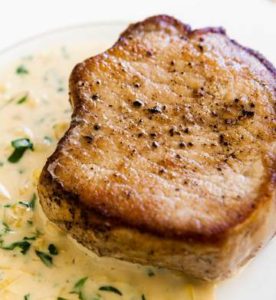
I found this recipe in my computer and hadn’t made it in almost a decade. I love mustard and this is a great way to cook pork chops.

Pork Chops with Mustard Sauce

Adapted from Fine Cooking, November, 2008, page 94a

Yield: serves 4

Preheat oven to low (150 to 160 degrees)

8 one-half-inch-thick boneless pork chops (about 3 ounces each) or 4 thicker pork chops
kosher salt and freshly ground black pepper
3 or more tablespoons all-purpose flour
1 tablespoon unsalted butter (regular butter will do since you use so little)
1 tablespoon extra-virgin olive oil; more as needed
one-half cup dry white wine
three-quarter cup heavy cream
one-half cup lower-salted chicken broth
one-quarter cup stoneground or country-style mustard

Put salt, pepper and flour in a plastic bag and dredge chops in bag, shaking off the excess.

Put butter and oil in a 12-inch skillet over medium heat. When hot, add 4 of the pork chops and cook, turning once, until golden on both sides and just cooked through, 4 to 6 minutes total. Transfer pork to a serving platter, tent with foil and place in low-degree oven. If necessary, repeat with remaining chops adding another tablespoon of oil to the pan, if necessary.

Our off any fat in the pan, add wine and scrape up the browned bits from the bottom of the pan with a wooden spoon. Increase the heat to medium-high and boil until wine is reduced to about 2 tablespoons, 2 to 3 minutes. Stir in cream, chicken broth and mustard and boil until reduced to a saucy consistency, about 5 minutes. Season to taste with salt and pepper.

Return pork and any juices to the pan, turn to coat with the sauce and then transfer back to the serving platter. Drizzle any sauce remaining in the skillet over the chops and serve.

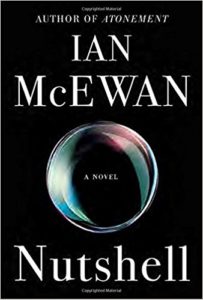
Reading Uncertainly: ‘Nutshell’ by Ian McEwan

Can you imagine an entire novel, spoken through the senses of a foetus, awaiting his entry into this world?

McEwan’s opening sentence sets the stage: “Here I am, upside down in a woman.” From that point, this young man extols first the “condition of the modern foetus. Just think: nothing to do but be and grow, where growing is hardly a conscious act. The joy of pure existence, the tedium of undifferentiated days. Extended bliss is boredom of the existential kind … In here I’m owed the privilege and luxury of solitude,” as his mother listens continuously, with ear-buds, to self-improvement books, biographies and world classics.

But at the same time it is a story of, first, murder, and then the revenge of his mother and of the young man himself. I realized that about halfway through this engrossing and often-hilarious tale, McEwan is embedded in a take-off on Hamlet. This youngster’s mother, Trudy, is drawn from Gertrude. His stepfather, Claude, is Claudius, a “fraud who’s wormed in between my family and my hopes.”

This leads the still-enclosed boy to conclude his “dim view of our species, of which psychopaths are a constant fraction, a human constant. ” His reaction: “Anxiously, I finger my cord.”

His brain, after listening to all that his mother hears, plus her plans with her lover, leads him to a sour conclusion about his life yet to come, “Long ago, someone pronounced a groundless certainty a virtue. Now, the politest people say it is. I’ve heard their Sunday-morning broadcasts from cathedral precincts. Europe’s most virtuous spectres, religion and, when it faltered, godless utopias bursting with scientific proofs, together they scorched the earth from the tenth to the twentieth centuries. Here they come again, risen in the East, pursuing the millennium, teaching toddlers to slit the throats of teddy bears. And here I am with my home-grown faith in the life beyond.”

Towards the end (or the beginning, his birth), he comments: “It’s already clear to me how much of life is forgotten even as it happens. Most of it. The unregarded present spooling away from us, the soft tumble of unremarkable thoughts, the long-neglected miracle of existence.” But the young man does start …

That sums up this mesmerizing story, in a nutshell: a woman’s womb for your world view.

My own coda: “To be or yet to be: that is gestation.”

Editor’s Note: ‘Nutshell’ by Ian McEwan, was published by Doubleday, New York, 2016.

Felix Kloman

About the Author: Felix Kloman is a sailor, rower, husband, father, grandfather, retired management consultant and, above all, a curious reader and writer. He’s explored how we as human beings and organizations respond to ever-present uncertainty in two books, ‘Mumpsimus Revisited’ (2005) and ‘The Fantods of Risk’ (2008). A 20-year resident of Lyme, he now writes book reviews, mostly of non-fiction that explores our minds, our behavior, our politics and our history. But he does throw in a novel here and there. For more than 50 years, he’s put together the 17 syllables that comprise haiku, the traditional Japanese poetry, and now serves as the self-appointed “poet laureate” of Ashlawn Farms Coffee, where he may be seen on Friday mornings. His wife, Ann, is also a writer, but of mystery novels, all of which begin in a bubbling village in midcoast Maine, strangely reminiscent of the town she and her husband visit every summer.