Letter From Paris: A Six-Month Performance Review for Emmanuel Macron

Nicole Prévost Logan

Six months into his mandate, French President Emmanuel Macron has been working at a dizzying pace to fulfill his campaign promises.

Hubert Vedrine, former minister of foreign affairs and expert in international and strategic affairs, made the following comment : “Emmanuel Macron immediately embodied the stature of a chief of State. ”

“The French people are impossible to reform”, said Macron during his campaign.  This is why he set out not to reform but to transform France from top to bottom.  First he brought “parity” men/women into the government. 

The “moralization” of the two legislative chambers was his second objective, which meant bringing an end to the opaque system of financial privileges long enjoyed by the deputies.  Like a breath of fresh air, the professional politicians who, since the beginning of the fifth Republic, had been playing musical chairs, faded away .They were replaced by influential members of the civil society, without any political experience.
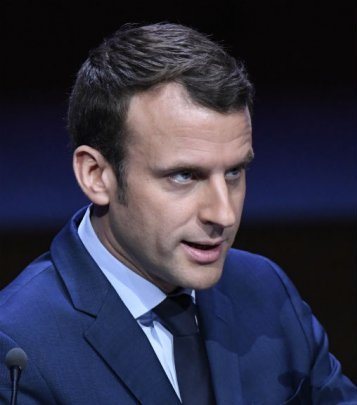
Emmanuel Macron

As a rule, the French do not really like to work during the summer.  Breaking with that tradition, Macron spent four months talking with the trade unions.  He invited – separately – the leaders of the different groups (CGT, FO, CFDT)  in order to hear their demands and make his own proposals.

The result was amazing.

The loud manifs (street demonstrations), which traditionally are the main tool of the trade unions, rapidly run out of steam.   On the basis of the summer negotiations, changes in the labor code were formulated into executive orders before becoming law.

Macron used the same strategy – divide and conquer – to defuse the revolt of the mayors. 

There are 36,000 municipalities in France.  Some of the communes are tiny with as few as 200 inhabitants, and feel unfairly treated as compared to the large and wealthy urban centers like Paris, Lyons or Marseille. When Macron announced he would drastically slash down the dotations (subsidies) made by the State, the local officials went up in arms. 

What did Macron do? 

He invited 1,500 mayors to the Elysée Palace and developed his plan to help the small communes .

Thanks to his work experience in the financial and business world, he focused on a crucial economic problem: the cost of French labor is not competitive enough. The main reason?  The cost of labor is bloated by the inclusion of “social charges.” Macron plans to have the entire population share the burden by paying a general tax.  The other pillar of his financial program is to stop demonizing capital income by reducing the tax to a flat rate of 30 percent  – a win-win system to encourage the French population to invest.

Emmanuel Macron has been described as having a velvet smile contrasting with the steely expression of his blue eyes. From the youthful, exuberant attitude he projected during the electoral campaign, he has evolved into the image of an authoritarian leader. He delegates the day-to-day running of the country to his prime minister Edouard Philippe, who is doing his job efficiently and with discretion.  This leaves Macron time to address the big picture, particularly regarding the new place of France on the world stage.

On Sept. 26, in a major speech at the Sorbonne, Macron showed his unwavering ‘Europhile’ vision. He proposes a ‘re-invention’ of Europe with action led by countries willing to make changes. To ensure the future of the Eurozone, he proposes a single budget, a ‘Super Minister’ of economy and the creation of a European IMF. He wants a “protective Europe” in relation to workers and consumers. He believes strongly in giving a central role to culture in defining the European identity.

During his visit to Abu Dhabi for the inauguration of the new Louvre museum on Nov. 8, Macron met with “MBS” (Saudi Arabia prince Mohammed Ben Salmane ) and with “MBZ” (Abu Dhabi crown prince, Mohammed Bin Zayed)  A feverish round of diplomacy took place in which the president succeeded to  “exfiltrate” the Sunni Lebanese minister Saad Hariri from Saudi Arabia and acted as a mediator in the growing fracture of the Persian Gulf.

On Nov. 28,  after a two-hour speech to 800 students of the Ouagadougou University, in Burkina Faso, the Q and A session turned into an hilarious exchange. “Can you help us fix the frequent power outages on the campus?” asked a student. “But this is not my responsibility,” Macron answered, “Ask your president to deal with this problem.” The reaction of his audience – was at first a roar of laughter then deafening applause. A symbolic detail of the Macron’s visit to Africa was that he was accompanied on his trip by leaders of recent  start-ups instead of the CEOs of large companies such as Areva or Total.

The three-day visit to Africa in late November was an opportunity for the French president to break, not only with the colonial era, but also with the neo-colonial era of Françafrique launched by General de Gaulle in 1960.  At a summit meeting held in Abidjan, Ivory Coast, where the discussions at the summit meeting dealt mostly with the immigration crisis, Macron initiated a partnership whereby Europeans and Africans should share responsibilities.  Macron did not mince words when he told his audience : “The passeurs (smugglers) are not European, my friends , they are African.”

At a time when Angela Merkel is vacillating and Brexit is looming, the role of Emmanuel Macron in Europe is crucial. 

Editor’s Note: This is the opinion of Nicole Prévost Logan.
Nicole Prévost Logan

About the author: Nicole Prévost Logan divides her time between Essex and Paris, spending summers in the former and winters in the latter. She writes a regular column for us from her Paris home where her topics will include politics, economy, social unrest — mostly in France — but also in other European countries. She also covers a variety of art exhibits and the performing arts in Europe. Logan is the author of ‘Forever on the Road: A Franco-American Family’s Thirty Years in the Foreign Service,’ an autobiography of her life as the wife of an overseas diplomat, who lived in 10 foreign countries on three continents. Her experiences during her foreign service life included being in Lebanon when civil war erupted, excavating a medieval city in Moscow and spending a week under house arrest in Guinea.
Letter From Paris: André Derain: Major Artist, “Fauvism” Champion Featured in Parisian Retrospective

Nicole Prévost Logan

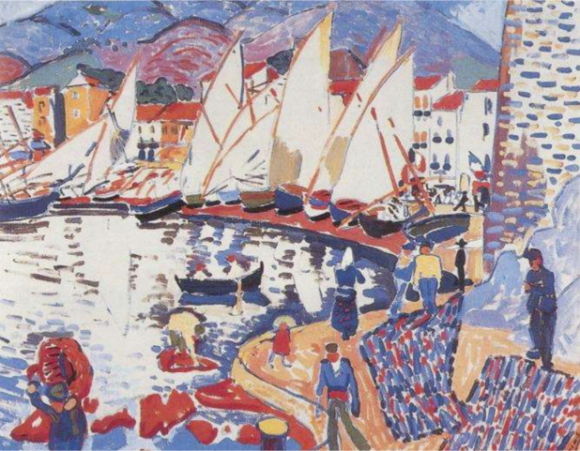
André Derain usually evokes cheerful scenes of sailboats bobbing up and down in the bright colors of a Mediterranean fishing port.

Actually, Derain (1880-1954) is a complex artist, who had a strong influence on the evolving avant-garde movements at the start of the 20th century.  The Pompidou Center is currently holding a retrospective titled, “Derain – 1904-1914. The radical decade.”

The curator of the Pompidou exhibit, Cecile Debray, comments, “Derain is the founder with Matisse of Fauvism and an actor of Cezanne’s Cubism with Picasso.” Never before had the artist been attributed such a crucial role. Derain was not only the link between the masters — Gauguin and Van Gogh — and the next generation of artists, but also an explorer of new sources of inspiration, including primitive Italians, along with African and Oceanic art. 

To quote Gertrude Stein (the writer and art collector famous on the cultural Parisian scene in the 1920s and 1930s), “Derain was the Christopher Columbus of modern art, but it is the others who took advantage of the new continents”

Not interested in the career of engineer planned for him by his father, the young Derain preferred to spend all his time at The Louvre, copying  the classics. He shared a studio with his friend Vlaminck on the Chatou island northwest of Paris where he was born. His first paintings had as subjects the Seine river, its banks and bridges, and the activities of workers. He displayed a distinctive technique of fast brush touches, (slightly different from “pointillism“), innovative plunging views and cropping, which give  his works the spontaneity of photographic snapshots.

“Collioure, the drying of the sails'” by André Derain.

In the summer of 1905, he spent the summer in Collioure with Matisse and was dazzled by the Mediterranean light. Derain defined light as the negation of shadow.  He writes, “Colors become cartridges of dynamite casting off light.”  The room VII of the 1905 Salon d’Automne, called “la cage aux fauves,” caused a scandal, (fauves mean wild animals.)  In 1907, the Russian art collector Ivan Morozov acquired Derain’s paintings from the merchant Ambroise Vollard for the sum of 600 francs.

The following summer,  Derain continued to work with Matisse at l’Estaque, near Marseille. His compositions became more structured, with strong lines, volumes, perspectives and plans.  He still used arbitrary colors.   

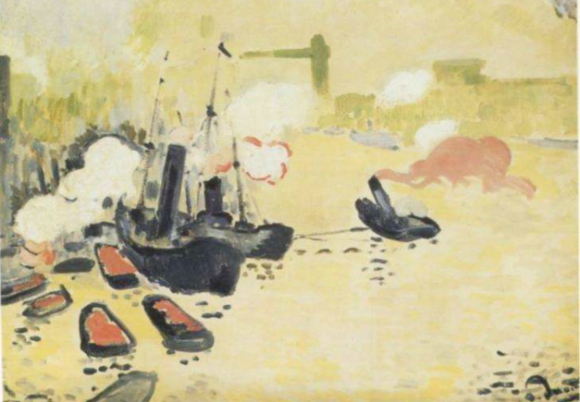
‘London’ by Andre Derain.

During two visits to London, he became fascinated by the bustling traffic of barges and tugboats on the Thames. He used the puffs of smoke mixed with the mist to decline all shades of whites. He found a new inspiration in the representation of water and sky. The apotheosis is an almost abstract sunset with the sun breaking through the dark clouds as if putting the sky on fire.

In 1910, Derain is part of the Cubist movement as shown in his representation of the village of Cagnes – an assemblage of cubes with red roofs scattered on a hilly landscape made of geometric lines and volumes of dense vegetation.

The versatility of Derain seems to be boundless. He played the piano, was  a professional photographer, and enjoyed fast cars (he owned 11 Bugattis.)  Using his virtuosity as a draughtsman, he created illustrations for humor publications along with stage and costume designs (for Diaghilev and the Russian ballets.)

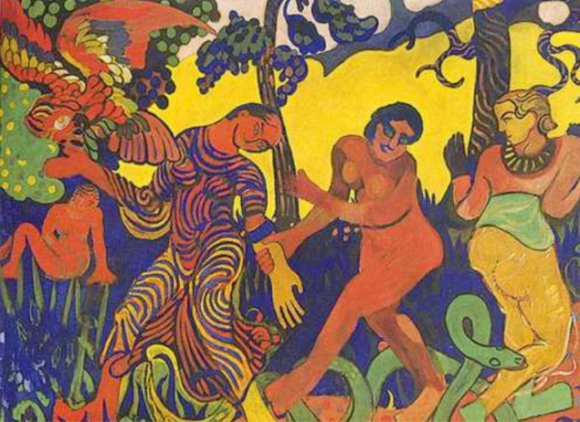
The dance” by André Derain.

Before leaving the exhibit, the visitor will be stunned by The Dance, 1906 – a large (185 x 228 cm) decorative composition of three women undulating in a luxuriant forest.  The work is rarely seen, since it belongs to a private collection.  Derain was inspired by a poem by Apollinaire and called it L’Enchanteur pourrissant (the rotting magician) about three fairies looking for Merlin’s tomb. The gestures of the dancers are reminiscent of Egyptian and Indian art, and could have inspired Nijinsky’s choreography. The mysterious vegetation and the hidden meaning of a snake and a multicolored parrot infuse the ritual scene with symbolism.

Editor’s Note: This is the opinion of Nicole Prévost Logan.

Nicole Prévost Logan

About the author: Nicole Prévost Logan divides her time between Essex and Paris, spending summers in the former and winters in the latter. She writes a regular column for us from her Paris home where her topics will include politics, economy, social unrest — mostly in France — but also in other European countries. She also covers a variety of art exhibits and the performing arts in Europe. Logan is the author of ‘Forever on the Road: A Franco-American Family’s Thirty Years in the Foreign Service,’ an autobiography of her life as the wife of an overseas diplomat, who lived in 10 foreign countries on three continents. Her experiences during her foreign service life included being in Lebanon when civil war erupted, excavating a medieval city in Moscow and spending a week under house arrest in Guinea.
Reading Uncertainly? ‘Lab Girl’ by Hope Jahren

This month, let’s try an intensely introspective autobiography of a botanical scientist, wrapped in a biography of trees, flowers, and plants.

Hope Jahren, a professor at the University of Hawaii at Manoa in Honolulu, writes the clear, coherent, and engaging story of her upbringing in Minnesota, her education, travel and work in California, Georgia, Maryland, and Hawaii, intermixed with her study and analysis of the history and lives of plants and trees. And she apparently has a photographic memory as she recalls detailed conversations with her teachers, students, science mates and husband.

But, early on in my reading, I had a nagging question: does this intense self-analysis and self-reflection indicate something else?

Jahren finally acknowledges being a “manic-depressive woman” four-fifths of the way through her writing. She is consumed with her love of and study of plants: it dominates her life.

Fellow human beings? She acknowledges an early debt to her science-minded father, but never mentions him again after her first pages. Her scientific partner, Bill, is never granted a last name, nor is her husband, Clint. And none of those three is mentioned in her credits. She devotes one of the longest chapters to the birth of her son, but he remains nameless (mentioned only as “my toddler” and “my son.” Note he is not “our” son.)

But her often lyrical phrases continue to delight you as a reader, “a leaf is a platter of pigment strung with vascular lace,” and “vines are hopelessly ambitious,” and “being able to derive happiness from discovery is a recipe for a beautiful life.” Hers is a two-part, parallel story of intense curiosity – her science and her life.

Her self-analysis close to the end reads as follows:

“I’m good at science because I’m not good at listening. I have been told that I’m intelligent, and I have been told that I am simple-minded. I have been told that I am trying to do to much, and I have been told that what I have done amounts to very little. I have been told that I can’t do what I want to do because I am a woman, and I have been told that I have only been allowed to do what I have done because I am a woman. I have been told that I can have eternal life, and I have been told that I will burn myself out into an early death. I have been admonished for being too feminine and I have been distrusted for being too masculine. I have been warned that I am far too sensitive and I have been accused of being heartlessly callous.

But I was told all these things by people who can’t understand the present or see the future any better than I can. Such recurrent pronouncements have forced me to accept that because I am a female scientist, nobody knows what the hell I am, and it has given me the delicious freedom to make it up as I go along. I don’t take advice from my colleagues, and I try not to give it. When I am pressed, I resort to these two sentences: You shouldn’t take this job too seriously. Except for when you should.”

If that doesn’t arouse your curiosity to read this book, I don’t know what will!

Jahren’s conclusion, “Our world is falling apart quietly.” And her more optimistic recommendation: go plant a tree once a year! Which is exactly what my wife and I have done in our 24 years in Lyme, Conn. We’ve planted 13 Evergreens, four Red Maples, three Acacia, two Apples, one Japanese Maple, and one Witch Hazel. Yes, we’ve cut down an apple savaged by a hurricane, plus two small apples, but the latter were promptly replaced with two pears!

Do read Hope Jahren … and plant a tree.

Editor’s Note: ‘Lab Girl’ by Hope Jahren is published by Alfred A. Knopf, New York 2016

Felix Kloman

About the Author: Felix Kloman is a sailor, rower, husband, father, grandfather, retired management consultant and, above all, a curious reader and writer. He’s explored how we as human beings and organizations respond to ever-present uncertainty in two books, ‘Mumpsimus Revisited’ (2005) and ‘The Fantods of Risk’ (2008). A 20-year resident of Lyme, he now writes book reviews, mostly of non-fiction that explores our minds, our behavior, our politics and our history. But he does throw in a novel here and there. For more than 50 years, he’s put together the 17 syllables that comprise haiku, the traditional Japanese poetry, and now serves as the self-appointed “poet laureate” of Ashlawn Farms Coffee, where he may be seen on Friday mornings. His wife, Ann, is also a writer, but of mystery novels, all of which begin in a bubbling village in midcoast Maine, strangely reminiscent of the town she and her husband visit every summer.

Letter From Paris: To Be or Not To Be [Independent] — The Catalonian Question

Nicole Prévost Logan

The tentative attempt by Catalonia to secede from Spain has failed – at least for now.  But the attachment of the Catalan people to their identity is so strong that the fight for independence is far from over.  The Catalonian regional elections on Dec. 21 are likely to take place in a very agitated, if not violent, context.

The province of Catalonia has just lived through its worst political crisis in decades.  On Aug. 17, the terrorist attack in Barcelona that killed 13 people and injured 113 left the population of that city badly shaken.  On Oct. 1, a referendum showed how divided the population was with 90.2 percent voting for independence … but with a participation rate of only 45 percent.  For several days, the two protagonists – Mariono Rajoy, prime minister of Spain and Carles Puigdemont, the Catalan President – faced off each other, avoiding any dialogue.

Then on Oct.17,  the separatist members of the Catalan parliament announced the declaration of independence by 70 votes to 10.  The situation became untenable for Puigdemont.  He surreptitiously left the country to reappear in Brussels.  For the first time ever, Article 155 of the constitution was activated — Madrid issued an arrest warrant for Puigdemont for espousing rebellion and placed the province under strict supervision. 

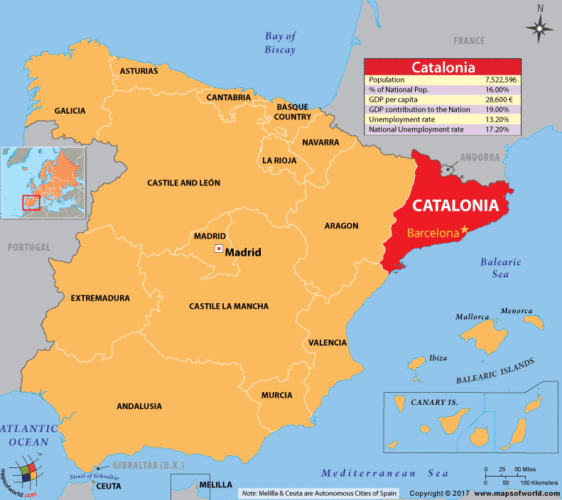
This map shows the location of Catalonia in Spain.

How does one explain the fierce nationalism of the Catalan people?  It is deeply anchored in their history.  Until the early 16th century, the county of Barcelona was at the center of power in Spain and closely united to the Aragon crown.  After the War of the Spanish Succession, the Catalans had to surrender to the Bourbons on Sept. 11, 1714.  The Catalonians remember that heroic battle by naming that day their National Day, calling it Diadia.  The civil war from 1936 to 1939, followed by 39 years of Franco’s fascist dictatorship, crystallized even further the Catalonians’ dream of autonomy.   

The European Union (EU) is keeping silent and uninvolved in what it considers as an internal problem for Spain.  Doomsday commentators had predicted that other regions of Europe such as Venetia, Lombardy or Corsica, would emulate Brexit. It is interesting to note that  Spain never recognized Kosovo for fear that Catalonia would follow suit.

When democracy was reinstated by King Juan Carlos, a new constitution and special self-rule status were granted to the Basque country, Catalonia and Cerdanya in 1978.  It is hard to understand why Catalonia did not accept the  favorable  terms offered by Madrid.  The ETA (Basque independence movement) did thus putting an end to their armed resistance, which had lasted for more than 50 years.

A visit to Barcelona helps understand the dynamic, feisty, almost turbulent temperament of the Catalan people.  Just mingle with the crowds on La Rambia – the heart of the city – or discover the extravagant architecture of Anton Gaudi in the Sagrada Familia cathedral. 

Catalonia can claim three artists, all larger than life and with strong personalities.  Joan Miro, the abstract artist creator of distinctive playful forms, was extremely proud of his Catalan origins.  Picasso spent several years as a teenager in Barcelona.  In 1905, he found the models for his “Les Demoiselles d’Avignon” among the prostitutes of a small street by that name located near the port.  The surrealist Salvador Dali went totally wild with the design of his museum in Figueres, his hometown.

Unfortunately, the project of the Catalan separatists did not take into account the long-term problems.  By early November of this year, 2,000 companies and banks had already left the province: tourism is being affected: the stock market has plummeted, and if Catalonia were to secede from Spain, it could not become part of the EU. 

In the simplest of terms, Catalonia may now, as a result of the most recent developments, find itself in a worse situation than before its declaration of independence.

Editor’s Note: This is the opinion of Nicole Prévost Logan.

Nicole Prévost Logan

About the author: Nicole Prévost Logan divides her time between Essex and Paris, spending summers in the former and winters in the latter. She writes a regular column for us from her Paris home where her topics will include politics, economy, social unrest — mostly in France — but also in other European countries. She also covers a variety of art exhibits and the performing arts in Europe. Logan is the author of ‘Forever on the Road: A Franco-American Family’s Thirty Years in the Foreign Service,’ an autobiography of her life as the wife of an overseas diplomat, who lived in 10 foreign countries on three continents. Her experiences during her foreign service life included being in Lebanon when civil war erupted, excavating a medieval city in Moscow and spending a week under house arrest in Guinea.
Legal News You Can Use: Smartphones May be Causing More Car Accidents


Suisman Shapiro Sponsored Post — Traffic safety advocates believe that smartphones are causing more deadly car accidents in Connecticut and across the U.S., but new federal statistics show that distracted driving deaths actually declined in 2016. What is going on?

According to the National Highway Traffic Safety Administration, only 448 people were killed in smartphone-related car crashes in 2015. That number dipped even further last year. However, traffic fatalities significantly rose the past two years, and a closer look at the data shows that half of all traffic deaths in 2015 involved cars that were driving straight ahead, rather than veering off the road due to weather or a blowout.

Safety experts believe that indicates that some drivers may have been distracted by their phones and simply plowed into something directly in front of them. This hunch correlates with numbers showing that pedestrian, bicyclist and motorcyclist deaths have risen sharply in recent years. For example, pedestrian fatalities rose 21.9 percent between 2014 and 2016. Over the same period, bicyclist and motorcyclist deaths jumped 15.2 and 15.1 percent, respectively. Meanwhile, studies show that smartphone use by drivers has continued to increase.

So why aren’t more traffic fatalities being classified as being smartphone-related? Experts say that some police investigators are overly focused on other accident causes, such as drunk-driving or speeding. Another problem is that it can be difficult to prove that a smartphone was responsible for a crash.

Car crashes caused by distracted drivers are a major problem in Connecticut. Individuals who are injured by a distracted driver have the right to pursue compensation in court. With the help of an attorney, it may be possible to obtain a settlement that covers medical expenses and other losses that have been sustained.

Source: Bloomberg, “Smartphones Are Killing Americans, But Nobody’s Counting“, Kyle Stock, Oct. 17, 2017