Legal News You Can Use: Divorce and Splitting Retirement Accounts

Photo by Helloquence on Unsplash

Suisman Shapiro Sponsored Post — When Connecticut couples divorce, one piece of property they may need to divide is a retirement account. This might be what is known as a qualified plan, including a 401(k), or it might be an Individual Retirement Account (IRA) or another non-qualified plan. There are different regulations for dividing these types of accounts.

With a qualified plan, if a person withdraws a portion of the money and gives it to a spouse, that money will be taxed and may be considered an early withdrawal. This can lead to a significant reduction in the final amount. However, if the couple gets a document known as a qualified domestic relations order (QDRO), the tax and early withdrawal penalty will be waived.

A couple can have a QDRO for an IRA, though it is not necessary to avoid tax. Furthermore, there will still be a penalty for early withdrawal for people under a certain age. Other specific regulations may differ across company plans or pensions, and a couple may want to look into these regulations. It is important not to assume that the process will be straightforward nor that it will not incur penalties or fees. Furthermore, the QDRO must be prepared accurately as it can be a costly document that becomes even more expensive if there are errors.

One option for couples who do not want to go through the trouble or expense of splitting a retirement account is for one person to keep the retirement account and the other person to take another valuable asset. This might be the home or an investment account. However, it is important that the values of these assets be assessed accurately. This means taking both taxes and penalties into account as well as the liquidity of the asset. For example, a bank account could be more liquid than a retirement account while maintenance and insurance are among the costs of a home that should be considered.

The Law Firm of Suisman Shapiro focuses on this area of the law. If you are seeking experienced legal guidance for a divorce in Connecticut, contact Attorney Robert Tukey to arrange an initial consultation with an experienced eastern Connecticut divorce lawyer.

Talking Transportation: Will the Real ID Act Disrupt Travel?

Something like 1.73 million Americans board airplanes ever day.  And each of them must go through a very necessary screening by the TSA, the Transportation Security Agency.  But beginning in late January 2018, a lot of passengers will be denied boarding because they don’t have the right kind of ID.

You can thank (or blame) the Real ID Act passed by Congress in 2005 after 9/11 to make sure people really are who they claim to be.  As any teen can tell you, it’s too easy to obtain a fake ID.  And if teens can do it, terrorists can also.

Because most people rely on their state driver’s license as ID, it’s been up to the states to gain compliance with the Federal rules.  A lot of those states are not in compliance, but Connecticut has passed the test, sort of.

If you’ve recently renewed your Connecticut license, you know you were given an option:  get a “regular” license or a “verified” ID.  To get a verified license you needed to bring extra proof to the DMV:  a US passport, birth certificate, original Social Security card, etc.

Look at your CT license and you’ll easily see the difference.  If yours has a gold star in the upper right corner, you’re verified.  No gold star, NOT verified … meaning that as of 2020 your license will NOT be enough ID to get you on an airplane.  That license clearly says “Not for Federal Identification.”  But for now, any CT driver’s license will get you past TSA.

Sure, you can always use your US Passport as ID.  It’s the gold standard and requires all kinds of identity proof to be issued.  But if you don’t have a passport and don’t have a gold star on your CT driver’s license, starting in 2020 you’ll have to start thinking about taking Amtrak or driving.

Only about 40 percent of all Americans have a passport.  Compare that to countries like Canada (60 percent) or the UK (70 percent).  Considering the fact that millions of Americans have never even been out of the country, why would they need one?  (PS: Isn’t it amazing how those same people always say the USA is #1 having no point of comparison?)

Leaving aside the paranoids who think that having a passport is an invasion of privacy because they are now embedded with RFID chips containing who-knows-what kind of information about you, we should all have a passport.  And getting one is pretty easy.

There are more than 8,000 Passport Offices in the US, most of them US Post Offices or libraries, which will process applications certain days each month.  But the main Passport Office for our state is in Stamford.  You can also file your application by mail, but only for renewals.  First time applicants must appear in person with all their documentation.

Mind you, US Passports are not cheap: $110 for first time applicants, plus $25 application fee.  Renewals are also $110 and “expedited” passports are an extra $60.

Turn-around time on your application can be anywhere from two to six weeks.  There are also private services that claim to be able to get you a new passport in one day, but they’ll cost you.

So the bad news is:  if you don’t have a passport already, may need one eventually.  The good news is, December is a great time to apply as it’s the Passport Office’s “slow season”, compared to the summer travel rush.  Happy traveling!

Posted with permission of Hearst CT Media

Editor’s Note: This is the opinion of Jim Cameron.

About the author: Former NBC News director and anchor, now a professional communications consultant, Jim Cameron, pictured left, leads workshops on media training, speech and presentations skills and preps clients for analyst briefings and legislative testimony. Jim served for 19 years on the CT Metro-North Rail Commuter Council, is an elected member of the Darien Representative Town Meeting (RTM) and is Program Director of Darien TV79, his town’s government TV station.

Reading Uncertainly? ‘A Gentleman in Moscow’ by Amor Towles

“By their very nature, human beings are so capricious, so complex, so delightfully contradictory, that they deserve not only our consideration, but our reconsideration – and our unwavering determination to withhold our opinion until we have engaged with them in every possible setting at every possible hour.” This is the theme of a compelling, engrossing, and forever cheerful story of an Russian aristocrat condemned to lifetime “house arrest” in Moscow’s Metropol Hotel in 1921.

Through the eyes and experiences of Count Alexander Rostov, in five segments (1921-22; 1923-46; 1950; 1950-53; and 1954), we are treated to a history of Russia, the Soviet Union, European literature, art, music, medicine and architecture. And dining: the Count becomes the Head Waiter at the hotel’s superlative dining room. An entire chapter is devoted to the creation of a sumptuous bouillabaisse – a foodie’s delight!

Consider this analysis: “Surely, the span of time between the placing of an order and the arrival of appetizers is one of the most perilous in all human interaction. What young lovers have not found themselves bat this juncture in a silence so sudden, so seemingly insurmountable that it threatens to cast doubt upon their chemistry as a couple? What husband and wife have not found themselves suddenly unnerved by the fear that they might not ever have something urgent, impassioned, or surprising to say to each other again?”

The good Count is forever curious, of people, events, and changing circumstances. On reading: “After all, isn’t that why the pages of a book are numbered? To facilitate the finding of one’s place after a reasonable interruption?” On how he spends his time: “dining, discussing, reading, reflection.” On history: “the business of identifying momentous events from the comfort of a high-backed chair.” On life itself: “ … life does not proceed by leaps and bounds. It unfolds. At any given moment, it is the manifestation of a thousand transitions.” And, given his confinement, also exercising: squats and push-ups every morning, plus climbing stairs to his attic rooms.

Towles names the Count’s barber at the hotel, Yaroslav Yaroslavl, provoking my own recollections of travel in Russia, first to St. Petersburg (then Leningrad) at its Hermitage in 1984 and later to Moscow and Yaroslavl in 1992. And the Count also states emphatically that, “all poets must eventually bow before the haiku,” a statement which — as a modest haiku composer myself — I endorse with pleasure!

So the Metropol becomes hardly a “prison” for Count Alexander, but rather it is his own wide, wide world.

One unusual note: all chapters have titles beginning in the letter A. And the end of the story has an unnamed lady waiting for the Count. But we know her name both begins and ends with an A …

The keynote of the eminently readable novel is “Montaigne’s maxim, that the surest sign of wisdom is constant cheerfulness.”

Editor’s Note: ‘A Gentleman in Moscow’ by Amor Towles is published by Viking, New York 2016.

Felix Kloman

About the Author: Felix Kloman is a sailor, rower, husband, father, grandfather, retired management consultant and, above all, a curious reader and writer. He’s explored how we as human beings and organizations respond to ever-present uncertainty in two books, ‘Mumpsimus Revisited’ (2005) and ‘The Fantods of Risk’ (2008). A 20-year resident of Lyme, he now writes book reviews, mostly of non-fiction that explores our minds, our behavior, our politics and our history. But he does throw in a novel here and there. For more than 50 years, he’s put together the 17 syllables that comprise haiku, the traditional Japanese poetry, and now serves as the self-appointed “poet laureate” of Ashlawn Farms Coffee, where he may be seen on Friday mornings. His wife, Ann, is also a writer, but of mystery novels, all of which begin in a bubbling village in midcoast Maine, strangely reminiscent of the town she and her husband visit every summer.

A la Carte: Dive Into Dips on New Year’s Eve

If New Year’s Eve plays out as planned, I will either be at home alone or with friends, or with other friends at their houses.

I will have spent Christmas Eve and Christmas Day with my family in Massachusetts. Often I fly off to California the that day or the day after, but because my LA daughter and her husband will be in Arizona for two or three days, and because I have to be back for meetings on Jan. 2, I will have the week between the holidays at home.

And I will be cooking. I do love to bake, but, very honestly, if I don’t have to make anything sweet for the next month or so, I will be so happy. For New Year’s Eve, I have decided to make a couple of dips. I loved the one I tasted that Gretchen Newsome, who is on board of education with me, took to a party three weeks ago. There was a lot of really good food at that get-together, but most of us decided that this artichoke dip was so delicious that we would rather eat it by the tablespoon than daintily dip pieces of bread into it. The second dip I have made a few times. I love the flavor of anchovy but don’t like to touch them. With this recipe, though, I will touch the little devils.

Gretchen Newsome’s Artichoke Dip

Preheat oven to 375 degrees.
Butter a Pyrex pan or gratin dish.

2 medium onions, chopped
12 cloves of garlic, peeled and minced
2 tablespoons of unsalted butter
1 can non-marinated artichokes, chopped (if packed in oil, drain)
1 16-ounce package of cream cheese, at room temperature
1 16-ounce package of shredded sharp cheddar
1 16-ounce jar of sour cream
1 2-pound round loaf of bread, preferably pumpernickel, or 2 1-pound loaves

Sauté the onions and garlic in butter on medium low until translucent. Do now brown. Add chopped artichokes and continue to cook until warmed through.

Pour cooked mixture into a large bowl. Add cream cheese, cheddar cheese and sour cream. Mix well. (I use my food processor and pulsed around five times.) Place mixture into gratin pan or heat-proof glass pan and bake until bubbling.

In the meantime, hollow out the bread and, if you like, toast the pieces of bread. When the dip is hot, you may it pour it into the hollowed bread and serve with pieces of bread for dipping (or use all the bread for dipping into the gratin dish/

Anchoiade Dip with Crudites

From Hors d’Oeuvres: Simple, Stylish, Seasonal by Gillian Duffy (William Morrow, New York 1998)

Yield: About 2 and one-half cups

2 ounces (2 tins) anchovy fillets, drained
2 cups extra-virgin olive oil
3 cloves garlic
1 tablespoon fresh thyme leaves
1 and one-half tablespoons Dijon mustard
1 and one-half tablespoons chopped fresh basil
Salt and freshly ground black pepper

Combine all the ingredient into a blender or the bowl of a food processor and puree until smooth. Pour into a bowl and serve with fresh vegetables and small chunks of good bread.

Letter From Paris: Deaths of Two Icons Leave a Nation in Mourning

Nicole Prévost Logan

From Les Invalides to the Champs Elysees, intense emotion grips France at the passing of two iconic personalities.

Within 24 hours France lost two familiar figures: Jean d’Ormesson, 92, man of letters, and Johnny Hallyday, 74, the popular singer who, for almost 60 years, enthralled millions of fans. The intensity of the emotions was incredible. For a week, politics, wars, economic crises, were suspended and replaced by an immense sadness, which united the nation. No matter how different the two men were, they shared a great simplicity and the gift of connecting with the people.

It is not unusual for the French to express their collective grief in the public place. In 1885, two million people attended the national funerals of Victor Hugo. Simone Weil, the courageous woman who showed exceptional fortitude in her public life by being a pioneer of the right to abortion, received the highest honors by being laid to rest in the Pantheon. In 1963, a human tide surged toward the Pere Lachaise cemetery to say goodbye to Edith Piaf.
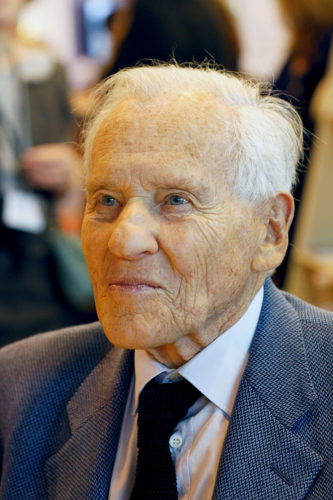
Count Jean d’Ormesson

Count Jean d’Ormesson, at age 48, was the youngest “immortal” to enter the Academie Française – a literary institution created by Louis XIII to uphold the French language. He died as the dean of that 40-members council. Son of a French ambassador, d’Ormesson was part of the French aristocracy, with degrees in history and philosophy. He directed the conservative daily Le Figaro, became a prolific writer, publishing a book per year, with the last one completed three days before his death. His smiling face and piercing blue eyes were a familiar sight for the viewers of countless televised literary shows, such Bouillon de Culture, Apostrophe or La Grande Librairie.

An elegant conversationalist, he spoke with wit, lightness, and optimism. His remarks, studded with literary quotes, included gems of uplifting philosophy, such as,”Life is beautiful because we are lucky to die”, and “In the New Testament, the myth of the Wandering Jew is condemned to immortality by Jesus.”

During the strikingly sober ceremony, in the courtyard of the Invalides, a small group of guests, representing the world of politics and culture, stood stoically, whipped by a glacial wind. The eulogy given by French president Emmanuel Macron, matched the literary sophistication of the deceased academician.

Johnny Hallyday was a monument in France with an amazing longevity. From the first time he appeared on the stage at age 17, this blond, tall young man became an adulated performer and he remained a star for almost 60 years. For millions of fans, his disappearance meant the loss of a chunk of their own life. Fighting lung cancer for several years, in spite of the terrible pain, he continued performing until the very end. People thought he was indestructible, hence the extreme shock people felt when they learned about his death on Dec. 6th.

Abandoned by his father at the age of eight months, Hallyday did not grow up in the security of a proper family but bounced around from one relative to another. A cousin gave him his stage name.

Facts about his career are staggering: more than 28 million spectators attended the 3,300 concerts he gave in 40 countries; he sold 110 million records. He had a real talent in choosing the best composers and song writers, which allowed him to produce 1,000 songs, many of them in Gold albums.

Johnny Hallyday

Hallyday went through all the styles of music from rock n’roll, pop, blues, soul, country, and hard rock. Among the best known hits is, “Ah Marie, si tu savais, tout le mal que l’on m’a fait” (Ah, Marie, if you only knew how much they hurt me) about a young man, fighting in the WWI trenches and writing to his fiancee.

It is a paradox that, in spite of his love for the US, that country barely knew him. Driving full speed on his Harley Davidson with his buddies from the Midwest to California was one of his greatest pleasures. He sang with Sammy Davis Junior. Michel Berger wrote for him a song called “On a tous quelque chose de Tennessee” (We all have something of Tennesse.) The lyrics recall lines from “Cat on a Hot Tin Roof.”

He spent the last 10 years of his life in Los Angeles, Calif., with Tom Hanks and Ben Affleck as neighbors and only returned to France to perform in concerts. Some of his concerts became giant productions of a size never seen before. The absolute zenith of his career was right after France won the soccer World Cup in 1998 when Hallyday flew over the Stade de France by helicopter and was lowered into the hysterical crowd.

The public funeral of Hallyday was an incredible spectacle offered to millions of fans. The cortege moved slowly down the Champs Elysees, led by a white coffin. This was followed by a caravan of black limousines filled with family, close friends and dignitaries and then – even for people who do not particularly like motorcycles – the incredible sight of 700 bikers, who had come from all over France.

On the steps of the Madeleine church, President Emmanuel Macron, paid his respects to the rock star and invited the crowd to bid farewell to “Mr. Johhny Hallyday.”

Editor’s Note: This is the opinion of Nicole Prévost Logan.

Nicole Prévost Logan

About the author: Nicole Prévost Logan divides her time between Essex and Paris, spending summers in the former and winters in the latter. She writes a regular column for us from her Paris home where her topics will include politics, economy, social unrest — mostly in France — but also in other European countries. She also covers a variety of art exhibits and the performing arts in Europe. Logan is the author of ‘Forever on the Road: A Franco-American Family’s Thirty Years in the Foreign Service,’ an autobiography of her life as the wife of an overseas diplomat, who lived in 10 foreign countries on three continents. Her experiences during her foreign service life included being in Lebanon when civil war erupted, excavating a medieval city in Moscow and spending a week under house arrest in Guinea.