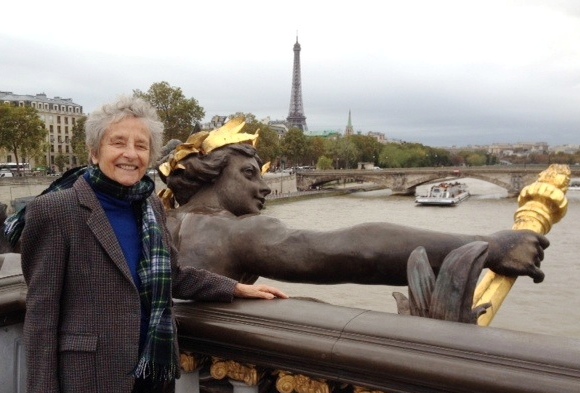
Welcome to Betsy Groth, our new ‘Family Wellness’ Columnist!

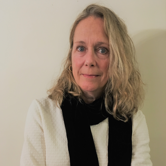
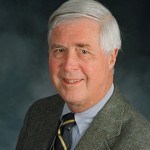
Betsy Groth

We are delighted to welcome Betsy Groth to our stable of writers today. She is an APRN, PMHS – BC and a pediatric nurse practitioner with advanced certification in pediatric mental health.  She is a counselor, mental health educator and parent coach in Old Lyme and will be writing a monthly column for us on ‘Family Wellness.’  

In this introductory column, she explains the background to her column and some of the subjects she will be covering. 

For more information about Betsy and her work, visit Betsy’s website at betsygroth.com

Family is defined by Merriam Webster as, “the basic unit in society traditionally consisting of two parents rearing their children; also: any of various social units differing from but regarded as equivalent to the traditional family.” But we all know in today’s society, family is defined more broadly both theoretically and practically speaking.

Wright and Bell (2009) define family as a group of individuals bound by strong emotional ties, a sense of belonging and a passion for being involved in one another’s lives. There is usually a generational aspect to our definition of family and a sense of development over time. We think of families that are couples, families with young children, families with older children, families that have launched the younger generation, and families caring for aged members.

There is no universally accepted definition of wellness. It has been described as “… a state of complete physical, mental and social well-being and not merely the absence of disease.” This state of being is a lofty goal for any individual or family!  But it can be a sought after goal, the “ball” on which we all keep our eye.

Development as an individual and as a family has some built-in challenges to wellness, in addition to the joys to be found at each stage. There are also some often unexpected challenges and struggles, such as illness in a family member, academic struggles, financial difficulties, strained relations within the family.

This monthly column will explore factors in family and individual wellness, and approaches to maintain the goal of optimal wellness. Topics will include stress and anxiety in children and adolescents (next month), caring for aging parents, coping with chronic illness, raising children in a competitive society, and adjusting to first time parenthood.

And of course, I am always listening to families and the areas that they would like addressed in these columns, so please drop me a line at betsy.groth.aprn.pmhs@gmail.com if there’s anything in particular you would like me to discuss.

Letter From Paris: The Seine is Flooding … Again

Nicole Prévost Logan

The Paris floods crested Friday, Jan. 26, at almost six meters, therefore slightly lower than in June 2016 . They did not even make the ‘Top 10’ among the most destructive floods of the past 100 years. The monster flood of 1910 saw the river’s level rise eight meters and 60 centimeters.  However, the inhabitants in the communities upstream from the city, who have been underwater for days and have now been flooded twice in 18 months, were certainly entitled to call it a natural disaster brought on by the global warming.

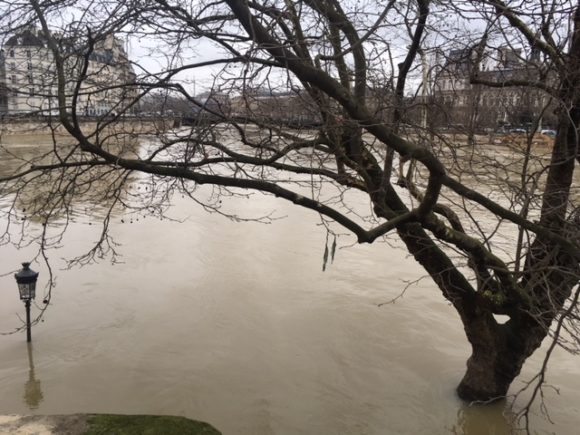
The submerged tree and lamp post in the foreground show the depth of the flooding on the Seine.  The Hotel de Ville stands at right in the background while the Ile de la Cité is at left. Photo by Sylvia Logan.

Monumental work has been done in the past century to protect the capital and the resultant price is paid by the surrounding areas.   Paris is such a strategic place that it has to be protected by a system of locks and reservoirs, both up and down stream. Besides, France is endowed with numerous waterways and this is particularly true in the Paris basin.  The Seine’s tributaries — Marne, Yonne, Aube and Loing — flow toward Paris.  In the case of extreme precipitation, these small rivers easily overflow and submerge their unprotected banks.  The small towns of Champagne, Moret or Thomery, only 30 minutes by train south of Paris, had disappeared underwater by midweek.

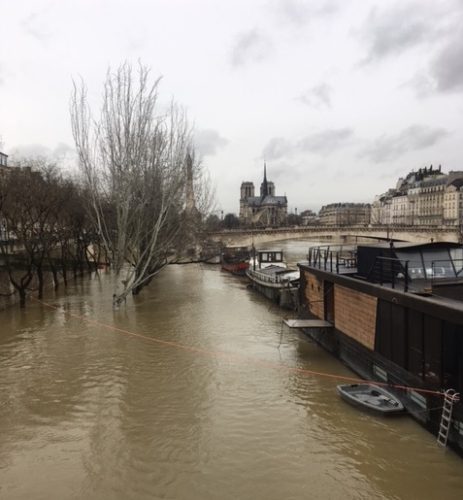
The banks of the Seine are submerged while the Cathedral of Notre Dame still stands proudly in the background. Photo by Sylvia Logan.

In prehistoric times, the Seine was a shallow stream, indolent and undisciplined, moving its bed all over the place.  The most northern of its secondary beds followed what is today the ring of Grands Boulevards and flowed from the Bastille, along the hills of Buttes Chaumont and Montmartre, and back down to the main channel below the hill of Chaillot.   On the Left Bank, the Seine also had a secondary bed, which used to flow under the modern Boulevard Saint Germain. 

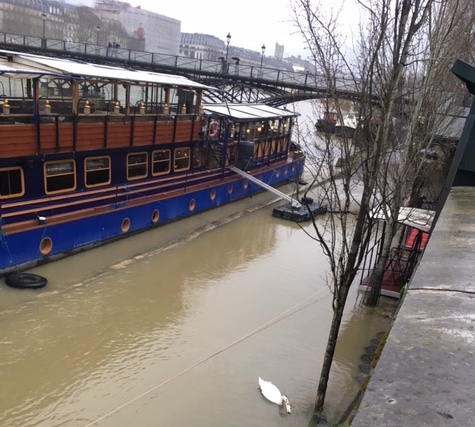
The restaurant ”Calife,” which is moored in the middle of the river near the Pont des Arts, is flooded.  Photo by Sylvia Logan.

Between 1991 and 1993, excavations prior to the building of the new Bercy district, brought to light spectacular remains of human settlements on the banks of the wandering Seine river.  Neolithic pirogues dating back to more than 3,000 years BC are exposed today in the Orangerie of the Carnavalet museum. They are the oldest found in Europe.

The construction of massive stone quays in Paris started in  the 14th century.  In 1991, they became part of the UNESCO World Heritage.

By midweek , as the peak of the floods approached, there was no panic among the city officials, engineers and technicians, but a feverish activity to prevent disaster.  By way of precaution, the RERC running along the river, was closed until the end of the month.  Already the treasures exposed on the lower levels of the Louvre and Orsay museums had been moved to safe locations.  The great danger was that the dense network of cables, pipes and wiring, providing gas, electricity and internet, and lying eight floor deep underground would be reached  by the water.

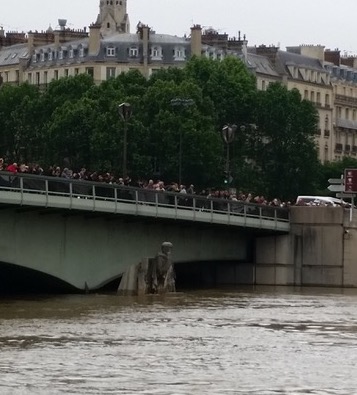
Crowds gather above the famous Zouave statue on the Pont de l’Alma. Photo by Karen Logan

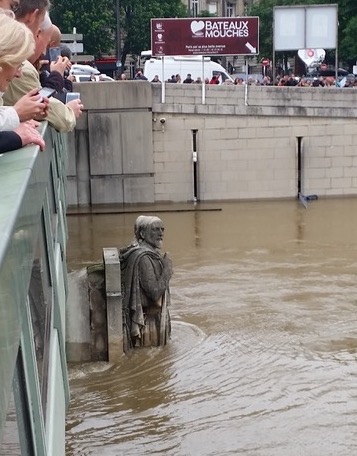
Curious onlookers have been following the progress of water on the statue of the Zouave at the Pont de l’Alma.  The statue was placed below the bridge in 1836 to mark one of the battles at Alma, near Sebastopol, during the Crimean war (1853-56.) 

The Zouave at the Pont de l’Alma has been a point of reference for the severity of Seine floods for centuries.. Photo by Karen Logan

The  coalition of France, England and the Ottoman Empire wanted to put a stop to the expansionist policy of the Russian Tsar Alexander II (1856-1881.) The Zouaves were part of the Algerian light brigade in the days of French Algeria — their bright red baggy pants were famous. 

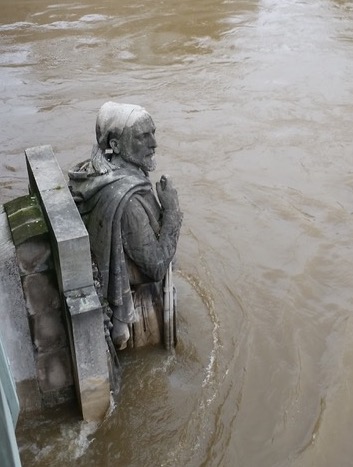
Down he goes!  As the waters rise, the Zouave at the Pont de l’Alma disappears deeper into the River Seine. Photo by Karen Logan

Although not very reliable – since the statue was raised by 40-80 centimeters  in 1970 – the Zouave remains the most popular indicator of the severity of the floods in Paris.

Editor’s Note: This is the opinion of Nicole Prévost Logan.

Nicole Prévost Logan

About the author: Nicole Prévost Logan divides her time between Essex and Paris, spending summers in the former and winters in the latter. She writes a regular column for us from her Paris home where her topics will include politics, economy, social unrest — mostly in France — but also in other European countries. She also covers a variety of art exhibits and the performing arts in Europe. Logan is the author of ‘Forever on the Road: A Franco-American Family’s Thirty Years in the Foreign Service,’ an autobiography of her life as the wife of an overseas diplomat, who lived in 10 foreign countries on three continents. Her experiences during her foreign service life included being in Lebanon when civil war erupted, excavating a medieval city in Moscow and spending a week under house arrest in Guinea.

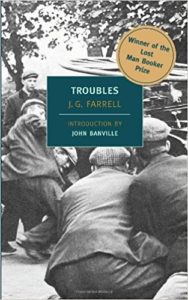
Reading Uncertainly? ‘Troubles’ by J.G. Farrell

When a world is collapsing all about us, how much are we willing to recognize?

J. G. Farrell’s description of a veteran of the World War I trenches going to Ireland to rejoin a young lady he had met only once in London during the War is an allegory on human inertia and lethargy in the face of rapid change.

In 1919, Major Brendan Archer travels from London to Kilnalough, Ireland, thinking to ask Angela Spencer to join him in marriage, even though he could not remember ever asking her outright to do so. He finds an elusive young lady and a scene of inertia and decay. Ireland has entered the “Troubles” with Sinn Fein pushing for complete separation from the British Empire.

And that Empire is collapsing just as the Majestic Hotel — owned and operated by Angela’s father, Edward, and the scene of the entire novel — is doing the same.

Farrell gives us the Hotel dominated by “dust.” Every page describes dust, “mould,” gloom, creepers, grime, cobwebs, collapsing floors, “man-eating” plants, and an ever-expanding entourage of reproducing cats. One room featured “an enormous greyish-white sweater that lay in one corner like a dead sheep.” The weather wasn’t any better: “it rained all that July,” and the hotel residents complained of the coming  “dreadful gauntlet of December, January, February.”

Both the hotel and Ireland exuded “an atmosphere of change, insecurity and decay.” But the residents continued to follow life’s rituals: prayers at breakfast, afternoon teas, dressing for dinner, and whist in the evening.

Add to this mordant scene the author’s interjection of gloomy news reports from around the world: White Russians and English military supporters being trounced in Russia, victorious Boers in South Africa, a mess in Mesopotamia and Egypt, rebellion in Poland, and, finally, the Indians attempting to remove themselves from British rule.

In the face of all this, the hotel’s owner and operator, Edward Spencer aggravates the Major: “ … his overbearing manner; the way he always insisted on being right, flatly stating his opinions in a loud and abusive tone without paying any attention to what the other fellow was saying.” Does this also describe the Brits in other sections of the world?

The Major remains always a drifter “with the tide of events,” never able to respond, dominated, it seems, by “the country’s vast and narcotic inertia.”

This is a story of the collapse of a hotel, descending at last into ashes, and an allusion to the similar collapse of the British Empire, with the Second World War being its enormous fire. It is a compelling read, one that suggests some connections to the events of the second decade of the 21st century …

Editor’s Note: ‘Troubles’ by J. G. Farrell is published by Weidenfeld & Nicolson, London 1970.

Felix Kloman

About the Author: Felix Kloman is a sailor, rower, husband, father, grandfather, retired management consultant and, above all, a curious reader and writer. He’s explored how we as human beings and organizations respond to ever-present uncertainty in two books, ‘Mumpsimus Revisited’ (2005) and ‘The Fantods of Risk’ (2008). A 20-year-resident of Lyme, he now writes book reviews, mostly of non-fiction that explores our minds, our behavior, our politics and our history. But he does throw in a novel here and there. For more than 50 years, he’s put together the 17 syllables that comprise haiku, the traditional Japanese poetry, and now serves as the self-appointed “poet laureate” of Ashlawn Farms Coffee. His wife, Ann, is also a writer, but of mystery novels, all of which begin in a bubbling village in midcoast Maine, strangely reminiscent of the town she and her husband visit every summer.

Letter From Paris: Emmanuel Macron Goes to China

Nicole Prévost Logan

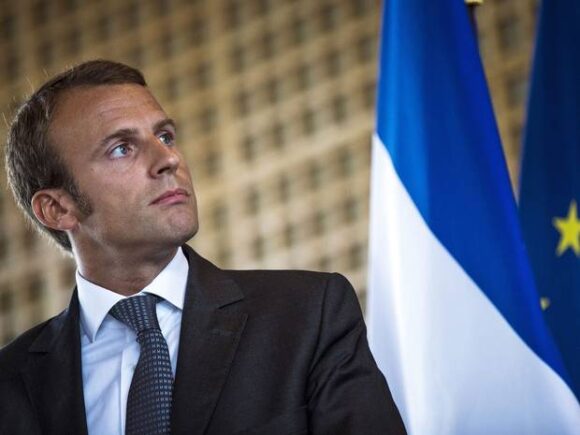
At first sight, the January visit of Emmanuel Macron to meet Xi Jinping might have appeared like the futile encounter between David and  Goliath.  But, in fact, it was a well thought-out strategic move and an illustration of Macron’s personal style of diplomacy.

Never before had any French president gone to China so early in his mandate. He timed his visit to seize the opportunity of a world stage left vacant by most of the players.

He came as an European leader, not as a French one. He stepped into the role Angela Merkel  –– still embroiled in internal political negotiations to create a coalition government — had played for many years.

The trip was put under the symbols of history and culture shared by France and China.  Instead of Pekin, it started in Xi-an, Shaansi province, where the discovery of an imperial tomb made world headlines in 1974.  The tomb contained 8,000 terracotta warriors, horses, and chariots, dating back from the golden age of the Han dynasty (206 BC-220 AD.)

During her several visits to Asia, German chancellor Merkel had openly blamed the Chinese government for its violation of human rights.  Unfortunately, this method did not bring any positive results. 

french President Emmanuel Macron

Macron chose a more pragmatic approach, limiting his criticisms to subliminal  remarks.  According to analysts, his diplomacy can be described as “Gaullienne.”  At a press conference in 1964, General de Gaulle abandoned his aloof and philosophical tone and declared that, to talk with leaders having opposing views, did not mean having to agree with or condone them.

Linguistics can create difficulties since the key words used be the two sides may have different meanings.  Take for instance the definition of “terrorism.”  For Xi Jinping, it mostly refers to the activity of the autonomists Ouïgours whereas for  Macron it means the bomb attacks inflicted on the French population by radical followers of Daesch.

To conduct diplomacy with China is to enter a minefield.  Two examples.  One does not attack China frontally for its action in the South China seas because the Chinese government considers this region as its private turf.  Macron would like China to help with the efforts of the G5 to fight terrorism in the Sahel but it might become a two-sided sword because interference by China in the region is not really wanted.

On the crucial topic of the nuclear threat coming from North Korea, the French president could only reinforce the European Union (EU) position.  He complimented Xi Jinping for becoming the world leader in the fight against global warming, and for being a staunch defender of the Paris Accord.

Fifty CEOs of leading French companies were part of the trip, which was marked by the signing of enormous contracts.  The Chinese government ordered 134 A320 Airbus commercial  planes.  AREVA, the French multinational specialized in nuclear power and renewable energy, signed an agreement China National Nuclear Corporation (CNNC) to build facilities for the reprocessing of nuclear waste.  The largest existing plant in the world is located in La Hague, near Le Havre.  Cooperation in the agro-business will be developed.  The Chinese enjoy French beef but since 2011 an embargo had been imposed on the imports following the “mad cow” disease.

The surplus of the Franco-Chinese trade balance amounts to $30 billion in favor of China.  Macron wants too re-equilibrate those figures.  His objective is to widen the types of exports beside foodstuff or cosmetics and include digital technology, artificial intelligence and other sectors.

The silk road sounds like a romantic concept, which makes one dream. but in reality it is pharaonic project where the Chinese plan to invest around $1,000 billions to build a network of rail, maritime, land, or air routes to export its products.  Almost needless to say, this project is worrying many … starting with Macron, who declares that the silk road should be a two-way road.  Historically the silk road was developed in the Han dynasty and its starting point was the town of Xi-an (cf. above.)

During the official visit to Pekin of the French presidential couple, it was impossible not to notice the spectacular redcoat (red is a symbolic color in Chinese, meaning happiness) worn by Brigitte Macron.

Translated into Chinese phonetics, the name Macron means “the horse that dominates the dragon.”  Is that perhaps a good omen for Emmanuel Macron?

Editor’s Note: This is the opinion of Nicole Prévost Logan.

Nicole Prévost Logan

About the author: Nicole Prévost Logan divides her time between Essex and Paris, spending summers in the former and winters in the latter. She writes a regular column for us from her Paris home where her topics will include politics, economy, social unrest — mostly in France — but also in other European countries. She also covers a variety of art exhibits and the performing arts in Europe. Logan is the author of ‘Forever on the Road: A Franco-American Family’s Thirty Years in the Foreign Service,’ an autobiography of her life as the wife of an overseas diplomat, who lived in 10 foreign countries on three continents. Her experiences during her foreign service life included being in Lebanon when civil war erupted, excavating a medieval city in Moscow and spending a week under house arrest in Guinea.

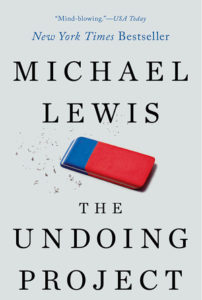
Reading Uncertainly? ‘The Undoing Project’ by Michael Lewis

No, this is not the story of a baseball team savant, who doubted conventional statistics and reused them with extraordinary success (Moneyball). It is not a personal disclosure of the seamy underbelly of financial markets (The Big Short; Flash Boys; Liar’s Poker).
Rather, it is the story of learning how our minds work, of behavioral economics, and of the unusual and highly prolific working relationship of two Israeli academics, who first met in 1960. It is the story of how an extrovert, Amos Tversky, and an introvert, Daniel Kahneman, stimulated and prodded each other over almost 40 years, first in Israel and then teaching  in the United States on the West coast, then in the Midwest, and finally in the East, uncovering and describing the numerous biases that confuse our thinking.

Each challenged the ideas of the other.

As the author describes an early intellectual collision, “Theories for Amos were like mental pockets or briefcases, places to out the ideas you wanted to keep. Until you could replace a theory with a better theory–a theory that better predicted what actually happened—you didn’t chuck a theory out. Theories ordered knowledge, and allowed for better prediction … But (Amos) left Danny’s seminar in a state of mid unusual for him: doubt. After the seminar, he treated theories that he had more or less accepted as sound and plausible as objects of suspicion.”

Kahneman: his “defining emotion is doubt.”

Tversky:  his interest is psychology: “why people behaved as they behaved, and thought as they thought,” never entirely “rational.”

Kahneman:  “He thought of himself as someone who enjoyed, more than most, changing his mind.”

Tversky: “People live under uncertainty whether they like it or not.”

Kahneman:  “It is the anticipation of regret that affects decisions, along with the anticipation of other consequences. This is why we seem to be instinctively ‘risk averse’.”

Tversky: “Reality is a cloud of possibility, not a point.”

Kahneman:  “The basic rules of undoing, however, apply alike to frustration and regret. They require a more or less plausible path leading to an alternative state.”

Together these two thinkers described the numerous biases that both confuse and enlighten our thinking: hindsight, anchoring, availability, small numbers, context, framing, the endowment effect, and many others. As Lewis explains it, “ they would learn to evaluate a decision not by its outcomes—whether it turned out to be right or wrong—but by the process that led to it. He then concludes: “ … the brain is limited. There are gaps in our attention. The mind contrives to make those gaps invisible to us. We think we know things we don’t. We think we are safe when we are not.”

In 1996, Amos Tversky died. In 2002, Daniel Kahneman won a Nobel Prize, one that almost certainly would have been awarded to Amos as well, had he been alive.

Do read this fascinating story of two thinkers, and go further and read Kahneman’s Thinking, Fast and Slow (2011).  And consider my own personal haiku, one that forces me to rethink all the time:

Pause for a moment:
Doubt, then curiosity.
Try another path.

Editor’s Note: ‘The Undoing Project’ by Michael Lewis was published by W. W. Norton, New York, in 2017.

About the Author: Felix Kloman is a sailor, rower, husband, father, grandfather, retired management consultant and, above all, a curious reader and writer. He’s explored how we as human beings and organizations respond to ever-present uncertainty in two books, ‘Mumpsimus Revisited’ (2005) and ‘The Fantods of Risk’ (2008). A 20-year resident of Lyme, he now writes book reviews, mostly of non-fiction that explores our minds, our behavior, our politics and our history. But he does throw in a novel here and there. For more than 50 years, he’s put together the 17 syllables that comprise haiku, the traditional Japanese poetry, and now serves as the self-appointed “poet laureate” of Ashlawn Farms Coffee, where he may be seen on Friday mornings. His wife, Ann, is also a writer, but of mystery novels, all of which begin in a bubbling village in midcoast Maine, strangely reminiscent of the town she and her husband visit every summer.