Letter From Paris: And Then There Were Two … Candidates Left for French President

Nicole Prévost Logan

Out of a chaotic and divisive campaign to elect the president of France came a surprisingly middle-of-the-road and constructive vote.  Emmanuel Macron, age 39, Europhile leader of the En Marche (EM) movement climbed to the first place with 24.01 percent of the votes.  Marine Le Pen (Front National or FN), received 21.3 percent, both therefore qualifying for the run-off election on May 7. For the FN it was an historical feat after a long struggle, started in 1972, to be acknowledged as an honorable political party.  The turn-out was high at 78 percent of the 47 million voters.

Until the last minute, the outcome was anyone’s guess.  The four candidates – two extremists, one conservator, and one center right – were running in a close pack.  “Fasten your seat belts” said a member of The City in London on the very morning of the elections, expressing the anxiety of the whole world.  At stake were a rejection of the Euro and abandoning the European Union (EU.)  “We were on the brink of world-wide financial tsunami” said one of the BFM radio economists.  Many around the globe greeted the result with a sigh of relief.

For the French voters what was happening had a deeper meaning than the one described in the international press.  This moment marks a painful turning point in French politics by ending the traditional pendulum swinging from Right to Left and wiping out the two main parties – the right wing Les Republicains (LR) and the Parti Socialiste (PS), which had been in existance for 30 years. The two winners were outsiders.  This a wrenching process for the French, who love to criticize, but hate change.

The whole campaign was overshadowed by the “Penelope-gate” and Fillon’s other affaires (troubles) [*See Letter from Paris” published on March 5, 2017.]  Bruno Retaillau, Fillon’s spokesman, commented with some bitterness, “This was not a campaign but a trial”.

On election night, as the numbers came up on the screens, political personalities made brief  comments then left to be replaced by others.  The right wing LR members announced they would transfer their votes to Emmanuel Macron.  Jean Pierre Raffarin, prime minister from 2002 to 2005 under president Jacques Chirac, forcefully endorsed  Macron.  Jean François Copé, former president of the UMP (predecessor of LR)  and minister,  agreed that they had to block Marine Le Pen.  He stressed that he would vote for En Marche but with a sinking heart. Alain Juppe, minister of Foreign Affairs under Nicolas Sarkozy and mayor of Bordeaux, also gave his vote to Macron saying “our country needs reforms.”  François Fillon’s words were the best of his campaign, “The defeat of the LR is mine, I take all responsibility. ”

Jean Luc Malenchon, leader of the leftist movement la France Insoumise (rebellious France), was obviously very upset to have lost.  Unlike the other candidates, he did not give instructions on how to vote in the run-off.  Since seven millions supporters voted for him, this question of transfer of votes will greatly tip the scale.
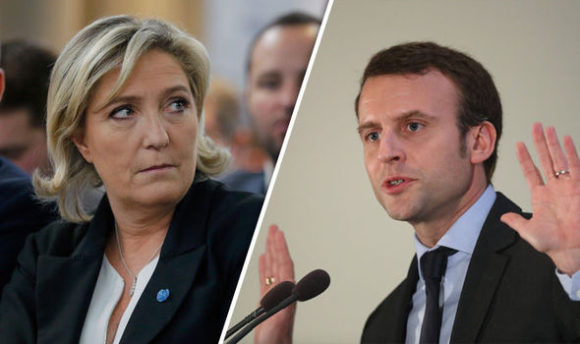
Marine Le Pen and Emmanuel Macron will face off in the final round of the French election on May 7.

On election night, Emmanuel Macron shared his satisfaction with the cheering flag-waving crowd in the huge hall at the Porte de Versailles.  His first words were to thank the other candidates.  Such courteousness is usually seen on the Rolland Garros tennis courts between Federer and Nadal, but certainly not among French politicians!

The electoral campaign took a sharp turn after April 23.  All of a sudden, it became a confrontation between the two candidates, a ruthless fight to the finish.  Macron was blasted for celebrating at the Rotonde brasserie on the first night and then for being invisible during the following two days. In contrast, Marine showed her ability as a superb strategist as she pre-empted the field immediately from the Ringis wholesale food market to a fishing trawler in the Mediterranean.

On April 26,   Macron went to Amiens (90 miles north of Paris) , his home town, to meet with the Whirlpool plant workers due to be laid off in 2018.  After talking with the Union representatives, he plunged into the battlefield and was roughed up by the angry crowd for 45 minutes.

But he stayed.

He talked to the workers, listened to their complaints.  He even had a heated discussion with Jean François Raffin, who is a star in France and won a César (French version of Oscar) in 2017 for his documentary Merci Patron (Thank you, boss.)  It is a satire on the relations between the working class and the super rich employers such as Bernard Arnaud,  CEO of LVMH.  Raffin, like Macron, is a native of Amiens.

Marine Le Pen, decided to drop by the Whirlpool site the same day.  She appeared all smiles, selfie in hand, working the crowds, hugging and kissing, doing small talks.  On an amazing picture she is shown beaming as she embraces a diminutive worker woman, who is in tears.

What happened in Amiens was emblematic of the confrontation between the two candidates in a difficult situation.  The relocation of a profit-making factory to Poland, where salaries are five times lower than in France, is one of the core issues the European Union (EU) is facing.

Le Pen promised the world to the workers, such as keeping the factory in France and, if needed, having it nationalized.  In contrast, the EM leader promised only to assist with the transition to other jobs.  He had the courage to tell an overheated audience that there will be many more similar relocations and one has to adjust to the new economy.

“Çà n’est pas gagné” (we have not won yet) said Macron, getting into his car.  He is right, especially when two people are fighting on different levels — one arousing fear and hatred, the other using pedagogy to propose obtainable solutions.

Editor’s Note: This is the opinion of Nicole Prévost Logan.
Nicole Prévost Logan

About the author: Nicole Prévost Logan divides her time between Essex and Paris, spending summers in the former and winters in the latter. She writes a regular column for us from her Paris home where her topics will include politics, economy, social unrest — mostly in France — but also in other European countries. She also covers a variety of art exhibits and the performing arts in Europe. Logan is the author of ‘Forever on the Road: A Franco-American Family’s Thirty Years in the Foreign Service,’ an autobiography of her life as the wife of an overseas diplomat, who lived in 10 foreign countries on three continents. Her experiences during her foreign service life included being in Lebanon when civil war erupted, excavating a medieval city in Moscow and spending a week under house arrest in Guinea.
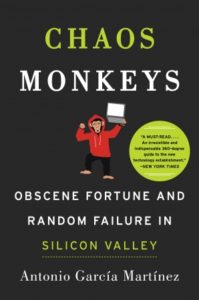
Reading Uncertainly: Chaos Monkeys: ‘Obscene Fortune and Random Failure in Silicon Valley, by Antonio Garcia Martinez

Let’s face it, we are all, every one of us, irrevocably married to this new and all-pervasive technology. We are computers and they are us. So isn’t it time that we learn something more about its source?
Antonio Garcia Martinez takes us on a four-year, inside-tour of Silicon Valley and San Francisco, an autobiography of life in the Valley: long-winded, discursive, sarcastic, cynical, opinionated, and always hilarious.

Martinez, an admitted “gleeful contrarian,” presents fascinating characters with enormous egos, from Zuck (Mark Zuckerberg), Sheryl (Sandberg), and Gokul (Gokul Rajaram); from start-ups to abrupt shutdowns; along with the organizations that shaped his life: University of California-Berkeley, Goldman Sachs, AdCharm, AdGrok, Facebook, Twitter, and, at last, Ayala, a cutter at anchor at Orcas Island in Puget Sound, prior to her escape into the Pacific Ocean. And people as well — since he is also a human being — including several female partners and two young children.

So exactly what is this “Valley?”

“It’s a society,” the author explains, “in which all men and women live in their own self-contained bubble, unattached to traditional anchors like family or religion, and largely unperturbed by outside social forces like income inequality or the Syrian Civil War.

‘Take it light, man’ elevated to life philosophy. Ultimately, the Valley attitude is an empowered anomie turbo-charged by selfishness, respecting some nominal ‘feel-good’ principals of progress or collective technological striving, but in truth pursuing a continual self-development refracted through the capitalist prism: hippies with a capitalization table and a vesting schedule.”

Wow!

His characters display both greed and credibility: they “ … spend their lives in a blizzard of meetings interspersed with email breaks.”

And what are the “chaos monkeys” of his title? They are the “software tools to test a product or a website’s resilience against random serve failures.” Beware the system!

Yet Martinez sees this mélange as being composed of human beings after all, noting, “The tech start-up scene for all its pretensions of transparency, principled innovation, and a counter-culture renouncement of pressed shirts and staid social convention, is actually a surprisingly reactionary crowd.” It is one “wired on caffeine, fear, and greed at all times.” And Facebook, Twitter, and Google have become “all-consuming new” religions. Technology is the Soma of our time.

Despite this cynicism, Martinez cannot help but admire Mark Zuckerberg: “I submit he was an old-school genius, the fiery force of nature possessed by a tutelary spirit of seemingly supernatural provenance that fuels and guides him, intoxicates his circle, and compels his retinue to be great as well …  The keeper of a messianic vision that, though mercurial and stinting on specifics, presents an overwhelming and all-consuming picture of a new and different world … the church of a new religion.”

The author suggests we consider similar leaders in history: Jefferson, Napoleon, Alexander, Joseph Smith, Jim Jones, and L. Ron Hubbard. The leaders and followers in the Valley are simply part of that natural human urge to believe and to be part of something bigger than oneself.

But the Martinez story doesn’t fade into a glowing future. Following Robert Frost’s admonition, the author in early 2016 concludes “a man occasionally reaches a fork in life’s road.”

His last sentence predicts a completely different future: “Thus do I bow off this stumbled-upon stage, hopefully forever, and disappear into the heaving swells of the Pacific Ocean, the only such sanctuary from social mediation we’ll soon have left.”

Sail on, skipper! I give you joy of your decision.

Editor’s Note: ‘Chaos Monkeys: Obscene Fortune and Random Failure in Silicon Valley’ by Antonio Garcia Martinez, is published by HarperCollins, New York 2016.

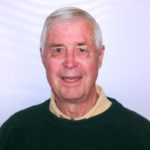
Felix Kloman

About the Author: Felix Kloman is a sailor, rower, husband, father, grandfather, retired management consultant and, above all, a curious reader and writer. He’s explored how we as human beings and organizations respond to ever-present uncertainty in two books, ‘Mumpsimus Revisited’ (2005) and ‘The Fantods of Risk’ (2008). A 20-year resident of Lyme, he now writes book reviews, mostly of non-fiction that explores our minds, our behavior, our politics and our history. But he does throw in a novel here and there. For more than 50 years, he’s put together the 17 syllables that comprise haiku, the traditional Japanese poetry, and now serves as the self-appointed “poet laureate” of Ashlawn Farms Coffee, where he may be seen on Friday mornings. His wife, Ann, is also a writer, but of mystery novels, all of which begin in a bubbling village in midcoast Maine, strangely reminiscent of the town she and her husband visit every summer.

Letter From Paris: Erdogan Wins Presidential Superpower in Turkey’s Rigged(?) Referendum

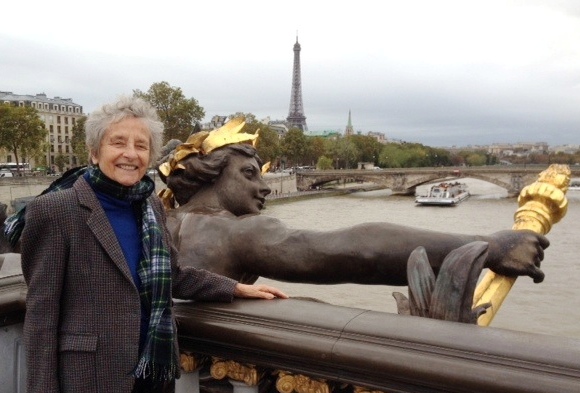
Nicole Prévost Logan

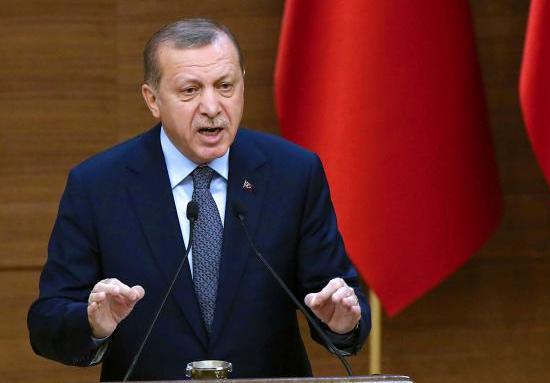
The good news about the victory of Recep Tayyip Erdogan in the April 16 referedum, increasing his constitutional powers to govern, is that  his accession to the European Union (EU) has become more unlikely.  If he wins another referendum on whether to restore the death penalty, that will be “crossing the red line,” French president François Holland said and it will remove permanently his demand for membership from the negotiating table.

The electoral campaign for the referendum took place in a country traumatized by several bomb attacks.  It left little room for the opposition to express its opinions.  Acts of intimidation were observed in many voting booths.

In the Netherlands the campaign to gather votes of Turkish expatriates, was particularly  unwelcome at a time when the country was having its own elections. Unhappy with the decision of the Dutch authorities not to allow the Turkish diplomats off the plane, the Turkish government called The Hague the “Nazi capital of Europe” and their action, “barbarian.”

It pretended to be shocked by Angela Merkel’s violation of freedom of expression because political rallies by the Turks were cancelled in Germany.  The Turkish expats in Europe voted overwhelmingly in favor of the referendum.

On April 13, violent riots took place at a soccer match in Lyon for the Europa League quarter final.  Thirty five hundred Turkish supporters of the Besiktas club had bought tickets. But it turned out that 20,000 more, coming from other European countries, had somehow got into the stadium without disclosing their identity.

Recep Tayyip Erdogan won the referendum with a 51.3 percent majority.  In the 18 articles of the new constitution, the principle of separation of powers – executive, judiciary and legislative – has disappeared. The president governs by executive orders whenever he wants.  There is no longer a prime minister. The president  designates ministers and high officials, chooses most of the judges. Parliament will be dissolved and all the new deputies will belong to AKP, the islamo-conservator party of “justice and development.” The president could potentially be in power until 2019.

President Recep Tayyip Erdogan.

“Erdogan lost the support of the middle classes of the three main cities – Istanbul, Ankara and Izmir.  A sort of a slap in the face for a man who grew up in Istanbul, was its mayor and considers it as his stronghold, “commented Bernard Guetta, a journalist specializing in geopolitics.  The  European Commission urged Turkey to seek the “broadest possible consensus.”

Anyone who has traveled in Turkey knows that it is made of two different worlds.  The president finds his supporters in the first group:  firstly, poor farmers living in remote areas of the Anatolian plateau without much in common with the population on the coastal regions who have always had contacts  with the West, through trade in the Aegean Sea or the Mediterranean. And secondly, the working class living in the outskirts of the cities.  Their shabby houses are the first ones to collapse during recurrent earthquakes.  The polluted air in industrial areas can reach unbearable levels.

At the other end of the spectrum one finds Roberts College, the oldest American School abroad still in its original location.  It was founded in 1863.  Among its alumni are many of the international elites who have shaped this region of the world .

In the 1950s, Turkey was one of the countries benefiting from the Marshall Plan.  In 1952 it became a valued member of NATO thanks to its strategic geographic location.  This was an invaluable role to play.  But even the relationship of Turkey with NATO is tense to-day.

Dorothee Schmid, head of the Contemporary Turkey program at the Institut Français pour la Recherche Internationale (IFRI), comments: “Turkey advances in the fog.  It is not compatible with international organizations  and its statute at NATO is under question.”

Erdogan  considers himself the heir of the sultans of the Ottoman Empire, which  spread as a crescent from central Europe, the Middle East to the Mediterranean shores of North Africa from 1299 to 1922.

The Turkish president may have also be looking  further back in history to the Hittite empire.  In the second milennium BC it was one of the two great powers in the Middle East, competing with Egypt until the decisive battle of Kadesh in 1274 BC against Ramses II.  The cyclopean walls and massive gate flanked by two sitting lions still standing to-day in Hattusas, or modern village of Bogäzköy,  give an idea of the mighty Hittite empire.

The Turkish president  seems to be driven by his thirst for power:  every two years or so there are either general elections or referendums.  The pull toward autocracy provokes an escalade of tension between the ruler and the people.  During the 2011 revolution, the protest on Tahir Square lasted for 18 days and was followed by a tough repression.  Since  the putsch attempt of July 2016, 1,500 military have been put on trial and tens of thousands arrested or lost their jobs.

Megalomania is another trait of the Turkish president.  He lives in a palace 30 times the size of the White House; he is planning to build the longest bridge in the world over the Dardanelles and a mosque so big that it will be seen from any point in Istanbul.

The priority for Erdogan today is to prevent the unification of the Kurds living both in Turkey and Syria.  The ongoing conflict has caused heavy losses in the two camps and much hatred.  The violence has had an impact on the economy.  Tourism has plummeted  down by 30 percent since last year.  “Turkey feels threatened,” says Ahmet Insel, Turkish economist and specialist on that country.

The agreement between Turkey and the EU *regarding the flux of refugees across the Aegean Sea seems to be working out: in 2015, 10,000 migrants crossed the sea as compared to only 43 to-day.  Insel says, “It is in no one’s interest to put an end to this agreement.”  The 3.5 million refugees now living in Turkey seem to be adjusting after going through difficult times.  The Turkish government is even thinking of offering them citizenship.

Marc Pierini, former French ambassador to Turkey comments, “Turkey remains a major actor in the area.”  Nevertheless it is frightening to see the leverage power Erdogan holds over the EU and by way of an almost tangible demonstration of that power, the question discussed by specialists on the France-Culture radio channel on April 8, 2017, was, “How the exacerbated nationalism of Erdogan will impact the geopolitical imbroglio?”

* see “Letter from Paris,” March 19, 2016

Editor’s Note: This is the opinion of Nicole Prévost Logan.

Nicole Prévost Logan

About the author: Nicole Prévost Logan divides her time between Essex and Paris, spending summers in the former and winters in the latter. She writes a regular column for us from her Paris home where her topics will include politics, economy, social unrest — mostly in France — but also in other European countries. She also covers a variety of art exhibits and the performing arts in Europe. Logan is the author of ‘Forever on the Road: A Franco-American Family’s Thirty Years in the Foreign Service,’ an autobiography of her life as the wife of an overseas diplomat, who lived in 10 foreign countries on three continents. Her experiences during her foreign service life included being in Lebanon when civil war erupted, excavating a medieval city in Moscow and spending a week under house arrest in Guinea.
Letter From Paris: Paris, Berlin Need to Work Together as the EU Determines its Future

Nicole Prévost Logan

For the French, Germany can be a source of admiration or of irritation . The Franco-German “couple” has been the pillar of the European Union (EU.)   The couple worked beautifully until the departure respectively of Francois Mitterand in 1995 and Helmut Kohl in 1998.  Today more than ever, the two countries need to spearhead initiatives to bring about a new Europe.

Marcel Fratzscher , president of the German Institute of Economic Research, writes on April 6, “Without a strong France, Europe cannot pull out of the crisis. We need France to play the role of a leader with a vision of the European project.”  Without agreeing on everything, the two countries have a lot to learn from each other.

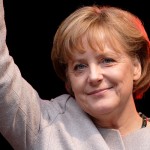
Angela Merkel

Chancellor Angela Merkel, head of the Christian Democratic Party (CDU), will run for a fourth mandate next September.  Hans Stark, professor of Germany civilization at the Sorbonne, believes  the Germans have not had enough yet of Merkel and will elect her again, possibly for the last time.  Her hold on the people is still strong as showed in the CDU winning 40 percent of the votes in the recent Saarland elections. The Social Democrats (SPD) tried to form a coalition with the Left (die Linke) and the Greens, but failed.

Merkel is pragmatic in her policies.  For instance she moved from the center to the left (stepping on Social Democrats’ turf) by adopting ideas attractive to the left such as the acceptance of same-sex marriage or opposition to nuclear arms.  In a nutshell, she remains in the center but maintains a slight tilt toward the left. 

Her longevity is explained by her ability to create consensus.  She has to be an acrobat to lead a country made up of 19 States  (Länder), six of them having come from East Germany and 13 from West Germany. 

It was the intention of the Allied forces occupying Germany to create a multitude of “checks and balances” in order to decentralize power by adding to the number of Länder already existing before the war.  Sailing on the Danube one can see the splendid architecture left by the powerful Prince-Bishops ruling Wurzburg or Bamberg länder.  The voting system by proportional ballot creates the need for coalitions and hence a fragmentation of power. 

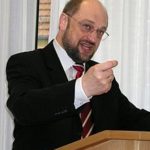
Martin Schulz

The main opponent of Merkel in next September’s election will be Martin Schultz, who has just been elected as the president of  Social Democrats (SPD) with 100 percent of the votes. The SPD plummeted after the unpopular reforms made by Gerard Schroder  but has now bounced back. Today the CDU and SPD are running neck and neck, each with about 33 percent of the electorate.

The right wing populist party “Alternative for Deutschland ” (AfD)  represents  9 percent of the vote.  It was not founded until 2013.  Since the  end of the war, Germany has had to live with certain taboos and one of them, was the aversion  to any political system reminiscent of fascism or communism.  Today the former East Germany is more populist than West Germany.  By way of example, in the last elections in Saxony-Anhalt, AfD received 25 percent of the vote. 

Germany is an economic success story, but at what price?  The system, called Hartz I-IV, implemented by Gerard Schroder in 2003, consisted of tough labor reforms and imposing sacrifices on the work force at a time when Germany was called the “sick man of Europe.”

But the results were indeed striking:  unemployment went down by half and is now only 5.9 percent,  exports have risen by 6 percent creating a trade surplus of 250 billion, and growth is at 1.9 percent.  Alexandra Spitz, a German professor of economics, published an article in the Harvard Business Review on March 13, 2017, titled, “The Real Reasons why the German Labor Market is Booming.”  In summary, she explains these reasons are that wages have not increased as much as  productivity; collective bargaining between employers and employees is decentralized, and workers have accepted lower salaries and flexible labor conditions.

Some of the French, who have a generous (perhaps, too generous?) “social model,” believe Germans have very low unemployment, but also millions of “poor workers” with many part-time, low-paid and short-duration jobs.  Other French people do not agree and are impressed by the German performance and willing to borrow some of their ideas.

Thierry Pech, head of the Terra Nova Think Tank, notes, “There has been an internal devaluation of the cost of labor because of the “poor workers.”  This policy can be called “mercantilism.”  It was used to boost the competitiveness of both industry and exports.  This caused  a problem for the European neighbors.  Germany is preoccupied with its own national interests and has displayed a lack of cooperation with others.  “Professor Hans Stark argues, “In 2004, the Eastern European countries, which joined the EU had low wage-economies.  This time it was Eastern Europe’s turn to practice mercantile policies toward Germany.” 

“Qualified workers have access to professional training at any time,” Professor Stark remarks. “Those persons, less qualified but having completed their “cursus,” can benefit from apprenticeships.  Those, without any qualification, fall to the bottom of the pile.  German industry is always looking for qualified workers.  In the sectors where labor is not qualified – construction, services, agribusiness – the salaries remain low.  This may constitute a problem for French farmers for instance.”  A minimum wage was introduced in 2015.

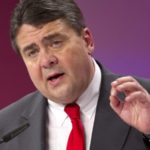
Sigmar Gabriel

Sigmar Gabriel, former president of SPD and now German minister of foreign affairs, says, “Let us stop thinking we are the cash cow in relation to the European budget.  We have also profited from Europe, particularly when the 1999 introduction of the Euro presented a devaluation from the Deutsch Mark.”

Germany has been cautious not to increase its military power (another taboo.)  The Parliament (Bundestag) has blocked the increase of the army (Bundeswehr.)  The government  abstained from taking part in the  Libyan campaign.  Now the defense of territory is becoming a priority again.  Four brigades have been deployed to defend the Baltic states from Russia.

President François Holland invited the leaders of Germany, Italy and Spain, to a mini-summit in Versailles on March 6 to discuss European defense.  Soon after, during an informal meeting in Malta attended by several EU leaders, Merkel declared, “There will be a European Union at different speeds.”

Clearly, this seems to preview what Europe may become – a number of core countries of the EU, working together on specific projects.

Editor’s Note: This is the opinion of Nicole Prévost Logan.

Nicole LoganAbout the author: Nicole Prévost Logan divides her time between Essex and Paris, spending summers in the former and winters in the latter. She writes a regular column for us from her Paris home where her topics will include politics, economy, social unrest — mostly in France — but also in other European countries. She also covers a variety of art exhibits and the performing arts in Europe. Logan is the author of ‘Forever on the Road: A Franco-American Family’s Thirty Years in the Foreign Service,’ an autobiography of her life as the wife of an overseas diplomat, who lived in 10 foreign countries on three continents. Her experiences during her foreign service life included being in Lebanon when civil war erupted, excavating a medieval city in Moscow and spending a week under house arrest in Guinea.

Letter From Paris: Thoughts on the First Few Days of Brexit

Nicole Prévost Logan

This was a very good editorial,  civilized and  compassionate.  It avoided throwing oil on the fire, playing the blame game or making doomsday predictions.

On March 30, in le Monde, an editorial appeared under the following title: “An Appeal to London and the 27.”  Actually it was a collective message published simultaneously by The Guardian, Le Monde, La Vanguardia and Gazeta Wyborcza.

One cannot undo 44 years of social, economic and human ties with just a strike of a pen — that was  the four newspapers’ message.   The collateral damage will be felt on both sides of the English Channel.  Three million Europeans live in the UK and more than two million British expats live on the continent. The fate of those five million people is at stake.  

The authors of the editorial suggested the Brexit process should be started on a positive note and tend to the status of the expatriate nationals right away, before starting the negotiation process.

But the day after Donald Tusk, president of the European Council, parted emotionally with the Euroskeptic David Davis British envoy,  the head-on confrontational negotiations started in earnest.

Like a chess player, Theresa May decided that attack was the best strategy and she put the central demands of the UK on the table: first, treat simultaneously the details of the “divorce” and the future of commercial relations between the UK and the European Union (EU); second, organize the future of security cooperation. 

Europe shot back in no uncertain terms.  Angela Merkel said Germany wanted to tackle other matters first and so did Francois Holland,  Donald Tusk and Michel Barnier, the chief negotiator for Europe.  The basic position of the Europeans is that no negotiations on free trade should start until the UK has left the EU totally and become a third-party country. 

The European Union (EU) wants discussions to proceed “per phases,” starting with “reciprocal and non discriminatory” guarantees as to the status of the Europeans living the UK and the 60 billion Euros already obligated by the UK to the budget of Europe. An extremely sensitive point will be for the UK to abide by the decisions taken by the European Court of Justice located in Luxembourg.

As far as the negotiations concerning the future relations between the two parties, some topics promise to be particularly stormy, particularly the “social, fiscal and environmental dumping” or whether to preserve the “financial passport” allowing the City of London to sell financial products on the continent.  The Europeans oppose discussions per economic sector, as wanted by Theresa May, and bi-lateral agreements to be signed between the UK and any of the EU members. 

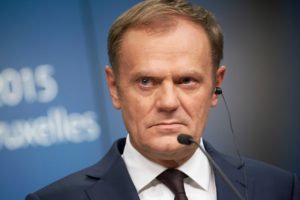
Donald Tusk, President of the European Council.

On March 31, Donald Tusk, gave a crucial six-page document to the 27 members of the EU laying down the essential principles of the negotiations to come. The text should be formally accepted by them on April 29 at a summit meeting in Brussels.

Obviously the presidential elections in France will have an impact on the negotiations.   Marine Le Pen applauds an event which will make Europe more fragile.  At the opposite end of the political spectrum, Emmanuel Macron (En Marche party) feels the access to the Common Market  has a price and should be balanced by contributions to the European budget.  François Fillon  (Les Republicains or LR ) supports a firm attitude toward the British demands. He thinks that the Le Touquet agreement needs to be modified and the borders moved from Calais to Dover.

The ideal scenario would be to have the parties agree on these first phases so that discussion on the future should be tackled by the beginning of 2018.

The tone of the difficult negotiations has been set.  It will be a roller-coaster ride for months to come.

Editor’s Note: This is the opinion of Nicole Prévost Logan.

Nicole LoganAbout the author: Nicole Prévost Logan divides her time between Essex and Paris, spending summers in the former and winters in the latter. She writes a regular column for us from her Paris home where her topics will include politics, economy, social unrest — mostly in France — but also in other European countries. She also covers a variety of art exhibits and the performing arts in Europe. Logan is the author of ‘Forever on the Road: A Franco-American Family’s Thirty Years in the Foreign Service,’ an autobiography of her life as the wife of an overseas diplomat, who lived in 10 foreign countries on three continents. Her experiences during her foreign service life included being in Lebanon when civil war erupted, excavating a medieval city in Moscow and spending a week under house arrest in Guinea.