Letter From Paris: Current Crisis Continues Long History of Franco-Italian Love-Hate Relationship

Nicole Prévost Logan

A diplomatic crisis is going on between France and Italy.   Salvoes of insults proffered by deputy prime ministers Matteo Salvini (extreme right) and Luigi Di Maio (anti-establishment) are flying  across the Alps.  A red line was crossed when Di Maio went to France and met with the most radical gilets jaunes who openly demand the resignation of the French president and the overturn of all political institutions.

This constituted a provocation and a never-seen before interference by one member of the European Union (EU)  into another’s internal affairs.  While on an official visit to Cairo, French President Emmanuel Macron disregarded these heinous remarks with total indifference. Paris recalled its ambassador to Italy – the first time since June 10, 1940 when André François Poncet left Rome following the declaration of war by Mussolini to defeat France. (The French ambassador is already back in Rome)

Tension is high. It is part of the long history of a difficult relationship between the two countries. During the unification of Risorgimento (1848 -1861), France often came to the rescue. At the famous battle of Solferino (1859), a Franco-Sardinian army led by Napoleon III and Victor Emmanuel II  defeated the Austrians under Emperor Franz Joseph I.  In contrast, the annexation of the county of Nice and the Savoie region to France, decided by the Treaty of Turin, was deeply resented by Italy, as was the loss of 550 sq. kms. including the mountain passes of Tende and La Brigue in February 1947.

The second cause of friction between the two countries stems from remnants of a colonial past. Italy often challenged France’s intrusion into what it considered its zone of influence. It never really accepted the Bardo Treaty of 1881, which created  France’s protectorate over Tunisia. In 1911, Italy had colonized Cyrenaica and Tripolitania, which were to become Libya.  So, when the French and British conducted air strikes over Libya with UN support  in 2011, Italy complained of having been kept out of the loop.

Economic and commercial dissensions between the two countries are not unusual. Some might recall that Italy refused to participate in the World Fair of 1889 in Paris.  Today the STX shipyard of St Nazaire may pass under the control of the Italian company Fincantieri in spite of France’e efforts to retain a majority vote. At stake in this confrontation is construction of the largest cruise ships in the world, such as “Harmony of the Seas,” which has become the latest vessel to join the Royal Caribbean fleet.

While Italy and France often behave like quarrelsome siblings, they are more than close culturally: they are complementary. Take art for instance.  At the turn of the 20th century, France may have been the center of the art world with Monet, Manet, Degas, Cezanne, Gauguin and others, but at the same time, a new school of painting called “Futurism” was growing in Italy with artists like Marinetti, Boccioni, Cora, Bala, and Severini.  The lattet were champions of the fast pace of the city, depicting cars, planes and all forms of modernity as well as being pioneers in the expression of movement and speed.

On a lighter side, a Franco-Italian film currently showing on French screens, is the perfect illustration of the closeness of those two “cousins.” The plot of the Estivants (the vacationers), directed by Valeria Bruni Tedeschi – sister of Carla Bruni, former French president Nicolas Sarkozy’s wife – is  set in a beautiful residence on the Cöte d’Azur.  A well-off and rather dysfunctional Franco-Italian family spends long hours on the terrace overlooking  the Mediterranean framed by cypress trees. Mixing the two languages, the guests discuss every subject under the sun, including societal conflicts evoked by the servants. Well-known actor Pierre Arditi is perfectly odious in the way he makes disparaging remarks about the lower classes while he older mother is at the grand piano playing the background score created by a talented Italian composer.

The present crisis between France and Italy is linked to the flow of migrants since 2015. Due to the “Dublin rule” making the European country of entry responsible for the refugee status and because only 200 kilometers separate Italy from the African shores, Italy has been on the front line in facing the surge.  Salvini accused other EU members, particularly France, of not sharing the burden of welcoming refugee seekers.  

The Italian government worked with the Libyan authorities to block the departure of migrants from Africa and prevented humanitarian ships from entering Italian ports. The “Aquarius” had to remain on the high seas for two weeks with dozen of migrants on board. it is worth noting that both France and Italy have about the same percentage  (10 percent) of immigrants.  Also, more than two-thirds of the sub-Saharan migrants come from former Italian colonies.

Di Maio is erroneously accusing France of investing the “Franc CFA ” (African Financial Community currency) in its own economy. The fact is that eight African countries asked Paris to put the money in the Banque de France‘s  vaults for safe-keeping.

For Salvini and Di Maio, Macron is the prime target.  For them, the French president crystallizes the policies rejected by their populist government:  a progressive, multilateralist program with an integrated Europe.  Their plan is to create an axis through Italy, Poland and Hungary of authoritarian and non-liberal states capable of countering the actions of the Franco-Germanic “couple” – an ominous trend for Europe.

The Italian economy is sitting on a time bomb.  Its public debt is 133 percent of the GDP, only second to Greece’s. It ranks at the bottom in Europe for GDP growth. The populist program of increasing minimum wages, lowering retirement age and other social measures, is bound to increase the deficit.  Scolded by Brussels. the Italian government had to revise its budget. Of course, the fact that Pierre Moscovici, the Commissioner for Financial Economic Affairs in Brussels, is French, contributes  to the sour relations.

What does this crisis hold for the future?  Seen from here, the histrionics of the Italians are not always taken seriously. Paolo Levi, Paris correspondent of La Stompa recently commented that Salvini was able to intercept a malaise and his political movement might not last.

How sad that both France and Italy were founding members of the EU that was created by the Treaty of Rome in 1957 …

Editor’s Note: This is the opinion of Nicole Prévost Logan.

Nicole Prévost Logan

About the author: Nicole Prévost Logan divides her time between Essex and Paris, spending summers in the former and winters in the latter. She writes a regular column for us from her Paris home where her topics will include politics, economy, social unrest — mostly in France — but also in other European countries. She also covers a variety of art exhibits and the performing arts in Europe. Logan is the author of ‘Forever on the Road: A Franco-American Family’s Thirty Years in the Foreign Service,’ an autobiography of her life as the wife of an overseas diplomat, who lived in 10 foreign countries on three continents. Her experiences during her foreign service life included being in Lebanon when civil war erupted, excavating a medieval city in Moscow and spending a week under house arrest in Guinea.
Letter From Paris: Life in the ‘City of Light’ is a War Zone … with Wheels!

Nicole Prévost Logan

Paris is waging a war on wheels.

In order to survive crossing the street, pedestrians have to defy car drivers while on the sidewalks, the war is between the people who walk and those on wheels in a multitude of forms.

Mayor Anne Hidalgo, a socialist, has made it her mission to reduce pollution in the French capital by shrinking the space open to vehicles.  It is a laudable cause and many Parisians appreciate its immediate results. 

Thanks to the closing of the roadways along the Seine, people have regained the previously lost pleasure of walking leisurely near the water, away from the noise of the traffic, while their children can play freely.

It is possible now to walk miles and discover Paris from east to west.  More boats line up at the quays and have become floating cafés.  In warm weather, tons of sand and palm trees appear overnight to give the berges (banks) de la Seine a summery look. 

But the process of narrowing avenues with larger sidewalks and creating bicycle and bus lanes can be overwhelming for residents.  For months, the ambitious project to reduce the Bastille circle to merely an intersection of avenues has turned the area into a gigantic worksite. 

People have to struggle through ever-changing makeshift paths amid the noise and dust of heavy equipment that is variously moving mountains of dirt or asphalt, installing fire hydrants and electrical cables, and relocating bus stops.  Everyday the urban landscape changes causing irritation among Parisians and resultant excessive horn-blowing. 

For pedestrians, crossing a street feels like an obstacle course.  When the lights change, motorcycles seem to think they are at the Le Mans 24 hour race (the most famous car race in France), backfire their engine to make as much noise as possible and surge forward riding only on their back wheel.  Pedestrians had better get out of the way! 

Arriving at a traffic light, drivers will not stop until it turns to amber.  The crossing space, called les clous in France (it used to be-marked by what looked like oversize thumbtacks), is encumbered with trucks, cars and busses through which one has to meander to find a passage. 

Even when the light turns green, a war of nerves starts between drivers and pedestrians. Tourists and out-of-towners hesitate and are too polite.  This is a big mistake, which is interpreted as an opportunity to move forward rapidly by drivers.  But old-time Parisians are more daring and will bluff their adversaries at the wheel.  At busy intersections, the vehicles coming from side streets do not even slow down, turning the scene into ridiculous grid locks .

Sidewalks are supposedly designed for pedestrians. Wrong!

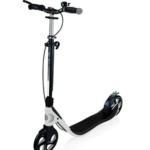
A ‘trottinette’

A ‘gyrorue’

Today the latter share the space with an ever-increasing number of humans on wheels: big-engined motorbikes taking a short-cut then parking right in front of their destination, bicycles, skateboards, electric scooters or trottinettes — the current rage — and monowheel scooters or gyroroue.  The list is open-ended since technology invents new devices all the time. 

Traffic on sidewalks is not regulated and follows the rule of the jungle, which means no rules at all.  

Last month, I attended a big event along with hundreds of residents of my arrondissement to hear our mayor present his New Year wishes.  Among the elected members of the conseil municipal (town council), I spotted the person in charge of transportation and commented on the war-like atmosphere in our streets. 

He was very evasive, saying, yes, we are aware there is a problem, but I wondered what this transportation official was actually doing besides “being aware of the problem.” 

I almost forgot … I should add another category to my story about the wheels onslaught and that is the hordes of tourists pushing their suitcases … on wheels!

Living in Paris is an enjoyable challenge.  Having no wheels definitely keeps you on your toes.

Editor’s Note: This is the opinion of Nicole Prévost Logan.

Nicole Prévost Logan

About the author: Nicole Prévost Logan divides her time between Essex and Paris, spending summers in the former and winters in the latter. She writes a regular column for us from her Paris home where her topics will include politics, economy, social unrest — mostly in France — but also in other European countries. She also covers a variety of art exhibits and the performing arts in Europe. Logan is the author of ‘Forever on the Road: A Franco-American Family’s Thirty Years in the Foreign Service,’ an autobiography of her life as the wife of an overseas diplomat, who lived in 10 foreign countries on three continents. Her experiences during her foreign service life included being in Lebanon when civil war erupted, excavating a medieval city in Moscow and spending a week under house arrest in Guinea.

Letter From Paris: It’s Been a Rocky Ride, But Will Macron Still Make It?

Nicole Prévost Logan

France always seems to stand out by doing the best or the worst through social and political upheavals.  The movement of the gilets jaunes has been like an earthquake shaking the system to its foundations.    It has created the most serious political crisis the Fifth Republic has known since its creation by General de Gaulle in 1958. 

It is a pivotal moment for France and many other Western democracies when the mechanism of political institutions does not seem to work any more. 

The gilets jaunes are the voice of a rural population never heard before and which feels abandoned.  It is a lower middle class of workers and retirees, who can’t make it to the end of the month and feel squeezed between the very poor — benefiting from social relief — and the more affluent middle class. 

At first overwhelmingly supported by the public opinion, their number –occupying roundabouts and tolls — has reduced from over 280,000 on Nov. 17, to about 84.000 today. Public opinion is becoming weary of the continuous violence.

“Act XI” is taking place as this article is being written. 

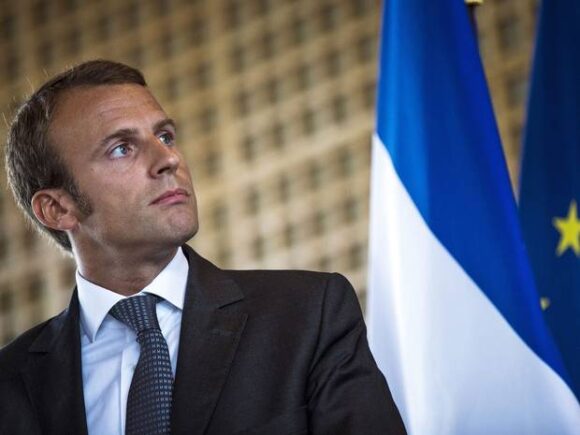
French President Emmanuel Macron.

A spectacular fist fight on the footbridge linking the Quai d’Orsay and the Tuileries garden marked the month of January.  Over time a hard core of  gilets jaunes has become more radical, asking for the dissolution of Parliament, the suppression of the Senate, and basically total destruction of the system in place.  It refuses dialogue while chanting “Macron. Demission” (Macron. Resign.)  

The Rassemblement National (RN) extreme right party of Marine Le Pen and the communist party or France Insoumise (LFI) are riding the wave. They help circulate false news to discredit Macron and his government.  The terrorist attack in Strasbourg in early December or the recent deadly explosion due to a gas leak in the center of Paris were just diversion tactics by the Executive, they say. 

On Jan. 23,  France and Germany signed the treaty of Aix La Chapelle to reinforce cooperation between the two countries and facilitate trans-border relations.  The treaty was followed by the announcement of outrageously distorted news on social networks that Alsace-Lorraine was being returned to Germany. 

Eighteen months into his mandate, Macron started  to suffer a catastrophic collapse in the polls. It was not a first for a French president:  Sarkozy and Hollande before him suffered the same disaffection soon after their election. For Macron though, the intensity of the fall was all the more spectacular as his victory had created a surge of hope.

Today he is trying to turn the tide around and pull the country out of its crisis.  And his method? A “Great Debate” throughout the country lasting until March 15.

On Jan. 13, the president posted a “Lettre aux Français” suggesting four themes open to discussion: taxes, public services, energetic transition, and political institutions, including immigration.  France is being turned into a laboratory to experiment with new forms of government – representative, participative or direct (with frequent referendums).

The hard core of gilets jaunes declined to participate.

Macron’s initial step was to face some of the 35.000 mayors of France.  First 700 of them in Normandy, then two days later 700 in the Lot department (Occitanie region.)  It was an impressive show of participative government in action.  Selected mayors presented their grievances related to very concrete and local problems: closing schools, disappearance of public services, medical “desertification,” lack of accessible transports, inadequate internet and phone access, hurtful impact of giant shopping malls on small business, and the demise of downtown areas of small town and villages.

Each speaker was polite, direct and, at times, quite tough. Macron’s performance was phenomenal.  As each speaker took the microphone, the president was taking notes furiously.  For close to seven hours, he absorbed the remarks then answered each one, recalling the interlocutor’s name.  His language was familiar, bringing smiles to the faces in the audience and devoid of any demagoguery. 

For instance, he expressed his opinion on how dangerous popular referenda can be, especially when based on false information — citing the UK’s Brexit vote as an example. Overall it was refreshing to witness courteous and constructive exchanges, far from the heinous invectives to which the president has been submitted lately. 

The “Great Debate” is a courageous, but risky exercise.  Talking to the mayors was the easy part. It will be harder for him to convince broader public opinion — including the moderate gilets jaunes — how to make a synthesis from all the wide array of  grievances and turn them into immediate and concrete measures?

Macron must meet some, if not all, of the demands being made by the gilets jaunes without appearing to be weak and submissive. In spite of the popular pressure for lower taxes and more benefits, he cannot afford to lose his objective, which is to reform France and make it economically competitive. Finally, time is short since there will only be two months left after the debate before the European elections are held. 

Violence hit cities throughout France causing widespread damage.

The violence brought on by the weekly street warfare in Paris, Bordeaux and many other cities has tarnished the image of France abroad.  The damage caused  to the urban landscape, small businesses and whole sectors of the economy can be numbered in millions of Euros. The loss of one point of France’s GDP has even become worrisome for the IMF. 

On Jan. 22, Macron invited 125 of the most important world CEOs, who were on their way to the Davos Economic Forum, to  a lavish lunch at the Chateau de Versailles, in order to reassure them of his country’s viability and stability prior to a possible Brexit.

The polls have risen slightly in favor of Macron but the president still faces an uphill battle. France is fortunate to have a young president full of energy … but the jury is still out on his future.

Editor’s Note: This is the opinion of Nicole Prévost Logan.

Nicole Prévost Logan

About the author: Nicole Prévost Logan divides her time between Essex and Paris, spending summers in the former and winters in the latter. She writes a regular column for us from her Paris home where her topics will include politics, economy, social unrest — mostly in France — but also in other European countries. She also covers a variety of art exhibits and the performing arts in Europe. Logan is the author of ‘Forever on the Road: A Franco-American Family’s Thirty Years in the Foreign Service,’ an autobiography of her life as the wife of an overseas diplomat, who lived in 10 foreign countries on three continents. Her experiences during her foreign service life included being in Lebanon when civil war erupted, excavating a medieval city in Moscow and spending a week under house arrest in Guinea.
Letter from Paris: Picasso’s Early Years on View in Blue … and Pink

Nicole Prévost Logan

In October 1900, Picasso – at age 19 – arrived at the Gare d’Orsay in Paris from Barcelona. So, it is appropriate that the Orsay Museum would host an exhibition about the young Spanish artist.

The blockbuster, which opened in the autumn of 2018, was called “Picasso. Bleu, Rose” and refers to the 1900-1906 years. It is a long overdue theme, never before treated in France.

For several reasons, this period is unique among Picasso’s long career. It reveals the precocious virtuosity of such a young person as a draughtsman;
never again will he express such intense emotions; Harlequin — a main character from the Commedia del’arte — is introduced for the first time and will remain his double throughout his life’s work. The image at right shows “Arlequin with an acrobat” (1905) portrayed as a young and emaciated boy.

Between 1900 and 1904, Picasso made several trips between Spain and Paris, until he settled permanently in the French capital where he rented a studio, along with other artists, in a dilapidated building baptized the Bateau-Lavoir (washhouse.)

He liked to hang around at the tavern of Els Quatre Gats (Four Cats) in Barcelona where he met Catalan friends – such as Santiago Rusinol or Ramon Casos. The exhibit shows hundreds of the small portraits and sketches, sometimes humorous, that he created at full speed.

With a voracious curiosity, he would watch the colorful, loud crowds at cabarets, bordellos, night clubs or caf’concs (cafés with a music hall performance) of Montmartre.

Toulouse Lautrec was his idol.

Like him, Picasso depicted the dejected night-life customers stunned under the effect of absinthe. “Arlequin and his companion” (1901, Pushkin museum, Moscow) shown at left represents a couple totally alienated from each other, sitting at a bistro table, with vacuous expressions on their faces.

The man is Harlequin, dressed in his usual costume with lozenges.

The “Portrait of Gustave Coquiot” (1901, Musee d’art moderne, Paris) at right is emblematic of this garish night life. The collector and art critic is depicted as a well-fed individual, with half naked girls dancing in the background, his mouth snarled in a lecherous grimace, under an insolent mustache.

But those years were lean years for Picasso. Both in Barcelona and in Paris Picasso lived in utter poverty.

This was the height of his “Blue Period” — the color of the bottom of the abyss. Beggars, orphans, the poor — Picasso showed his empathy for all of them.

He would take for models the former prostitutes incarcerated at the Saint Lazare prison in Barcelona, where many were dying of venereal diseases .

One usually links the Blue Period with the death of his close friend Casagemas in 1901 The painting at left of the young Catalan artist on his death bed, (1901, Musee Picasso, Paris) is realistic and shows the bullet wound on his temple after he committed suicide. The feverish multicolor strokes around the candle are reminiscent of van Gogh’s technique.

Abject poverty did not prevent Picasso from leading a lively, bohemian life among artists, poets, writers in the Montmartre district of the French capital, which was the center of the artistic world at that time.

The German art dealer Daniel-Henry Kahnweiler immediately discovered the genius of Picasso. Things started looking up when art merchant Ambroise Vollard bought several of his paintings. His melancholy disappeared when he fell passionately in love with Fernande Olivier, one of his many companions whose body and face he kept deconstructing.

The distinction between Blue and Pink Periods is rather artificial. Sadness lingered on through both periods.

Pink became predominant when the artist became interested in the circus world. Several times a week he would go to the cirque Medrano. But unlike other artists like Seurat, Rouault or Matisse, he was not interested in the spectacles per se but rather in what happened backstage and in the miserable existence of the acrobats.

In “Acrobate a la boule” (at right), a frail adolescent is trying to keep his (her) balance on a round ball watched by a heavy set acrobat sitting on a massive cube. Art historians give a deep meaning to the scene, to the contrast between the spiritual world, taking risks, being continually in motion with the stability of life grounded in the earth.

In the summer of 1906, Picasso’s life took a new turn. Being with Fernande on the hillside village of Gozolf, he seemed totally happy, enjoying the sun and inspired by the pink and ochre color of the clay. He discovered the Iberian sculptures of the fifth and sixth centuries BC influenced by Phoenician and Greek cultures as well as 12th century medieval sculptures.

His art seems to be changing course. In “Deux Nus” (1906, MOMA), shown at left, the bodies of the naked women, are deformed, with disproportionate legs and heavy torso. Picasso was ready for another discovery … African art.

Matisse showed him an African statuette in the apartment of Gertrude and Leo Stein. Picasso was stunned.

As a result, after numerous sketches, (the Steins bought most of them when Picasso was still unknown), Picasso produced the ‘Demoiselles d’Avignon’ (1907, MOMA), which remains probably the most important painting of the 20th century.

Editor’s Note: This is the opinion of Nicole Prévost Logan.

Nicole Prévost Logan

About the author: Nicole Prévost Logan divides her time between Essex and Paris, spending summers in the former and winters in the latter. She writes a regular column for us from her Paris home where her topics will include politics, economy, social unrest — mostly in France — but also in other European countries. She also covers a variety of art exhibits and the performing arts in Europe. Logan is the author of ‘Forever on the Road: A Franco-American Family’s Thirty Years in the Foreign Service,’ an autobiography of her life as the wife of an overseas diplomat, who lived in 10 foreign countries on three continents. Her experiences during her foreign service life included being in Lebanon when civil war erupted, excavating a medieval city in Moscow and spending a week under house arrest in Guinea.

With Approach of Brexit Deadline, a New Conundrum Emerges: UK Grows More Divided, EU More United

Nicole Prévost Logan

It was a close call for Theresa May and probably the most difficult time of the 900-odd days of the Brexit negotiations. 

On Monday, Dec. 10, her proposed “deal” faced opposition from all sides. Several of her ministers had already resigned: Boris Johnson,  Dominic Raab and David Davis, successive Secretaries of State for Brexit. Even her own Tory party was divided. 

Europhile Jo Johnson, brother of Boris, refused the terms of her “deal.” On the left, the Labor Party, led by Jeremy Corbyn, wanted to remain in Europe, but within a large customs union, to maintain trade relations and be in control of immigration. Both Scottish First Minister Nicola Sturgeon and the Democratic Unionist Party of Northern Ireland (DUP), on whom May’s Conservatives rely for a majority in parliament, preferred  a “Norway plus” formula. 

A coup de theatre occurred in the House of Commons on Dec. 12: the leader of the conservative Brexiters, Jacob Rees-Mogg, led a motion of no confidence against the prime minister. She won by 200 votes to 117. This vote meant  a reprieve for May until Jan. 21, 2019 to make a final decision on the “deal.”  She cannot drag out the timetable indefinitely, however, since the process has to be completed before the European elections on May 26.  

During that fateful week, in a desperate effort to save her plan, the British Prime Minister raced from the House of Commons to make hasty visits to the European countries most sympathetic to her ideas such as The Netherlands or Germany.  She returned to London and made a statement in front of 10 Downing Street on a cold winter night, cheered a little by a Christmas tree standing nearby. On Dec. 13, she was back on the continent to attend a meeting of the European Council hoping to wrench out a few more concessions from the weary Europeans.

She returned to the UK empty-handed.

May warns that “no deal” would be catastrophic for the UK.  She says that only by achieving a deal can the UK hope to preserve its independence and remain in control of its economy and borders. The Brexiters’ argument is that during the transition period, which starts on March 29, 2019, the UK will remain within the EU Custom Union, unable to sign bilateral cooperation agreements with other countries and forced to make financial contributions, while having no say in the decision-making process.

The 27 EU members ratified the hefty 600-page withdrawal document of the UK after smoothing out a few thorny issues. One is the administration of the Gibraltar enclave.  Spain had to be satisfied lest it used its veto. The other one dealt with the demands by fishermen from France,  Denmark and a few other countries to retain access to the waters — rich in fish — around the British Isles.  Until today, they have been allowed to do so as per the Common Fisheries Policy (CFP).

But by far the most crucial point is the border between Northern Ireland and the Republic of Ireland.  Both the UK and the EU want a “backstop” — a device designed to maintain the UK with the EU Customs Union until a trade agreement is signed — but for different reasons. For Brussels, it is a non- negotiable red line, a temporary measure, like an insurance to be applied during the transition period scheduled to end on Dec. 31, 2020. Ireland does not want to see the re-emergence of the bloody conflict, which finally ended on Good Friday 1998.  

Theresa May wants a legally-binding text agreement that proposes a backstop to prevent the return of a physical border. The EU’s chief Brexit negotiator Michel Barnier and his team are ready to make adjustments to create a “backstop” more palatable to the British, saying, “Let us be imaginative and creative.”  He now offers other solutions such as setting up control points about 10 miles from the border in industrial buildings .  

On the whole, the 27 European Union (EU) members are displaying an exceptional show of unity, which may come as a surprise for outside observers.  One would  expect the EU to be tough with the UK to prevent a possible ‘domino effect’ inspiring others to leave a continent already torn between populism and nationalism. 

In fact, the exact opposite is happening. and none of the 27 seem willing to leave Europe. In France, Marine Le Pen changed her mind quickly about keeping the Euro.  In Greece, Prime Minister Tsipras and his Syriza party are not in conflict with Brussels any longer.  The Italian government has agreed to reduce its deficit in accordance with the EU rules.  Eastern Europeans appreciate greatly the assistance they receive from Brussels and also the protection the latter gives them against their Russian neighbor They do not show any intention of leaving the EU.. 

The scenario of a new referendum is gaining ground.  Since the European Court of Justice has just declared that a EU member state can unilaterally withdraw its intention to leave the Union, the task of the “Remainers” would be simplified. If they win the referendum, it will be back to square one — an outcome generally favored by the Europeans. 

Editor’s Note: This is the opinion of Nicole Prévost Logan.

Nicole Prévost Logan

About the author: Nicole Prévost Logan divides her time between Essex and Paris, spending summers in the former and winters in the latter. She writes a regular column for us from her Paris home where her topics will include politics, economy, social unrest — mostly in France — but also in other European countries. She also covers a variety of art exhibits and the performing arts in Europe. Logan is the author of ‘Forever on the Road: A Franco-American Family’s Thirty Years in the Foreign Service,’ an autobiography of her life as the wife of an overseas diplomat, who lived in 10 foreign countries on three continents. Her experiences during her foreign service life included being in Lebanon when civil war erupted, excavating a medieval city in Moscow and spending a week under house arrest in Guinea.