Letter from Paris: Riots Fuel ‘Yellow Vest’ Rebellion Against Macron’s Reforms, Stir Memories of May ’68

Editor’s Note: We are watching events in Paris today with deep dismay. Nicole Logan’s topical column gives her opinion on the background to the tense situation unfolding there.
Nicole Prévost Logan

France is in a tailspin.  

The crisis started with the fury against the seven-cent tax hike on diesel fuel. The movement of the gilets jaunes (yellow vests) spread like wildfire through the social networks as they blocked the roads all over France. For three weeks in November, the demonstrators congregated in Paris each Saturday. Their confrontation with the police culminated in scenes of violence, which shocked the world: Place de l’Etoile obliterated by the smoke of tear gas, graffiti desecrating the Arc de Triomphe, and a policeman being attacked near the monument.  

Riots have been occurring in cities all over France but are centered on Paris. File photo by Randy Colas on Unsplash

Since the Champs Elysées and the Place de la Concorde were cordoned off by the police, the casseurs (hooligans) spilled over Avenue Kleber and Avenue de la Grande Armee, where they looted shops and set fire to six buildings. Hundreds were wounded and 412 demonstrators arrested. By the day’s end, a picture of desolation remained with the smoldering remains of 35 cars and streets littered with whatever was used as a projectile by the radicalized mob.

The tension is mounting. The government seems unable to contain it. The gilets jaunes are widening their demands to lower all taxes, raise salaries and retirements as well as the dissolution of the National Assembly. At this point they will not stop short of the resignation of Macron. 

It is an unprecedented, unstructured popular anger directly aimed at the president.  The opposition parties – with much glee – are surfing on this tsunami.

The government is making concessions to meet people’s demands. Unfortunately these concessions always arrive too late. The more the government concedes, the more the gilets jaunes demand, apparently comforted by their success.  On Dec. 4th, Prime Minister Edward Philippe announced a six-month freeze on fuel and utility taxes followed by their cancellation the same evening. And the price tag of this measure? Four billion euros. This was the first admission of defeat by the Macron team – a measure very hard to swallow since it went against its own environmental principles. 

What are the causes of this crisis? Mistakes made by a president attempting to reform the country from the bottom up? Ungovernable French people? Perhaps a combination of both.

During the first 16 months of his mandate, Macron undertook structural reforms  to turn France into a modern and competitive country. These reforms dealt with political institutions, the labor code,  the impressive — but somewhat antiquated — railroad system or  SNCF (Societé Nationale des Chemins de Fer), crowded universities  by abolishing a chaotic and ridiculous entrance selection by lottery. 

But French people do not like changes and are attached to their privileges, tax niches and social benefits acquired over decades. An attempt at reforming the system was bound to face an uphill battle .

All these reforms were part of a general plan — a vision — which the president had placed at the core of his electoral campaign and on the basis of which he had been elected. in 2017. He gave himself five years to achieve his goals. 

Unfortunately for him the people wanted immediate results. He wanted to raise the French economy and society from the bottom up and encourage the active population. This was different from a “trickle down” process, but was not perceived as such by the French.  Soon the label,”President of the Rich,” was firmly attached to him.

Macron’s strategy was to consult with trade unions, elected local officials or business people at the Elysée Palace before making any decisions.

Apparently tetanized by the fast pace of the president’s method, the population seemed at first to accept the reforms. But gradually, overwhelmed by the sheer number of new regulations, taxes, or reforms facing them them every morning, its discontent started as an underground rumble until it finally exploded. The last drop was the additional tax on diesel. 

Overall, the French population is justified in its revolt against an unbearable tax burden. France is the world number one champion of taxes with 48 percent of its Gross Domestic Product coming from tax revenues versus 40 percent in the other European countries and less than 30 percent in the US.  One of the buzz expressions among the gilets jaunes is “ras le bol” (meaning “we are totally fed up.”) There are hundreds of hidden taxes in France. For example, did you know that here, one has to pay a tax on “oiseaux de companie” (pet birds)?

The French have a special craving for social justice as shown in their attitude toward the Impot de Solidarite sur la Fortune (ISF) or wealth tax. Macron had split that tax between property wealth — which he retained — and financial holdings such as stocks. In order to encourage investments — particularly on green energy — he created a “flat tax” of only 30 percent.  What he did was misunderstood by the public opinion and may be scrapped soon.    

Today Macron’s room to maneuver is very small.  Since the opposition has no leader to replace him, where is the country going?  Cohn Bendit, the hero of May 1968, the largest French uprising in the past 50 years, gave a frightening prognosis, “I see the present movement in France as a possibly the first step toward totalitarianism, headed by an illiberal despot.” 

The situation is evolving by the hour.  More demonstrations of force are already planned …

Editor’s Note: This is the opinion of Nicole Prévost Logan.

Nicole Prévost Logan

About the author: Nicole Prévost Logan divides her time between Essex and Paris, spending summers in the former and winters in the latter. She writes a regular column for us from her Paris home where her topics will include politics, economy, social unrest — mostly in France — but also in other European countries. She also covers a variety of art exhibits and the performing arts in Europe. Logan is the author of ‘Forever on the Road: A Franco-American Family’s Thirty Years in the Foreign Service,’ an autobiography of her life as the wife of an overseas diplomat, who lived in 10 foreign countries on three continents. Her experiences during her foreign service life included being in Lebanon when civil war erupted, excavating a medieval city in Moscow and spending a week under house arrest in Guinea.
Letter From Paris: Thoughts on an Historic Day of Respectful Remembrance … and Distressing Disrespect

Nicole Prévost Logan

Editor’s Note:  We are delighted to welcome back Nicole Prévost Logan after her traditional break from writing while she summers in Essex, Conn.  She has now returned to Paris just in time for the centennial celebrations of the end of World War I, on which she provides an insightful commentary in this column.

Paris was the center of the world on November 11 – the 100-year anniversary of the Armistice of World War I.  Struggling against a strong wind and in pouring rain, 70 world leaders walked toward the Arc de Triomphe on a deserted Avenue des Champs Elysées – a striking image on an historical day.

The ceremony, taking place by the tomb of the unknown soldier, was magnificently choreographed by the French president Emmanuel Macron.  It was solemn and sober.  Not intended to be a show of triumphalism, it did not include a military parade.

The president only reviewed only some of the elite military academies: students from Ecole polytechnique, wearing bicornes (two-pointed hats), and from St Cyr (equivalent to West Point) with their emblematic “casoars” of red and white feathers, as well as students from the air force and naval academies.  The ceremony was to be essentially both an homage to the millions who died and a reminder of the importance of reconciliation and peace.

The timing of the proceedings was synchronized to the minute: at 11 o’clock  all the bells of France tolled, the five Mirages of the patrouille de France flew twice over the Place de l’Etoile in impeccable formation leaving tricolor strands of smoke in the sky.  The sounds of Sonnerie aux Morts (The Last Post) and other bugle and drums pieces added their somber touch. 

Whereas most of the foreign leaders had ridden busses from the Palais de l’ Elysée to the Tomb of the Unknown Soldier, the American and Russian presidents as well as the Israeli prime minister were driven all the way in their cars for security reasons.  The honorable guests gathered under the transparent awning and waited.  And waited.  And waited.

Finally the armored car of Donald Trump, in a convoy of 53 vehicles carrying 700 security agents and US government officials, appeared at the bottom of the Champs Elysées.  The American president had a chance for a photo op alone in front of the other heads of State.  

The seating on the first row must have ben a nightmare for the protocol people.  Trudeau was far enough from Trump and protected from him by the King of Morocco and his son.  Trump was next to Angela Merkel.  A few minutes later Vladimir Putin arrived (according to a Russian radio commentator, he had been kept in his car for 20 minutes until the Trumps were settled.)  He took his place next to Brigitte Macron.  Trump broke into a broad smile for the first and only time of the weekend as he greeted Putin.

The visit of the American president to France had started on a sour note.  He distorted what Macron had said  during his November 10 interview with CNN’s Fareed Zakaria.  In a furious tweet, he said that he found the French president’s comment about building an independent European military force “insulting.”  In fact, Macron had never used the words “against the US.”

A cultural and emotional program started with the cellist Yo-Yo Ma playing a Sarabande of the Suite No.5 in C minor by Johann Sebastian Bach and ended with the 17-minute long Ravel Bolero, performed by the European Union Youth Philharmonic Orchestra.  A group of young people of all nationalities read excerpts form diaries written by a few French poilus (soldiers) among the 1.4 million killed during the Great War.  The message was the transmission of memory through the future generations.

Macron was born in Amiens, a provincial town in the heart of the devastated regions of France during World War I.  His four great-grandfathers fought there.  In his speech, the French president spoke with emotion of the battlefields he visited during the seven days prior to the centennial, saying, “I walked on the grey earth where so many soldiers were buried, which is today covered by innocent nature.” 

One of the highly symbolic moments of that week was in the clearing of Rethondes when Merkel (the first time ever for a German chancellor) and Macron sat side by side in the train car where the armistice was signed  November 11, 1918.

In the second part of his speech Macron, portrayed himself as a patriot.  Nationalism, he said, has nothing to do with patriotism and is, in fact, its betrayal.  Withdrawal within one’s borders is harmful for the rest of the world, he added.  The anger of Trump was becoming increasingly tangible as he heard those words, his face frozen in a  pouting expression.  One might describe the speech as outright provocation, but it was well-deserved .

The chasm between Trump and Macron grew deeper in the afternoon.  A Peace Forum had been scheduled at La Villette for business people, NGOs, associations and also political leaders, with the objective of  promoting multilateralism.  The American president chose not to attend.

TV viewers were treated to a surreal split screen: on one side Trump speaking at the American cemetery of Suresnes, near Paris, to honor some of the 116,000 Americans who fell during the Great War and on the other, Merkel giving the inaugural speech at the Forum, in which she supported Macron’s vision of an European army to be created in the distant future.

The American president intensified his flurry of angry tweets after his return to the US and threatened France with increased taxes on its wine exports.  In a November 15 interview held on the French nuclear aircraft carrier Charles de Gaulle, the French president commented: ‘I do not answer tweets. I believe in mutual respect between allies.’

How unfortunate that such a solemn commemoration was hijacked by low-level diatribe.

Editor’s Note: This is the opinion of Nicole Prévost Logan.

Nicole Prévost Logan

About the author: Nicole Prévost Logan divides her time between Essex and Paris, spending summers in the former and winters in the latter. She writes a regular column for us from her Paris home where her topics will include politics, economy, social unrest — mostly in France — but also in other European countries. She also covers a variety of art exhibits and the performing arts in Europe. Logan is the author of ‘Forever on the Road: A Franco-American Family’s Thirty Years in the Foreign Service,’ an autobiography of her life as the wife of an overseas diplomat, who lived in 10 foreign countries on three continents. Her experiences during her foreign service life included being in Lebanon when civil war erupted, excavating a medieval city in Moscow and spending a week under house arrest in Guinea.
Letter From Paris: Exhibition Explores Work of American Female Artist in Male World of French Impressionism

Nicole Prévost Logan

“Mary Cassatt (1844-1926) was the most French of all American artists,” said art historian Jerome Coignard.  She was the only woman – along with Berthe Morisot – to be recognized by the Impressionist movement and therefore permitted to show her works in their annual Salons. 

For 40 years she developed a personal and artistic friendship with Edgar Degas, which was somewhat surprising considering Degas was well known for his misogyny.  Her long association with the famous art merchant Paul Durand Ruel, especially after he opened a gallery on Madison Avenue, increased the exposure of impressionism in the US.

The Jacquemart-André Museum in Paris is currently holding a retrospective exhibition of monographs by Mary Cassatt titled, ‘An American Impressionist in Paris.’  It is a long overdue recognition of an artist whose works are found mostly in the US, but who is better known in France.  Jacquemart-André is one of the most elegant art galleries in Paris.  It was built in the 1860s as one of the townhouses of the imperial aristocracy in the “plaine Monceau” (an area of Paris in the 17th arrondissement.)

The property is slightly set back from Boulevard Haussmann, and on the upper level, opens up onto a vast courtyard under the watchful eyes of two stone lions.  The magnificent residence, with its eclectic furniture, boiseries (wood wall paneling), fireplaces and Gobelins tapestries, used to attract thousands of guests from the high society.

In the West Wing of the Metroplitan Museum in New York, paintings by Cassatt are hung in a gallery exclusively reserved for the works of other women.  Cassatt might have been upset by this apparent patronization by critics and art historians toward domestic scenes created by women.  She might have deemed it unfair because painters like Edouard Vuillard (1868-1940) or Pierre Bonnard (1867-1947) are famous for their paintings inspired by the intimacy of the home. 

Art historian Guillaume Morel comments that the many mother and child scenes painted by Cassatt were, in fact, more feminist than it appears at first.  He writes that she may have found herself endowed with a mission to represent scenes to which men did not have access.  Her “maternity scenes” effectively propelled her into modernism.

At the turn of the 20th century, women were tied to their homes, seemingly leading an indolent existence limited to feminine activities, primarily the care of small children.  They almost never ventured onto the public place – like a café, race track or a prostitute’s haunt.  The subject in “La Loge (The theater box)” (1878) is a departure from this tradition: a self-assured woman is by herself looking through her opera-glasses, and apparently unconcerned by the male spectator staring at her from another balcony.

Even in France, the obstacles inflicted on women artists were enormous: they were neither allowed in the Ecole des Beaux Arts nor were naked models permitted in their art classes.  Women could not copy the grands maitres (Old Masters) in museums like the Louvre.

The special talent of Cassatt was to have overcome these obstacles by taking advantage of her place in the privileged class, traveling extensively and establishing contacts with members of the artistic elite such as Isabella Stewart Gardner (Boston), Alfred Atmore Pope (Connecticut) or Henry Walters (Baltimore.)

From a very young age, she rebelled against the formal teaching offered in the few fine art institutions open to women.  She hated the idea of learning her craft through the use of castings and copies.  She showed an intrepid personality when she told her father she wanted to pursue her artistic education in Europe.  Her father admonished her, saying, “I would rather see you dead.”

And her response to her father’s threat?  She went anyway.

Cassatt was born in Pittsburgh into a well-to-do family.  Her father was an investment banker and her mother was educated in a school created by a former chambermaid of Marie Antoinette.  At the age of seven, she sailed for the first time to Europe with her family.  David McCullough, in his superb book titled The Greater Journey, published in 2011, describes the luxury steamers carrying less than 300 privileged passengers, who could afford the crossing in comfortable accommodations in an “interior richly embellished with satin wood, gilded ceilings … and indoor plumbing.”

The co-curator of the present exhibit held in Paris,  Nancy Mowell Mathews, rejects the expression “woman Impressionist.”  She comments, “Mary Cassatt did not paint differently from other Impressionists.  What she had in common with them was her taste for rough sketches, the unfinished feel of strokes and her daring cadrages (framing of the subject) mostly used in photography or  cinematography.”

Cassatt’s models – mostly members of her family – do not pose in a stilted attitude, but appear relaxed and natural.  In “The little girl in a blue armchair” (1878), the little girl is literally sprawling on a big, shapeless, overstuffed blue armchair.  And so is the small boy looking at us in the painting called, “Woman sitting with a child in her arms. 

“The Cup of Tea “(1880) is an unsurpassed exercise in Impressionist virtuosity.  Fast brush strokes  and the rejection of details are sufficient to render volumes.   The dramatic contrast between the fluffy, pink dress and the black of the solid armchair creates a strong composition.  In 1879, Cassatt was officially accepted in the Impressionist Salon.  The two following decades marked the summit of her career. 

Although Cassatt painted mostly in oils and pastels, Degas had also detected her exceptional talent as both draughtsman and engraver.  Her eaux-fortes (etchings) constitute a large part of her works, while “La Toilette” and “The letter ” (both dated 1891) show signs of japonism.  The engraving process with a pointe-sèche (dry point) is a painstaking and dangerous process since acid is used.

She was the friend of the most influential American feminists and joined their movement for equality, which had started in the US in 1840.  Toward the end of her life, she increasingly devoted her time to counseling American art collectors.  Among them was her close friend Lousine Hvenmeyer, wife of wealthy sugar baron, who owned more than 2,000 Impressionist works. 

After spending 60 years in France, she died in her estate, the Chateau de Beaufresnes in Le Mesnil Théribus, north west of Paris, although interestingly, she never took French nationality.

Letter From Paris: The (Rail) Battle That Macron Must Win 

Nicole Prévost Logan

France is going through the labor pains of implementing a variety of overdue structural reforms if France is to be brought into the 21st century.  President Emmanuel Macron has tackled this objective at a dizzying speed since his election on May 7, 2017.  The pace of change was so fast that the opposition appeared unable to react until Macron turned to the reform of the SNCF (Société Nationale des Chemins de fer Français.) 

Now that process is developing into a major crisis.  Other groups  – university students,  Air France personnel, hospital staff,  garbage collectors, violent clashes at the Notre Dame des Landes “zad” (zone à defenre), etc. – joined the movement.  To overcome the spread of the social discontent  will be the first and decisive test for the French president. 

When the government announced a restructuring of the SNCF , which involved the status of the railroad workers or cheminots, dealing with the unsustainable debt, introducing competition, and the overall modernization of the rail network – the reaction of the unions was immediate and massive.

On March 18, four trade unions – CGT (Confédération Générale du Travail), UNSA (Union Nationale des Syndicats Autonomes), RAIL-SUD and CFDT (Confédération Française Démocratique du Travail) – announced  an innovative and deadly form of strikes: work stops for two days, then trains run for three days.  This schedule will be repeated for a total of 36 days during a period of three months until the end of June … longer if necessary. 

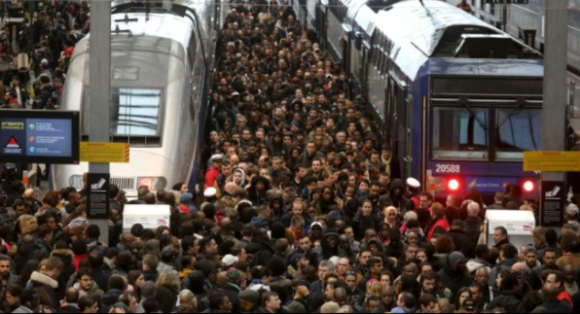
The platform at the Gare de Lyon in Paris on April 3, showing the rail strike’s devastating effect.

The French are bracing themselves for this monster strike, which will be hard for millions of working people, mainly commuters.  The specter of the 1995 strike, which paralyzed France for one month, looms over the country.  The collateral cost of a widespread strike is astronomical with the loss of work days; hotels and restaurants losing more than 30 percent of their profits; and factories momentarily having to close down and lay off employees, and the like.

Facing the angry unions was Minister of Transports Elizabeth Borne, who is a petite, remarkably qualified 57-year-old woman.  A product of the top elite school Polytechnique, part of the socialist government of Lionel Jospin, former head of the RATP (Régie Autonome des Transports Parisiens) and of the SNCF strategy from 2002 to 2005. Technocrat rather than politician, Borne knows everything, but communication is not her forte

The 150,000 cheminots occupy a special place in France and are at the heart of the nation’s DNA. This is why the government’s efforts to bring reforms have met resistance violence the like of which it may not have anticipated.  The aura surrounding  the cheminots has been significantly fed in popular culture by a couple of films. 

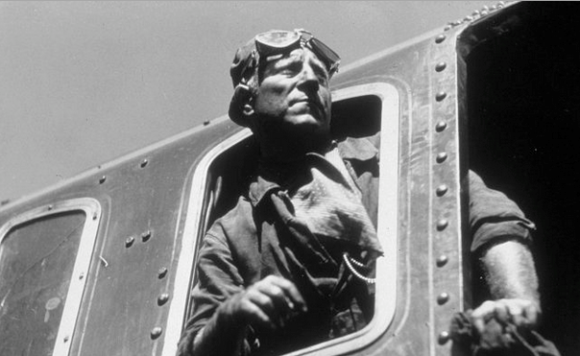
In Jean Renoir’s “La Bête Humaine”, 1938, Jean Gabin portrays a cheminot. He looks quite dashing as he leans out of the steam engine wearing goggles, his face smeared with black dust.  Sustained by a bottle of wine he shares with his jolly co-worker, his exhausting job is to feed the “beast” with coal in the deafening noise of an inferno while breathing  poisonous fumes. The indelible image of this hero inspired the population’s respect for the hard work of the cheminots. 

Jean Gabin as a cheminot in ‘La Bête Humaine,’ 1938.

The other film, which contributed to the collective adulation of the French for their cheminots, is La Bataille du Rail, 1946, played by non-professional actors.  It shows their courage against the Nazi occupants in provoking the derailment of many German trains.

The cheminots are fiercely attached to their special status including retiring at as early an age 52 with a very generous package of  guaranteed employment for life and free transport tickets for the extended family. The government is trying to be reassuring, saying that the changes will only concern the railroad workers hired in the future.  The cheminots will also benefit from a “social backpack” whereby they can take their special status with them in case of transfer to another job.

The SNCF is badly in the red: its debt of over 50 billion Euros increases by three billion every year and the infrastructure is in dire need of investment.  Although showing some signs of disfunction – trains are often late,  major break downs such as the ones which occurred last fall when the Gare Saint Lazare and Gare Montparnasse left passengers stranded for hours – the rail system is still one of the best in Europe.  The French people do not realize what an expensive luxury it is to have such a public transport system.  But this luxury comes at a price: its operation cost is 30 percent higher than the one of other European railroads.    

The cheminots have a visceral fear of the word” privatization.”  The government has repeatedly said that there will be no privatization.  The state will remain the sole share holder and the only change will be that, in the future, the SNCF will be run as a private company, according to directives approved by the European Council in 2001.

The opponents to reforms spread unfounded horror stories about the introduction of competition and problems it caused in other countries.  Besides, the SNCF’s structure, as a public company created in 1937, had already entered that process over the years.  Freight was privatized in 2003.  International lines – like Eurostar (to England) and Thalys (to Belgium, the Netherlands, Germany) – are run independently from the SNCF.   The Italian company Thello runs night trains between Paris and Venice.  All Trains à Grande Vitesse (TGV — high-speed train) tracks are scheduled to be shared with foreign companies by 2020, according to the guidelines approved by the European Union (EU) members.

Criticisms have been expressed about the overbuilding of TGV lines at a high cost and at the expense of other lines.  The announcement of  suppression of small lines provoked an outcry from public opinion well-orchestrated by the unions.  The dense network of TER (Transport Express Regional) and inter-city trains dates back to the days after WWII.  It was a time when half the French population lived and worked in the country versus less than only 4 percent today.  Each village wanted its gare (railroad station.)  Obviously, the time has come to adapt the network to the population’s current needs.  Since 2002, the small lines are the responsibility of the 12 “regions.”

Emmanuel Macron is dealing with the most challenging issue of his presidency to date.

With the one-year mark of his mandate approaching, Macron felt it was timely to take stock of  what has been accomplished to date by his government.  His first talk took place on Thursday, April 12, during the midday news.  The president was sitting on a tiny chair in an elementary classroom in Normandy.  In a relaxed atmosphere, the president answered the questions French people – including retirees – were asking regarding the erosion of their purchasing power.

Many people expected fireworks during the second event on the evening of Sunday, April 15.  The fireworks duly happened. 

Two journalists – Edwy Plenel from Mediapart and Jean-Jacques Bourdin, from RMC (Radio Monte-Carlo ) wanted only one thing: to tear Macron to pieces.  Interrupting him from the start, their questions were bundled with disinformation.  Insults and accusations flew.  Plenel went as far as saying, “Mr. President, you only won the election by default and your program was supported by just a handful of people.”  Bourdin treated the president as a criminal — as  he frequently does in respect of the person he is interviewing, bullying them into  a “Yes or No” answer.  When the exchange touched on the veil worn by Moslem women, both journalists blasted Macron for totally opposite reasons.

Macron’s performance was superb.  He kept his cool and managed not only to answer the questions at length, but also to explain the rationale for his policy.  Among all the information he disclosed, one was crucial — starting in 2010, the state will gradually take over the huge debt of the SNCF.

Editor’s Note: This is the opinion of Nicole Prévost Logan.

Nicole Prévost Logan

About the author: Nicole Prévost Logan divides her time between Essex and Paris, spending summers in the former and winters in the latter. She writes a regular column for us from her Paris home where her topics will include politics, economy, social unrest — mostly in France — but also in other European countries. She also covers a variety of art exhibits and the performing arts in Europe. Logan is the author of ‘Forever on the Road: A Franco-American Family’s Thirty Years in the Foreign Service,’ an autobiography of her life as the wife of an overseas diplomat, who lived in 10 foreign countries on three continents. Her experiences during her foreign service life included being in Lebanon when civil war erupted, excavating a medieval city in Moscow and spending a week under house arrest in Guinea.
Letter From Paris: Macron & Merkel: Can This Power “Couple” Lead Europe?

Nicole Prévost Logan

On Sept. 26, 2017, Emmanuel Macron chose the Sorbonne University to develop his grand vision for Europe.  In that seminal speech he was urging his perceived partner German Chancellor Angela Merkel to join him in tackling the lofty goals of European reforms, speeding up the integration of the Eurozone through the creation of a parliament, a ministry of finances, and its own budget.   

Macron proposed to strengthen the common market and reduce the economic inequalities through the  harmonization of taxes, creation of a minimum wage, and reform of the “detached workers” system, which leads to employment of migrant workers at cheaper rates than would likely be available locally — a practice known as “social dumping.”  His approach is based on several principles: a Europe protected by well-managed  external borders and a strong defense; the opening of Europe to free trade, but with due regard for reciprocity, and solidarity among the European Union (EU) members regarding the treatment of refugees.

After an interminable six months, the “Great Coalition” between German Conservatives and Social Democrats has made it possible for Angela Merkel to start her fourth mandate. Barely a few hours after her confirmation as Chancellor on Friday, March 16, she met with French President Macron accompanied by several ministers.  The speed with which she came to Paris shows how important it was for those two heads of state to get to work. 

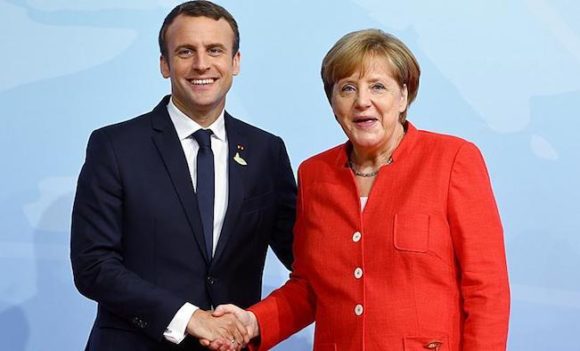
French President Emmanuel Macron and German Chancellor Angela Merkel.

Unfortunately, the geopolitical environment allowing them to be the driving force of a dynamic Europe has shifted and even deteriorated during that long waiting period and their task has become more difficult. Merkel is politically weaker.  The continent is now fragmented and the resistance from newly-created groups within the EU has become more aggressive.  Macron will have to downgrade his proposals and make adjustments.

The political context in which Merkel starts her fourth mandate is quite different from the one existing in 2013.  Only 52 percent of the population supported the new chancellor in 2017 versus 73 percent in the earlier elections.  Compared to the consensus Merkel was able to maintain previously, it is harder now for her to keep the lid over dissenting opinions.

Even though they are part of the “Great Coalition,” several ministers stand in disagreement with the chancellor, including Olaf Scholz (social democrat or SPD), vice-chancellor and minister of finances, who believes in tightening the budget; Horst Seehofer  (head of the conservative Christian Social Union or CSU in Bavaria), who was given the  “super ministry” of the interior, who intends to be harsher toward the immigration policy in the name of the reactivated concept of “heimat” (homeland); Jens Spahn, 37, minister of health (Christian democratic union, CDU or Merkel’s own party), who is also a critic of Merkel’s policy on migrants, and Andrea Nahles, leader of SPD in the Bundestag, wants to rush through social reforms in favor of the workers. 

Even more difficult for Merkel will be the meteoric growth of the far right party (Alternative for Germany or AfD).  In  2013 it did not have enough votes to have representatives  in the Bundestag.  To-day AfD holds 92 seats out of 709.   At a recent news cast on the ARTE channel, the violent tone of a AfD member at the Bundestag was incredible.

The “Countries of the North” (as they are now called) — Ireland, Iceland, along with the Scandinavian and Baltic states, as well as the Netherlands — believe in a strict budget and are inflexible about financial and monetary discipline. Mark Rutte, Prime Minister of TheNetherlands, speaking for the North countries , declared, “We have to adhere to the Maestrich criteria,” namely to keep the public deficit under 3 percent of the Domestic Gross Product.  On March 27, for the first time in 10 years, France saw her deficit fall down to 2.6 percent.  This was a significant accomplishment:  France is now a credible member of the “club.” 

The North countries ask that Italian and Greek banks clean up their toxic debts.  A “mutualization” of the debt (particularly of Greece’s sovereign debt) and financial transfers are a red line conservative parties from Germany or Holland are not willing to cross.  Like Macron and Merkel, however, Rutte sets as a priority a European Stability Mechanism (EMS) and a European Monetary Fund .

The recent Italian elections on March 8 were a blow for moderate centrists like Matteo Renzi, and the victory of two extremist, anti-system and xenophobe parties: the Five Stars (M5S) at the far left, and The League at the far right.  Italy joins now the eurosceptic countries like Austria and the Visegrad group (the former Iron Curtain countries of Eastern Europe.)  All these countries oppose the Macron/Merkel policies on trade, finances, democratic values and attitude toward the migrants.

Given this overview of the political landscape of Europe, it seems that the strategy of Macron and Merkel will be to start from the areas of agreement – passage toward Brexit, defense against terrorism, and protection against excessive Chinese investments in the name of the “Silk Road.”

The reactions of other EU members toward Macron’s “jupiterian” style and desire to reform are ambivalent.  In a March 20 interview published by Le Monde, Xavier Bettel  prime minister of Luxembourg said that a “directorate Paris-Berlin is out of the question, but added”  France and Europe are lucky to have him. Even if we do not agree with all his proposals, they are most welcome.” 

Editor’s Note: This is the opinion of Nicole Prévost Logan.

Nicole Prévost Logan

About the author: Nicole Prévost Logan divides her time between Essex and Paris, spending summers in the former and winters in the latter. She writes a regular column for us from her Paris home where her topics will include politics, economy, social unrest — mostly in France — but also in other European countries. She also covers a variety of art exhibits and the performing arts in Europe. Logan is the author of ‘Forever on the Road: A Franco-American Family’s Thirty Years in the Foreign Service,’ an autobiography of her life as the wife of an overseas diplomat, who lived in 10 foreign countries on three continents. Her experiences during her foreign service life included being in Lebanon when civil war erupted, excavating a medieval city in Moscow and spending a week under house arrest in Guinea.