Letter From Paris: As Notre Dame Burns, the World Mourns

Nicole Prévost Logan

On April 15, the world watched in shocked awe as the 850-year-old Notre Dame cathedral went up in flames.  The emotion was immediate, intense and spread around the globe.  Crowds of stunned people, who gathered on the banks of the Seine, many in tears, some singing religious hymns, gasped when the flèche (spire), consumed by the blaze, finally collapsed.

The French president decided to postpone an important public address.

Heads of state reacted to the fire in the same manner as if it were a major event in world affairs.

Michael Kimmelman wrote in the New York Times that France, “… Weeps for a Symbol of Paris’s Enduring Identity.

Notre Dame Cathedral in Paris was consumed by flames, April 15.

Why is this venerable monument so loved?  It is for a combination of reasons.  Situated on a strategic location on the Ile de la Cité, it is more than a place of cult but a symbol of a civilization.  A Gallo-Roman basilica or temple stood there in the 4th century when Paris was still Lutetia,  then a Merovingian palace was built by Clovis in the 5th century, which was followed by a Christian church in the 10th century.  The construction of the existing cathedral started in 1132 and was not completely finished until 1345.

Napoleon chose it for his self-coronation. as depicted by Jacques Louis David. in 1807. It was to Notre Dame that Charles de Gaulle went first, after marching down the Champs Elysées, in August 1944. During the funeral of François Mitterand, German chancellor Helmut Kohl could be seen with tears in his eyes.

“There was a great and furious flame rising between the two towers, with whirlwinds of sparks” wrote Victor Hugo in 1832. At that time, Notre Dame   was falling into disrepair and Victor Hugo accomplished the best ever exercise of “com” by writing the novel, “Notre Dame de Paris” (translated into English the following year as “The Hunchback of Notre Dame”) to attract attention to the plight of Gothic architecture.  The monument has become an iconic part of the popular culture since.

The 1939 American film,”The Hunchback of Notre Dame,” added to the collective memory by showing the unforgettable Charles Laughton begging for water on the pillory and the 19-year-old gypsy girl Maureen O’Hara helping him.  “Notre Dame de Paris” has been one of the most popular musical comedies in recent years.  Today computer games attract younger populations under the nave.  In this era of globalization, the cathedral has been an obligatory stop for mass tourism, bringing more than 12 million visitors a year to the building.

On a French televised literary program shown the day after the fire, British author Ken Follet was invited to talk about his 1989 best seller, “The Pillars of the Earth,” describing the generation-long construction of a fictional early Gothic church set in the English countryside.

The cathedral has inspired artists, like Turner, Corot, Hopper, Matisse.  In 1909,  Paul Delaunay created a modernistic vision of the city, as seen from the  top of the spire, through movement and light.  Listening to Debussy’s “La Cathedral Engloutie,” one can’t help thinking of  Notre Dame. The opening stark fifth chords describe the calm waters from which the cathedral slowly rose, inspired from a medieval Breton legend.

But the main reason to revere Notre Dame is that, like the Parthenon, it is a perfect example of the canon of architectural beauty. The masters of the 13th century created a well-balanced, light, elegant structure, devoid of unnecessary decorations.  They created a building at human scale.  Unlike some other cathedral, such as the much taller and rather austere Cologne cathedral, for example, the feeling of height is not oppressive because of the elegant archways of the  “tribune” and the “trifonium” and the upper windows pouring light over the six-point vault rib of the nave.  The giant 13th century rosaces (rose stained glass windows of the north and south transept) filter soft red-blue colors.

This is why I, like so many Parisians or visitors, have being seduced by the cathedral.  Once you visit it, it becomes yours.  Aware that I may never see it again, I am holding on to shreds of memories.

A view of Notre Dame before the devastating fire.

In the mid 19th century, the cathedral was showing its age and historian and medievalist architect Eugene Viollet-le-Duc,  aged 31, was chosen to lead the restoration starting in 1843 . He first created  stunning drawings, blueprints and watercolors.  Beside repairing the damage of time, he also made some bold additions such as the flèche – completed in 1859 – the gargouilles (gargoyles) and chimeras representing fantastic birds, demons, often used as rain spouts.  Built in Neo-Gothic style, they matched  the original spirit of the structure.

Within 48 hours of the fire, there was an unprecedented outpouring of donations.  French billionaires – Francois Pinault (maker of luxury goods, owner of Christie’s auction house) and Bernard Arnaud (LVMH, Vuitton) – rivaled each other as to whom would donate the most and turn down the tax deductions.

The main loss was the 13th century oak framework under the roof.  When it collapsed, the flèche fell through the nave at the crossing of the transept, leaving a gaping hole. For a while, experts feared the danger of collapse in three particular areas. Then stormy weather, with rain and strong winds, forced the workers  to do a fast and amazing job of protecting the structure.  The ones with mountaineering experience were dispatched to the most difficult places, like pinnacles, to lay down tarps over a temporary frame installed where the roof had been.

Two weeks after the blaze, Benjamin Mouton, former chief architect of Notre Dame commented that the building was still fragile.  Stones were at first dangling in the air.  Work by an expert will have to determine the damage caused, in a great part, by the tons of water the hundreds of firemen hosed on the building to put out the fire. It will take several months just to dry up.  The consolidation process alone will take about four months.

Fortunately the rosaces were not damaged, but to bring them back to their original condition will be a painstaking job: each pane of the stained glass will have to be taken down, cleaned, then stored until reinstalled.

Prime Minister Edouard Philippe announced an international competition.  How to conduct the restoration is causing an ongoing controversy:  whether to duplicate the original building or modernize it by using new technology?  Philippe Villeneuve, chief architect of historical monuments, will arbitrate opposing point of views.  Should Notre Dame freeze in the past or at the same time, should one stay away from wild architectural projects not in keeping with the soul of the cathedral?  One of the main dilemmas is whether to replace the oak framework (called “the forest”) with wood or use another material such as metal — as in Reims cathedral — or concrete and metal as in Chartres?

An army of carpenters,  stone-carvers and glass-blowers will be needed.  Les Compagnons du Devoir et du Tour de France (nothing to do with the annual bicycle tours), dating back to the Middle Ages, is an association of monastic character, with 80 houses across France, producing the best artisans and craftsmen in the world.  The transmission, through the centuries, of their savoir-faire will be crucial.

Restoration work, as a rule, is overseen by the Ministry of Culture.  But this time the government appointed General Jean-Louis Gorgelin, former army chief of staff, to conduct the work … and on the double.

The day after the fire, Notre Dame, seen from the East on Quai d’Orléans on Ile St Louis,  looked like a wounded bird.  With the roof gone, buttresses seemed disconnected and to be flying in all directions.

Let us hope it will rise again soon in all its former splendor.

Editor’s Note: This is the opinion of Nicole Prévost Logan.

Nicole Prévost Logan

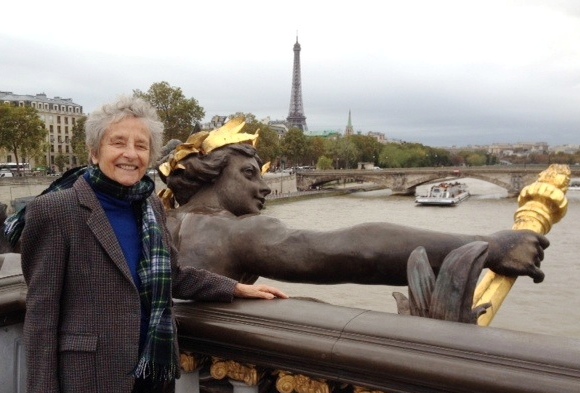
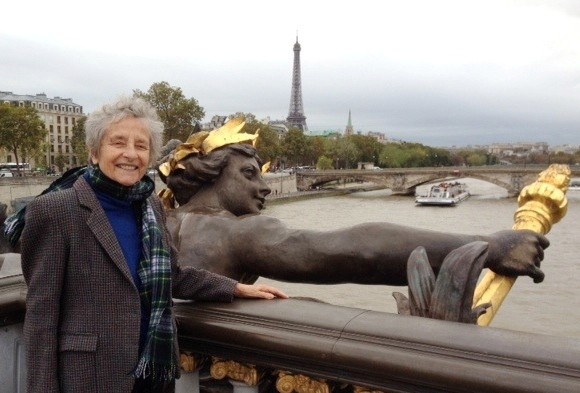
About the author: Nicole Prévost Logan divides her time between Essex and Paris, spending summers in the former and winters in the latter. She writes a regular column for us from her Paris home where her topics will include politics, economy, social unrest — mostly in France — but also in other European countries. She also covers a variety of art exhibits and the performing arts in Europe. Logan is the author of ‘Forever on the Road: A Franco-American Family’s Thirty Years in the Foreign Service,’ an autobiography of her life as the wife of an overseas diplomat, who lived in 10 foreign countries on three continents. Her experiences during her foreign service life included being in Lebanon when civil war erupted, excavating a medieval city in Moscow and spending a week under house arrest in Guinea.

Letter From Paris: Exhibition of Macke & Marc’s Art Unintentionally Makes Powerful Statement on European Current Affairs

Nicole Prévost Logan

The exhibition titled Franz Marc / August Macke. The Adventure of the Blue Rider (der Blaue Reiter) at the Musée de l’Orangerie is the exhibit to see this spring when in Paris.  It is a festival of colors by two German artists, Macke (1887-1914) and Marc (1880-1916), who both died prematurely on the front during World War I more than a century ago.

Long overdue, and shamefully so – I believe all art historians would agree – Macke and Marc have never before been shown in France in an exhibit dedicated exclusively to them. The event opened first at the Neue Galerie of New York, then will remain in Paris until June 17.  The curators have made a few changes, particularly stressing the connection with the Blaue Reiter movement and the relationship with other European avant-gardes, particularly the fauvism and cubism in France.

After writing an article myself on April 11 2015 on this very site, it was pure pleasure to see the original works hanging in the spacious lower level rooms of the Orangerie Museum in the Tuileries gardens.

Franz Marc, The Dream [Der Traum], 1912, Museo Thyssen-Bornemisza, Madrid. Image taken from the Musee de l’Orangerie website.

Although they are shown together, the two artists have distinct personalities and styles. They first met in January 1910 and became close friends until the war.  Macke lived in Bonn on the Rhine in central Germany.  Marc, with the Russian artist Wassily Kandisnky and his companion Gabriel Munter and other members of the Blaue Reiter, loved Bavaria in southern Germany. He settled  first in Mirnau, about 40 miles south of Munich, then on Lake Kochel.

At a time when Europe is currently torn by political fractures, when the closeness of France and Germany is crucial to the survival of the continent, this exhibit has a strong symbolic meaning.  The European Union was founded on a determination to put an end to all wars.  What a powerful message when the art of these two young men is displayed together in an exceptional exhibition in Paris, considering, ironically, both men loved France and its culture, and yet died fighting against the country they revered.

Letter From Paris: And So It Goes On … Brexit, That Is

Nicole Prévost Logan

“Order, Order!” barked John Bercow, Speaker of the House of Commons before announcing the results of the third-time-around vote on Theresa May’s Brexit “deal” .  “The ayes to the right 286, the noes to the left 344,  the left have it.”

It was that fateful day, March 29 – chosen by the Prime Minister as the deadline to decide on the “divorce” of the United Kingdom (UK) from the European Union (EU).  The masterful and funny Speaker was able to control his troops and even to provoke laughter, telling one Member of Parliament (MP), “Get a grip, man, do yoga, it will be beneficial to you.”

In retrospect, not much progress had been made to resolve the Brexit issue on the British side since the June 23, 2016 referendum. It seemed that the government was taking its time and fantasizing about the legal elbow room it actually had to make decisions. (See my previous articles published on 3/5/2016; 4/6/2017 and 12/29/18)

Action in the House of Commons started really in earnest on Nov. 15, 2018 when Theresa May’s original deal was voted down. A second vote on the same motion, and a third with almost identical text were also rejected by the MPs. By drawing red lines, the tenacious but inflexible Prime Minister made it hard for herself to negotiate.

During the winter months, the parliament at Westminster offered the world a spectacle of one “decisive week” after another with votes ending in an inability to reach a majority. By March 14, Theresa May had lost her voice and the headlines in the press read “Game over.”

On the eve of the March 29 deadline, the situation turned surrealistic with two superimposed pictures (to use the words of Le Monde special envoy to London) of a vote on May’s deal and eight others on alternative proposals the MPs had organized on their own.  In a dramatic gesture, Theresa May used her last joker – stepping down from office – in case her deal was supported.   

The Prime Minister described the situation as “the end of a process” with the MPs having said no to everything : to the deal, to the absence of a deal, to Brexit, to Article 50 itself, to the eight separate proposals. In the face of this total collapse of a possible way out of this impasse, Donald Tusk, European Council President announced an extraordinary summit in Brussels on April 10.

A surprising amount of information and live coverage is now appearing on the French media,  shedding a new light on Brexit.

One report showed to what extent the public opinion was in fact manipulated.  More than 80 percent of the British press was hostile to Europe and contained “fake news” items.  The “Brexiteers” promised that the Commonwealth would save the UK. The famous red bus of Boris Johnson traveled throughout the country, displaying the number of 350 million pounds sterling ($455 million) in giant letters . That is the amount “BoJo” (Boris Johnson’s nickname) claimed that the UK is sending the EU every week instead of using it to fund the National Health Service (NHS). 

A Canada-based web site called AggregateiQ, created by Dominic Cummings, utilized private data collected from social networks and used it to “microtarget” individuals with “dark ads.” The “Vote Leave” site used a strategy comparable to that used by Cambridge Analytica, a company heavily implicated in the 2016 US election manipulation.

Other reports helped better understand why re-establishing a border between the two Irelands was a visceral impossibility. The Good Friday agreement in 1998 brought peace back but the catholic and protestant communities in Belfast, are still separated.

In this fragile context, the Irish people fear that a 300-mile external border with the EU would jeopardize the hard-won peace agreement. Trying to solve the problem of a border is an attempt at squaring a circle. The only solution might be a border at the bottom of the Irish Sea.  The backstop which allows the border to remain open until a final treaty is signed, is only a temporary solution.

It was not until the 11th hour – or less than one week before the March 29 deadline – that a significant turn occurred in London.  Prime Minister May entered into talks with Jeremy Corbyn, leader of the Labour party, in spite of their sharp disagreements.  It was such a breakthrough that the Chancellor of the Exchequer Philip Hammond declared on April 5, “the threat of the UK crashing out of the Union is heavily diminished.”  The Conservative party began to lean toward a “soft Brexit” and the possibility of the UK remaining in the Custom Union.

During all these months, the Europeans showed a consensual unity.  Their only caveat being that another delay would have to be justified by a clear plan such as general elections or a second referendum.  Their patience though began to wear out by early April as some divergences of opinion emerged. 

The priority for Angela Merkel is to avoid a no deal Brexit and she will bend over backwards to make that happen.   Although sharing many views with the UK in economy or trade, Mark Rutte, Prime Minister of the Netherlands, confirmed his alignment with the collective position. 

The “flextension” of one year suggested by Donald Tusk, President of the European Council, might not appeal to everybody. President Macron and EU Commissioner Juncker sound tougher on more delays. However, Macron reaffirmed on April 1, that he will stand by the decision made by Brussels and will not use his veto.   

The repeated postponements requested by Prime Minister May (April 12, May 23, June 30) forced the MPs to cancel their Easter recess. Much more serious, is the imbroglio caused by the colliding of the Brexit discussions with the European elections scheduled to take place May 26.

This long saga turned rather nasty when Tory MP Jacob Rees-Mogg, ultra Brexiteer, tweeted on April 5, “Let us stay [in Europe] and this way we will be able to damage the Union from the inside and oppose our veto on any Brussels decision”.

And so, the suspense goes on.  During these final hours, the two Houses of Parliament are scrambling to find a solution and seem to agree that a no-deal Brexit is unacceptable.  The Europeans do not want to push the UK out of the Union.

Chances are that the outcome will be Britain remaining in the Custom union, an à la carte solution, which was almost obvious from the beginning.  The British should take heart.  It only took 22 years for Norway to establish relations with the EU through the European Economic Area (EEA), and 29 years for Canada to negotiate with Europe through the Comprehensive Economic and Trade Agreement (CETA)!

Since all the thorny issues – the City, fishing , citizens’ rights, Gibraltar, etc – are included in the 27 pages of the non legally-binding Political Declarations, a  second part of Article 50 (in other words, swept under the rug ) will have to be negotiated later . Brexit will continue to haunt both the divided British opinion and also Europe .

Some may think it is the UK’s vocation is to be independent from Europe and turned toward the rest of the world.  It certainly seems British people consider EU membership a straight-jacket. Interestingly, these are the same reasons General Charles de Gaulle gave persistently more than 50 years ago as to why he was against the original entry of Britain into the European Economic Community (EEC).

Editor’s Note: This is the opinion of Nicole Prévost Logan.

Nicole Prévost Logan

About the author: Nicole Prévost Logan divides her time between Essex and Paris, spending summers in the former and winters in the latter. She writes a regular column for us from her Paris home where her topics will include politics, economy, social unrest — mostly in France — but also in other European countries. She also covers a variety of art exhibits and the performing arts in Europe. Logan is the author of ‘Forever on the Road: A Franco-American Family’s Thirty Years in the Foreign Service,’ an autobiography of her life as the wife of an overseas diplomat, who lived in 10 foreign countries on three continents. Her experiences during her foreign service life included being in Lebanon when civil war erupted, excavating a medieval city in Moscow and spending a week under house arrest in Guinea.

Letter From Paris: Present Pace of European Politics is Dizzying

Nicole Prévost Logan

The unity of Europe is being put to the test now more than ever: the deadline of the Brexit pushed back from March 29 to April 12 is heightening the uncertainty to an almost unbearable level, the visit of Chinese president Xi Jinping to Italy, Monaco and France is preoccupying several members of the European Union (EU), and the populist votes in recent European elections are gaining strength.   

On March 22, British Prime Minister Theresa May was in Brussels, waiting for a decision by the European Council gathered at an extraordinary Summit. She obtained a short “technical” extension of the Brexit deadline until May 24 in the event the House of Commons reaches an agreement.  In spite of their weariness, the 27 EU members wanted to show some benevolence by granting a few more days.  Another reason was that they did not want to be the ones to lower the hatchet on the UK.

Xi Jinping and his wife, a former opera singer and general, Peng Liyuan, landed in Rome on March 21.  The president of China has found in Italy a major beachhead for its Silk Roads initiative in Europe.  Italy, which fell into recession at the end of 2018, needs money to invest into its infrastructure. Presidents Giuseppe Conte and Xi Jinping signed contracts for billions of  Euros, including some earmarked for the development of  Trieste and Genoa commercial harbors. It is extremely worrisome that one of the G7 countries would grant access to Schengen Space to a foreign power.

French President Emmanuel Macron planned the official visit of the Chinese couple in grand style with a program loaded with symbols … an overnight in the famous Negresco Hotel in Nice; watching the sunset over the sea from the museum-villa Kerylos (a replica of an Athenian residence) in Beaulieu  and thus alluding to Ancient Greece as the cradle of European culture; dinner at the Elysée palace for 200 guests, including – at the request of Xi Jinping –  a French actress from the most popular TV series in China.  The top pastry chef, cheese expert and wine sommelier of France were collectively watching over the dinner, the menu of which remained a secret.  Last time Paris went all out for a Chinese president was in 2004, when the Eiffel Tower was turned red to mark the visit of Hu Jintao. 

But the crucial message of the visit came out loud and clear when Macron, German Chancellor Angela Merkel and Jean-Claude Juncker, president of the EU  Commission, together greeted the president of China.  The message was to present a joint European front.  In his address, Macron formulated the general guidelines of future relations between China and Europe avoiding no confrontation, a partnership based on reciprocity while not appearing to be naïve.

In recent years, the Chinese have invested more than 140 billion Euros in Europe.  Since 2014, they have organized “16+1” summits attended every year by 11 Eastern European and five Balkan countries to expand economic cooperation.  In announcing his vision for “renovated multilateralism,” Macron hopes to hamper China’s strategy, which has been until now to pressure individual countries with its power and capitalize on their vulnerability.  Finally, Macron stressed that European countries must preserve their sovereignty and stop the take-over of strategic installations by foreign countries. 

Although Europe appeared united as a bloc in the face of Brexit, recent developments in The Netherlands , Hungary and Poland are emblematic of changes taking place in the political landscape.

In The Netherlands, elections took place on March 20, the day after the terrorist attack on the tramway in Utrecht.  A new party, “Forum for democracy (FvD), headed by jurist and historian Thierry Baudet, age 36. caught up in the polls with Dutch Prime Minister Mark Rutte of the “Popular and Democratic” party (VVD).  Baudet is a right-wing Eurosceptic, anti-migrants, and a supporter of Donald Trump.  He is for a “tolerant and inclusive nationalism.”  He denounces political “élites”and a multicultural society.

On March 16, Zuzana Caputova, a lawyer, divorced and pro-choice, won the presidential elections in Slovakia, a very catholic country of close to six  million people.  She won in the second round of the ballot against Maros Sfcovic of the leftist populist party.  Having worked before for an ONG defending human rights, she holds liberal views on the economy.  The elections were influenced by the murder, one year ago, of a journalist and his fiancée — the journalist was investigating the links between the Italian Mafia and the Slovakian Central Executive.  The protest demonstrations in Bratislava that followed the murder were the largest since the independence of Slovakia in 1993.

On March 4, Gdansk again showed its importance as a center of the opposition in Poland.  After the murder of  Pawel Adamovicz, the city’s mayor, Aleksandra Dulkiewicz, the mayor’s deputy, won the mayoral election with a landslide.  She may become a strong adversary to the government.

In another development, Robert Biedron, head of the party Wiosna (spring), 42, and Poland’s first openly gay politician, wants to end the monopoly of two parties in power since 2005, namely, PO –  a civic platform, conservative but liberal economically — and PiS or “law and order,” the ultra-conservative ruling party.  Although far behind the two major parties, this new candidate, who is anti-church, pro-women’s rights, and an ecologist, is a sign of change in Polish politics.

Hungary is the country making the most waves.  On March 20, ultra-right prime minister Viktor Orban’s party Fidesz was reprimanded for putting up anti-Brussels posters, and for his repressive policy.  The European parliament decided to take action and suspended  Fidesz from the Parti Populaire Europeen (PPE) with an overwhelming majority of 190 to. 4. 

Many are sickened by Orban’s provocations.  He appears obsessed with George Soros, the American  billionaire of Hungarian origin.  The European Parliament in Strasbourg voted to maintain Soros’ Central Europe University. “We put Orban in the freezer and Van Rompoy* holds the door”(*Herman Van Rompoy, a Belgian, is former president of the European Council) commented a Belgian Euro-deputy.

The suspension will at least prevent Orban from joining hands with Matteo Salvini of the Far Right League in Italy and the Law and Justice party in Poland.

Editor’s Note: This is the opinion of Nicole Prévost Logan.

Nicole Prévost Logan

About the author: Nicole Prévost Logan divides her time between Essex and Paris, spending summers in the former and winters in the latter. She writes a regular column for us from her Paris home where her topics will include politics, economy, social unrest — mostly in France — but also in other European countries. She also covers a variety of art exhibits and the performing arts in Europe. Logan is the author of ‘Forever on the Road: A Franco-American Family’s Thirty Years in the Foreign Service,’ an autobiography of her life as the wife of an overseas diplomat, who lived in 10 foreign countries on three continents. Her experiences during her foreign service life included being in Lebanon when civil war erupted, excavating a medieval city in Moscow and spending a week under house arrest in Guinea.

Letter From Paris: Will Europe Fight Back in Face of World, Local Challenges?

Nicole Prévost Logan

The European Union (EU) is under attack from all sides.

Will the EU strike back?

The most serious threat against Europe is the dislocation of the world system of security and defense, which Europe relies on as a protection.  During the past two years, an avalanche of steps taken by the US is unraveling the Atlantic-dominated frameworkwith a possible US pull-back from NATO;  a hasty and sloppy departure of US troops from Syria in December 2018 putting the European allies in front of the fait accompli; breaking away from the Intermediate-Range Nuclear Forces Treaty (INF) in February 2019 (immediately followed by Russia doing the same thing the next day.)

The noxious transatlantic relations came to light during the Munich Security Conference (MSC), February 15-17, an annual event, since 1963, attended by the decision-makers of the world.  Angela Merkel was the voice of many worried Europeans. The contrast between her speech and US vice president Mike Pence’s was striking. 

Without a script, the German chancellor made a passionate plea for multilateralism, clearly pointing at the US, Russia and China to save the world order which she sees in danger of decline and destruction. 

She received a standing ovation.

After her spirited performance, the US Vice President’s words sounded leaden.  “He admonished Europeans the way Brejhnev did the Iron Curtain countries back in the USSR days,” commented a French analyst.  Pence’s speech was met with an icy reception.  There was an incredible moment when he brought Donald Trump’s greetings. 

An interminable and deafening silence followed.  He clearly was expecting applause from the audience. 

Russian Foreign Minister Sergei Lavrov proposed to prolong the New START (Strategic Arms Reduction) Treaty after 2021. This treaty – limiting the number of long-range nuclear missiles- is one of the last remaining from the cold war era.   

Sylvie Kauffman, editorial writer for Le Monde, commented, “The Europeans feel left out in the cold, tetanized by the major powers working out a system above their heads.”  Sigmar Gabriel, former German minister of foreign affairs, wrote, “In a world of carnivorous geopolitics, the Europeans are the last vegetarians.  After the departure of the UK, we will become vegans, then prey.”

One way to attack and therefore weaken Europe is to capitalize on the fact that it is divided.  Some foreign powers have become quite adept at using the “Trojan horse” strategy.

On Feb. 13-14, the US and Israel chose Poland as the location of a conference on the Middle East. In Warsaw they were able to meet with the other members of the Visegrad group (V4) —  Hungary, Slovakia and Czech Republic. These four countries are run by populist and authoritarian governments and clear in their intention to unravel the EU as it exists today.  There was little media coverage here about the conference, which was by-passing Brussels.  Federica Mogherini, High Representative of the EU for Foreign Affairs, was not even present.

Steve Bannon, former advisor of Donald Trump is busy traveling all over Europe, giving his support to populist countries like Italy and Hungary.  He proclaims that Brexit is a great thing and advocates the creation of a possible axis through Rome/Budapest/Warsaw to counter the Franco-German “couple”.  He has purchased a monastery near Rome and turned it into a training center for “sovereignists.”

Europe represents a juicy market of over 700 millions inhabitants.  It is particularly vulnerable because it continues to respect some rules, which are disregarded elsewhere.  The most striking illustration of unfair competition is the recent failure of the fusion of the two European railroad  magnates Alstom and Siemens.  The EU Commissioner for competition, Margrethe Vestager, stopped the process lest it violates the antitrust rule, a rather outdated notion when one considers the size of the giant telecommunications companies in the US.  The danger for Europe is that this decision in Brussels leaves the way wide open for China.

China is by far the main predator trying to wedge its way into Europe, hiding under a charming euphemism of “silk road” (the Chinese call it also the “Belt and Road Initiative.”)  The investments of Xi Jinping’s government have increased in leaps and bonds to reach a peak in 2016, particularly in the infrastructure of smaller and poorer Eastern European countries, where they are financing bridges, tunnels, or taking over commercial harbors, airports.  Even in Western Europe, they are rescuing failing companies or acquiring new ones — China has already taken over the electricity grids of Greece, Italy and Portugal.

How can the EU strike back?

Nathalie Loiseau, French Minister of European Affairs, 55, an extremely intelligent woman and a candidate to watch for in the May 26 European elections, wants to be positive and stresses what has been accomplished, “We have gained more in 18 months than in decade on the subject of defense … Germany has joined us on the idea of a common budget for the Euro zone … Poland agrees with France on the PAC  (Common Agricultural Policy) … There is no cohesion among the nationalist governments … Austria and Hungary disagree on many topics.”

Business leaders of the MEDEF (Movement of French enterprises) met in February to reassert their economic sovereignty against malicious cyber attacks and industrial espionage, “Being liberal, they say, does not mean being naive.”

On March 4, the French president Emmanuel Macron published a “Letter to the Citizens of the 28 EU countries.”  His vision for the “renaissance of the construction of Europe” is consistent with the seminal speech on foreign policy that he gave at the Sorbonne on Sept. 26, 2017, and also with the Aix-la-Chapelle Treaty of Jan. 22, 2019, between France and Germany.  Macron advocates a protective Europe with external  borders guaranteeing free “Schengen Space,” a strong defense and security treaty, the harmonization of salaries, and protection against cyber attacks during elections.  

The reactions of the 28 EU members were favorable, although several of them said that trust is more important than the creation of new institutions. 

The attitude of all the member countries of the EU to Brexit has proved that those 27 countries do not, in fact, want to leave Europe.  Chief Brexit negotiator Michel Barnier has so far accomplished the almost impossible in keeping his troops together. 

Editor’s Note: This is the opinion of Nicole Prévost Logan.

Nicole Prévost Logan

About the author: Nicole Prévost Logan divides her time between Essex and Paris, spending summers in the former and winters in the latter. She writes a regular column for us from her Paris home where her topics will include politics, economy, social unrest — mostly in France — but also in other European countries. She also covers a variety of art exhibits and the performing arts in Europe. Logan is the author of ‘Forever on the Road: A Franco-American Family’s Thirty Years in the Foreign Service,’ an autobiography of her life as the wife of an overseas diplomat, who lived in 10 foreign countries on three continents. Her experiences during her foreign service life included being in Lebanon when civil war erupted, excavating a medieval city in Moscow and spending a week under house arrest in Guinea.