Letter From Paris: Back to Normal in France? Not Quite …

Nicole Prévost Logan


A Cannes Film Festival turned virtual,  the Roland Garros tennis tournament and Tour de France bicycle race both postponed until September?  France will definitely not be the same this  summer!

Tourism and culture are two of the main sectors of French economy and the pandemic has inflicted a direct blow on both of them.  Hundreds of festivals, sport events, art shows, plays, and concerts or activities linked to historical monuments had to be drastically reduced, presented behind closed doors, or totally cancelled, putting hundreds of thousands of people out of work .

But you would not think there is a virus going around when you see the way the French behave.

In Paris, restaurants and bistros spread their terraces across the sidewalks and into the streets.  They mark their space with bushes and flower beds.  Beach umbrellas add color to the scene.  Taking advantage of the warm weather, Parisians hang out outside.

Away from the cities, the French have been seeking  the calm of the countryside, enjoying family gatherings and organizing barbecues with  friends .

Young people could barely wait for the end of the lockdown to have fun in Paris … to huddle on the banks of the Seine or the Canal St Martin, to congregate in open spaces and dance into the night, or to flock to discotheques.  Meanwhile, St Tropez, down on the Riviera coast in the far south of the country, became a particularly hot spot.

People were reluctant to take the subways and, as a result, car traffic has surged.  Bicycles have taken over Paris.  It is likely that this trend will persist, virus or not.

Barely out of the lockdown, one thing was on everybody’s mind … the next vacation.  Every day the media tempted the viewers with sights of clear waters, beaches, and cool mountain trails.  This year the French seem to have rediscovered their own country and become the only tourists there.

It was to be expected that such behavior would have an impact on the evolution of the pandemic.  Clusters have multiplied throughout the country, which led to the specialists warning that the virus was still active.

But the present situation is quite different from what it was at the height of the crisis back in March and April.  The number of  deaths, or severe cases, being treated in the hospitals remains very low.  A general lockdown appears to be out of the question today.

Hospitals are better prepared and treatments made easier for the patients.  Masks and testing are more available.  Central government and local authorities adjust their policies to manage the pandemic in a more flexible way.  For instance, as of this week , Paris and several other large cities require masks to be worn outside in crowded areas.

From this overview of the pandemic in France, let us now change scenery and take a look at some highlights of life in France and Europe over these past months …

Every six years in France, the people are riveted by municipal elections. There are 36,000 communes in France headed by a maire assisted by a conseil municipal. The wide spectrum goes from the highly political Paris town hall, employing 40,000 people — Jacques Chirac headed that institution before becoming president of France — to the tiniest mairie.

The small village on the Dordogne, where one of my daughters lives, had been dormant for the past four decades with an unopposed maire at the wheel. This year however, things were different. The ballot took place in a heated atmosphere.  Participation was high. The scene was like a microcosm of French politics … and the maire was defeated.

In early July, Edouard Philippe stepped down as prime minister. A growing feeling of insecurity and violence has damaged the authority of the French executive. President Macron decided that a major reshuffle was required to bring new faces and methods and thus energize the government prior to the next presidential election.

Even a new voice was welcome. Jean Castex comes from the Pyrenées region and has a southern accent, which the French usually associate with vacations on the Mediterranean. Castex nevertheless is a product of the élite schools, a graduate of Ecole Nationale  d’Administration (ENA). As a high-ranking official, he has held key positions at the very center of power at the Elysée Palace.  He is an old pro — although he does not sound like one.

Over in Poland, Ardrzej Duda, leader of the conservative party Droit et Justice (PIS), was reelected as president on July 12.  The very small margin of his victory – 50.4 percent to 49.6 percent – suggests that it is only a question of time until a liberal, pro-European movement, possibly headed by Rafal Trzaskowski, defeats the authoritarian executive.

In Italy, meanwhile, after 14 months of the disastrous government of populist Matteo Salvini, Giuseppe Conte brought  appeasement as a centrist prime minister, who works well with Brussels.

At 5.30 a.m. on July 22, the 27 members of the European Union (EU) met  in response to a Franco-German initiative.  It was the longest summit in EU history.  Arduous negotiations produced an agreement to inject over $2 trillion into the economy and 360 billion in loans.

The recovery plan of the EU — labeled “Next Generation EU”– is ambitious.  At its core is  a  “Green Pact.”

The plan, which will be implemented gradually along with each year’s budget, includes support of the health system, innovation assistance to viable companies, aid to farmers and fishermen, and 100 billion to help pay for widespread partial unemployment.

Banking rules will be made more flexible to facilitate the borrowing by entrepreneurs.  Right now the European Central Bank (CBE) enjoys a high credit rating, which helps the borrowing process. Margrethe Verstager , Executive Vice President of the EU Commission, will promote a Digital Single Market.

Alstom — a French multinational company operating in rail  transport markets — bought the Canadian company Bombardier.  The merger will create a rival to the giant China Railway Construction  Corporation (CRCC). China is continuing to make inroads in Europe and just invested in Portugal’s trams.

Overall the numbers of the European economic recovery are impressive:  together Brussels plus the 27 EU national governments will inject 40,000 billion Euros into the economy — far more than the US or even China

The “frugals”– the Netherlands, Austria, Denmark, Sweden and Finland — fought tooth and nail against transfers of funds from the richer North to the South.  Dutch prime minister Mark Rutt stressed that the 750 billion Euros were not a blank check to weaker economies like Italy’s  — whose vertiginous debt is 240 percent of its GDP — but an investment plan to be controlled by Brussels.

Concessions had to be made.  The “frugals” received a rebate in their annual contribution to the European budget.  But the real beneficiaries are Poland and Hungary, who keep receiving money in spite of their frequent violation of the rule of law.

Recent developments show how fragile — but also resilient — the EU is.  Even the “Eurosceptics” do not want to let go of  their profitable membership in the “club .” But the real strength of the EU is that it constitutes a huge market, the largest trading block of the world.  The richer EU economies need the tariff-free Single Market.  Germany relies particularly on Lombardy  for its exports.  Maybe the EU should learn from  Alexander Hamilton who advocated the “mutualization” of the sovereign debts of the States to make the federation stronger?

And finally … on Aug. 21, Emmanuel Macron and Angela Merkel met at the medieval Fort de Brégançon, the summer residence of French presidents.  On this late summer day, they seemed to enjoy this picturesque spot on the Mediterranean  to meet for five working hours.  They reiterated the unity of their policy at this complicated time.

At unprecedented speed, France and Germany led the EU in its mediation to support the protests following the Belarus elections.  They also acted swiftly also in flying Alexei Novalny, who is in a coma, to a hospital in Germany for treatment of a possible poisoning by the Russian government.

Editor’s Note: This is the opinion of Nicole Prévost Logan.

Nicole Prévost Logan

About the author: Nicole Prévost Logan divides her time between Essex and Paris, spending summers in the former and winters in the latter. She writes a regular column for us from her Paris home where her topics will include politics, economy, social unrest — mostly in France — but also in other European countries. She also covers a variety of art exhibits and the performing arts in Europe. Logan is the author of ‘Forever on the Road: A Franco-American Family’s Thirty Years in the Foreign Service,’ an autobiography of her life as the wife of an overseas diplomat, who lived in 10 foreign countries on three continents. Her experiences during her foreign service life included being in Lebanon when civil war erupted, excavating a medieval city in Moscow and spending a week under house arrest in Guinea.

Letter From Paris: Thoughts on Life Under Lockdown in Fontainebleau, How France Has Coped With COVID-19

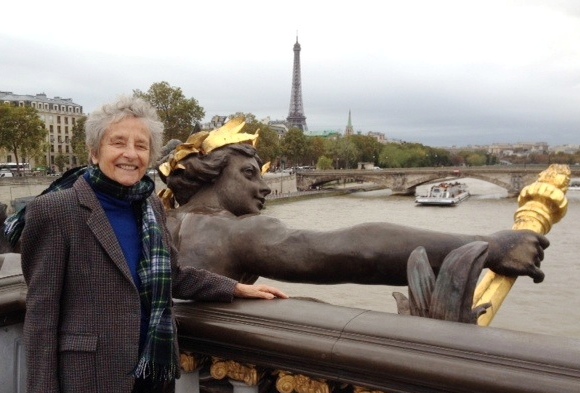
Nicole Prévost Logan in Paris prior to the lockdown.

There have been many deadly pandemics in the history of the planet but this is the first time ever that one has affected so many people. COVID-19 forced half the world population – or more than three billion – into confinement. I guess this is the price one has to pay for living in a globalized world. Each country handled the coronavirus crisis in a different way.

How did Europe, and more particularly France, manage the virus outbreak, both during the stay-at-home period and after the relaxation of the rules?

Like many people, I escaped the approaching lockdown of large cities – in my case the French capital of Paris.

The famed Château de Fontainebleu. Published under the terms of the GNU Free Documentation License.

On March 16, I left Paris on what I thought would be an extended weekend but turned out to be eight weeks, and was fortunate enough to stay with my daughter in Fontainebleau.  Only a 40-minute train ride south east from Paris, Fontainebleau is a lively town of 15,000 inhabitants, famous for its 12th century chateau restored and enlarged by generations of kings.

During the period of “confinement” – as the lockdown is called here – technology became quite helpful. People exchanged news and jokes across the globe, using WhatsApp; some did yoga or gym watching  YouTube; meetings took place via  Zoom;  people on Skype remained safely behind the screen while they urged other to stay home, and a French actor read La Fontaine fables on Instagram. In other words  globalization had not ended … it just had become virtual.

A feeling of anguish never went away. Week after week, one watched hospital scenes with medical staff and caregivers hovering over patients disappearing under respirators, ventilators, machines of all types connected by wires and tubes. We, the spectators, became numbed by so much suffering.

Every night the head of the health  department gave frightening, sometime confusing information. On TV all we saw were doctors, surgeons, epidemiologists, and doctors specialized in intensive care. Politics, economy, even social conflicts had been moved to the back burner.

In France, late March was the most frightening time. We were at the bottom of the curve showing an acceleration of the virus and feared a tsunami . It was on March 23 that the stock market fell to the lowest point, losing 40 percent from its high. The world was collapsing around us.

I attempted to read “The Plague” by Albert Camus, published  in 1947. Bad idea! The  description of the ghastly symptoms and of the panicked Oran population became unbearable. The story resonated too much with what we were going through.

The epidemic in France started in the Grand Est. A group of 2000 evangelists had gathered for a week of fasting in Mulhouse.  The area became the epicenter of the outbreak. Very soon it was joined by the heavily-populated Ile de France with Paris at its center.

France has been one of the countries hardest hit by the virus. Actually it ranks as fifth for the number of deaths, after the US, Russia, Italy and the UK.

The objective of the French government was to make sure that the medical facilities would be able to absorb the sudden surge of infected people. Chaos was avoided thanks to planning ahead. At the height of the crisis, transfers of patients were organized to areas less affected by the virus, and to other countries like Germany or Switzerland. Helicopters, fast trains, military planes, boats … all means of transports went into action.

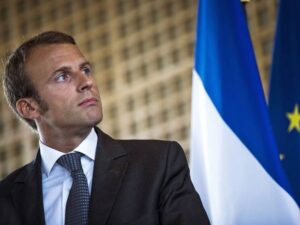
French President Emmanuel Macron.

The Macron government showed compassion during this difficult time, expressed gratitude toward the caregivers, and showed humility in its limited ability to cope with such an  unprecedented situation. In other words it appeared human … while also gaining a few points in the polls.

The government took unparalleled measures compared to most other countries. It gave temporary unemployment status – with up to 90 percent of a person’s salary covered – to one out of three wage earners – or 13 million people. Some taxes were cancelled, and bonuses distributed. The total of this largesse reached 120 billion Euros. The Maestrich Treaty rule of capping European Union (EU) members’ deficit at 3 percent is now forgotten. The French national debt, usually limited to 60 percent of the Gross Domestic Product, doubled.

The management of the coronavirus crisis did not go without a number of hiccups however. The main one was the shortage of masks. It has been a source of irritation throughout. On the advice of medical experts, the government kept saying that the masks were useless except when used in public  places. It stressed that priority should be given to the medical staff who are battling the disease on the front line.

The real reason for this policy soon exploded into a scandal; in reality, there were not enough masks. Frantic orders were placed in other countries, mainly China. At one point, one witnessed a real war of the masks. Some shipments were burglarized, other rerouted.  One shipment intended for Italy was confiscated on its arrival at Prague airport and, in another case, France took over a shipment on its way to Sweden. On the eve of the “deconfinement” masks were still hard to find.

Another criticism of  the crisis management has been the insufficient  number of testing facilities.

One does not want to be old at a time of pandemic because statistics do indeed show that older people are most vulnerable to the disease. At one point, a rumor started that “our fragile seniors” should remain locked up long after the rest of the population.

Fortunately for all the older people, Bernard Pivot, a most popular and entertaining moderator of a literary show on TV, rebelled one day. He was so funny and convincing that the government changed its policy and replaced age discrimination by health criteria.

It is a fact though that real carnage has taken place in nursing homes and retirement homes with assisted-living.

The stay-at-home rules were quite strict in France. Public gardens and forests (like the forest of Fontainebleau) were off-limit. Only a one-hour walk was allowed and no further than one kilometre from the person’s residence. A signed document and ID were required at all times. Dispensation was only granted for the imperative need to purchase food or medicine.

By mid-April, one began to see the light at the end of the tunnel when Macron gave May 11 as the date for the end of our, “deconfinement.”

The gradual opening up of society after that date was a cautious, arduous and very gradual process.  Prime Minister Edouard Philippe and his key ministers  spelled out the rules in a 60-page Protocol. A map showed France divided between red and green zones. The hardest task was to organize public transport in heavily populated areas as well as re-opening of the schools. Today there is a limit of 60 miles for travel from one’s residence. Cafés and restaurants remain closed in the red zones.

On June 3, the government will reassess the impact of loosening the rules. About 30 small “clusters” of contamination are popping out around France. Several of them are where people work in in slaughter-houses. But nothing to worry about (as yet).

At the outset of the COVID-19, France was just pulling out of months of strikes and social turmoil following the government’s structural reforms intended to modernize the country. The crucial retirement system was being debated in the Parliament. Overall, progress had been made under the Macron mandate: the economy was sound and unemployment at its lowest levels in years.

Then progress and turmoil came to a full stop almost overnight because of the pandemic.

Culture felt the brunt of the crisis. Cinemas, theaters, opera houses, concert halls, museums and festivals will stay closed until June.  The cancellation of the Cannes Festival was the worst blow.

Europe has been slow in tackling the coronavirus.  Ursula von der Leyden , president of the European Commission acknowledged that fact herself. A gigantic stimulus is being negotiated by the  EU members. Thierry Breton, European Minister of Internal Trade said, “Only solidarity can help the EU get back on its feet.”

But the “North countries” like The Netherlands and some Eastern European countries, including  Hungary, are balking at the idea of helping those hardest hit by the virus. On May 19, an accord between Macron and Germany’s Angela Merkel was a real breakthrough with a proposal to create a bond of 500 billion to help the EU recovery.  The 27 members have still to agree to it.

How did the French accept the lockdown? Surprisingly well … at least at first. But as the anxiety diminished, the opposition found its voice again, public opinion resumed its usual pastime of scrutinizing and criticizing every move by the government.

Bruno Lemaire, the French Minister of the Economy declared, “The hard part is ahead of us.” The main priority will be to assist three sectors:  aeronautics, the car industry and tourism. It is a unique opportunity to redirect the economy to be carbon-free.

But the future looks like a black hole with the economy under perfusion.

Let’s end with good news though. Beaches have reopened and travel restrictions are set to disappear in July and August … just in time for vacation!

Editor’s Note: This is the opinion of Nicole Prévost Logan.

Nicole Prévost Logan

About the author: Nicole Prévost Logan divides her time between Essex and Paris, spending summers in the former and winters in the latter. She writes a regular column for us from her Paris home where her topics will include politics, economy, social unrest — mostly in France — but also in other European countries. She also covers a variety of art exhibits and the performing arts in Europe. Logan is the author of ‘Forever on the Road: A Franco-American Family’s Thirty Years in the Foreign Service,’ an autobiography of her life as the wife of an overseas diplomat, who lived in 10 foreign countries on three continents. Her experiences during her foreign service life included being in Lebanon when civil war erupted, excavating a medieval city in Moscow and spending a week under house arrest in Guinea.

Letter From Paris: France is Embroiled in a Pension Reform Crisis, But Seems to be Doing Fine … or is it?

Nicole Prévost Logan

Reform of the retirement system was at the core of French President Emmanuel Macron’s 2016 campaign. He wanted to simplify the system and make it universal. The reform is so highly sensitive – one might even say explosive – that several prime ministers have fallen in similar attempts (1986, 1995, 2008.) Although close to 60 percent of public opinion is favorable to the reforms, the opposition is orchestrated into an angry movement by the unions and the Left.  

In a nutshell, the objective of the reform is two-fold: first, to prevent the system from being in the red in the 2020s and second to achieve social justice. This latter aim is being sought by suppressing the 42 régimes spéciaux (special systems), which grant privileges to certain groups of the population, such as civil servants, train workers (SNCF) bus and subway employees (RATP), personnel of the Paris Opera, members of the two legislative assemblies, etc. Some of these benefits include calculating the amount of retirement after the last six months of employment rather than the last 25 years.  And not surprisingly, these régimes spéciaux cost the French government billions every year.

The pension system in France is based on “repartition,” meaning that the active population pays for the retired one.  The problem is that in 1950, there were four working people for each retiree. Demography will soon reduce the ratio to 1 to 1.  In the US, the retirement system is based on “capitalization,” that is, individuals are free to invest their accumulated capital in a pension fund or other types of investment as they wish.  The Scandinavian countries use both systems – “capitalization” and “repartition”- simultaneously. 

For an American reader, it must be hard to comprehend the over-regulated retirement system in France, which applies not only to the 5.6 million civil servants  but also to the private sector.  A special dispensation is even required for retirees to be allowed to work.

The Macron plan is based on a points system.  Throughout one’s professional life, each hour’s work is translated into “points.” Variables – such as the political or economic environment – may impact the points’ value.  Employers and unions will determine together the value of each point.  Hence the anxiety of the people regarding this unfamiliar system.

France has the most generous retirement pension in Europe but it’s costing the country dearly. Photo by Hans Ripa on Unsplash.

France is the ‘Etat-providence’ (Welfare State) par excellence and the most generous in Europe.  The retirement age is 62 in France as compared to 65 in the UK.  It can be as low as 52 as in the case of train conductors.  More than 13 percent of the Gross Domestic Product is devoted to funding pensions.

The French government announced its plan to reform pensions on Dec. 5, 2019.  The reaction was immediate:- a general strike of all public transport. That meant no subway in Paris, except for two lines (which are automated), no buses, and very few trains.  That ordeal lasted for weeks without even a respite during the Christmas and New Year vacations.  Life for working people, who had to commute from the suburbs, became a pure nightmare.  Videos showed stampede scenes at stations.

On Jan. 28, 2020  the Gare de Lyon was packed as usual with passengers waiting for TGVs and suburban trains.  Suddenly a deafening sound resonated under the glass and steel structure.  Several explosions followed and pink smoke filled the station.  It turned out that dozens of the men getting off the train, wearing black parkas with yellow stripes, were firefighters on their way to join a demonstration at the Bastille. They were just getting warmed up, using their talents with pyrotechnics to blast powerful fire-crackers. 

After 50 days, the strikes had partially stopped.  The street demonstrations continued and have become a way of life in the city.  The left-wing unions and radical groups keep the momentum going and direct their actions to strategic areas such as blocking the main ports or shutting down oil refineries .

Tens of thousands people in black robes marched near the Bastille on Feb. 3.  They were some of France’s 70,000 lawyers, who have been on strike for five weeks – an absolute first.  The atmosphere was peaceful.  Not a single policeman in sight, no police vans nor water guns. 

I went down to take pictures.  ‘Why are you on strike?’  I asked a young lawyer. ‘We have our own retirement system,’ she answered, ‘which is autonomous and, furthermore, has a surplus.  Now the government has announced that the contributions toward the pension fund will double from 14 to 28 percent.’ Actually, what she said is not entirely accurate — the increase will be gradual: it will not start until the late 2020s and will not apply to all equally. 

French President Emmanuel Macron.

The launching of this crucial pension reform is like stepping into an anthill.  Wherever the government goes, it cuts into well-entrenched benefits, provoking an outpouring of protests.  Every time the government helps one group financially, this assistance has to be paid for by depriving another group.  This in turn feeds the popular mistrust for the government . 

After consultation with all the unions at the Hotel Matignon (seat of the Executive Power), an agreement was reached with the CFDT (Confederation Française Democratique du Travail), the most reformist of the unions.  For Laurent Berger, the CFDT leader,  the “age pivot” (retirement age) of 64 was a “red line” not to be crossed.  The Prime Minister agreed to pull back from it and replace it with a “cocktail of measures” to generate 12 billion Euros in order to balance the pension system. 

A parliamentary commission  of 80 deputies from all parties from the RN (Rassemblement National of Marine LePen) to LFI (La France Insoumise of Jean-Luc Melanchon) was appointed.  The government’s proposal was met with a ridiculous number of 22,000 amendments, (19,000 by LFI alone.)  Their obvious strategy was total obstruction of the process.  A general debate in the Parliament will follow.  If time runs out because of the municipal elections in 36,000 towns on March 15, the Prime Minister may resort to Executive Orders. 

In this crisis, I believe both sides are to blame: the government’s project may not have been prepared well enough and appeared confusing.  The opposition consistently refuses to enter any dialogue.  It is a French cultural trait:- first you flex your muscles then – possibly – you may be willing to come to the negotiating table.  But keep in mind that compromise is a dirty word in France.

The proposed retirement reform has somehow triggered other requests.  Seeing an opportunity, demands for higher wages and benefits are snowballing.  Some teachers in public schools are striking for pay raises.  These school students take their cue from their teachers and march in the street, or block their classrooms to protect their future pension rights — an odd sight indeed for 12- or 13-year olds!

The unrest (accompanied by violence) is dragging on.  There does not seem to be an end to it.

France appears to be functioning on two different levels — on the one hand, there is a France of  angry people, who feel very sorry for themselves. On the other, there is a dynamic France doing rather well, which has become economically attractive to foreign investors thanks primarily to labor market reforms. 

At the same time, Macron has chosen to keep above the in-fighting and focus on his role as the president of the only nuclear power of Europe, strengthening its defense and security while seeking a more integrated European Union.

Editor’s Note: This is the opinion of Nicole Prévost Logan.

Nicole Prévost Logan

About the author: Nicole Prévost Logan divides her time between Essex and Paris, spending summers in the former and winters in the latter. She writes a regular column for us from her Paris home where her topics will include politics, economy, social unrest — mostly in France — but also in other European countries. She also covers a variety of art exhibits and the performing arts in Europe. Logan is the author of ‘Forever on the Road: A Franco-American Family’s Thirty Years in the Foreign Service,’ an autobiography of her life as the wife of an overseas diplomat, who lived in 10 foreign countries on three continents. Her experiences during her foreign service life included being in Lebanon when civil war erupted, excavating a medieval city in Moscow and spending a week under house arrest in Guinea.
Letter From Paris: Brexit Has Happened – An Historic Day Which Sparked Joy, Tears, and Innumerable Challenges

Editor’s Note: The United Kingdom finally left the European Union (EU) at 11 p.m. on Jan 31, 2020, after being a member of the EU for 47 years. Despite a referendum passing in 2016 by a very slim margin that requested the extraction of the UK from the EU, it has been a long three years of butter argument to reach this point. Even now, it is estimated that roughly half of the population are delighted with Brexit and the other half are devastated.  But what are thinking on the other side of the English Channel?  Nicole Prévost Logan is back to give her thoughts from Paris on how the French see the whole business and where we all go from here.

Nicole Prévost Logan

The historic day has finally come … applauded by some and mourned by others.

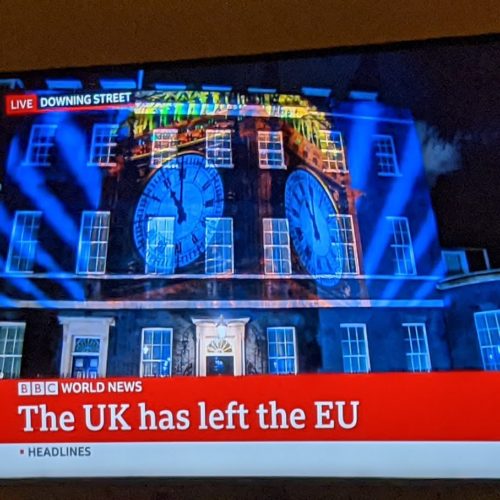
The United Kingdom has left the European Union (EU).  With emotional tears the deputies of the European Parliament sang Auld Lang Syne – a 1788 Scottish song with a traditional folk tune – and hugged each other.

Now the real work is starting.  The UK has only an 11-month transition period (starting Feb. 1) to negotiate the terms of Brexit.

The extent of the long, drawn-out discussions has been covered many times in the past four years (see my previous article in Letter from Paris dated 12/9/14;  3/2/164/6/1712/29/18;  4/12/19)

On both sides of the English Channel there is, at least for now, a feeling of relief that a decision has been reached.

An image of 10 Downing Street — the UK British Prime Minister’s official residence – taken from a BBC broadcast moments after the 11 p.m. deadline on Jan. 31, 2020 when the UK left the EU.

How did Boris Johnson win

The French have been very impressed by the dexterity with which Boris Johnson (BJ) was able out to turn around the majority in the House of Commons: the Tories won 364 seats, an increase of 48 seats while the Labour party took 262, representing a loss of 60.   “Salut l’Artiste” (congratulations to the artist), wrote Françoise Fressoz, Le Monde editorialist  on Jan. 8.  On a radio talk show, a commentator said that BJ has become a model for the French Right: a conservative with social projects. The French feel that BJ, because of his super majority, is going to negotiate from a position  of strength.

A brillant strategist, he put his focus on the less wealthy population of the North of England and the Midlands, who supported Brexit. He undercut the Labour party by proposing a number of social measures such as raising the minimum wage, encouraging apprenticeships, building 40 hospitals and schools, and investing in railroad tracks at the cost of 100s of billions pounds sterling.  How will these projects be carried out?  How they will be paid for?  Not a mention of that in his campaign.

The other part of his strategy was to put pressure on the EU.  It is not clear how he did this, possibly in making concessions.  In a populist fashion, he probably told the Europeans what they wanted to hear.  A French journalist-columnist for The Daily Telegraph said BJ bluffed his way through. His optimism is more appealing that May’s stubbornness.  The French like another trait of his: his culture.  On our TV screens here, we saw him recite The Iliad poem for two and a half hours in classical Greek.

With Brexit both sides will lose, but many feel the UK will lose more.  The UK exports 47 percent of its products to Europe whereas the EU exports only 20 percent.  Some have compared Donald Trump’s attitude toward the EU to Boris Johnson’s.  There is one big difference though: BJ is not trying to destroy Europe.

Immigration has been at the core of Brexit since the beginning.  In this area, there is an inner contradiction.  Although the UK was never part of the Schengen Area (which guarantees freedom of circulation of the people), it still took advantage of the accession of eight new states to the EU in 2004, and 2007, to welcome these new labor forces – particularly from Poland.  It is unknown at this point how this situation will be resolved under Brexit.

The transition period

What’s going to happen during the transition?  Concretely, very little except that the Union Jack will not fly any more at the entrance of the EU HQ.

In the immediate term, ferry boats will continue crossing The Channel and Eurostar will continue to carry passengers and goods.  There will be no custom duties, no tariffs, and no visas required.

However, some changes are going to be immediately painful for the UK. The 73 British deputies at the European Parliament packed their bags on Jan. 31.  The British Commissioners have been gone for a while.  This means that the UK will not participate in the decision-making process, while it will still have to contribute to the EU budget and abide by the decisions of the European Court of Justice.

Michel Barnier from France has been appointed again as chief negotiator.  This is good news for everybody because he is a consensus-making personality.  He will work with a group of deputies from the European Parliament in Strasbourg,  Barnier has always stressed that the EU is not out to punish the UK.  Its only objective is to protect the EU’s interests.  Barnier feels sorry for the British population that was misinformed prior to the 2016 referendum.

The task ahead

In the simplest of terms, it is Herculean.

The UK is party to more than 600 international agreements with around 100 other countries through its EU membership.  As it leaves the EU , the UK will be cut off from these agreements.  However, it can retain its place whenever the UK signed an agreement in its own right.  The undoing of all these agreements is called (delightfully) “detricotage” in French (tricoter is to knit.)

The country has already taken steps to secure continuity in its relationships with other countries.  Examples include a treaty maintaining the UK’s civil nuclear trade; bilateral aviation agreements with the US and Canada; citizens rights agreements with Norway, Iceland, and Switzerland; protection for Scotch and Irish Whiskey exports.

The Lancaster House Bilateral Treaty of 2010 between the UK and France is a good example. It was signed between then French President Sarkozy and then UK Prime Minister Cameron and concerns Defense and Security Cooperation. Nathalie Loiseau, former French minister for European Affairs is the president of  the Commission on Security and Defense of the European Parliament.

One of the greatest fears in Europe is the prospect of a “Singapore-on-Thames.”  This would mean a country disrespectful of social and environmental norms and regulations.  Fiscal dumping will not be tolerated, says Brussels.  “There will not be quotas nor tariff if the UK forgets about dumping” writes the newspaper La Croix.

The first issue to be tackled will be fishing.  The negotiators will sit down around the negotiating table as early as Feb. 3, 2020.  The French fishermen have for years been fishing in 60 percent of the time in British waters.  The problem is that the British fisherman need the huge Single Market of 500 million people to sell their catch … and they already complain about quotas, which are imposed in order to avoid the depletion of fish!

France is one of the closest commercial partners of the UK (its foreign trade with that country has a trade surplus  of 12 billion Euros), which mean that it is particularly exposed to the consequences of the Brexit.  The manufacturing sector, such as the automobile industry, is fully integrated with Europe and relies on spare parts coming from the continent.  Every day 1,100 trucks transport parts back and forth through the Channel.  Aeronautics is facing a huge logistics problems since Air Bus employs 13,500 people in Great Britain.

The pharmaceutical industry, such as Sanofi, prepared for the Brexit by accumulating huge quantities of drugs.  The Total energy company is relocating its treasury department from London to Paris.

The traders of BNP Paribas Paris – the largest European bank in the UK – will have to leave the City of London whenever dealing with European clients. HSBC – the largest bank in the EU – is relocating many of its units to Paris.  One thousand personnel have already moved. Bank of America is now located on Rue de la Boetie in Paris.  J.P. Morgan has also relocated here.

The complicated problem of the border  between Northern Ireland and the Republic of Ireland seems to have been defused.  One hears now that, in the long term, the two Irelands may be reunited.  The border would then go under the Irish Channel and the North Sea.  The idea of a “backstop,” which we heard so much about under Theresa May’s watch, seems to have vanished today.

In a recent debate, Pascal Lamy, Honorary Director of the Jacques Delors Institute (Delors was one of the founding fathers of the EU. He created the Single Market in 1993) made a few remarks about

Prognosis for the future

The more the UK diverges from the EU’s norms, the thicker the wall between them will grow.  The 27 members of the EU are extremely attached to the Single Market, the largest in the world.  It seems likely that BJ will in the end up aligned with Europe.  If BJ carries out his proposed social policy, the public deficit risks will be enormous.  Will there be “Boris Bonds” ?

Recently the populist governments in Denmark and Italy have collapsed.  Johnson’s electoral base is a mismatch between the less wealthy Brexiteers of the North and the rich ones from London. Nicola Sturgeon in Scotland and Arlene Foster in Northern Ireland will have an important role to play in whether there is going to be a break-up of the United Kingdom or not.  The UK will likely remain closer to the EU than the US.

On Dec. 13, 2019, some European leaders stated their position toward Brexit in carefully selected words:

Charles Michel, president of the European Council said, “We are ready.”

German Chancellor Angela Merkel noted, “This will be a challenge.”

French President Emanuel Macron stated: “We welcome a new partner who should be a fair competitor.”

And in a Jan. 30, 2020 interview on French radio, Her Majesty’s Ambassador to France, Baron Llewellyn of Steep, said in the most British of ways,”Let’s have a cup of tea and go to work!”

Editor’s Note: This is the opinion of Nicole Prévost Logan.

Nicole Prévost Logan

About the author: Nicole Prévost Logan divides her time between Essex and Paris, spending summers in the former and winters in the latter. She writes a regular column for us from her Paris home where her topics will include politics, economy, social unrest — mostly in France — but also in other European countries. She also covers a variety of art exhibits and the performing arts in Europe. Logan is the author of ‘Forever on the Road: A Franco-American Family’s Thirty Years in the Foreign Service,’ an autobiography of her life as the wife of an overseas diplomat, who lived in 10 foreign countries on three continents. Her experiences during her foreign service life included being in Lebanon when civil war erupted, excavating a medieval city in Moscow and spending a week under house arrest in Guinea.
Letter From Paris: Seeing “Red” at the Grand Palais

Nicole Prévost Logan

The year 1917 in Russia marked a unique moment of history when art and  revolution fused together into a mutual source of inspiration. The creativity and energy fed on each other for a short few years, to eventually vanish under the brutal repression and purges of Stalin to become an official and bland art form called “Socialist Realism.”

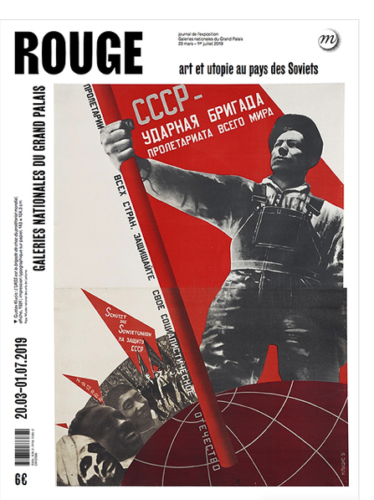
The exhibit “Red – Art and Utopia in the Soviet Country” at the Grand Palais, Paris, in the spring of 2019 is breaking new ground in describing that unique moment.

All forms of arts were impacted by the October Revolution, from the visual arts to architecture, theater, cinema, music and, of course, literature.  In addition to major artists, already well known before World War I, such as Malevich, the Bolchevik government did welcome all talented artists eager to experiment with new art forms.

Mayakovsky (1893-1930) was the voice of the Revolution – a giant with a booming voice, who galvanized the crowds when he read his poetry.  His emblematic play, the “Bedbug,” is a satire of the NEP (New Economic Policy.)  A young man of that period is frozen and found himself  in a perfect communist world 50 years later where there was no drunkenness nor swearing. 

He decided he was not made for the future.  As a journalist, Mayakovsky used  simple street  language.  A gifted artist, he drew satirical cartoons, making fun of the “petty bourgeoisie.” One of the main metro stations in central Moscow was named after him. He shot himself in 1930 at the age of 37.

Malevich (1878-1935), a major artist of the 20th century, was inspired until 1914, by Gauguin, Matisse and Cezanne, and then moved to abstraction and geometric forms until he reached his extreme “White on White” in 1918.  He was the theoretician of art par excellence. 

His book “From Cubism to Suprematism in Art …” is considered one of the most important reference works of the 20th century. Toward the end of his life he was  forced to reintroduce figurative characters into his paintings.  He never left the Soviet Union where he died of cancer in 1935.

Tatlin (1885-1953) was associated with the concept of “constructivism,” based on the use of materials, the exploitation of movement and tension in matter.  He aimed at the harmonization of artistic form with utilitarian goals.

Artists’ association multiplied at that time.  AKhRR  (Association of Russian Artists of Revolutionary Russia) was founded in 1922.  Vkhutemas (higher Institutes of art and technique) were created as early as 1920 all over the country.  Both Malevich and Tatlin occupied important positions in those institutions .

Vsevolod Mayerhold, (1874-1940) following in the footsteps of Stanislavsky (master of the stage in the 19th century – particularly Chekhov plays), revolutionized theatrical techniques, suppressed settings and replaced them by “constructivist” space, trained the actors according to a new system of “bio-mechanic” and how to form human pyramids. His stage production of Mayakovsky’s  “Bed Bug” is emblematic of the Soviet era.

Rodchenko  (1891-1956) was the leading innovator of the 1917 revolution-inspired  art.  He wanted to bring art down from its pedestal.  He stood against estheticism and “art for art” and made art the champion of productivity. He created a new artistic language by experimenting with photography, using photo-montage, double exposures, and unexpected angles. He gloried the machine in a factory or objects of daily life rather than still life motives in traditional art.

Among this group of brilliant artists were two women – Lioubov Popova, (1889-1924), who died of scarlet fever, and  Varvara Stepanova (1894-1958i), Rodchenko’s wife.

A poster by Gustav Klutsis.

Posters became a new art form used as the most important tool of propaganda. They were intended to make a strong and immediate impact on the viewer.  Using a graphic art medium with calligraphy and geometric designs, they carried a simple message.  The color red was used extensively  (it is interesting to note that, in Russian, “red” and “beautiful” are the same word.)

Oversize paintings like “Bolchevik” by Kustodiev are easy to understand.  A giant man walks through dwarfed  city landscape with churches, holding a huge red banner.  The messages of the October revolution were spread throughout the country in the “agit-prop trains”  to educate the masses.  Some figures are impressive: in 1917 the literacy of the population  was 25 percent whereas by 1939, it had risen to 81 percent.

Gustav Klutsis (1895-1935), born in Latvia, was also one of the best at using photo-montage and posters . He wrote: “Put color, slogan at the service of class war.”  Klutsis was arrested and shot in 1938.

Sergei Eisenstein  (1898-1948) – a pioneer of the cinema – created his own style characterized by melodramatic acting, close-up shots and theatrical editing.  A sequence of “Battlefield Potemkin” has become an absolute classic: during an attack by the Cossacks against Odessa civilians, a baby carriage falls all the way down the long steps.

Eisenstein ‘s mob scenes are so realistic (such as the storming of the Winter Palace in St Petersburg) that they are often mistaken for newsreels in documentaries.

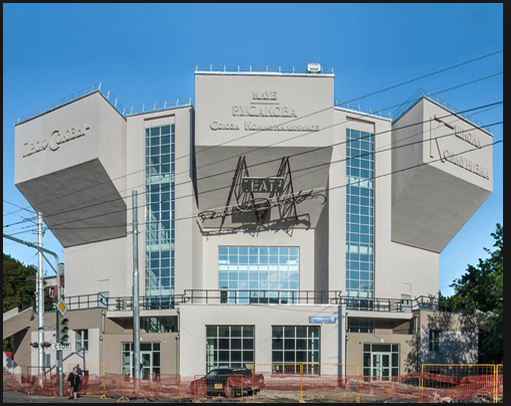
Architecture played a crucial role in bringing about utopia of the proletariat.  Plans for grand buildings, squares and majestic avenues are intended to impress the masses, who are more important than the individuals.  Still standing today is the workers’ club Roussatov designed by Melnikov.

Roussakov Workers’ Club designed by Melnikov, 1927-28.

After the death of Lenin in 1924, power became concentrated in the hands of Stalin, who tightened his control over artists.  In 1932  all artistic associations were suppressed — artists were forced to join the official Union.

The creative, innovative productions had to bend and conform to rules of the new doctrine of Socialist Realism formulated by Andrei Zhdanov in a speech to the Writer’s Union in 1934.  In art,  it can be defined as representation of the bright future of communism through the representation of idealized  workers in healthy bodies.

Therefore, at the 1937 Universal Fair held in Paris, a double statue of a vigorous factory worker and a strong woman kolkhoz farmer stood on top of the Soviet building.

Most representative of this period was Alexander Deïneka, who painted naked, young factory workers taking a break on the beach in the Donbass or Lenin riding in an open sports car through bucolic countryside with several blonde children.

Somehow out of place in 1937 is a delightful painting by Yuri Pimenov called, “The New Moscow.”  A young woman is driving a convertible car on one of the main thoroughfares of central Moscow.  The style is very much in the Impressionist style.

Already in the 1990s, the Tretiakov Gallery of Moscow held exhibits on the 1920s and 1930s Soviet art.  At that time, the Soviet posters were readily available in the book stores of the Arbat pedestrian street.  

Although a large part of the exhibited works included in the “Red” exhibit come from the permanent collection of the Centre Pompidou, Paris, it is interesting to note that in the 1979 Paris-Moscow exhibit organized by that same museum, Soviet art was barely mentioned.

Editor’s Note: This is the opinion of Nicole Prévost Logan.

Nicole Prévost Logan

About the author: Nicole Prévost Logan divides her time between Essex and Paris, spending summers in the former and winters in the latter. She writes a regular column for us from her Paris home where her topics will include politics, economy, social unrest — mostly in France — but also in other European countries. She also covers a variety of art exhibits and the performing arts in Europe. Logan is the author of ‘Forever on the Road: A Franco-American Family’s Thirty Years in the Foreign Service,’ an autobiography of her life as the wife of an overseas diplomat, who lived in 10 foreign countries on three continents. Her experiences during her foreign service life included being in Lebanon when civil war erupted, excavating a medieval city in Moscow and spending a week under house arrest in Guinea.