Letter From Paris: Anatomy of a Crisis — Retirement Reform in France

Nicole Prévost Logan

A crushing defeat for the French president, many angry people and a country convulsing into chaos. Let’s rewind the video back to early 2023. 

There was a feeling of déjà vu when observing the political and social turmoil going on in France. Once more the “Street” is in an uproar and the deputies in the Assemblée Nationale are fighting like cats and dogs. This time the cause was an attempt  by French President Emmanuel Macron to carry out retirement reform. The prospect of the legal age to retire being raised  from 62 to 64 provoked a storm. It was the cornerstone of Macron’s plan, but also the most controversial.

For an observer from abroad, this situation is almost incomprehensible. Why would the French refuse to retire at 64 when other countries are adapting to demographic changes such as a longer life expectancy and the aging of the population?  

Other French presidents, like Nicolas Sarkozy or Jacques Chirac, have also tried to reform the system but without success. Retirement reform occupied a central place in Macron’s electoral campaign at the outset of his first mandate in 2017. He had a vision of a system of répartitions (contributions), which would be largely complemented by capitalization. It means each individual receives a pension that comes from the capital accumulated in that person’s account.

Macron explained that the repartition system is not tenable financially.  Since this system is based on the principle of an active population paying for retirees,  it works well when the ratio of active population versus retirees is right. The aging of the population puts too much of a burden on the active population. In the 1960s, there were four actively-employed persons for one retiree. In the 1970s, the ratio was three to one. Today that ratio has fallen to 1.7 active persons per retiree. The system is doomed to run eventually into a wall, Macron believes.  
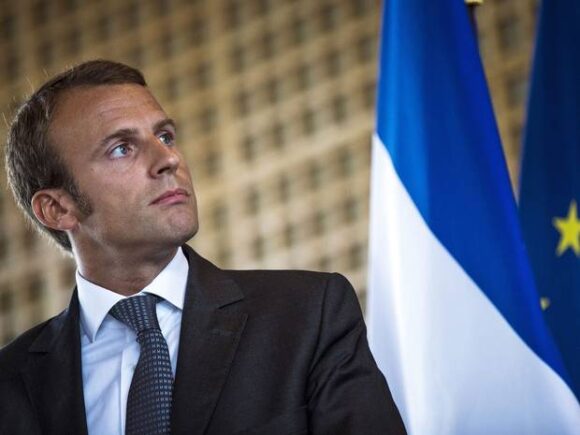
French President Emmanuel Macron.

The state has to make up for the difference since there is an imbalance between the amount of contributions and the pensions to be paid out. The retirement system in France is cumbersome and costly. It represents 14 percent of the Gross Domestic Product (GDP), which is the second highest in the European Union behind Italy. As a comparison the cost of the retirement in the US is only 7 percent of GDP.

For the French the idea of working two more years is unacceptable. Retirement reform has become an existential confrontation between the government and 65 percent of the population. It also seems ill-timed with the interruption of oil supplies from Russia causing an energy crisis, roaring inflation and an unprecedented drought. 

Retirement reform is, in fact, unattainable because the proposed changes are going much further than just retirement — they are also touching on many other issues such as labor laws, inequality between men and women, insufficient purchasing power for many people unable to make ends meet. 

It also reflects the new way people relate to work after the COVID pandemic. The reform is considered by the left-wing trade unions as unjust.  And on top of all that, add an utter dislike for Macron who has only a 36 percent approval rating at present. 

What are the main points of the reform? 

Eliminate the régimes spéciaux or  “niches” of long-established privileges of certain groups of people

There are 15 régimes spéciaux.  Among them, employees of utility companies like EDF (Electricity) and GDF (natural gas), Paris Opéra and Comédie Française employees,  RATP (Paris subway and bus system ) national police, clerks in notaries offices, members of the Assemblée Nationale and of the Senate, SNCF (railroad) workers, etc. The régimes spéciaux notch a 30 billion Euros deficit each year

Long careers creating a confusing situation

The  government made a number of concessions about the cases of someone who started work at age 19, or of an apprentice, who may have started at a very early age such as 14. It would have been much simpler and saved the government lots of headaches, not to quote a retirement age like 64 but rather set the requirement of 172 quarters (or trimesters), corresponding to 43 years, to qualify for a full pension. This was probably the worst error. They should not have set an age for retirement but just increased the number of years of contributions from 42 to 43. 

Minimum pension and “protection” of stay-at-home mothers

As a rule women make 1/3 less money and consequently, retirement income, compared with men. So an effort was made to add eight quarters of maternity leave and child-rearing leave to the calculation of quarters. The minimum pension will be 1,200 Euros with an additional 100 Euros. It is still pitifully low. With that amount, how can a retiree live? Many have to resort to eating in Restaurants du Coeur, the French version of soup kitchens.  

Raising the low ratio of seniors’ employment

In France, only 56 percent of 55 to 64 years-old or “seniors” are employed, versus 76 percent In Sweden for example. In Denmark, the retirement age is indexed to life expectancy. The number of seniors has doubled in the past 10 years. In that country, one retires when one wants. Danes find that part of their identity is linked to their work. 

The reform is supposed to take place gradually and will not be completed until 2035. There is a grandfather clause for people still employed.  

President Macron put Prime Minister Elizabeth Borne in charge of retirement reform. First she led three months of talks with the Trade Unions, followed by two weeks of debates in the Assemblée Nationale. Day after day the TV showed Borne on the floor of the legislative body, confronting rowdy members of the NUPES (alliance of left wing LFI or La France Insoumise, headed by Jean Luc Mélanchon, the Communist party, the Socialist party, the Europe Ecology party (the Greens or EELV) plus  a couple of smaller partners.)

One of the most vocal and disruptive NUPES deputy is François Ruffin, a school mate of Macron in Amiens. Marine Le Pen, now comfortably sitting at the head of 89 deputies in the National Assembly, is staying above the fray, watching the gesticulations of the deputies. Many commented that it was an appalling spectacle.

The NUPES advanced about 15,000 amendments out of a total of 20,000. It appeared that their objective was, in fact, the obstruction of the whole legislative process, in order to force the government to act by the 49-3 Executive Order. What happened was that, after two weeks, only two of the of the 20 articles of the proposed law had been debated. Article 7 — the most important since it concerned raising the legal retirement age from 62 to 64 — was not even addressed . 

The next stage was intended to be a debate at the Senate. Since the beginning of the Fifth Republic, the 348 member-strong Senate is dominated by right wing parties . They are the Renaissance (the new name of LREM La Republique en Marche ), Les Republicains, and the Union Centriste . It was no surprise that the debates were calmer and even continued during weekends.  

To make sure that the work was completed by the deadline, another article inscribed in the Constitution — 44-3 — helped speed up the debates of the proposed retirement reform. 

While the parliamentary proceedings were going on, the popular anger grew. Seven days of vigorous protest brought out more than one million demonstrators in small and large towns daily. In the crowd, one could see a few young people. Hard to believe that 14-year olds would already be worrying about their retirement benefits set to materialize 50 years down the road.

But marching in the street is not sufficient to get results.

Other tools were used by the unions to exert power such as strikes of public transport (the worse one for the public was on Christmas Eve); targeted power outages (Gerard Larcher, president of the Senate, had his own electricity cut off) for four hours in early March; blockage of refineries; and closing the methane terminals where liquefied natural gas arrives in France. 

The shut-down of the waste incinerators serving the Paris region, and the strike of garbage collectors turned the capital into a disgusting  (and smelly) mess of more than 10,000 tonnes of garbage littering sidewalks and streets. Anne Hidalgo, the Socialist mayor, refused to interfere and help with the waste removal.

Some other countries look at France with envy for being able to fight for the preservation of what they deem essential to their quality of life and to which they are incredibly attached. 

The retirement reform proposal is far from perfect but the French government can hardly afford the luxury of doing nothing. To express an opinion on this most important issue of Macron’s mandate, one should first place it in its societal context.  

The government has been trying to help the population: dozens of small checks have been given to the most vulnerable groups of the population. Students can eat a decent meal for only one euro. Financial assistance is provided for people, who have to use their car to go to work, or can ‘t afford to keep warm in the winter. The cost of electricity is capped so that the boulangers  can continue baking their famous baguettes . These dozens of small checks have added to 43 billion Euros to the national debt. The inflation has been kept in check at 6.5 percent, which is the lowest in Europe. These measures deserve acknowledgement .

One might say that inflation has nothing to do with retirement reform, but it does. The popular anti-Macron surge is greatly due to the fact other economic problems are bundled up with the general resentment caused by retirement reform.

Macron’s government has been criticized for lacking a pedagogical sense in promoting the reform. It is widely accepted that the proposal is utterly confusing. Even a professor at Sciences Po and a researcher at CNRS (Centre National de la Recherche Scientifique) made that comment about several  of the provisions of the reform. 

The French find the president aloof and distant. 

On Jan. 18, at a time when the reform was the absolute top priority in everybody’s mind, the president decided to take 11 key ministers on an official visit to Spain. Anti-retirement public opinion turned sour. 

In mid March, the president attended environmental conferences in four countries of central Africa. It provoked the same outrage among the population.

Trade unions wanted to meet with the president. This was refused by the Elysées palace. Macron had delegated his authority to the Prime Minister in this matter. This is typical of France — the French keep criticizing Macron but they will not talk to anybody but him

On March 15 , the Senate passed the reform project. The text then went to a commission paritaire of seven deputies and seven senators for approval. 

On the eve of the final and crucial vote scheduled to take place in the Assemblée Nationale on March 16, Prime Minister Borne sounded very confident that the reform would pass with a majority vote. The suspense was still intense though. 

But on March 17, there was a coup de théatre — the government did not have a majority. Several deputies and a handful of “frondeurs” from the Right and the Center voted against the reform. In a deafening noise, Borne had to announce that the government reluctantly had to use Article 49-3.

The reaction was immediate: riots, violence, and destruction of shops, bus stops and more were contained with difficulty by the police. Multiple arrests were made. The Place de la Concorde and the Champs Elysées are now cordoned off by the police..  

This is just the beginning. The future looks bleak. The expected votes of confidence may not succeed, but the task of the Macron’s government going forward seems enormous.

Editor’s Note: This is the opinion of Nicole Prévost Logan.

Nicole Prévost Logan

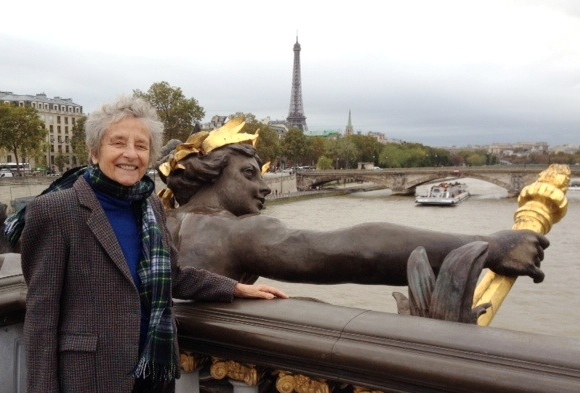
About the author: Nicole Prévost Logan divides her time between Essex and Paris, spending summers in the former and winters in the latter. She writes an occasional column for us from her Paris home where her topics will include politics, economy, social unrest — mostly in France — but also in other European countries. She also covers a variety of art exhibits and the performing arts in Europe. Logan is the author of ‘Forever on the Road: A Franco-American Family’s Thirty Years in the Foreign Service,’ an autobiography of her life as the wife of an overseas diplomat, who lived in 10 foreign countries on three continents. Her experiences during her foreign service life included being in Lebanon when civil war erupted, excavating a medieval city in Moscow and spending a week under house arrest in Guinea.


Letter From Paris: From Macron v1 to Macron v2: France Negotiates Turbulent Times 

Editor’s Note: We are delighted to welcome back Nicole Prévost Logan (no relation.) Today she offers a detailed analysis of happenings in the French political landscape, saying, “A lot has happened in France in the past two months and I felt important to write about what is not making the headlines.”

Nicole Prévost Logan

Surreal political developments are taking taken place in France. 

Barely had President Emmanuel Macron been reelected on April 24 with 58.5 percent of the votes on the second round of the majority ballot that a vote of no confidence against the newly appointed prime minister Elizabeth Borne was already announced as well as a possible dissolution of the Assemblée Nationale (National Assembly).

Three ministers which had been appointed in the new Cabinet just six weeks earlier had to step down losing their seats in the legislative elections.  Two strong supporters of Macron – Richard Ferrand, President of the National Assembly and Christophe Castaner, the former president of the majority party – had to resign.

What had seemed like a victory for Emmanuel Macron, when he was reelected for a second five-year mandate turned into a cold shower brought on by the outcome of the Legislative elections.  The far left party was quick to describe it as a déroute (total collapse.) 

French President Emmanuel Macron.

Presidential elections had been held on April 10 and 24. The legislative elections on June 12 and 19 changed the aspect of the National Assembly, (incidentally, note the remarkable number of 577 ‘deputés‘ in France as compared to only 435 in the House of Representatives). The number of seats of Macrons’ party, La République en Marche or LREM, was  reduced from 346 to  to 246. It has now only a “relative majority” and is short 44 seats to reach the absolute majority of 289. 

For five years the Presidential party was in control, but now it has to share its power with the opposition. Making compromises is not in the DNA of French politics. This is an unprecedented situation when the government needs to supplement its relative majority.  Quite a difference from a country like Germany where Olaf Shultz was able to strike an alliance with four parties. 

The new Assemblée Nationale is now basically made up of three competing blocks:  LREM, NUPES (New Union Political Economic and Social)  and the Rassemblement National or RN. 

Jean Luc Mélanchon, head of the far left party La France Insoumise, or LFI, led an active campaign  between April and June to create an anti Macron coalition.

It bore fruit.

He was able to pull together the forces of the Socialists, the Europe Ecologie les Verts or EELV, the Communist Party and his own radical LFI together under the name of NUPES for a total of 131 deputés. It is not a party but a fragile coalition, which could fall apart at any time. Its main objective is to block Macron’s action . 

Marine LePen. 1922 photo published under Creative Commons Public Domain Mark 1.0.

The most striking change in the parliament was the spectacular surge of the RN, from seven seats in the previous Assembly to 89 today. Even the RN leader Marine Le Pen was stunned. She had expected 60 seats at most.

After her disastrous performance in the debate against Macron in the 2017 presidential elections, Le Pen had kept a low profile in the recent electoral campaigns.

And it paid off.

She has also been helped by the collapse of the far right camp of Erik Zemmour, who was left with only 7 percent of the vote in the Presidential elections. 

In the past Le Pens’ electoral base was limited to small areas in the north of France and in the south east. Now she has supporters in the entire country. The RN is progressively changing from being a pariah to becoming “acceptable,” … but one should always be cautious with Le Pen and not overlook the fact that she was in Moscow, cozying up to Putin and seeking his help in obtaining a loan. 

When she suggested her aim was to emulate the politics of Viktor Orban as a model, it is a clear red flag that, under a liberal veneer, she is still a true populist. 

On July 4, Macron introduced his definitive and reshuffled cabinet. Overall it included a number of unknown faces, with several technocrats, specialized in their field. 

For example Braun, a doctor-ER specialist was nominated to tackle the huge problem of health, public hospitals, access to medical treatment which has disappeared in many regions away from the urban centers.

Another specialist is Olivier Klein, mayor of Clichy-sous-Bois, a popular neighborhood, former socialist, to handle housing and urban issues.

Pap Ndiaye is the new Education minister. A historian, born in France, of African descent, he is highly educated and a graduate of the University of Virginia. He is the symbol of diversity and the egalité des chances (equal opportunities).  He is being criticized by some for entering his children in the elite- and expensive-Ecole Alsacienne private school on the Left Bank (full transparency — four of my grand children attended that school.) 

The Borne 2 Cabinet has a total of 42 members, including 16 ministers, 15 ministres delegués and 10 secretaires d’Etat.  Three heavyweight ministers retained their positions:  Bruno Lemaire, with an expanded Ministry of Economy and Finances,  Gerald Darmanin, Minister of the Interior and Eric Dupond -Moretti, as minister of Justice.  Moretti is a heavy set, often regarded as a bully, but a brilliant, though controversial, criminal defense lawyer.

The “feminization” process is showing mixed progress : there are only five women ministers versus 11 men. Nine of the 10 of the Secretaires d’Etat (Secretaries of State) are women. Therefore it still looks like that women occupy lower positions than men.

However, one should point out that some women are now holding key posts:  Elizabeth Borne as Prime Minister, Yaël Braun-Pivet as President of the National Assembly,  Aurore Bergé, as president of the LREM.

Foreign Affairs and European Affairs are now the domain of Catherine Colonna, a career diploma and a former ambassador to the UK . This was a surprising move because the post had been held for many years by Jean-Yves Le Drian, an old-timer, who had served in the government since the Francois Holland government. 

The ongoing problems with sexual harassment had some impact with the appointment of ministers. Heavily-handicapped Damien Abad, minister of Solidarity, was denounced by four women for rape, attempted rape, and sexual assault and had to resign probably under the influence of the new Prime Minister. Sexual scandals could not be tolerated any longer, said Borne, and the principle of “exemplarity” would be applied.

This raised the question whether Eric Cockerel , LFI, the newly appointed head to the key post of the Assembly Finances Committee, might be brought under investigation on the accusation by a former Gilet Jaune (yellow jacket) militant, for improper sexual behavior. A complaint by a woman for improper sexual behavior is still outstanding. The far left NUPE so far has paid not attention to that complaint. Incidentally, Cockerel ‘s unlikely profession is as an organizer of the famous Vendée Globe, the only round-the-world solo sailing race. 

But the prime minister may not tolerate that double standard for long. 

The #Metoo movement is still going strong here.

Macron was criticized (as usual) for being too slow in creating his Cabinet, for dragging his feet. Public opinion resented the fact that the French president seemed to be always addressing the population between two doors, on his way abroad, or from the tarmac of an airport. 

It is true that Macron has been busy with international affairs particularly during the six months as president of the Council of the EU From January to June 2022 .  

The 27 EU members take turns leading this body on a rotating basis every six months. (Note: the Council of the EU is not to be confused with the European Council where EU leaders meet quarterly to discuss broad policy matters. At the writing of this article the Czech Republic is heading the Council of the EU.

On July 2, a superb documentary — produced by France 2, one of the main French public TV channels — was released. It is titled “Macron,  l’Europe et la Guerre.”

The film showed how intense the French president ‘s involvement has been in the crisis created by the war in Ukraine.   Conversations with Putin were listened to, recorded and analyzed at the Elysées Palace and the Quai d’Orsay round the clock. 

The documentary does not consist of staged interviews but rather gives the viewer the opportunity to share the spontaneous reactions of the government’s inner circle. This is diplomacy in action. 

Using the familiar “tu” of the French language, one witnesses a sometime intimate exchange with Putin, who at one point tells Macron he has to leave to go to an ice hockey match. 

Macron is in Moscow on Feb. 7. the situation was more incendiary than in 2008 or 2014. 

On Feb. 8, Macron is in Kiev and spends three hours with Zelensky in the Maryinsky Palace. 

Six days before the onset of the Russian invasion, Putin declared, “The war games have come to an end.”T

Three days before Feb.  24, Putin announces the independence of Donetsk and Lujhansk. 

On Feb. 22, Macron is instrumental in setting European sanctions against Russia. Macron states, “We are here to help Ukraine not to topple the Russian government.

On June 23, France strongly supports giving Ukraine the official status of candidate to membership in the EU. An incredible nine-hour train ride through a country at war, brings Macron, German Chancellor Olaf Sholz and Mario Dragui to Kiev.

The film shows that, no matter how futile it may have appeared, it was an extraordinary effort on the part of the French president to maintain the dialogue open with a Russian leader unwavering in his objective of total destruction of a country.  

Is France ungovernable ?  

Will politics be a wrestling match between the Executive and the Legislative Chambers from now on?

Macron will have to be a real “artist” if he wants to be able to  make compromises with an unbending opposition. The problem is that the president, having been elected by universal suffrage, is still perceived as acting as “Jupiter”.

At the beginning of his second mandate he excluded both the extreme partiers RN and NUPEs from a possible coalition.  Les Republicains, (center right) or LR refused to act as the” spare tire” of the government.  The NUPEs threatened to introduce  a vote of no confidence even before the government unveiled its program.  In other words, if the system is to function as a parliamentary democracy, the lack of an absolute majority will force both sides to abandon the posturing game.

The power center of gravity has moved: public opinion is now the arbiter.  

What tools does the government has to govern without the support of the Assembly ? In fact it has more power than appears at first sight :The main tool is the article 49-3, equivalent of Executive Orders in the US.

In 1988, under Francois Mitterand, the Prime Minister Michel Rocard used it 28 times during the first three years,  then  39 times during the following five years under the second mandate. 

Today the rules have changed: only one 49-3 is allowed  during a parliament’s session.

Two other tools exist: it is not easy to dissolve the Assembly since 2/3 , or 289 of the votes are needed.  Besides, Article 47 stipulates that in the event  the budget is not voted upon within 70 days , the government may act by Executive Order.

The government faces a daunting task.

The priority is to manage the pouvoir d’achat  or purchasing power, in order to cope with the rising cost of living including energy and food essentials makes it is urgent to help the poorest households, which cannot make ends meet. 

A Green deputy violently attacked Macron, saying that he does not understand anything about environment. He even wants to dig into the deepest depth of the ocean, she said. But Macron understands the urgency of the environment problems very well, also but he has to set priorities.

Whenever people get hungry the situation becomes explosive. Threatening famine was the main cause of the “Arab Spring” in the early 2010s. 

Bruno Lemaire comments about the dire economic situation of France. Inflation is now 5.8%, a little less than in other European countries because France has dis-industrialized and increased its services sector. The interest on the public debt used to be negative, but now it is 2% and growing. This interest will this year will be 55 billion Euros, an increase of 45% or 66% in two years. 

The debt has reached 120% of the GDP.

The BCE  (Central Bank of Europe) is drying up its buying of sovereign debts of the EU member states. This is the end of quoiqu’il en coûte (no matter the cost ), which became necessary with COVID. 

The RN proposes to lower the TVA (value added tax)  from 20% to 5% , to raise the minimum wage to 1,500 euros per month  These proposals are totally unrealistic and would drive France’s economy into the wall very quickly.

While Russia has made 60 billion Euros selling its gas and oil, it cost Europe a great deal to declare embargo on energy from Russia since it has to buy it – at a higher cost from other countries. 

At the G7 meeting in Bavaria, in late June, Macron condemned the profiteurs de Guerre (war profiteers) who make millions. He pointed out Total, which increased its profits by 48% this year, or CMA CGM, the third largest container shipping company (headquarters in Marseille and in Norfolk Virginia ) made 56 billion Euros in profits in 2021. 

EDF, the electricity and gas supply giant and the big companies of the CAC 40 also made huge profits. 

In the UK, the government imposed a 25% windfall tax on oil and gas producers to support the poorest households. 

Will France do the same?

It is in this climate of mounting economic and social problems that Elizabeth Borne, the new Prime Minister, made her general policy speech at the Assemblée Nationale on July 6. It was an impressive performance and was received with flying colors by most. Not phased by a loud and sometime rowdy Chamber, she was firm and showed her authority.  Without discussing specifics of the government’s program, she set the tone and method of her future actions.  

She had already held conversations with all political groups and intends to continue in the Fall. She made it clear that substantive decisions will be made in a consensual manner, that the government will show a back bone but at the same time reach out for compromises. 

What a contrast with what happened to Edith Cresson in 1991-1992 – the only other woman Prime Minister in France!   For 11 months, she was the non-stop target of sexism in the Assembly, the street and the media.The Guignols puppet show satirizing French politics made fun of her day after day. 

Borne, a civil engineer by profession, is the product of the elite school Polytechnique,  has held several ministerial posts, and showed her talent of tough negotiator during the months of talks with the powerful Cheminots or railroad workers of the SNCF  (Société Nationale des Chemins de Fer Français). She was able to combine her no-nonsense attitude with a personal tone, saying, “I owe a lot to the Republic, she said, since I am a pupille de la Nation (a ward of the State). Her father, a Polish Jew and a survivor from Auschwitz, committed suicide when she was 11.    

Borne knows her stuff. She touched on important topics: security, police, agriculture, vulnerable women — particularly if single parents,  in need of health care, etc.  Her remark about the French would have to work “a bit more” provoked loud protests by a good chunk of the deputés.

Disorder is not an option, she said. 

She made an important announcement: the government intends to nationalize EDF, which manages the nuclear plants and is heavily in debt. Currently the State owns 85% of the shares. One percent is held by the staff and 14% by individuals and institutions.  

This will give more room to the government to maneuver. The objective of the Macron government is a reduction in nuclear power by 50% by 2035 and a carbon-free country by 2050.  

In 1960, under General de Gaulle, France became the fourth most important nuclear power in the world. France’s nuclear power underwent a surge during the 1973 OPEC oil crisis. 

Today there are 56 plants in France with an average age of 37 years. Half the plants are closed due to routine maintenance or defects. By 2020 France had 70% of the power plants in Europe, Slovakia had 53%, Ukraine 51% and Hungary 48%.

There have been problems with the construction of the fourth generation EPR (water-pressurized plant) of Flamanville.  Macron wants France is to become a leader in low-carbon-energy using small modular reactors and green hydrogen. 

The largest and most advanced experimental project on nuclear fusion or ITER is under construction in the south east of France managed by a collaboration of 35 European countries.

The transition between the first and the second mandate of Macron will not be easy . “Do not expect things to go smoothly,” commented Borne.    

One must trust the ability of Macron to adjust. Between a president, who is on a permanent crusade to promote a stronger EU and a pragmatic prime minister to work on the home front, one is entitled to be optimistic. 

Editor’s Note: This is the opinion of Nicole Prévost Logan.

Nicole Prévost Logan

About the author: Nicole Prévost Logan divides her time between Essex and Paris, spending summers in the former and winters in the latter. She writes an occasional column for us from her Paris home where her topics will include politics, economy, social unrest — mostly in France — but also in other European countries. She also covers a variety of art exhibits and the performing arts in Europe. Logan is the author of ‘Forever on the Road: A Franco-American Family’s Thirty Years in the Foreign Service,’ an autobiography of her life as the wife of an overseas diplomat, who lived in 10 foreign countries on three continents. Her experiences during her foreign service life included being in Lebanon when civil war erupted, excavating a medieval city in Moscow and spending a week under house arrest in Guinea.

Letter From Paris: Antony Blinken Has Major Advantage Being Bilingual at Helm of US Foreign Policy  

Nicole Prévost Logan

Never before has a US Secretary of State been as utterly bilingual as Antony Blinken. 

Granted, two of the Founding Fathers of America also had special relationships with France. But Benjamin Franklin was 70 when he was appointed ambassador to Paris in 1776. For nine years, he resided in Passy and became a real Parisian.

Thomas Jefferson was 41 when he planted his roots in Paris for five years in 1784. Antony Blinken’s case was quite different since he arrived in Paris at the age of nine and remained there during his formative years before entering Harvard University.

US Secretary of State Antony Blinken. Official State Department photo. Public Domain.

As a rule, most US Secretaries of State have enough knowledge of the French language to be able to read it or give a speech while remaining close to their prepared notes.

None of them have sounded as much at ease with the language of Molière as Blinken does. It is an enormous asset to be able to use that tool of diplomacy par excellence.

“Wow!” That was the reaction of my French-speaking daughter when she heard, for the first time, Blinken speak French. She was impressed by his impeccable, fluent use of that language with only a barely detectable trace of a foreign accent.

The quality of his spoken French and almost academic style could put many French people to shame

Being bilingual is not limited to linguistics — it also means to be bi-cultural, to have a mind shaped by the historical heritage of the other’s country, to have a thorough understanding of how the people of that country react, reason, and feel about the world.

Understanding and making jokes in the second country is the ultimate test.

In 1971, Blinken moved to the elegant Avenue Hoche in the 8th arrondissement with his mother and stepfather, an international lawyer and attended the Ecole Active Bilingue Jeanine Manuel (EABJM) located at that time near the Parc Monceau in the 17th arrondissement.

Who else knew the American student Blinken better than Jacqueline Roubinet, who was associated for 31 years with EABJM and became its headmistress? I was able to reach her through my children’s acquaintances. She was kind enough to answer my many questions in a long letter.   

She is quite passionate about the school, admired both its founder’s intelligence and her vision that the key to better international understanding was bilingualism. Jeanine Manuel was a member of the Resistance who joined the Free French living in London in 1940. When she opened the school in 1954, it had nine students. Today the school under its new name — Ecole Jeanine Manuel (EJM) — has 3,000 students from 80 countries.

Roubinet draws a sympathique (as we say in French) portrait of young Blinken, as a student, describing him as, “facetious, quickly integrated in his new environment, with many friends, gifted and modest at the same time.”

During his senior year – or terminale – he followed the curriculum in economics of the “serie B.” In 1980, he passed the French Baccalaureate. By then, the school had moved its campus to the Rue du Theatre in the 15th arrondissement. 

Blinken was quite popular in the school, Madame Roubinet recalled, and enjoyed extra curricular activities.

With a few friends, including lawyer Robert Malley, who is today part of Joe Biden’s foreign affairs team, he created the first Yearbook for the school. They gave an American format to this purely Anglo-Saxon tradition and jazzed it up with humor à la française. 

As a co-editor, he was responsible for the photographs, the interviews, and even the financing of the publication. While speaking at a conference held in EJM’s packed amphitheater on Nov. 5, 2015, he remarked, “Jeanine Manuel taught us to think like the other person, see things through the other’s eyes, and to respect differences.”  

He liked films, sports, but music most of all. One of the anecdotes told in the weekly l’Express  about Blinken as an adolescent  was that he was a fan of Pink Floyd and enjoyed singing ” We don’t need no education / Hey teachers, leave the kids alone.”

Today most of the children of the 10,000 odd American citizens  – diplomats, members of international organizations or of the business world – who live in Paris, attend one of the many bilingual or multilingual schools implanted in the French capital.  They follow in the footsteps of EJM – the pioneer .

On Oct. 4-6 of this year, the US Secretary of State was on an official visit to France to chair the ministerial meeting of the Organization for Economic Cooperation and Development (OECD).  At the end of the month he was in Rome, accompanying US President Joe Biden to the G20 meeting in Rome prior to the opening of the COP26 in Glasgow.

Constantly in the public eye, Blinken’s face has become familiar to the general public of France .

The appointment at the head of US State Department of such a francophile and francophone personality to lead American foreign policy is particularly important today and will be even more after January 1, 2022, when France takes over the rotating presidency of Europe by heading the Council of Europe for six months.

It will be a crucial time for France, especially after the departure of Angela Merkel following the Sept. 26 elections. French President Emmanuel Macron is the champion of a strong Europe on the world scene and wants to reinforce the cohesion between himself and France’s own Secretary of States to help the US and Europe to work together on multiple geopolitical, economic and environmental issues around the globe.  

On Feb. 6, 2021, Blinken made his first official appearance as the new Secretary of State at the State Department.  President Joe Biden took this opportunity to praise the Foreign Service Officers (FSOs) and their families for  being “the face of America abroad, to be trusted and empowered. ”

On a personal note, those words filled me with emotion since they echoed my own  life. I could say that, as a bilingual person myself and having spent my whole life in the world of diplomacy, I could doubly relate to Blinken.

Gerard Araud, French Ambassador to the US  from 2014 to 2019, applauded Blinken’s nomination as Secretary of State,  saying that American diplomacy was now headed by a friend of France.

Editor’s Note: This is the opinion of Nicole Prévost Logan.

Nicole Prévost Logan

About the author: Nicole Prévost Logan divides her time between Essex and Paris, spending summers in the former and winters in the latter. She writes a regular column for us from her Paris home where her topics will include politics, economy, social unrest — mostly in France — but also in other European countries. She also covers a variety of art exhibits and the performing arts in Europe. Logan is the author of ‘Forever on the Road: A Franco-American Family’s Thirty Years in the Foreign Service,’ an autobiography of her life as the wife of an overseas diplomat, who lived in 10 foreign countries on three continents. Her experiences during her foreign service life included being in Lebanon when civil war erupted, excavating a medieval city in Moscow and spending a week under house arrest in Guinea.
Letter From Paris: Restoration of Notre Dame Cathedral Symbolizes Hope for Both France, the World

Nicole Prévost Logan

April 15, 2021 was the second anniversary of the fire, which ravaged Notre Dame cathedral in Paris, and also the day when France reached 100,000 deaths from COVID-19. President Emmanuel Macron of France stressed that the reconstruction of the cathedral will be the symbol his country’s rebound from the pandemic.

Before giving the latest update of the most recent restoration process, here is a recap of what has been achieved over the past two years. The scope of the work is enormous.

For a long time, whenever I used to walk around the church prior to the 2019 fire, I had noticed that there was always scaffolding somewhere on  the church. It was a reminder for visitors that the cathedral was very old and fragile.

Throughout the centuries, it had suffered many fires and disasters. But the 2019 fire was the most catastrophic of all. It was a miracle that the cathedral survived that last tragedy.

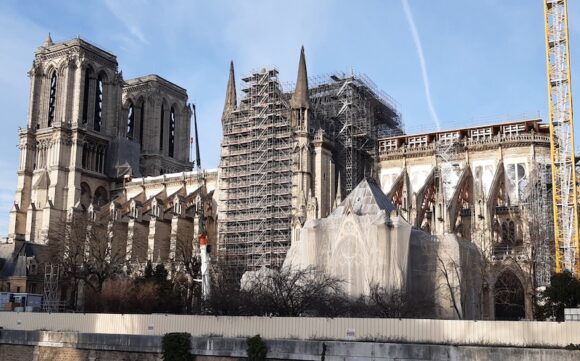
After the fire, with hardly a square inch of the stone building still visible under so much scaffolding, wooden frames, plastic wrapping, tarp covers, and other protective contraptions, it was almost no longer recognizable. It ended up looking like a sick old bird.

View of the cathedral showing some of the extensive scaffolding. Photo by Nicole Prévost Logan.

The gables and pinnacles at the end of the north and south transepts were in danger of toppling over with the force of the wind. Workers, dangling in the air like alpinists were doing their perilous job of wrapping the carved stones. Hovering over the cathedral cranes and other heavy machinery made the church look as if it was under perfusion.

The stained-glass windows were taken down and replaced by what looked like giant French doors. The collapse of the 19th century spire over the nave had left an enormous gaping hole at the crossing of the transept. Water – regardless of whether it is rain or the power spray used by firefighters – can cause lots of damage. It penetrates the stones, destroying the mortar between them .

The fire obliterated the roof. The lead dripped, spread and left a thick layer of toxic dust everywhere. For months, no one could go inside the cathedral because of the danger from the lead dust and also from the debris falling from the broken vault. A lonely robot, directed by remote control, was able to clear up the charred remains.

The organ and the three rose windows were thankfully preserved, but they will, however, require  lengthy restoration. The 7,800 pipes of the largest organ in the word have been pulled apart and so have been all the stained-glass pieces.

The stunning South Rose window in the cathedral. Photo by Nicole Prévost Logan.

It is particularly comforting to know that the Rose Window at the south end of the transept is intact. Given the light of the sun throughout the day, it is the Rose Window, which gives the cathedral its beautiful warm glow. Notre Dame would not be the same without the scenes of the triumphant Christ depicted through that magnificent window. In 1250, Louis IX, or Saint Louis, donated it after the end of the second crusade.

The April 15, 2019 fire left the cathedral in danger of collapse — in fact, it was a touch-and-go situation. The most urgent step was to consolidate the structure

A gothic cathedral is like a house of cards:- if one side weakens, the whole thing collapses. Because of its daring height and the fact that the outside walls are weakened by several tiers of windows, the structure is fragile.

The medieval master carpenters were real geniuses when they designed the 28 flying buttresses to reinforce the strength of the walls. An arch or beam extends from the walls of the church to a pier against the lateral forces arising from the roof and pushes the walls outwards.

Ken Follett in his 2002 book, The Pillars of the Earth, wrote a gripping story of the 12th century monks attempting to do something never done before, failing many times and starting all over again.

The earliest buttresses of Notre Dame date from the 12th century. They are massive and fairly close to the main structure. Later, during the flamboyant gothic period in the 14th century, the spans of the flying buttresses are longer and more decorated.

The first phase of the restoration — preservation and protection — lasted 15 months. President Macron appointed General Jean Louis Georgelin, former chief of staff under President Sarkozy, to supervise the work.

This photo shows the cathedral’s 14th  century flying buttresses prior to the fire. File used under the Creative Commons Attribution-Share Alike 3.0 Unported license.

The 28 damaged buttresses were reinforced by fitting custom-made wooden “centering frames” under each one of them. Each one of the buttresses had different dimensions, hence the fitting required utmost precision.

Then started the most difficult and dangerous operation: dismantling the scaffolding, which had been erected in May 2018 to repair the crumbling spire created by 19th century architect Eugene Viollet-le-Duc.

That scaffolding had melted, creating an ugly- and mean-looking black mass of 40,000 metal pieces glued together. Rope access workers (called cordists in French) had to pick the pieces by hand one by one, hanging from ropes high in the air. Sensors were placed under that unstable mass.

At one point the alarm sounded. Everybody fled. To disentangle that mass was like playing a giant pick-up sticks game, which involves removing sticks without disturbing the rest of the pile.

Twice the restoration work on the cathedral was interrupted: first when the scare caused by the lead contamination forced all activities to stop. Workers had to wear white haz-mat suits with masks connected to supplies of filtered air. They looked as clumsy as moon walkers.

Subsequently, the lock-down caused by the Coronavirus pandemic in March 2020 shut down operations for three months.

Five days before the fire, as a result of a near-miracle, the 10 ft. tall copper statues of the apostles and evangelists, climbing up the bases of the spire were air-lifted for restoration. Parisians enjoyed watching the ballet in the sky.

The statues are being restored in two workshops located near Perigueux. It takes four month to restore one statue. Pending the completion of the cathedral, all these art works will be exhibited  at the museum of architecture on Place du Trocadero.

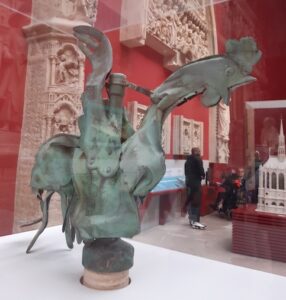
This rooster was on top of the spire. It is now exhibited in the Museum of Archaeology. Photo by Nicole Prévost Logan.

The rooster, pictured left, which used to sit at the top of the spire, will remain in the museum.  A replica will replace it.

Late in June 2020, chief architect Philippe Villeneuve climbed on an inspection tour of the cathedral. He was able to access the top of the vaults, which by then had been cleared of most of the debris.

Villeneuve was pleased to see that the limestone of the vault had resisted the damage caused by the fire itself as well as the water to extinguish the fire. For him, it was a milestone and he declared that the structure was now safe.

The first phase of conservation was over and one could look forward to the restoration to be launched at a later date.

In July 2020 came the decision everybody was waiting for. After months of deliberation and heated discussions between architects, historians and restoration professionals across the globe about how the future Notre Dame would look, a consensus was reached.

Based on a 300-page paper presented by Villeneuve and with the support of the public opinion, it was decided that the cathedral would be returned to its original appearance:- a spire identical to 1859 Viollet-le-Duc’s creation; a lead roof; and a wooden framework to support the roof.

A large part of the restoration work will be carried out using the methods of 13th century builders. Fortunately this type of savoir faire is kept alive in France thanks to a guild of crafted artisans, who are trained as Compagnons du Devoir.

All restoration will be done respecting the safeguards established by ICOMOS (the International Council for Monuments and Sites) founded by the Venice Charter of 1964 to protect historic monuments.

In 1991, UNESCO placed Notre Dame and the banks of the Seine within the area considered as part of the world heritage.

Within 24 hours of the fire, pledges to pay for the restoration poured in and reached close to one billion Euros. The two richest men in France raced to be the highest bidder. François Pinault pledged 100 million and refused to accept tax deductions. Bernard Arnault beat him with a sum of 200 million.

Arnault is the head of the LVMH (Louis Vuitton Moët Hennessy) luxury goods and champagne empire. The readers of this area might be interested to know that Antoine, one of the Arnault’s five children, is building a “cottage” in the Fenwick peninsula in Old Saybrook. He is married to Russian super-model Tatyana.

The Cathedral of Notre Dame de Paris prior to the fire. This file is licensed under the Creative Commons Attribution-Share Alike 2.0 Generic license.

At the two year mark since the fire, it is fitting to give the most recent update on the restoration process of Notre Dame. The task concerns the strengthening of the cathedral’s vault and the preparation of the future wooden framework, which will support the roof.

The scope of this phase to secure the building should be completed by next summer. It is just gigantic.

Most of the cathedral’s interior is now encased in metal scaffolding. An umbrella-like tarp has been installed above the gaping hole, where the spire once stood, for protection against the rain.

The vaults connecting the crossing of the transept were covered with platforms to enable rope-access workers to complete their job of removing the last fallen debris. This operation is still ongoing.

Most of those debris — stone, metal, glass — have been cleared up, analyzed, and used toward the creation of a 3D model, which is a replica of the original architecture and guiding the restorers in their mission.

Wooden scaffolding is being installed to stabilize the fragile areas of the cathedral’s vault, particularly the vaults adjacent to the crossing of the transept. Stonemasons apply plaster to the gaps and the exposed ends of the stones. They reinforce the most damaged areas with fiberglass.

The next step will be the insertion “of half-hangers” (also called “centring frames”)  under the six-rib vaults in the choir, the north transept and the nave. Note that the spire  crashed toward the West, onto the nave.

Above the vault and under the roof, other major work is in progress. The reconstruction of the 12-14th century wooden framework, called “the forest” is being prepared. Made-to-measure “half-hangers” and large-size triangular frames are being wedged under the roof to support it.

One thousand of the best oak trees have already been picked out in several French forests. A CNRS (National Center for Scientific Research) study of the use of timber led to surprising conclusions. Those conclusions differ from what one often reads in non-scientific publications.

The 13th century trees were much younger and smaller than often stated:  60 years, 39 ft. in height, and 12 ins. in diameter. Furthermore, the trees were not left to dry for 18 months but were used while still green, after being felled.

From the top of the cathedral, President Macron, accompanied by Paris Mayor Anne Hidalgo and Minister of Culture Roselyne Bachelot expressed huge thanks to the hundreds of people involved in the restoration: carpenters, scaffolders, rope access technicians, crane operators, master glassmakers, restorers, stonemasons, archaeologists, researchers and donors.

Macron reiterated his vision of the cathedral reopening to worship by 2024 in time for the Olympic games, while acknowledging the fact that the complete restoration will probably take several years longer.

A glimmer of hope is much needed for the weary French population. The latest curfew at 6 p.m., which applied to the whole country, should be lifted in early May, with café and restaurant terraces reopening by mid-May — that should really boost morale!

Letter From Paris: After 47 Years, UK Leaves EU with ‘Thin’ Post-Brexit Deal

Nicole Prévost Logan

After 47 years of co-habitation, the UK has left the European Union (EU) with a “thin” post-Brexit deal.

An end-of-year need for holiday food delicacies, such as caviar, lobster or foie gras, panic about running short of fresh produce — such as lettuce, combined with the Covid-19 procedure slowing down the traffic, caused spectacular chaos with thousands of trucks lining up on highways or parked in Kent’s makeshift areas.

It was a sort of a preview of what a no-deal Brexit would bring.

The atmosphere in the country was unreal.

On Christmas Eve at four in the afternoon, the news broke: The UK and the European Union (EU) have reached an agreement on a narrow trade deal.  There will not be a “hard Brexit” as everybody had feared, with a brutal departure of the British Isles from the continent.  The two sides will remain friends and look forward to building up a commercial partnership and intensifying cooperation in transport, security, police, nuclear power, research and many other areas.

An 11th hour agreement

Reaching an agreement was quite an accomplishment. As late as Dec. 20, the mood was grim on both sides of the English Channel. On that date I wrote an article, entitled: “Betting on a “thin” Brexit deal”.

As follows, is part of my article:

Time is running out.  The transition period, which followed the departure of the UK from the EU on Jan. 31, 2020, is ending on Dec. 31.  If the two sides – UK and EU – do not reach an agreement by then, the “hard Brexit” will feel like falling off a cliff. The alternative is a “soft” Brexit.
On Dec. 13, 2019 , UK Prime Minister Boris Johnson led a successful campaign, the problem is that he based that campaign on three fateful words: “Get Brexit done”  He locked himself in an impasse,  making it hard for him to negotiate further.  He is under pressure from all sides to satisfy the hard-Brexiter Tories, the business circles rejecting Brexit for fear of a tariff war and  public opinion increasingly against a departure from the EU.   

The impossibility to bridge the positions from both sides of the Channel is clear:  the differences are more than deep. They are existential.  

For the British, sovereignty is paramount and the constraints of the Single Market unacceptable. The EU lies on the principles of the “Schengen Space”, consisting of free movement of people, capital, goods and services. Those principles constitute the main asset of the Single Market and are sacred, declared Christine Okrent, a French seasoned journalist and an authority on foreign affairs.

One should not forget that the UK has never been part of the Schengen “Space” nor of the Eurozone.

“Zanny” Minton  Beddoes, editor-in-chief of the Economist describes the negotiators as “playing on their voters’ audiences”.  It may be true in England, but definitely not in the EU. The EU is not budging from its core proposals, and its 27 members remain totally united. It would be miscalculation on Johnson’s part to count on the EU backing down.  

A hard Brexit would be a lose-lose proposition, but the UK would be more affected. Half its trading activities are with Europe, its economy is intertwined with Europe’s, as Beddoes pointed out. In contrast, Brexit has ceased to be a priority for the EU, commented Christine Okrent

In an interview, Michel Barnier, chief negotiator of the EU, declared that a nine month transition was too short. Most trading agreements take at least five years. He said: “Two prerequisites are needed: a free and fair competition (no “Singapore on the Thames”) and a reciprocal access to markets and waters.” 

I predict – and am going out on a limb now – that enough concessions will take place on both sides to reach a “thin” deal (to use Beddoes’ words ) allowing  the negotiations to continue after Dec. 31.  More time is needed to create a tailor-made arrangement to satisfy the UK and help it access the Customs Union or the European Economic Area (EEA), like Norway.  

Those were my predictions on Dec. 20.

The British Union Jack flag flies alongside the EU flag … but not for much longer. Photo by Rocco Dipoppa on Unsplash.

Back to Dec. 24, when the post-Brexit “deal'” was reached. What was fascinating on that historical day, was to hear, in real time, the comments coming from all sides of the political spectrum as well as reactions from the general public.

Johnson was exultant, raising his arms in a victory gesture. The trilingual Ursula von der Leyen , president of the European Commission was the one to announce (in excellent French) that, “a good, fair, and well balanced” deal has been reached.  Towering over her Michel  Barnier added his voice to the official announcement.  It was thanks to his fairness and persistence, that he made the deal happen.

Declaring, “We have kept our promise,” Johnson continued, “We have taken back the control of our economy. Freed from the EU Single Market bureaucracy, we can act very fast. The rapid vaccination program is an illustration of this. Our relationship with the EU will be comparable to the one between Canada and the EU (CETA).”

This is not exactly accurate however because CETA makes it easier to export both and goods and services, whereas the post-Brexit deal does not include the suppression of tariffs on services. The most important thing for Johnson was to say, “I have done it”.  He did succeed unlike other prime ministers – Thatcher, Major, Cameron and May – who failed in their attempts.

Denis MacShane, a Member of Parliament (MP), Minister of State for Europe under Tony Blair, and formerly a member of the Labor party said the population had had enough and wanted to turn the page of the Brexit.

A professor of the French School of Political Sciences was lukewarm about the deal.  The accord does not warrant taking the champagne out to celebrate, he said.  To lose one member of the EU is a loss, a form of “disintegration”

Reuters press agency announced that the British Parliament was expected to approve the deal. Both Houses will be recalled to vote on the decision on Dec. 30.  Johnson has a comfortable majority of 364 out of 650 in the House of Commons.  Many of the 200 Labor MPs will vote in favor of the agreement since they supported the post-Brexit trade deal from the beginning.

The European Parliament will make its decision known in 2021. The agreement text will have to be translated into 23 languages before being approved by the 27 EU member states.

As a 1,246-page agreement, it will take a while to fully comprehend the complex and lengthy text.

Professor Anand Menon, director of “The UK in a Changing World” Think Tank, commented that the lifting of tariffs and quotas will favor the EU since it is where it has a surplus. France has a surplus of 12 billion in her trade balance with the UK. The biggest amount is food products. 150,00 French companies export them to the UK.  Furthermore 80 percent of food and wine transit through France to reach Great Britain.

Quotas and tariffs will not be imposed on products. However, custom and various administrative formalities and procedures at the borders might become cumbersome for both sides. Times will be difficult in the short term for British companies and a cost of 4 percent of the GDP  is expected.

However, from now on the UK will be free to reach bilateral agreements with outside countries, such as New Zealand for the import of meat.

Tariffs will remain on the services . With the post-Brexit deal, the UK becomes a third country in regards to the EU,  80 percent of its economy is immaterial and tied to services and therefore not part of this post-Brexit deal. In order to exercise its financial activities  and access to the Single Market or the Customs Union, the  “passporting” (meaning selling financial services freely) will no longer be an option unless the UK joins the EEA, as Norway has done.

The main sticky point will be to preserve the level playing field and guarantee fair competition on both sides of the Channel.. This will be resolved by the principle of “managed divergence” the parties reserving the right to retaliate.  In other words any hope of creating a “Singapore on Tames “will be under strict scrutiny by the EU.

Dominic Raab, acabinet minister and conservative MP declared that the provisions included in the agreement  are not the end of the story. The “deal” is a living document that will need to be revisited in the future. The rules will  evolve.

As an example, a system has been put in place to settle litigations and will be re-examined in four years. Next February there will be more rules. Raab added that for the next five or six years, the UK will be working on re-establishing new ties with Europe.

On a positive note for Johnson: the UK will not be bound by judgments made by the European Court of Justice

The Irish border

The Irish premier Micheal Martin approved the fact that a hard border between the two Irelands was avoided ; The Common Travel Area with Great Britain will be maintained ; the deal preserves Ireland’s position in the Single Market, he said, it will avoid quotas and tariffs imposed on farmers, businesses and exporters.

Varadkar, another Irish politician seems also satisfied with the deal. Northern Ireland will remain effectively in the EU Single Market. Custom checks will take place in the Irish Sea instead of on land. Sea.

Still unknown but likely to emerge soon  is the question of Scotland. First Minister of Scotland Nicola Sturgeon lashed out at the agreement within minutes.  In 2016, 62 percent of Scottish people voted to remain in Europe.  The Flag of Scotland still flew above the Parliament.  Scotland will probably not wait for the spring to organize another referendum.

Fishing rights

A commercial fishing boat comes into port. Photo by Thomas Millot on Unsplash

Johnson declared, “We have regained the control of our waters.  Although it represents a minute part of the GDP of both sides , this issue occupied a major place in the negotiations because it is essentially the symbol of the British sovereignty.  Barnier knows a lot of about fishing rights.  He was minister of Agriculture and Fishing from 2007 to 2009.

There will be “fishing committees” enforcing control. Johnson demanded that 80 percent of the proceeds from the fishing industry be returned to the UK. He achieved 25 percent, during a transition period of five and a half years.  He will grant 100 millions of UK pounds sterling to help the fishermen.

The fish catch by the Europeans last year was worth 650 million Euros last year. The British waters are richer in fish population than the European waters. The Brits don’t eat much fish. They sell back most of their catch to the EU. During his speech Johnson was wearing a tie covered with fish.

The devil is in the details and annoying changes are going to take place. There will be no more mutual recognition of professional qualifications. British doctors, architects, veterinarians, engineers will have to seek new certification.

Freedom of movement will disappear, and a visa will have to be obtained for a stay longer than 90 days. An EU pet passport will cease to be valid.

The Erasmus student exchange program will not include the UK any more. Instead of a fee of 170 Euros paid to  European universities, foreign students studying in the UK will be charged tens of thousands pounds. To work in England, a permit will be required. In other words a post-Brexit deal will not be “business as usual.”  There will be many changes.

On the last day of 2020, Sky News announced that Johnson’s father, Stanley Johnson, was asking for French nationality.  He is French on his wife’s side and very much a Europhile. In a book coming out later in January, author Christian de Bourbon-Parme has written a biography of Boris Johnson.

Surprisingly, we learn that his name was not Boris but Alexander, that he lived in Belgium when his father was working for the European Commission in 1973. In the book, Johnson is depicted as a person full of humanity. He always loved Europe and was very attached to it — but not the EU.

In spite of of the enthusiastic attitude of the British Prime Minister, the mood was rather somber on both sides of the Channel.

Michel Barnier commented ” There was no winner in this deal. We all lost,” while Ursula von der Leyen added a lyrical note, saying, “Parting is such sweet sorrow.”

Editor’s Note: This is the opinion of Nicole Prévost Logan.

Nicole Prévost Logan

About the author: Nicole Prévost Logan divides her time between Essex and Paris, spending summers in the former and winters in the latter. She writes a regular column for us from her Paris home where her topics will include politics, economy, social unrest — mostly in France — but also in other European countries. She also covers a variety of art exhibits and the performing arts in Europe. Logan is the author of ‘Forever on the Road: A Franco-American Family’s Thirty Years in the Foreign Service,’ an autobiography of her life as the wife of an overseas diplomat, who lived in 10 foreign countries on three continents. Her experiences during her foreign service life included being in Lebanon when civil war erupted, excavating a medieval city in Moscow and spending a week under house arrest in Guinea.