Letter From Paris: Tragic Death of Christophe de Margerie, CEO of Total, Stuns France    

Nicole Prévost Logan

Nicole Prévost Logan

On the night of Monday, Oct. 20 , the visibility was poor at the Vnukovo  airport.  The control tower had given clearance to the Falcon private jet to take off.   A few seconds after leaving the ground, the pilot saw a snowplow on the runway but was unable to avoid it.  The landing gear caught the roof of the vehicle, flipped over and crashed a few yards away.  There was just one passenger on board – Christophe de Margerie, CEO of  the world’s fourth largest oil producer.
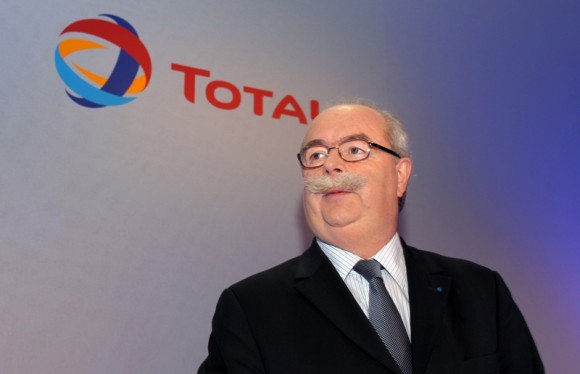
The late Christophe de Margerie.

The late Christophe de Margerie.

The news hit France like a bomb.   At Total’s headquarters in the district of La Defense employees were stunned.  The country reacted as if a chief of state had died.  Tributes poured in from everywhere.

Total has a capital ranking second in the CAC 40 (the ‘Cotation Assistée en Continu’ is a benchmark French stock market index) and employs more than 100,000 people in 130 countries.  It is hard to believe therefore why such a company – the jewel of  the French economy –  should have so many detractors in France.  The day after the accident, the conservative daily Le Figaro published an article entitled, “The man who wanted the French to make peace with Total”.   That man, Christophe de Margerie, was a charismatic  and jovial person, full of warmth, direct but tough .

De Margerie came from an aristocratic family that could be described as representative of, ‘vieille France.’  Family members occupied prominent positions in the world of high finance, diplomacy (his cousin was ambassador to the US) and the arts.  He was the grandson of Pierre Taittinger, the founder of a champagne empire.  Several of his relatives own and live in an elegant apartment building tucked away in a garden, behind massive walls and a monumental gate, right at the heart of the Faubourg St Germain.

He joined Total about 40 years ago and was named CEO in 2007.  In 1995, he became the head of Middle East Total, which explains his particular interest for that part of the world.  The Jubail giant refinery inaugurated in 2013  by Total and Saudi Arabia, is but one example.

The main criticisms against the company concern its huge benefits, which do not profit the French economy because the company pays practically no taxes in France.  The ‘marée noire’ (black tide) caused by the oil spill off the coast of Brittany in 1999 has not been forgotten.  In 2010,the decision to close the Dunkirk refinery and the associated firing of more than 1,000 workers outraged the opinion.  Finally, de Margerie’s policy of creating joint ventures with Russian companies Loukoi, Novatek or Gazprom and his rejection of the sanctions enforced by the West have isolated him.

De Margerie wanted to project a positive image and show his concern for the environment by encouraging renewable energy.  In recent years, signs of transformation of the company had been noticeable, particularly in the reduction and higher selectivity of investments.  The question now is whether de Margerie’s successors, Thierry Desmarets as chairman and Patrick Pouyanné as CEO, will bring changes to the company’s strategy or maintain the course.

Nicole Logan

Nicole Logan

About the author:  Nicole Prévost Logan divides her time between Essex and Paris, spending summers in the former and winters in the latter.  She will write a regular column for us from her Paris home where her topics will include politics, economy, social unrest — mostly in France — but also in other European countries.  She also will cover a variety of art exhibits and the performing arts in Europe.  Logan is the author of ‘Forever on the Road: A Franco-American Family’s Thirty Years in the Foreign Service,’ an autobiography of her life as the wife of an overseas diplomat, who lived in 10 foreign countries on three continents.  Her experiences during her foreign service life included being in Lebanon when civil war erupted, excavating a medieval city in Moscow and spending a week under house arrest in Guinea.
“A Letter From Paris” is Back! Amidst Economic Depression, Two Nobel Prizes for France Lift the Communal Spirit    

Nicole Prévost Logan

Nicole Prévost Logan

We are delighted to welcome back Nicole Logan, who has returned to Paris for the winter from her summer home in Essex.  She writes our weekly, “Letter from Paris,” which gives a unique insight into France and the French.  Today she writes about the depressing state of the French economy and contrasts it to the tremendous excitement that winning two Nobel Prizes has brought to the country.

It is the time of year when financial laws are voted on and budgets submitted.  The 2015 budget represents a triple hurdle for France since the country is under scrutiny from the European Union (EU) Commission in Brussels headed now by Jean Claude Yuncker from Luxemburg; the Eurogroup (made up of the ministers of finances from the 18 members of the euro zone) and led by Jeroen Dijsselbloem from the Netherlands; and finally by the European Council, presided over by Herman Van Rompuy from Belgium.

Will France meet the criteria set in the 1992 Maestrich Treaty, namely an annual deficit of less than 3 percent and a public debt no more than 60 percent of that GDP?   It is most unlikely, since the latest figures stand at a 4.3 percent deficit.  François Hollande is criticized for not having used the two years respite, granted in 2013, to undertake structural reforms.  Instead, he has limited his action to carry out an austerity program by steadily increasing taxes on the most vulnerable individuals like retirees, wage earners or small entrepreneurs.

So to-day the French government is scrambling for ways to reduce its expenses by 21 billion Euros.  Three sudden measures have shocked public opinion:  closing of the Val de Grace hospital, an historical institution in Paris, the military base of Chalon, and the oldest air base of France in Dijon.  More savings are on the table but promise to provoke violent confrontation since they are all considered as untouchable taboos.

Given the fact France’s economy is the second of Europe, the widespread opinion is that it cannot be allowed to fail.  Imposing sanctions of 0.02 percent would make it even more impossible for the country to pull out of a recession with dire consequences for the rest of the continent.  Behind the scenes, the new French Minister of Economy Emmanuel Macron and his German counterpart are at work on the elaboration of a common investment policy.

Two Nobel prizes have just been awarded to French nationals. This unexpected news has definitely lifted the spirits here.

Patrick Modiano

Patrick Modiano

Patrick Modiano received the prize for Literature, following in the footsteps of Camus, Sartre and Gide.  Several of his many novels take place during the German Occupation of France. One of them inspired Louis Malle for his outstanding 1974 film Lacombe Lucien.

The Nobel prize for Economics is particularly interesting because it rewards  not only an individual, but also an institution.  Jean Tirone, born in 1953 and a graduate of the Ecole Polytechnique, holds a PhD from MIT.  In 2007, he founded  the Toulouse School of Economics (note that this name is in English), inspired  from an American model.  It is today one of the world’s 10 most important centers for economic research.

Tirone belongs to the school of economists using a rigorous scientific and mathematical approach.  His research is centered on the regulation of free market economy.  Tirone’s nomination follows the phenomenal success of Thomas Piketty ‘s ” Capital in the Twenty First Century” published in 2013.

Nicole Logan

Nicole Logan

About the author:  Nicole Prévost Logan divides her time between Essex and Paris, spending summers in the former and winters in the latter.  She will write a regular column for us from her Paris home where her topics will include politics, economy, social unrest — mostly in France — but also in other European countries.  She also will cover a variety of art exhibits and the performing arts in Europe.  Logan is the author of ‘Forever on the Road: A Franco-American Family’s Thirty Years in the Foreign Service,’ an autobiography of her life as the wife of an overseas diplomat, who lived in 10 foreign countries on three continents.  Her experiences during her foreign service life included being in Lebanon when civil war erupted, excavating a medieval city in Moscow and spending a week under house arrest in Guinea.
Letter From Paris:  Van Gogh at the Orsay Museum

Nicole Prévost Logan

Nicole Prévost Logan

During the last four years of his life, Vincent Van Gogh produced a phenomenal number of works.  But it was also the time when he suffered episodes of madness, which were to lead him to suicide in 1890 at the age of 37.

The Orsay museum chose this period of intense creation and of psychological despair to present the current exhibit entitled,  “Van Gogh/Artaud. The man driven to suicide by society.”   This new approach to the genius of Van Gogh is through the eyes of Antonin Artaud, a poet, actor and artist, who suffered serious mental illness, was interned nine years and underwent shock treatment.  In 1947, he had a chance to see a major retrospective of Van Gogh’s works at the Orangerie museum.  He wrote, “Van Gogh was not crazy, he was saying a truth that society could not accept.”  He went on by denouncing the prejudices of  moral and science unable to fit genius and madness within the accepted norms.  Throughout the exhibit,the paintings and drawings of Van Gogh are commented in poetic terms by this  troubled soul mate.

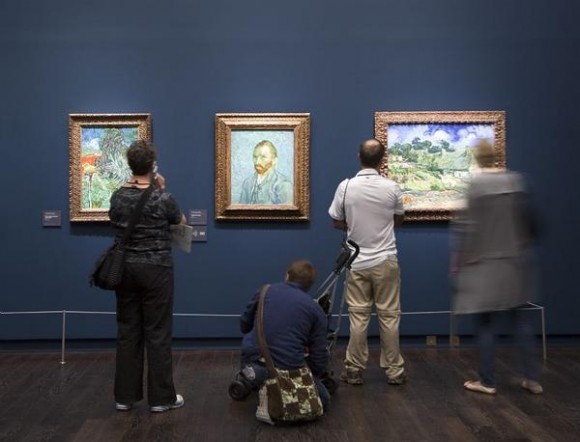
Visitors study the Van Gogh paintings in the new exhibition of the artist's work at the Musee d'Orsay.

Visitors study the Van Gogh paintings in the new exhibition of the artist’s work at the Musee d’Orsay.

The exhibit opens in a very dark room, with incoherent sentences scattered on the black walls with a back drop of moaning sounds.  Forty six of Van Gogh’s strongest works have been selected along with some graphic works.  The visitor travels through four periods of the Dutch painter’s life – in Paris, Arles, Saint-Remy-de-Provence and Auvers-sur-Oise.

Several among the more than 40 self portraitsVan Gogh painted throughout his life are — for the public — like a brutal confrontation with the artist.  They certainly are not an exercise in complacency, but a harsh and almost merciless exercise.  American art historian Meyer Schapiro remarks that, for Van Gogh, creating a self portrait was a form of therapy and a way to reconstruct his inner self.  The artist used it to protect himself from crises of instability.

In contrast, portraits of ” La Berceuse”  and “Père Tanguy” express the peaceful and introspective mood of the models. In both paintings, the background — floral in one,  Japanese etchings in the other — show his attraction to pure decorative and aesthetic considerations reminiscent of Matisse’s.   The portrait of Dr. Gachet, at first his psychiatrist and then his friend, seems to radiate kindness, but also melancholy.  Van Gogh writes, “This man is in as bad a shape as myself.  He wears the sorry expression of our times.”

After the tragedy of the night of Dec. 23, 1888, when he had a fight with Gauguin, who was visiting him in Arles, Van Gogh sliced his left ear.  At his own request, he was admitted at the Saint-Paul hospital, near Saint-Remy-de-Provence.  However, he was  authorized to go out and, on those occasions, painted some of his most powerful  landscapes.

His trees are soaring into the sky and dwarf the silhouettes of people.  In “Cyprès avec deux femmes“, June 1889, the tormented volutes of the trees are an ominous shape hovering over two young women walking.  In “Arbres dans le jardin de l’hopital Saint -Paul” , October 1889, the twisted trunks tower over a barely visible woman carrying a red parasol.  His “Foret de pins au declin du jour ,” (pine forest at dusk) December 1889, is a frightening scene, where the trees are beaten by the wind.  They are outlined on an acid yellow sky and a smoldering orange sun.

During his last months in Auvers-sur-Oise, north of Paris, he painted  farm houses with red tiles or thatch roof, giving them a quaint and welcoming touch.  Only the sky, scratched with jagged lines,  reveals the artist’s tension.

The most important work of the exhibit – “Champ de Ble avec Corbeaux” (wheat field with crows) – is projected on a screen, drawing the onlooker into the heavy yellow mass of wheat swaying under a stormy sky.   The tracks on the path combined with the birds everywhere create a harried movement with little time to spare.

HeadshotAbout the author:  Nicole Prévost Logan divides her time between Essex and Paris, spending summers in the former and winters in the latter.  She will write a regular column for us from her Paris home where her topics will include politics, economy, social unrest — mostly in France — but also in other European countries.  She also will cover a variety of art exhibits and the performing arts in Europe.  Logan is the author of ‘Forever on the Road: A Franco-American Family’s Thirty Years in the Foreign Service,’ an autobiography of her life as the wife of an overseas diplomat, who lived in 10 foreign countries on three continents.  Her experiences during her foreign service life included being in Lebanon when civil war erupted, excavating a medieval city in Moscow and spending a week under house arrest in Guinea.
Letter From Paris: Two Local Elections — Two Remarkably Different Outcomes

Nicole Prévost Logan

Nicole Prévost Logan

Local elections have just taken place in Turkey and in France.  The outcomes of the elections speak a great deal about these two countries .

Primeminister Recep Tayyip Erdogan of Turkey, already in power for 12 years, is showing no intention of stepping down.  His aura at the polls was barely affected by the scandals and accusations of wrong-doing.  Particularly the violent repression of the popular manifestations on Istanbul Taksim Square, the  allegations of frauds directed not only at him, but at his family, the murky circumstances of score settlings.

His recent strategy includes the taking over 85 percent of the main TV channel and the curbing of social networks like Twitter or Facebook.  Nevertheless  Erdogan’s party, the AKP  (Party of Justice and Development),  passed  the test of the polls with flying colors, not acknowledging the distress of the public opinion.  These events did not speak much for the democratic system of that country and should constitute a red flag for the 28 EU members next time Turkey knocks at their door.

In contrast, the French municipales (local elections) were a reflection of the French opinion’s strong disapproval of the policy  of the Francois Hollande government and brought on major changes.

The municipales,  are always an important and colorful event in France,  when mayors and  council members of 36,500 communes (towns) are elected for six years.  But this time they turned into a tsunami, which modified the political landscape of the country.  The vague bleue (blue wave ) showing the gains of the Right and even the vague bleue marine (navy blue wave ) named after Marine Le Pen, head of the far right Front National.  Just a few figures:  in 2008 in the towns of more than 10,000 inhabitants, the Left had 509 mayors and the Right 433.  In 2004, the Left was reduced to 349 and the Right grew to 572.  Emblematic  was the town of Limoges, which had voted socialist since 1912, and turned conservative.

Paris resisted this tidal wave and remained socialist.  Incumbent Mayor Bertrand  Delanoe had groomed his assistant Anne Hidalgo to be his successor.  Together, they engaged in an intensive and efficient campaign.  The Mayor of Paris is elected according to a special system of voting in three rounds.  The first two rounds each Parisian vote for the mayor and council in each arrondissement.  Then mayors and councils vote for the mayor of Paris.  The fight to the finish between Anne Hidalgo and her conservative opponent Union pour un Mouvement Populaire (UMP) Nathalie Kosciusko-Morizet , was fierce, to say the least.  The former won by 53.34 over 44.06 percent.

The map of Paris to-day is made up of two halves: a blue west, and a red east.   With 11 versus nine arrondissements,   Hidalgo leads but not as much as  Jacques Chirac did in 1983 when he won all of them.  These results will be important in the next senatorial elections since the members of the Senat (high chamber)  are elected by the mayors.

Barely 24 hours after the closing of the polls, president François Hollande appeared on TV.  He declared that he had heard and understood the people’s message of disapproval of the policy he conducted since 2012.  He reassured his audience that appropriate measures would be taken.

A day later he announced the remaniement (reshuffle) of the government.  The soft spoken, kind-looking prime minister Jean Marc Ayrault was replaced by tough and energetic Manuel Valls, former minister of the interior.  The number of ministers was trimmed down from 38 to 16 and the parity men/women respected.  The new ministers are more experienced and some of the “heavyweights” remained, like Laurent Fabius, at the Foreign Affairs desk.

The decision concerning Bercy (ministry of Finances and Economy)  was crucial given the urgency to reduce the budget deficit and increase the competitivité (competitiveness)  of the French industry.  The new prime minister Manuel Valls decided to split the responsibilities between two ministers: Michel Papin handling Budget and Finances , Arnaud Montebourg becoming minister of Economy.  This will be a “hot” area since France has to work in a partnership with Brussels.

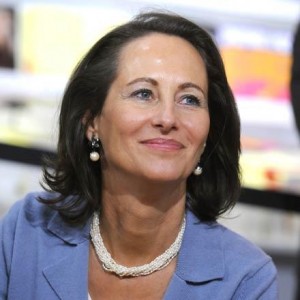
Ségolène Royal

Ségolène Royal

The second spectacular move was the nomination of Ségolène Royal as the minister of Ecology, Sustainable Industry and Energy.  She will rank as number three in the new cabinet.  She is an old timer, particularly in the environmental field.  Her appearance in the courtyard of Hotel de Matignon made quite a splash.  Royal is a highly educated woman, used to be Hollande’s companion for 29 years, the mother of their four children and the last contestant for the presidency against Sarkozy in  2002.  Her appointment will be helpful to Valls’ government because she brings her strong connections to the lower working class with her.

The outspoken Housing minister Cecile Duflot left the Matignon in a huff and a puff , showing her overwhelming dislike for Valls.  Her colleagues in the Green party at the Assemblée Nationale, were upset by her move as they were willing to work within the cabinet.

The overhaul of the new government was greeted by salvos of criticisms and gibes from the UMP and naturally from the extreme parties – this is normal in France.   However, the composition of the new government was interpreted, by more unbiased analysts,  as the determination to follow the road map set out by François Hollande at the Jan. 14  press conference and to keep the course on the Pacte de Responsabilité, but to  implement it with more determination, more speed and more pedagogy.

Failure is not an option and Brussels  will not ease off the pressure.

HeadshotAbout the author:  Nicole Prévost Logan divides her time between Essex and Paris, spending summers in the former and winters in the latter.  She will write a regular column for us from her Paris home where her topics will include politics, economy, social unrest — mostly in France — but also in other European countries.  She also will cover a variety of art exhibits and the performing arts in Europe.  Logan is the author of ‘Forever on the Road: A Franco-American Family’s Thirty Years in the Foreign Service,’ an autobiography of her life as the wife of an overseas diplomat, who lived in 10 foreign countries on three continents.  Her experiences during her foreign service life included being in Lebanon when civil war erupted, excavating a medieval city in Moscow and spending a week under house arrest in Guinea.

Letter From Paris: Following a New Silk Road

Nicole Prévost Logan

Nicole Prévost Logan

The presidents of the United States and of China were in Europe this week.  It was the first visit of a Chinese president to the European Union’s (EU) headquarters since 1975.  He will meet with the presidents of the Council, Herman Van Rompuy, of the Commission, Manuel Barroso and of the Parliament, Martin Schuls, showing a nascent  interest in  Europe as a political entity.

However, Europe has been the largest trade partner of China for a decade, with German leading the pack.  Why then did president Xi Jinping choose France as one of his four stops in Europe in spite of  that country’s small trade and investment with the Middle Kingdom ?  The reasons are historical, cultural, the Chinese’s attraction to  gastronomy and good wine, and, finally, the desire to acquire more areas of French “savoir faire” and state of the art technology, heretofore unexplored.

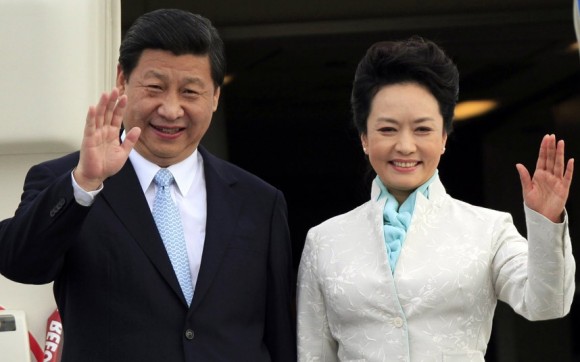
Xi Jinping and his beautiful star singer wife Peng Liyuan opened his three-day state visit in Lyon, the French silk capital, and announced his intention to promote a “new Silk Road.”  Started with French King Francis I, the silk-making industry in Lyon was flourishing by the 17th century.  In the 1920s cultural ties developed between China and France.  Chinese students entered French universities, among them several future political leaders.  In 1964 General Charles de Gaulle was the first Western chief of state to establish full diplomatic relations with the Middle Kingdom.

In this file photo, Xi Jinping and his wife Peng Liyuan wave to the crowd.

In this file photo, Xi Jinping and his wife Peng Liyuan wave to the crowd.

Mutual interests in literature, cinema and art have created special bonds between Chinese and French intelligencia.  Chinese fans of the “Nouvelle Vague” films (new wave) are sometimes more knowledgeable about the names of the directors that the French themselves.  The 1992 film “l’Amant‘”(the Lover), directed by Jean Jacques Annaud, based on the 1984 novel by Marguerite Duras, was a huge success in France.  The plot is the affair a “Chinaman” struck with a young French girl on a ferry boat crossing the Mekong river.  French readers cheered on the high school “Joueuse de Go” (Go player) character created by author Shan Sa, whose courage symbolized the determination of the Chinese population fighting against the impending invasion of Manchuria by the Japanese in 1931.

But the objectives of the Chinese president and of his cohort of businessmen and investors who accompanied him were more down to earth:  they were here for serious business.  Both by making inroads into the French industry and by opening their own market to French goods in order to tilt the massive trade deficit between the two countries.  The car company Dongfeng just acquired 14 percent of the PSA’s (Peugeot-Citroen) shares.   The Chinese have been trying to take over 46 percent of  Club Med’s (touristic villages) capital.

Whether it is nuclear energy  or aeronautic technology, automobile industry, or fast trains, the transfer of technology has always been a touchy point for the French.   The most striking example of this situation is the TGV (Train à grande vitesse) or fast train which was designed by Alstom in France in the 1970s and was further developed  jointly with other Western countries.  Now the Chinese network is ten times longer than the French and in July 2013  “Harmony Express” surpassed the speed of the French trains.

On a televised program, a spokeswoman for the Chinese government was asked the question about transfer of technology.   She said that the Chinese now are pretty much caught up, ( which is certainly true with telecom giants like Huawei and ZTE) and that now their policy was veering toward “partnership and cooperation” – language to be expected from a government spokeswoman.

The Chinese love France.  Millions of tourists speed through the most famous halls of the Louvre.  The growing middle class and the wealthy are increasingly   fascinated by luxury goods.  They are not satisfied anymore by the pirated brands one finds all over the world.  Now they can find the real stuff 72 percent cheaper in France thanks to the system of “detaxe” and by avoiding import duties into China.

During the many years we lived in Africa with the American Embassy, in the 1960s and 1970s, I had a chance to observe that, in those days, the Chinese lived in spartan compounds totally secluded from the local population , working on Guinea tea plantations or building a soccer stadium in the Gambia.  They have come a long way.  To-day they visit France to do their spring shopping and buy Chambertin ou Chateau Lafitte wine, Hermes silk scarves or Vuitton bags.

Agribusiness is a field where improvements would be welcome.   One remembers the problems China suffered a few years ago with contaminated powder milk.  The Chinese are very fond of foie gras and cheese.  They have just discovered the “Jambon de Bayonne.”  It takes many hours of preparation and manual work to prepare the dark red ham meat.  The traditional “savoir faire” has existed since the 13th century in the south west of France.  Its commerce is labeled “IGP” (Indication Geographique Protegéee) or geographically protected.  Pork is one of the main food staple in China and there the huge market is promising.  Will the  transfer of “savoir faire” be followed by the loss of the brand?

During the elegant dinner at the Elysees palace and the following night at the  Opera Royal of the Chateau de Versailles, what was president François Hollande thinking of  — 18 billion euros of new contracts or the difficult political situation he is in right now after the disastrous (for him) recent local elections?

HeadshotAbout the author:  Nicole Prévost Logan divides her time between Essex and Paris, spending summers in the former and winters in the latter.  She will write a regular column for us from her Paris home where her topics will include politics, economy, social unrest — mostly in France — but also in other European countries.  She also will cover a variety of art exhibits and the performing arts in Europe.  Logan is the author of ‘Forever on the Road: A Franco-American Family’s Thirty Years in the Foreign Service,’ an autobiography of her life as the wife of an overseas diplomat, who lived in 10 foreign countries on three continents.  Her experiences during her foreign service life included being in Lebanon when civil war erupted, excavating a medieval city in Moscow and spending a week under house arrest in Guinea.